
 Информатика
Похожие презентации:







Week 1. Classical Cryptography
1. CRYPTOGRAPHY
2. WEEK 1 Classical Cryptography
WEEK 1CLASSICAL CRYPTOGRAPHY
• Shift Cipher
• Substitution cipher
• Affine cipher
• Vigenere cipher
• Hill cipher
• Permutation cipher
• Stream cipher
• Criptanalysis of classical cipher
3. The Shift Cipher
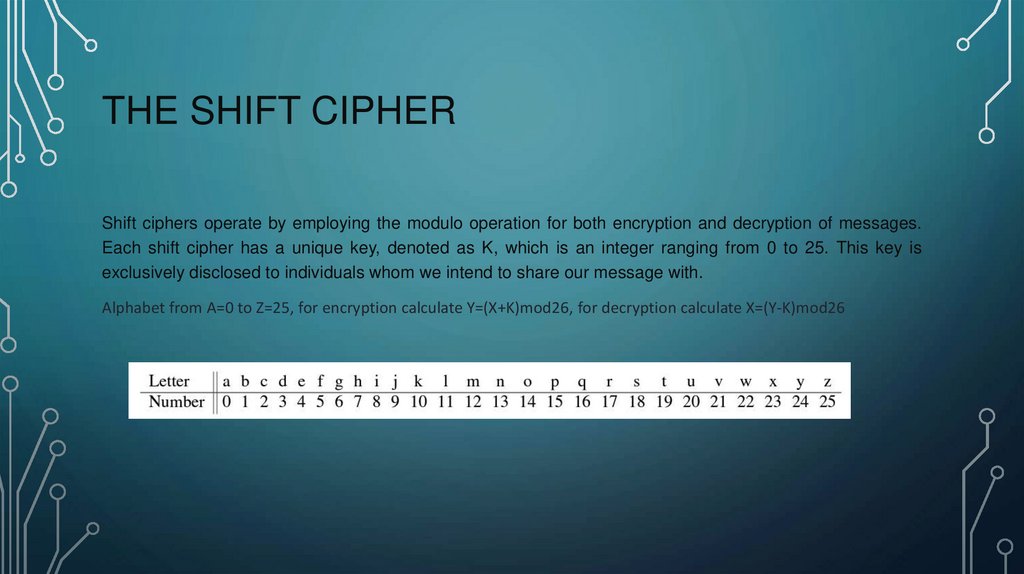
THE SHIFT CIPHERShift ciphers operate by employing the modulo operation for both encryption and decryption of messages.
Each shift cipher has a unique key, denoted as K, which is an integer ranging from 0 to 25. This key is
exclusively disclosed to individuals whom we intend to share our message with.
Alphabet from A=0 to Z=25, for encryption calculate Y=(X+K)mod26, for decryption calculate X=(Y-K)mod26
4. Assignment 1.1
ASSIGNMENT 1.1• Task:
a) By using the Shift Cipher with key K=19 send your NAME as a message by
encrypting it.
b) Show how the receiver will decrypt the message.
5. The Affine cipher
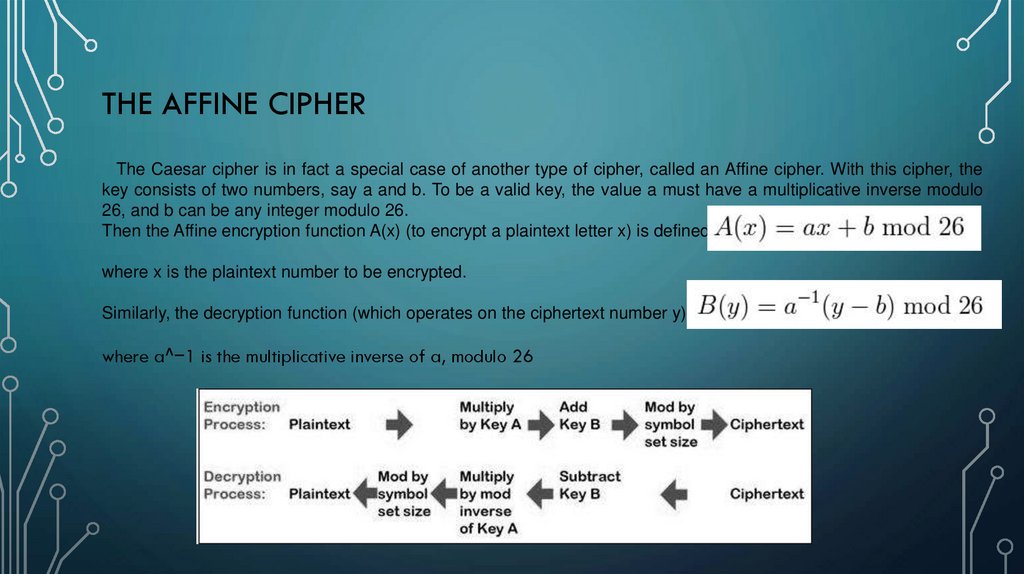
THE AFFINE CIPHERThe Caesar cipher is in fact a special case of another type of cipher, called an Affine cipher. With this cipher, the
key consists of two numbers, say a and b. To be a valid key, the value a must have a multiplicative inverse modulo
26, and b can be any integer modulo 26.
Then the Affine encryption function A(x) (to encrypt a plaintext letter x) is defined by:
where x is the plaintext number to be encrypted.
Similarly, the decryption function (which operates on the ciphertext number y) is:
where a^−1 is the multiplicative inverse of a, modulo 26
6. The Affine cipher
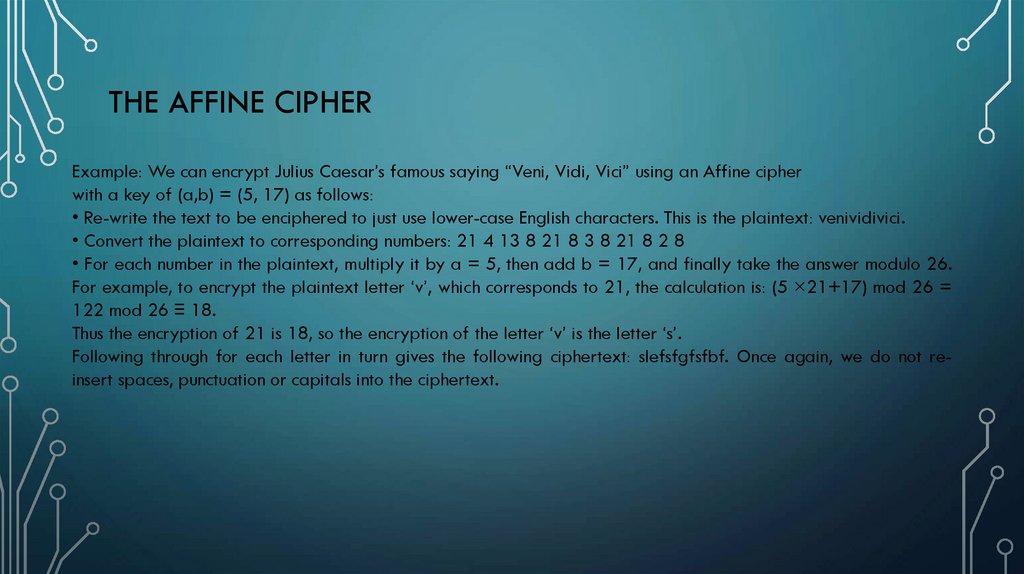
THE AFFINE CIPHERExample: We can encrypt Julius Caesar’s famous saying “Veni, Vidi, Vici” using an Affine cipher
with a key of (a,b) = (5, 17) as follows:
• Re-write the text to be enciphered to just use lower-case English characters. This is the plaintext: venividivici.
• Convert the plaintext to corresponding numbers: 21 4 13 8 21 8 3 8 21 8 2 8
• For each number in the plaintext, multiply it by a = 5, then add b = 17, and finally take the answer modulo 26.
For example, to encrypt the plaintext letter ‘v’, which corresponds to 21, the calculation is: (5 ×21+17) mod 26 =
122 mod 26 ≡ 18.
Thus the encryption of 21 is 18, so the encryption of the letter ‘v’ is the letter ‘s’.
Following through for each letter in turn gives the following ciphertext: slefsfgfsfbf. Once again, we do not reinsert spaces, punctuation or capitals into the ciphertext.
7. Assignment 1.2 Affine Cipher
ASSIGNMENT 1.2AFFINE CIPHER
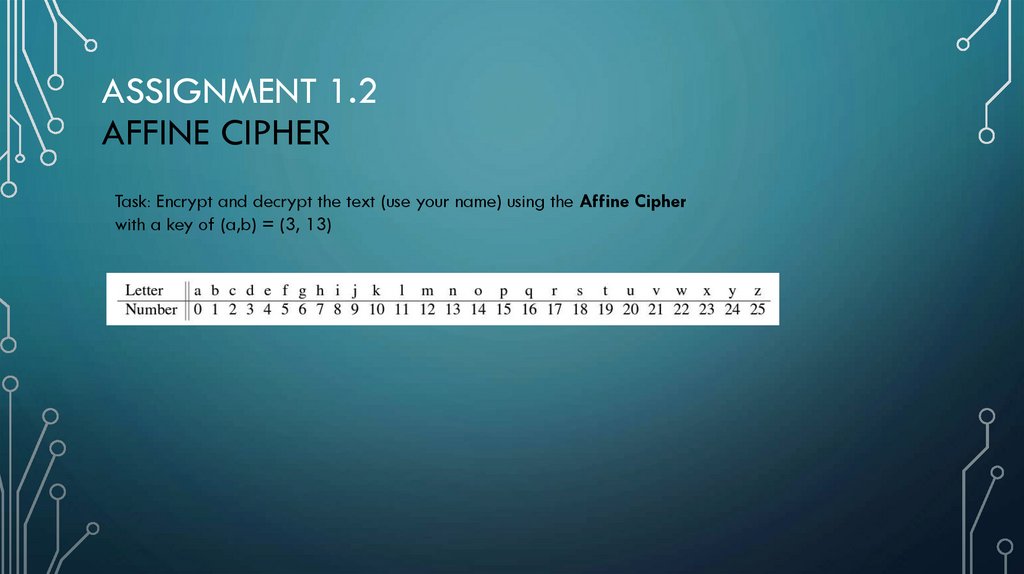
Task: Encrypt and decrypt the text (use your name) using the Affine Cipher
with a key of (a,b) = (3, 13)
8. Vigenère Cipher
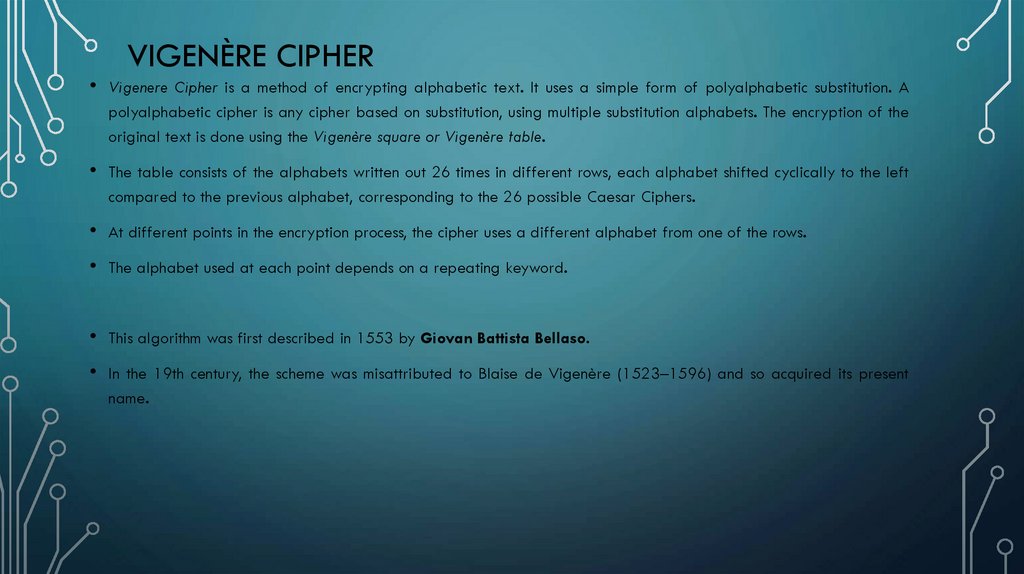
VIGENÈRE CIPHER• Vigenere Cipher is a method of encrypting alphabetic text. It uses a simple form of polyalphabetic substitution. A
polyalphabetic cipher is any cipher based on substitution, using multiple substitution alphabets. The encryption of the
original text is done using the Vigenère square or Vigenère table.
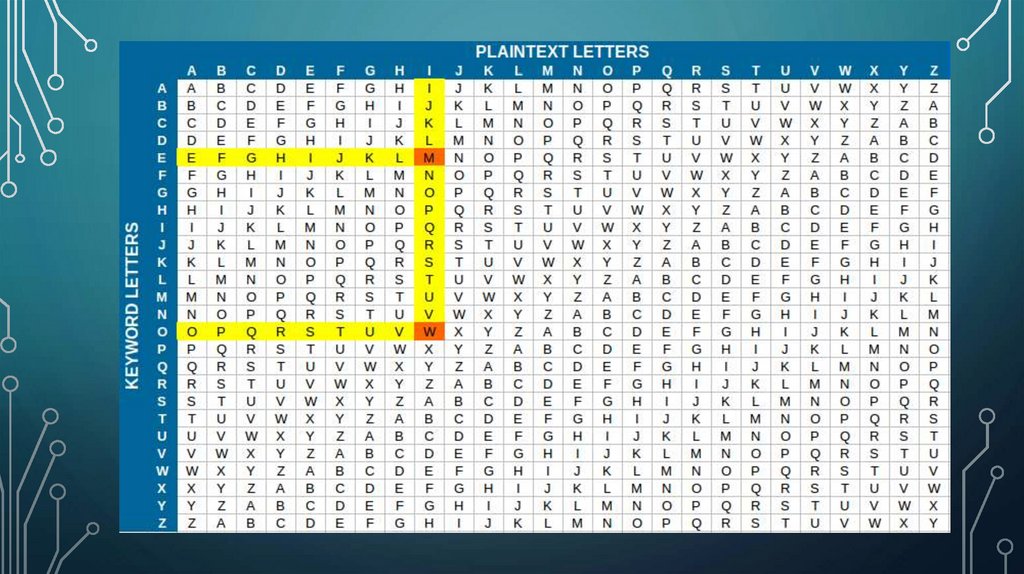
• The table consists of the alphabets written out 26 times in different rows, each alphabet shifted cyclically to the left
compared to the previous alphabet, corresponding to the 26 possible Caesar Ciphers.
• At different points in the encryption process, the cipher uses a different alphabet from one of the rows.
• The alphabet used at each point depends on a repeating keyword.
• This algorithm was first described in 1553 by Giovan Battista Bellaso.
• In the 19th century, the scheme was misattributed to Blaise de Vigenère (1523–1596) and so acquired its present
name.
9.
10.
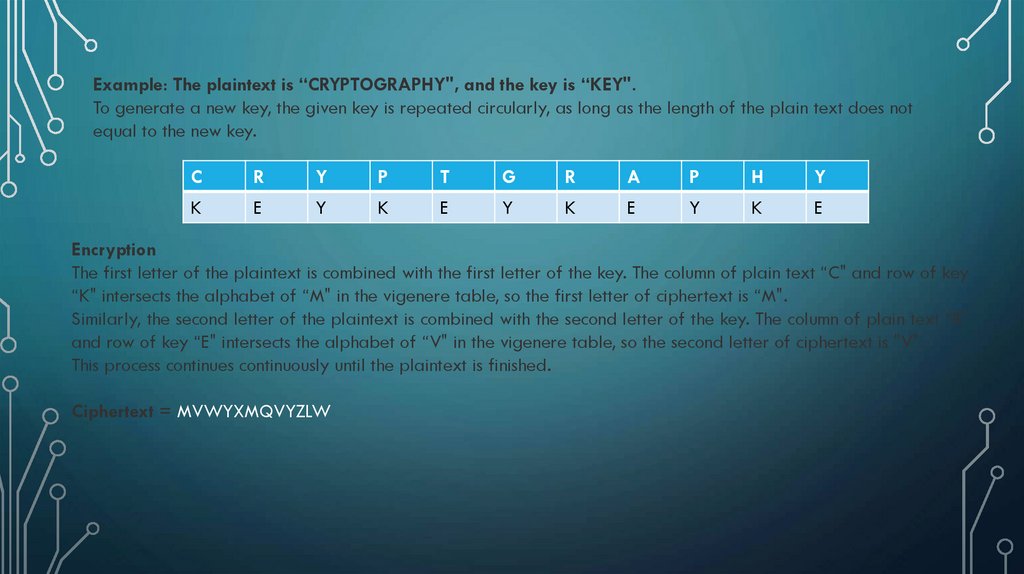
Example: The plaintext is “CRYPTOGRAPHY", and the key is “KEY".To generate a new key, the given key is repeated circularly, as long as the length of the plain text does not
equal to the new key.
C
R
Y
P
T
G
R
A
P
H
Y
K
E
Y
K
E
Y
K
E
Y
K
E
Encryption
The first letter of the plaintext is combined with the first letter of the key. The column of plain text “C" and row of key
“K" intersects the alphabet of “M" in the vigenere table, so the first letter of ciphertext is “M".
Similarly, the second letter of the plaintext is combined with the second letter of the key. The column of plain text “R"
and row of key “E" intersects the alphabet of “V" in the vigenere table, so the second letter of ciphertext is "V".
This process continues continuously until the plaintext is finished.
Ciphertext = MVWYXMQVYZLW
11.
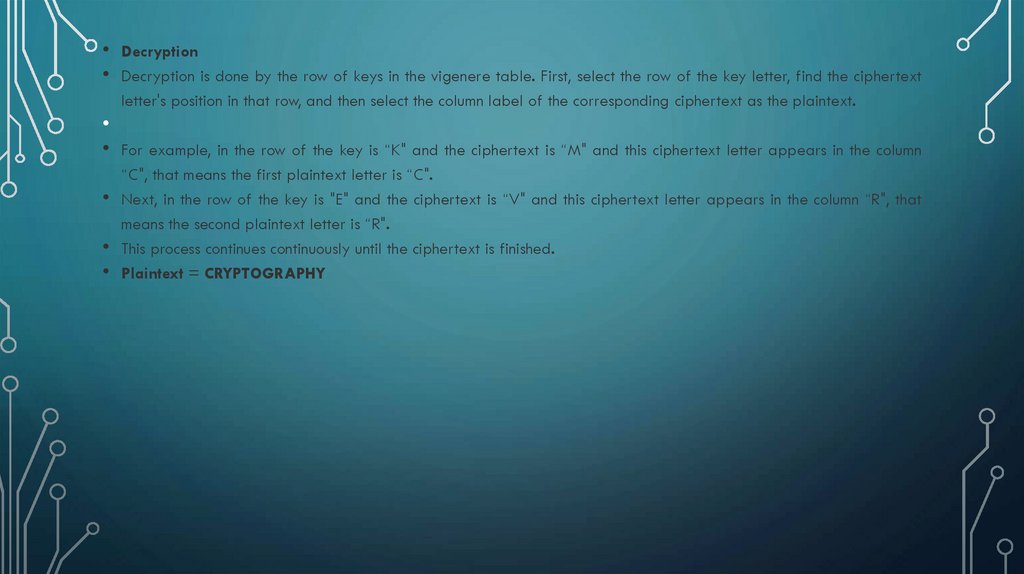
• Decryption• Decryption is done by the row of keys in the vigenere table. First, select the row of the key letter, find the ciphertext
letter's position in that row, and then select the column label of the corresponding ciphertext as the plaintext.
• For example, in the row of the key is “K" and the ciphertext is “M" and this ciphertext letter appears in the column
“C", that means the first plaintext letter is “C".
• Next, in the row of the key is "E" and the ciphertext is “V" and this ciphertext letter appears in the column “R", that
means the second plaintext letter is “R".
• This process continues continuously until the ciphertext is finished.
• Plaintext = CRYPTOGRAPHY
12. Assignment 1.3 VEGENERE Cipher
ASSIGNMENT 1.3VEGENERE CIPHER
• Task: Encrypt and decrypt the text (use your name) using the Vegenere Cipher
with a keyword: KEY
13. The Hill cipher
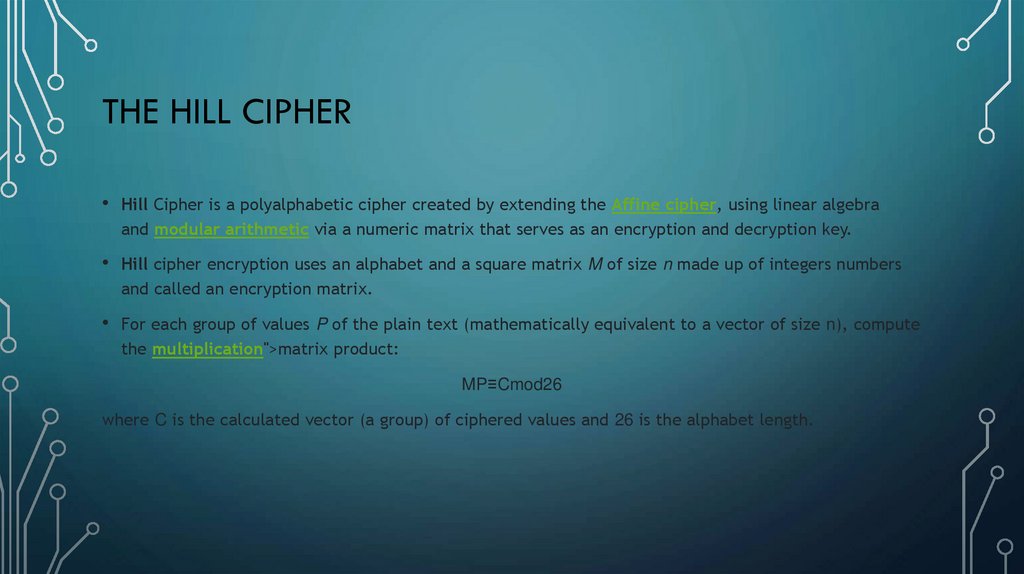
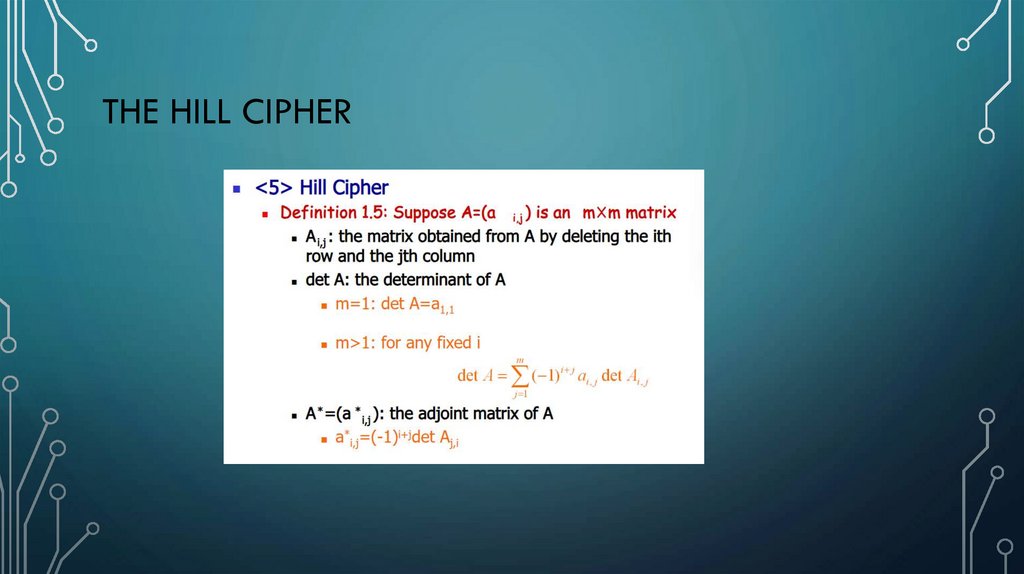
THE HILL CIPHER• Hill Cipher is a polyalphabetic cipher created by extending the Affine cipher, using linear algebra
and modular arithmetic via a numeric matrix that serves as an encryption and decryption key.
• Hill cipher encryption uses an alphabet and a square matrix M of size n made up of integers numbers
and called an encryption matrix.
• For each group of values P of the plain text (mathematically equivalent to a vector of size n), compute
the multiplication">matrix product:
MP≡Cmod26
where C is the calculated vector (a group) of ciphered values and 26 is the alphabet length.
14. The Hill cipher
THE HILL CIPHER15. Assignment 1.4
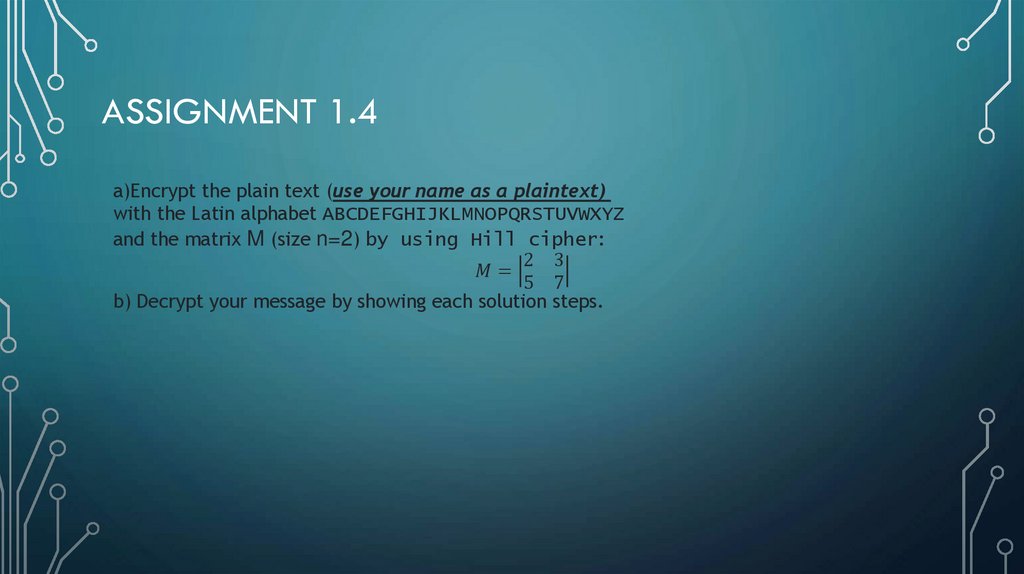
ASSIGNMENT 1.4a)Encrypt the plain text (use your name as a plaintext)
with the Latin alphabet ABCDEFGHIJKLMNOPQRSTUVWXYZ
and the matrix M (size n=2) by using Hill cipher:
2 3