 География
Похожие презентации:



Northern Ireland
1. Nothern Ireland
Выполнил Лейва Георгий2. Belfast is the capital of Northern Ireland
Population: ~345,000 in the city, ~640,000 in the
metropolitan area.
Modern Day: A cultural and economic hub. The
city has been revitalized after the period of
conflict (The Troubles) and is known for its
political murals and vibrant atmosphere.
Main Attractions:
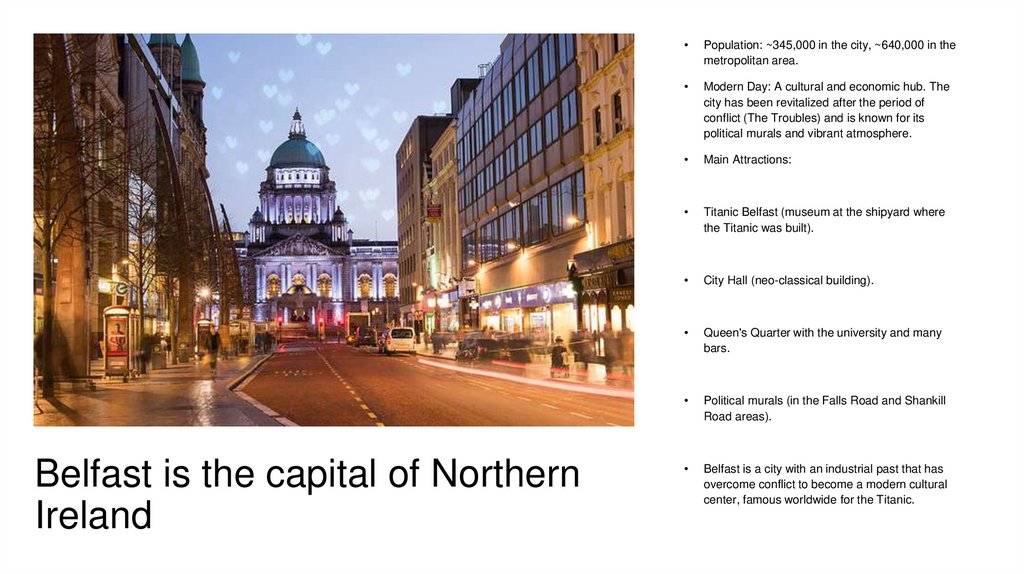
Titanic Belfast (museum at the shipyard where
the Titanic was built).
City Hall (neo-classical building).
Queen's Quarter with the university and many
bars.
Political murals (in the Falls Road and Shankill
Road areas).
Belfast is a city with an industrial past that has
overcome conflict to become a modern cultural
center, famous worldwide for the Titanic.
3. The nature of Northern Ireland
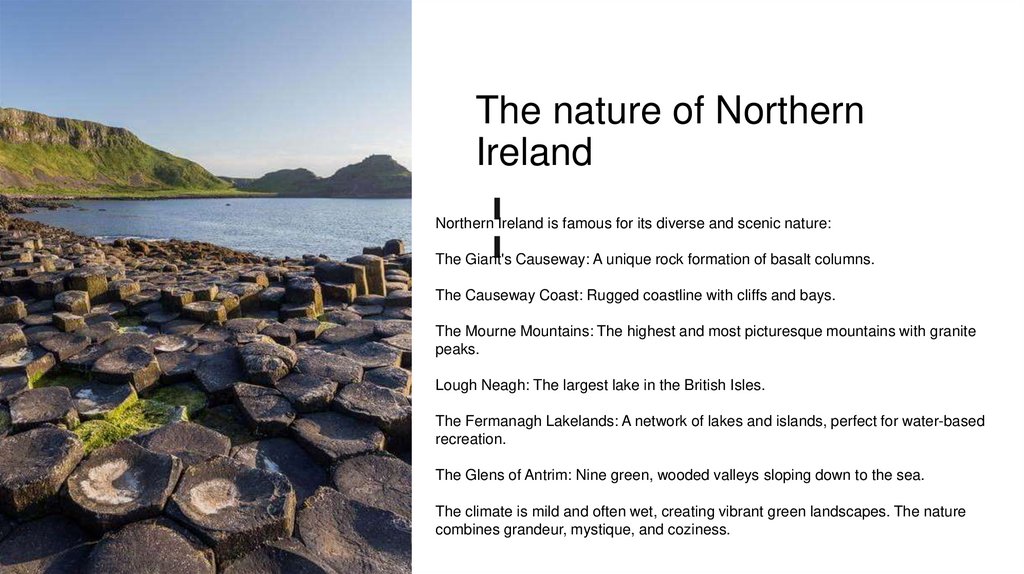
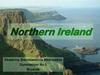
Northern Ireland is famous for its diverse and scenic nature:The Giant's Causeway: A unique rock formation of basalt columns.
The Causeway Coast: Rugged coastline with cliffs and bays.
The Mourne Mountains: The highest and most picturesque mountains with granite
peaks.
Lough Neagh: The largest lake in the British Isles.
The Fermanagh Lakelands: A network of lakes and islands, perfect for water-based
recreation.
The Glens of Antrim: Nine green, wooded valleys sloping down to the sea.
The climate is mild and often wet, creating vibrant green landscapes. The nature
combines grandeur, mystique, and coziness.
4. An amazing fact
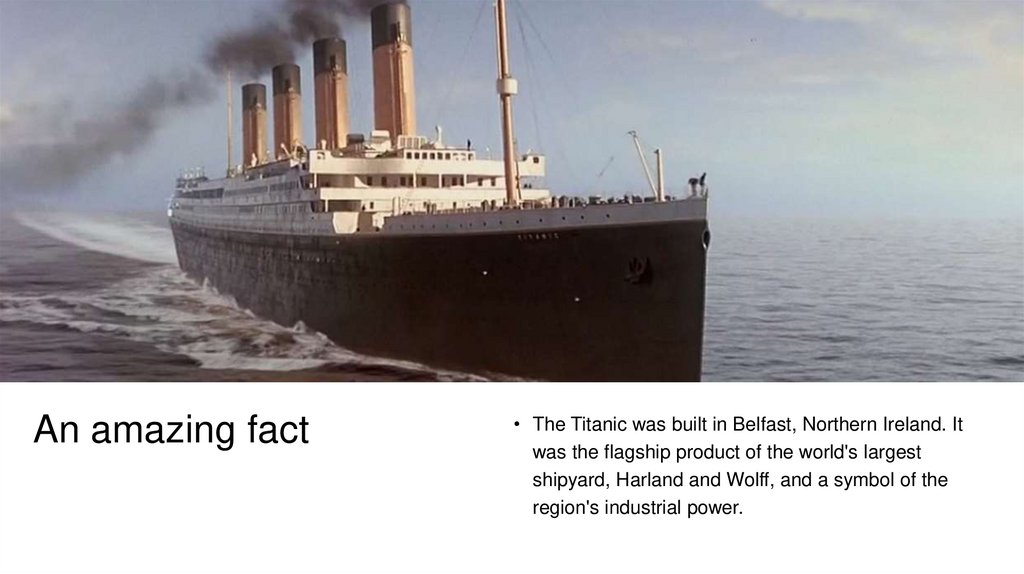
• The Titanic was built in Belfast, Northern Ireland. Itwas the flagship product of the world's largest
shipyard, Harland and Wolff, and a symbol of the
region's industrial power.
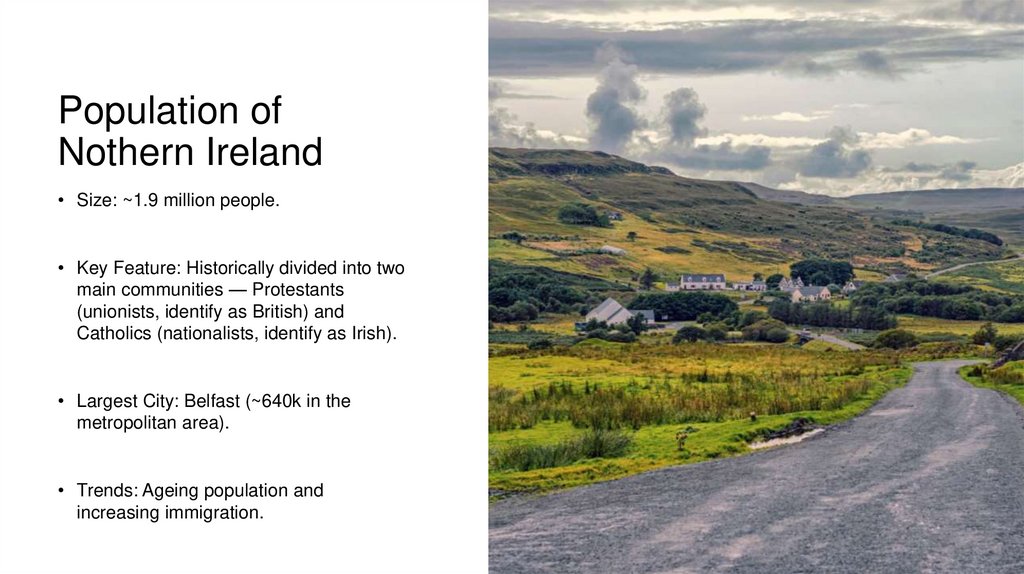
5. Population of Nothern Ireland
• Size: ~1.9 million people.• Key Feature: Historically divided into two
main communities — Protestants
(unionists, identify as British) and
Catholics (nationalists, identify as Irish).
• Largest City: Belfast (~640k in the
metropolitan area).
• Trends: Ageing population and
increasing immigration.
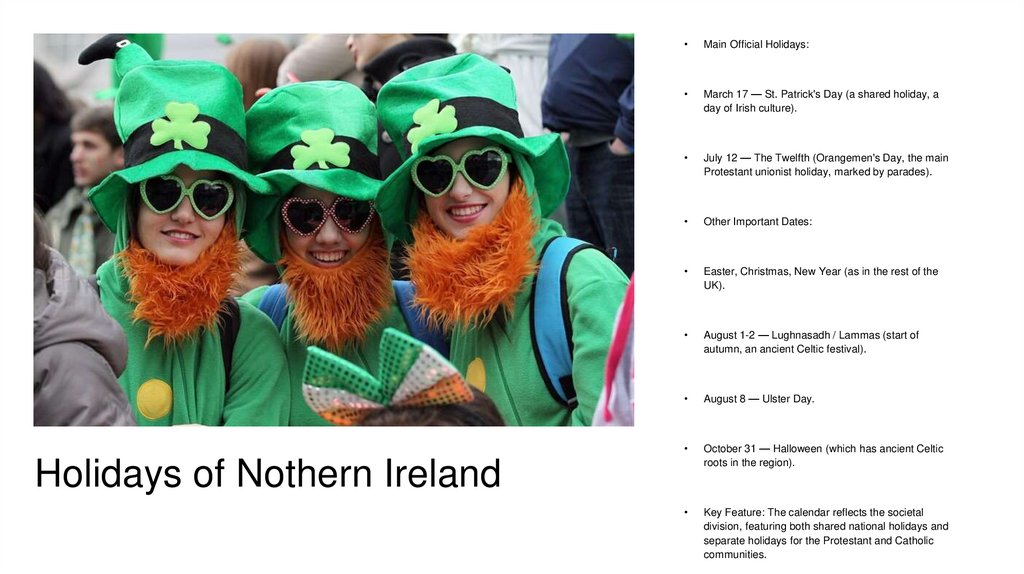
6. Holidays of Nothern Ireland
Main Official Holidays:
March 17 — St. Patrick's Day (a shared holiday, a
day of Irish culture).
July 12 — The Twelfth (Orangemen's Day, the main
Protestant unionist holiday, marked by parades).
Other Important Dates:
Easter, Christmas, New Year (as in the rest of the
UK).
August 1-2 — Lughnasadh / Lammas (start of
autumn, an ancient Celtic festival).
August 8 — Ulster Day.
October 31 — Halloween (which has ancient Celtic
roots in the region).
Key Feature: The calendar reflects the societal
division, featuring both shared national holidays and
separate holidays for the Protestant and Catholic
communities.
Holidays of Nothern Ireland
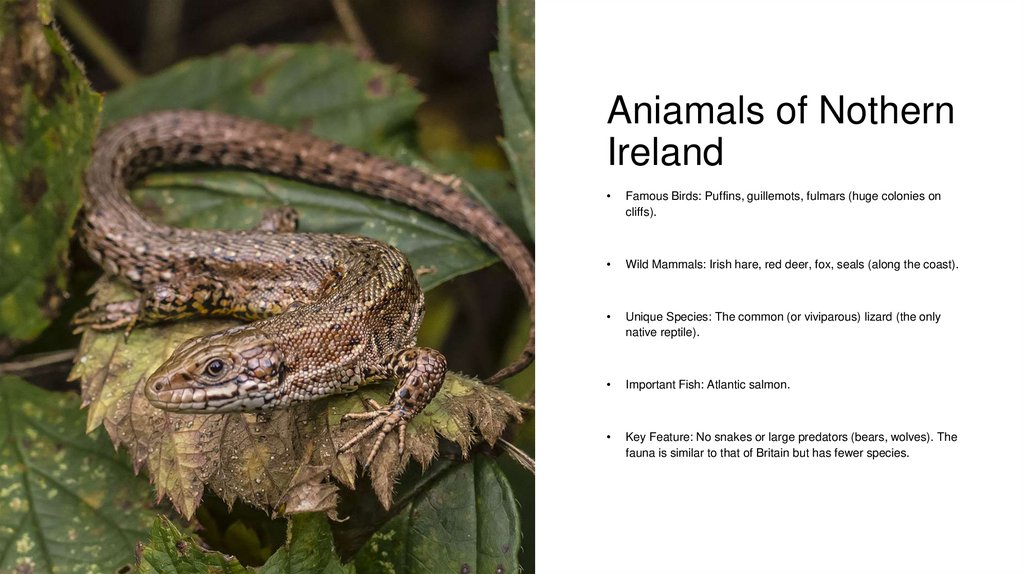
7. Aniamals of Nothern Ireland
Famous Birds: Puffins, guillemots, fulmars (huge colonies on
cliffs).
Wild Mammals: Irish hare, red deer, fox, seals (along the coast).
Unique Species: The common (or viviparous) lizard (the only
native reptile).
Important Fish: Atlantic salmon.
Key Feature: No snakes or large predators (bears, wolves). The
fauna is similar to that of Britain but has fewer species.
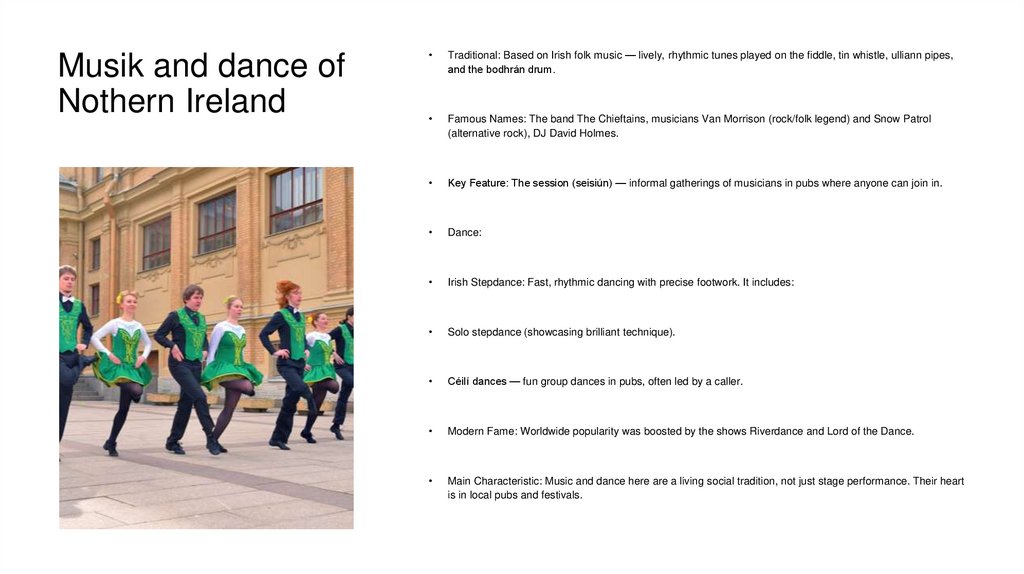
8. Musik and dance of Nothern Ireland
Traditional: Based on Irish folk music — lively, rhythmic tunes played on the fiddle, tin whistle, ulliann pipes,
and the bodhrán drum.
Famous Names: The band The Chieftains, musicians Van Morrison (rock/folk legend) and Snow Patrol
(alternative rock), DJ David Holmes.
Key Feature: The session (seisiún) — informal gatherings of musicians in pubs where anyone can join in.
Dance:
Irish Stepdance: Fast, rhythmic dancing with precise footwork. It includes:
Solo stepdance (showcasing brilliant technique).
Céilí dances — fun group dances in pubs, often led by a caller.
Modern Fame: Worldwide popularity was boosted by the shows Riverdance and Lord of the Dance.
Main Characteristic: Music and dance here are a living social tradition, not just stage performance. Their heart
is in local pubs and festivals.
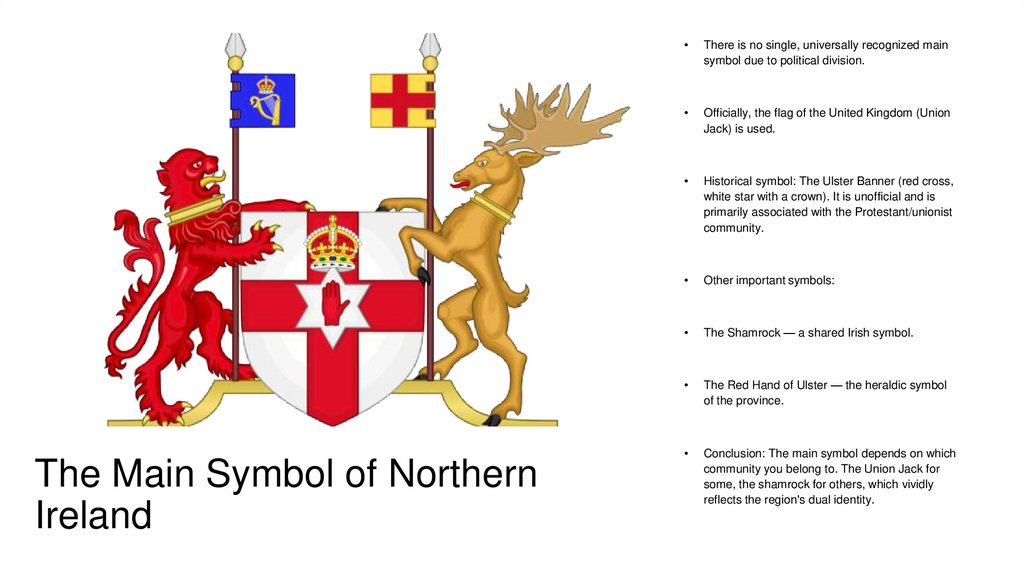
9. The Main Symbol of Northern Ireland
There is no single, universally recognized main
symbol due to political division.
Officially, the flag of the United Kingdom (Union
Jack) is used.
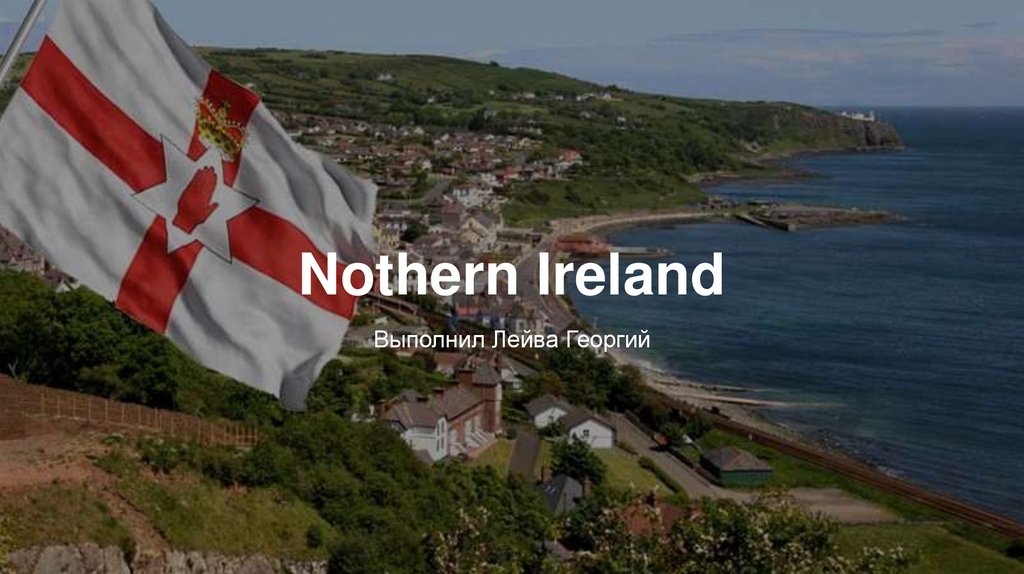
Historical symbol: The Ulster Banner (red cross,
white star with a crown). It is unofficial and is
primarily associated with the Protestant/unionist
community.
Other important symbols:
The Shamrock — a shared Irish symbol.
The Red Hand of Ulster — the heraldic symbol
of the province.
Conclusion: The main symbol depends on which
community you belong to. The Union Jack for
some, the shamrock for others, which vividly
reflects the region's dual identity.
10. Thank you for your attention
• I hope you learned a lot aboutNorthern Ireland.