 Астрономия
Похожие презентации:
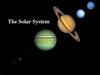



Солнечная система
1.
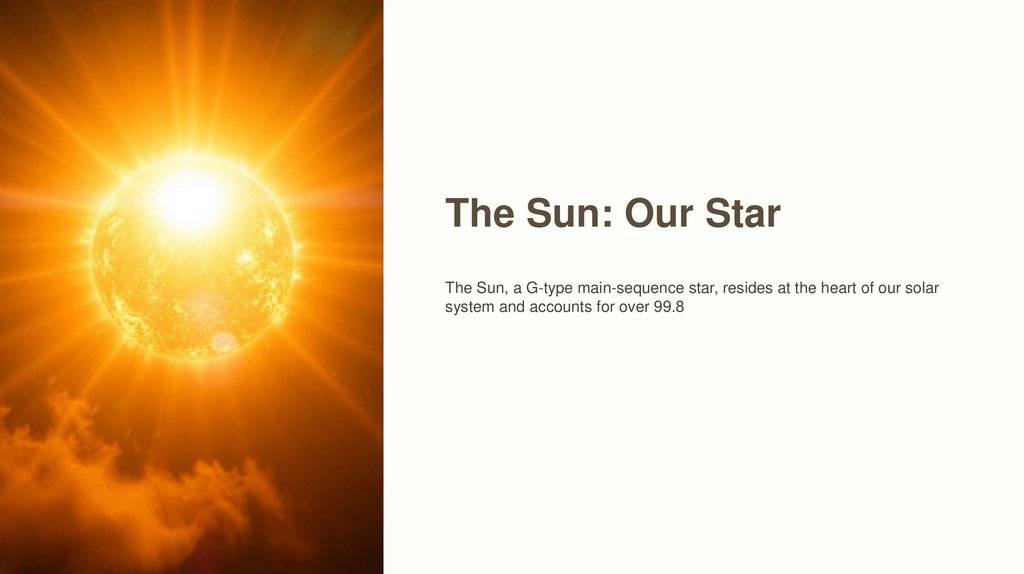
The Sun: Our StarThe Sun, a G-type main-sequence star, resides at the heart of our solar
system and accounts for over 99.8
2.
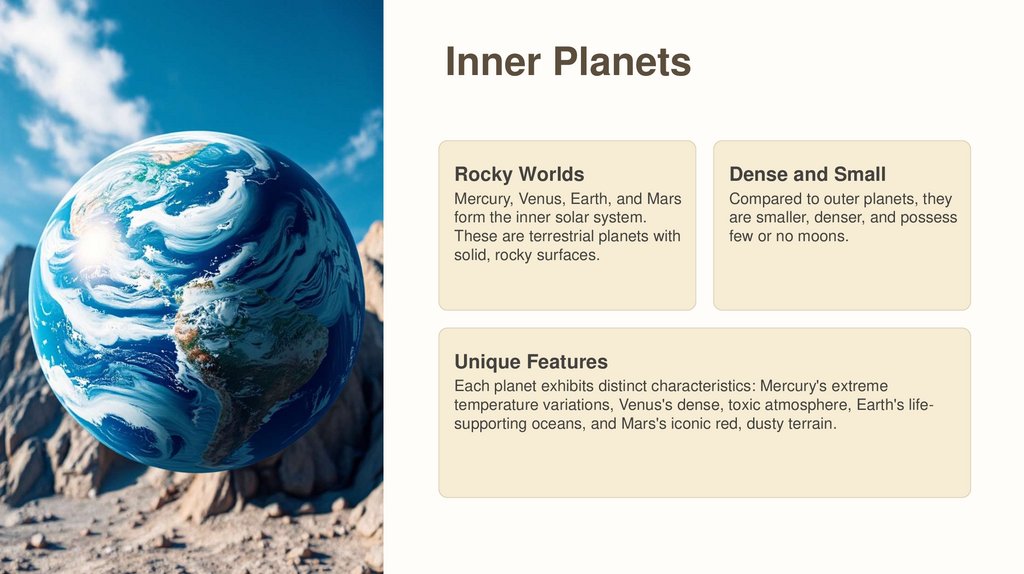
Inner PlanetsRocky Worlds
Dense and Small
Mercury, Venus, Earth, and Mars
form the inner solar system.
These are terrestrial planets with
solid, rocky surfaces.
Compared to outer planets, they
are smaller, denser, and possess
few or no moons.
Unique Features
Each planet exhibits distinct characteristics: Mercury's extreme
temperature variations, Venus's dense, toxic atmosphere, Earth's lifesupporting oceans, and Mars's iconic red, dusty terrain.
3.
Outer PlanetsGas Giants
Features
Jupiter, Saturn, Uranus, and Neptune are the gas giants.
They are significantly larger and less dense than terrestrial
planets.
These planets possess prominent ring systems, especially
Saturn's famous rings, and a multitude of moons, some
larger than Mercury.
Composition
Jupiter and Saturn are mostly hydrogen and helium. Uranus
and Neptune contain substantial amounts of 'ices' like
water, ammonia, and methane.
4.
Dwarf Planets and Asteroids1
2
3
Dwarf Planets
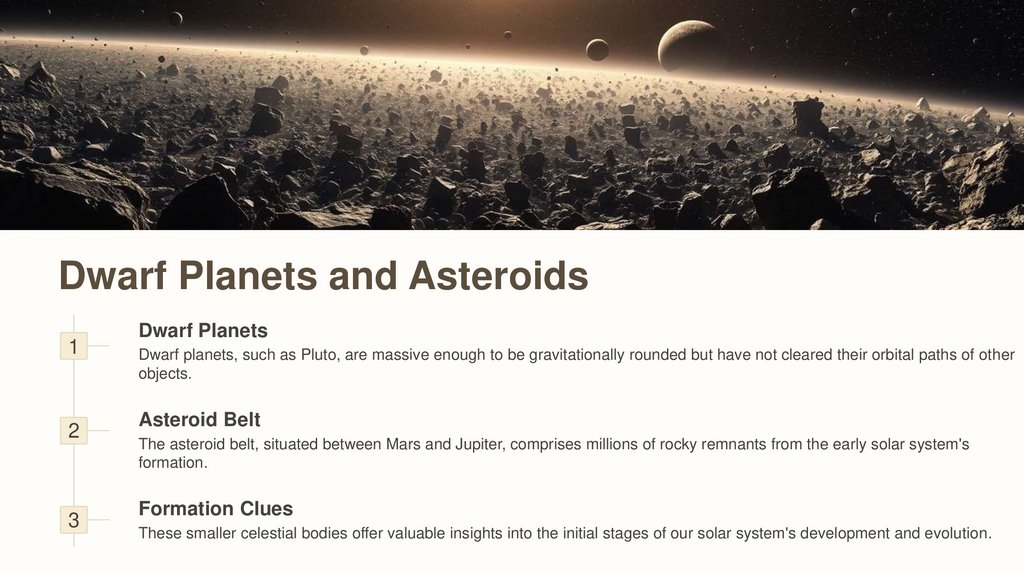
Dwarf planets, such as Pluto, are massive enough to be gravitationally rounded but have not cleared their orbital paths of other
objects.
Asteroid Belt
The asteroid belt, situated between Mars and Jupiter, comprises millions of rocky remnants from the early solar system's
formation.
Formation Clues
These smaller celestial bodies offer valuable insights into the initial stages of our solar system's development and evolution.
5.
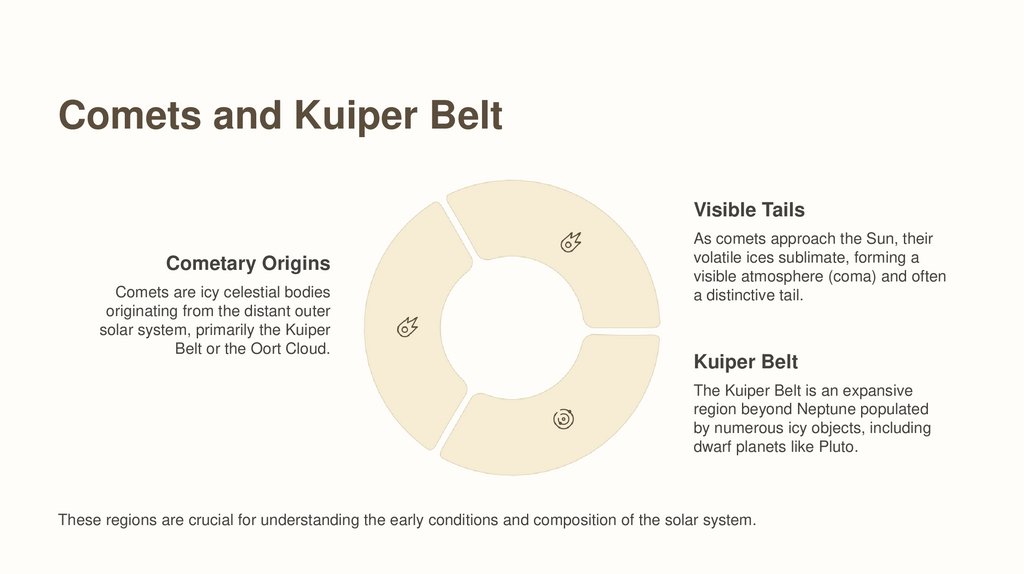
Comets and Kuiper BeltVisible Tails
Cometary Origins
Comets are icy celestial bodies
originating from the distant outer
solar system, primarily the Kuiper
Belt or the Oort Cloud.
As comets approach the Sun, their
volatile ices sublimate, forming a
visible atmosphere (coma) and often
a distinctive tail.
Kuiper Belt
The Kuiper Belt is an expansive
region beyond Neptune populated
by numerous icy objects, including
dwarf planets like Pluto.
These regions are crucial for understanding the early conditions and composition of the solar system.
6.
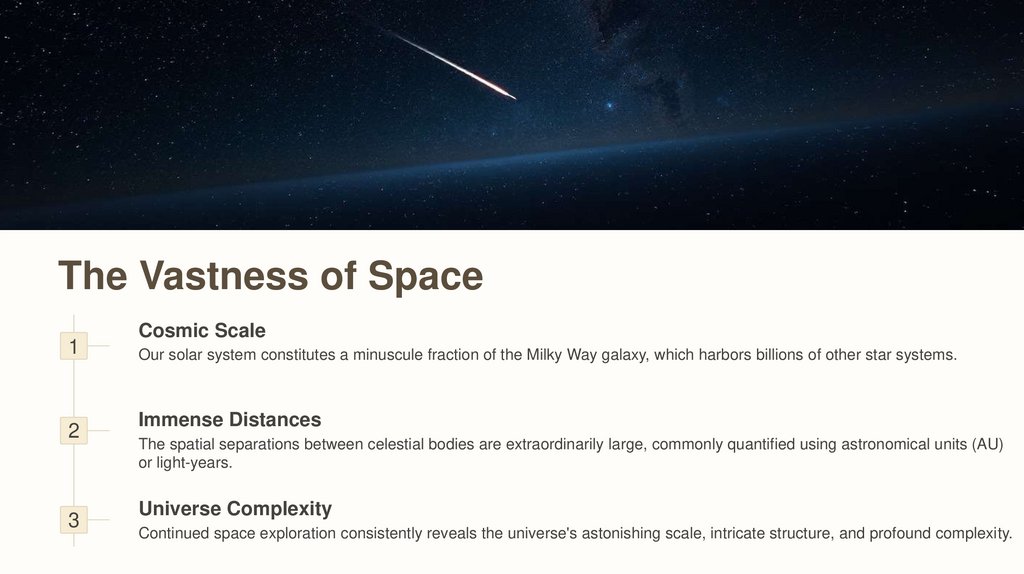
The Vastness of Space1
2
3
Cosmic Scale
Our solar system constitutes a minuscule fraction of the Milky Way galaxy, which harbors billions of other star systems.
Immense Distances
The spatial separations between celestial bodies are extraordinarily large, commonly quantified using astronomical units (AU)
or light-years.
Universe Complexity
Continued space exploration consistently reveals the universe's astonishing scale, intricate structure, and profound complexity.
7.
Our Place WithinUnique Earth
Understanding Earth
Inspiring Exploration
Earth stands as the sole known
planet hosting life, rendering our
solar system a truly exceptional and
precious cosmic location.
Investigating our solar system
provides critical context for
comprehending Earth's historical
development and potential future
trajectories.
Ongoing exploration via advanced
telescopes and dedicated space
missions continuously broadens our
knowledge and serves as a powerful
inspiration for future scientific
endeavors.
8.
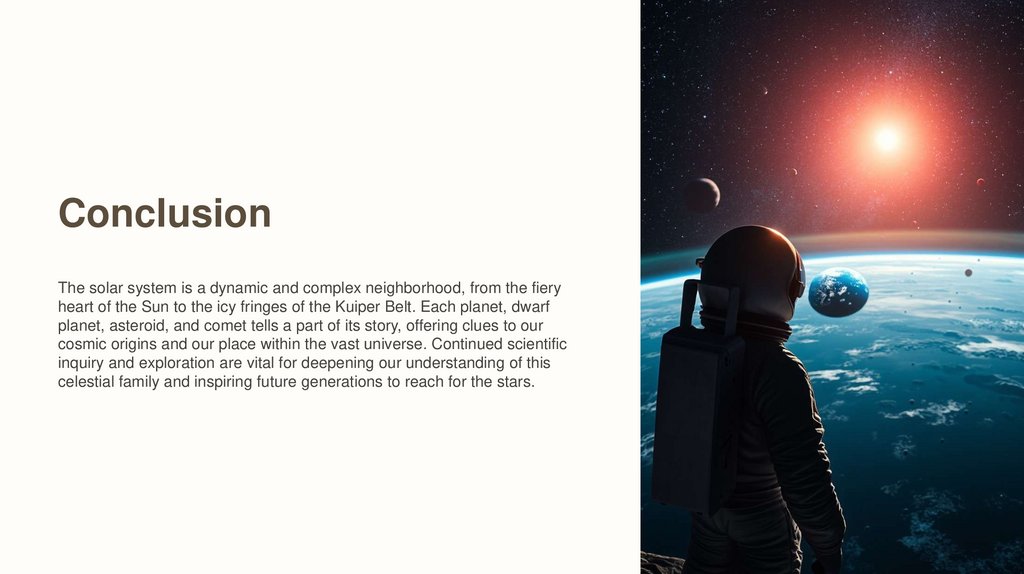
ConclusionThe solar system is a dynamic and complex neighborhood, from the fiery
heart of the Sun to the icy fringes of the Kuiper Belt. Each planet, dwarf
planet, asteroid, and comet tells a part of its story, offering clues to our
cosmic origins and our place within the vast universe. Continued scientific
inquiry and exploration are vital for deepening our understanding of this
celestial family and inspiring future generations to reach for the stars.