




 Английский язык
Похожие презентации:







Pocket Money and Skills for Life
1. Speaking
PART 12.
23. Answer the questions
1. How do you get your pocket money?2. What do Russian teenagers usually buy
with their pocket money?
3.
Would you like to get a summer job, and
why yes or no?
4. What do you spend your pocket money
on?
5. Who gives you pocket money?
6. How often do you get your pocket
money?
7. What do you do to receive your pocket
money?
3
4.
5.
6. Listening
PART 27. Вы услышите четыре коротких текста, обозначенных буквами А, B, C, D. В заданиях 1–4 запишите в поле ответа цифру 1, 2 или 3,
соответствующую выбранному Вами вариантуответа. Вы услышите запись дважды.
A. At the end of the event, the
participants are invited to …
1) create a handmade souvenir.
2) take part in a lottery.
3) enjoy some cakes and drinks.
B. Andrew is calling to find out …
1) how long the excursion is going to be.
2) what transport they are going to use.
3) where the meeting point is.
C. What birthday present has Ron
bought for his niece?
1) A board game.
2) A new tablet.
3) A painting set.
D. What musical instrument does Emma
play?
1) The violin.
2) The guitar.
3) The drums.
7
8. Answers and explanations
• 1. At the end of the event, the participants are invited to create ahandmade souvenir. «... you learn some techniques on how to work
with paper fabric dry flowers and other materials. Of course you can
take home everything you create today.»
• 3. Andrew is calling to find out where the meeting point is.
«Do you remember by the way where exactly the bus will be waiting
for us tomorrow morning?»
• 1. What birthday present has Ron bought for his niece? A board
game. «I'll take this board game.»
• 3. What musical instrument does Emma play? The drums. «I've been
accepted into a band as a new drummer.»
8
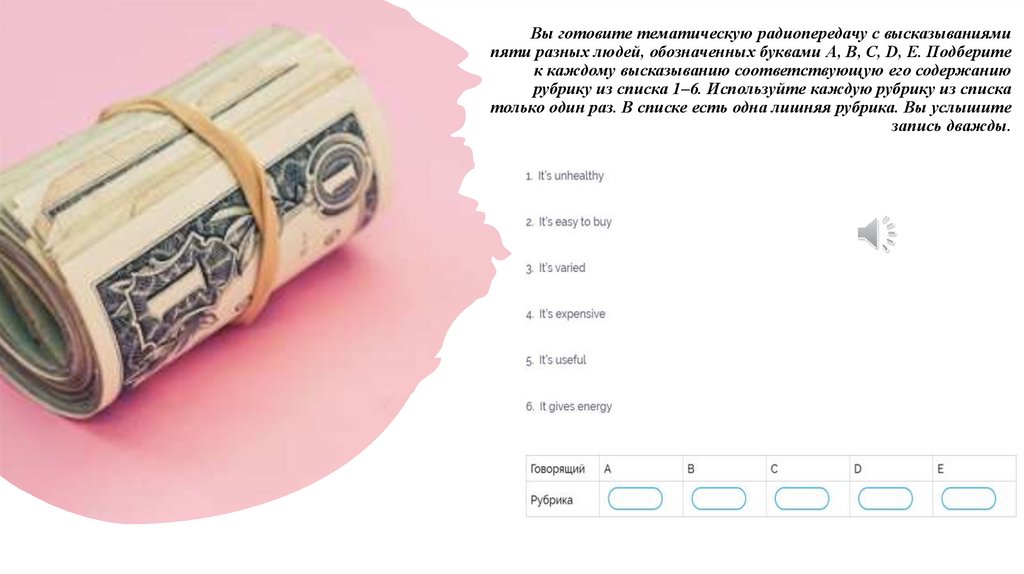
9. Вы готовите тематическую радиопередачу с высказываниями пяти разных людей, обозначенных буквами А, В, С, D, Е. Подберите к
каждому высказыванию соответствующую его содержаниюрубрику из списка 1–6. Используйте каждую рубрику из списка
только один раз. В списке есть одна лишняя рубрика. Вы услышите
запись дважды.
10. Answers and explanations
Рубрика 6 (It gives energy) соответствует высказыванию спикера A: «... I can't imagine my morningwithout a cup of strong coffee. It gives me the strength to get up.»
Рубрика 3 (It’s varied) соответствует высказыванию спикера B: «I would like to try all kinds of
coffee which they sell there because they have coffee for any weather or occasion.»
Рубрика 1 (It’s unhealthy) соответствует высказыванию спикера C: «I've read that coffee makes your
blood pressure high. And can give you a strong headache.»
Рубрика 5 (It’s useful) соответствует высказыванию спикера D: «They also believe that a cup of
coffee a day helps prevent heart problems. That's a good reason to drink coffee in reasonable quantities.»
Рубрика 4 (It’s expensive) соответствует высказыванию спикера E: «But it must be really good coffee
which is certainly not cheap. High quality coffee costs a fortune.»
10
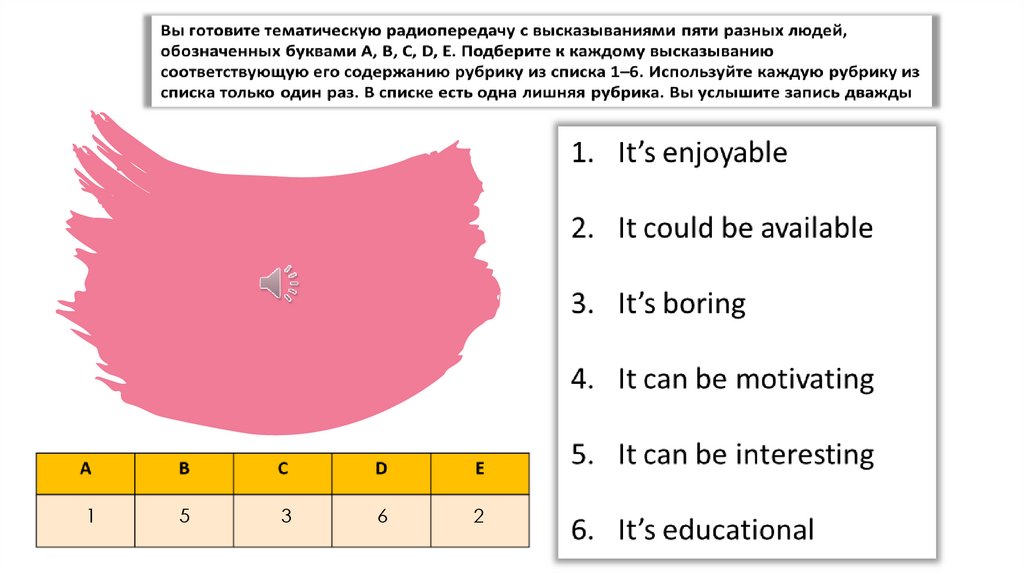
11. Вы готовите тематическую радиопередачу с высказываниями пяти разных людей, обозначенных буквами А, В, С, D, Е. Подберите к
каждому высказыванию соответствующую его содержаниюрубрику из списка 1–6. Используйте каждую рубрику из списка
только один раз. В списке есть одна лишняя рубрика. Вы услышите
запись дважды.
12. Answers and explanations
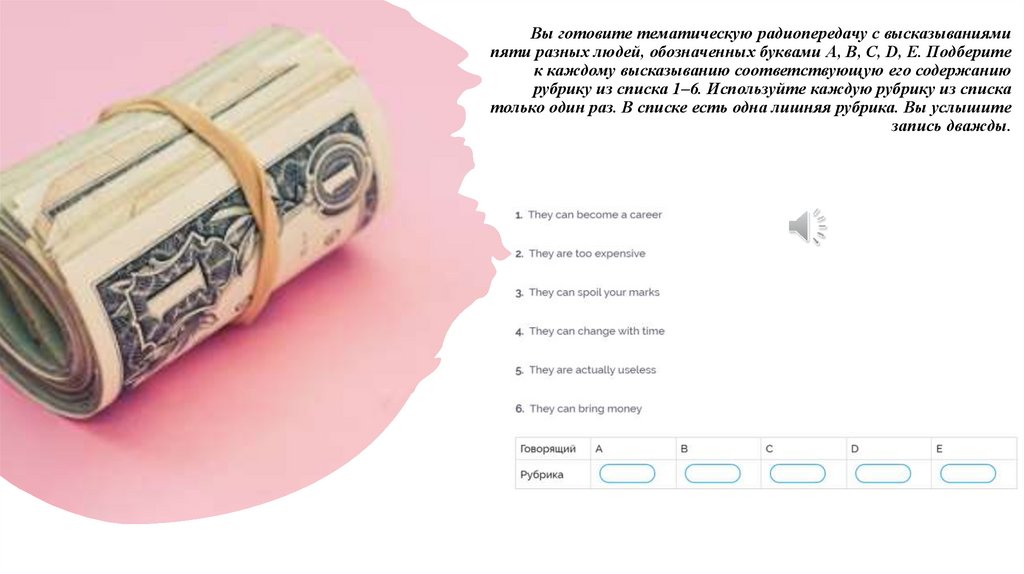
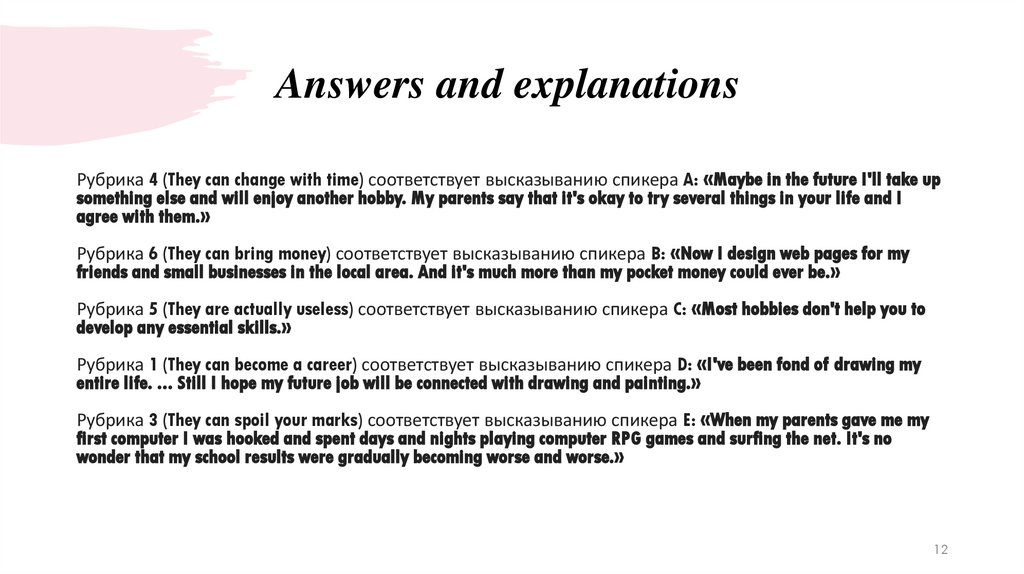
Рубрика 4 (They can change with time) соответствует высказыванию спикера A: «Maybe in the future I'll take upsomething else and will enjoy another hobby. My parents say that it's okay to try several things in your life and I
agree with them.»
Рубрика 6 (They can bring money) соответствует высказыванию спикера B: «Now I design web pages for my
friends and small businesses in the local area. And it's much more than my pocket money could ever be.»
Рубрика 5 (They are actually useless) соответствует высказыванию спикера C: «Most hobbies don't help you to
develop any essential skills.»
Рубрика 1 (They can become a career) соответствует высказыванию спикера D: «I've been fond of drawing my
entire life. ... Still I hope my future job will be connected with drawing and painting.»
Рубрика 3 (They can spoil your marks) соответствует высказыванию спикера E: «When my parents gave me my
first computer I was hooked and spent days and nights playing computer RPG games and surfing the net. It's no
wonder that my school results were gradually becoming worse and worse.»
12
13.
15
3
6
2
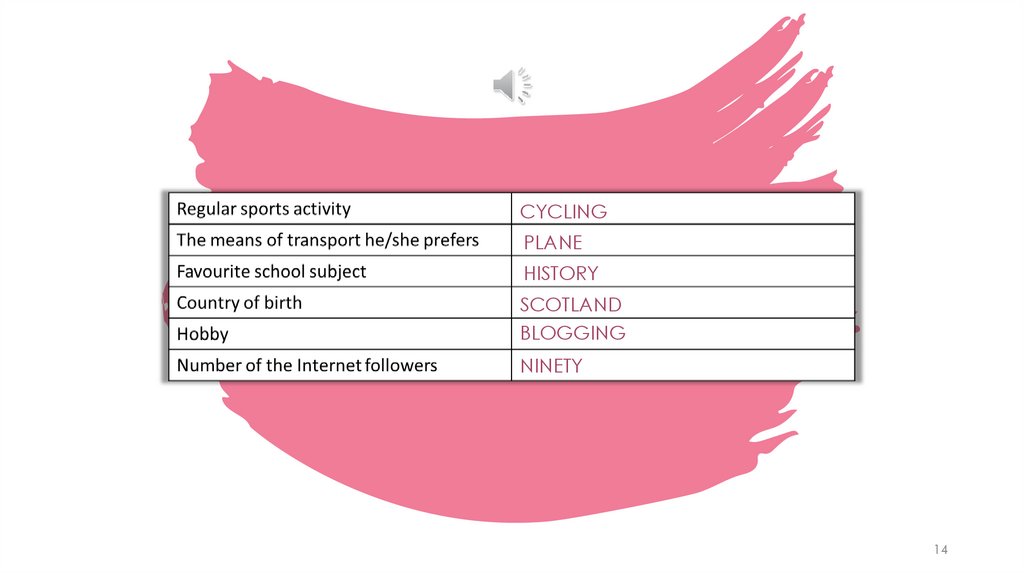
14.
CYCLINGPLANE
HISTORY
SCOTLAND
BLOGGING
NINETY
14
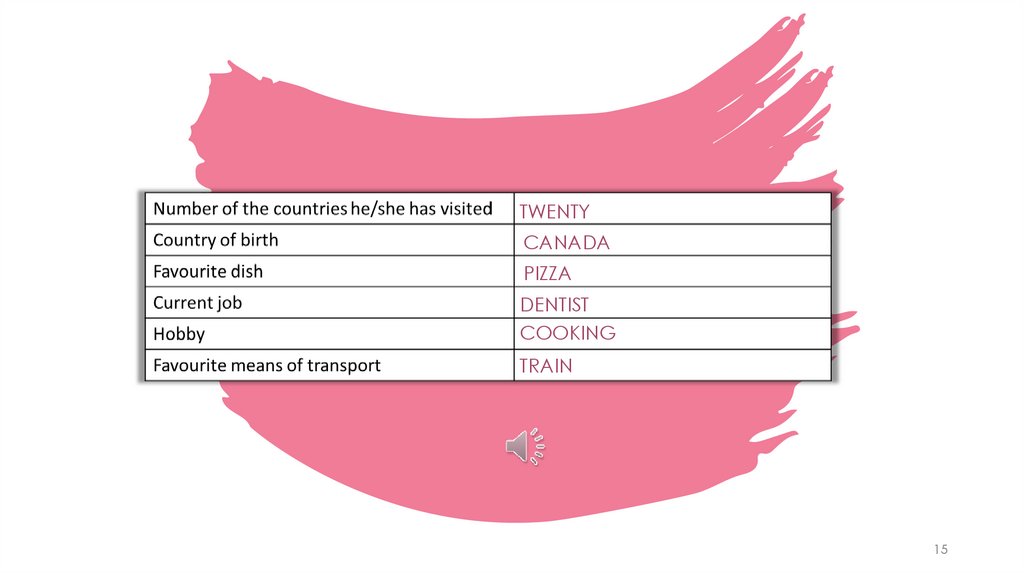
15.
TWENTYCANADA
PIZZA
DENTIST
COOKING
TRAIN
15
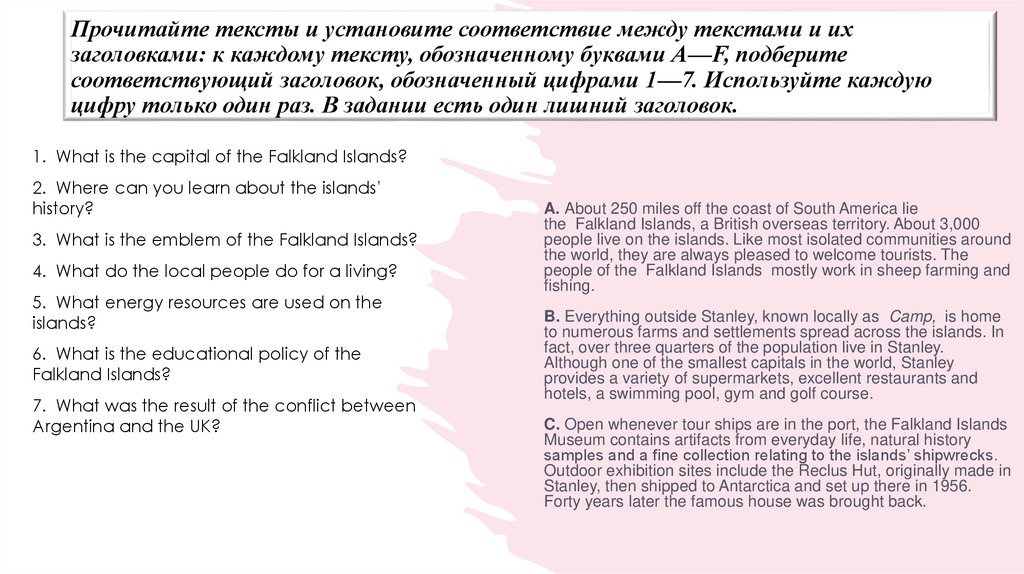
16. Reading
PART 317. Прочитайте тексты и установите соответствие между текстами и их заголовками: к каждому тексту, обозначенному буквами А––F,
подберитесоответствующий заголовок, обозначенный цифрами 1––7. Используйте каждую
цифру только один раз. В задании есть один лишний заголовок.
1. What is the capital of the Falkland Islands?
2. Where can you learn about the islands’
history?
3. What is the emblem of the Falkland Islands?
4. What do the local people do for a living?
5. What energy resources are used on the
islands?
6. What is the educational policy of the
Falkland Islands?
7. What was the result of the conflict between
Argentina and the UK?
A. About 250 miles off the coast of South America lie
the Falkland Islands, a British overseas territory. About 3,000
people live on the islands. Like most isolated communities around
the world, they are always pleased to welcome tourists. The
people of the Falkland Islands mostly work in sheep farming and
fishing.
B. Everything outside Stanley, known locally as Camp, is home
to numerous farms and settlements spread across the islands. In
fact, over three quarters of the population live in Stanley.
Although one of the smallest capitals in the world, Stanley
provides a variety of supermarkets, excellent restaurants and
hotels, a swimming pool, gym and golf course.
C. Open whenever tour ships are in the port, the Falkland Islands
Museum contains artifacts from everyday life, natural history
samples and a fine collection relating to the islands’ shipwrecks.
Outdoor exhibition sites include the Reclus Hut, originally made in
Stanley, then shipped to Antarctica and set up there in 1956.
Forty years later the famous house was brought back.
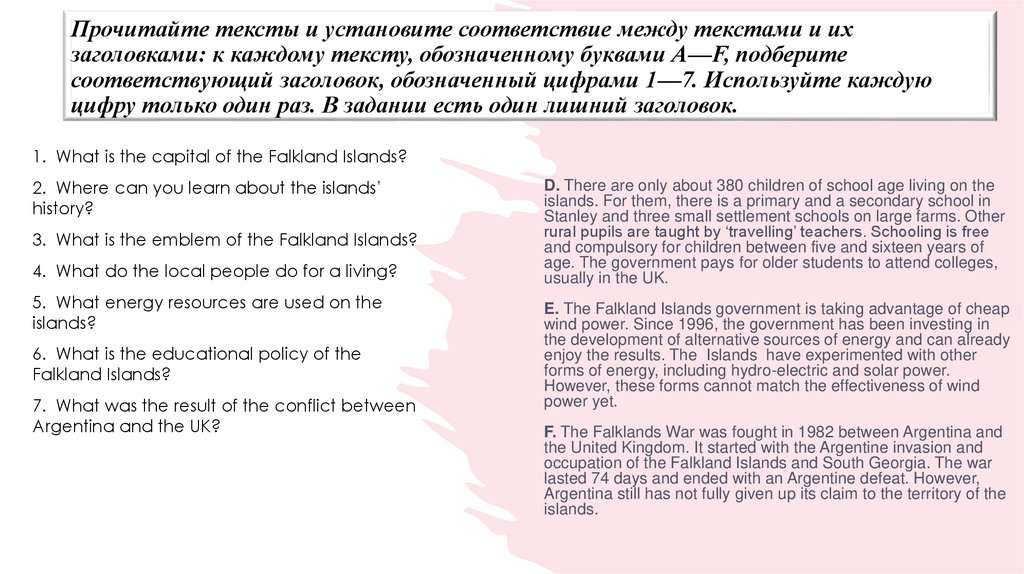
18. Прочитайте тексты и установите соответствие между текстами и их заголовками: к каждому тексту, обозначенному буквами А––F,
подберитесоответствующий заголовок, обозначенный цифрами 1––7. Используйте каждую
цифру только один раз. В задании есть один лишний заголовок.
1. What is the capital of the Falkland Islands?
2. Where can you learn about the islands’
history?
3. What is the emblem of the Falkland Islands?
4. What do the local people do for a living?
5. What energy resources are used on the
islands?
6. What is the educational policy of the
Falkland Islands?
7. What was the result of the conflict between
Argentina and the UK?
D. There are only about 380 children of school age living on the
islands. For them, there is a primary and a secondary school in
Stanley and three small settlement schools on large farms. Other
rural pupils are taught by ‘travelling’ teachers. Schooling is free
and compulsory for children between five and sixteen years of
age. The government pays for older students to attend colleges,
usually in the UK.
E. The Falkland Islands government is taking advantage of cheap
wind power. Since 1996, the government has been investing in
the development of alternative sources of energy and can already
enjoy the results. The Islands have experimented with other
forms of energy, including hydro-electric and solar power.
However, these forms cannot match the effectiveness of wind
power yet.
F. The Falklands War was fought in 1982 between Argentina and
the United Kingdom. It started with the Argentine invasion and
occupation of the Falkland Islands and South Georgia. The war
lasted 74 days and ended with an Argentine defeat. However,
Argentina still has not fully given up its claim to the territory of the
islands.
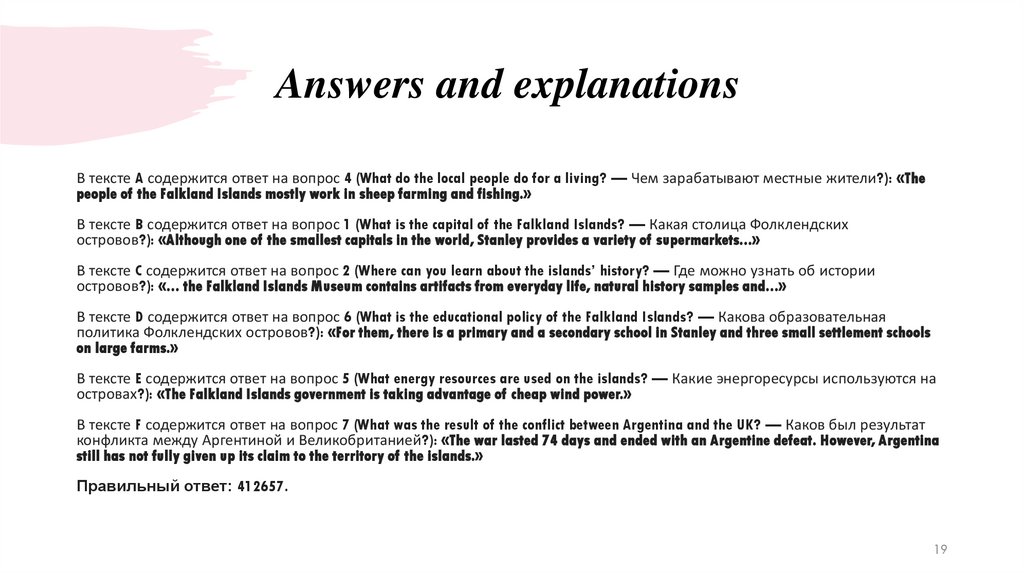
19. Answers and explanations
В тексте A содержится ответ на вопрос 4 (What do the local people do for a living? — Чем зарабатывают местные жители?): «Thepeople of the Falkland Islands mostly work in sheep farming and fishing.»
В тексте B содержится ответ на вопрос 1 (What is the capital of the Falkland Islands? — Какая столица Фолклендских
островов?): «Although one of the smallest capitals in the world, Stanley provides a variety of supermarkets...»
В тексте C содержится ответ на вопрос 2 (Where can you learn about the islands’ history? — Где можно узнать об истории
островов?): «... the Falkland Islands Museum contains artifacts from everyday life, natural history samples and...»
В тексте D содержится ответ на вопрос 6 (What is the educational policy of the Falkland Islands? — Какова образовательная
политика Фолклендских островов?): «For them, there is a primary and a secondary school in Stanley and three small settlement schools
on large farms.»
В тексте E содержится ответ на вопрос 5 (What energy resources are used on the islands? — Какие энергоресурсы используются на
островах?): «The Falkland Islands government is taking advantage of cheap wind power.»
В тексте F содержится ответ на вопрос 7 (What was the result of the conflict between Argentina and the UK? — Каков был результат
конфликта между Аргентиной и Великобританией?): «The war lasted 74 days and ended with an Argentine defeat. However, Argentina
still has not fully given up its claim to the territory of the islands.»
Правильный ответ: 412657.
19
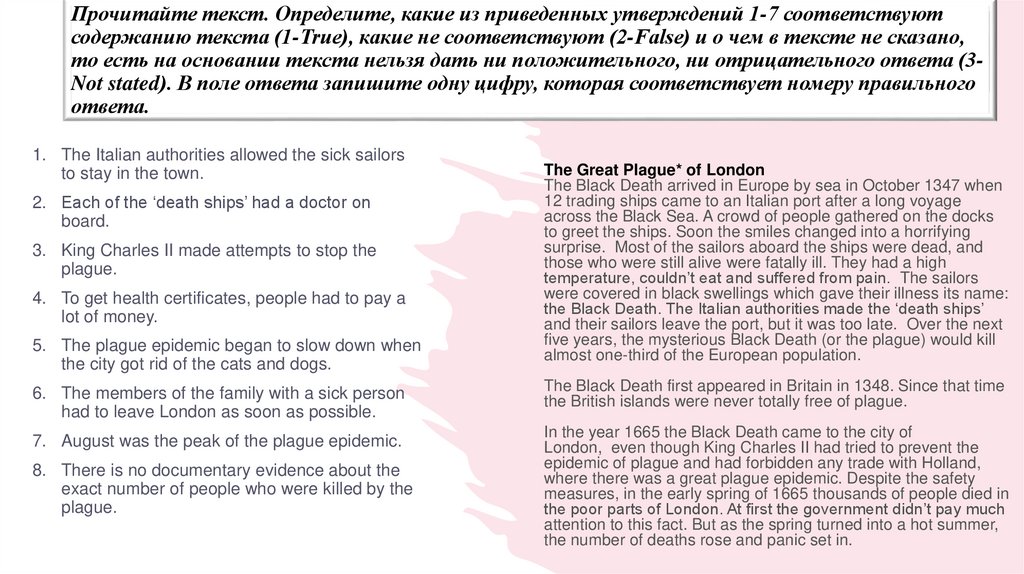
20. Прочитайте текст. Определите, какие из приведенных утверждений 1-7 соответствуют содержанию текста (1-True), какие не
соответствуют (2-False) и о чем в тексте не сказано,то есть на основании текста нельзя дать ни положительного, ни отрицательного ответа (3Not stated). В поле ответа запишите одну цифру, которая соответствует номеру правильного
ответа.
1. The Italian authorities allowed the sick sailors
to stay in the town.
2. Each of the ‘death ships’ had a doctor on
board.
3. King Charles II made attempts to stop the
plague.
4. To get health certificates, people had to pay a
lot of money.
5. The plague epidemic began to slow down when
the city got rid of the cats and dogs.
6. The members of the family with a sick person
had to leave London as soon as possible.
7. August was the peak of the plague epidemic.
8. There is no documentary evidence about the
exact number of people who were killed by the
plague.
The Great Plague* of London
The Black Death arrived in Europe by sea in October 1347 when
12 trading ships came to an Italian port after a long voyage
across the Black Sea. A crowd of people gathered on the docks
to greet the ships. Soon the smiles changed into a horrifying
surprise. Most of the sailors aboard the ships were dead, and
those who were still alive were fatally ill. They had a high
temperature, couldn’t eat and suffered from pain. The sailors
were covered in black swellings which gave their illness its name:
the Black Death. The Italian authorities made the ‘death ships’
and their sailors leave the port, but it was too late. Over the next
five years, the mysterious Black Death (or the plague) would kill
almost one-third of the European population.
The Black Death first appeared in Britain in 1348. Since that time
the British islands were never totally free of plague.
In the year 1665 the Black Death came to the city of
London, even though King Charles II had tried to prevent the
epidemic of plague and had forbidden any trade with Holland,
where there was a great plague epidemic. Despite the safety
measures, in the early spring of 1665 thousands of people died in
the poor parts of London. At first the government didn’t pay much
attention to this fact. But as the spring turned into a hot summer,
the number of deaths rose and panic set in.
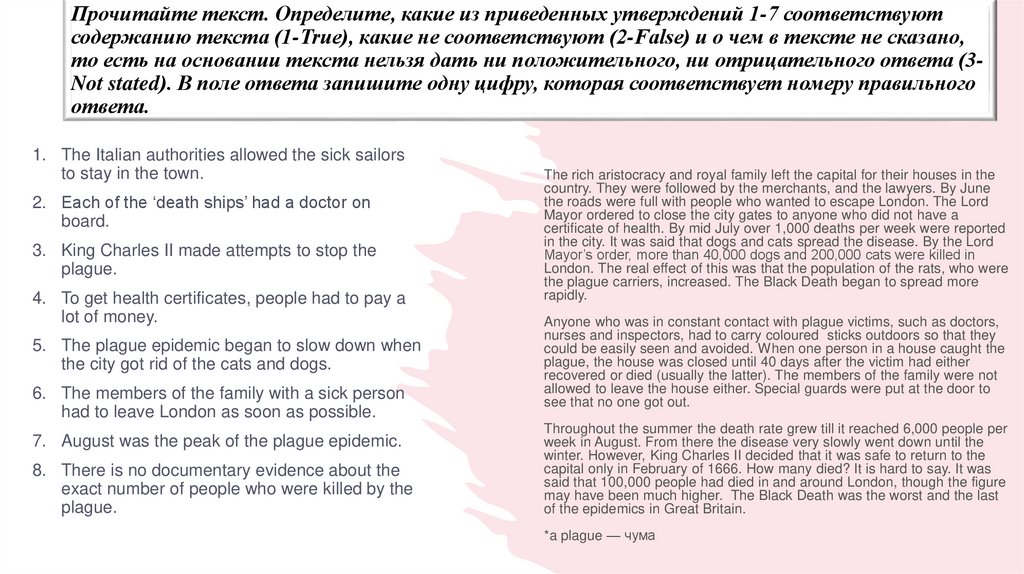
21. Прочитайте текст. Определите, какие из приведенных утверждений 1-7 соответствуют содержанию текста (1-True), какие не
соответствуют (2-False) и о чем в тексте не сказано,то есть на основании текста нельзя дать ни положительного, ни отрицательного ответа (3Not stated). В поле ответа запишите одну цифру, которая соответствует номеру правильного
ответа.
1. The Italian authorities allowed the sick sailors
to stay in the town.
2. Each of the ‘death ships’ had a doctor on
board.
3. King Charles II made attempts to stop the
plague.
4. To get health certificates, people had to pay a
lot of money.
5. The plague epidemic began to slow down when
the city got rid of the cats and dogs.
6. The members of the family with a sick person
had to leave London as soon as possible.
7. August was the peak of the plague epidemic.
8. There is no documentary evidence about the
exact number of people who were killed by the
plague.
The rich aristocracy and royal family left the capital for their houses in the
country. They were followed by the merchants, and the lawyers. By June
the roads were full with people who wanted to escape London. The Lord
Mayor ordered to close the city gates to anyone who did not have a
certificate of health. By mid July over 1,000 deaths per week were reported
in the city. It was said that dogs and cats spread the disease. By the Lord
Mayor’s order, more than 40,000 dogs and 200,000 cats were killed in
London. The real effect of this was that the population of the rats, who were
the plague carriers, increased. The Black Death began to spread more
rapidly.
Anyone who was in constant contact with plague victims, such as doctors,
nurses and inspectors, had to carry coloured sticks outdoors so that they
could be easily seen and avoided. When one person in a house caught the
plague, the house was closed until 40 days after the victim had either
recovered or died (usually the latter). The members of the family were not
allowed to leave the house either. Special guards were put at the door to
see that no one got out.
Throughout the summer the death rate grew till it reached 6,000 people per
week in August. From there the disease very slowly went down until the
winter. However, King Charles II decided that it was safe to return to the
capital only in February of 1666. How many died? It is hard to say. It was
said that 100,000 people had died in and around London, though the figure
may have been much higher. The Black Death was the worst and the last
of the epidemics in Great Britain.
*a plague — чума
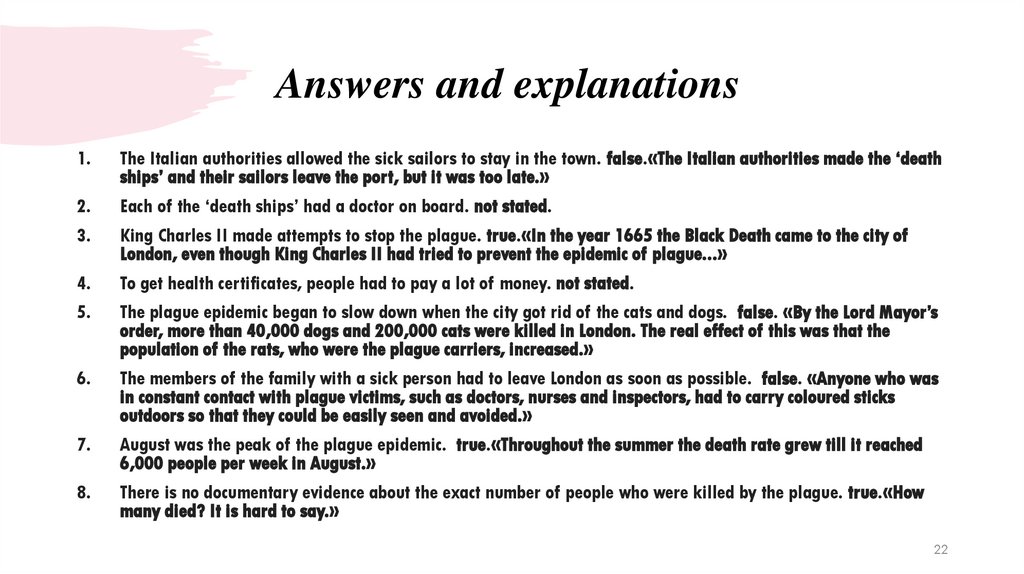
22. Answers and explanations
1.The Italian authorities allowed the sick sailors to stay in the town. false.«The Italian authorities made the ‘death
ships’ and their sailors leave the port, but it was too late.»
2.
Each of the ‘death ships’ had a doctor on board. not stated.
3.
King Charles II made attempts to stop the plague. true.«In the year 1665 the Black Death came to the city of
London, even though King Charles II had tried to prevent the epidemic of plague...»
4.
To get health certificates, people had to pay a lot of money. not stated.
5.
The plague epidemic began to slow down when the city got rid of the cats and dogs. false. «By the Lord Mayor’s
order, more than 40,000 dogs and 200,000 cats were killed in London. The real effect of this was that the
population of the rats, who were the plague carriers, increased.»
6.
The members of the family with a sick person had to leave London as soon as possible. false. «Anyone who was
in constant contact with plague victims, such as doctors, nurses and inspectors, had to carry coloured sticks
outdoors so that they could be easily seen and avoided.»
7.
August was the peak of the plague epidemic. true.«Throughout the summer the death rate grew till it reached
6,000 people per week in August.»
8.
There is no documentary evidence about the exact number of people who were killed by the plague. true.«How
many died? It is hard to say.»
22
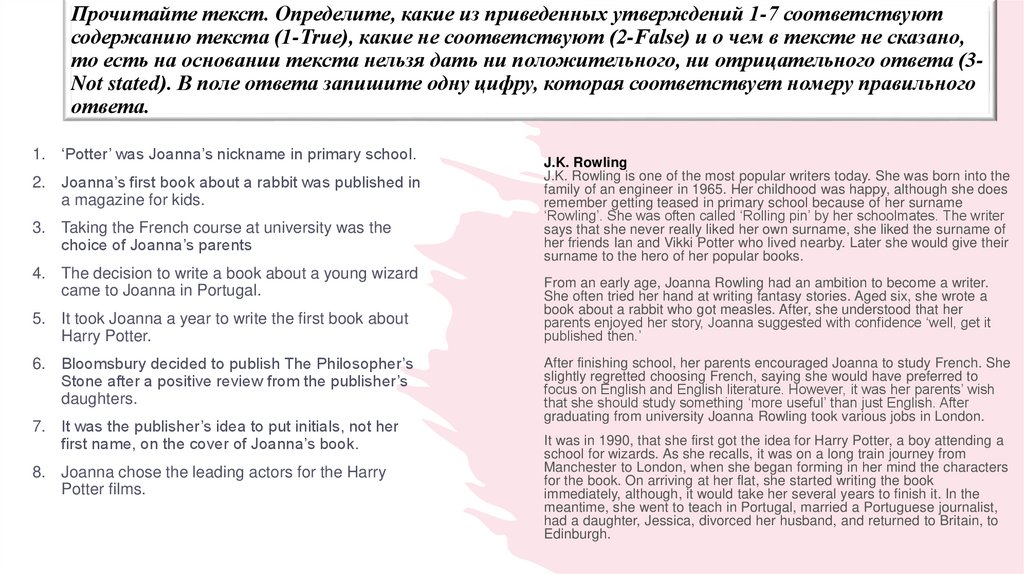
23. Прочитайте текст. Определите, какие из приведенных утверждений 1-7 соответствуют содержанию текста (1-True), какие не
соответствуют (2-False) и о чем в тексте не сказано,то есть на основании текста нельзя дать ни положительного, ни отрицательного ответа (3Not stated). В поле ответа запишите одну цифру, которая соответствует номеру правильного
ответа.
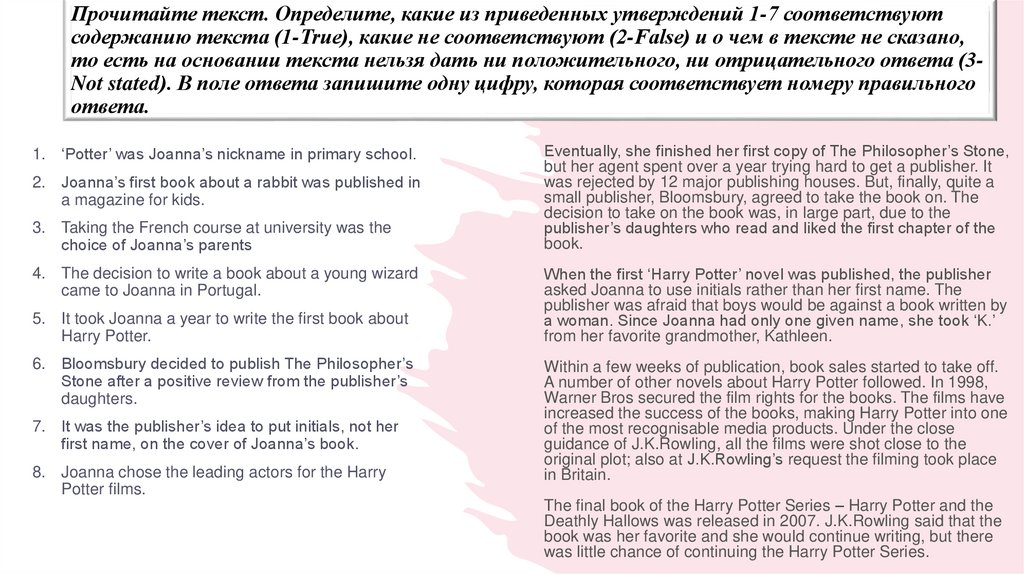
1. ‘Potter’ was Joanna’s nickname in primary school.
2. Joanna’s first book about a rabbit was published in
a magazine for kids.
3. Taking the French course at university was the
choice of Joanna’s parents
4. The decision to write a book about a young wizard
came to Joanna in Portugal.
5. It took Joanna a year to write the first book about
Harry Potter.
6. Bloomsbury decided to publish The Philosopher’s
Stone after a positive review from the publisher’s
daughters.
7. It was the publisher’s idea to put initials, not her
first name, on the cover of Joanna’s book.
8. Joanna chose the leading actors for the Harry
Potter films.
J.K. Rowling
J.K. Rowling is one of the most popular writers today. She was born into the
family of an engineer in 1965. Her childhood was happy, although she does
remember getting teased in primary school because of her surname
‘Rowling’. She was often called ‘Rolling pin’ by her schoolmates. The writer
says that she never really liked her own surname, she liked the surname of
her friends Ian and Vikki Potter who lived nearby. Later she would give their
surname to the hero of her popular books.
From an early age, Joanna Rowling had an ambition to become a writer.
She often tried her hand at writing fantasy stories. Aged six, she wrote a
book about a rabbit who got measles. After, she understood that her
parents enjoyed her story, Joanna suggested with confidence ‘well, get it
published then.’
After finishing school, her parents encouraged Joanna to study French. She
slightly regretted choosing French, saying she would have preferred to
focus on English and English literature. However, it was her parents’ wish
that she should study something ‘more useful’ than just English. After
graduating from university Joanna Rowling took various jobs in London.
It was in 1990, that she first got the idea for Harry Potter, a boy attending a
school for wizards. As she recalls, it was on a long train journey from
Manchester to London, when she began forming in her mind the characters
for the book. On arriving at her flat, she started writing the book
immediately, although, it would take her several years to finish it. In the
meantime, she went to teach in Portugal, married a Portuguese journalist,
had a daughter, Jessica, divorced her husband, and returned to Britain, to
Edinburgh.
24. Прочитайте текст. Определите, какие из приведенных утверждений 1-7 соответствуют содержанию текста (1-True), какие не
соответствуют (2-False) и о чем в тексте не сказано,то есть на основании текста нельзя дать ни положительного, ни отрицательного ответа (3Not stated). В поле ответа запишите одну цифру, которая соответствует номеру правильного
ответа.
1. ‘Potter’ was Joanna’s nickname in primary school.
2. Joanna’s first book about a rabbit was published in
a magazine for kids.
3. Taking the French course at university was the
choice of Joanna’s parents
4. The decision to write a book about a young wizard
came to Joanna in Portugal.
5. It took Joanna a year to write the first book about
Harry Potter.
6. Bloomsbury decided to publish The Philosopher’s
Stone after a positive review from the publisher’s
daughters.
7. It was the publisher’s idea to put initials, not her
first name, on the cover of Joanna’s book.
8. Joanna chose the leading actors for the Harry
Potter films.
Eventually, she finished her first copy of The Philosopher’s Stone,
but her agent spent over a year trying hard to get a publisher. It
was rejected by 12 major publishing houses. But, finally, quite a
small publisher, Bloomsbury, agreed to take the book on. The
decision to take on the book was, in large part, due to the
publisher’s daughters who read and liked the first chapter of the
book.
When the first ‘Harry Potter’ novel was published, the publisher
asked Joanna to use initials rather than her first name. The
publisher was afraid that boys would be against a book written by
a woman. Since Joanna had only one given name, she took ‘K.’
from her favorite grandmother, Kathleen.
Within a few weeks of publication, book sales started to take off.
A number of other novels about Harry Potter followed. In 1998,
Warner Bros secured the film rights for the books. The films have
increased the success of the books, making Harry Potter into one
of the most recognisable media products. Under the close
guidance of J.K.Rowling, all the films were shot close to the
original plot; also at J.K.Rowling’s request the filming took place
in Britain.
The final book of the Harry Potter Series – Harry Potter and the
Deathly Hallows was released in 2007. J.K.Rowling said that the
book was her favorite and she would continue writing, but there
was little chance of continuing the Harry Potter Series.
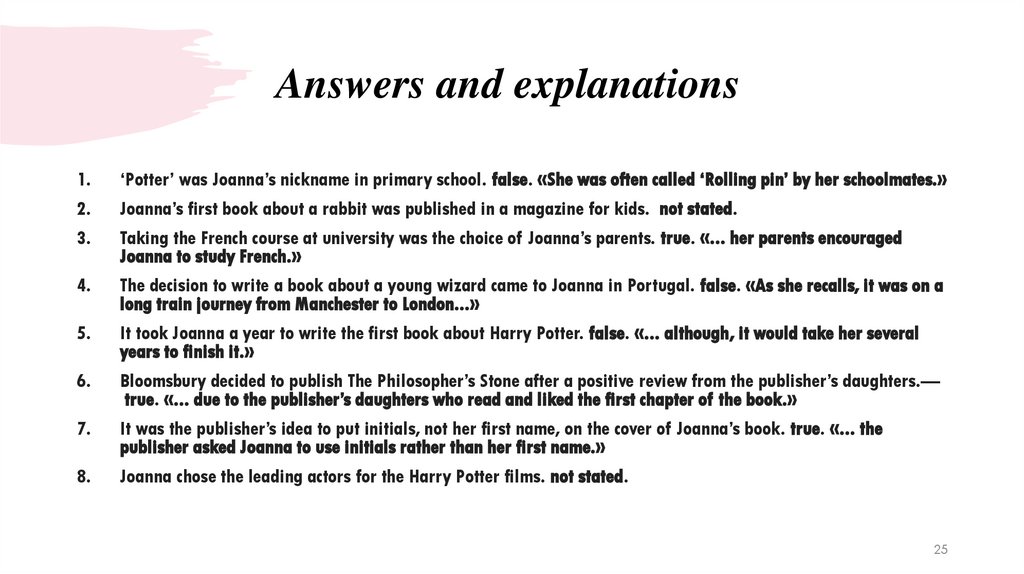
25. Answers and explanations
1.‘Potter’ was Joanna’s nickname in primary school. false. «She was often called ‘Rolling pin’ by her schoolmates.»
2.
Joanna’s first book about a rabbit was published in a magazine for kids. not stated.
3.
Taking the French course at university was the choice of Joanna’s parents. true. «... her parents encouraged
Joanna to study French.»
4.
The decision to write a book about a young wizard came to Joanna in Portugal. false. «As she recalls, it was on a
long train journey from Manchester to London...»
5.
It took Joanna a year to write the first book about Harry Potter. false. «... although, it would take her several
years to finish it.»
6.
Bloomsbury decided to publish The Philosopher’s Stone after a positive review from the publisher’s daughters.—
true. «... due to the publisher’s daughters who read and liked the first chapter of the book.»
7.
It was the publisher’s idea to put initials, not her first name, on the cover of Joanna’s book. true. «... the
publisher asked Joanna to use initials rather than her first name.»
8.
Joanna chose the leading actors for the Harry Potter films. not stated.
25
26. Writing
PART 427.
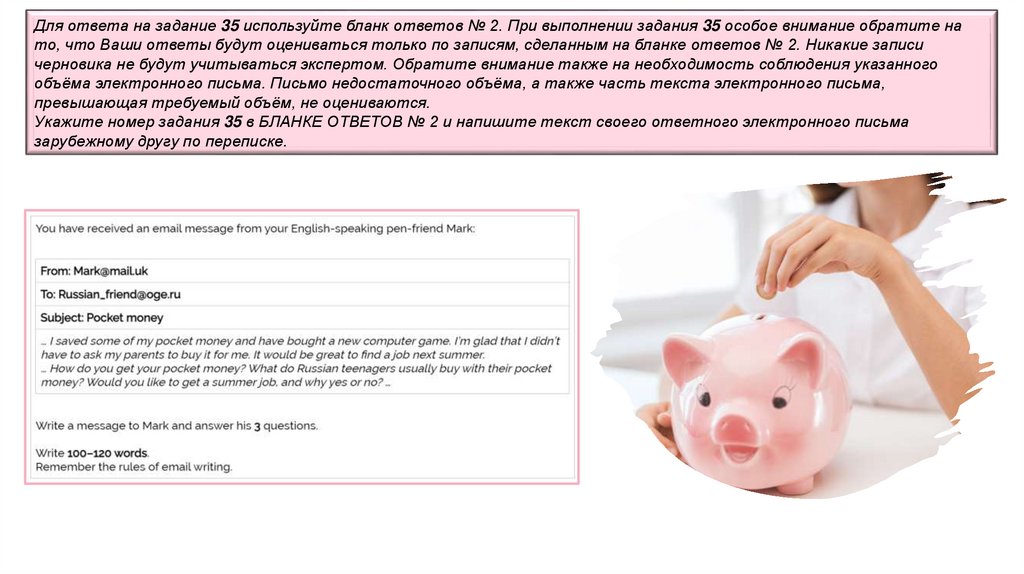
Для ответа на задание 35 используйте бланк ответов № 2. При выполнении задания 35 особое внимание обратите нато, что Ваши ответы будут оцениваться только по записям, сделанным на бланке ответов № 2. Никакие записи
черновика не будут учитываться экспертом. Обратите внимание также на необходимость соблюдения указанного
объёма электронного письма. Письмо недостаточного объёма, а также часть текста электронного письма,
превышающая требуемый объём, не оцениваются.
Укажите номер задания 35 в БЛАНКЕ ОТВЕТОВ № 2 и напишите текст своего ответного электронного письма
зарубежному другу по переписке.
28. Grammar
PART 529.
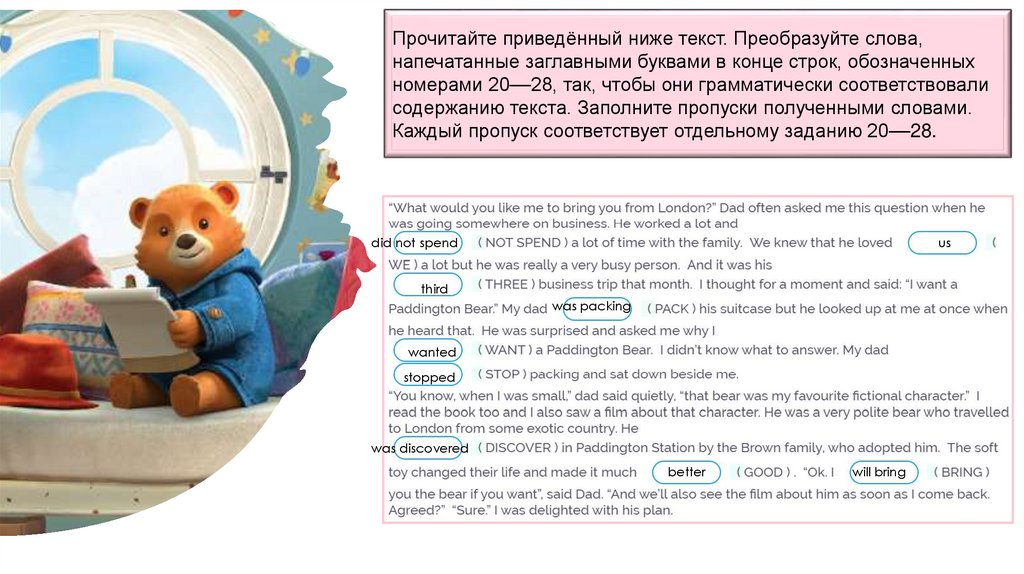
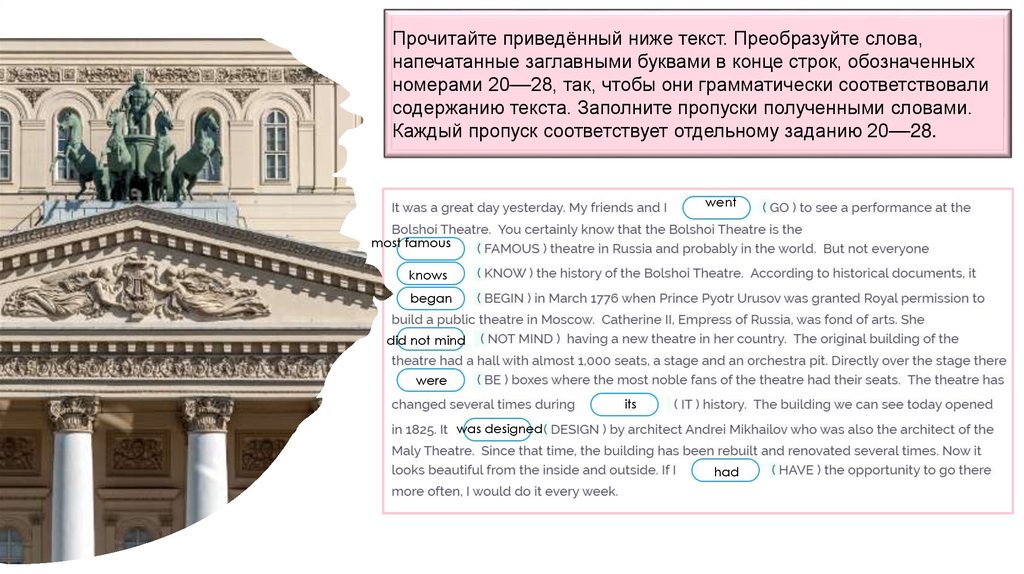
Прочитайте приведённый ниже текст. Преобразуйте слова,напечатанные заглавными буквами в конце строк, обозначенных
номерами 20––28, так, чтобы они грамматически соответствовали
содержанию текста. Заполните пропуски полученными словами.
Каждый пропуск соответствует отдельному заданию 20––28.
did not spend
us
third
was packing
wanted
stopped
was discovered
better
will bring
30.
Прочитайте приведённый ниже текст. Преобразуйте слова,напечатанные заглавными буквами в конце строк, обозначенных
номерами 20––28, так, чтобы они грамматически соответствовали
содержанию текста. Заполните пропуски полученными словами.
Каждый пропуск соответствует отдельному заданию 20––28.
went
most famous
knows
began
did not mind
were
its
was designed
had
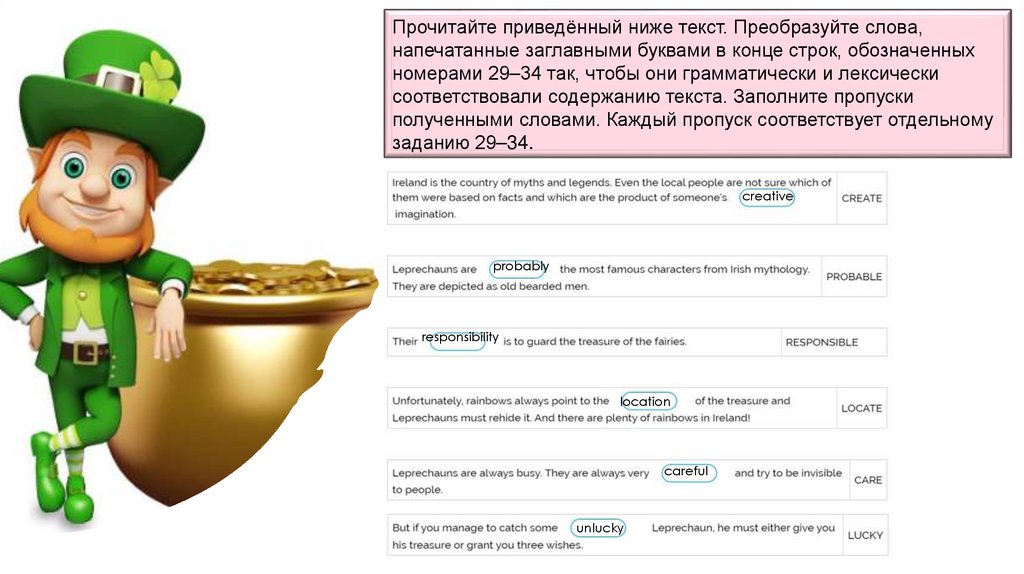
31.
Прочитайте приведённый ниже текст. Преобразуйте слова,напечатанные заглавными буквами в конце строк, обозначенных
номерами 29–34 так, чтобы они грамматически и лексически
соответствовали содержанию текста. Заполните пропуски
полученными словами. Каждый пропуск соответствует отдельному
заданию 29–34.
creative
probably
responsibility
location
careful
unlucky
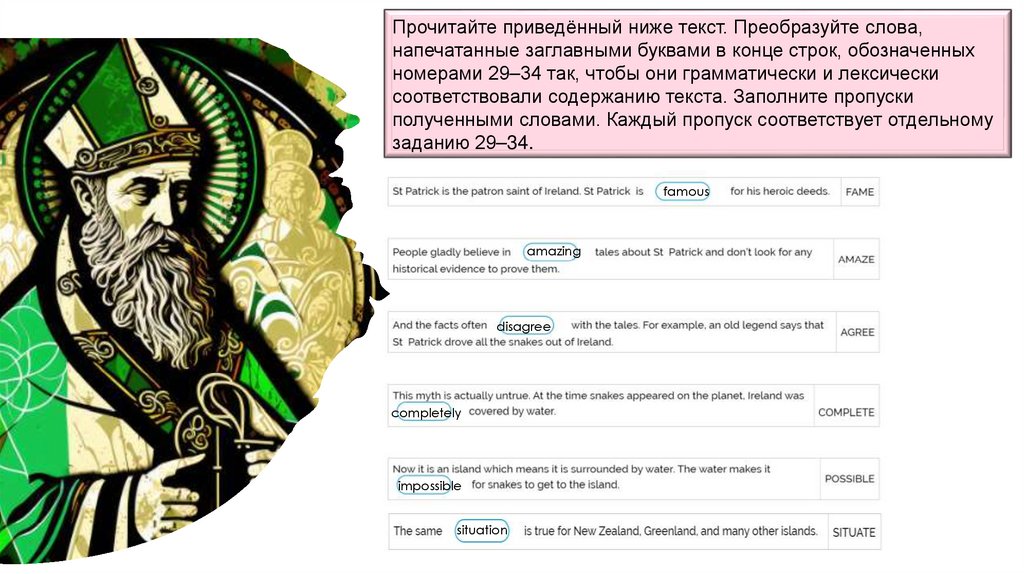
32.
Прочитайте приведённый ниже текст. Преобразуйте слова,напечатанные заглавными буквами в конце строк, обозначенных
номерами 29–34 так, чтобы они грамматически и лексически
соответствовали содержанию текста. Заполните пропуски
полученными словами. Каждый пропуск соответствует отдельному
заданию 29–34.
famous
amazing
disagree
completely
impossible
situation