
 Литература
Похожие презентации:




Lecture_2_Chaucer
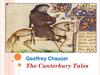
1. Lecture 2 The Canterbury Tales
BY GEOFFREY CHAUCER(1342/43-1400)
2. Geoffrey Chaucer. The Canterbury Tales (1387-1400)
PrologueWhan that Aprille with his showres soote
The droughte of March hath perced to the roote,
And bathed every veine in swich licour,
Of which vertu engendred is the flowr;
Whan Zephyrus eek with his sweete breeth
Inspired hath in every holt and heeth
The tender croppes, and the younge sonne
Hath in the Ram his halve cours yronne,
And smale fowles maken melodye
That slepen all the night with open ye –
So priketh him Nature in hir corages –
Thanne longen folk to goon on pilgrimages.
3.
Geoffrey Chaucer. The Canterbury Tales(1387-1400)
Prologue
“When the soft, sweet showers of April reach the
roots of all things, refreshing the parched earth,
nourishing every saplings and every seedling,
then humankind rises up in joy and expectations.
The west wind blows away the stench of the city
and crops flourish in the fields beyond the walls.
After the waste of winter, it is delightful to hear
birdsong once more in the streets. The trees
themselves are bathed in song. It is a time of
general renewal and restoration. The sun has passed
midway through the sign of the Ram, a good time for
the sinews and the heart. This is the best season of the
year for travelers. That is why good folk then long to
go on pilgrimages.“
a modern translation of Chaucer’s Canterbury Tales
by Peter Ackroyd
iambic
pentameter
4. The impact of Norman Conquest (1066)
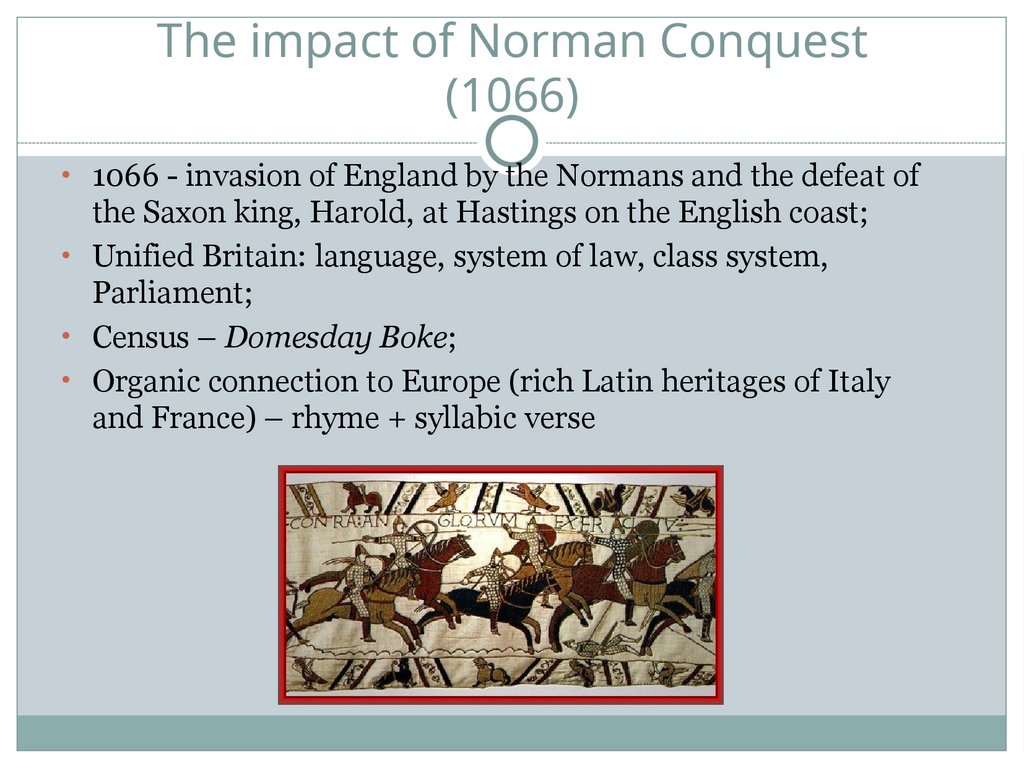
• 1066 - invasion of England by the Normans and the defeat ofthe Saxon king, Harold, at Hastings on the English coast;
• Unified Britain: language, system of law, class system,
Parliament;
• Census – Domesday Boke;
• Organic connection to Europe (rich Latin heritages of Italy
and France) – rhyme + syllabic verse
5.
Geoffrey Chaucer. The Canterbury Tales(1387-1400)
Chaucer’s audience
apostrophe to spring - favorite theme of the Italian poet
Petrarch and of many Romantic poets since;
science of astrology;
reference to Zephyrus, the Roman god of wind - knowledge of
Latin;
use of French;
cultivated audience;
civilized tone;
nature is not cruel;
a new worldview emerges through this poetry, and the poetry
itself emerges from this worldview
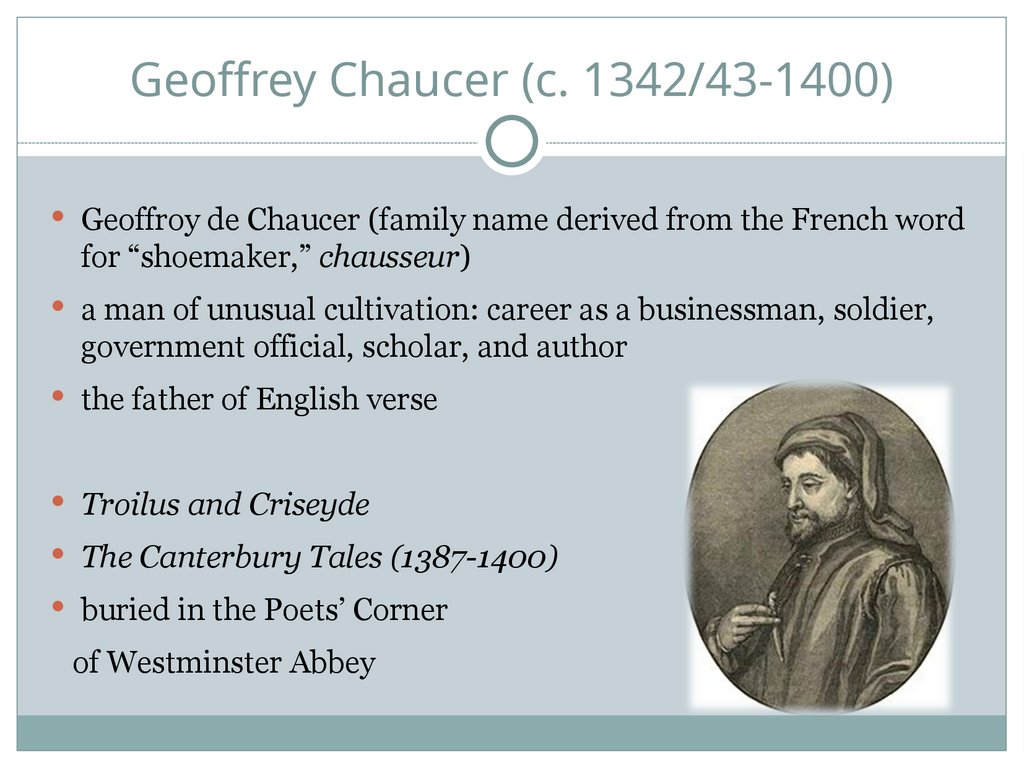
6. Geoffrey Chaucer (c. 1342/43-1400)
Geoffroy de Chaucer (family name derived from the French wordfor “shoemaker,” chausseur)
a man of unusual cultivation: career as a businessman, soldier,
government official, scholar, and author
the father of English verse
Troilus and Criseyde
The Canterbury Tales (1387-1400)
buried in the Poets’ Corner
of Westminster Abbey
7. Geoffrey Chaucer. The Canterbury Tales (1387-1400)
manuscript ;no full text of the poem - has been reconstructed from various
versions, none of which is in Chaucer’s hand;
Chaucer’s original design: 116 tales, two from each of the 29
pilgrims on the way to Canterbury and two on the return trip;
what survives: Prologue and 21 tales, some of which are
fragmentary
8.
Geoffrey Chaucer. The Canterbury Tales(1387-1400)
written and transcribed in scriptoria (copy shops)
some 100 years before printing was introduced;
initially written for recitation, learned imperfectly by
some reciters;
widely circulated;
had a significant effect on the emergence of standard
English
9.
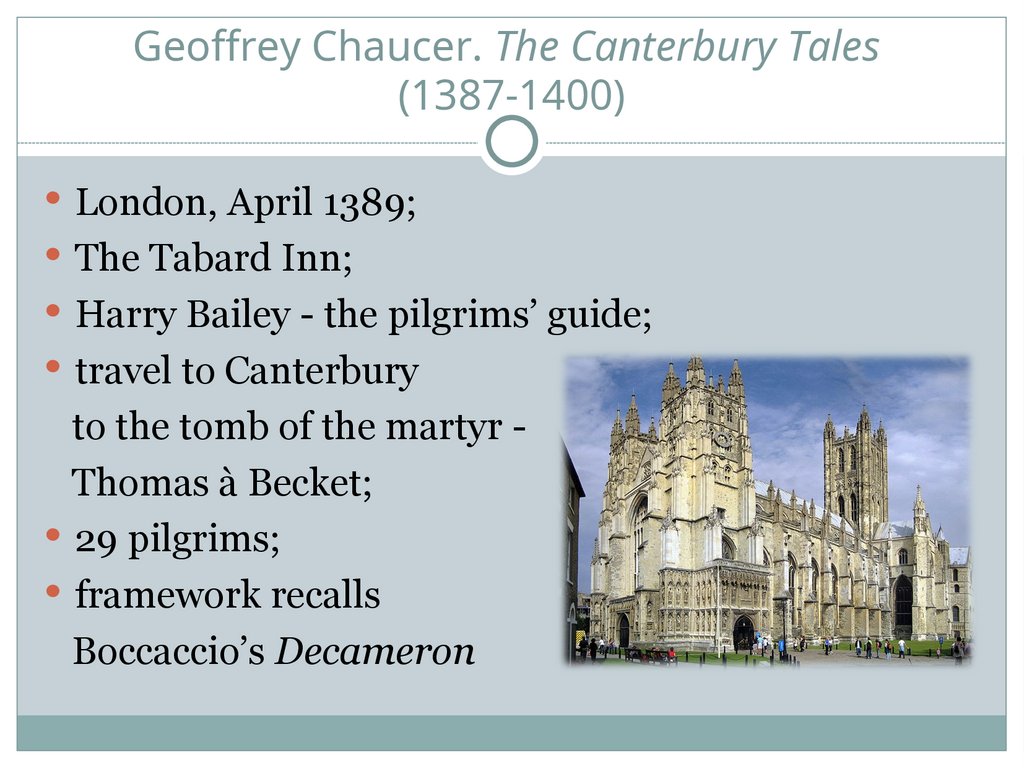
Geoffrey Chaucer. The Canterbury Tales(1387-1400)
London, April 1389;
The Tabard Inn;
Harry Bailey - the pilgrims’ guide;
travel to Canterbury
to the tomb of the martyr Thomas à Becket;
29 pilgrims;
framework recalls
Boccaccio’s Decameron
10.
Geoffrey Chaucer. The Canterbury Tales(1387-1400)
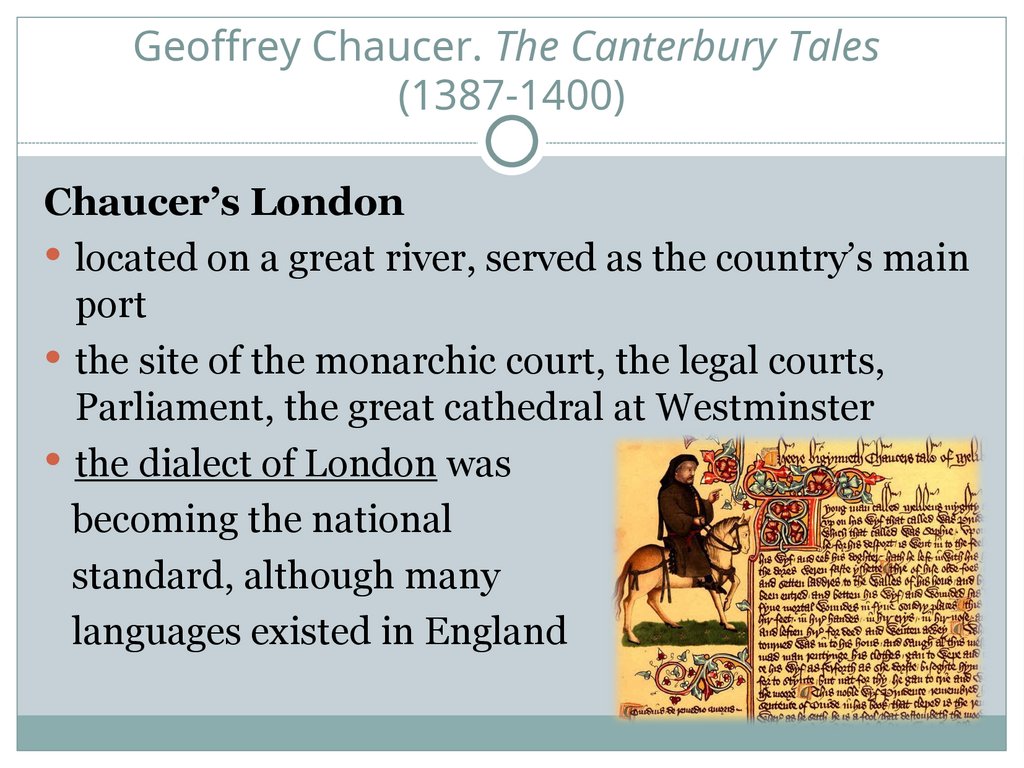
Chaucer’s London
located on a great river, served as the country’s main
port
the site of the monarchic court, the legal courts,
Parliament, the great cathedral at Westminster
the dialect of London was
becoming the national
standard, although many
languages existed in England
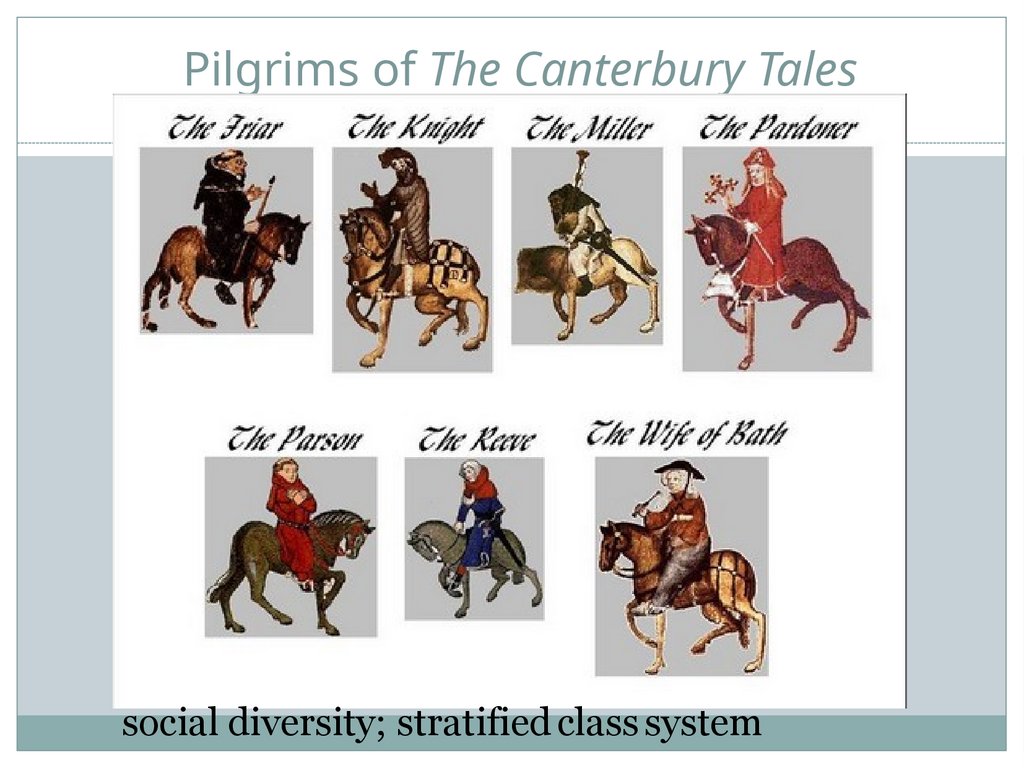
11. Pilgrims of The Canterbury Tales
social diversity; stratified class system12. The Knight's Tale
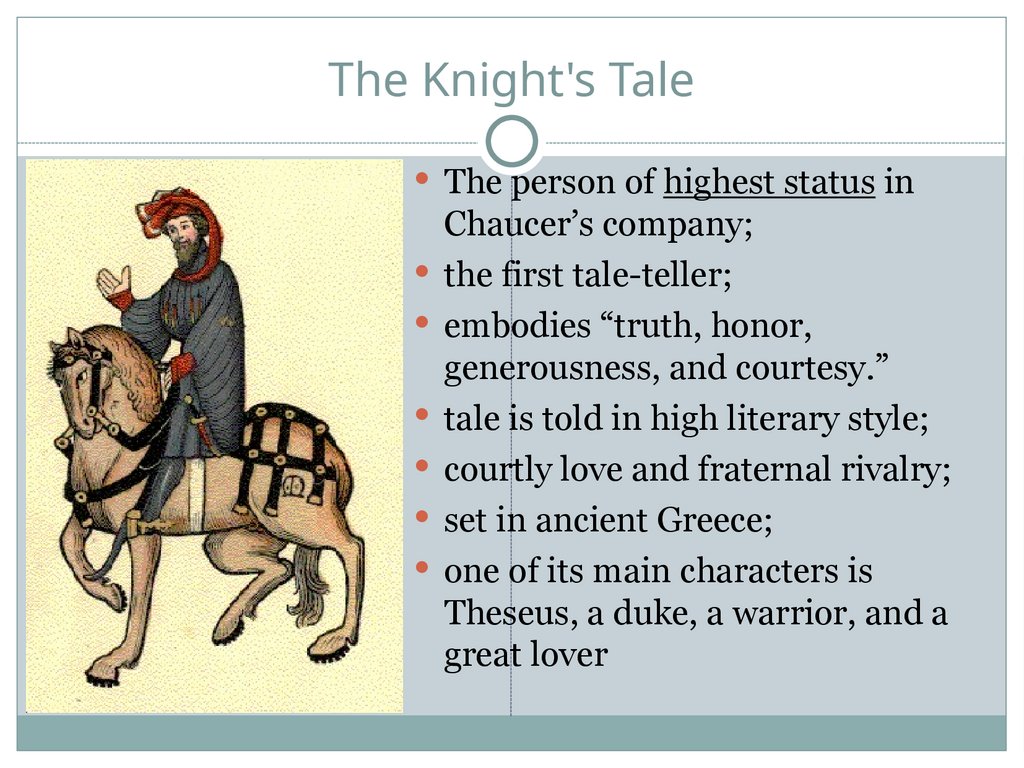
The person of highest status inChaucer’s company;
the first tale-teller;
embodies “truth, honor,
generousness, and courtesy.”
tale is told in high literary style;
courtly love and fraternal rivalry;
set in ancient Greece;
one of its main characters is
Theseus, a duke, a warrior, and a
great lover
13.
Stratified class system inThe Canterbury Tales
the lowest status: the cook, the reeve (a land agent),
the miller, and a shipman;
a little above: the merchant and the franklin,
members of the emergent bourgeoisie;
of the same class: are the doctor of physic, sergeant at law.
churchmen and women: friars, monks, nun-priests, nuns,
summoners, pardoners, a parson.
the parson’s tale - the set of sermon-like biblical precepts;
the monk’s tale - a catalogue of great people who have fallen from
fortune;
the best tales come from the least interesting people or the worst
people in the company.
14. The Miller's Tale
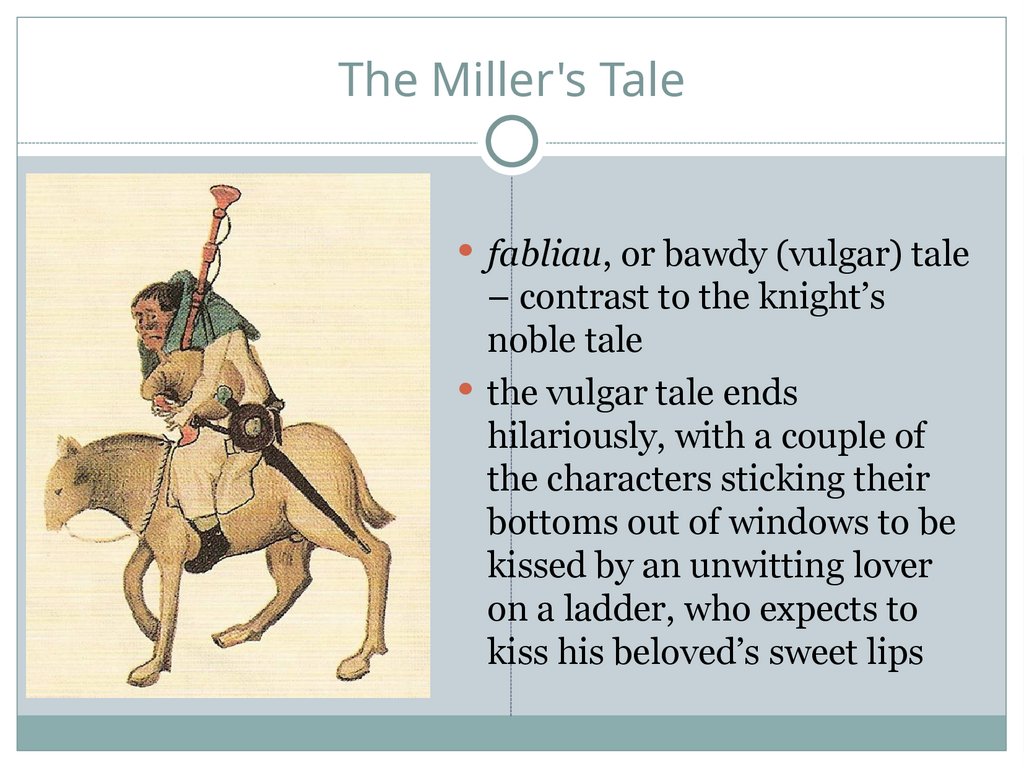
fabliau, or bawdy (vulgar) tale– contrast to the knight’s
noble tale
the vulgar tale ends
hilariously, with a couple of
the characters sticking their
bottoms out of windows to be
kissed by an unwitting lover
on a ladder, who expects to
kiss his beloved’s sweet lips
15. Geoffrey Chaucer. The Canterbury Tales
Chaucer varies the tone of the talesthe tales modulate according to the status and
character of the teller
each of the stories has a prologue, usually delivered
in the pilgrim’s own voice and character
16. The Wife of Bath, Alisoun
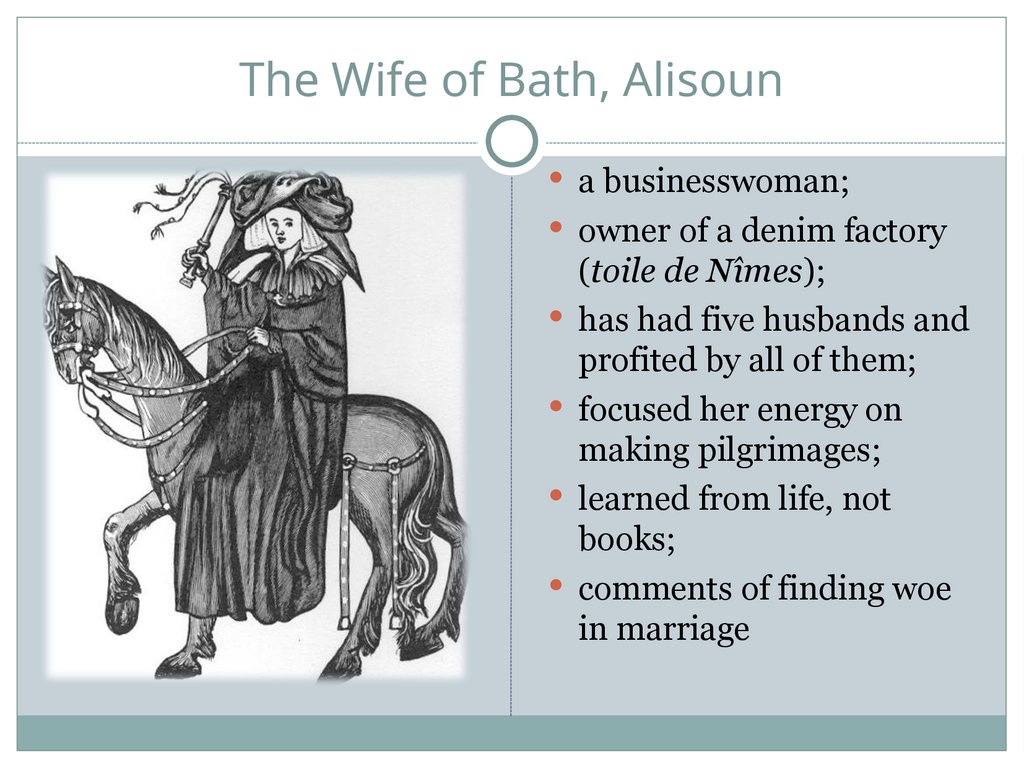
a businesswoman;owner of a denim factory
(toile de Nîmes);
has had five husbands and
profited by all of them;
focused her energy on
making pilgrimages;
learned from life, not
books;
comments of finding woe
in marriage
17. The clerk
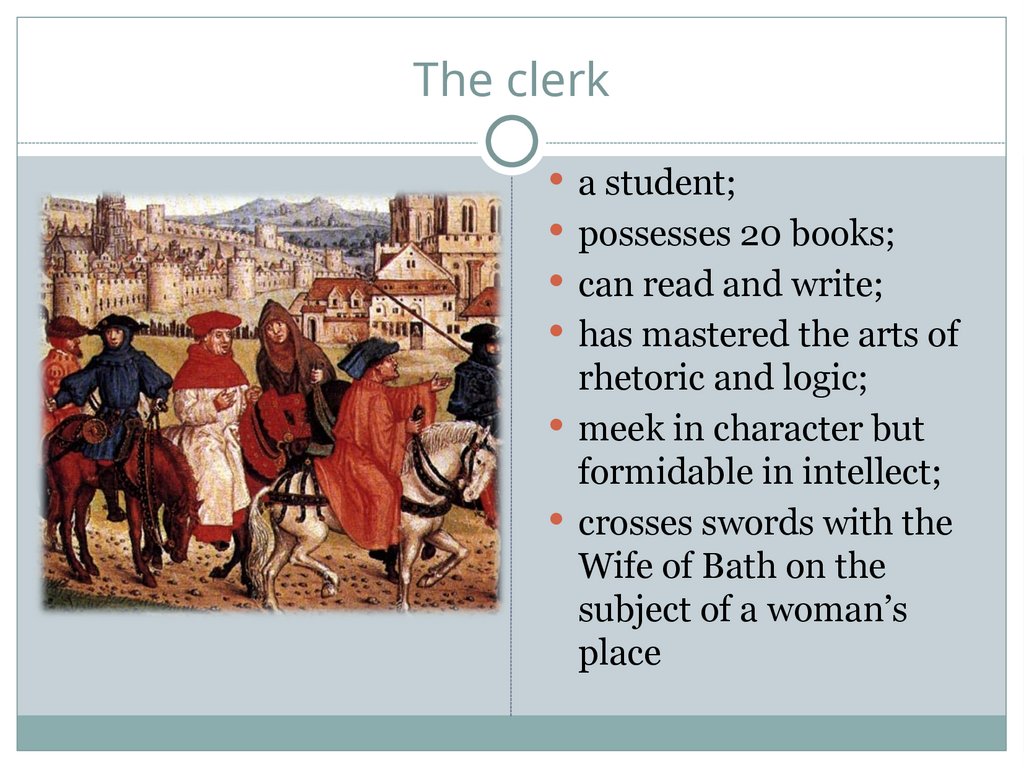
a student;possesses 20 books;
can read and write;
has mastered the arts of
rhetoric and logic;
meek in character but
formidable in intellect;
crosses swords with the
Wife of Bath on the
subject of a woman’s
place
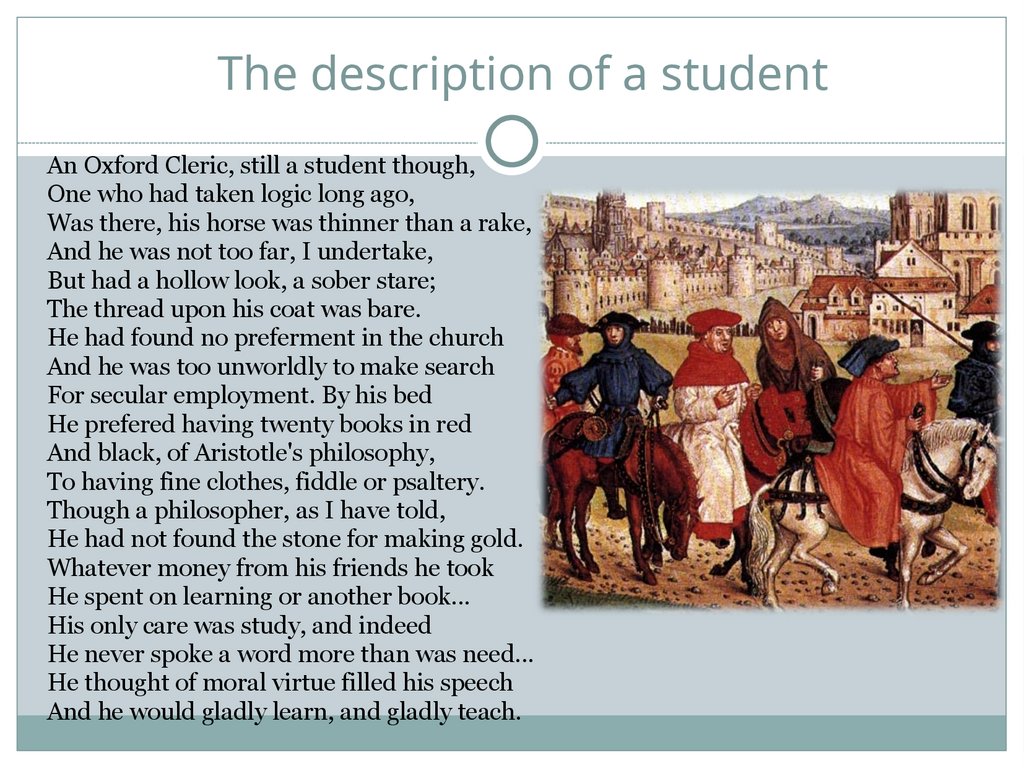
18. The description of a student
An Oxford Cleric, still a student though,One who had taken logic long ago,
Was there, his horse was thinner than a rake,
And he was not too far, I undertake,
But had a hollow look, a sober stare;
The thread upon his coat was bare.
He had found no preferment in the church
And he was too unworldly to make search
For secular employment. By his bed
He prefered having twenty books in red
And black, of Aristotle's philosophy,
To having fine clothes, fiddle or psaltery.
Though a philosopher, as I have told,
He had not found the stone for making gold.
Whatever money from his friends he took
He spent on learning or another book...
His only care was study, and indeed
He never spoke a word more than was need...
He thought of moral virtue filled his speech
And he would gladly learn, and gladly teach.
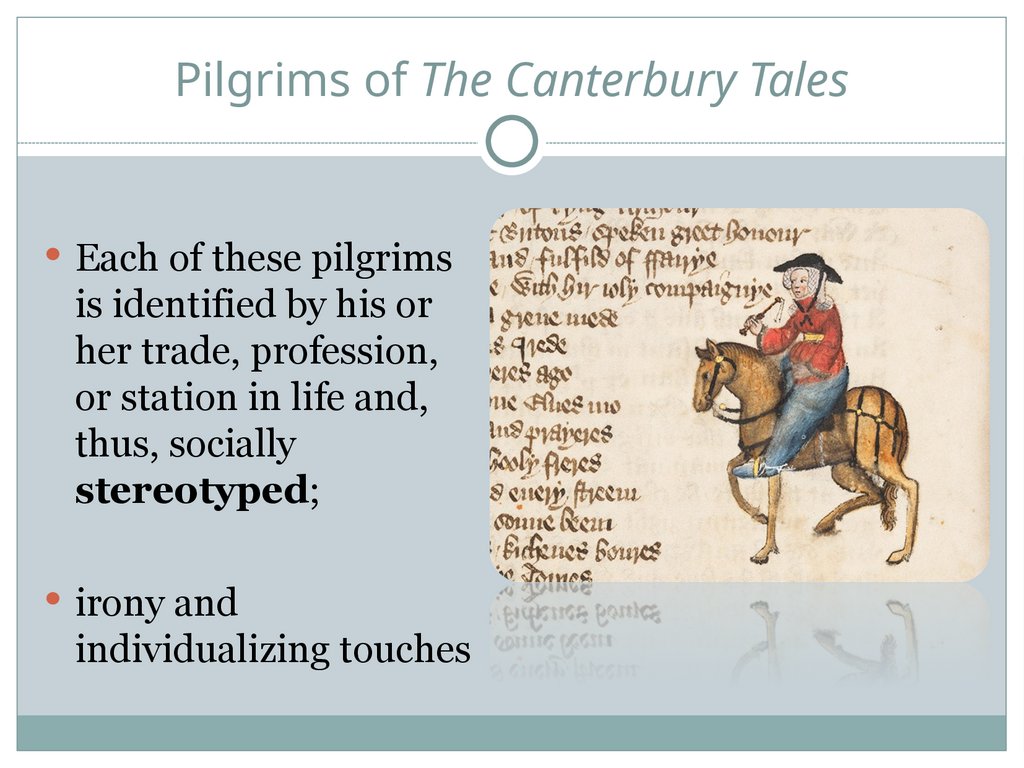
19. Pilgrims of The Canterbury Tales
Each of these pilgrimsis identified by his or
her trade, profession,
or station in life and,
thus, socially
stereotyped;
irony and
individualizing touches
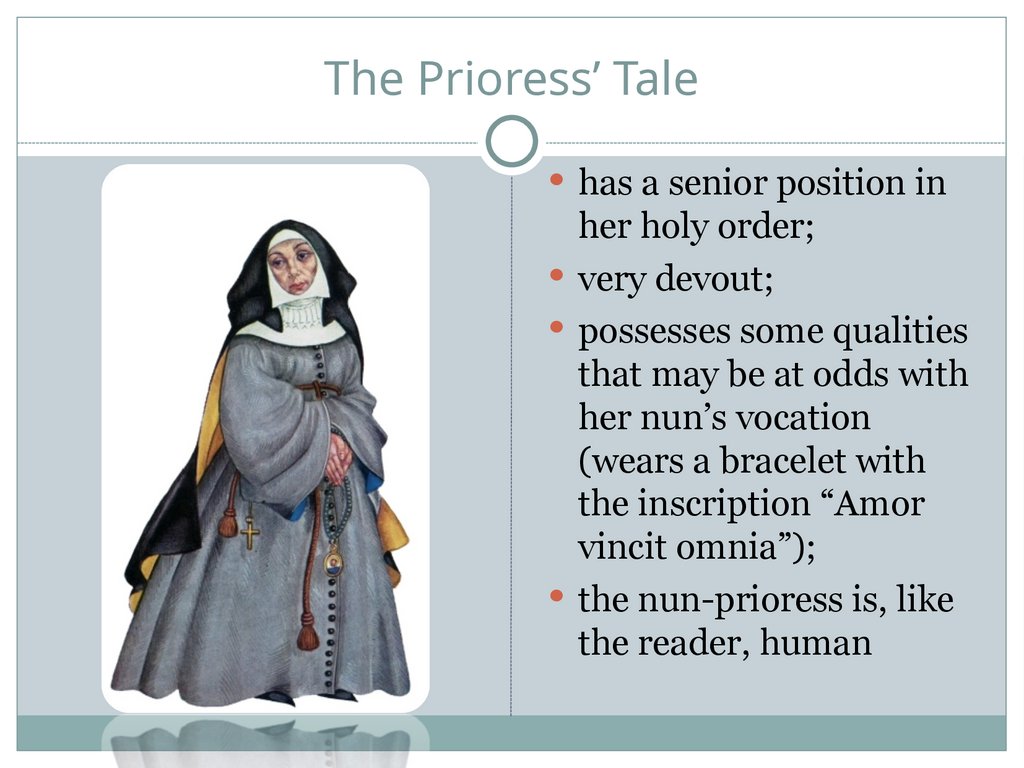
20. The Prioress’ Tale
has a senior position inher holy order;
very devout;
possesses some qualities
that may be at odds with
her nun’s vocation
(wears a bracelet with
the inscription “Amor
vincit omnia”);
the nun-prioress is, like
the reader, human
21. Pilgrims of The Canterbury Tales
social inclusivenessand elasticity of the
Christian religion;
dynamism and
complexity of
English society
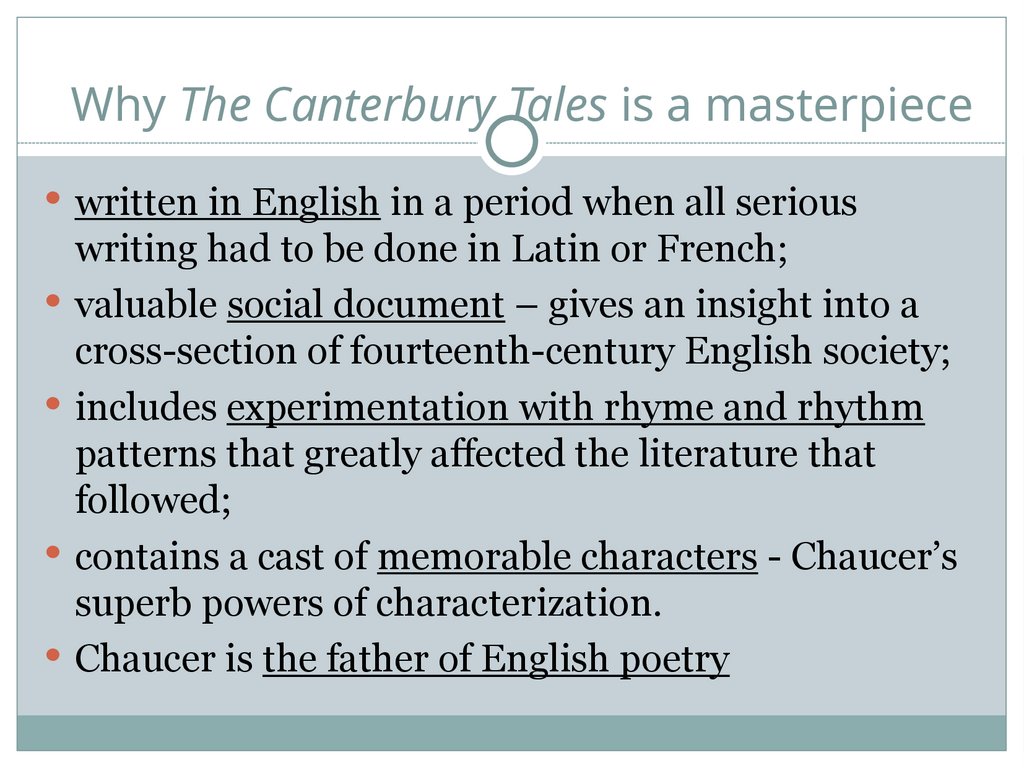
22. Why The Canterbury Tales is a masterpiece
written in English in a period when all seriouswriting had to be done in Latin or French;
valuable social document – gives an insight into a
cross-section of fourteenth-century English society;
includes experimentation with rhyme and rhythm
patterns that greatly affected the literature that
followed;
contains a cast of memorable characters - Chaucer’s
superb powers of characterization.
Chaucer is the father of English poetry
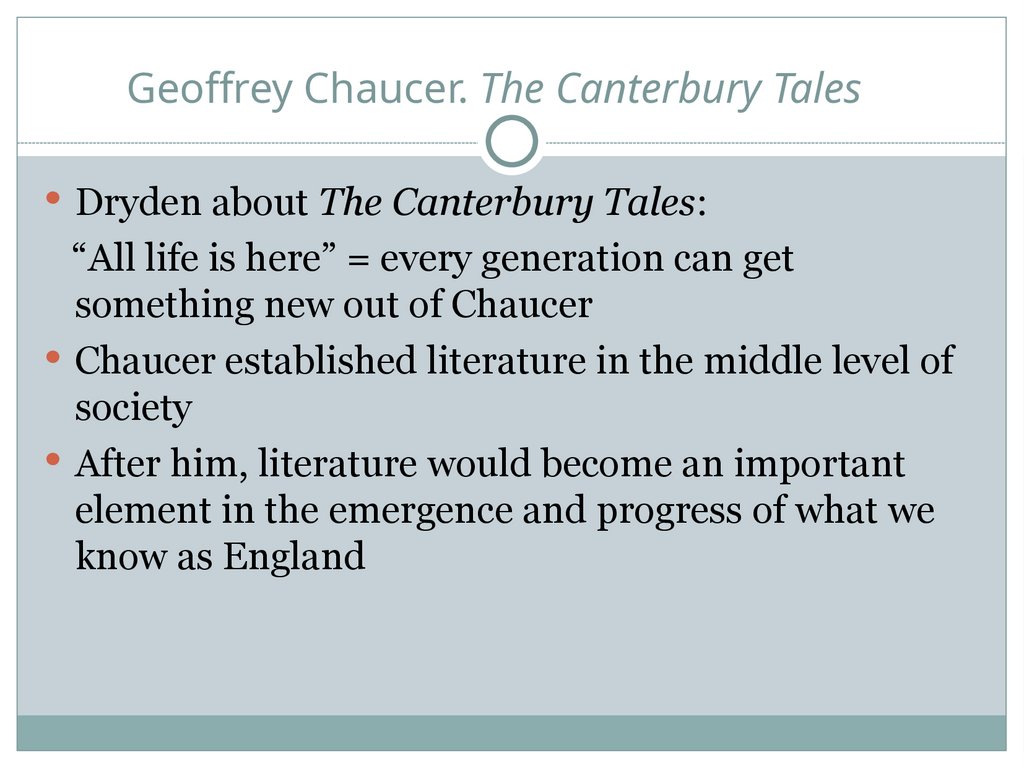
23. Geoffrey Chaucer. The Canterbury Tales
Dryden about The Canterbury Tales:“All life is here” = every generation can get
something new out of Chaucer
Chaucer established literature in the middle level of
society
After him, literature would become an important
element in the emergence and progress of what we
know as England
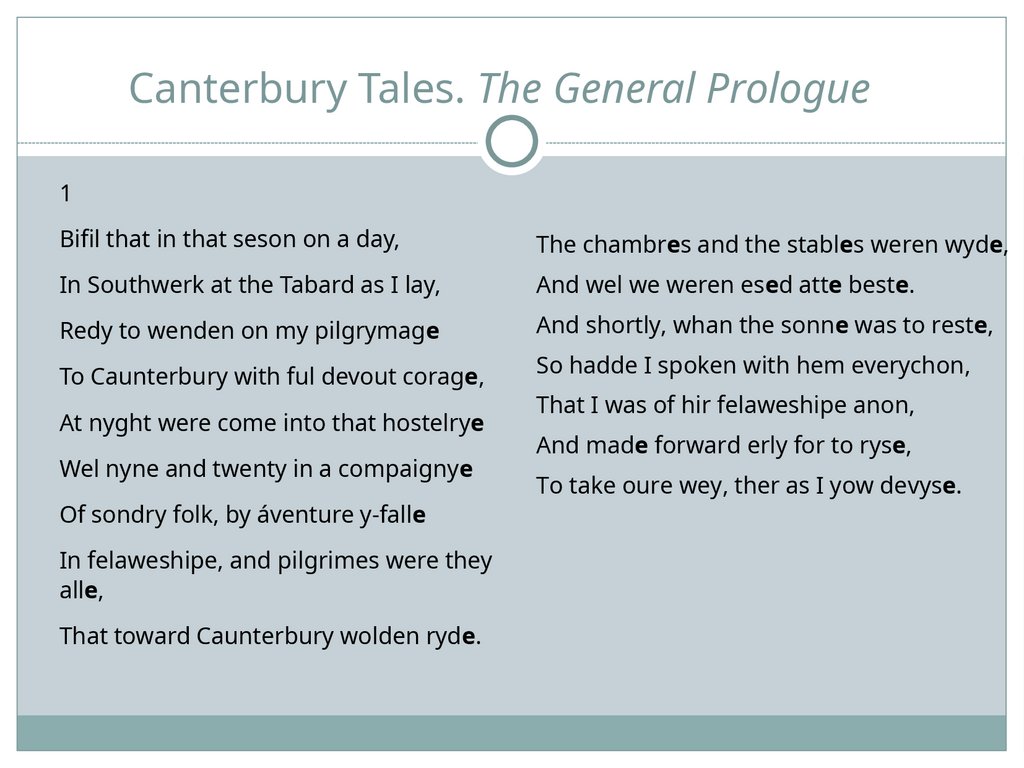
24. Canterbury Tales. The General Prologue
1Bifil that in that seson on a day,
The chambres and the stables weren wyde,
In Southwerk at the Tabard as I lay,
And wel we weren esed atte beste.
Redy to wenden on my pilgrymage
And shortly, whan the sonne was to reste,
To Caunterbury with ful devout corage,
So hadde I spoken with hem everychon,
At nyght were come into that hostelrye
Wel nyne and twenty in a compaignye
Of sondry folk, by áventure y-falle
In felaweshipe, and pilgrimes were they
alle,
That toward Caunterbury wolden ryde.
That I was of hir felaweshipe anon,
And made forward erly for to ryse,
To take oure wey, ther as I yow devyse.
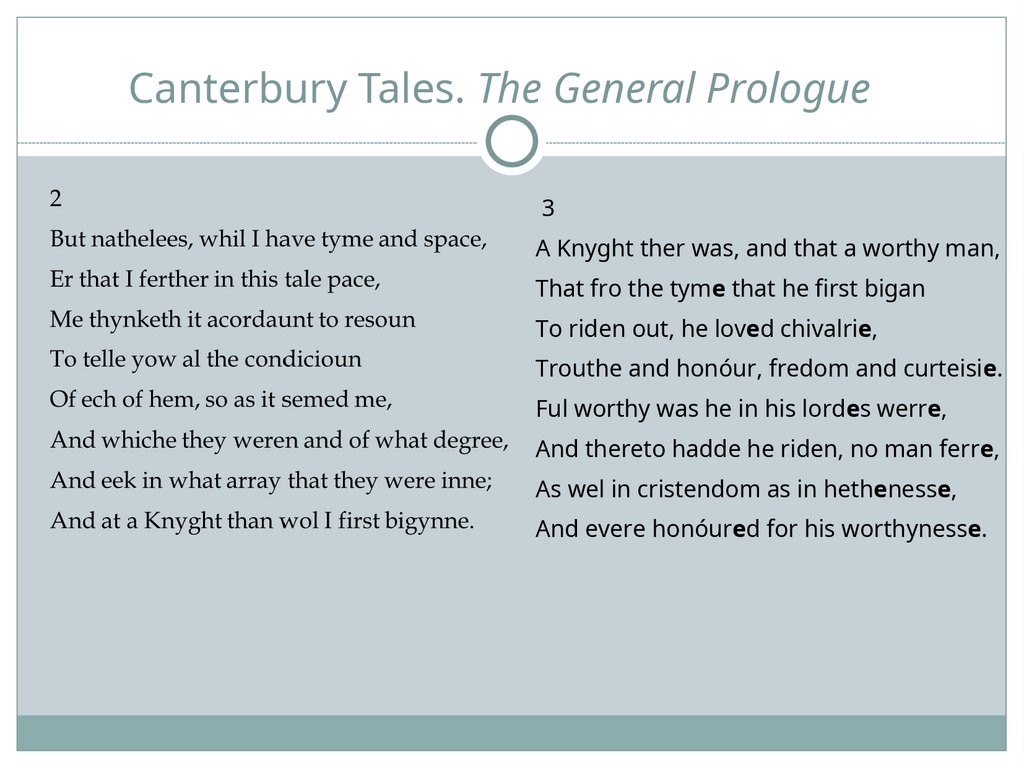
25. Canterbury Tales. The General Prologue
3A Knyght ther was, and that a worthy man,
That fro the tyme that he first bigan
To riden out, he loved chivalrie,
Trouthe and honóur, fredom and curteisie.
Ful worthy was he in his lordes werre,
And thereto hadde he riden, no man ferre,
As wel in cristendom as in hethenesse,
And evere honóured for his worthynesse.