 Литература
Похожие презентации:




The Renaissance in English Literature
1. The Renaissance in English Literature
Lecture #32. Making Connections
the battle of Hastings – the Normans took control of England;the beginning of the Middle Ages - England and France were
almost one country;
the Hundred Year’s War (started in 1337) – England separated
from France;
the English society adopted the feudal system; strict distinction
between social classes;
dynastic conflicts (the second half of the 15th cent.) – instability,
civil war – the Wars of the Roses (the House of York vs. the
House of Lancaster);
the battle of Barnet in 1417 – the House of York won a victory
and secured the throne;
Henry VII Tudor (came to the throne in 1485) – stable country
about to embark on a social and cultural renaissance
3. Historical Background Britain 1485-1625
Kings and Queens of England in the 16th century alldescended from a Welsh squire, Owen Tudor
This dynasty produced 3 great leaders:
Henry VII (1485-1509) restored people’s faith in the
monarchy;
Henry VIII (1509-1547) established the Church of
England;
Elizabeth I (1558-1603) encouraged exploration of
and trade with other continents - would lead to the
creation of the British Empire
4. Historical Background Britain 1485-1625. RELIGION
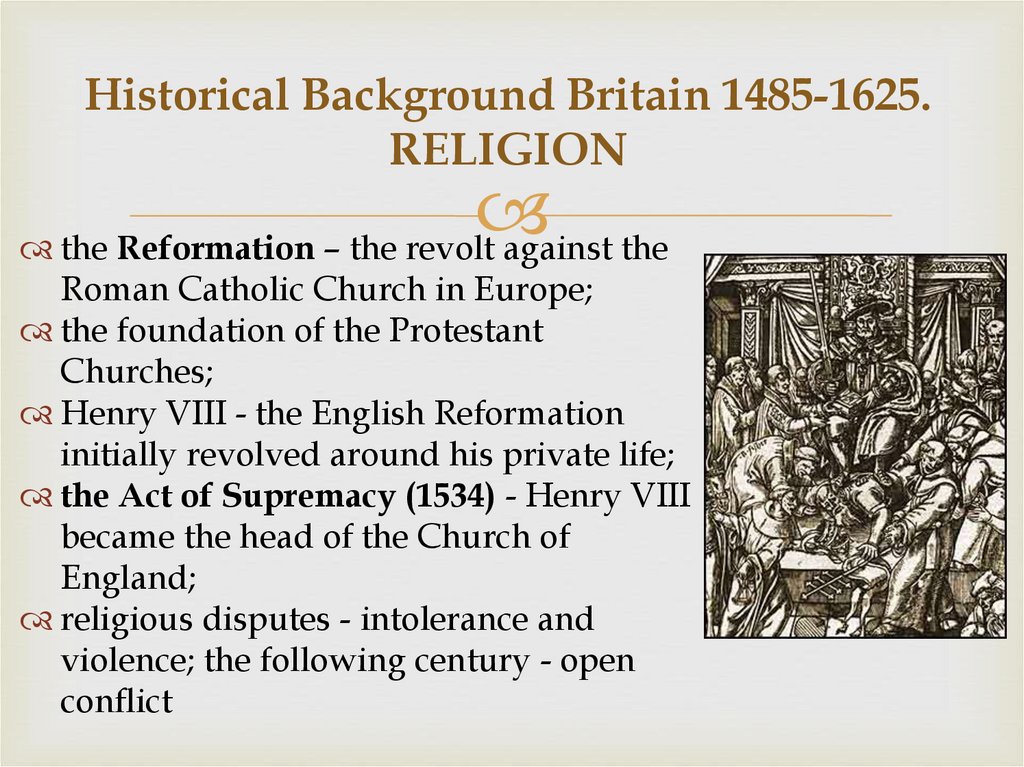
the Reformation – the revolt against theRoman Catholic Church in Europe;
the foundation of the Protestant
Churches;
Henry VIII - the English Reformation
initially revolved around his private life;
the Act of Supremacy (1534) - Henry VIII
became the head of the Church of
England;
religious disputes - intolerance and
violence; the following century - open
conflict
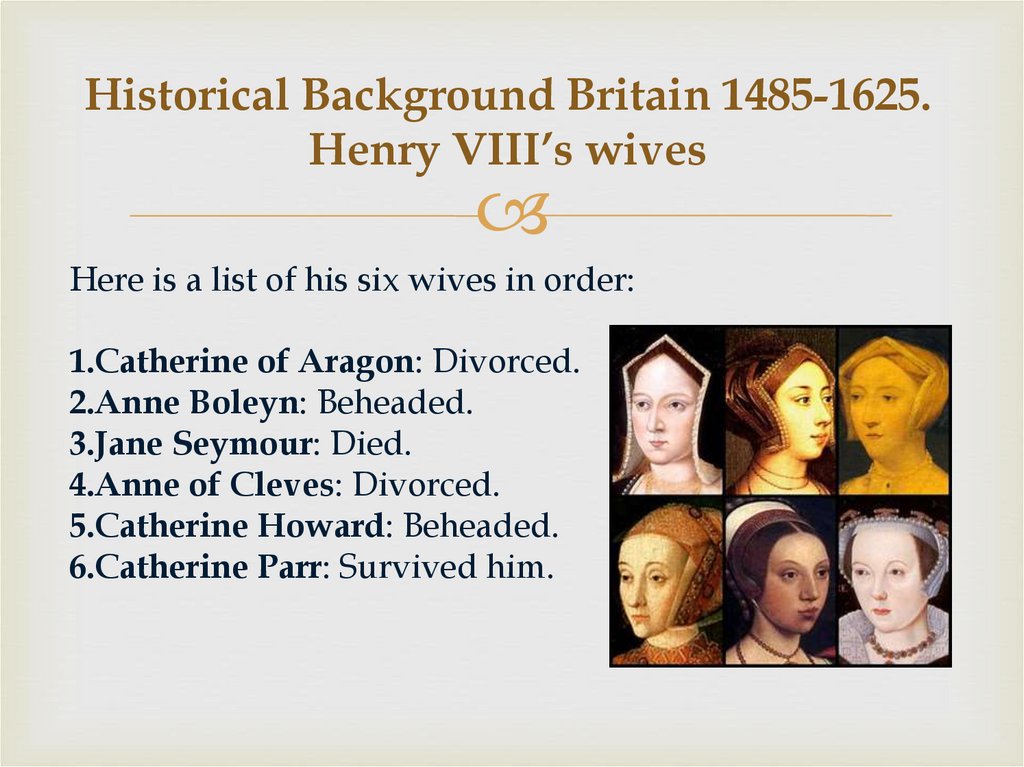
5. Historical Background Britain 1485-1625. Henry VIII’s wives
Here is a list of his six wives in order:1.Catherine of Aragon: Divorced.
2.Anne Boleyn: Beheaded.
3.Jane Seymour: Died.
4.Anne of Cleves: Divorced.
5.Catherine Howard: Beheaded.
6.Catherine Parr: Survived him.
6.
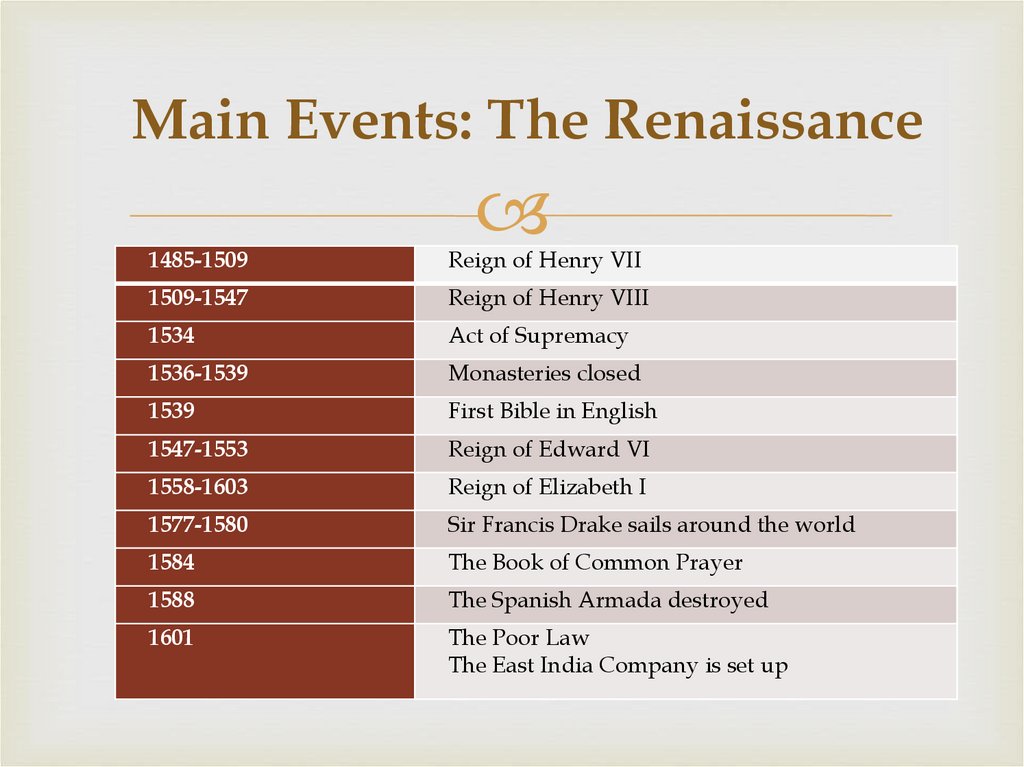
7. Main Events: The Renaissance
1485-1509Reign of Henry VII
1509-1547
Reign of Henry VIII
1534
Act of Supremacy
1536-1539
Monasteries closed
1539
First Bible in English
1547-1553
Reign of Edward VI
1558-1603
Reign of Elizabeth I
1577-1580
Sir Francis Drake sails around the world
1584
The Book of Common Prayer
1588
The Spanish Armada destroyed
1601
The Poor Law
The East India Company is set up
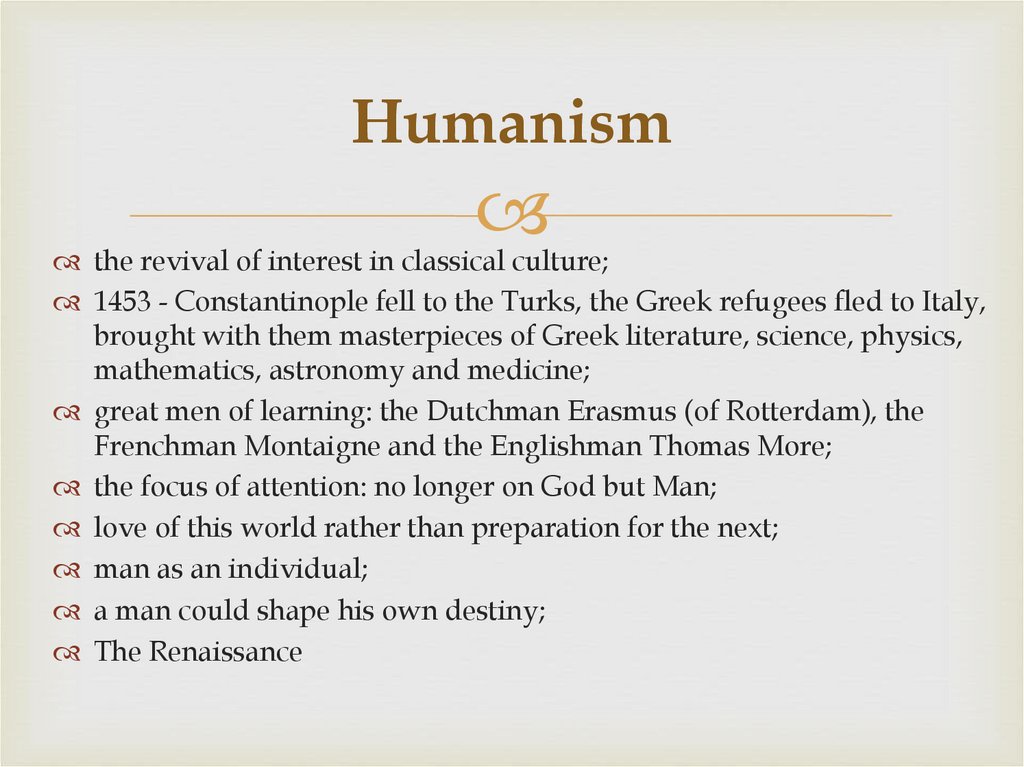
8. Humanism
the revival of interest in classical culture;1453 - Constantinople fell to the Turks, the Greek refugees fled to Italy,
brought with them masterpieces of Greek literature, science, physics,
mathematics, astronomy and medicine;
great men of learning: the Dutchman Erasmus (of Rotterdam), the
Frenchman Montaigne and the Englishman Thomas More;
the focus of attention: no longer on God but Man;
love of this world rather than preparation for the next;
man as an individual;
a man could shape his own destiny;
The Renaissance
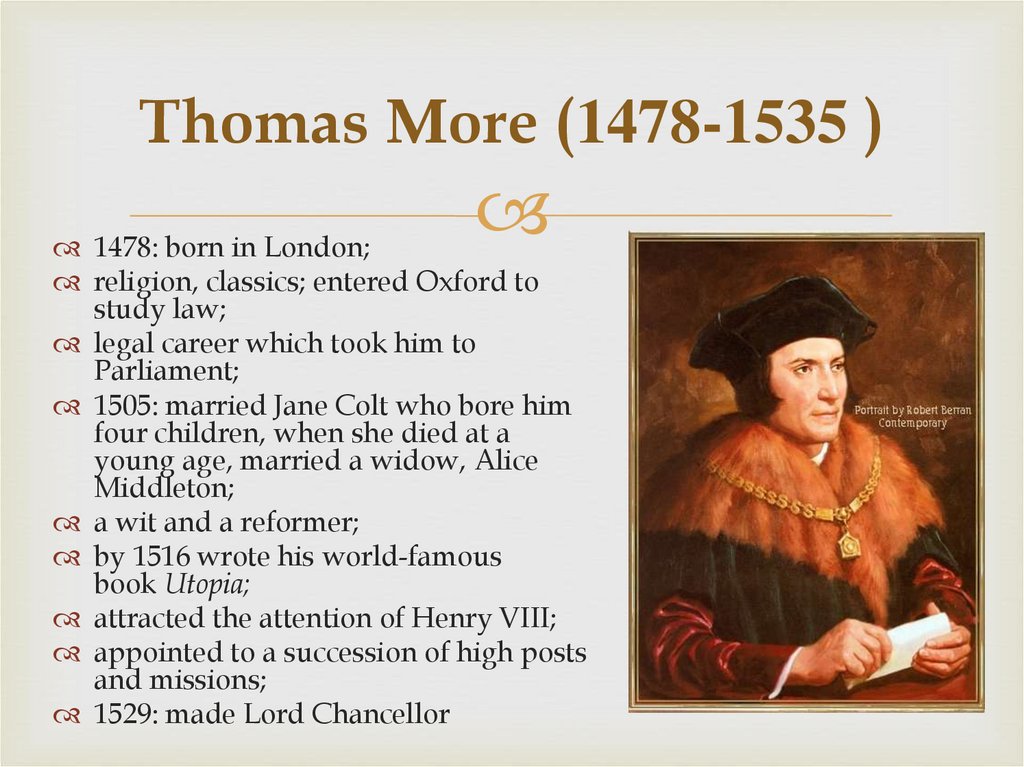
9. Thomas More (1478-1535 )
Thomas More (1478-1535 )1478: born in London;
religion, classics; entered Oxford to
study law;
legal career which took him to
Parliament;
1505: married Jane Colt who bore him
four children, when she died at a
young age, married a widow, Alice
Middleton;
a wit and a reformer;
by 1516 wrote his world-famous
book Utopia;
attracted the attention of Henry VIII;
appointed to a succession of high posts
and missions;
1529: made Lord Chancellor
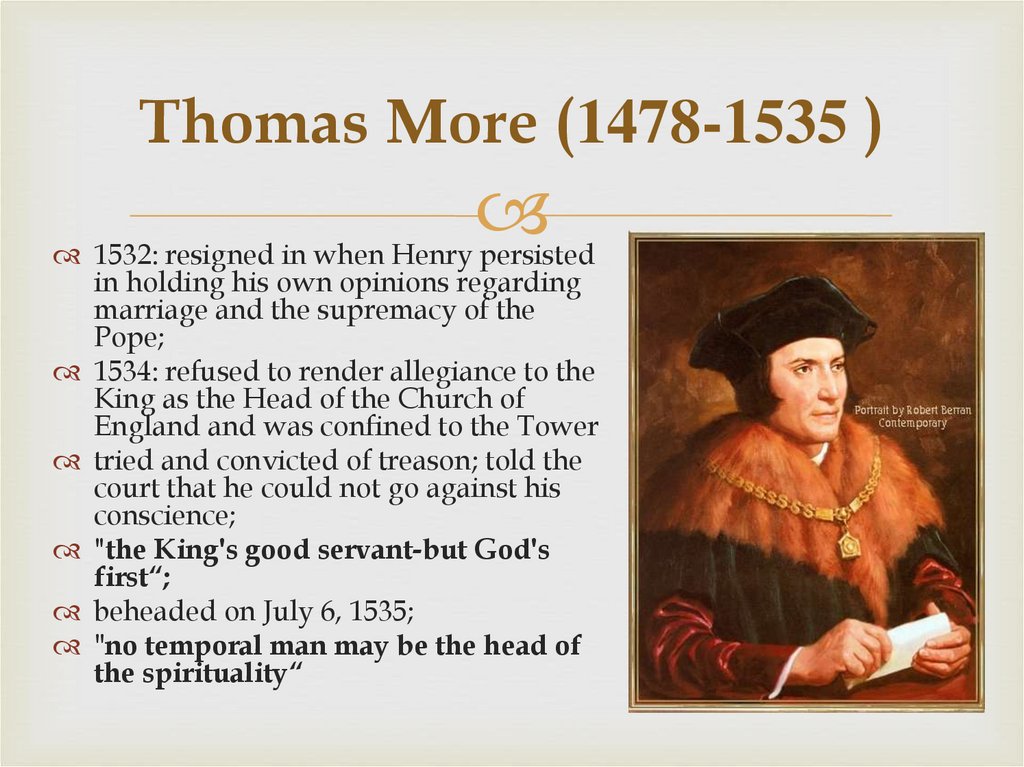
10. Thomas More (1478-1535 )
Thomas More (1478-1535 )1532: resigned in when Henry persisted
in holding his own opinions regarding
marriage and the supremacy of the
Pope;
1534: refused to render allegiance to the
King as the Head of the Church of
England and was confined to the Tower
tried and convicted of treason; told the
court that he could not go against his
conscience;
"the King's good servant-but God's
first“;
beheaded on July 6, 1535;
"no temporal man may be the head of
the spirituality“
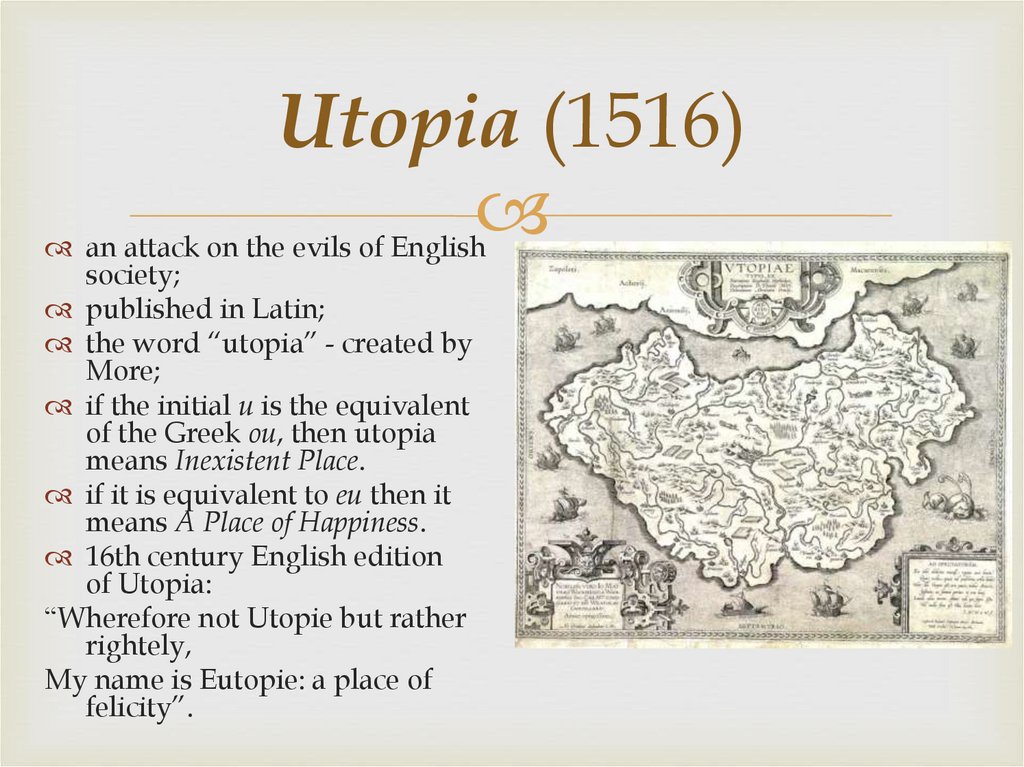
11. Utopia (1516)
an attack on the evils of Englishsociety;
published in Latin;
the word “utopia” - created by
More;
if the initial u is the equivalent
of the Greek ou, then utopia
means Inexistent Place.
if it is equivalent to eu then it
means A Place of Happiness.
16th century English edition
of Utopia:
“Wherefore not Utopie but rather
rightely,
My name is Eutopie: a place of
felicity”.
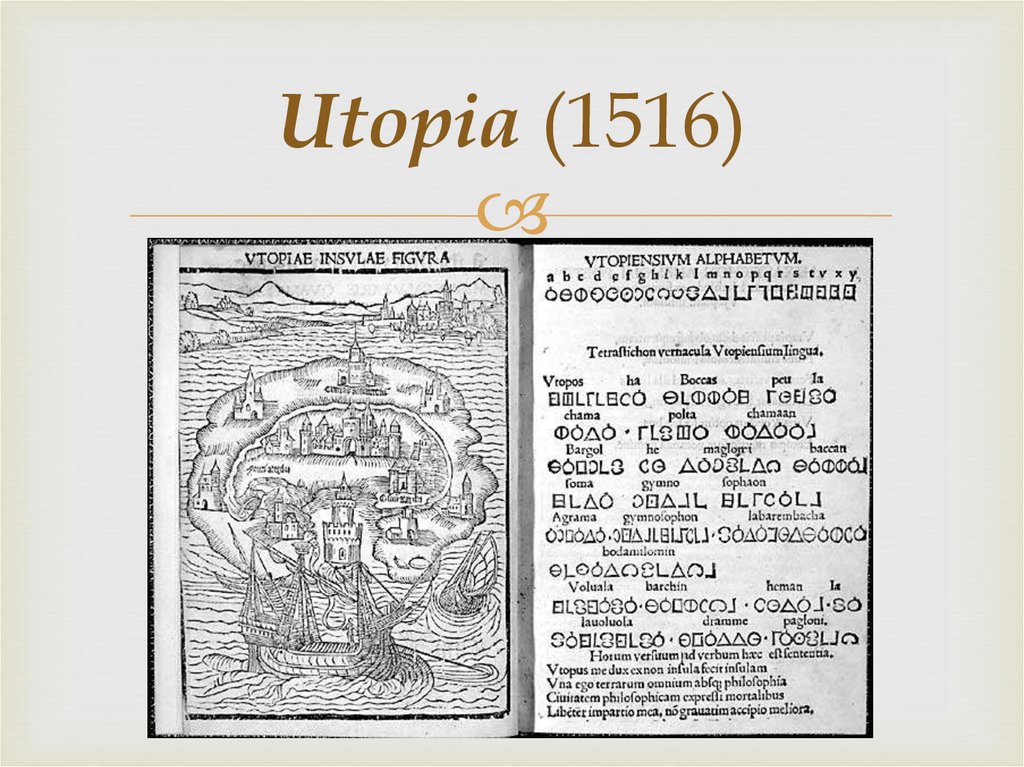
12. Utopia (1516)
13. Utopia (1516)
Divided into 2 books:Book 1 - a dialogue between More and the mariner
Raphael
- denounces England for its corruption, and criticises the
misuse of private property, religious intolerance, the
exploitation of workers, etc.
The rich are “rapacious, immoral and useless,” hardened men
who “daily reduce the salary of the poor, not only with secret
fraud but also with public laws” (More)
Book 2 - Raphael describes the world of Utopia, which
has the best possible form of government, a society based
on shared property, education for both men and women
and religious tolerance.
14. Of Their Trades, and Manner of Life
Agriculture is that which is so universally understood among themthat no person, either man or woman, is ignorant of it; they are
instructed in it from their childhood, partly by what they learn at
school and partly by practice; they being led out often into the fields,
about the town, where they not only see others at work, but are
likewise exercised in it themselves. Besides agriculture, which is so
common to them all, every man has some peculiar trade to which he
applies himself, such as the manufacture of wool, or flax, masonry,
smith's work, or carpenter's work; for there is no sort of trade that is
not in great esteem among them.
Throughout the island they wear the same sort of clothes without
any other distinction, except what is necessary to distinguish the two
sexes, and the married and unmarried. The fashion never alters; and
as it is neither disagreeable nor uneasy, so it is suited to the climate,
and calculated both for their summers and winters. Every family
makes their own clothes; but all among them, women as well as
men, learn one or other of the trades formerly mentioned.
15. Of Their Trades, and Manner of Life
Women, for the most part, deal in wool and flax, which suit bestwith their weakness, leaving the ruder trades to the men. The
same trade generally passes down from father to son, inclinations
often following descent; but if any man's genius lies another way,
he is by adoption translated into a family that deals in the trade to
which he is inclined: and when that is to be done, care is taken not
only by his father, but by the magistrate, that he may be put to a
discreet and good man.
And if after a person has learned one trade, he desires to acquire
another, that is also allowed, and is managed in the same manner
as the former. When he has learned both, he follows that which he
likes best, unless the public has more occasion for the other.
16. Disputes over More’s true intention in Utopia
Is Utopia an ironic description of the folly committedby those who allow reason alone to be their guide?
Is it the accusation that reason in isolation does more
good than a betrayed Christian faith?
Does More truly believe in the validity of
the Utopia described by Rafael?
Does he see in it an authentic social ideal?
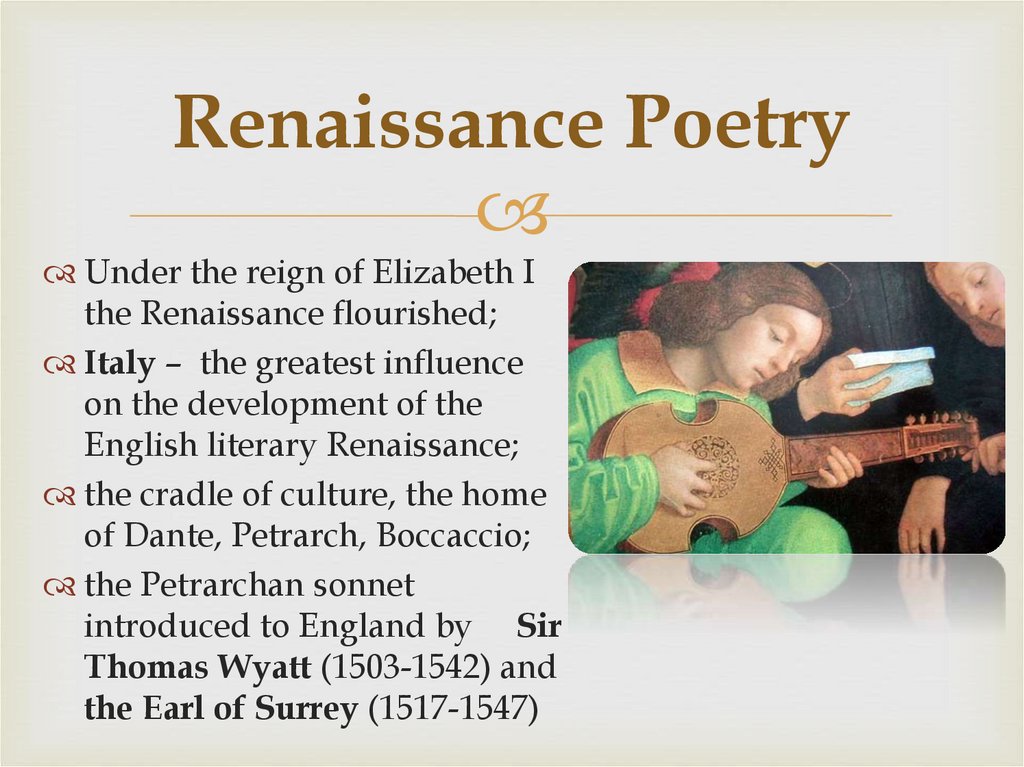
17. Renaissance Poetry
Under the reign of Elizabeth Ithe Renaissance flourished;
Italy – the greatest influence
on the development of the
English literary Renaissance;
the cradle of culture, the home
of Dante, Petrarch, Boccaccio;
the Petrarchan sonnet
introduced to England by Sir
Thomas Wyatt (1503-1542) and
the Earl of Surrey (1517-1547)
18. Renaissance Poetry
Italian (Petrarchan) sonnet:the first 8 lines – the octave (introduced the problem);
the last 6 lines – the sestet (provided an answer or comment and
expressed the personal feelings of the poet);
the rhyming scheme was usually ABBA-ABBA-CDC-DCD
Elizabethan (Shakespearean) sonnet:
Wyatt changed the rhyming scheme of the sestet to CDDC-EE
creating a quatrain (four lines) and a couplet (two lines).
The Earl of Surrey separated the couplet from the quatrain and
used it to comment on the previous twelve lines.
The final pattern for the Elizabethan sonnet: three quatrains (four
lines) and a couplet (two lines) ABAB-CDCD-EFEF-GG
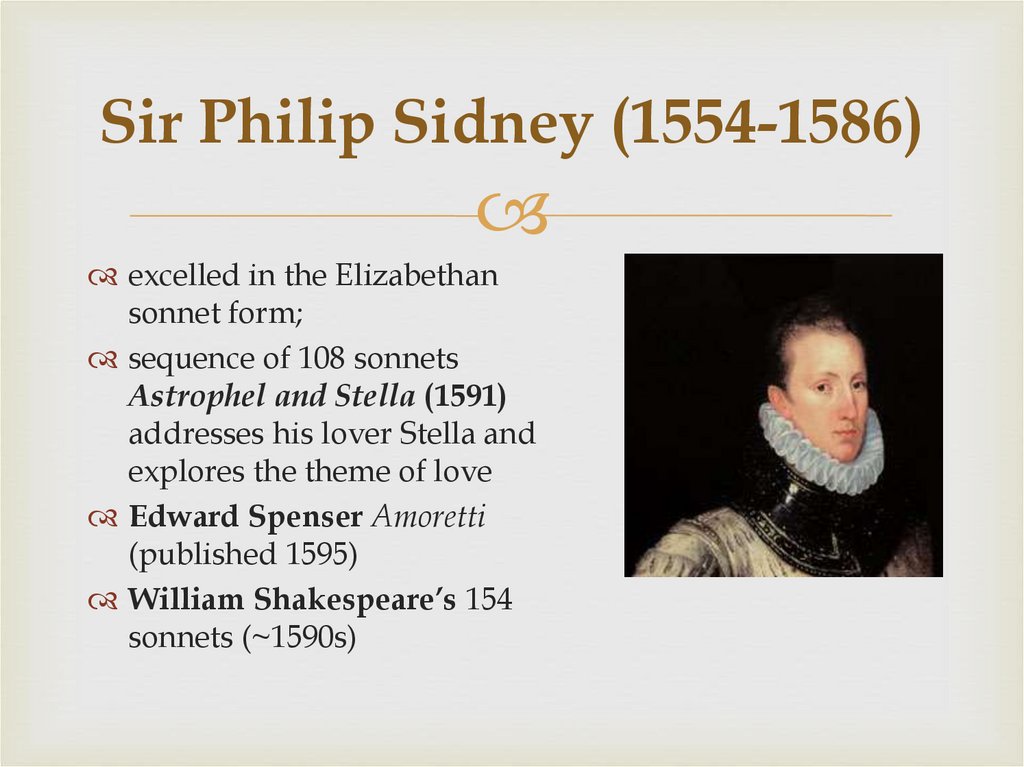
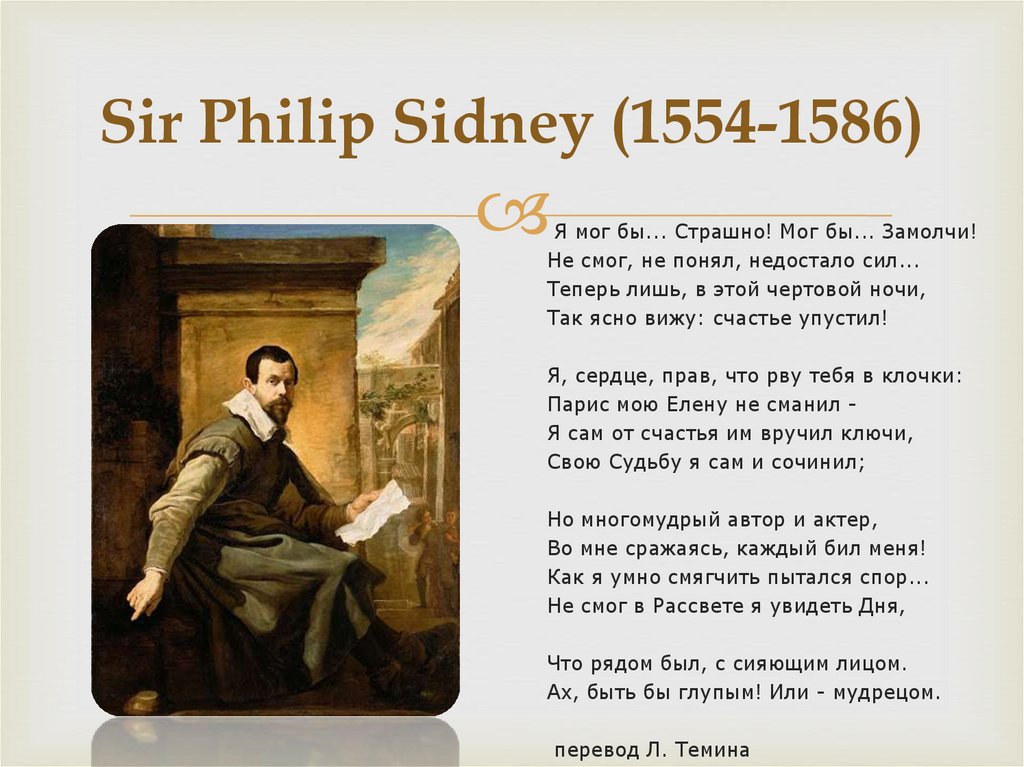
19. Sir Philip Sidney (1554-1586)
excelled in the Elizabethansonnet form;
sequence of 108 sonnets
Astrophel and Stella (1591)
addresses his lover Stella and
explores the theme of love
Edward Spenser Amoretti
(published 1595)
William Shakespeare’s 154
sonnets (~1590s)
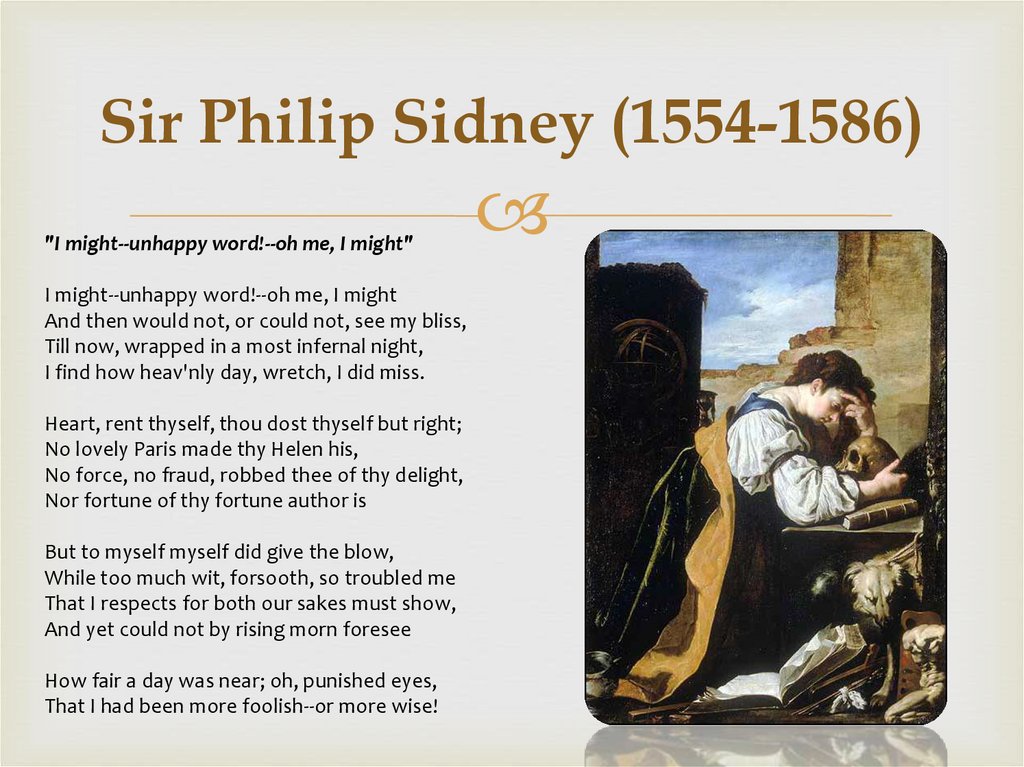
20. Sir Philip Sidney (1554-1586)
"I might--unhappy word!--oh me, I might"I might--unhappy word!--oh me, I might
And then would not, or could not, see my bliss,
Till now, wrapped in a most infernal night,
I find how heav'nly day, wretch, I did miss.
Heart, rent thyself, thou dost thyself but right;
No lovely Paris made thy Helen his,
No force, no fraud, robbed thee of thy delight,
Nor fortune of thy fortune author is
But to myself myself did give the blow,
While too much wit, forsooth, so troubled me
That I respects for both our sakes must show,
And yet could not by rising morn foresee
How fair a day was near; oh, punished eyes,
That I had been more foolish--or more wise!
21. Sir Philip Sidney (1554-1586)
Я мог бы... Страшно! Мог бы... Замолчи!Не смог, не понял, недостало сил...
Теперь лишь, в этой чертовой ночи,
Так ясно вижу: счастье упустил!
Я, сердце, прав, что рву тебя в клочки:
Парис мою Елену не сманил Я сам от счастья им вручил ключи,
Свою Судьбу я сам и сочинил;
Но многомудрый автор и актер,
Во мне сражаясь, каждый бил меня!
Как я умно смягчить пытался спор...
Не смог в Рассвете я увидеть Дня,
Что рядом был, с сияющим лицом.
Ах, быть бы глупым! Или - мудрецом.
перевод Л. Темина
22. The Renaissance Drama
the greatest Renaissance literary works are plays;the medieval tradition of Mystery and Miracle plays
continued under the reign of Henry VII;
Henry VIII put an end to medieval religious drama;
humanism revived interest in classical drama, many
Greek plays were translated into English;
Seneca’s tragedies - particularly popular - horror and
bloodshed;
Thomas Kyd (1558-1594) – The Spanish Tragedy
(1587)
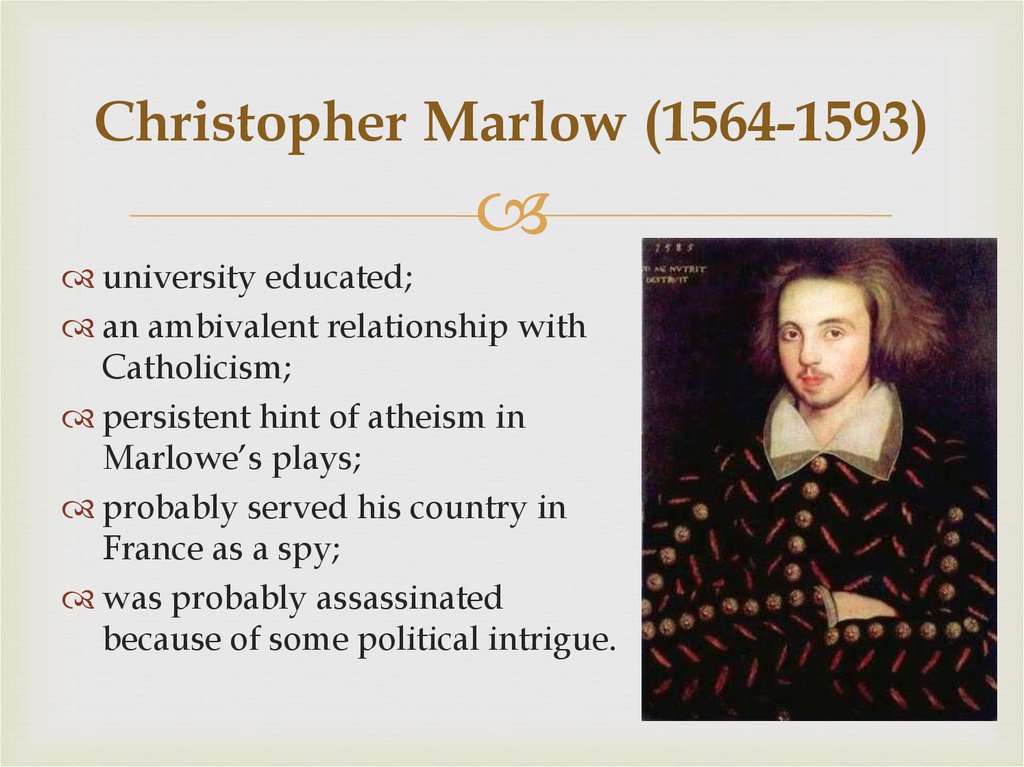
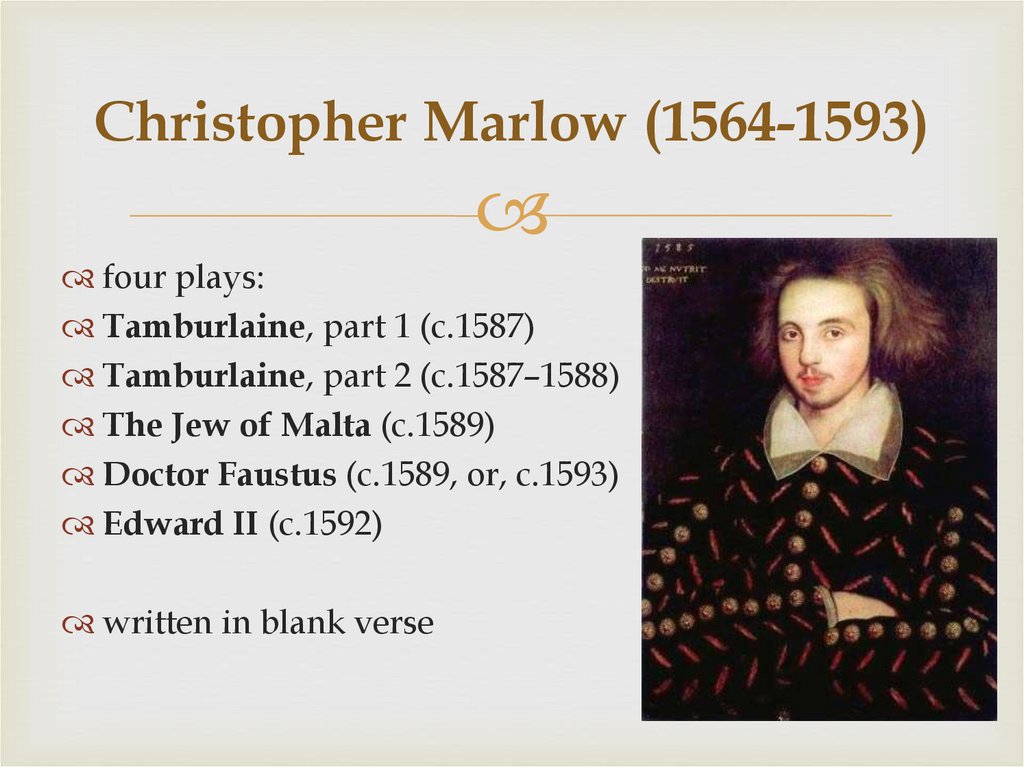
23. Christopher Marlow (1564-1593)
university educated;an ambivalent relationship with
Catholicism;
persistent hint of atheism in
Marlowe’s plays;
probably served his country in
France as a spy;
was probably assassinated
because of some political intrigue.
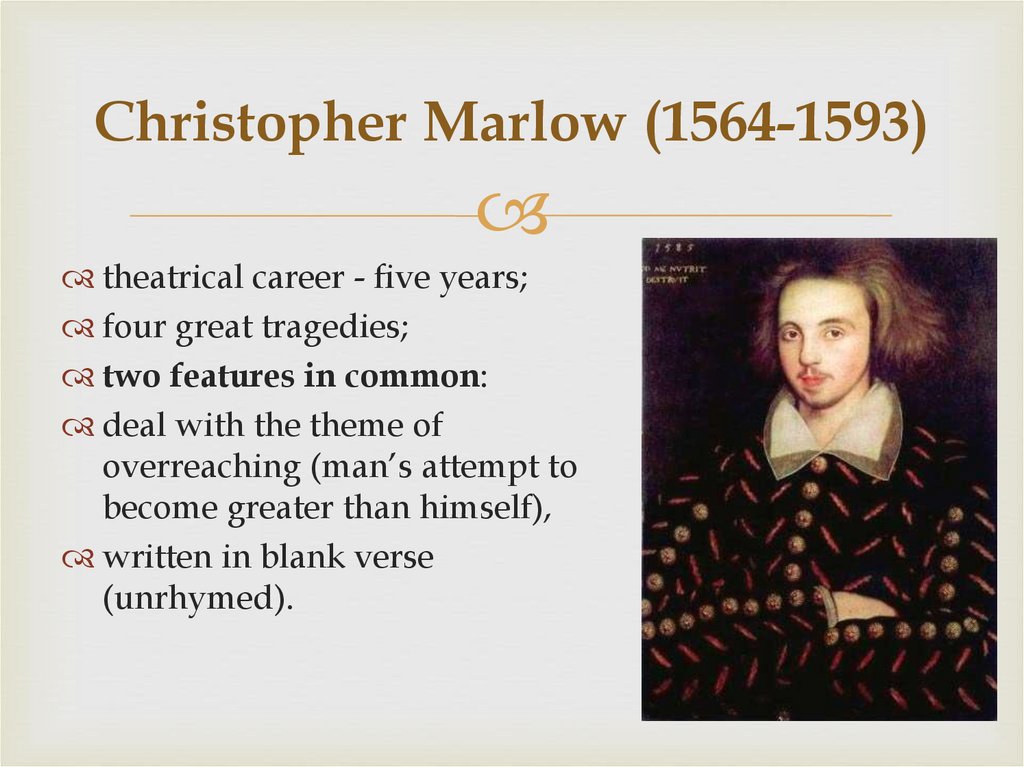
24. Christopher Marlow (1564-1593)
theatrical career - five years;four great tragedies;
two features in common:
deal with the theme of
overreaching (man’s attempt to
become greater than himself),
written in blank verse
(unrhymed).
25. Christopher Marlow (1564-1593)
four plays:Tamburlaine, part 1 (c.1587)
Tamburlaine, part 2 (c.1587–1588)
The Jew of Malta (c.1589)
Doctor Faustus (c.1589, or, c.1593)
Edward II (c.1592)
written in blank verse
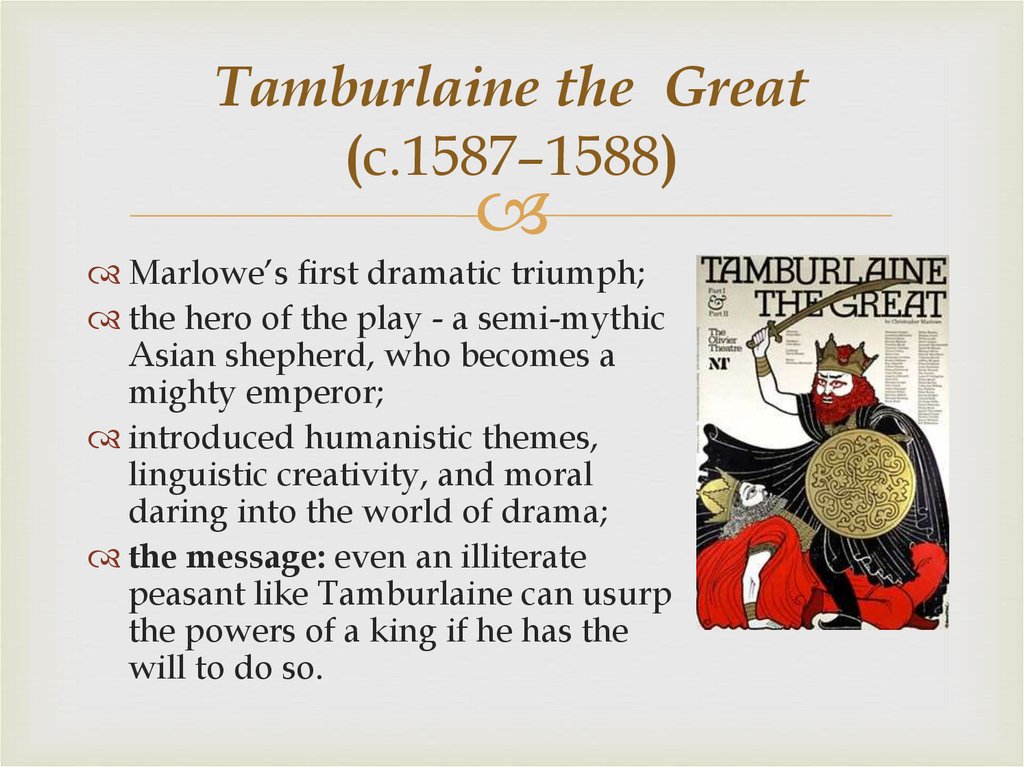
26. Tamburlaine the Great (c.1587–1588)
Marlowe’s first dramatic triumph;the hero of the play - a semi-mythic
Asian shepherd, who becomes a
mighty emperor;
introduced humanistic themes,
linguistic creativity, and moral
daring into the world of drama;
the message: even an illiterate
peasant like Tamburlaine can usurp
the powers of a king if he has the
will to do so.
27. Doctor Faustus (c.1589, or, c.1593)
Marlowe’s most famous work;the main theme: What would you sell your soul for?
Knowledge is power and Faustus wants it.
signs a contract in blood with Mephistopheles, by
which he will get 24 years of service from the devil;
Faustus wastes his omnipotent years on selfindulgence;
the larger theme: overreachers must die;
Marlowe could not end the play atheistically
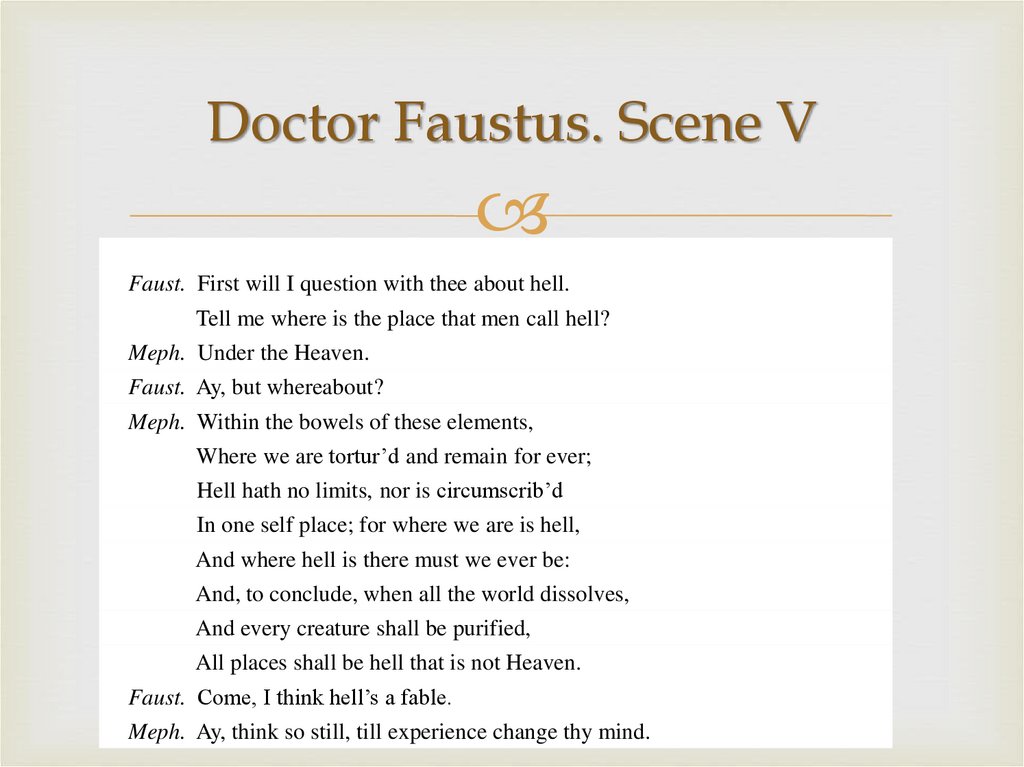
28. Doctor Faustus. Scene V
Faust. First will I question with thee about hell.Tell me where is the place that men call hell?
Meph. Under the Heaven.
Faust. Ay, but whereabout?
Meph. Within the bowels of these elements,
Where we are tortur’d and remain for ever;
Hell hath no limits, nor is circumscrib’d
In one self place; for where we are is hell,
And where hell is there must we ever be:
And, to conclude, when all the world dissolves,
And every creature shall be purified,
All places shall be hell that is not Heaven.
Faust. Come, I think hell’s a fable.
Meph. Ay, think so still, till experience change thy mind.