
 Политика
Похожие презентации:





Nation. State. Government
1. NATION. STATE. GOVERNMENT
What are the meanings and differencesof the mentioned terms?
2. NATION. STATE. GOVERNMENT
In the history of mankind there were several social divisionsof activity by gender (male and female activities) and
by type of economy (agriculture and cattle breeding)
in relation to property (public and private)
The latter led to the emergence of property and social
inequality - there was a need for political power as a
special governing body capable of ensuring the existence
of a now "split" society.
At different times in different territories, different state
formations have been forming.
3. NATION. STATE. GOVERNMENT
State and country - what's the difference?Different countries could be part of different states, such as
the modern Czech Republic and Slovenia were part of
Austria-Hungary
Russia is a country that had several state structures on its
territory, such as the Russian Empire, the RSFSR as one
of the 15 republics of the USSR and the Russian
Federation now.
Before the division in 1945, there was the country of Korea,
now these are two countries with different government
systems.
4. NATION. STATE. GOVERNMENT
What's the difference between “country” and“state”?
The concept of "state" refers to the political
system of power established in a certain
territory, while the concept of "country" refers
rather
to
cultural,
historical,
general
geographical (community of territory) and other
factors.
5. NATION. STATE. GOVERNMENT
6. NATION. STATE. GOVERNMENT
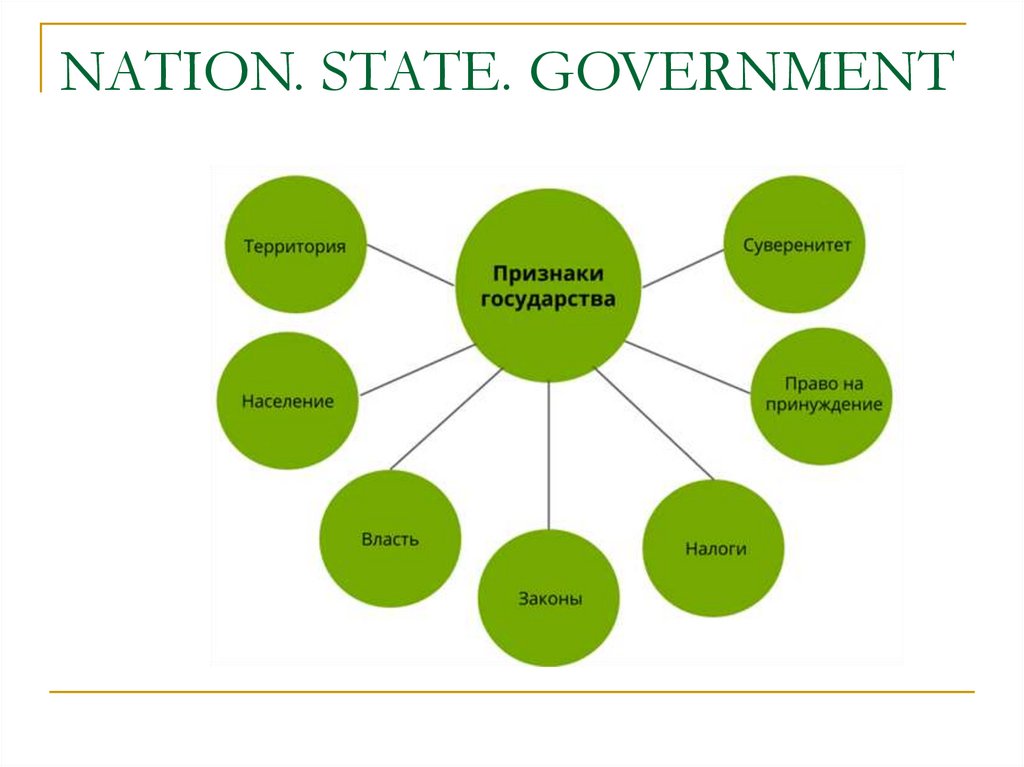
The main general factors in the state formation arePopulation
Territory
Centralized Political Power
Sovereignty (legal system)
Army (regular)
Taxation(regular)
Culture (traditions)
Language
7. NATION. STATE. GOVERNMENT
A state is a centralized political organization thatimposes and enforces rules over a population within a
territory. There is no undisputed definition of a
state.
One widely used definition comes from the German
sociologist Max Weber: a "state" is a polity that
maintains a monopoly on the legitimate use of
violence, although other definitions are not
uncommon.
Absence of a state does not preclude the existence of
a society, such as stateless societies like the Gypsy for
example
8. NATION. STATE. GOVERNMENT
As an alternative to defining the state in terms ofits legal standing, the state can also be defined
by the key organizational structures that operate
as "the government" and the key functions that
the state performs.
In this structural-functional perspective, the state
might be defined as the organized institutional
machinery for making and carrying out
political decisions and for enforcing the laws
and rules of the government.
9. NATION. STATE.GOVERNMENT
Governments are the organisations of individuals whoare legally empowered to make binding decisions on
behalf of a particular community.
A government's basic functions are:
providing leadership,
maintaining order,
providing public services,
providing national security,
providing economic security,
providing economic assistance..
10. Famous people about ‘Government’
Every nation has the government that itdeserves.
- Joseph De Maistre, letter to X, August 1811
The less government we have, the better.
- Ralph Waldo Emerson, Politics
The whole art of government consists in
being honest.
- Thomas Jefferson, letter to Colonel Edward Carrington,
1788
11. NATION. STATE. GOVERNMENT
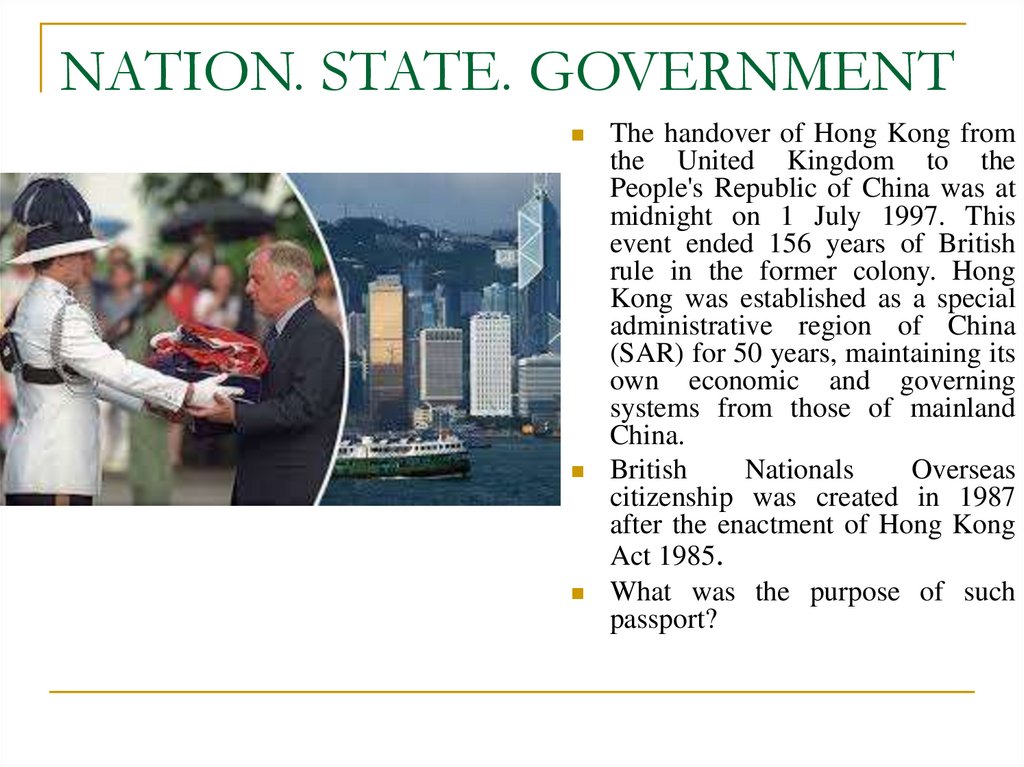
The handover of Hong Kong fromthe United Kingdom to the
People's Republic of China was at
midnight on 1 July 1997. This
event ended 156 years of British
rule in the former colony. Hong
Kong was established as a special
administrative region of China
(SAR) for 50 years, maintaining its
own economic and governing
systems from those of mainland
China.
British
Nationals
Overseas
citizenship was created in 1987
after the enactment of Hong Kong
Act 1985.
What was the purpose of such
passport?
12. NATION. STATE. GOVERNMENT
A sovereign state of which most of the citizensor subjects are united also by factors which
define a nation, such as language or
common descent.
What is a nation-state simple definition?
nation-state is a territorially bounded sovereign
polity—i.e., a state—that is ruled in the name
of a community of citizens who identify
themselves as a nation
13. NATION. STATE. GOVERNMENT
Different factors might constitute the basis of politicalnation:
shared descent (belief in a common kinship or
history),
shared culture,
shared geographic space,
shared religion,
shared language, or
shared economic order.
14. NATION. STATE. GOVERNMENT
Nationality is the belonging of a person to a certainnation or to a certain national state – in broad meaning is
a citizenship.
Nationality is a legal identification of a person in
international law, establishing the person as a subject, a
national, of a sovereign state.
It affords the state jurisdiction over the person and
affords the person the protection of the state against
other states
15. NATION. STATE. GOVERNMENT
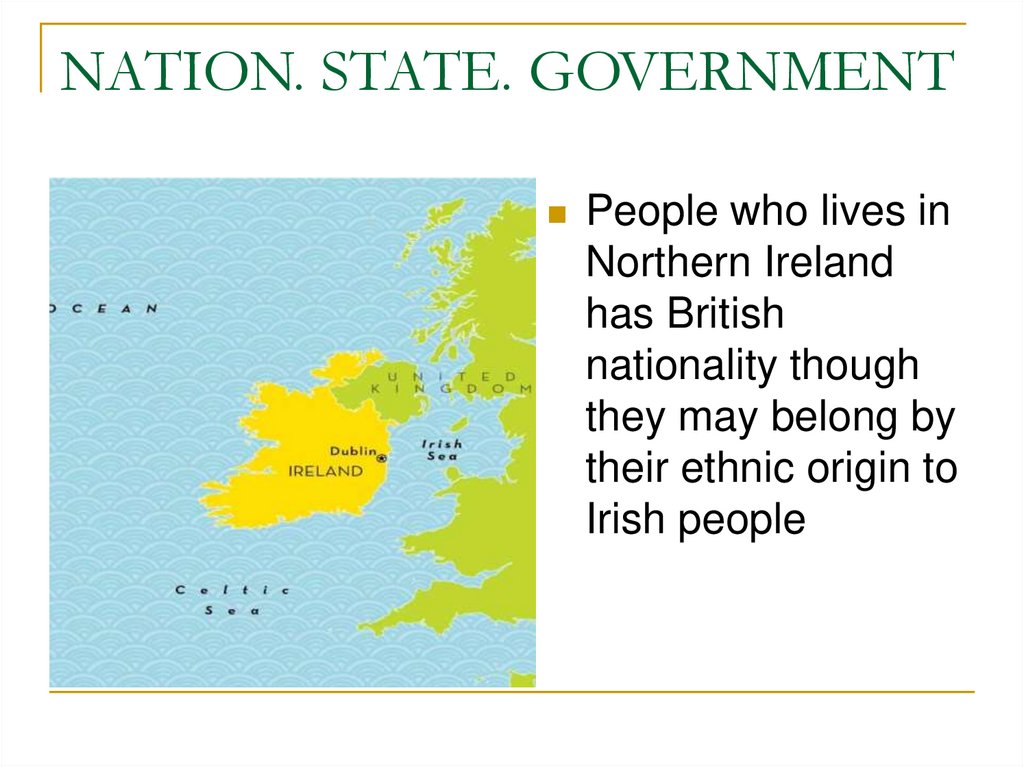
People who lives inNorthern Ireland
has British
nationality though
they may belong by
their ethnic origin to
Irish people
16. NATION. STATE. GOVERNMENT
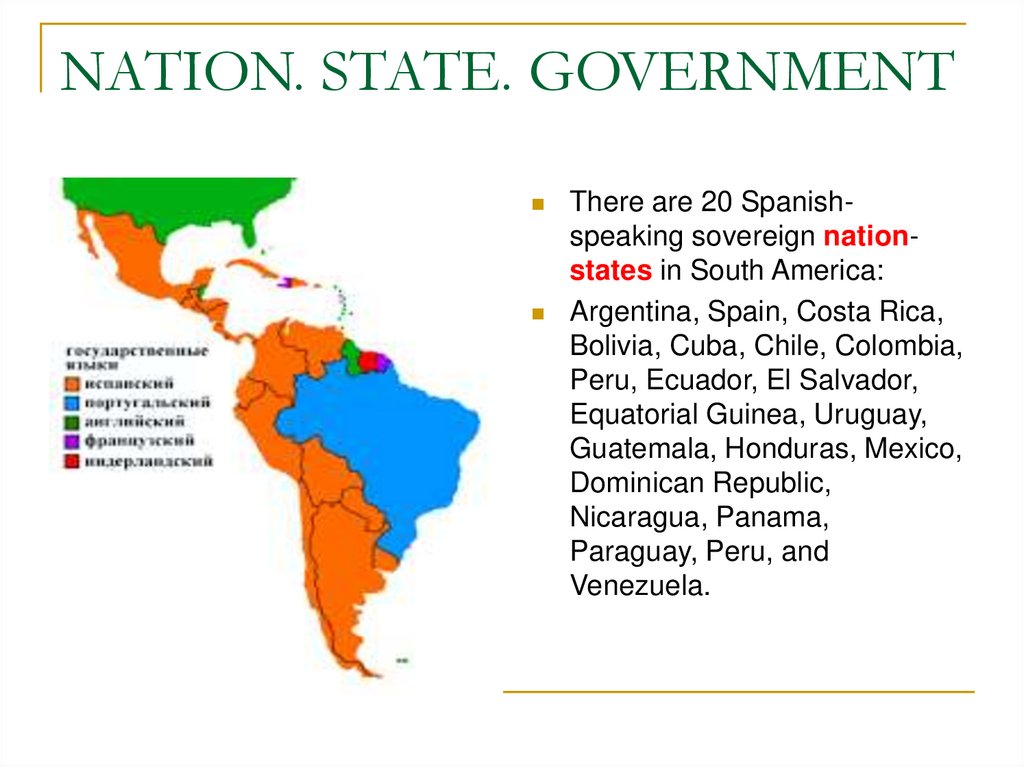
There are 20 Spanishspeaking sovereign nationstates in South America:Argentina, Spain, Costa Rica,
Bolivia, Cuba, Chile, Colombia,
Peru, Ecuador, El Salvador,
Equatorial Guinea, Uruguay,
Guatemala, Honduras, Mexico,
Dominican Republic,
Nicaragua, Panama,
Paraguay, Peru, and
Venezuela.
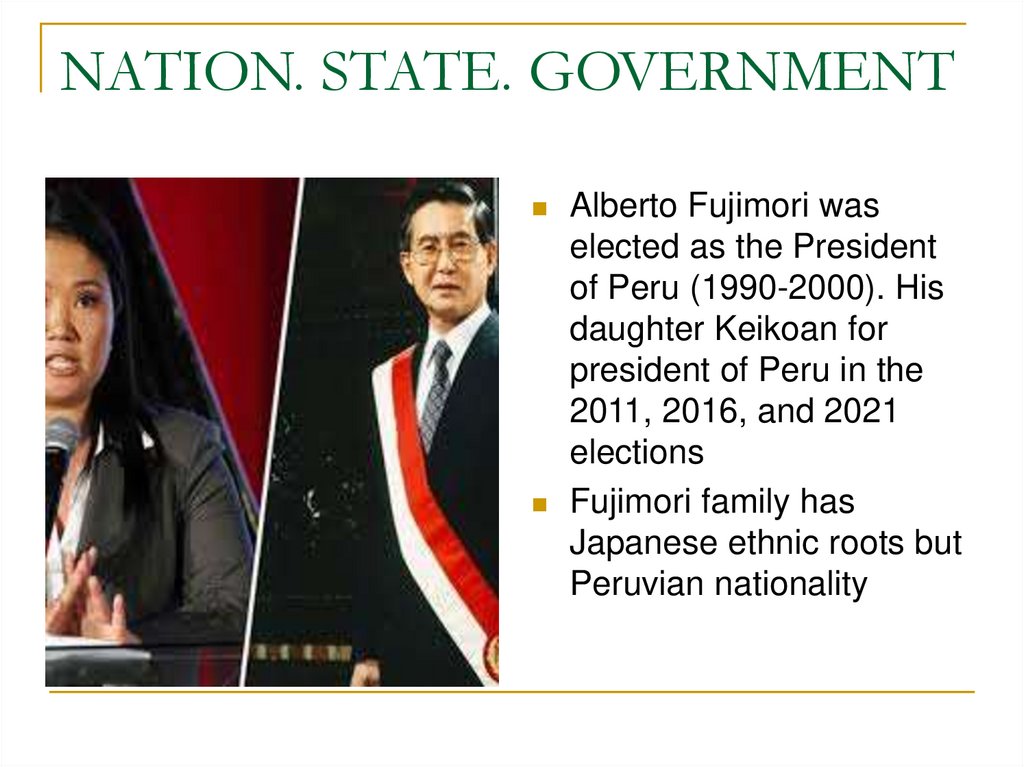
17. NATION. STATE. GOVERNMENT
Alberto Fujimori waselected as the President
of Peru (1990-2000). His
daughter Keikoan for
president of Peru in the
2011, 2016, and 2021
elections
Fujimori family has
Japanese ethnic roots but
Peruvian nationality
18. Modern Typologies of Governments
Relationship between state and societyRelationship between the executive and legislative powers of
government
Liberal-democratic
Totalitarian
Authoritarian
Parliamentary
Presidential
Degree of centralisation or decentralisation
Unitary state
Devolution
Federalism
Confederation
19. CONCEPT OF NATION/STATE
Nation is not just the population of a state.Since industrialization and development of market
economy a nation has been defined as a culturalpolitical community that has become conscious of
its autonomy, unity and particular interests.
The four characteristics of a nation-state
are: sovereignty, land, population, and
government.
20. CONCEPT OF NATION/STATE
Many geographic entities have some but not allthe qualities that make up a sovereign state. As of
2020 there are 195 sovereign states in the world
(197 by some counts);
193 are members of the United Nations (the
United Nations excludes Palestine and the Holy
See).
There are the entities, like Taiwan or Kosovo, are
recognized by some but not all members of the
United Nations or recognized by few ones.
21. CONCEPT OF NATION/STATE
In the 17th century, the concept of "nation"appeared in England as the residents of one state are
subjects of one king.
And since the 19th century, after the French
Revolution, a fundamentally different idea of the
nation arose - the nation as popular sovereignty
(нация как народный суверенитет), as a
consequence of it.
That is political or civil nation, not ethnic.
22. CONCEPT OF NATION/STATE
The agitation of the Quebequois in Canada, theBasques in Spain, and the Irish Catholics in Northern
Ireland are testimony to the possibility that even
centuries-old states might split apart.
Some scholars predict that the current reorganization
of states based on nationality identities will produce
in the interim, and nation-based conflicts might
remain the major cause of violence and instability in
the modern period.
The issues of identity, especially national, ethnic or
religious are the most sensitive.
23. NATION. STATE. GOVERNMENT
Questions:Explain your understanding the differences between such
terms as “country”, “state”, “government”, “nation”,
“nationality”
Give your samples
Sources:
https://cyberleninka.ru/article/n/k-voprosu-o-vozniknoveniiprotogosudarstvennogo-organa-vlasti-instituta-voennogovozhdya
https://en.wikipedia.org/wiki/State_(polity)
https://en.wikipedia.org/wiki/Nationality