 Астрономия
Похожие презентации:





GNSS: Latest Trends in Satellite Navigation Technologies
1. GNSS: Latest Trends in Satellite Navigation Technologies
GNSS:L AT E S T
TRENDS IN
S AT E L L I T E
N AV I G AT I O N
TECHNOLOGI
ES
Kalinin P.V.
Novosibirsk State Technical University
Applied Informatics, 2nd year, part-time
January 13, 2026
2. What is GNSS?
WHAT IS GNSS?GNSS = Global Navigation Satellite System
• Satellite systems that provide positioning anywhere on Earth
• Gives exact location coordinates and precise time
• Works 24/7 in any weather conditions
3. Main GNSS Systems
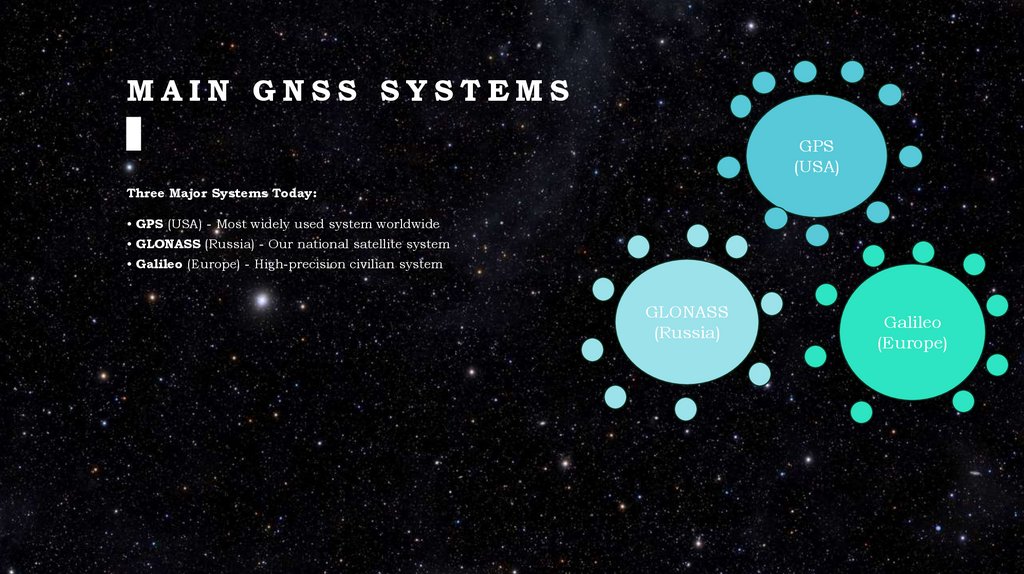
MAIN GNSS SYSTEMSGPS
(USA)
Three Major Systems Today:
• GPS (USA) - Most widely used system worldwide
• GLONASS (Russia) - Our national satellite system
• Galileo (Europe) - High-precision civilian system
GLONASS
(Russia)
Galileo
(Europe)
4. How GNSS Works
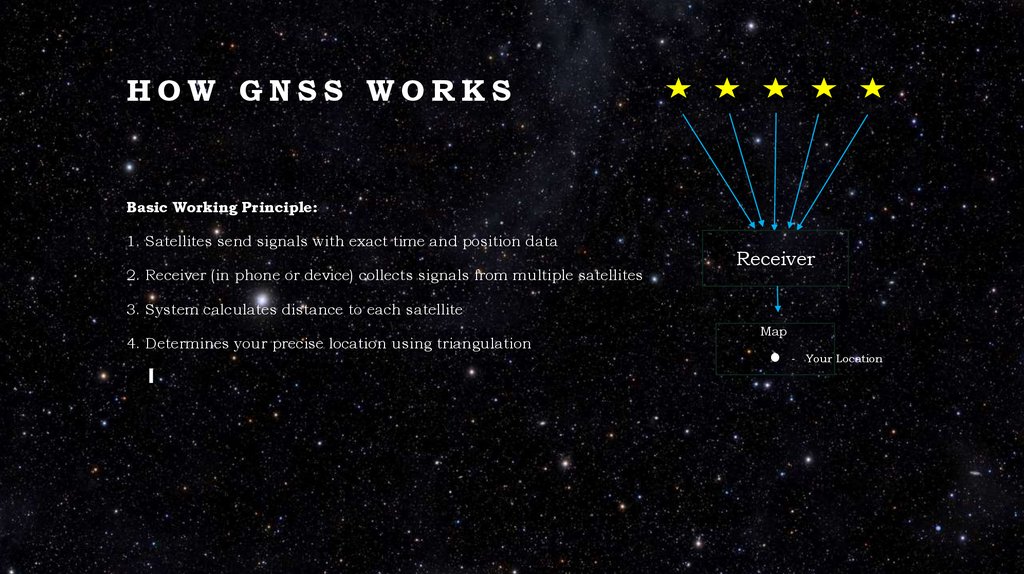
HOW GNSS WORKSBasic Working Principle:
1. Satellites send signals with exact time and position data
2. Receiver (in phone or device) collects signals from multiple satellites
Receiver
3. System calculates distance to each satellite
4. Determines your precise location using triangulation
Map
- Your Location
5. Modern Achievements
MODERN ACHIEVEMENTSLatest Technology Advances:
• Multi-system receivers - Use GPS + GLONASS + Galileo
together
• 30 cm accuracy (was 10 meters 10 years ago)
• Indoor positioning - New signals work inside buildings
• 5G integration - Satellite navigation + mobile internet
6. Applications
APPLICATIONSWhere GNSS is Used:
• Transportation - Navigation for cars, ships, airplanes
• Agriculture - Precision farming equipment
• Emergency services - Search and rescue operations
• Construction - Surveying and site planning
• Everyday life - Navigation apps in smartphones
7. Advantages vs Old Technologies
ADVANTAGES VSOLD TECHNOLOGIES
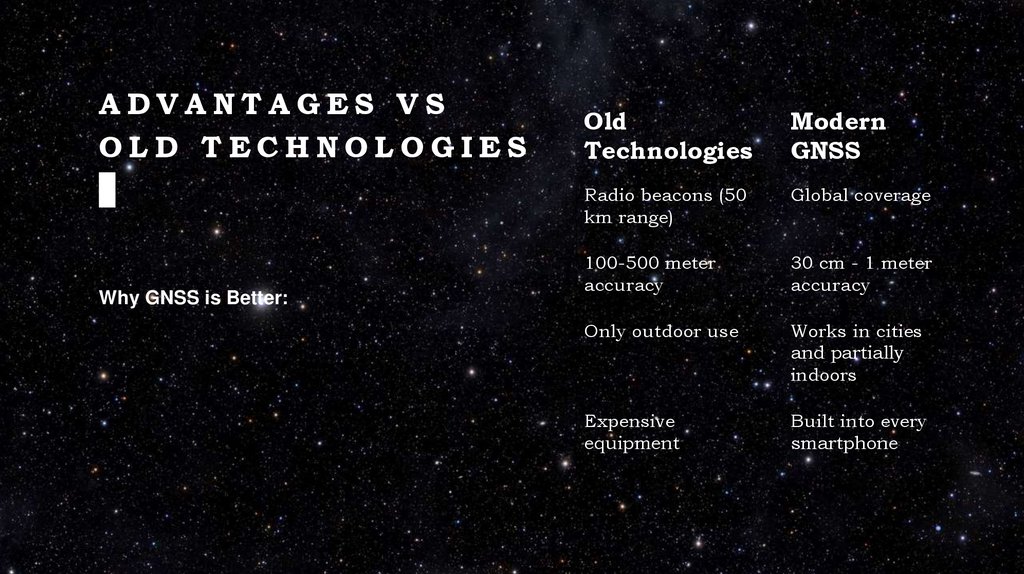
Why GNSS is Better:
Old
Technologies
Modern
GNSS
Radio beacons (50
km range)
Global coverage
100-500 meter
accuracy
30 cm - 1 meter
accuracy
Only outdoor use
Works in cities
and partially
indoors
Expensive
equipment
Built into every
smartphone
8. Problems and Limitations
PROBLEMS AND LIMITATIONSCurrent Challenges:
• Signal blockage - Doesn't work well through thick walls or
underground
• Satellite dependency - Accuracy drops if satellites fail
• High cost - Professional equipment starts from 50,000 rubles
• Power consumption - Drains battery faster than regular apps
9. Future of GNSS
FUTURE OF GNSSWhat's Coming Next:
• Quantum clocks on satellites - millimeter-level accuracy
• Artificial intelligence to predict signal interference
• AR integration - Augmented reality navigation
• Space navigation - Systems for Mars missions
• Lower prices - Professional equipment will become 3x cheaper
10. Conclusion
CONCLUSIONKey Takeaways:
• GNSS is the foundation of
modern navigation and timing
• Russian GLONASS system plays
an important global role
• Technology is developing very
rapidly
• Future brings precise and
affordable navigation for everyone
11. Thank You!
THANK YOU!Questions?
Kalinin Pavel Viktorovich
De-420
pvllkalinin002.@gmail.ru