 История
Похожие презентации:









Russia: the early 20th century
1. Russia: the early 20th century
The period full of extraordinary events & severestresses
2 wars: the Russo-Japanese war, the First world
war
3 revolutions: 1905, 1917
2. Economic & social developments in the countryside
Economic & socialdevelopments
in the countryside
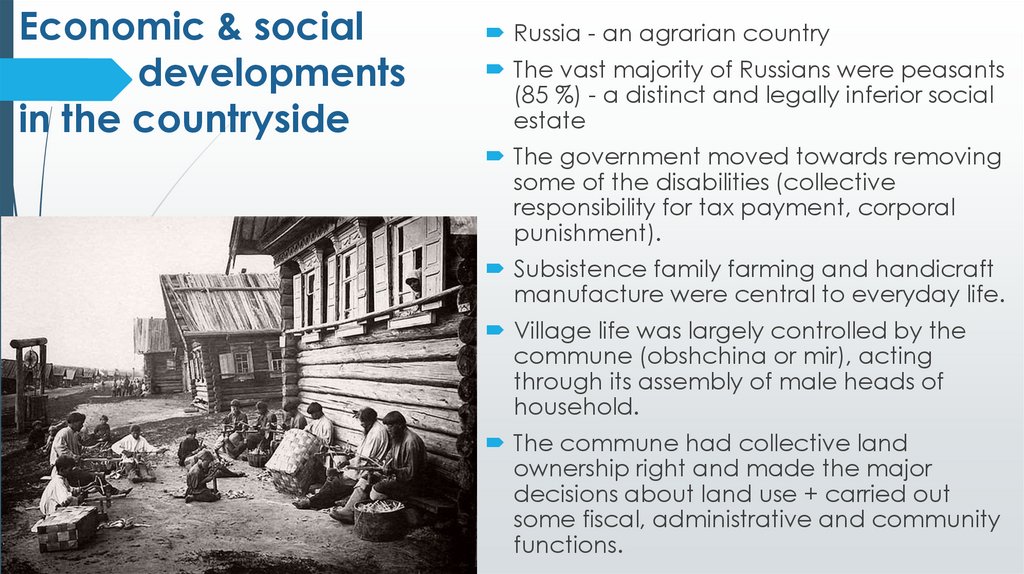
Russia - an agrarian country
The vast majority of Russians were peasants
(85 %) - a distinct and legally inferior social
estate
The government moved towards removing
some of the disabilities (collective
responsibility for tax payment, corporal
punishment).
Subsistence family farming and handicraft
manufacture were central to everyday life.
Village life was largely controlled by the
commune (obshchina or mir), acting
through its assembly of male heads of
household.
The commune had collective land
ownership right and made the major
decisions about land use + carried out
some fiscal, administrative and community
functions.
3. Economic & social developments in the countryside
Economic & socialdevelopments
in the countryside
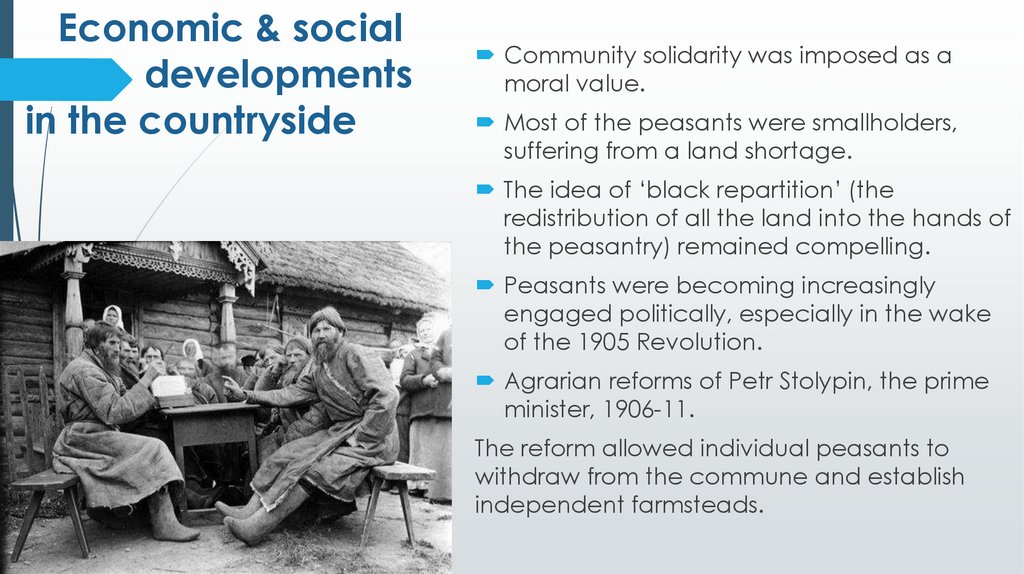
Community solidarity was imposed as a
moral value.
Most of the peasants were smallholders,
suffering from a land shortage.
The idea of ‘black repartition’ (the
redistribution of all the land into the hands of
the peasantry) remained compelling.
Peasants were becoming increasingly
engaged politically, especially in the wake
of the 1905 Revolution.
Agrarian reforms of Petr Stolypin, the prime
minister, 1906-11.
The reform allowed individual peasants to
withdraw from the commune and establish
independent farmsteads.
4. Economic & social developments in the countryside
Economic & social developments in the countrysideThe changes in the experiences & lifestyle of peasants
Peasants were exposed to knowledge of the larger world,
beyond their village
- Migration to industrial and urban work
- More outsiders appeared in the villages (educated reformers,
teachers, clergy)
- The rapid expansion of schooling and literacy, the massive
rise in newspapers and literature
Peasants were no longer confined by traditional spaces and
knowledges
The new knowledge stimulated new desires and expectations
5. Industrialization and urban development
The government undertook effortsto stimulate modern industrial
economy
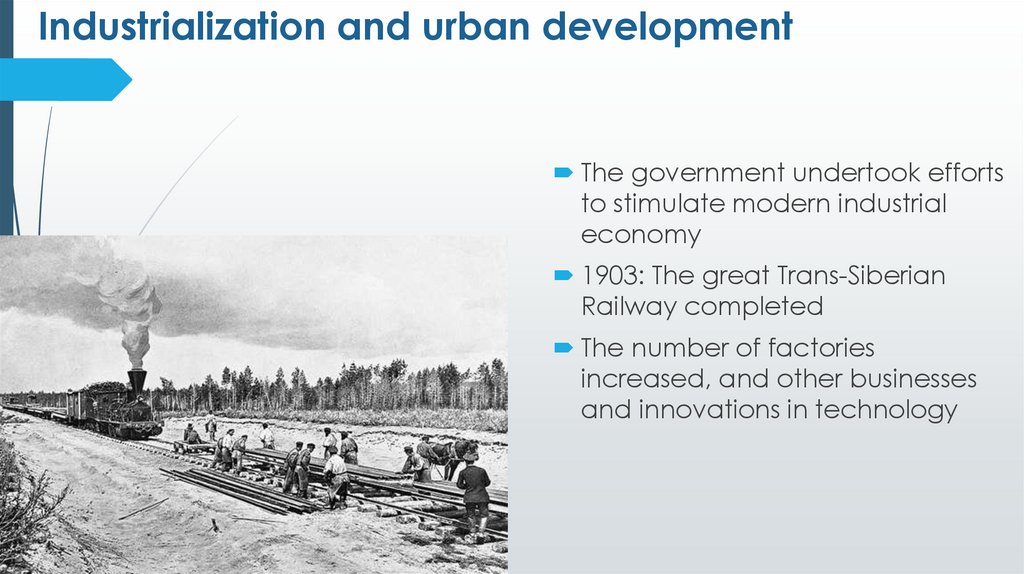
1903: The great Trans-Siberian
Railway completed
The number of factories
increased, and other businesses
and innovations in technology
6. Proletarians
Large numbers of industrialworkers
- 42–3 % of the populations of
St Petersburg and Moscow in
1910–12
- 49 % in Baku
Urban workers were likely to
be or become literate
Working conditions had been
eased by labor legislation,
which regulated female and
child labor and limited the
working day.
But conditions remained difficult:
- overcrowded housing with deplorable
sanitary conditions,
- an exhausting work-day (10-hour
work-day 6 days a week),
- widespread disease (notably
tuberculosis)
- high rates of premature mortality,
- constant risk of injury from poor safety
conditions,
- harsh discipline and inadequate
wages.
The visible sign of worker discontent
was strikes and the growth of trade
unions.
7. Public sphere
Economic and social modernization contributed theexpansion of public sphere & social life.
The role of cultural institutions, public associations and
organizations increased.
Such organizations have enormous implications for
politics, providing the essential foundation for civil
society & democratization.
8. Political developments
Oscillation between attempts to politically modernizeRussia, democratize it, and the opposite trend – political
repressions.
Intellectuals & ideologies of dissent
- Russia’s class of educated men & women offered
alternative visions of the state and society.
- They formed secret ‘circles’ (kruzhki), and organized a
series of oppositional parties.
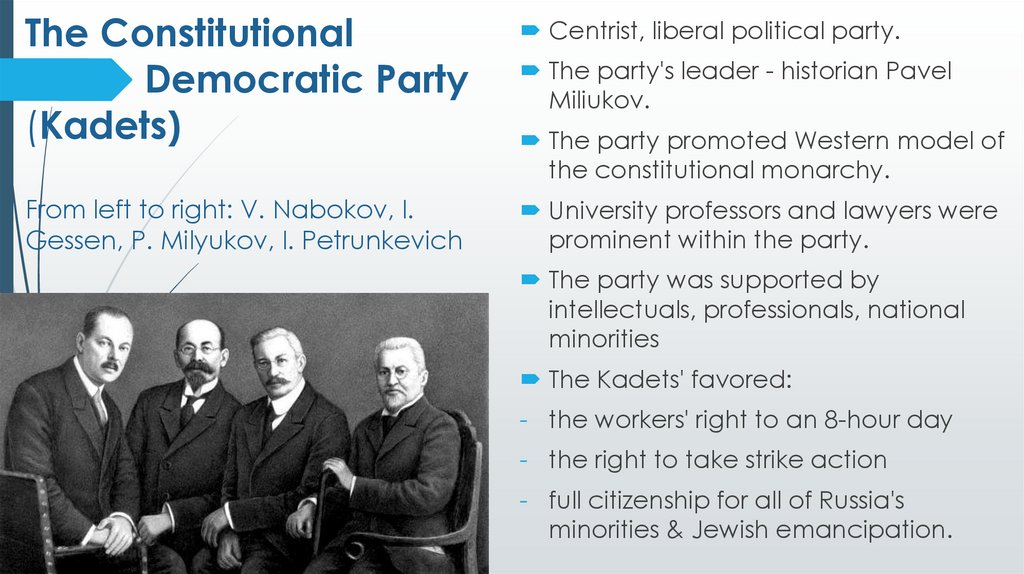
9. The Constitutional Democratic Party (Kadets) From left to right: V. Nabokov, I. Gessen, P. Milyukov, I. Petrunkevich
The ConstitutionalDemocratic Party
(Kadets)
Centrist, liberal political party.
From left to right: V. Nabokov, I.
Gessen, P. Milyukov, I. Petrunkevich
University professors and lawyers were
prominent within the party.
The party's leader - historian Pavel
Miliukov.
The party promoted Western model of
the constitutional monarchy.
The party was supported by
intellectuals, professionals, national
minorities
The Kadets' favored:
- the workers' right to an 8-hour day
- the right to take strike action
- full citizenship for all of Russia's
minorities & Jewish emancipation.
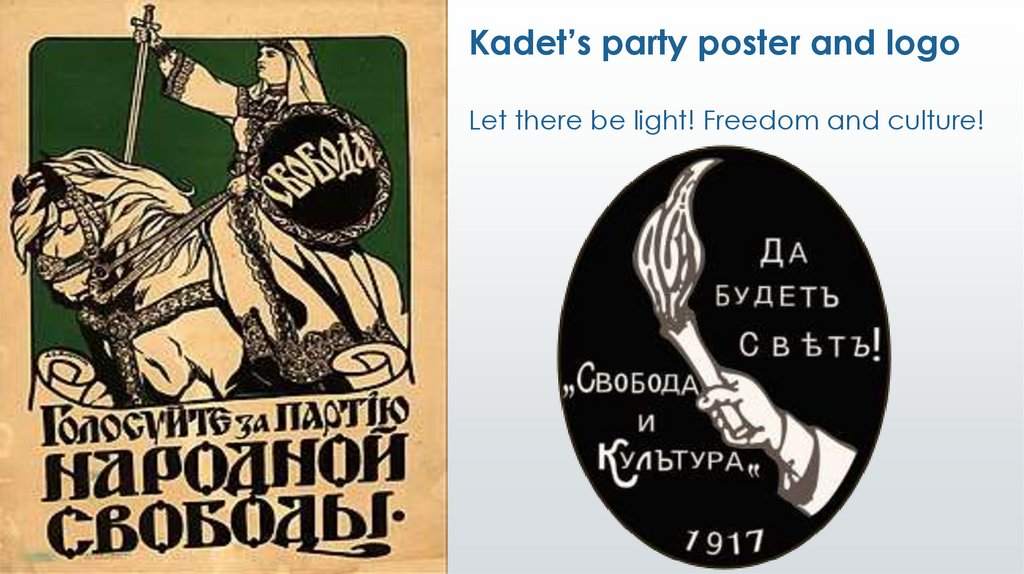
10. Kadet’s party poster and logo Let there be light! Freedom and culture!
Kadet’s party poster and logoLet there be light! Freedom and culture!
11. The Octobrist Party
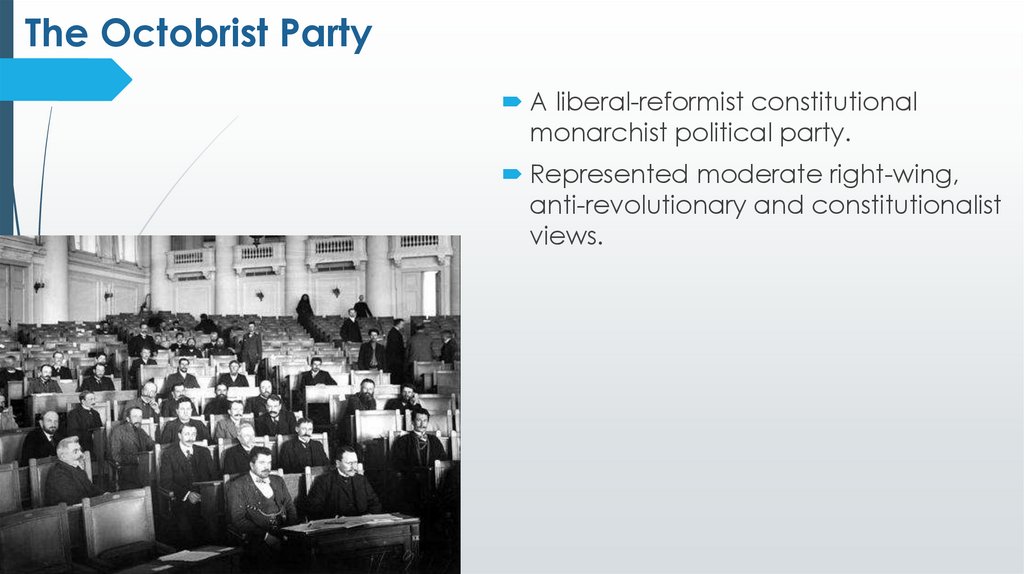
A liberal-reformist constitutionalmonarchist political party.
Represented moderate right-wing,
anti-revolutionary and constitutionalist
views.
12. Common set of goals of liberals
Russia’s transformation into amodern polity.
Evolution towards a
constitutional monarchy
(modeled on Great Britain).
Responsible ministry - a
government appointed by the
State Duma and responsible to
the Duma.
A democratic parliament.
Strong local self-government.
The rule of law should replace
the arbitrary will of autocrat,
bureaucrats & police.
Basic civil rights (freedom of
conscience, religion, speech,
assembly) for all citizens of the
empire.
Reforms: of public education,
moderate land reform to make
more land available to peasants,
introduction of a protective labor
legislation.
Moral transformation of the
Russian people: they were to
become modern individuals.
Liberals viewed themselves as
acting for the national good
rather than the interests of any
particular class.
13. Socialists
Democratic goalsIdeas of freedom &
elimination of social, cultural
& political constraints for all
people. Ideas of dignity of
the human person.
Communal notions of
solidarity and
interdependent interests.
More radical approach to
Russia’s emancipation.
Underground socialist
organizations emerged.
Marxists, organized around the
Russian Social Democratic
Workers’ Party (1903), became
increasingly numerous and
influential.
The party was designed to incite &
lead democratic revolution in
Russia.
The party split into two factions:
the Bolsheviks and the Mensheviks.
The influence of socialist ideas
among workers, students and
others was considerable.
Many people in Russia were
unhappy with autocratic political
order & embraced ideas of
democracy.
14. The ‘woman question’ in debates about democratic change in Russia
Within the family, the malehead of household exercised
enormous power.
Women’s civic roles &
personal autonomy were
circumscribed.
Such patriarchalism had
been persistently challenged
by activists.
A series of women’s organizations &
publications promoted this cause &
targeted particular problems (lack of
education, lower wages, lack of
support for maternity & childcare, lack
of legal protections & civil rights).
The movement for women’s
emancipation gained particular force
during the 1905 Revolution.
The movement was divided:
- Some activists fought directly to
overcome women’s inferior status.
Women were appealing for
respect as human beings and - Other women, especially socialists,
argued that the common cause must
for equal rights as citizens.
free all people from restrictions of the
old order.
15. The Revolution of 1905
An unprecedented empire-wideupheaval.
Economic & political demands were
interconnected.
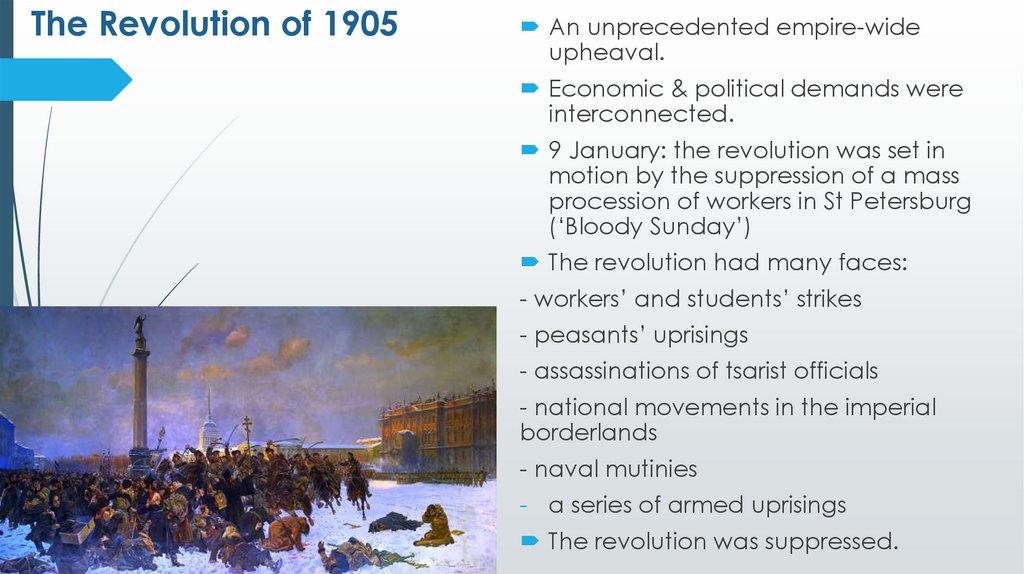
9 January: the revolution was set in
motion by the suppression of a mass
procession of workers in St Petersburg
(‘Bloody Sunday’)
The revolution had many faces:
- workers’ and students’ strikes
- peasants’ uprisings
- assassinations of tsarist officials
- national movements in the imperial
borderlands
- naval mutinies
- a series of armed uprisings
The revolution was suppressed.
16. Concessions from the government
Important reforms were implemented leading to somedemocratization
17 October 1905: "October manifesto" ("The Manifesto on the
Improvement of the State Order")
- A parliament (the State Duma) with legislative powers was
established. The tsar’s power was no longer "unlimited“.
- The manifesto guaranteed a measure of civil liberties, freedom
of conscience, speech, assembly and association.
- Political parties were allowed & the multi-party system was
introduced
- Greater press freedom was guaranteed. The press, magazines
and books disseminated ideas of democracy, justice, the rule
of law, universal rights, the natural equality of all human
beings and the mutability of every political order.
- Trade unions and strikes were legalized
17. The limits of reforms
Trade unions remained undercontrol of the police. The police
closed unions for engaging in
political activities.
The press could be closed for its
criticism of government.
Hundreds of people were
sentenced & executed for antigovernment agitation or sedition
(‘Stolypin’s necktie’).
Authority of the State Duma was
restricted (lack of parliamentary
control over the appointment or
dismissal of cabinet ministers).
The tsar retained substantial
power.
He alone appointed and dismissed
ministers, controlled the
bureaucracy, foreign policy, the
military and the Church.
He retained veto power over all
legislation, the right to dissolve the
Duma and hold new elections, the
right to declare martial law.
Nicholas II regretted the political
concessions he made.
He sought to hold all the power in
his hands.
18. The limits of reforms
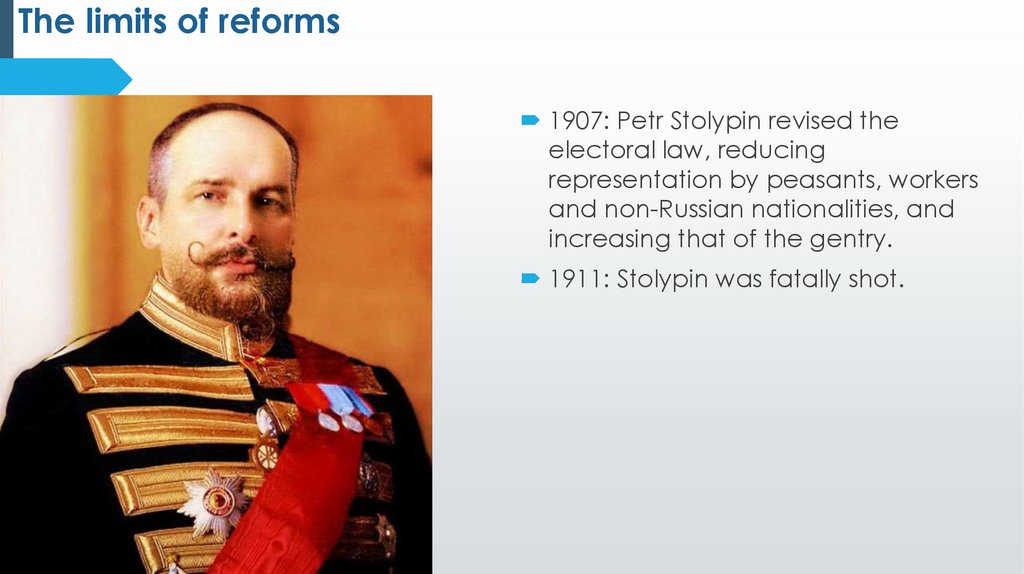
1907: Petr Stolypin revised theelectoral law, reducing
representation by peasants, workers
and non-Russian nationalities, and
increasing that of the gentry.
1911: Stolypin was fatally shot.
19. Lev Tolstoy
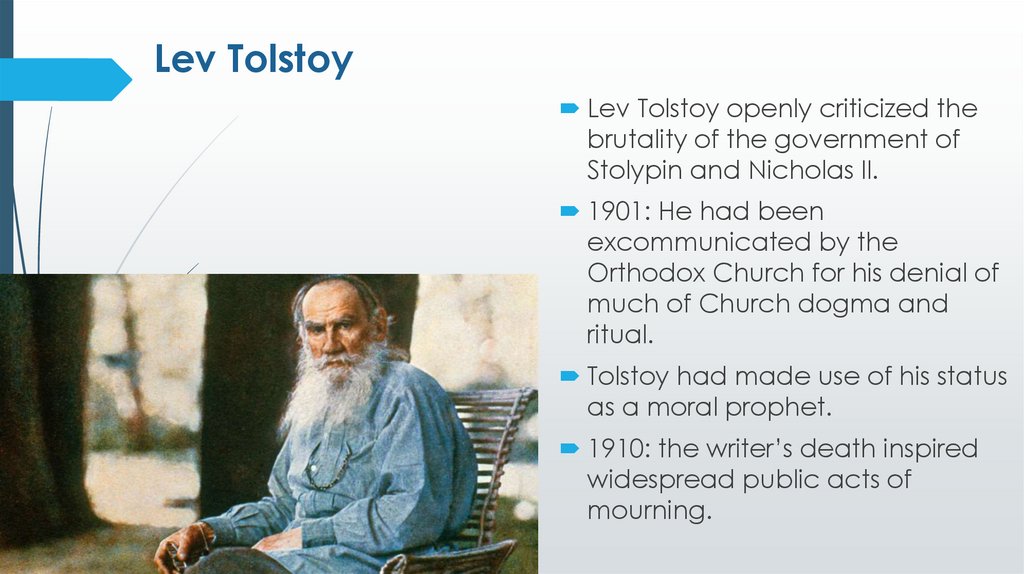
Lev Tolstoy openly criticized thebrutality of the government of
Stolypin and Nicholas II.
1901: He had been
excommunicated by the
Orthodox Church for his denial of
much of Church dogma and
ritual.
Tolstoy had made use of his status
as a moral prophet.
1910: the writer’s death inspired
widespread public acts of
mourning.
20. Persistence of strikers
1910–14: the strikemovement revived.
1912: striking workers in the
Lena goldfields in Siberia
were attacked by
government troops. Over a
hundred of workers died.
Appeals for economic & political
change. Apart from higher wages
and shorter hours, the demands
focused on universal rights,
equality, justice and ‘moral issues’
(or ‘dignity issues’): workers should
‘live like human beings’, they are
not ‘machines’, ‘slaves’ or ‘cattle’.
A great deal of anger &
resentment among workers. A
desire to punish those who stood
above them.
The growing popularity of the
radical Bolsheviks.
21. Spiritual searching
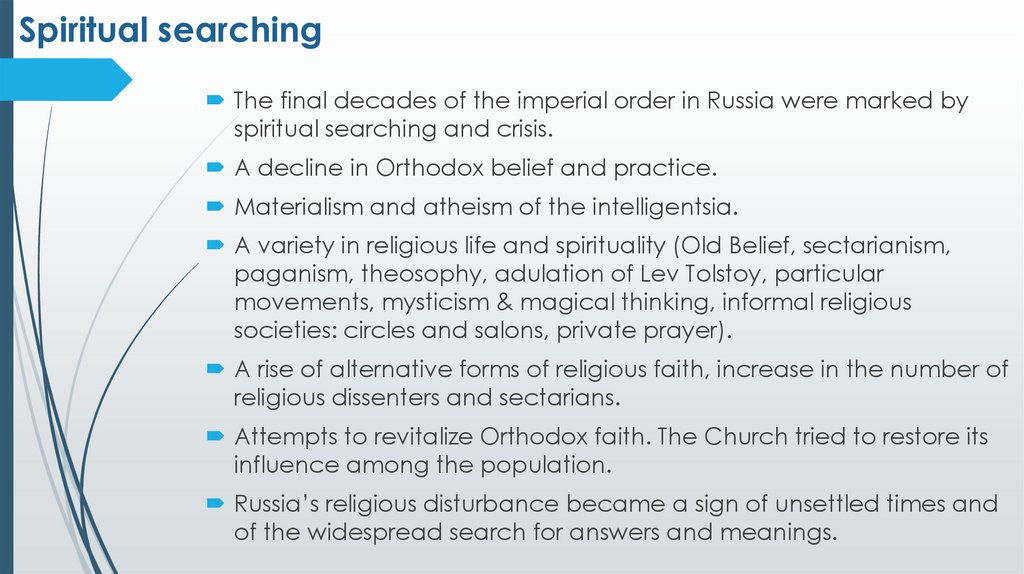
The final decades of the imperial order in Russia were marked byspiritual searching and crisis.
A decline in Orthodox belief and practice.
Materialism and atheism of the intelligentsia.
A variety in religious life and spirituality (Old Belief, sectarianism,
paganism, theosophy, adulation of Lev Tolstoy, particular
movements, mysticism & magical thinking, informal religious
societies: circles and salons, private prayer).
A rise of alternative forms of religious faith, increase in the number of
religious dissenters and sectarians.
Attempts to revitalize Orthodox faith. The Church tried to restore its
influence among the population.
Russia’s religious disturbance became a sign of unsettled times and
of the widespread search for answers and meanings.
22. The empire’s national complexity
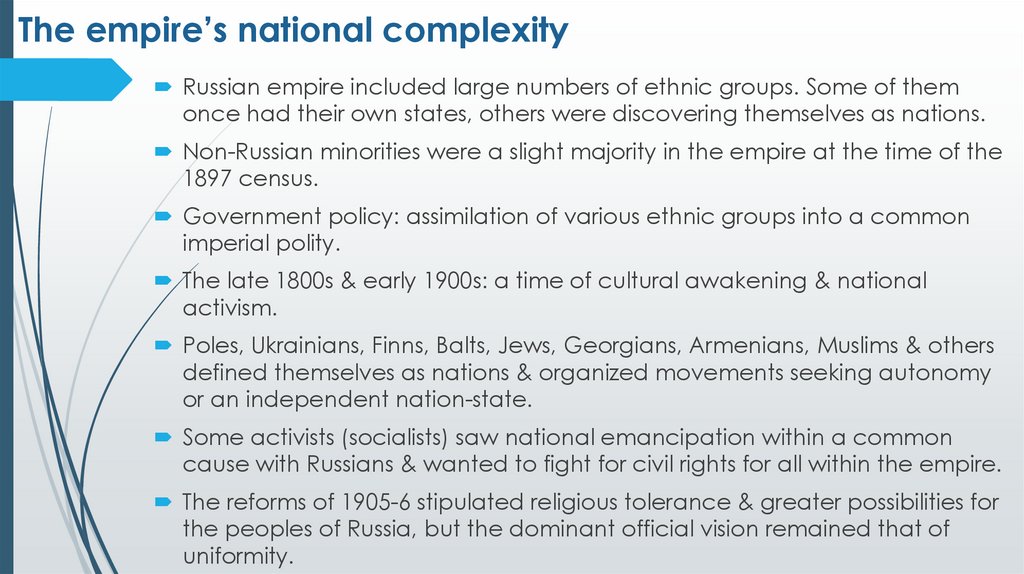
Russian empire included large numbers of ethnic groups. Some of themonce had their own states, others were discovering themselves as nations.
Non-Russian minorities were a slight majority in the empire at the time of the
1897 census.
Government policy: assimilation of various ethnic groups into a common
imperial polity.
The late 1800s & early 1900s: a time of cultural awakening & national
activism.
Poles, Ukrainians, Finns, Balts, Jews, Georgians, Armenians, Muslims & others
defined themselves as nations & organized movements seeking autonomy
or an independent nation-state.
Some activists (socialists) saw national emancipation within a common
cause with Russians & wanted to fight for civil rights for all within the empire.
The reforms of 1905-6 stipulated religious tolerance & greater possibilities for
the peoples of Russia, but the dominant official vision remained that of
uniformity.