 История
Похожие презентации:






The First World War (1914–1918) and its consequences
1. Contemporary world history
The pessimistic trend in historiography of the 20th century.- Aleksandr Solzhenitsyn: the 20th century was the most terrorist
one.
- Eric Hobsbawm: the 20th century was the age of extremes,
due to the nature of events that created tremendous
changes in the political and economical fabric of the world.
The reasons for pessimism:
- Two world wars
- The existence of anti-human totalitarian regimes.
Totalitarian regimes and world wars have become the symbols
of the 20th century.
2. Contemporary world history: opposite trends
The presence of opposite and contradictory tendencies.The scientific technological revolution.
Tremendous acceleration in the development of human
society.
The unity of the world and countries’ interdependence
grew dramatically. The processes of integration and
globalization accelerated.
Democracies continued to exist (USA, Great Britain etc.).
The development of pacifist movements.
The extremes of the 20th century are:
totalitarianism/democracy, capitalism/socialism,
nationalism/internationalism etc.
3. Distinctive features of world wars
Global and total natureMost destructive. Technical progress affected warfare.
Reshaped the world.
The way of recruiting for the armies changed.
In the 19th century in a majority of Western European countries armies began to be
built up on the basis of compulsory military service, which made it possible to create
mass armies.
Wars became battles of nations.
Great sufferings among the civilian population.
A country that entered the world war was totally involved in it by all aspects of
social and economic life, with all its potential and resources.
Wars and military conflicts in the 19th century took the lives of 5 million people. 20th
century conflicts - 140 millions.
The consequences of world wars are hard to predict. They lead to dramatic
changes in the geopolitical situation.
The WWI became a watershed in contemporary history, a generator of huge
geopolitical changes.
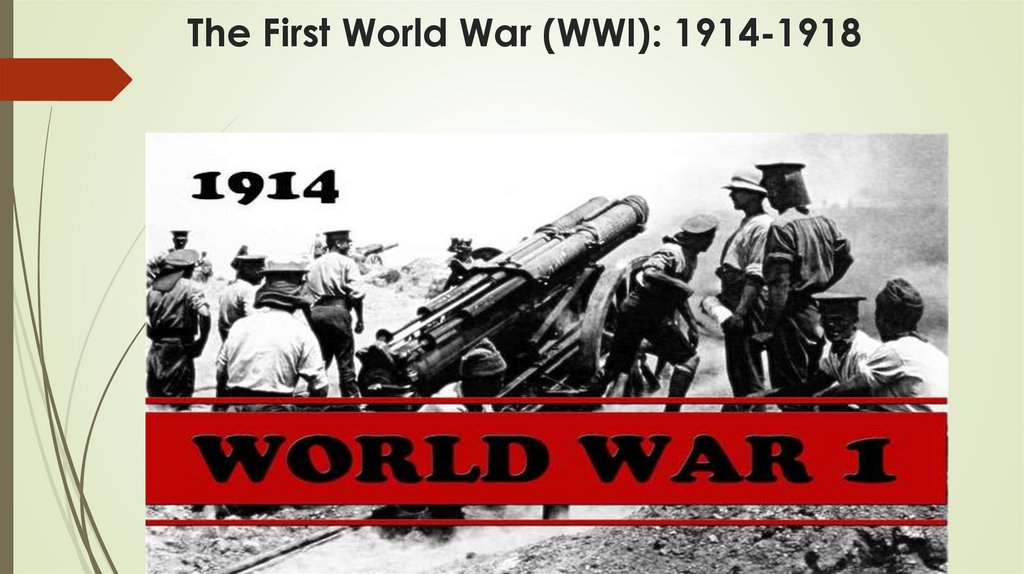
4. The First World War (WWI): 1914-1918
5. The outbreak of war
Absence of any effective international mechanisms for resolvinginterstate conflicts on the European continent.
Diplomatic arrangements were predicated on the concept of
balance of power
The balance of power theory in IR suggests that states may secure
their survival by preventing any one state from gaining enough
military power to dominate all others.
No state should dominate, according to this approach.
There should be a multipolar world, an equilibrium of power
between rival coalitions.
This is classical understanding of the balance of power as the basis
for the stability of international relations.
This way of thinking was common in European diplomacy in the
19th century ("old diplomacy").
The balance was disrupted by the rise of a powerful Germany.
6. The immediate casus belli
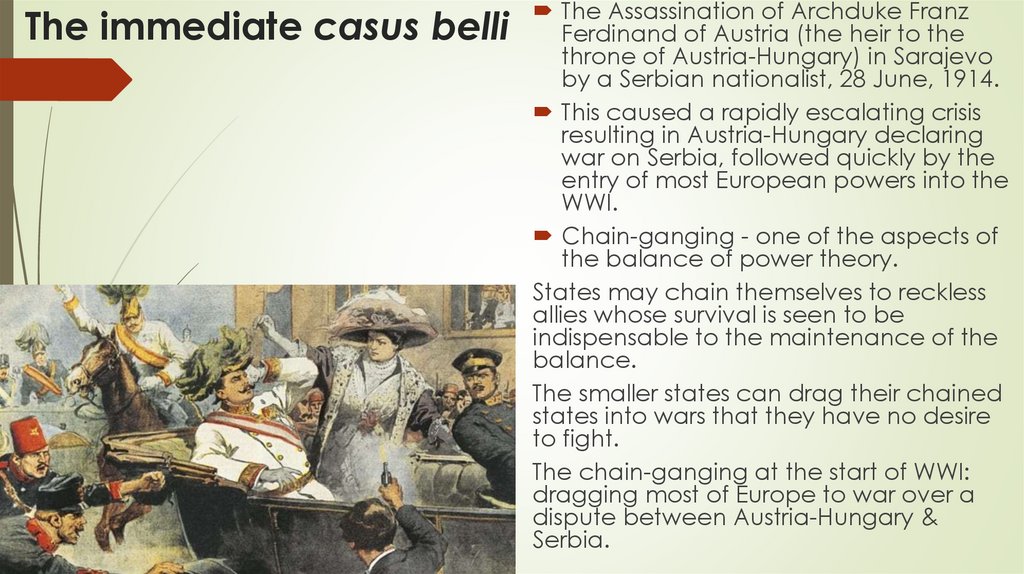
The Assassination of Archduke FranzFerdinand of Austria (the heir to the
throne of Austria-Hungary) in Sarajevo
by a Serbian nationalist, 28 June, 1914.
This caused a rapidly escalating crisis
resulting in Austria-Hungary declaring
war on Serbia, followed quickly by the
entry of most European powers into the
WWI.
Chain-ganging - one of the aspects of
the balance of power theory.
States may chain themselves to reckless
allies whose survival is seen to be
indispensable to the maintenance of the
balance.
The smaller states can drag their chained
states into wars that they have no desire
to fight.
The chain-ganging at the start of WWI:
dragging most of Europe to war over a
dispute between Austria-Hungary &
Serbia.
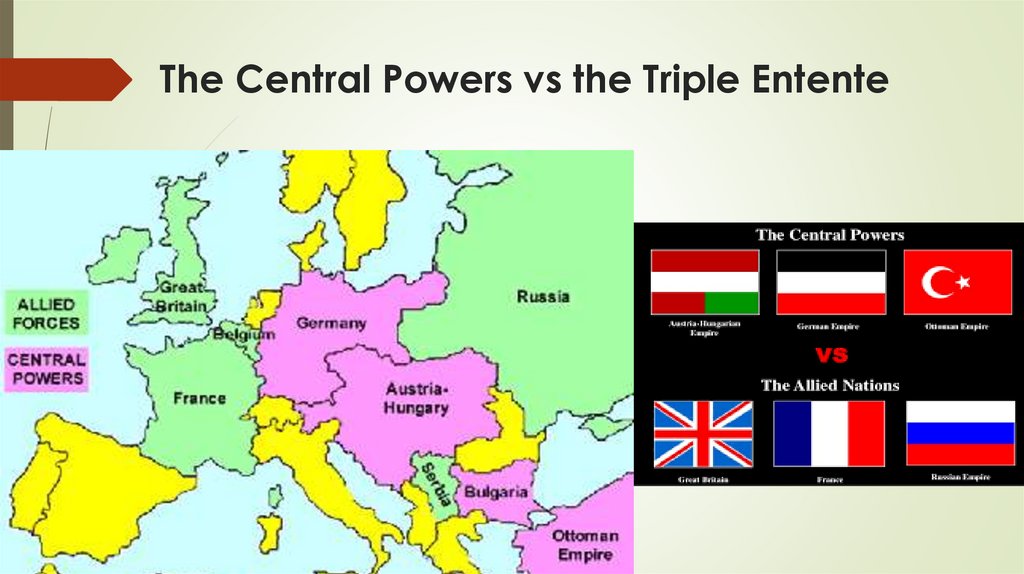
7. The Central Powers vs the Triple Entente
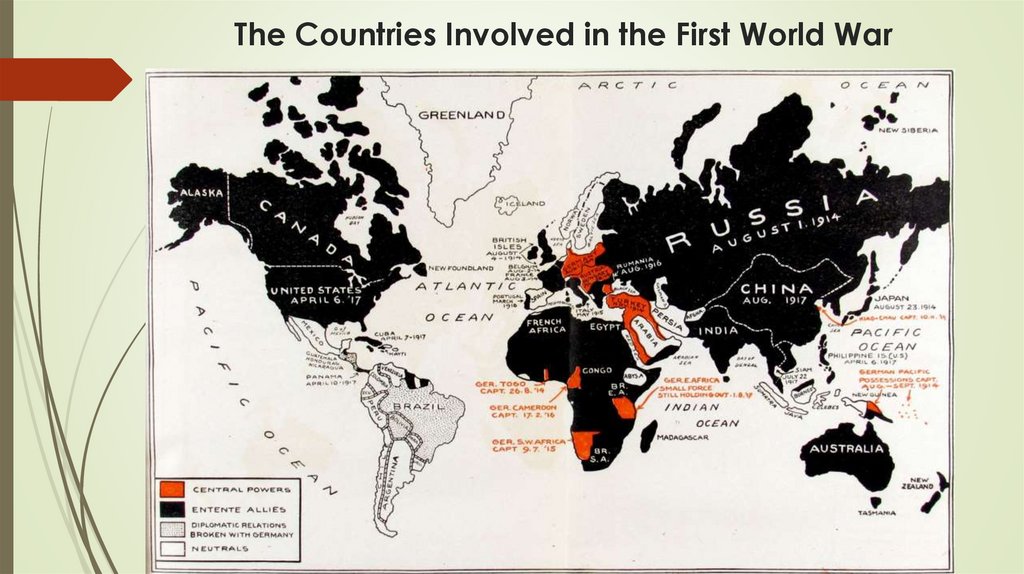
8. The Countries Involved in the First World War
9. The character of the war
Global war33 states took part in the war.
Together with the colonies
they accounted for 87 % of
the world's population.
Battles were fought in
Europe, in the Middle East, in
Africa & on the Asian
continent.
There was an intense struggle
for sea communications in
the Northern, Mediterranean
Seas & in the Atlantic.
Total war
Total war (as distinguished from limited war) is a
specific type of warfare, in which the contenders
are willing to make any sacrifice in lives & other
resources to obtain a complete victory.
It is unrestricted & is fought without limitations on
targets or weapons.
The rules & norms of war are disregarded.
Total war mobilizes all resources of society.
The roles of soldiers & civilians are difficult to
separate.
WWI had all the characteristics of the total war
(large scale, destructiveness, pointless violence
etc.)
A significant part of the adult male population (of
the countries at war) went through the WWI. Huge
human resources on the home front were involved
in military production.
10. Russian Empire in the war Russia’s “forgotten war”
Russian Empire in the warThe Russian Empire entered the WWI in
the summer of 1914 on the Entente side.
Russia’s “forgotten war”
The eastern front of the war - the set of
battlegrounds in the western borderlands
of the Russian empire - today’s Poland,
Ukraine, Belarus, Lithuania, Latvia &
Estonia.
(In the western front Germany acted
against France and Britain)
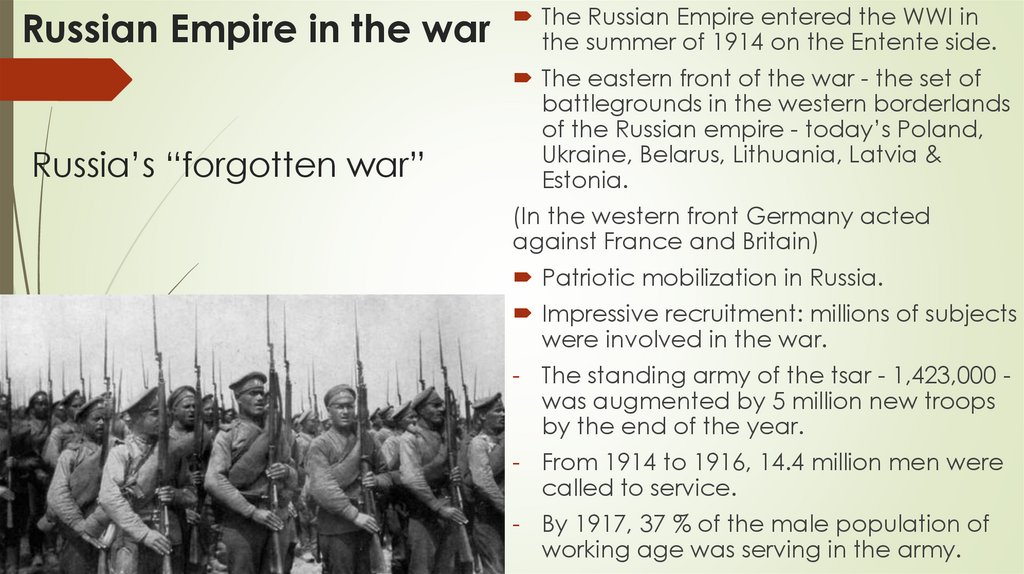
Patriotic mobilization in Russia.
Impressive recruitment: millions of subjects
were involved in the war.
- The standing army of the tsar - 1,423,000 was augmented by 5 million new troops
by the end of the year.
- From 1914 to 1916, 14.4 million men were
called to service.
- By 1917, 37 % of the male population of
working age was serving in the army.
11. Russian Empire in the war
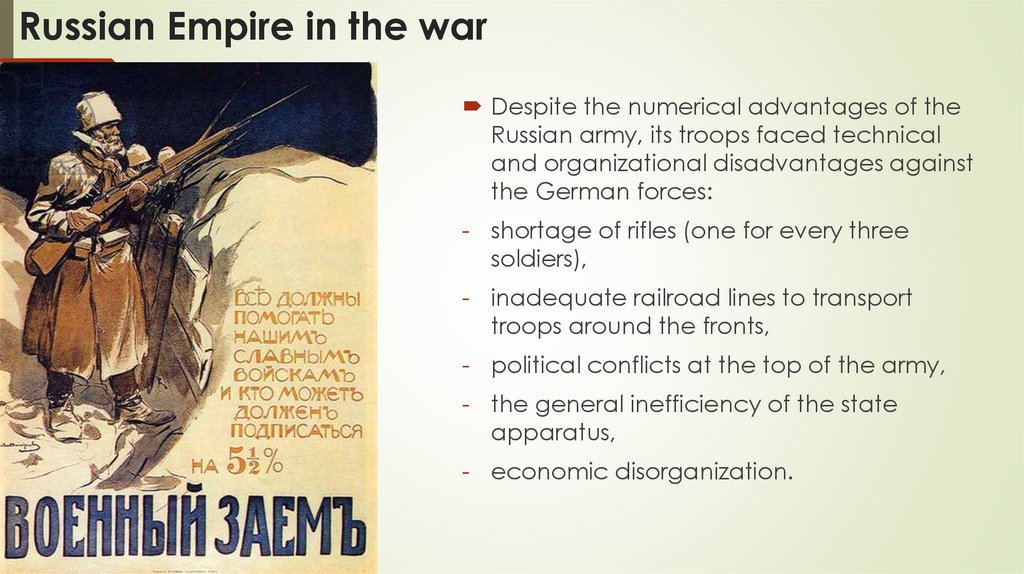
Despite the numerical advantages of theRussian army, its troops faced technical
and organizational disadvantages against
the German forces:
- shortage of rifles (one for every three
soldiers),
- inadequate railroad lines to transport
troops around the fronts,
- political conflicts at the top of the army,
- the general inefficiency of the state
apparatus,
- economic disorganization.
12. Political transformations in Russia
Autocratization intensifiedSome areas of the Empire were
placed under martial law
Control of the military authorities
over the population was
imposed.
The expansion of surveillance.
The powers of the State Duma
were curtailed.
Nicholas II was determined to
defend his autocratic prerogatives
and to roll back the concessions he
had made under pressure in 1905.
The Duma had no power to
influence the course of the war.
The Fourth Duma was reduced
from a legislative to a consultative
assembly.
Military censorship was introduced,
press and postal controls.
13. The outcome & consequences of war for Russia
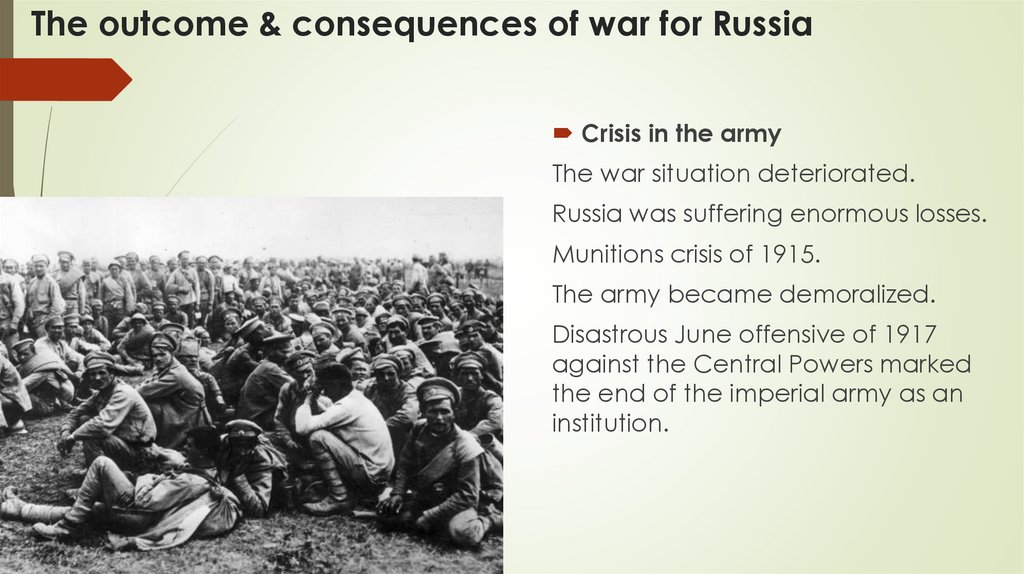
The outcome & consequences of war for RussiaCrisis in the army
The war situation deteriorated.
Russia was suffering enormous losses.
Munitions crisis of 1915.
The army became demoralized.
Disastrous June offensive of 1917
against the Central Powers marked
the end of the imperial army as an
institution.
14. The outcome & consequences of war for Russia
The outcome & consequences of war for RussiaThe economic crisis
Industrial mobilization &
impressive recruitment
triggered the crisis.
Food crisis / life support crisis
happened (the same
problems in Austria-Hungary
and the Ottoman Empire).
Underdeveloped means of
communications collapsed
during the war.
The entire economic system
became paralyzed.
Political crisis of the regime
Confusion in the government and
lack of coordination
Court intrigues and constant
personnel replacements came to
replace policy-making
Nicholas II undermined the legitimacy
and functioning of the official state
institutions
Social consequences
Broad demoralization of not only the
military, but also the civilian
population
15. The rise of the opposition
Moderate opposition used thecause of patriotism in its conflict
with the autocracy. It defended
Russia’s Great Power status and
expressed justification for the
further pursuit of war and the
mobilization of society.
Other oppositional forces challenged
the autocracy on its right to rule.
Liberals demanded a government
of confidence, amnesty, the
repeal of discriminatory measures
against minorities, the extension of
local self-government, respect for
the constitution. But liberals did not
oppose the war.
The Bolsheviks & the Mensheviks
condemned the war and the
political and social order that
had brought it about.
The socialists and anarchists
sought an honorable,
democratic peace.
V. Lenin & the Bolsheviks called
for Russia’s defeat and the
radicalization of the revolution.
The imperialist war was to be
transformed into a civil war.
Soldiers entered political life as
defenders of revolutionary
Russia.
The split emerged even within
the Russian ruling elite.
Ethnic polarization
16. The end of the war
The war brought Nicholas II down.After the 1917 revolution the new government under
Vladimir Lenin proclaimed peace & signed the separate
peace treaty (Treaty of Brest-Litovsk) in March 1918.
The treaty ended the war between Russia and the
Central powers and was highly favorable to Germany.
Germany shifted forces to the Western Front and tried to
overwhelm the Allies.
April 1917: the United States entered the war against the
Central Powers.
1918: Germany finally failed, the Allies won decisively.
The treaty of Brest-Litovsk is often considered as a
betrayal of Russia’s national interests.
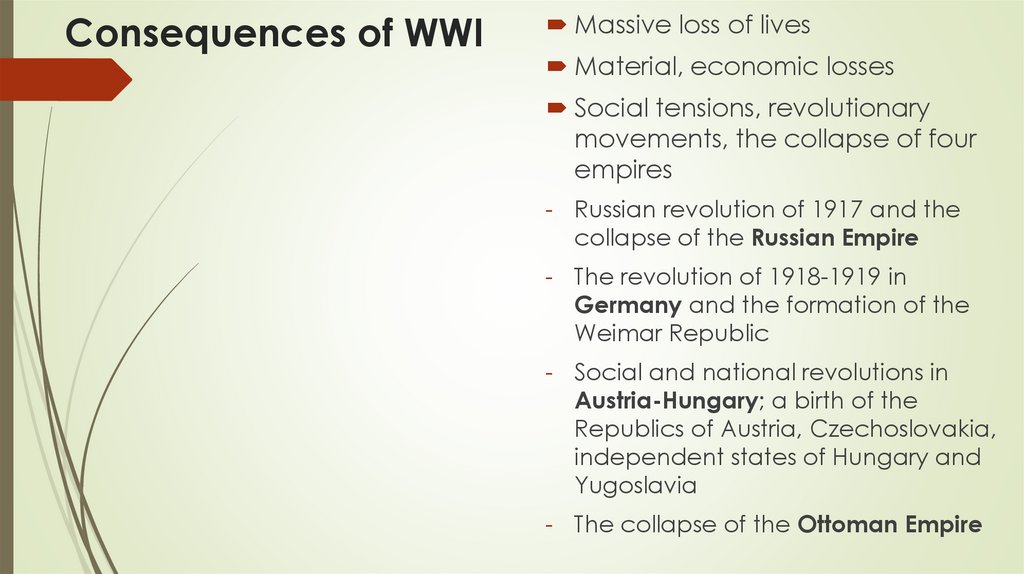
17. Consequences of WWI
Massive loss of livesMaterial, economic losses
Social tensions, revolutionary
movements, the collapse of four
empires
- Russian revolution of 1917 and the
collapse of the Russian Empire
- The revolution of 1918-1919 in
Germany and the formation of the
Weimar Republic
- Social and national revolutions in
Austria-Hungary; a birth of the
Republics of Austria, Czechoslovakia,
independent states of Hungary and
Yugoslavia
- The collapse of the Ottoman Empire
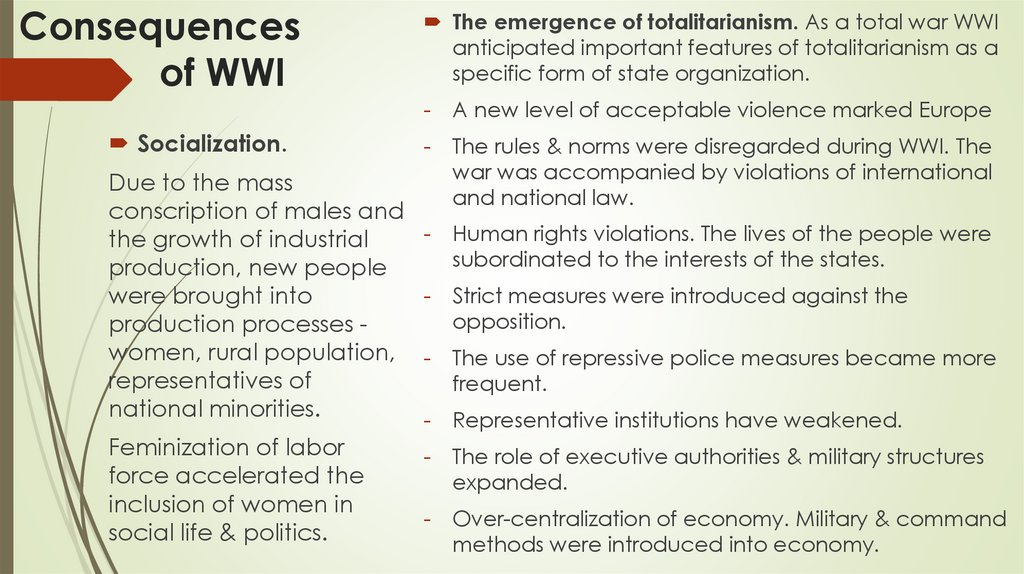
18. Consequences of WWI
Socialization.Due to the mass
conscription of males and
the growth of industrial
production, new people
were brought into
production processes women, rural population,
representatives of
national minorities.
Feminization of labor
force accelerated the
inclusion of women in
social life & politics.
The emergence of totalitarianism. As a total war WWI
anticipated important features of totalitarianism as a
specific form of state organization.
-
A new level of acceptable violence marked Europe
-
The rules & norms were disregarded during WWI. The
war was accompanied by violations of international
and national law.
-
Human rights violations. The lives of the people were
subordinated to the interests of the states.
-
Strict measures were introduced against the
opposition.
-
The use of repressive police measures became more
frequent.
-
Representative institutions have weakened.
-
The role of executive authorities & military structures
expanded.
-
Over-centralization of economy. Military & command
methods were introduced into economy.
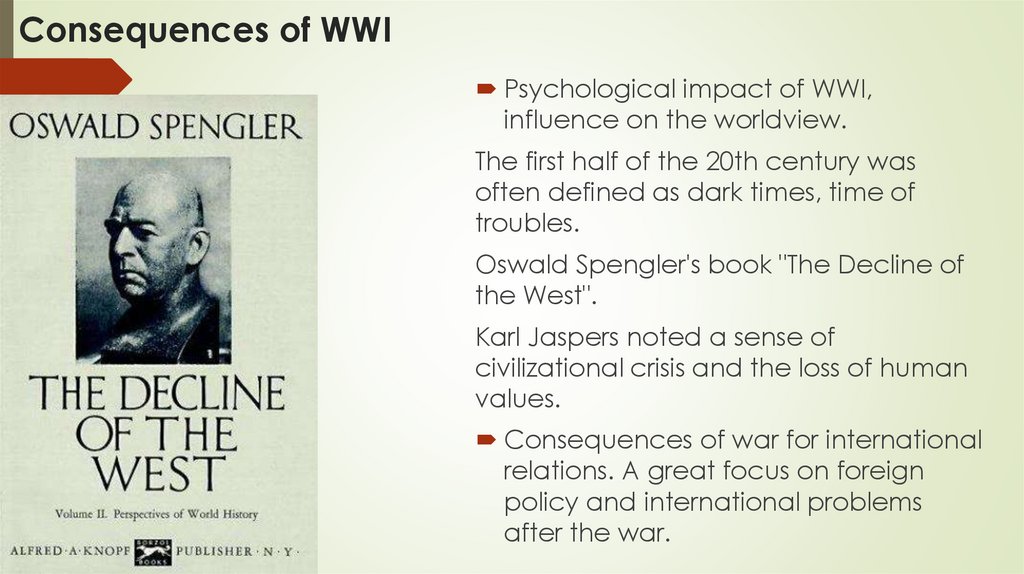
19. Consequences of WWI
Psychological impact of WWI,influence on the worldview.
The first half of the 20th century was
often defined as dark times, time of
troubles.
Oswald Spengler's book "The Decline of
the West".
Karl Jaspers noted a sense of
civilizational crisis and the loss of human
values.
Consequences of war for international
relations. A great focus on foreign
policy and international problems
after the war.