 Политика
Похожие презентации:



Post-war international order: The Versailles-Washington World Order
1. Post-war international order
2. Interwar period: 20 years (1919-1939)
1919-1929: the phase ofstability and pacifism in
international relations, when
the international community
sought to prevent another
global disaster.
The countries and peoples
became more interdependent.
The role of international forums
and organizations dramatically
increased.
1929-39: the phase of
confrontation and
national egoism, when the
states based their foreign
policies on their narrow
national interests, moving
away from universal
values.
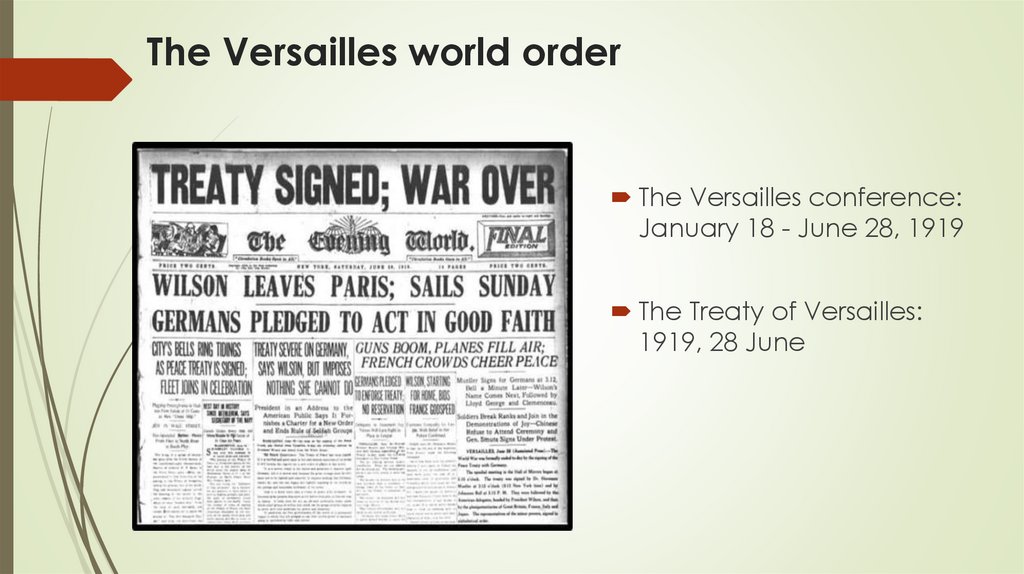
3. The Versailles world order
The Versailles conference:January 18 - June 28, 1919
The Treaty of Versailles:
1919, 28 June
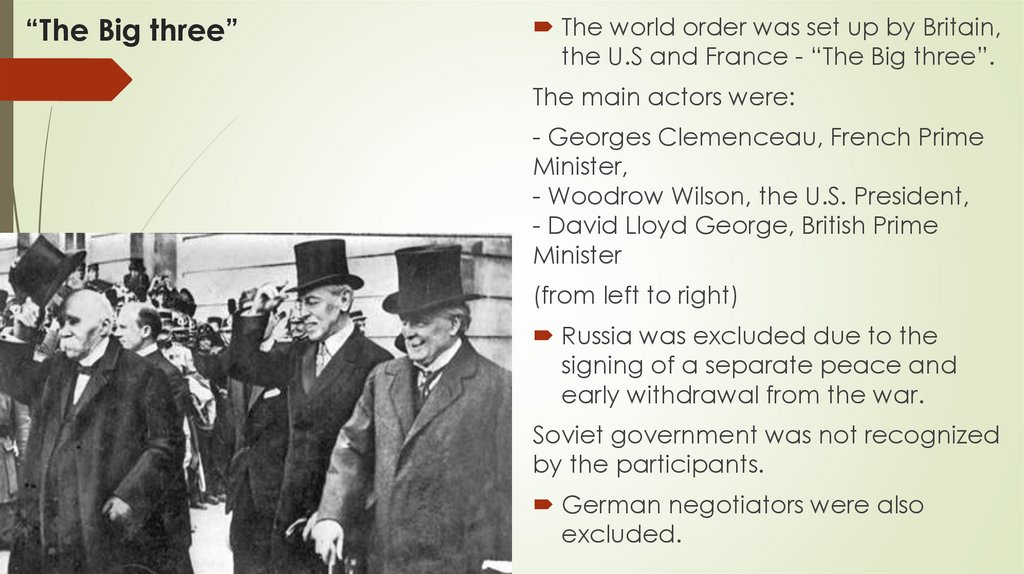
4. “The Big three”
The world order was set up by Britain,the U.S and France - “The Big three”.
The main actors were:
- Georges Clemenceau, French Prime
Minister,
- Woodrow Wilson, the U.S. President,
- David Lloyd George, British Prime
Minister
(from left to right)
Russia was excluded due to the
signing of a separate peace and
early withdrawal from the war.
Soviet government was not recognized
by the participants.
German negotiators were also
excluded.
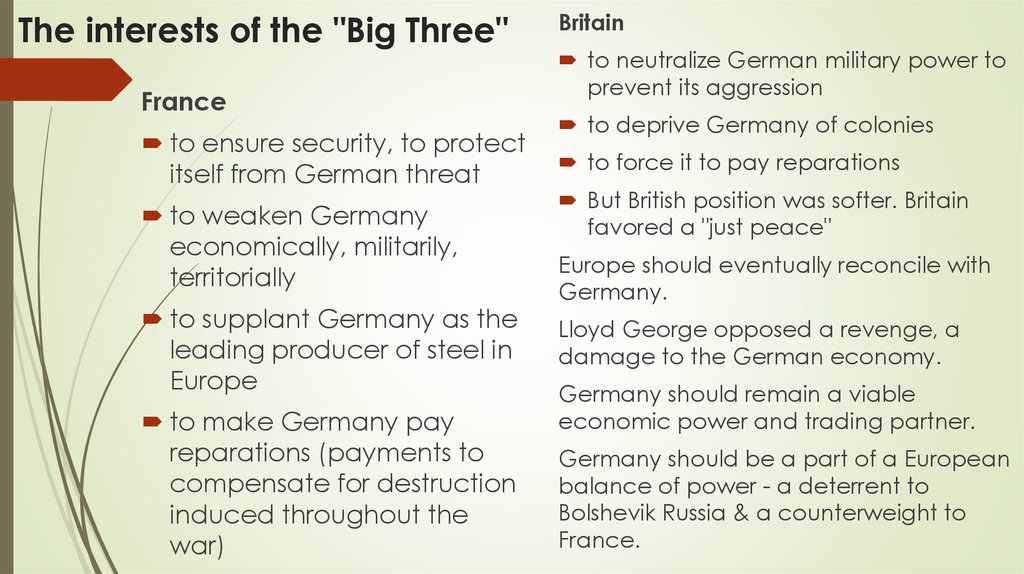
5. The interests of the "Big Three"
The interests of the "Big Three"France
to ensure security, to protect
itself from German threat
to weaken Germany
economically, militarily,
territorially
to supplant Germany as the
leading producer of steel in
Europe
to make Germany pay
reparations (payments to
compensate for destruction
induced throughout the
war)
Britain
to neutralize German military power to
prevent its aggression
to deprive Germany of colonies
to force it to pay reparations
But British position was softer. Britain
favored a "just peace"
Europe should eventually reconcile with
Germany.
Lloyd George opposed a revenge, a
damage to the German economy.
Germany should remain a viable
economic power and trading partner.
Germany should be a part of a European
balance of power - a deterrent to
Bolshevik Russia & a counterweight to
France.
6. The approach of France and Britain
Lloyd George and Clemenceau adhered to"old diplomacy" of spheres of influence and
the balance of power of great powers.
The leaders of Great Britain and France
wanted to transfer these old principles to the
post-war world.
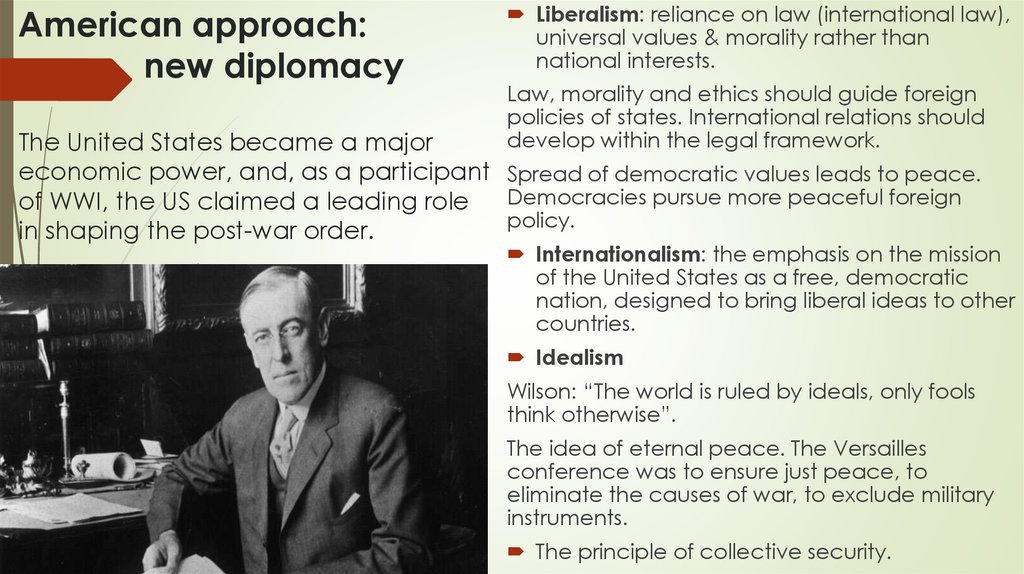
7. American approach: new diplomacy The United States became a major economic power, and, as a participant of WWI, the US claimed
American approach:new diplomacy
Liberalism: reliance on law (international law),
universal values & morality rather than
national interests.
Law, morality and ethics should guide foreign
policies of states. International relations should
develop within the legal framework.
The United States became a major
economic power, and, as a participant Spread of democratic values leads to peace.
Democracies pursue more peaceful foreign
of WWI, the US claimed a leading role
policy.
in shaping the post-war order.
Internationalism: the emphasis on the mission
of the United States as a free, democratic
nation, designed to bring liberal ideas to other
countries.
Idealism
Wilson: “The world is ruled by ideals, only fools
think otherwise”.
The idea of eternal peace. The Versailles
conference was to ensure just peace, to
eliminate the causes of war, to exclude military
instruments.
The principle of collective security.
8. Wilson’s idea of self-determination
The United States, as a former colony, rejected the colonial system &performed as one of the main anti-colonial and anti-imperialist powers.
The right of nations to self-determination became part of Wilson’s liberal
worldview.
The principle of self-determination was directed against Empires.
Self-determination for Wilson was the primary basis when drawing
international borders: the borders should be drawn along ethnic lines.
The ideal international order is the one consisting of one-nation states,
ethno-states, where each nation has a chance to represent itself in world
community.
Such a world was seen as more democratic and equal.
While the British and French wanted to annex the German colonial empire,
Wilson saw that as a violation of rights of native populations. He called for
the major powers to aid the native populations until they could govern
themselves.
It was important for Wilson to ensure equal rights of all nations, ethnic
groups & native populations.
9. The 14 points of Wilson
1. Open diplomacy.Diplomacy should proceed
always frankly and in the
public view. Secret
diplomacy should be
abandoned.
2. Freedom of the seas.
Absolute freedom of
navigation upon the seas
outside territorial waters,
alike in peace and in war.
3. Removal of economic
barriers between nations,
the establishment of an
equality of trade conditions
among all the nations. The
policy of free trade.
4. Reduction of armaments to a minimum.
5. Fair solution of colonial problems. A free,
open-minded, and absolutely impartial
adjustment of all colonial claims.
6-13. These points deal with individual states
(Russia, Belgium, France, Italy, Austria-Hungary,
the Balkans, Turkey, Poland).
In these points, Wilson focused on the settlement
of colonial disputes, self-determination, the
importance of ensuring the autonomous
development of nations.
6. Evacuation of all Central Powers from Russia
to allow it to define its own independence.
14. The formation of a world organization League of Nations to ensure peace.
Thanks to this document the elements of
liberalism & idealism were introduced into
international politics, replacing balance of
power ideas and egoistic self-interests of states.
10. The 14 points of Wilson
6. The evacuation of all Russian territory and such asettlement of all questions affecting Russia as will secure
the best and freest cooperation of the other nations of
the world in obtaining for her an unhampered and
unembarrassed opportunity for the independent
determination of her own political development and
national policy and assure her of a sincere welcome into
the society of free nations under institutions of her own
choosing; and, more than a welcome, assistance also of
every kind that she may need and may herself desire. The
treatment accorded Russia by her sister nations in the
months to come will be the acid test of their good will, of
their comprehension of her needs as distinguished from
their own interests, and of their intelligent and unselfish
sympathy.
11. Conference decisions on Germany
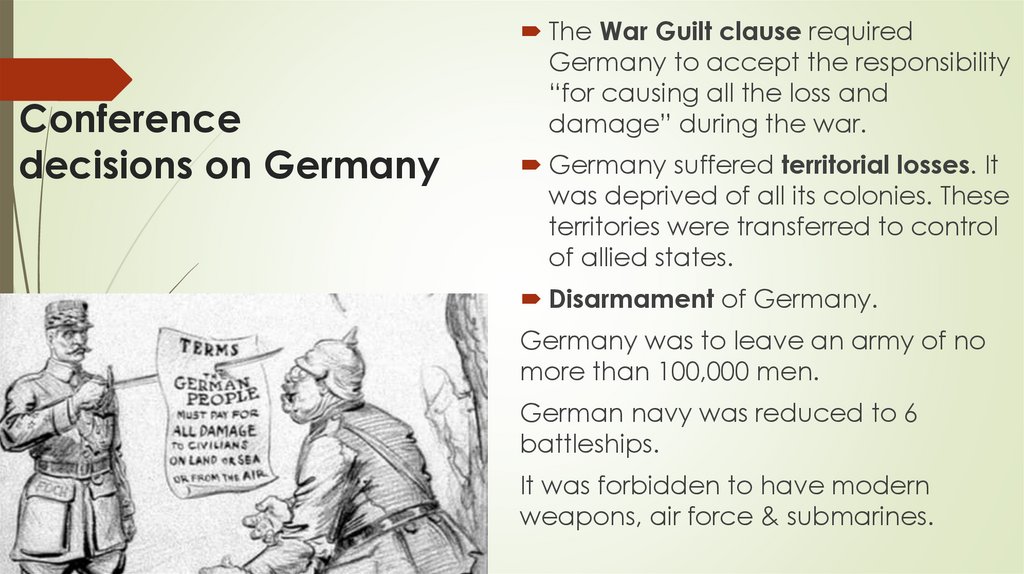
The War Guilt clause requiredGermany to accept the responsibility
“for causing all the loss and
damage” during the war.
Germany suffered territorial losses. It
was deprived of all its colonies. These
territories were transferred to control
of allied states.
Disarmament of Germany.
Germany was to leave an army of no
more than 100,000 men.
German navy was reduced to 6
battleships.
It was forbidden to have modern
weapons, air force & submarines.
12. Conference decisions on Germany
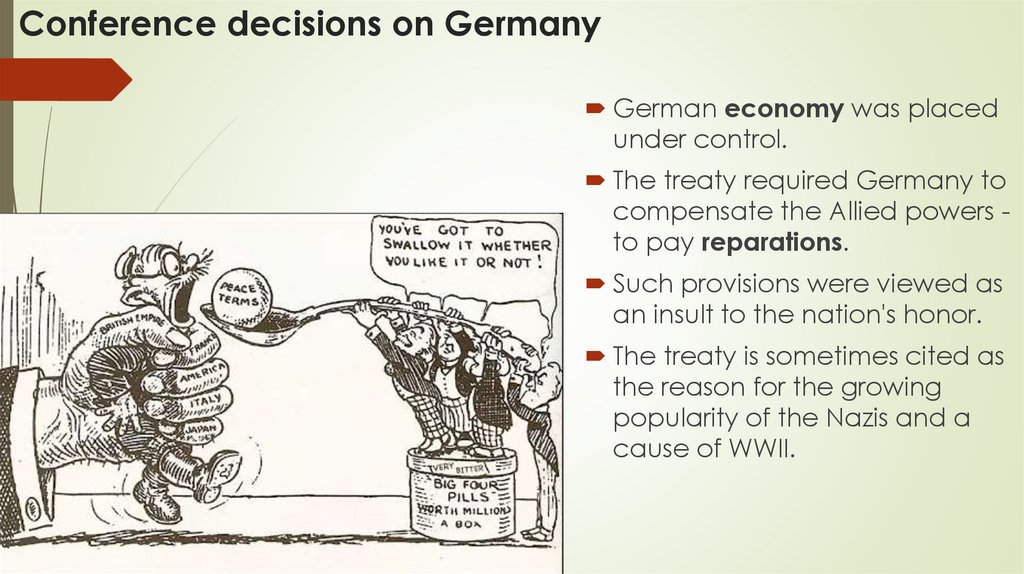
German economy was placedunder control.
The treaty required Germany to
compensate the Allied powers to pay reparations.
Such provisions were viewed as
an insult to the nation's honor.
The treaty is sometimes cited as
the reason for the growing
popularity of the Nazis and a
cause of WWII.
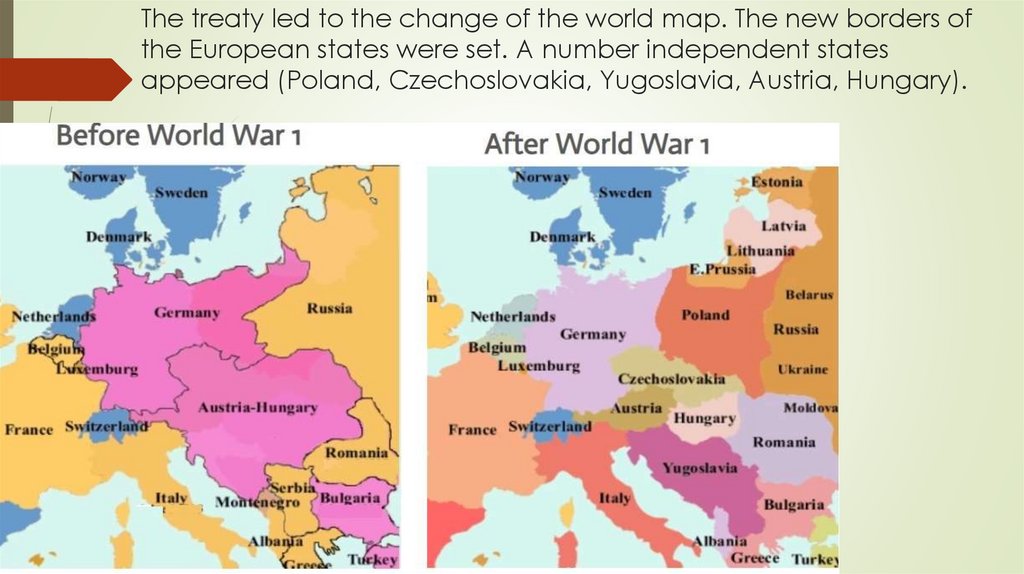
13. The treaty led to the change of the world map. The new borders of the European states were set. A number independent states
appeared (Poland, Czechoslovakia, Yugoslavia, Austria, Hungary).14. The League of Nations
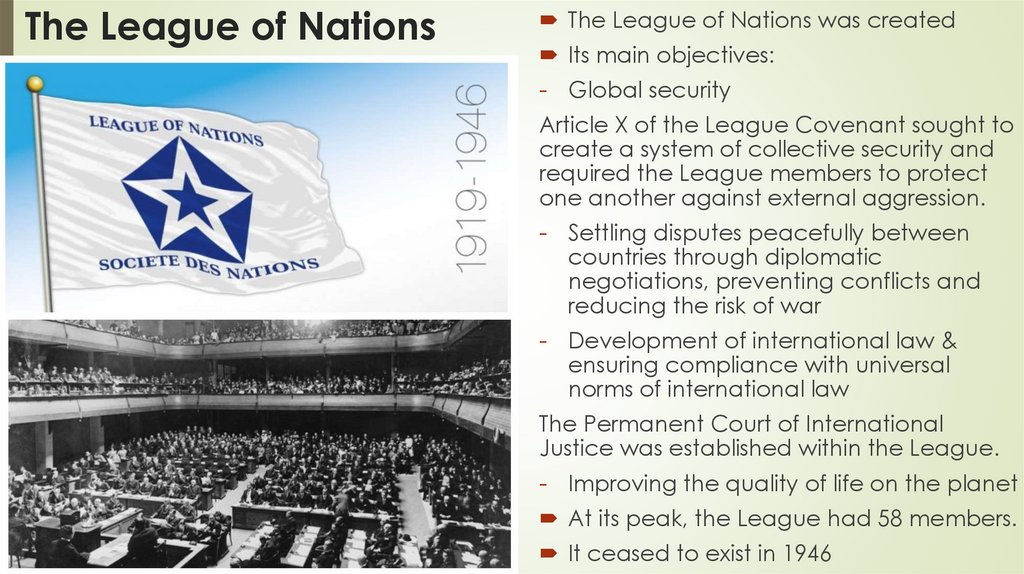
The League of Nations was createdIts main objectives:
- Global security
Article X of the League Covenant sought to
create a system of collective security and
required the League members to protect
one another against external aggression.
- Settling disputes peacefully between
countries through diplomatic
negotiations, preventing conflicts and
reducing the risk of war
- Development of international law &
ensuring compliance with universal
norms of international law
The Permanent Court of International
Justice was established within the League.
- Improving the quality of life on the planet
At its peak, the League had 58 members.
It ceased to exist in 1946
15. Human rights and global problems at the conference
Human rights were discussed for the first time atinternational level: individual, as well as collective (rights
of nations for self-determination).
- Equal rights for racial and religious minorities were
proclaimed.
- The articles of the Treaty of Versailles concerned labor
protection. Previously established norms were to be
restored.
The Treaty included the provisions on global issues.
It proclaimed the need to exercise strict control over drug
trafficking (opium), production and trade of weapons,
asked to unite efforts in order to combat epidemics.
16. Causes of instability of the Versailles world order
The Versailles Order didn’t become comprehensive.Strong opposition to Wilson's policies in the United States.
Ratification of the Treaty of Versailles failed in the
Senate. The US could not enter the League of Nations
and failed to become a guarantor of European security.
Russia and Germany were left out of this world order.
China was dissatisfied with the decisions made.
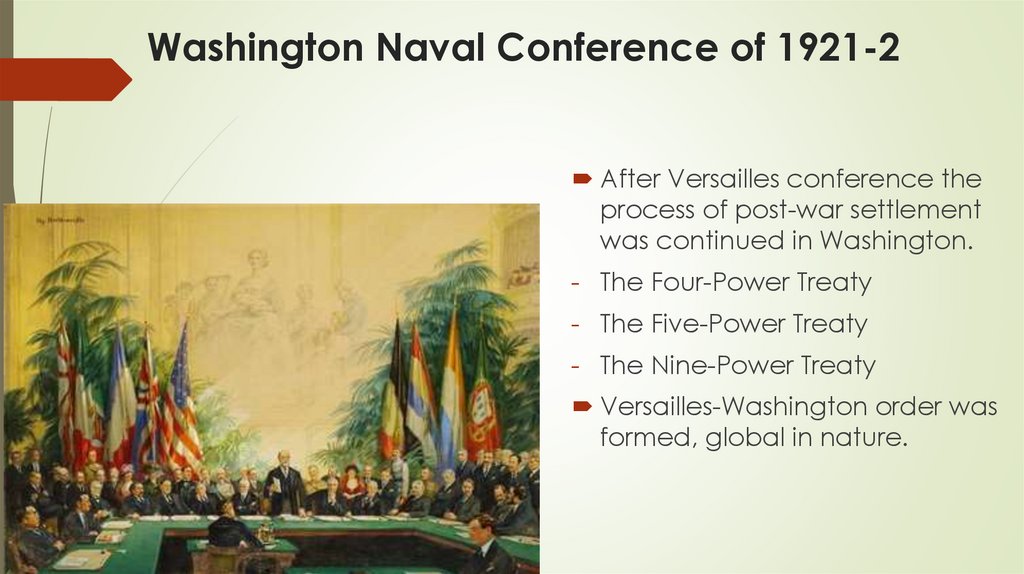
17. Washington Naval Conference of 1921-2
After Versailles conference theprocess of post-war settlement
was continued in Washington.
- The Four-Power Treaty
- The Five-Power Treaty
- The Nine-Power Treaty
Versailles-Washington order was
formed, global in nature.
18. Major trends in the development of international relations in the 1920s
A lot of peaceful conferences were held.The peoples of Europe and the world tried to consolidate
positive principles in world politics.
Major trends in the
development of
international relations
in the 1920s
Anti-war sentiments. Pacifism.
1928: The Kellogg–Briand Pact or Pact of Paris (officially the
General Treaty for Renunciation of War as an Instrument of
National Policy)
Initiated by France & the US and named after its authors: US
Secretary of State Frank B. Kellogg and French foreign
minister Aristide Briand.
The document’s main idea is a rejection of war. Signatory
states promised not to use war to resolve their disputes.
This idea was widely supported by the international
community. The pact was signed by most established
nations (including the USSR).
The pact created international legal grounds for restricting
the use of military force.
The pact remains in effect.
19. Pan-European movement
A pan-European movement developed within European pacifistmovement.
The idea of European unification (the United States of Europe)
to free Europe from war.
Pacifism is at the heart of European idea.
Real projects of European unification appeared, projects of a
federation of European states.
These ideas and projects have created a certain climate in
Europe.
European integration projects were particularly popular in
France.
These projects were not realized in the interwar period, but
played a significant role in shaping the concept of European
unity.
20. The principles of the Versailles-Washington world order
Open diplomacyPriority of peaceful solutions to
international problems over
military ones
Condemnation of aggression
Disarmament
Attention to the problems of small
nations
Collective responsibility in IR
Non-interference in internal affairs
of states
Attention to human rights