 История
Похожие презентации:





The Russian Revolution, 1917
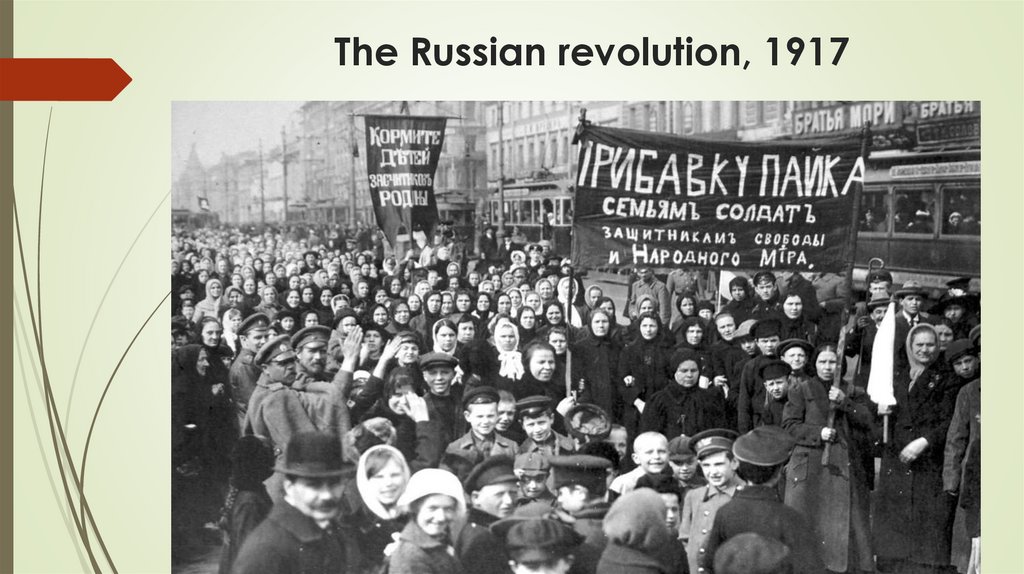
1. The Russian revolution, 1917
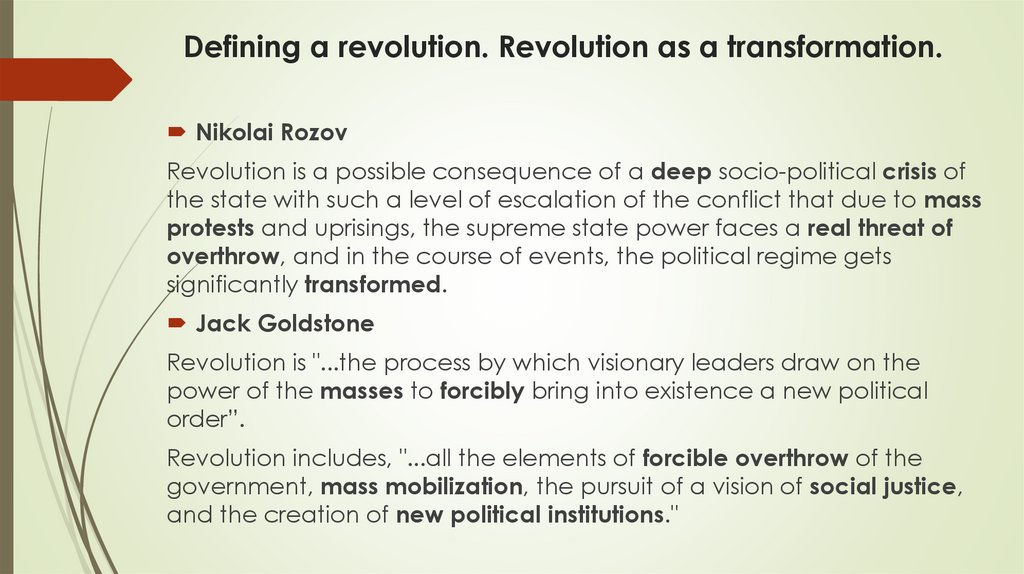
2. Defining a revolution. Revolution as a transformation.
Nikolai RozovRevolution is a possible consequence of a deep socio-political crisis of
the state with such a level of escalation of the conflict that due to mass
protests and uprisings, the supreme state power faces a real threat of
overthrow, and in the course of events, the political regime gets
significantly transformed.
Jack Goldstone
Revolution is "...the process by which visionary leaders draw on the
power of the masses to forcibly bring into existence a new political
order”.
Revolution includes, "...all the elements of forcible overthrow of the
government, mass mobilization, the pursuit of a vision of social justice,
and the creation of new political institutions."
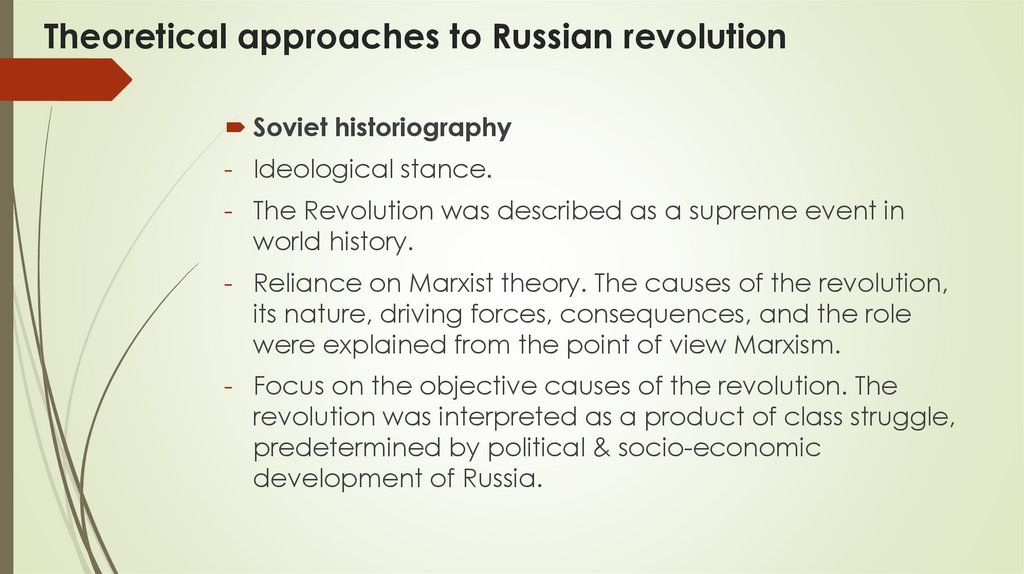
3. Theoretical approaches to Russian revolution
Soviet historiography- Ideological stance.
- The Revolution was described as a supreme event in
world history.
- Reliance on Marxist theory. The causes of the revolution,
its nature, driving forces, consequences, and the role
were explained from the point of view Marxism.
- Focus on the objective causes of the revolution. The
revolution was interpreted as a product of class struggle,
predetermined by political & socio-economic
development of Russia.
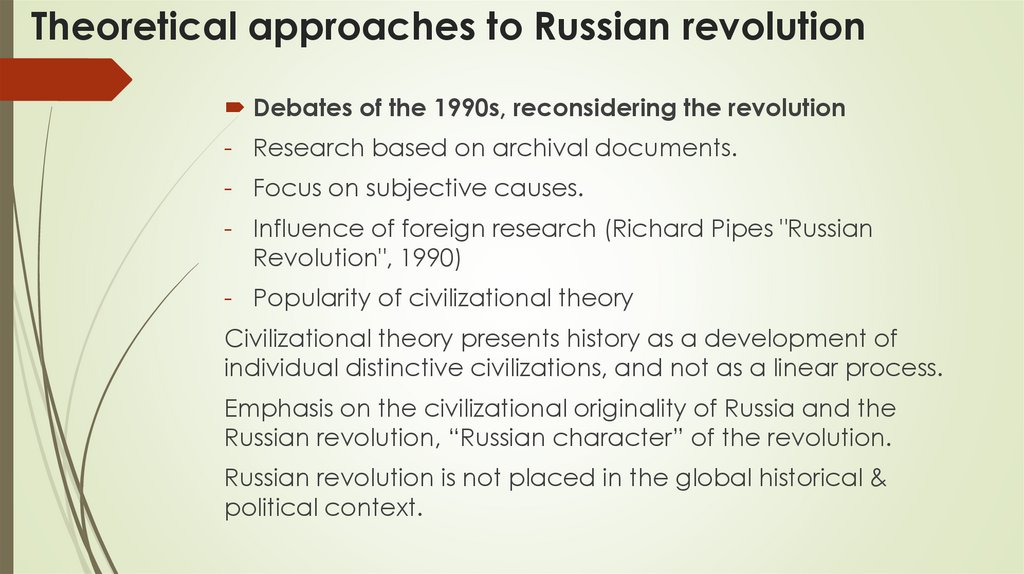
4. Theoretical approaches to Russian revolution
Debates of the 1990s, reconsidering the revolution- Research based on archival documents.
- Focus on subjective causes.
- Influence of foreign research (Richard Pipes "Russian
Revolution", 1990)
- Popularity of civilizational theory
Civilizational theory presents history as a development of
individual distinctive civilizations, and not as a linear process.
Emphasis on the civilizational originality of Russia and the
Russian revolution, “Russian character” of the revolution.
Russian revolution is not placed in the global historical &
political context.
5. Civilizational theory: Alexander Ahiyezer
Explanation of thepatterns of Russian
history beyond the
Marxist-Leninist
methodology.
The idea of cyclical
development of Russian
history.
The concept of a historical pendulum:
Russia develops according to the principle
of a pendulum because of the
sociocultural divide.
Russia is geographically, culturally &
historically located between a traditional
and liberal society. It’s curse lies in the
brutal struggle between traditionalism and
liberalism.
Social integrators are weak.
Therefore, the historical route of Russia is
broken, it constantly fluctuates, as if
following a pendulum.
The starting and ending point of each
cycle of Russian history is a national
catastrophe, caused by internal conflict.
1917 Revolution became one of such
catastrophes.
6. Theoretical approaches to Russian revolution
2000s. Theory of modernization- Modernization theory describes the development of all
countries and peoples from a universalist position.
- It describes the process of renewal of traditional society,
transition from a traditional society to an industrial one,
formation of new economic, political and sociocultural
structures.
- Economic & political development is believed to take
place in the same direction, with patterns common to all.
Backward countries repeat the path of developed
countries. National characteristics are secondary.
- The 1917 Revolution is viewed in the context of
modernization, as a way of transition from agricultural to
industrial society.
7. Objective causes of the Russian revolution: the systemic crisis
- Agrarian problem was crucial. Most of the peasants were smallholderssuffering from a land shortage; they were doomed to live in poverty.
The division of landlords' lands could give an impetus to development, but
1/3 of the land remained in the hands of landlords. Domestic market could
not grow.
- Workers’ problem: the workers were seeking higher salaries, 8 hour
working day, fully established trade unions, state insurance.
- Social stratification; strong disparity in standards of living, income and
consumption of different segments of the population; lack of justice and
equality.
- Thesis of Marxists: The agrarian problem and the problems of workers
were not resolved due to the social and class nature of the autocratic
regime. The autocratic regime was associated with large landowners
and relied on them.
8. Objective causes of the Russian revolution: the systemic crisis
- Discrimination of bourgeoisie. Bourgeoisie was interested inmodernization, elimination of semi-feudal elements, and
formation of the internal market, but the dominant
bureaucracy was unable to understand and to solve these
problems.
- National Factor.
- Crisis of autocracy, delegitimization of the political regime. The
main classes were in opposition to the autocracy.
- World War I. The war exacerbated social tensions, led to
polarization of political life, gave a powerful impulse to
revolutionary movement.
9. Other causes
Subjective causes- Moral preconditions
- The role of personalities
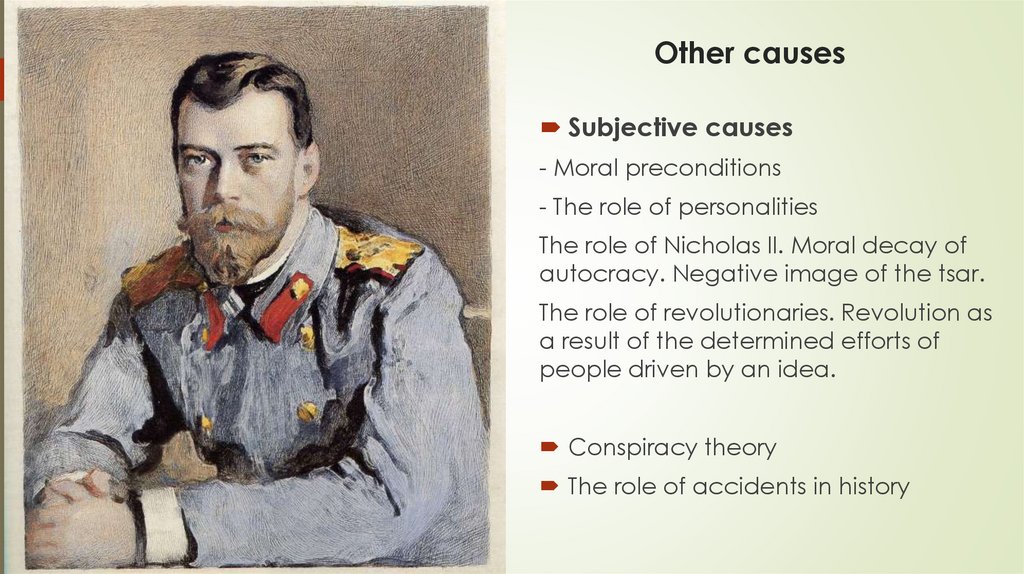
The role of Nicholas II. Moral decay of
autocracy. Negative image of the tsar.
The role of revolutionaries. Revolution as
a result of the determined efforts of
people driven by an idea.
Conspiracy theory
The role of accidents in history
10. V. Lenin in January 1917 in Zurich: "We of the older generation may not live to see the decisive battles of this coming
V. Lenin in January 1917 in Zurich: "We of the oldergeneration may not live to see the decisive battles of
this coming revolution."
V. Lenin: "A combination of a whole series of conditions
of world-historic importance was required for the tsarist
monarchy to have collapsed in a few days".
A. Shchusev in a letter to A. Benois: "The whole edifice
crumbled – somehow even without a cloud of dust
and very quickly".
V. Rozanov: " Russia has disappeared in two days. In
three days at most. Even the paper "Novoe vremya"
couldn't be closed faster than Russia was closed.”
11. Chronology
Soviet literature: The events of 1917 are divided into twostages:
- The February bourgeois-democratic Revolution (FebruaryOctober 1917)
- The Great October Socialist Revolution (October 25 /
November 7, 1917 - ?)
Contemporary approaches
- The events of 1917 are perceived as a single
revolutionary process, divided into a number of stages
- All 3 revolutions in Russia are perceived as a single
process (The revolution of 1905-07, the February & October
revolutions of 1917)
12. Driving forces / actors of the revolution
Political elites, political parties- Liberals (Kadet party)
- Socialists
- Bolsheviks
Broad masses
- Working class
- Peasantry
- Intellectuals
- Students
- Soldiers
- National minorities
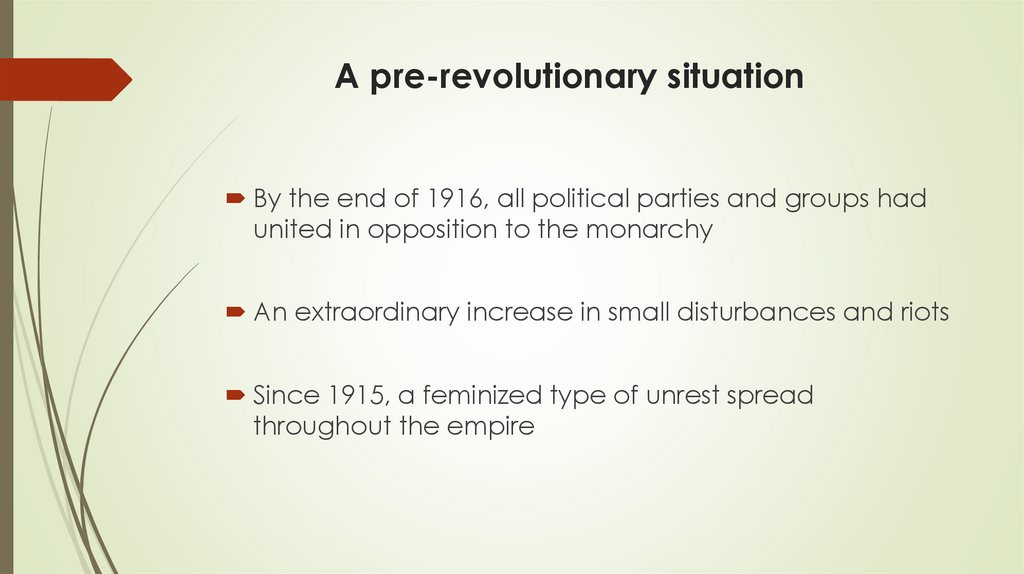
13. A pre-revolutionary situation
By the end of 1916, all political parties and groups hadunited in opposition to the monarchy
An extraordinary increase in small disturbances and riots
Since 1915, a feminized type of unrest spread
throughout the empire
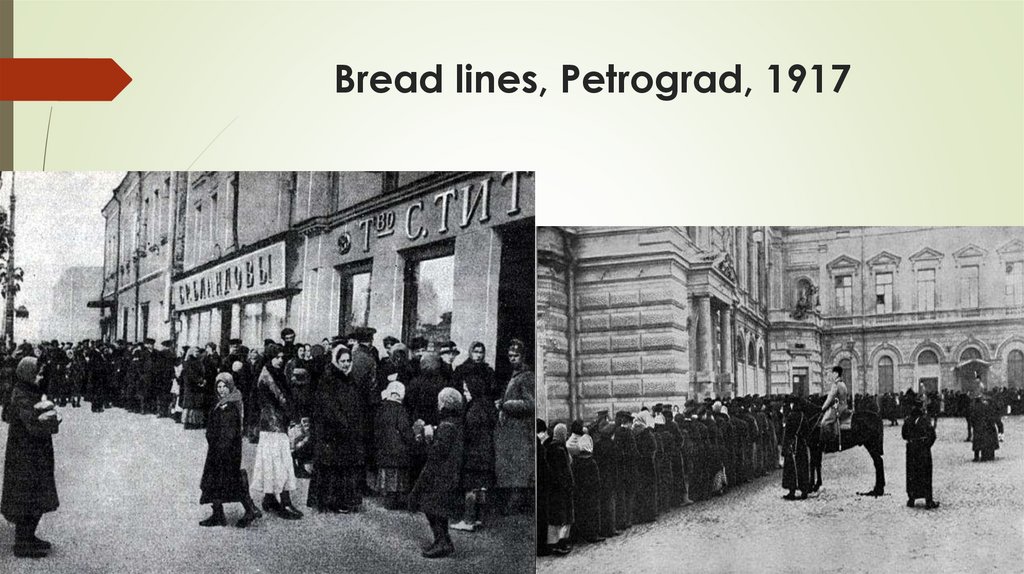
14. Bread lines, Petrograd, 1917
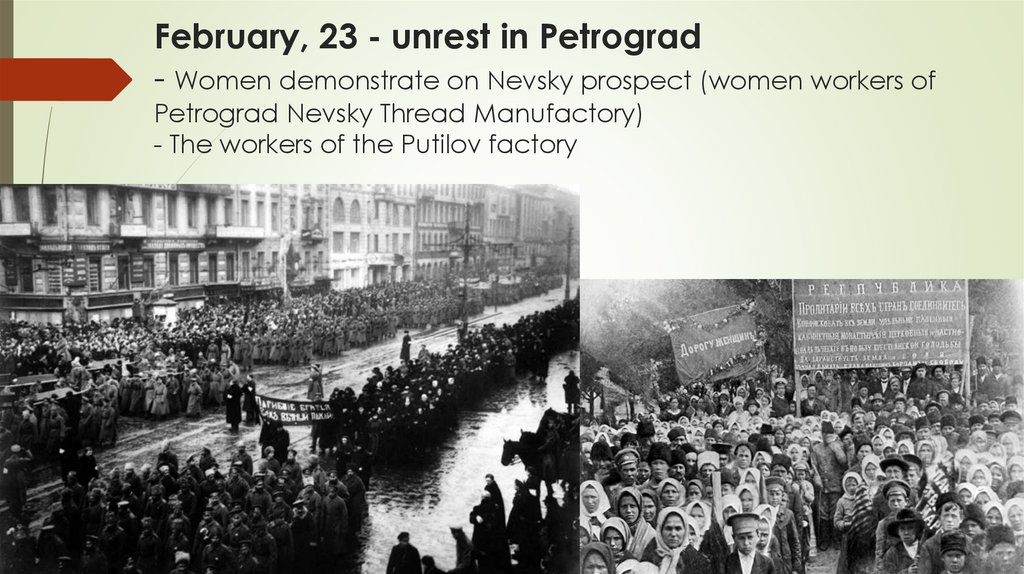
15. February, 23 - unrest in Petrograd - Women demonstrate on Nevsky prospect (women workers of Petrograd Nevsky Thread
Manufactory)- The workers of the Putilov factory
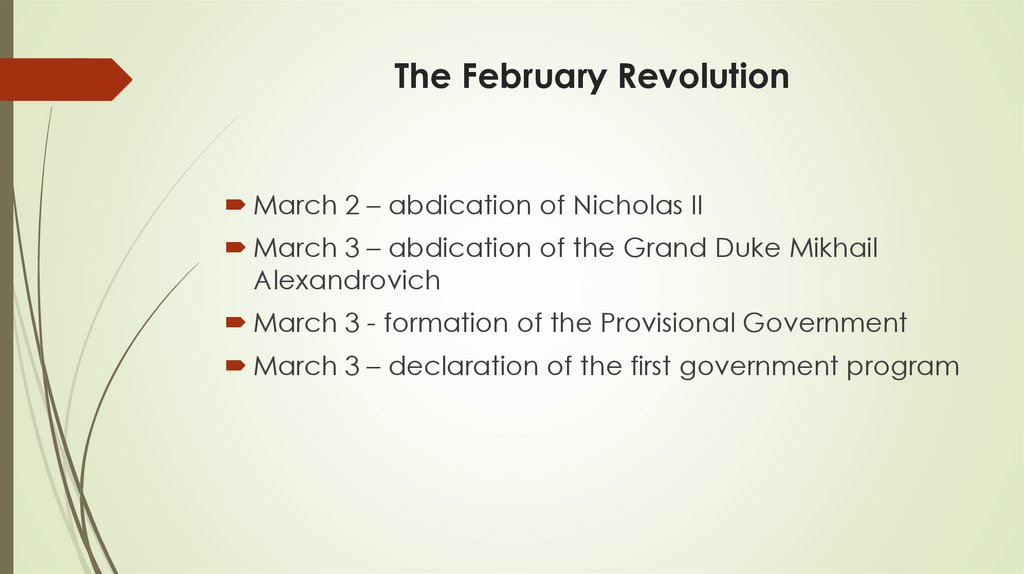
16. The February Revolution
March 2 – abdication of Nicholas IIMarch 3 – abdication of the Grand Duke Mikhail
Alexandrovich
March 3 - formation of the Provisional Government
March 3 – declaration of the first government program
17. Ilya Repin: “How blessed we are. I still can't believe it. How happy I am” Kuzma Petrov-Vodkin: "... A wonderful life awaits
Ilya Repin: “How blessed we are. I still can'tbelieve it. How happy I am”
Kuzma Petrov-Vodkin: "... A wonderful life awaits
our homeland; and the people – the owner of the
Russian land - will become unrecognizably good"
Igor Grabar: "You just live like in a dream and
experience one fairy tale after another... Now life
is so joyful and I want to do so much that my head
is spinning“
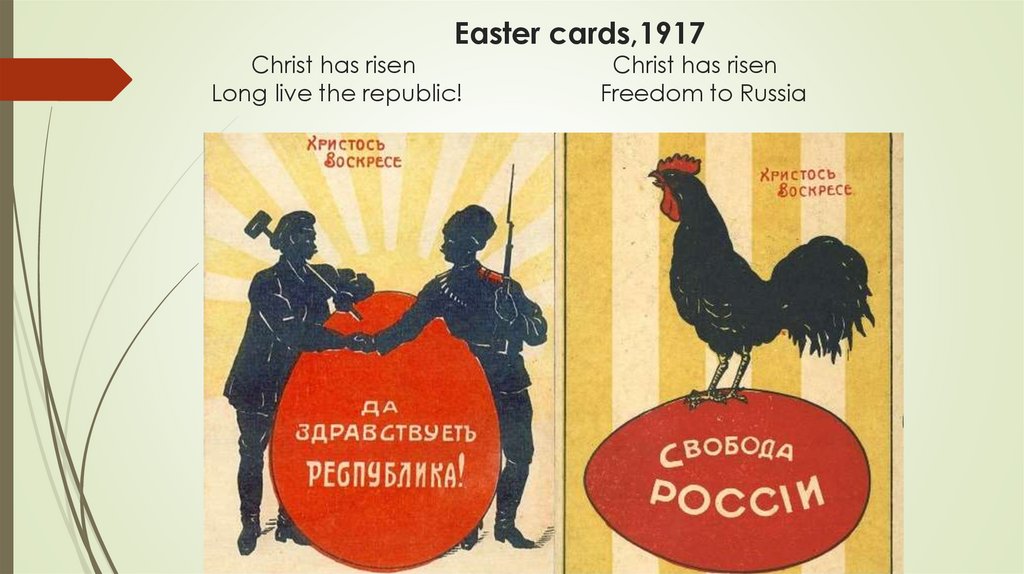
18. Easter cards,1917 Christ has risen Christ has risen Long live the republic! Freedom to Russia
Easter cards,1917Christ has risen
Long live the republic!
Christ has risen
Freedom to Russia
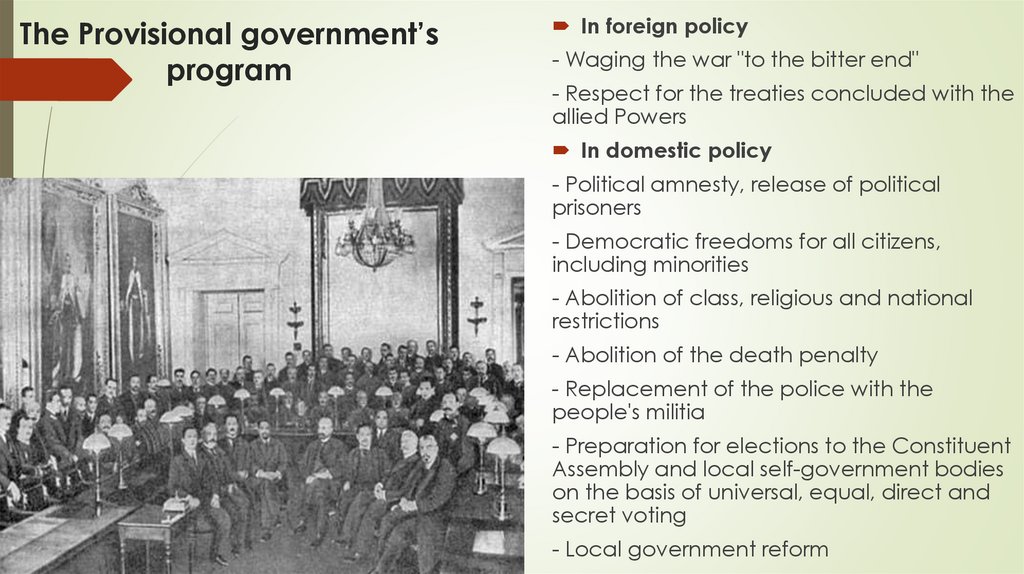
19. The Provisional government’s program
In foreign policy- Waging the war "to the bitter end"
- Respect for the treaties concluded with the
allied Powers
In domestic policy
- Political amnesty, release of political
prisoners
- Democratic freedoms for all citizens,
including minorities
- Abolition of class, religious and national
restrictions
- Abolition of the death penalty
- Replacement of the police with the
people's militia
- Preparation for elections to the Constituent
Assembly and local self-government bodies
on the basis of universal, equal, direct and
secret voting
- Local government reform
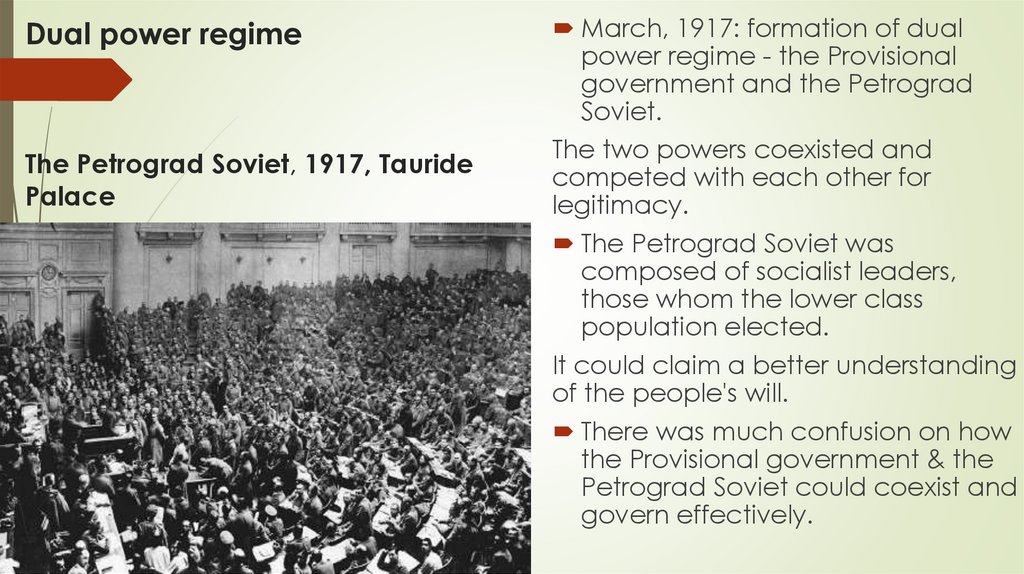
20. Dual power regime The Petrograd Soviet, 1917, Tauride Palace
March, 1917: formation of dualpower regime - the Provisional
government and the Petrograd
Soviet.
The two powers coexisted and
competed with each other for
legitimacy.
The Petrograd Soviet was
composed of socialist leaders,
those whom the lower class
population elected.
It could claim a better understanding
of the people's will.
There was much confusion on how
the Provisional government & the
Petrograd Soviet could coexist and
govern effectively.
21. The Provisional government crises
April crisis: caused by a note of the Foreign Minister Milyukovon the continuation of Russia’s participation in the war,
fighting the war "to the bitter end“
July: riots in Petrograd, negotiations with Ukraine on
autonomy, Finland’s demand for independence
The Provisional Government postponed any restructuring of the
former empire, but the continued deterioration of the center's
authority brought forth the response of escalating demands for
autonomy.
August: General Lavr Kornilov failed revolt
A nationwide crisis affecting social, economic, and political
spheres
Radicalization of politics towards the left. The Bolsheviks
gained considerable popularity thanks to their attractive
slogans.
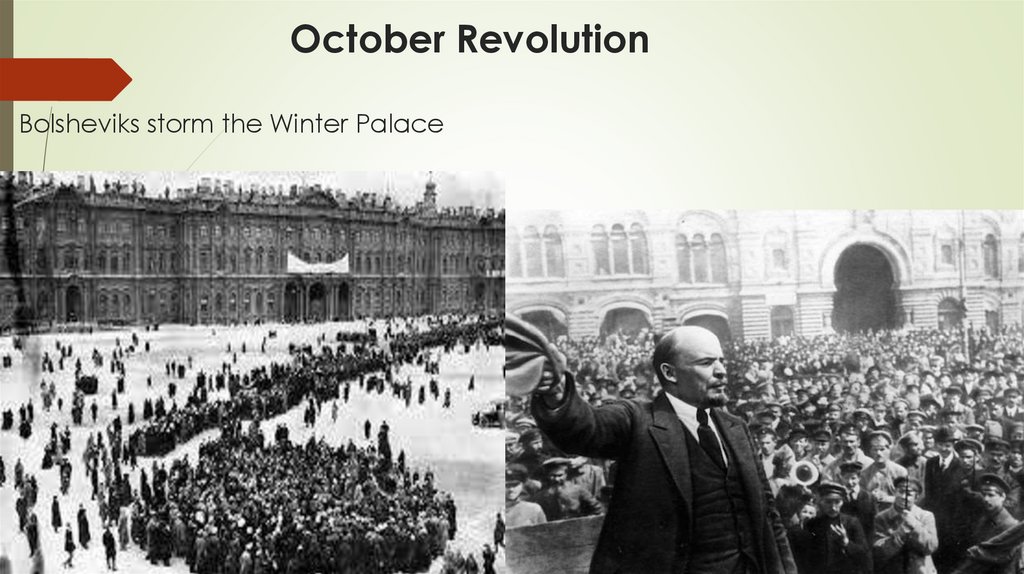
22. October Revolution Bolsheviks storm the Winter Palace
23. October Revolution
October 24 – the launch of an armed uprisingOctober 25 – seizure of the general staff, the
telegraph office, railway stations and other facilities
October 25 – deposition of the Provisional
Government
October, 25 – the Second All-Russian Congress of
Soviets was held in Smolny
Soviet power was gradually established throughout
the territory of the former Russian Empire: “The
triumphal march of Soviet Power”.
24. The Second All-Russian Congress (November 7–9)
The Second All-Russian Congress (November 7–9)The two main documents were adopted by the Congress
- The Decree on Peace proposed an immediate Russia's withdrawal from
the war. It called on all warring parties to immediately begin negotiations
for a just and democratic peace.
The right to self-determination was proclaimed.
- The Decree on land. All land became the common national heritage.
The land was redistributed to peasants.
Everyone could cultivate the land only by their own labor on the basis of
equalized land use.
The document abolished private property.
The first Soviet government was established – the Council of People's
Commissars (Sovnarkom)
Political competition was eliminated, a one-party political system was
formed.
25. The main reasons for public support of Bolsheviks
decisive liquidation of landlord ownershiptransfer of land to peasants
withdrawal from the war
introduction of workers' control in industry
recognition of the right of the peoples of the former
empire to acquire state independence
26. Main problems
November 1917: The Constituent Assembly was electedand dissolved
The Bolsheviks gained 24 % of the votes, losing to the Social
Revolutionaries (60 %)
The seizure of power. The establishment of the Bolsheviks’
dictatorship instead of creating a democratic government
and tackling the pressing problems of the people.
The Bolsheviks did not fulfill many of their promises (transfer
of land to peasants, convocation of the Constituent
Assembly, ensuring the right of nations to selfdetermination)
27. The results
Overthrow of power (first the Emperor, then theProvisional Government)
Formation of a new statehood, transformation of
institutions and state structures
Failure of the democratic experiment, restoration of the
autocratic regime in a new form
The October Revolution was not recognized by many
segments of the population in Russia. The Civil War broke
out (1918-1922). The Bolsheviks lost elections and came
to power by force of arms, winning the Civil war
28. Interpretations of the October revolution
The revolution was popular, in the sense of involving massesof people and broad support for Soviet power (if not the
Bolshevik party itself)
The degree, consistency, durability and meaning of that
support remain a matter of dispute.
October revolution was a coup without popular support. The
Revolution is viewed as the implementation of the extremist
plan of the party.
A version of the accidental nature of the Revolution.