



 Право
ПравоПохожие презентации:










The Formation of Law in France: From Ancient Customs to the Civil Code
1. The Formation of Law in France: From Ancient Customs to the Civil Code
HOW DID FRENCH LAW EVOLVE FROMLOCAL CUSTOMS INTO A UNIFIED SYSTEM?
WHICH DOCUMENTS DEFINED THE LAW IN
EACH HISTORICAL ERA?
WHO PLAYED A KEY ROLE IN ITS
FORMATION?
HOW DID THE NAPOLEONIC CODE BECOME
A MODEL FOR THE WORLD?
2. Introduction: The French Legal Identity
• The core of the Romano-Germanic(Civil Law) legal family.
A synthesis of Roman law, Germanic
customs, and canon (ecclesiastical)
law.
The journey
from fragmentation to codification and
centralization.
3. Historical Stage 1: Gallo-Roman & Frankish Period (Antiquity – 9th Century)
Historical Stage 1: GalloRoman & Frankish Period(Antiquity – 9th Century)
• Gallo-Roman Gaul: Dominance of
written Roman Law.
Frankish Kingdoms: Introduction of
oral Germanic customary
law (e.g., Lex Salica).
Principle: Personality of Law (law
follows a person's origin).
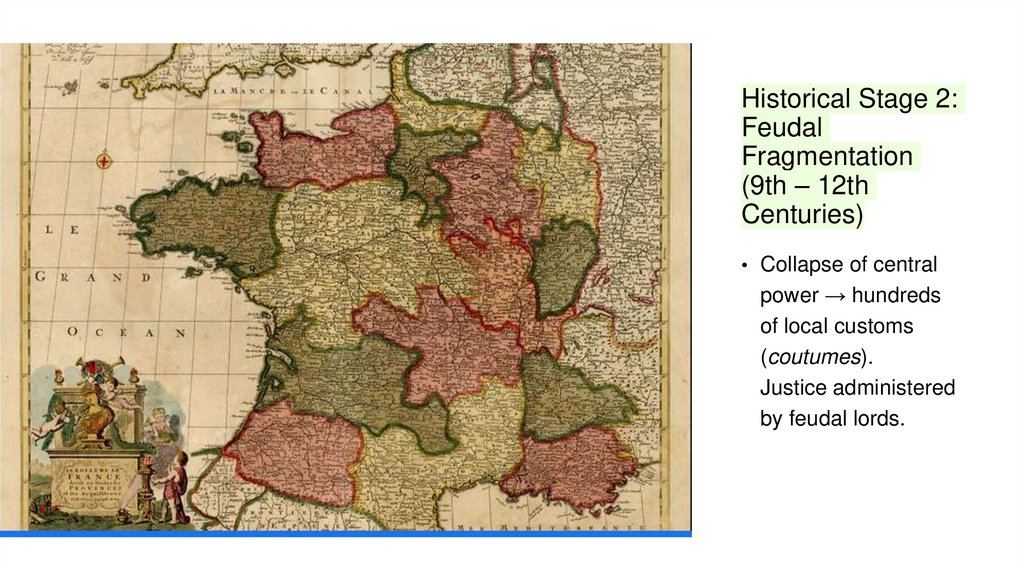
4. Historical Stage 2: Feudal Fragmentation (9th – 12th Centuries)
• Collapse of centralpower → hundreds
of local customs
(coutumes).
Justice administered
by feudal lords.
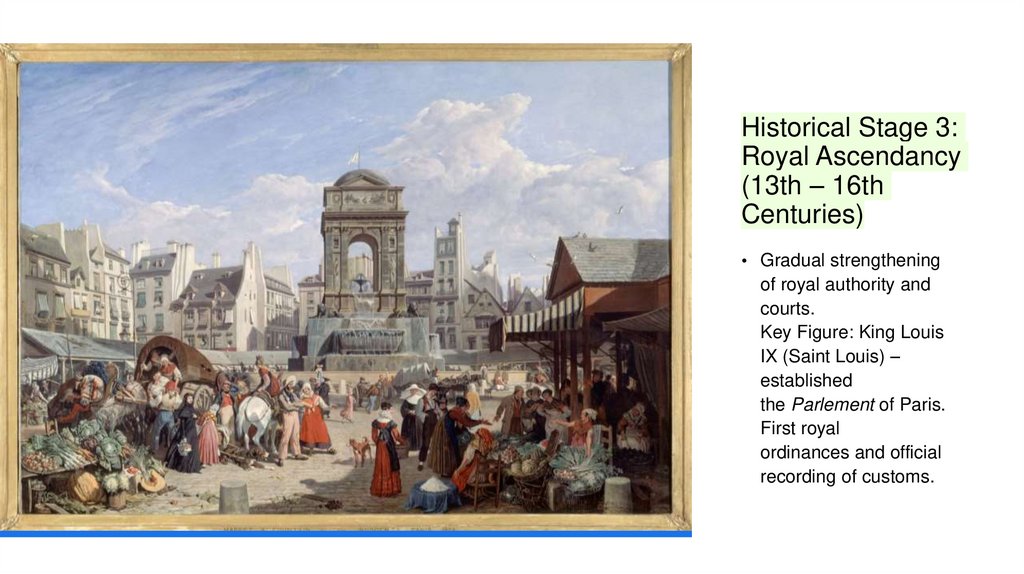
5. Historical Stage 3: Royal Ascendancy (13th – 16th Centuries)
• Gradual strengtheningof royal authority and
courts.
Key Figure: King Louis
IX (Saint Louis) –
established
the Parlement of Paris.
First royal
ordinances and official
recording of customs.
6. Historical Stage 4: Absolutism and the Call for Reform (17th – 18th Centuries)
• Peak of royal power, but legalchaos persists.
Contradiction: National monarchy vs.
local laws.
Enlightenment ideas demand
a single, rational legal code for all.
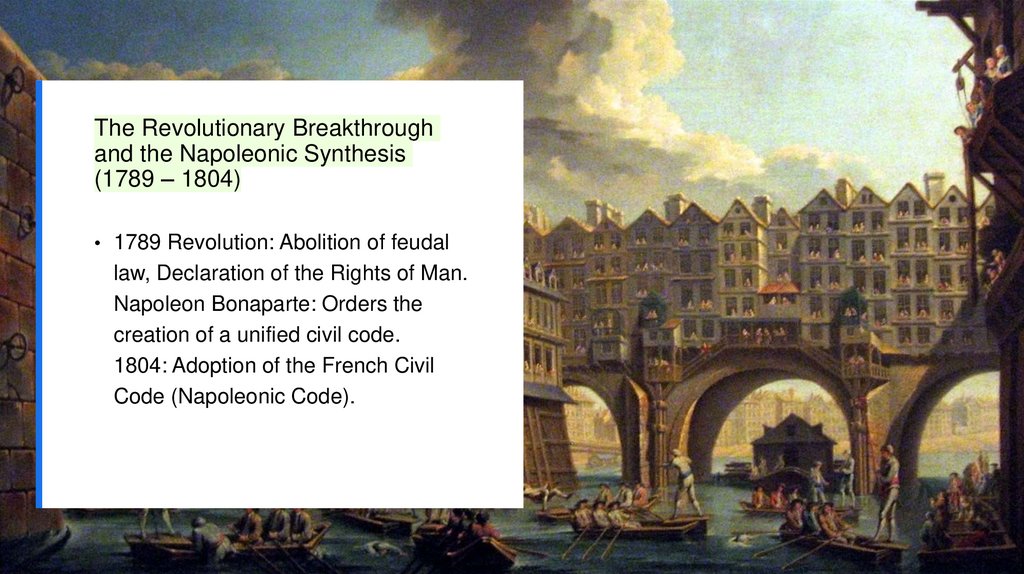
7. The Revolutionary Breakthrough and the Napoleonic Synthesis (1789 – 1804)
• 1789 Revolution: Abolition of feudallaw, Declaration of the Rights of Man.
Napoleon Bonaparte: Orders the
creation of a unified civil code.
1804: Adoption of the French Civil
Code (Napoleonic Code).
8.
Key Legal Documentsand Figures
Text on the slide:
Document / FigureRole
/ SignificanceLex
Salica (5th c.)
• Foundation of Frankish
customary law.
Ordinances of KingsStep
towards national royal
legislation. Declaration of
the Rights of Man (1789)
Philosophical and legal
basis of modern
law.Napoleonic Code
(1804) Unified, logical,
secular code; a model for
the world.
9. Conclusion and Legacy
Main Trend: From fragmentation →
to unification and codification.
Key Result: Creation of
the Napoleonic Code – ensured
legal uniformity, clarity, and equality.
Global Impact: The Code became
the basis for legal systems in
Europe, Latin America, and beyond.