 Военное дело
Похожие презентации:
War crimes. Ways to deal with them
1. War crimes. Ways to deal with them
Glushachenkov NikitaОС-40.05.01.00-22
2. Purpose:
The purpose of my presenttion is to showways to combat war crimes in different
countries
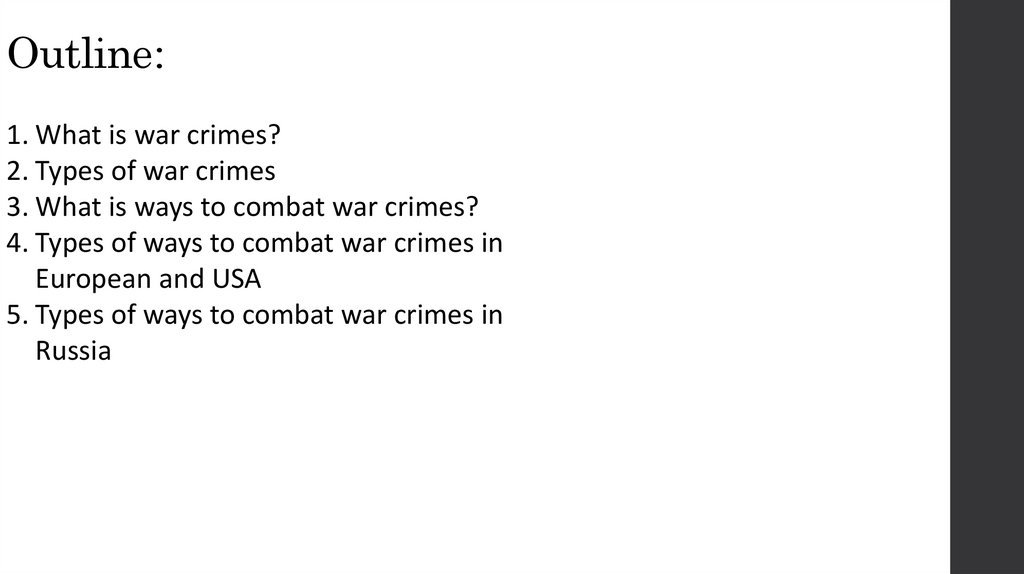
3. Outline:
1. What is war crimes?2. Types of war crimes
3. What is ways to combat war crimes?
4. Types of ways to combat war crimes in
European and USA
5. Types of ways to combat war crimes in
Russia
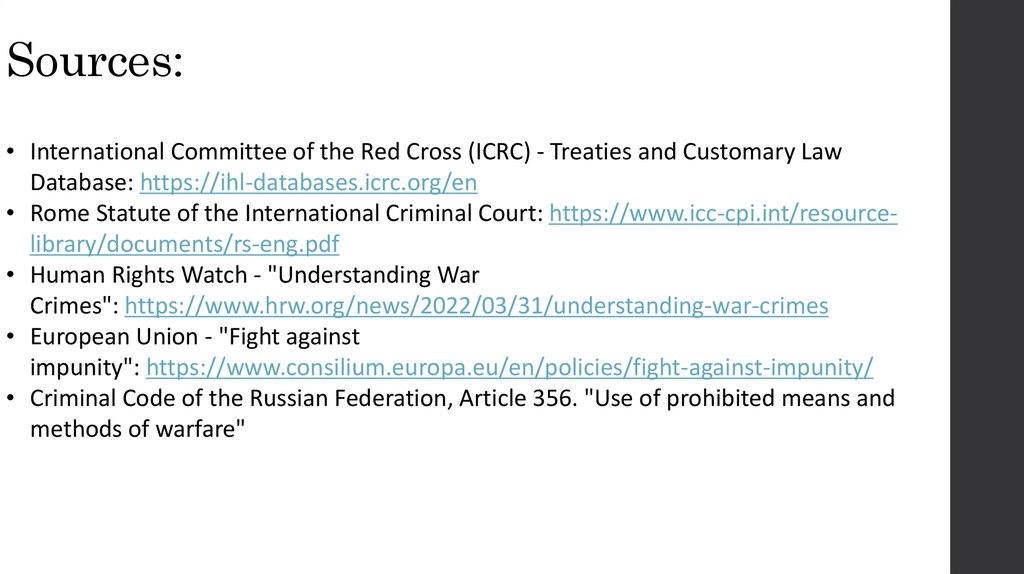
4. Sources:
• International Committee of the Red Cross (ICRC) - Treaties and Customary LawDatabase: https://ihl-databases.icrc.org/en
• Rome Statute of the International Criminal Court: https://www.icc-cpi.int/resourcelibrary/documents/rs-eng.pdf
• Human Rights Watch - "Understanding War
Crimes": https://www.hrw.org/news/2022/03/31/understanding-war-crimes
• European Union - "Fight against
impunity": https://www.consilium.europa.eu/en/policies/fight-against-impunity/
• Criminal Code of the Russian Federation, Article 356. "Use of prohibited means and
methods of warfare"
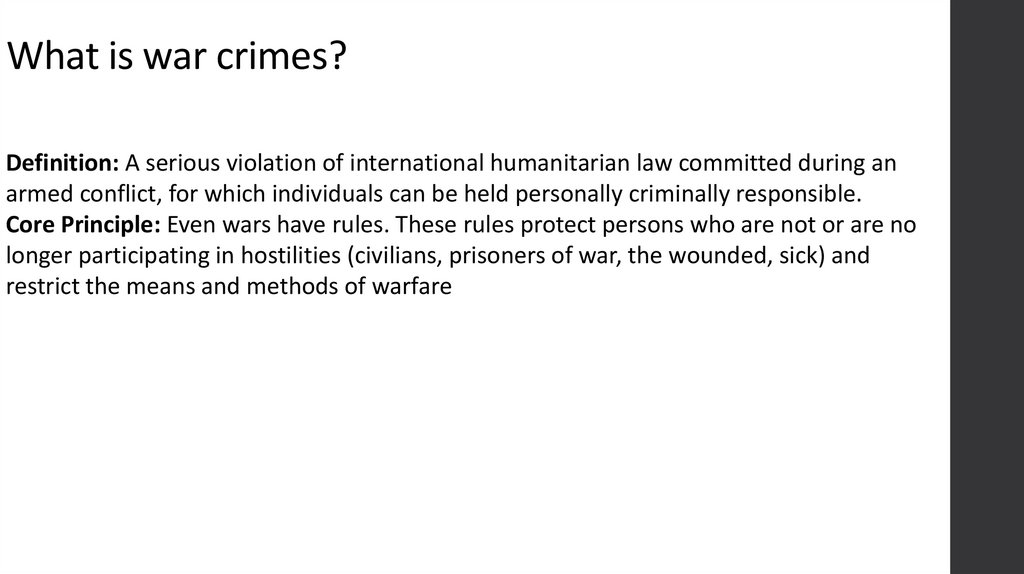
5. What is war crimes?
Definition: A serious violation of international humanitarian law committed during anarmed conflict, for which individuals can be held personally criminally responsible.
Core Principle: Even wars have rules. These rules protect persons who are not or are no
longer participating in hostilities (civilians, prisoners of war, the wounded, sick) and
restrict the means and methods of warfare
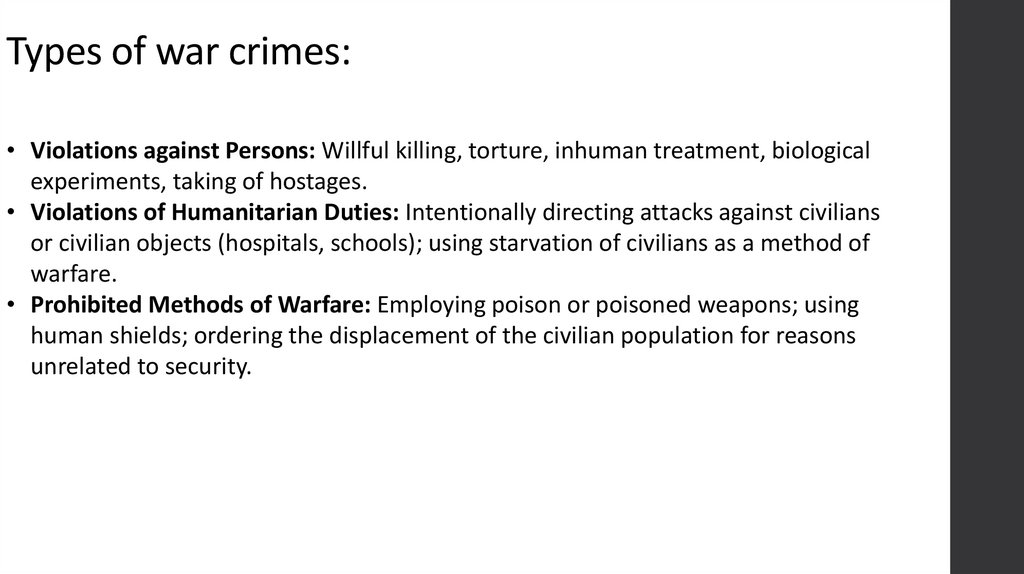
6. Types of war crimes:
• Violations against Persons: Willful killing, torture, inhuman treatment, biologicalexperiments, taking of hostages.
• Violations of Humanitarian Duties: Intentionally directing attacks against civilians
or civilian objects (hospitals, schools); using starvation of civilians as a method of
warfare.
• Prohibited Methods of Warfare: Employing poison or poisoned weapons; using
human shields; ordering the displacement of the civilian population for reasons
unrelated to security.
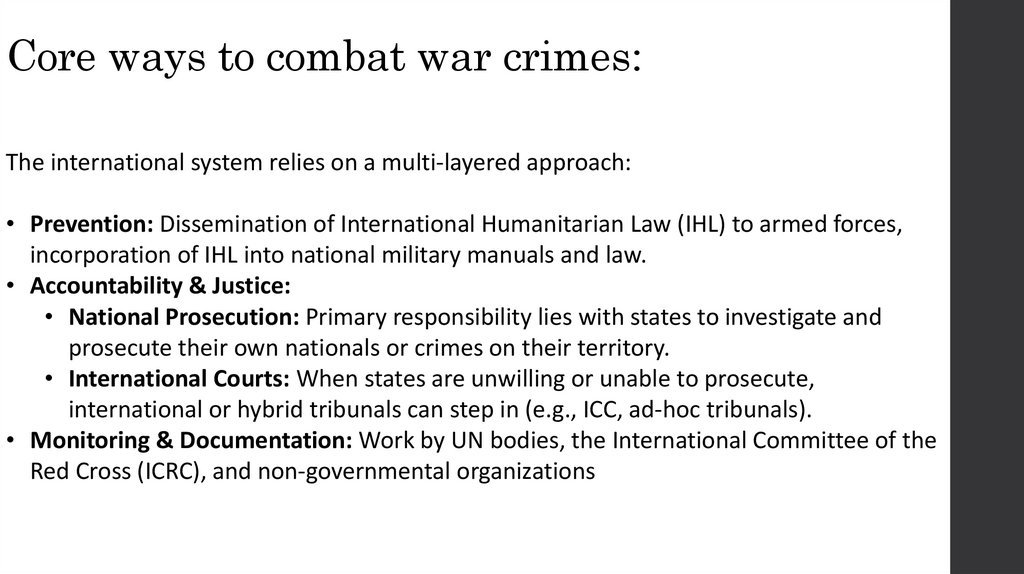
7. Core ways to combat war crimes:
The international system relies on a multi-layered approach:• Prevention: Dissemination of International Humanitarian Law (IHL) to armed forces,
incorporation of IHL into national military manuals and law.
• Accountability & Justice:
• National Prosecution: Primary responsibility lies with states to investigate and
prosecute their own nationals or crimes on their territory.
• International Courts: When states are unwilling or unable to prosecute,
international or hybrid tribunals can step in (e.g., ICC, ad-hoc tribunals).
• Monitoring & Documentation: Work by UN bodies, the International Committee of the
Red Cross (ICRC), and non-governmental organizations
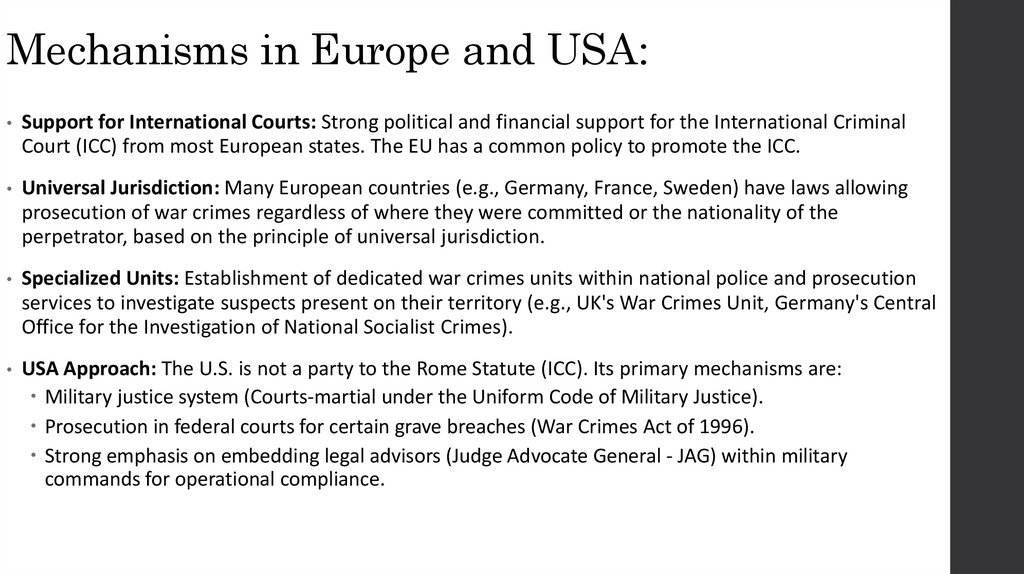
8. Mechanisms in Europe and USA:
• Support for International Courts: Strong political and financial support for the International CriminalCourt (ICC) from most European states. The EU has a common policy to promote the ICC.
• Universal Jurisdiction: Many European countries (e.g., Germany, France, Sweden) have laws allowing
prosecution of war crimes regardless of where they were committed or the nationality of the
perpetrator, based on the principle of universal jurisdiction.
• Specialized Units: Establishment of dedicated war crimes units within national police and prosecution
services to investigate suspects present on their territory (e.g., UK's War Crimes Unit, Germany's Central
Office for the Investigation of National Socialist Crimes).
• USA Approach: The U.S. is not a party to the Rome Statute (ICC). Its primary mechanisms are:
Military justice system (Courts-martial under the Uniform Code of Military Justice).
Prosecution in federal courts for certain grave breaches (War Crimes Act of 1996).
Strong emphasis on embedding legal advisors (Judge Advocate General - JAG) within military
commands for operational compliance.
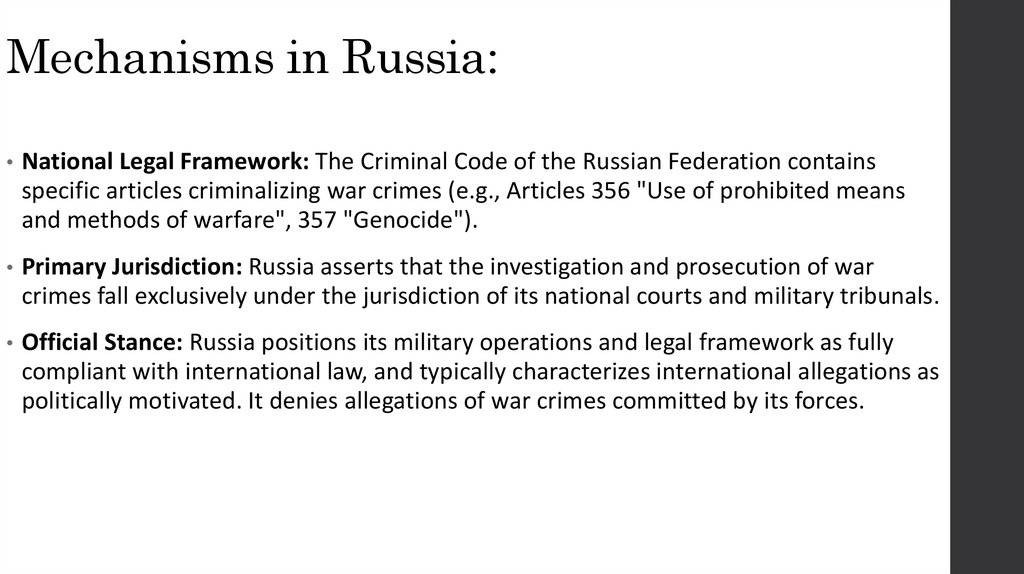
9. Mechanisms in Russia:
• National Legal Framework: The Criminal Code of the Russian Federation containsspecific articles criminalizing war crimes (e.g., Articles 356 "Use of prohibited means
and methods of warfare", 357 "Genocide").
• Primary Jurisdiction: Russia asserts that the investigation and prosecution of war
crimes fall exclusively under the jurisdiction of its national courts and military tribunals.
• Official Stance: Russia positions its military operations and legal framework as fully
compliant with international law, and typically characterizes international allegations as
politically motivated. It denies allegations of war crimes committed by its forces.
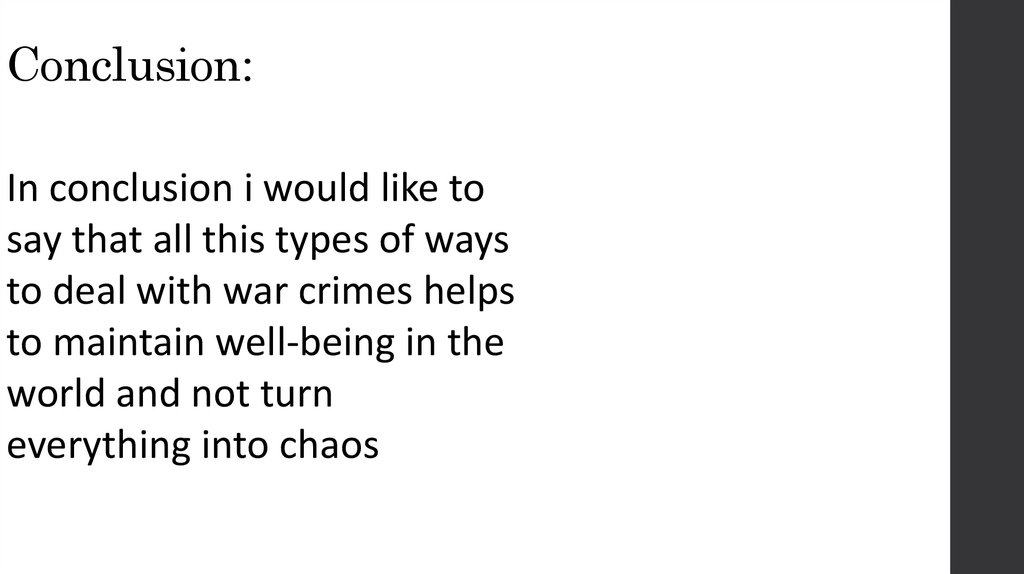
10. Conclusion:
In conclusion i would like tosay that all this types of ways
to deal with war crimes helps
to maintain well-being in the
world and not turn
everything into chaos