

 Экономика
Похожие презентации:





Introduction to Economics
1. Unit 1. Introduction to Economics 1.1 What is economics?
2. Lesson objectives:
• using a PPC diagram, demonstrate the concept of trade-offs andopportunity cost
• explain how a PPC may demonstrate the idea of increasing and
constant opportunity costs
3. PPC Curve Activity: Why is the PPC Bowed Outwards?
• Group 1: Smartphones and Laptops• Group 2: Electric Cars and Solar Panels
• Group 3: Wheat and Milk
• Group 4: Water Purifiers and Medical Masks
4. PPC Curve Activity: Why is the PPC Bowed Outwards?
• Discuss within your group the available resources for your production (workers, land,machines, technology, raw materials).
• Understand which good your economy is more specialized in producing and how reallocating
resources will impact the production of the other good.
• Discuss the concept of opportunity cost: What are you giving up when you switch
resources?
• Use a table to record how many units of each good you produce at different levels of resource
allocation.
• Plot your data on a graph.
• Observe the shape of your PPC. Is it straight or bowed outwards?
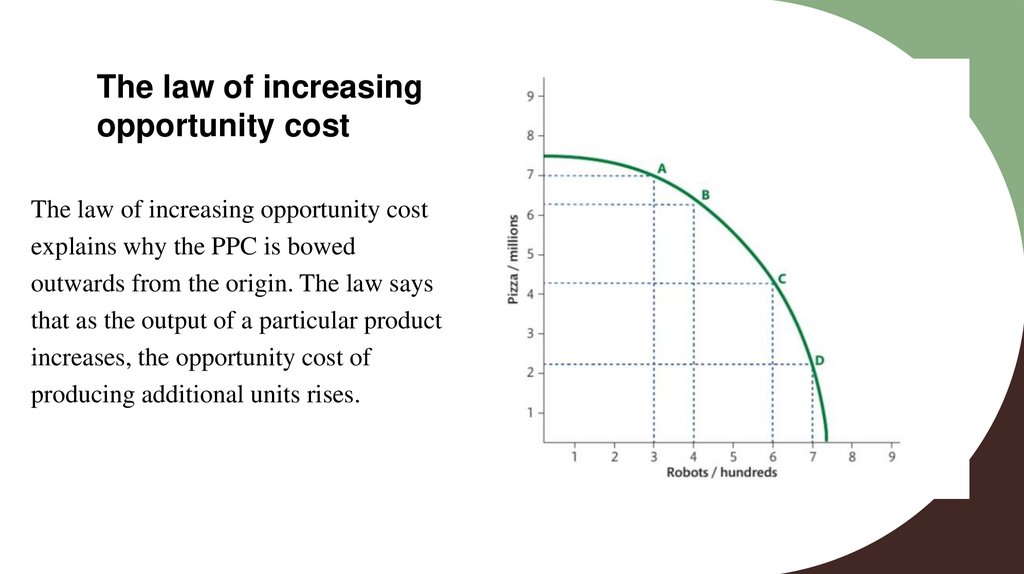
5. The law of increasing opportunity cost
The law of increasing opportunity costexplains why the PPC is bowed
outwards from the origin. The law says
that as the output of a particular product
increases, the opportunity cost of
producing additional units rises.
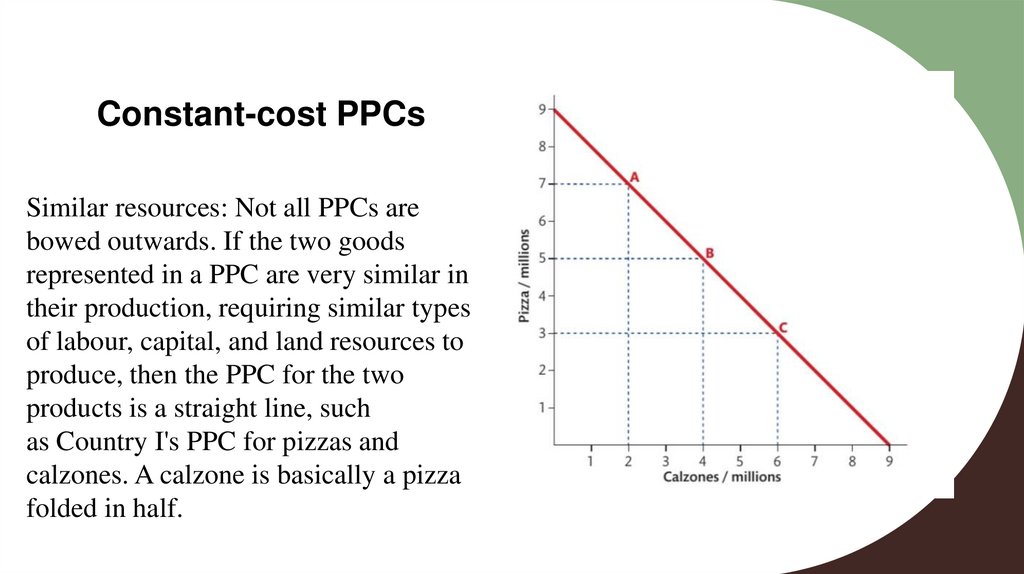
6. Constant-cost PPCs
Similar resources: Not all PPCs arebowed outwards. If the two goods
represented in a PPC are very similar in
their production, requiring similar types
of labour, capital, and land resources to
produce, then the PPC for the two
products is a straight line, such
as Country I's PPC for pizzas and
calzones. A calzone is basically a pizza
folded in half.
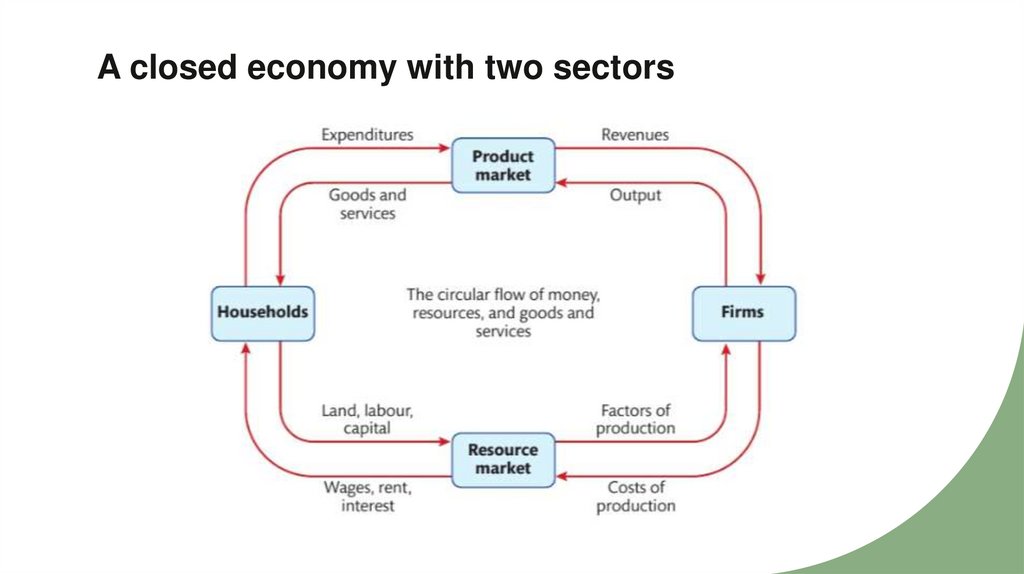
7. The circular flow of income model
describe, using a diagram, the circularflow of income between households
and firms in a closed economy with no
government
outline that the income flow is
numerically equivalent to the
expenditure flow and the value of
output flow
explain how the circular flow
demonstrates the interdependence of
all sectors of the economy
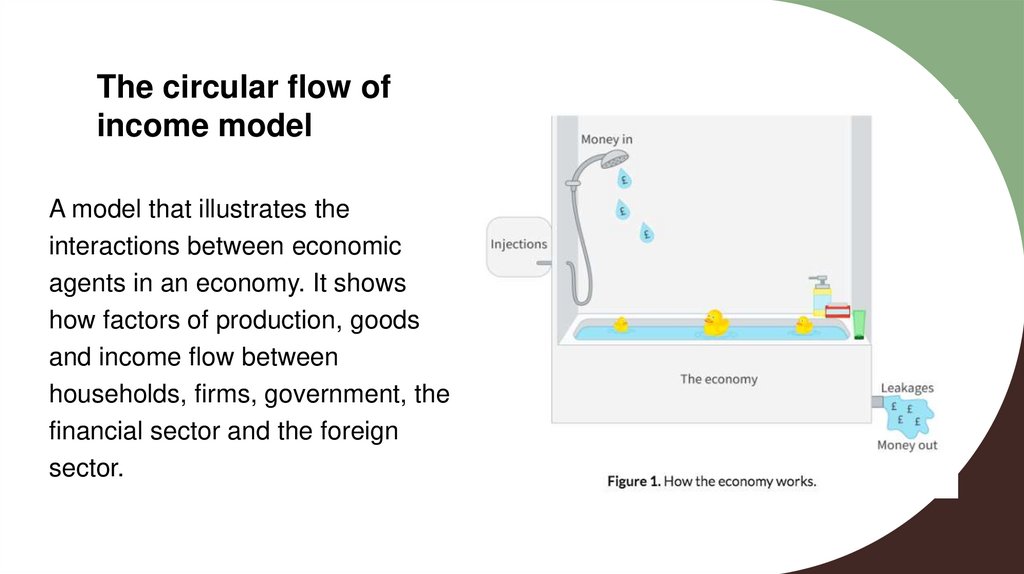
8. The circular flow of income model
A model that illustrates theinteractions between economic
agents in an economy. It shows
how factors of production, goods
and income flow between
households, firms, government, the
financial sector and the foreign
sector.
9.
10. A closed economy with two sectors
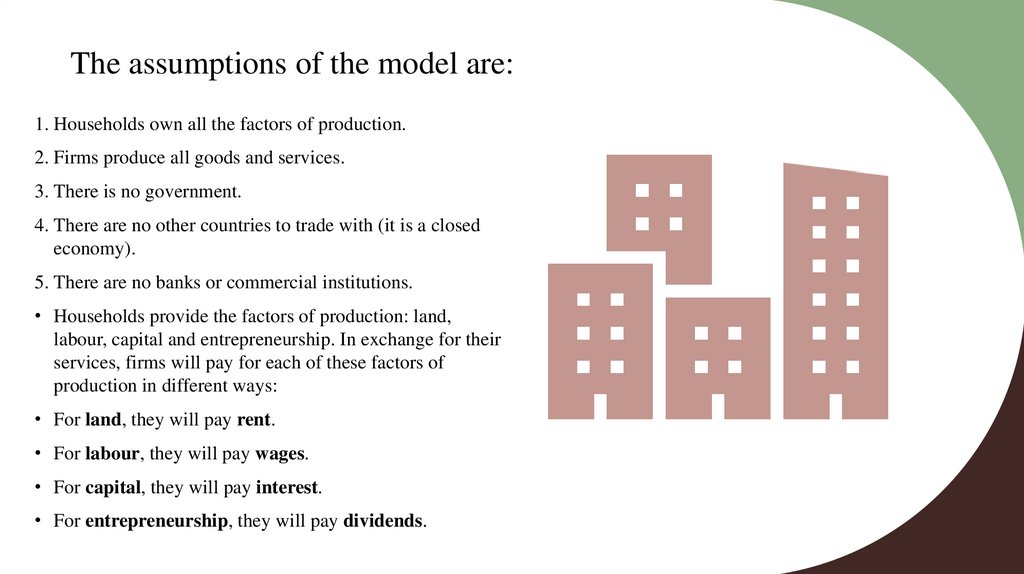
11. The assumptions of the model are:
1. Households own all the factors of production.2. Firms produce all goods and services.
3. There is no government.
4. There are no other countries to trade with (it is a closed
economy).
5. There are no banks or commercial institutions.
• Households provide the factors of production: land,
labour, capital and entrepreneurship. In exchange for their
services, firms will pay for each of these factors of
production in different ways:
• For land, they will pay rent.
• For labour, they will pay wages.
• For capital, they will pay interest.
• For entrepreneurship, they will pay dividends.
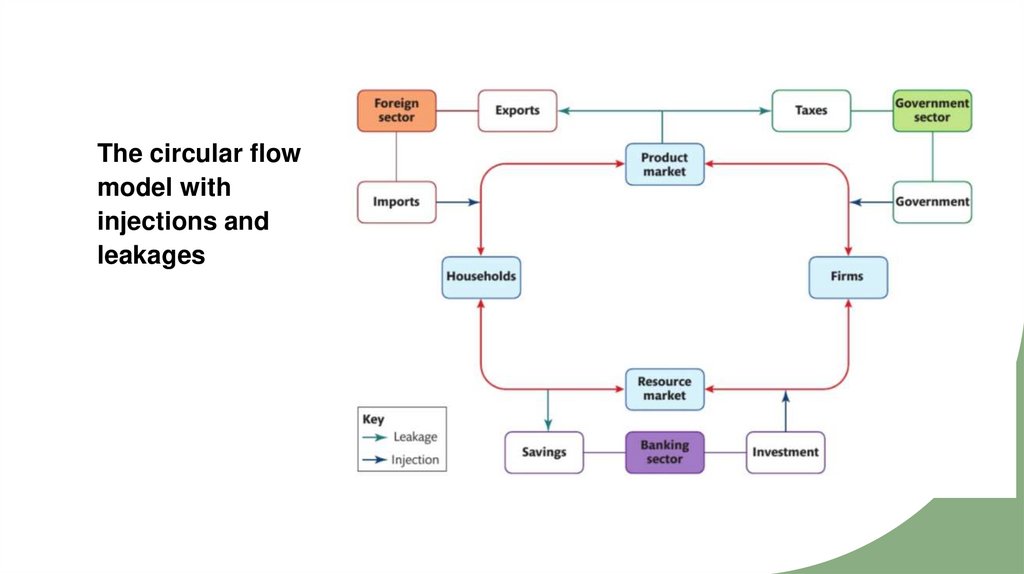
12. The circular flow model with injections and leakages
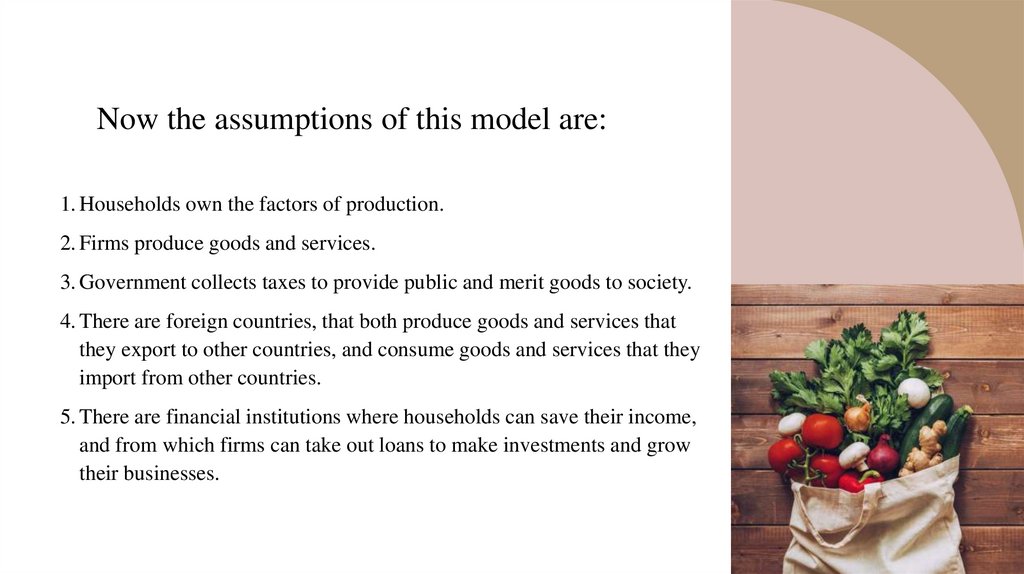
13. Now the assumptions of this model are:
1. Households own the factors of production.2. Firms produce goods and services.
3. Government collects taxes to provide public and merit goods to society.
4. There are foreign countries, that both produce goods and services that
they export to other countries, and consume goods and services that they
import from other countries.
5. There are financial institutions where households can save their income,
and from which firms can take out loans to make investments and grow
their businesses.
14. The government sector: taxes and spending
Governments draw tax money from thepopulation, a leakage of income out of the
model. However, that money should eventually
re-enter the model as government spending on
everything from salaries to infrastructure.
(Even if we assume that some of the money is
lost through corruption, it may also eventually
re-enter as consumer spending) This idea, that
the flow of money never truly escapes the
model, is one that holds true with the other
new actors in the model.
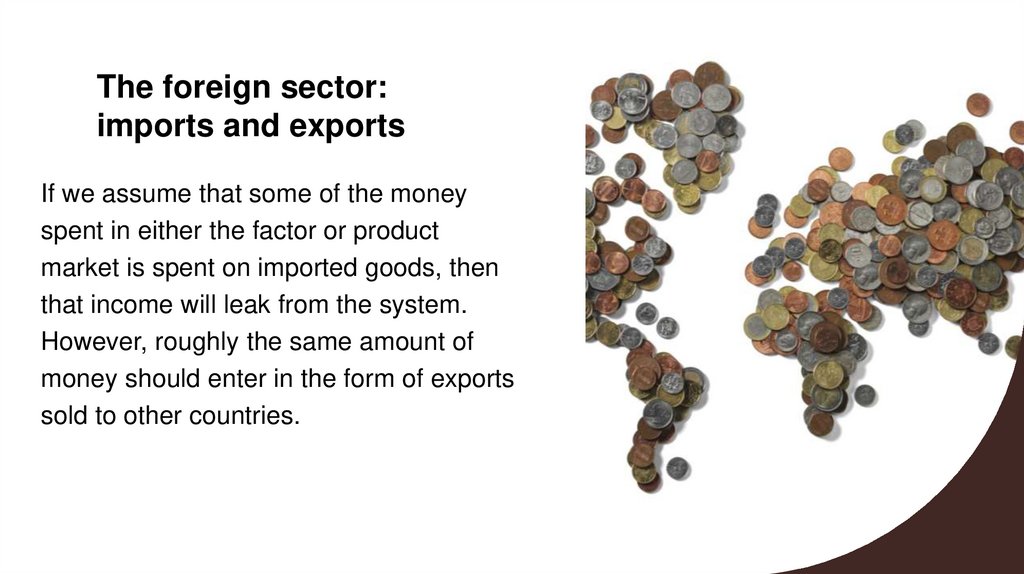
15. The foreign sector: imports and exports
If we assume that some of the moneyspent in either the factor or product
market is spent on imported goods, then
that income will leak from the system.
However, roughly the same amount of
money should enter in the form of exports
sold to other countries.
16. The financial sector: savings and investment
Some consumers save a portion of their money,rather than spend it. Savings would slow down the
flow of expenditure and eventually income.
However, money that is saved in banks is made
available to borrowers. These borrowers then inject
the savings back into the economy in the form of
investment, whether as capital goods or by the
purchase of housing by households. Thus, the
leakages of savings re-enter the system through
loans made by the financial sector.
17. Is the condition National income = National output = National Expenditure true?
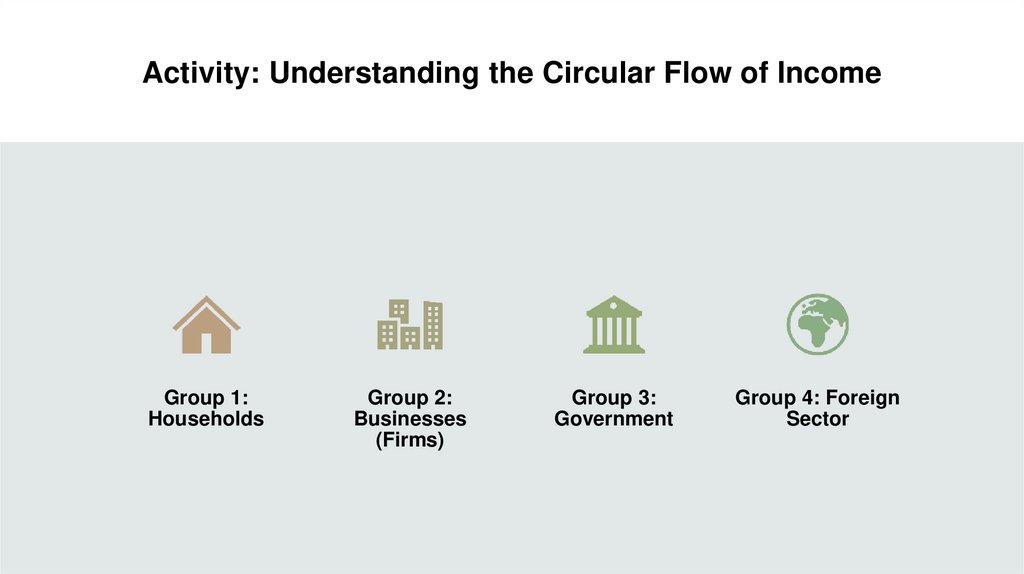
18. Activity: Understanding the Circular Flow of Income
Group 1:Households
Group 2:
Businesses
(Firms)
Group 3:
Government
Group 4: Foreign
Sector