 Менеджмент
Похожие презентации:






Summary Report of 2025 Yearly Plan for 2026
1.
ProcessAutomation
Division
SUMMARY REPORT OF 2025
YEARLY PLAN FOR 2026
2.
Key Achievements in 2025Contract overview in 2025
Personnel Status
Key Issues & Risks
Key Plans for 2026
3.
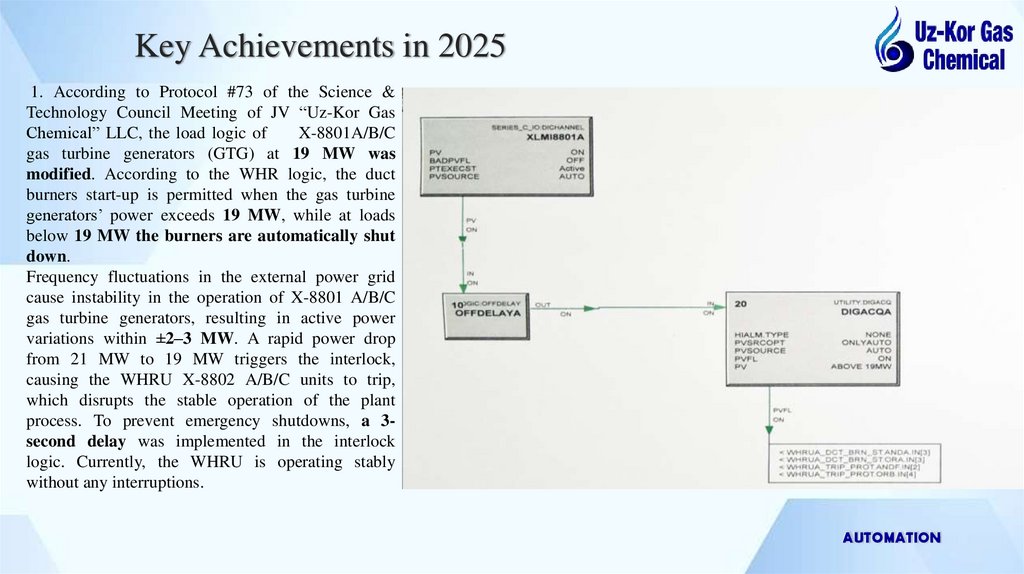
Key Achievements in 20251. According to Protocol #73 of the Science &
Technology Council Meeting of JV “Uz-Kor Gas
Chemical” LLC, the load logic of
X-8801A/B/C
gas turbine generators (GTG) at 19 MW was
modified. According to the WHR logic, the duct
burners start-up is permitted when the gas turbine
generators’ power exceeds 19 MW, while at loads
below 19 MW the burners are automatically shut
down.
Frequency fluctuations in the external power grid
cause instability in the operation of X-8801 A/B/C
gas turbine generators, resulting in active power
variations within ±2–3 MW. A rapid power drop
from 21 MW to 19 MW triggers the interlock,
causing the WHRU X-8802 A/B/C units to trip,
which disrupts the stable operation of the plant
process. To prevent emergency shutdowns, a 3second delay was implemented in the interlock
logic. Currently, the WHRU is operating stably
without any interruptions.
AUTOMATION
4.
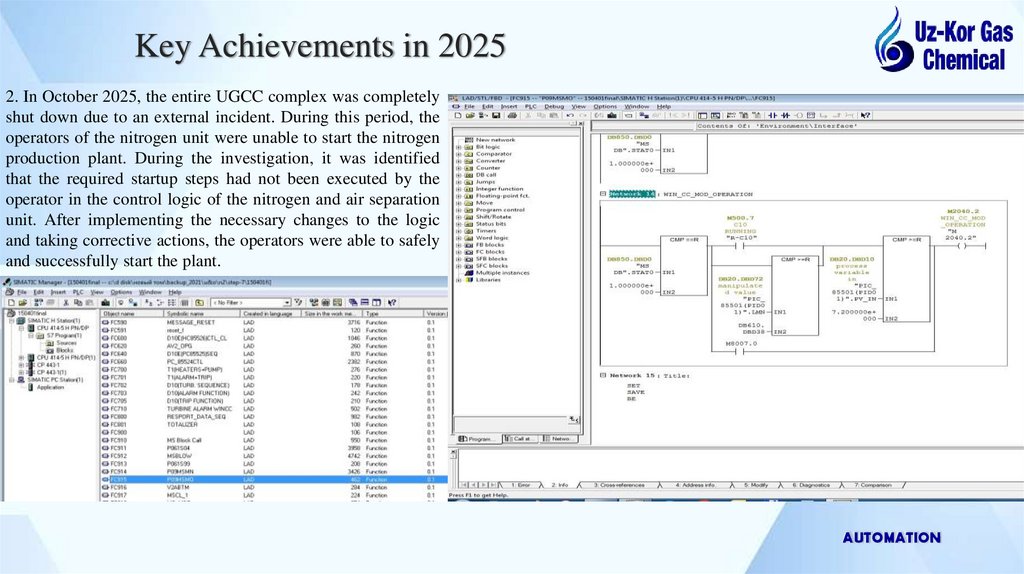
Key Achievements in 20252. In October 2025, the entire UGCC complex was completely
shut down due to an external incident. During this period, the
operators of the nitrogen unit were unable to start the nitrogen
production plant. During the investigation, it was identified
that the required startup steps had not been executed by the
operator in the control logic of the nitrogen and air separation
unit. After implementing the necessary changes to the logic
and taking corrective actions, the operators were able to safely
and successfully start the plant.
AUTOMATION
5.
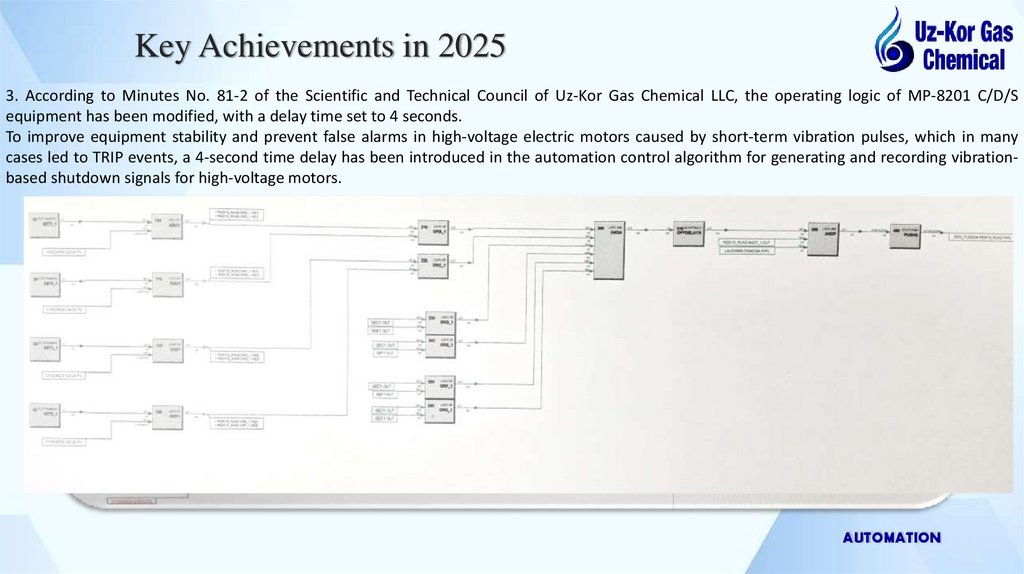
Key Achievements in 20253. According to Minutes No. 81-2 of the Scientific and Technical Council of Uz-Kor Gas Chemical LLC, the operating logic of MP-8201 C/D/S
equipment has been modified, with a delay time set to 4 seconds.
To improve equipment stability and prevent false alarms in high-voltage electric motors caused by short-term vibration pulses, which in many
cases led to TRIP events, a 4-second time delay has been introduced in the automation control algorithm for generating and recording vibrationbased shutdown signals for high-voltage motors.
AUTOMATION
6.
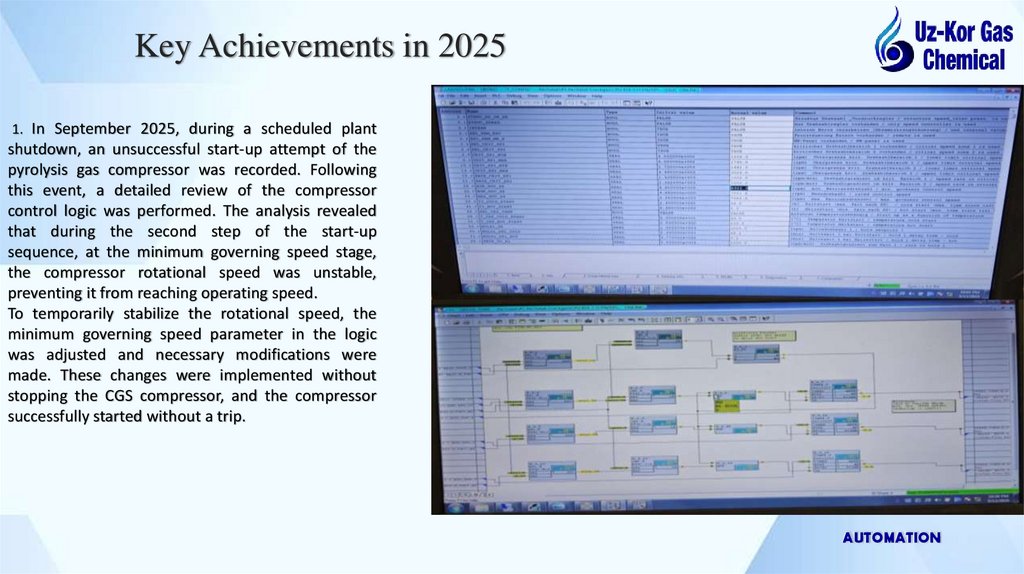
Key Achievements in 20251. In September 2025, during a scheduled plant
shutdown, an unsuccessful start-up attempt of the
pyrolysis gas compressor was recorded. Following
this event, a detailed review of the compressor
control logic was performed. The analysis revealed
that during the second step of the start-up
sequence, at the minimum governing speed stage,
the compressor rotational speed was unstable,
preventing it from reaching operating speed.
To temporarily stabilize the rotational speed, the
minimum governing speed parameter in the logic
was adjusted and necessary modifications were
made. These changes were implemented without
stopping the CGS compressor, and the compressor
successfully started without a trip.
AUTOMATION
7.
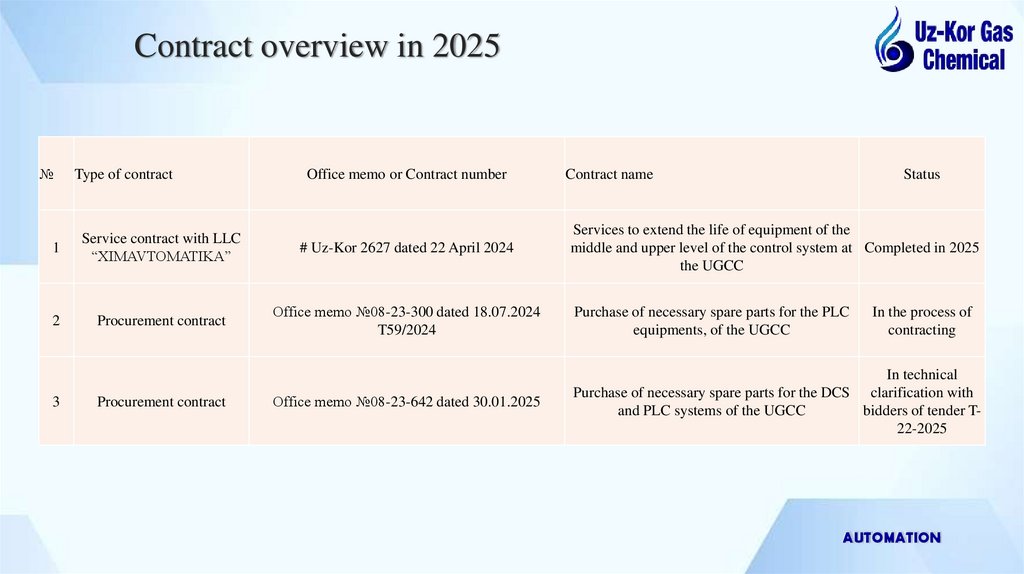
Contract overview in 2025№
Office memo or Contract number
Contract name
1
Service contract with LLC
“XIMAVTOMATIKA”
# Uz-Kor 2627 dated 22 April 2024
Services to extend the life of equipment of the
middle and upper level of the control system at Completed in 2025
the UGCC
2
Procurement contract
Office memo №08-23-300 dated 18.07.2024
T59/2024
Purchase of necessary spare parts for the PLC
equipments, of the UGCC
Office memo №08-23-642 dated 30.01.2025
In technical
Purchase of necessary spare parts for the DCS clarification with
and PLC systems of the UGCC
bidders of tender T22-2025
3
Type of contract
Procurement contract
Status
In the process of
contracting
AUTOMATION
8.
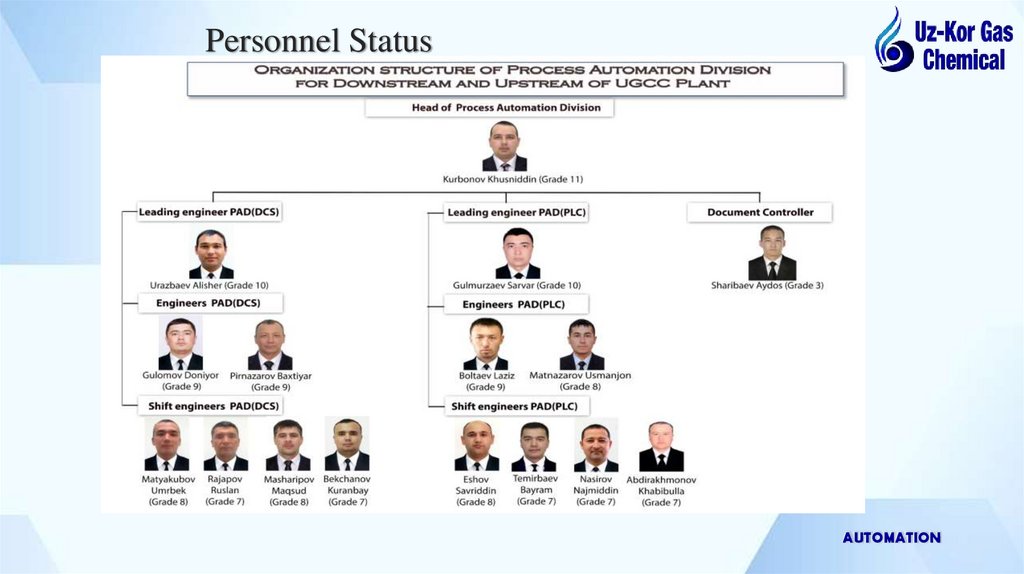
Personnel StatusAUTOMATION
9.
AUTOMATION10.
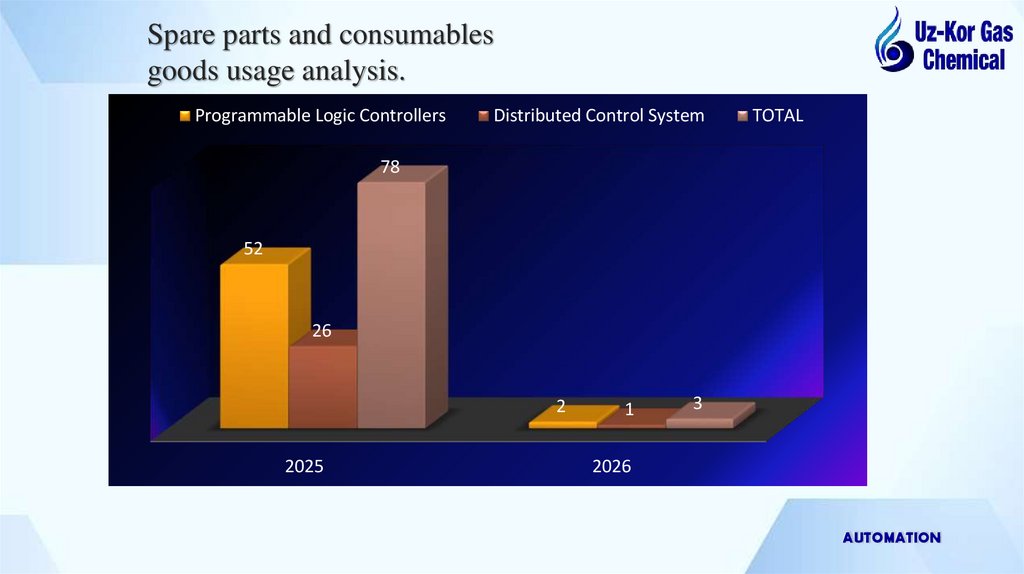
Spare parts and consumablesgoods usage analysis.
Programmable Logic Controllers
Distributed Control System
TOTAL
78
52
26
2
2025
1
3
2026
AUTOMATION
11.
Problems and issues ofAutomation Division
1. The experience and knowledge of the division's engineers.
Training Justification & Risk Assessment
Current Situation
• Automation specialists’ experience: 1–2 years
• Competency level: basic operation
• Systems in use:
• Honeywell Experion PKS (EPKS)
• Honeywell Safety Manager
• PLC systems: Siemens, Allen-Bradley
Key Problem
• Limited ability to independently handle complex and non-standard
failures
• High dependency on:
• Vendors
• external contractors
• Increased exposure to operational and safety risks
Risk Assessment — Without Advanced Training
Operational Risks
• Longer system downtime during incidents
• Slow fault diagnosis and recovery
• Repeated failures due to unresolved root causes
Safety Risks
• Incorrect handling of Safety Instrumented Systems (SIS)
• Increased probability of human error during abnormal conditions
• Potential violation of functional safety requirements (SIL)
Production & Financial Risks
• Unplanned shutdowns of critical process units
• Production losses and missed targets
• Increased maintenance and contractor costs
Compliance & Reputation Risks
• Non-compliance with industry standards (IEC 61508 / IEC 61511)
• Audit findings and regulatory observations
• Reputational damage in case of incidents
Proposed Solution
Implementation of a structured advanced training program, delivered by experienced
and certified engineers, covering:
• Honeywell Experion PKS
• Honeywell Safety Manager
• Siemens PLC
• Allen-Bradley PLC
Expected Business Impact
• Reduced downtime and incident recovery time
• Improved safety and system reliability
• Lower dependence on vendors
• Strong internal automation expertise
AUTOMATION
12.
Problems and issues ofAutomation Division
Training Roadmap
Junior Level (0–2 years) — System
Awareness
Objective: Safe and correct system operation
• DCS / PLC / SIS architecture fundamentals
• Basic Experion PKS and PLC operation
• Reading logic, drawings, and loop
diagrams
• Standard operating procedures
Middle Level (2–4 years) — Independent
Maintenance
Objective: Resolve most system issues
• Advanced diagnostics (DCS, PLC,
networks)
• Industrial networks (EtherNet/IP, Profinet,
Profibus)
• Alarm, event, and trend analysis
• Backup, restore, and recovery
• Participation in commissioning and
modifications
Senior Level (4+ years) — Expert & Risk
Owner
Objective: Minimize operational and
safety risks
• EPKS and SIS architecture &
redundancy
• Safety Manager, SIL, IEC 61511
• Root Cause Analysis of critical failures
• Management of Change (MOC)
• Reduced vendor dependency
Final Value for Oil & Gas / Chemical /
Power Plants
• Stable and safe operation of hazardous
production facilities
• Compliance with international safety
standards
• Reduced lifecycle and operational costs
• Increased production reliability and
resilience
Available courses on the system:
DCS system
Course Title
Target Audience
Main Topics
Control and
System architecture, Control
Experion PKS
automation
Builder basics, HMI overview,
Fundamentals
engineers
alarms
Experion PKS
Engineering with Control
Engineering &
Advanced control Builder, PID loops, HMIWeb,
Configuration
engineers
Modbus/OPC setup
Experion PKS
Operators and
Operating Station usage, alarms,
Operation
dispatchers
trends, screen navigation
Experion PKS
Troubleshooting, FTE/LCN
Maintenance and Maintenance and diagnostics, module replacement,
Troubleshooting support engineers backup/restore
AUTOMATION
13.
Problems and issues ofAutomation Division
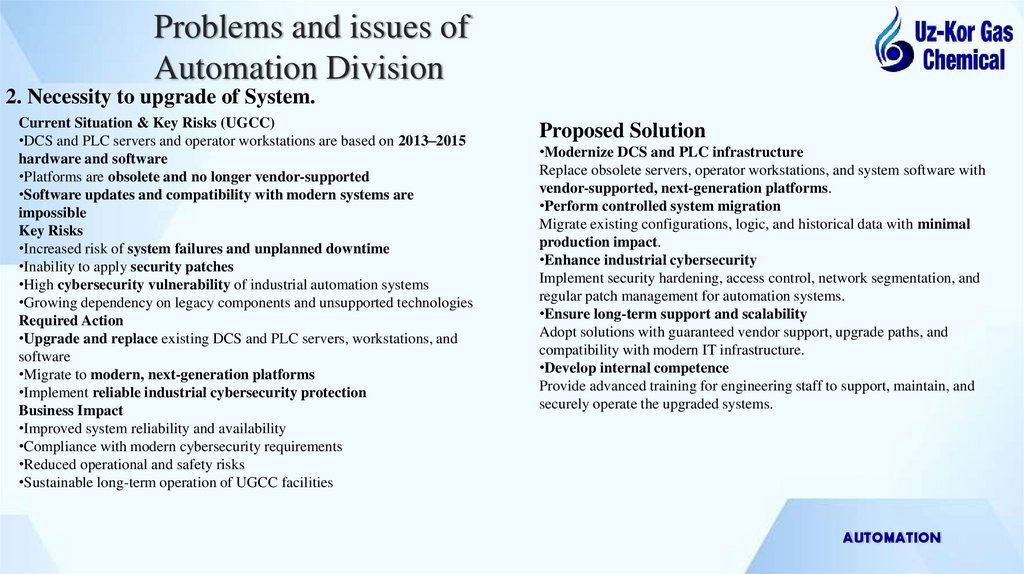
2. Necessity to upgrade of System.
Current Situation & Key Risks (UGCC)
•DCS and PLC servers and operator workstations are based on 2013–2015
hardware and software
•Platforms are obsolete and no longer vendor-supported
•Software updates and compatibility with modern systems are
impossible
Key Risks
•Increased risk of system failures and unplanned downtime
•Inability to apply security patches
•High cybersecurity vulnerability of industrial automation systems
•Growing dependency on legacy components and unsupported technologies
Required Action
•Upgrade and replace existing DCS and PLC servers, workstations, and
software
•Migrate to modern, next-generation platforms
•Implement reliable industrial cybersecurity protection
Business Impact
•Improved system reliability and availability
•Compliance with modern cybersecurity requirements
•Reduced operational and safety risks
•Sustainable long-term operation of UGCC facilities
Proposed Solution
•Modernize DCS and PLC infrastructure
Replace obsolete servers, operator workstations, and system software with
vendor-supported, next-generation platforms.
•Perform controlled system migration
Migrate existing configurations, logic, and historical data with minimal
production impact.
•Enhance industrial cybersecurity
Implement security hardening, access control, network segmentation, and
regular patch management for automation systems.
•Ensure long-term support and scalability
Adopt solutions with guaranteed vendor support, upgrade paths, and
compatibility with modern IT infrastructure.
•Develop internal competence
Provide advanced training for engineering staff to support, maintain, and
securely operate the upgraded systems.
AUTOMATION
14.
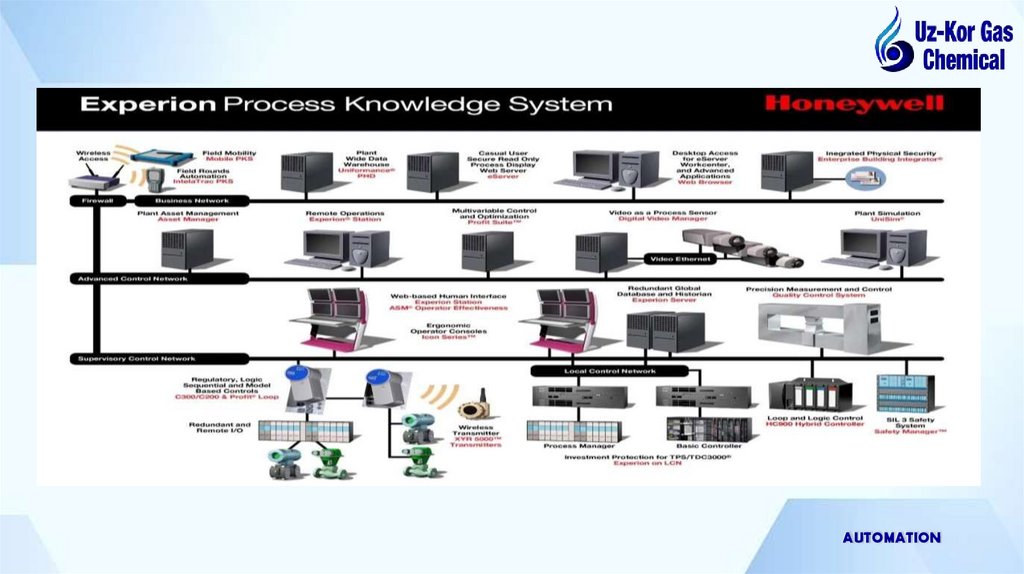
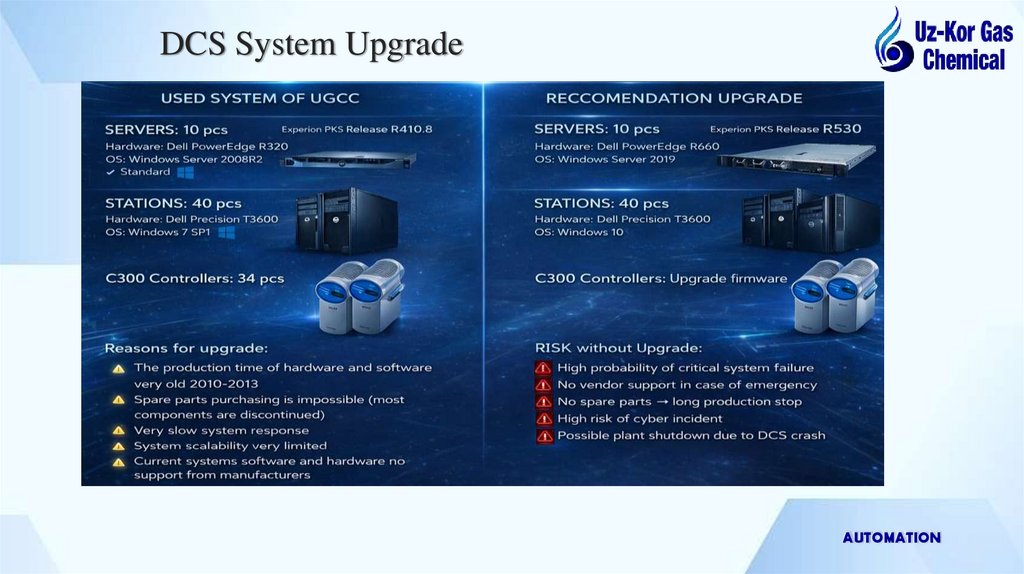
DCS System UpgradeAUTOMATION
15.
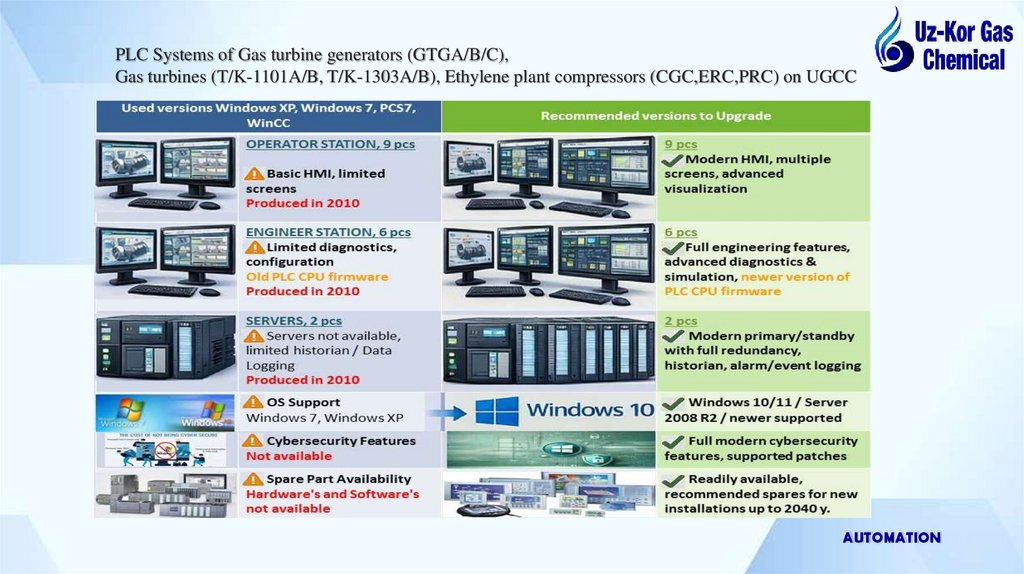
PLC Systems of Gas turbine generators (GTGA/B/C),Gas turbines (T/K-1101A/B, T/K-1303A/B), Ethylene plant compressors (CGC,ERC,PRC) on UGCC
AUTOMATION
16.
Problems and issues ofAutomation Division
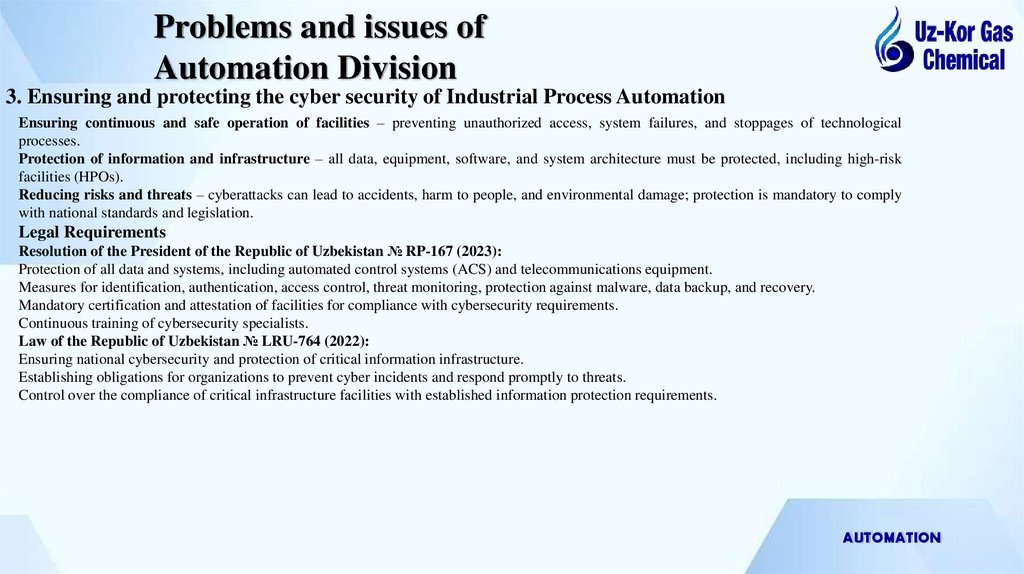
3. Ensuring and protecting the cyber security of Industrial Process Automation
Ensuring continuous and safe operation of facilities – preventing unauthorized access, system failures, and stoppages of technological
processes.
Protection of information and infrastructure – all data, equipment, software, and system architecture must be protected, including high-risk
facilities (HPOs).
Reducing risks and threats – cyberattacks can lead to accidents, harm to people, and environmental damage; protection is mandatory to comply
with national standards and legislation.
Legal Requirements
Resolution of the President of the Republic of Uzbekistan № RP-167 (2023):
Protection of all data and systems, including automated control systems (ACS) and telecommunications equipment.
Measures for identification, authentication, access control, threat monitoring, protection against malware, data backup, and recovery.
Mandatory certification and attestation of facilities for compliance with cybersecurity requirements.
Continuous training of cybersecurity specialists.
Law of the Republic of Uzbekistan № LRU-764 (2022):
Ensuring national cybersecurity and protection of critical information infrastructure.
Establishing obligations for organizations to prevent cyber incidents and respond promptly to threats.
Control over the compliance of critical infrastructure facilities with established information protection requirements.
AUTOMATION
17.
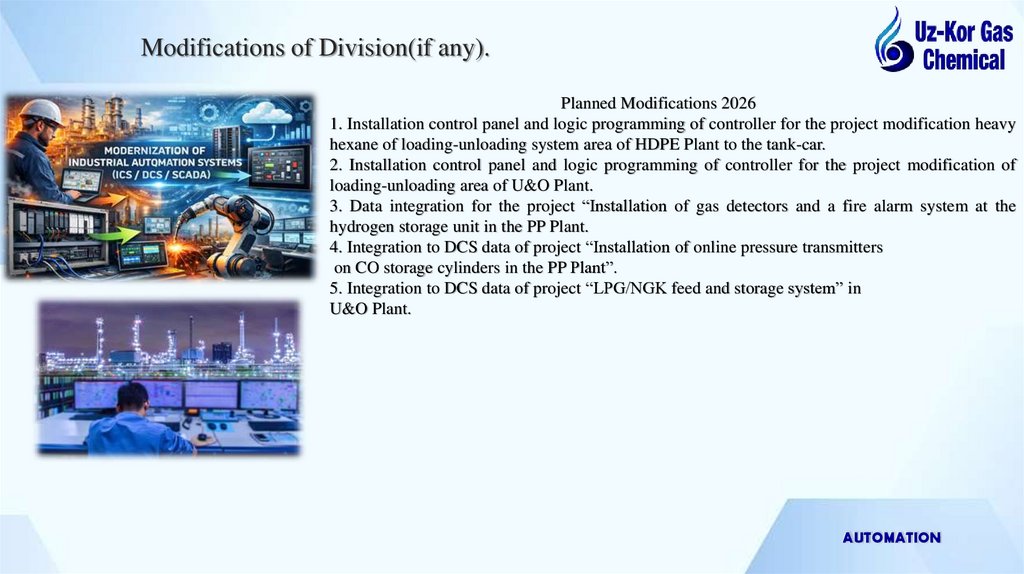
Modifications of Division(if any).Planned Modifications 2026
1. Installation control panel and logic programming of controller for the project modification heavy
hexane of loading-unloading system area of HDPE Plant to the tank-car.
2. Installation control panel and logic programming of controller for the project modification of
loading-unloading area of U&O Plant.
3. Data integration for the project “Installation of gas detectors and a fire alarm system at the
hydrogen storage unit in the PP Plant.
4. Integration to DCS data of project “Installation of online pressure transmitters
on CO storage cylinders in the PP Plant”.
5. Integration to DCS data of project “LPG/NGK feed and storage system” in
U&O Plant.
AUTOMATION
18.
End of presentation.Thank you for your attention.
Questions are welcome.
AUTOMATION