

 Педагогика
Похожие презентации:





Questionnaire
1.
WARM-UP: Think–Discuss–Share
● How can researchers find out what
many people think about an issue?
Discuss answers in pairs
Share ideas with the class
2.
11th GradeQuestionnaire
G11, T3, W3, LP 1-2
3.
Lesson ObjectivesBy the end of the lesson, students will be able to:
Identify different types of questionnaire questions
● Evaluate good vs poor questionnaire questions
4.
Assessment CriteriaYou have met:
● 11CT3.1, if you correctly identify multiple question types and
can distinguish between them using examples.
● 11CT3.2, if you accurately evaluate questions by identifying
problems and justifying judgments.
5.
What is a questionnaire?Questionnaires are sets of questions printed on paper or created through an
online tool, which are used for both qualitative and quantitative research. When a
set of questions is distributed to a portion of the total population, it is simply
called a questionnaire. If a set of questions is distributed to the entire population,
it is called a census. Questionnaires can contain multiple-choice, fill-in-the-blank,
or open-ended questions. The data collected through a questionnaire is
combined and analyzed by the researcher to create a better understanding of a
large group or population.
6.
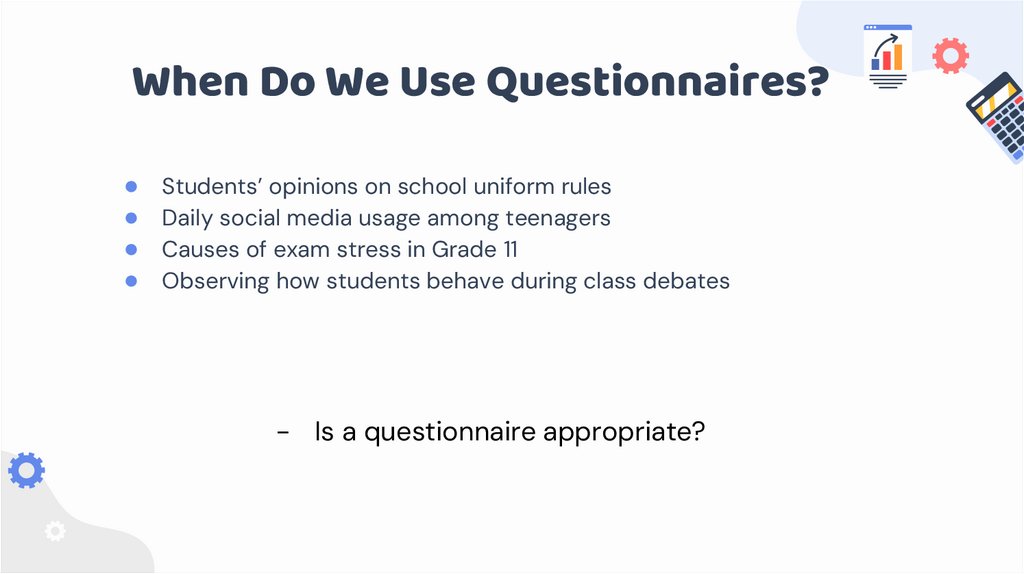
When Do We Use Questionnaires?Students’ opinions on school uniform rules
Daily social media usage among teenagers
Causes of exam stress in Grade 11
Observing how students behave during class debates
- Is a questionnaire appropriate?
7.
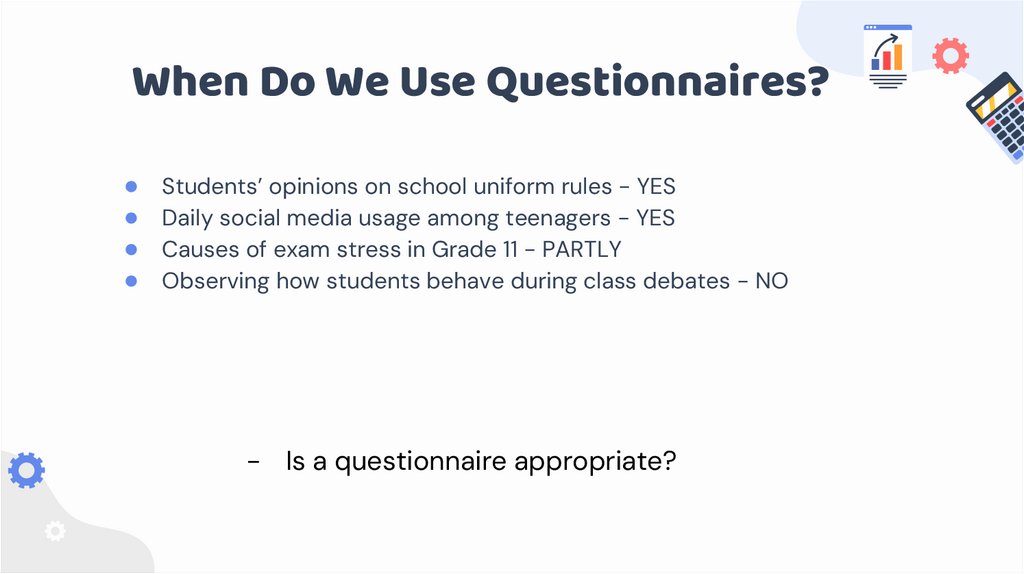
When Do We Use Questionnaires?Students’ opinions on school uniform rules - YES
Daily social media usage among teenagers - YES
Causes of exam stress in Grade 11 - PARTLY
Observing how students behave during class debates - NO
- Is a questionnaire appropriate?
8.
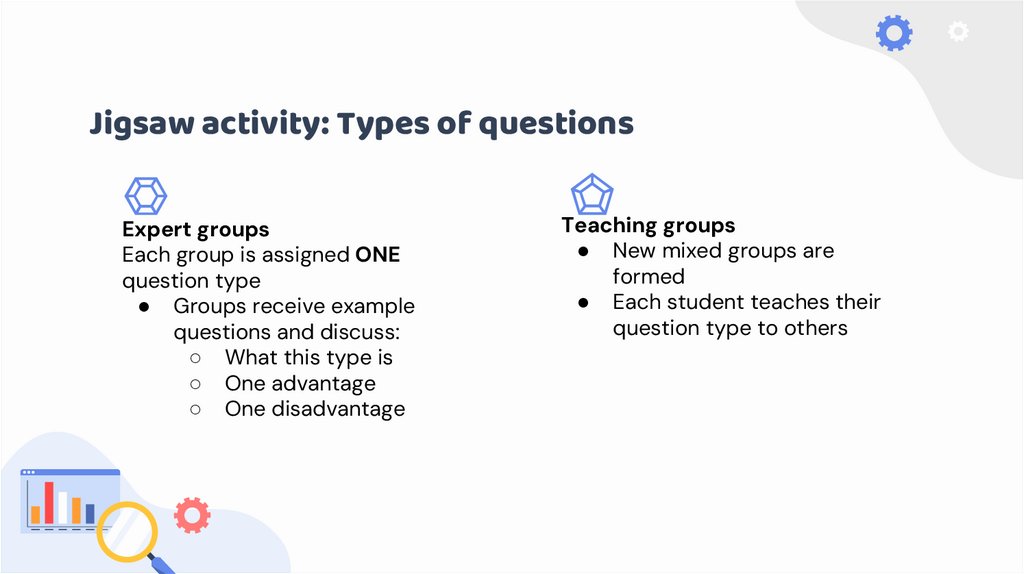
Jigsaw activity: Types of questionsExpert groups
Each group is assigned ONE
question type
● Groups receive example
questions and discuss:
○ What this type is
○ One advantage
○ One disadvantage
Teaching groups
● New mixed groups are
formed
● Each student teaches their
question type to others
9.
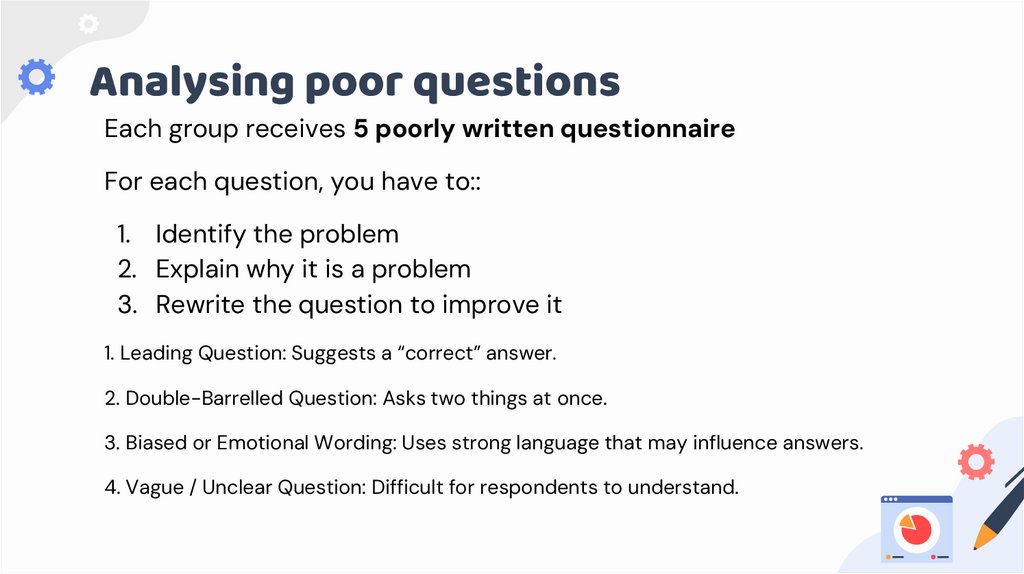
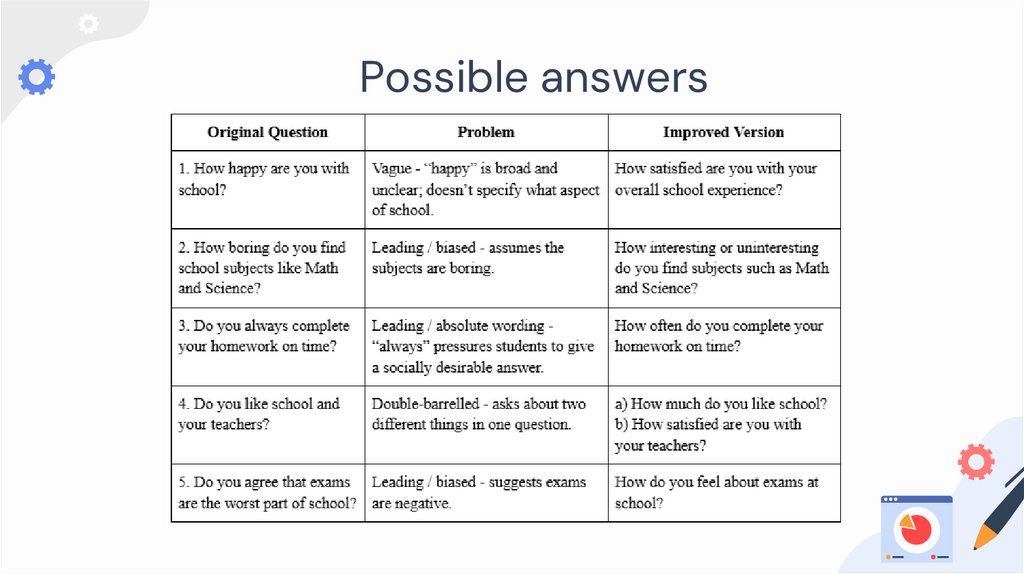
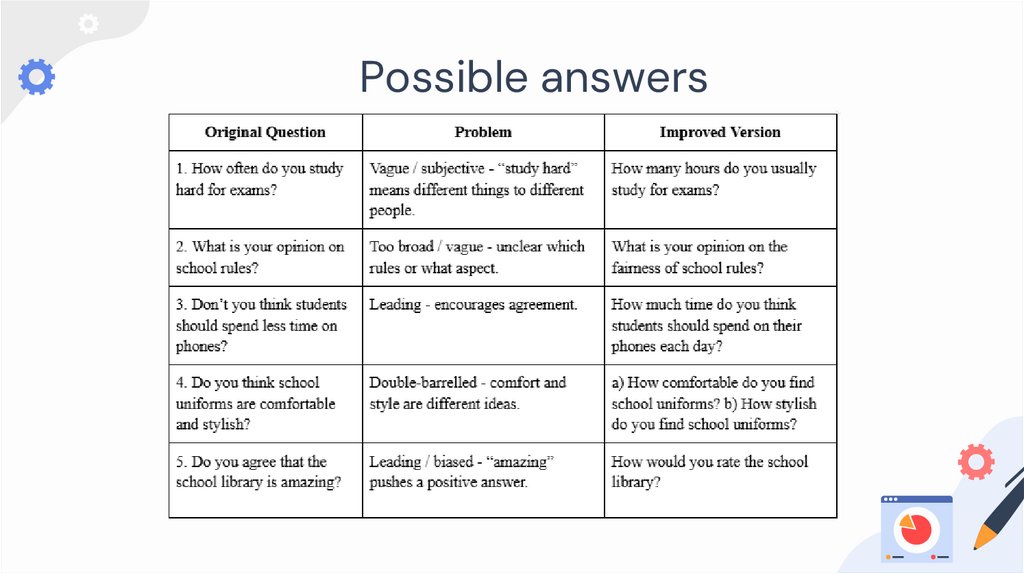
Analysing poor questionsEach group receives 5 poorly written questionnaire
For each question, you have to::
1. Identify the problem
2. Explain why it is a problem
3. Rewrite the question to improve it
1. Leading Question: Suggests a “correct” answer.
2. Double-Barrelled Question: Asks two things at once.
3. Biased or Emotional Wording: Uses strong language that may influence answers.
4. Vague / Unclear Question: Difficult for respondents to understand.
10.
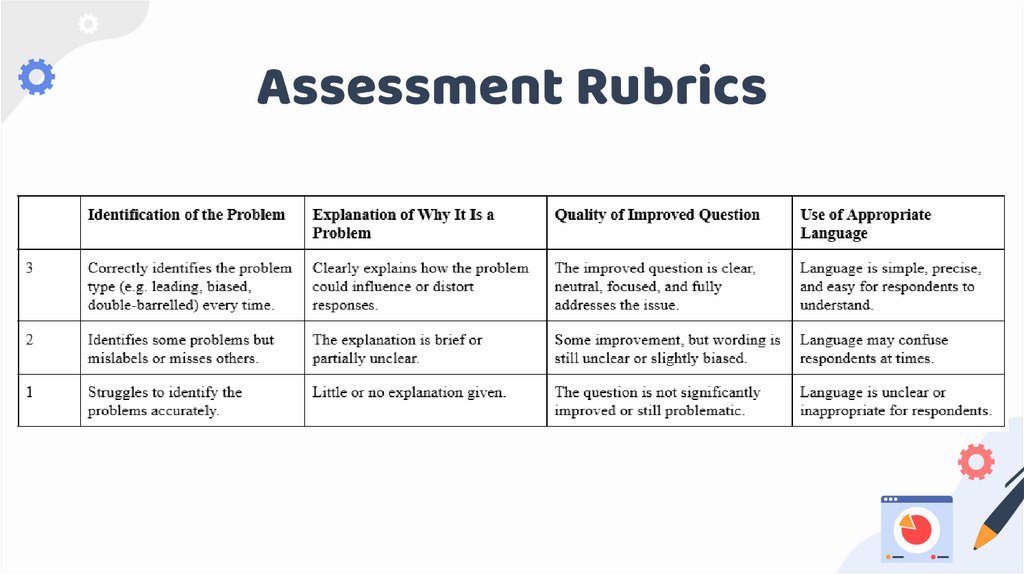
Assessment Rubrics11.
Possible answers12.
Possible answers13.
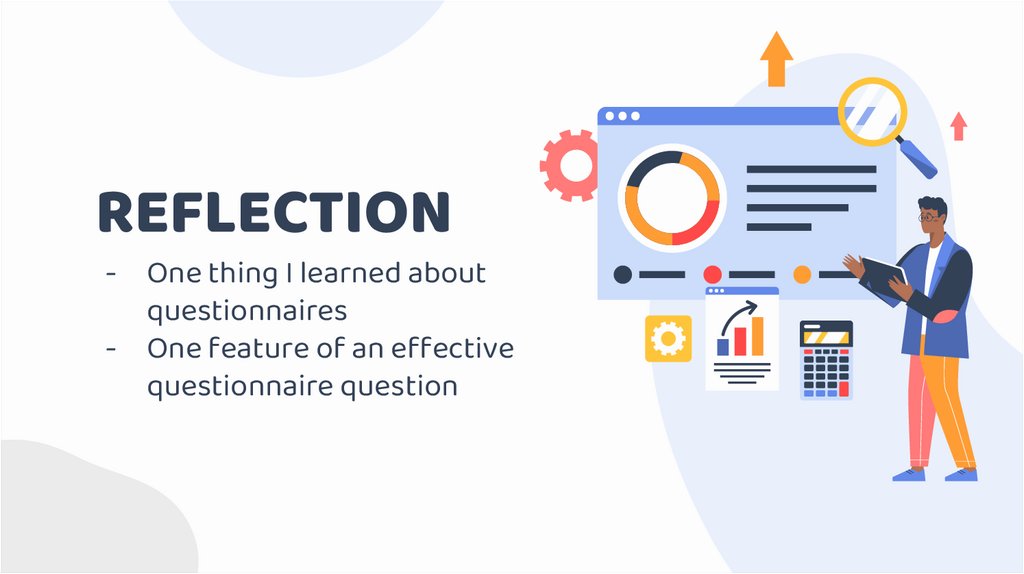
REFLECTION- One thing I learned about
questionnaires
- One feature of an effective
questionnaire question
14.
Lesson ObjectivesBy the end of the lesson, students will be able to:
Design a short, effective questionnaire
● Evaluate questionnaires using research criteria
15.
Assessment CriteriaThe objectives will be achieved:
● 11CO3.1, if you design a questionnaire that has 6–8 clear, focused
questions; all are relevant and easy for respondents to
understand.
● 11RES3.2, if you evaluate questionnaire effectively, identifying
strengths, weaknesses, and potential improvements
16.
Lead-InAgree / Disagree Corners
You will be given several statements for
which you have to choose a side
1.
2.
3.
Move to a corner
Discuss reasons with others in the
same corner
One student from each corner
shares a reason
17.
“If a questionnaire has many questions,the results will be more accurate.”
18.
“Open-ended questions give better datathan closed-ended questions.”
19.
“Anonymous questionnaires producemore truthful responses.”
20.
“Likert scale questions accuratelymeasure attitudes.”
21.
“It is acceptable to influence responsesif it supports the research aim.”
22.
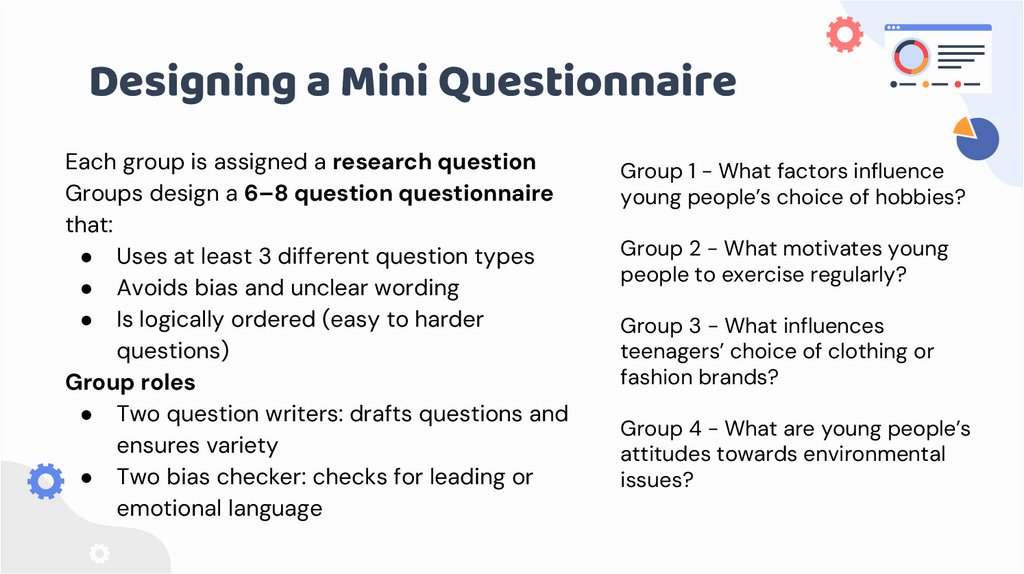
Designing a Mini QuestionnaireEach group is assigned a research question
Groups design a 6–8 question questionnaire
that:
● Uses at least 3 different question types
● Avoids bias and unclear wording
● Is logically ordered (easy to harder
questions)
Group roles
● Two question writers: drafts questions and
ensures variety
● Two bias checker: checks for leading or
emotional language
Group 1 - What factors influence
young people’s choice of hobbies?
Group 2 - What motivates young
people to exercise regularly?
Group 3 - What influences
teenagers’ choice of clothing or
fashion brands?
Group 4 - What are young people’s
attitudes towards environmental
issues?
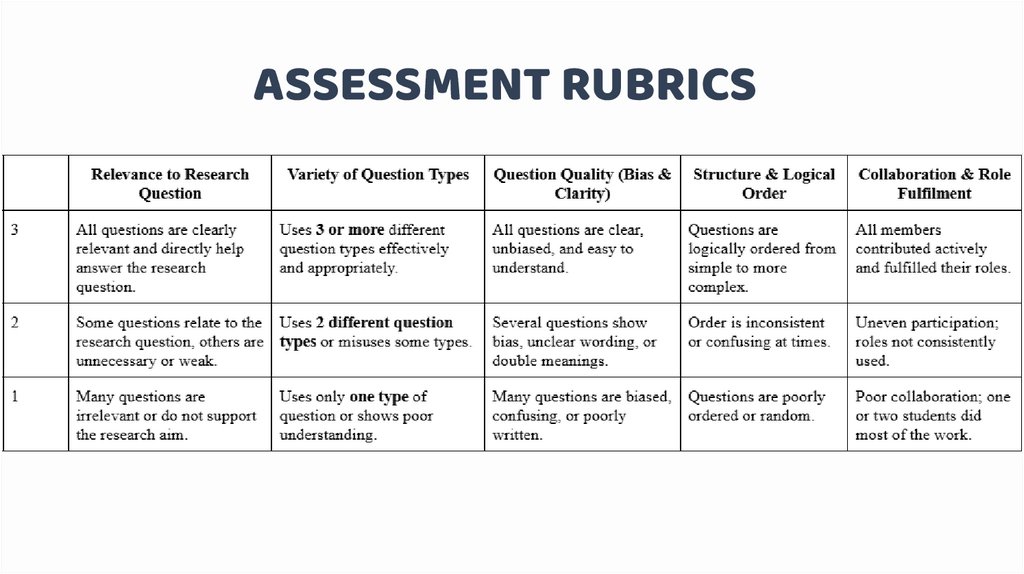
23.
ASSESSMENT RUBRICS24.
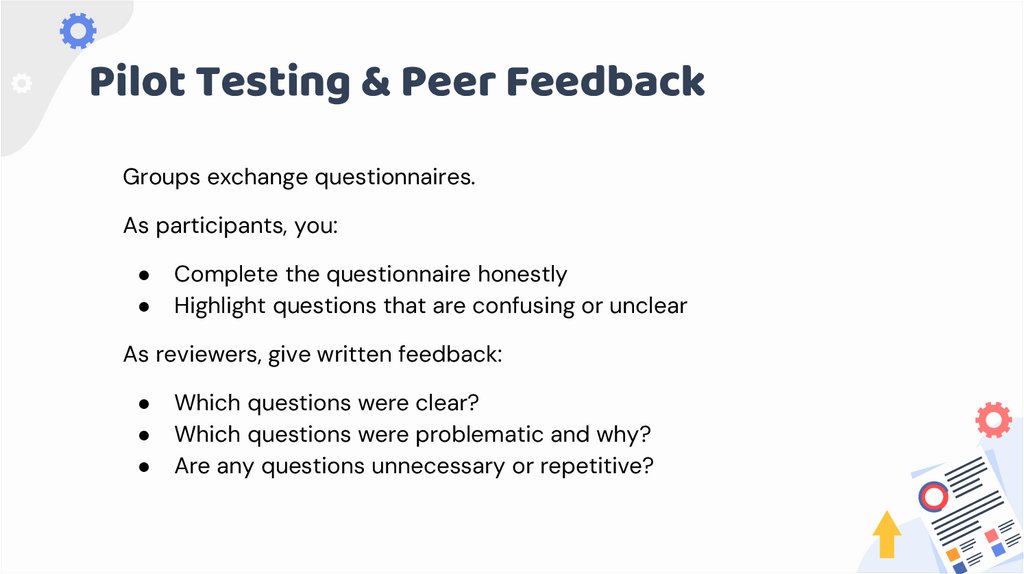
Pilot Testing & Peer FeedbackGroups exchange questionnaires.
As participants, you:
Complete the questionnaire honestly
Highlight questions that are confusing or unclear
As reviewers, give written feedback:
Which questions were clear?
Which questions were problematic and why?
Are any questions unnecessary or repetitive?
25.
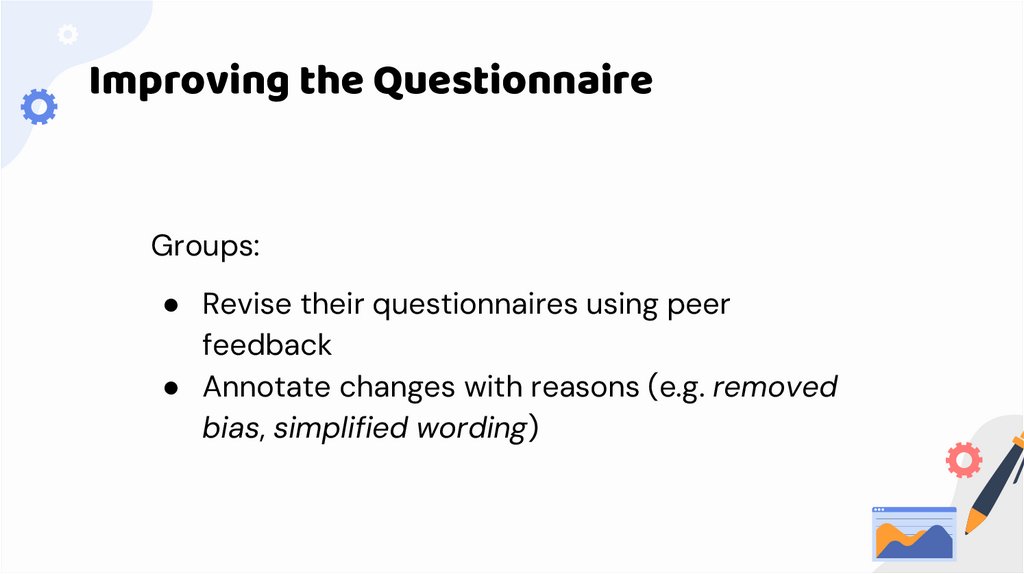
Improving the QuestionnaireGroups:
● Revise their questionnaires using peer
feedback
● Annotate changes with reasons (e.g. removed
bias, simplified wording)
26.
REFLECTIONWhat did I contribute to my group?
● One research skill I improved
● One thing I would change if I conducted real research