

 Бизнес
Похожие презентации:




Introduction to Social Entrepreneurship
1.
Theme 2. Introduction toentrepreneurship
2.
Traditional and social entrpreneursipKey distinguishing elements between the traditional
entrepreneur and a social entrepreneur
a traditional or conventional enterprise aims to
deliver a bottom-line profit for serving a market in a
better or more efficient manner
the social entrepreneurs have a triple bottom line to
consider: first, people, second, the planet and lastly
profit orientation.
3.
Characteristics of social entrepreneursThe characteristics include the following:
having a new idea for solving a critical social problem;
being creative;
having an entrepreneurial personality;
envisioning the broad social impact of the idea;
and
possessing an unquestionable ethical attitude.
From the above definitions we can understand that social
entrepreneurs are people with great vision to serve the society,
especially, the needy and underserved communities.
4.
Characteristics of social entrepreneursCharacteristics of the individual:
i.Recognition of Social Impact
ii.Creativity – A social entrepreneur must be creative in setting his vision and in problem solving
iii.Entrepreneurial Qualities
iv.Leadership and Management - social entrepreneurs have the qualities or behaviours associated with
business entrepreneurs (such as good leadership and management skills), but they are more concerned
about ―caring and helping than with making mone. They are described as people who inject imagination
and vision into social problem solving, motivate others, build networks, and demonstrate capabilities in
overcoming obstacles and risks in the process. v.Social entrepreneurs are ambitious.
vi.Ability to Communicate Social vision - and having the ability to communicate a vision that inspires those
around them – a vision of adding value to the underprivileged in a community.
vi. Creativity - They are creative, and engender trust and co-operation through the establishment of
relationships and networks in their search for resources.
5.
History of social entrepreneurshipThe terms social entrepreneur and social entrepreneurship were
used first in the literature in 1953 by H. Bowen in his book Social
Responsibilities of the Businessman. The terms came into
widespread use in the 1980s and 1990s, promoted by Bill Drayton,
Charles Leadbeater.
William Drayton (born 1943) is an American social entrepreneur.
Drayton was named by U.S. News & World Report as one of
America's 25 Best Leaders in 2005. He is responsible for the rise of
the phrase "social entrepreneur", a concept first found in print in
1972.
6.
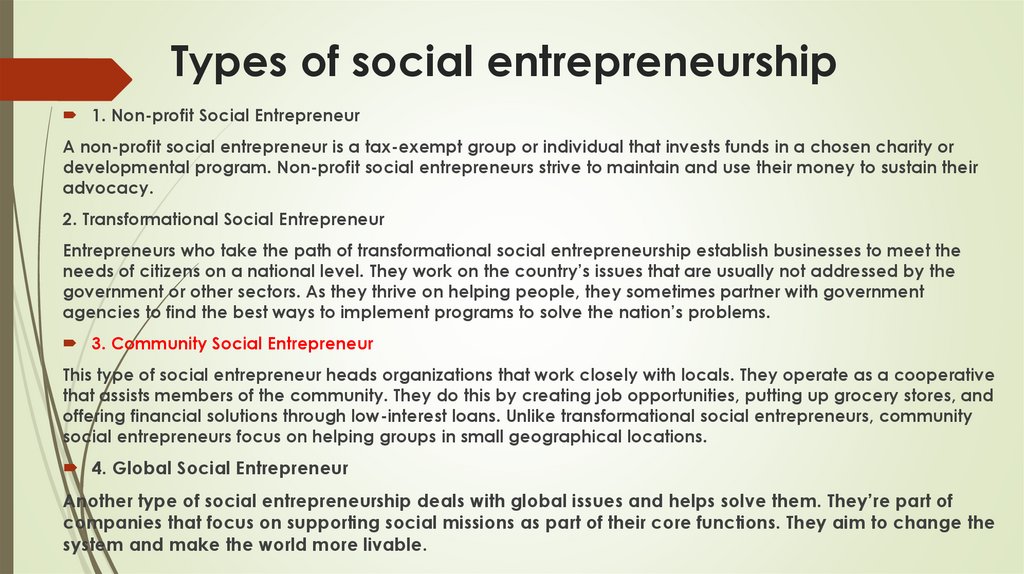
Types of social entrepreneurship1. Non-profit Social Entrepreneur
A non-profit social entrepreneur is a tax-exempt group or individual that invests funds in a chosen charity or
developmental program. Non-profit social entrepreneurs strive to maintain and use their money to sustain their
advocacy.
2. Transformational Social Entrepreneur
Entrepreneurs who take the path of transformational social entrepreneurship establish businesses to meet the
needs of citizens on a national level. They work on the country’s issues that are usually not addressed by the
government or other sectors. As they thrive on helping people, they sometimes partner with government
agencies to find the best ways to implement programs to solve the nation’s problems.
3. Community Social Entrepreneur
This type of social entrepreneur heads organizations that work closely with locals. They operate as a cooperative
that assists members of the community. They do this by creating job opportunities, putting up grocery stores, and
offering financial solutions through low-interest loans. Unlike transformational social entrepreneurs, community
social entrepreneurs focus on helping groups in small geographical locations.
4. Global Social Entrepreneur
Another type of social entrepreneurship deals with global issues and helps solve them. They’re part of
companies that focus on supporting social missions as part of their core functions. They aim to change the
system and make the world more livable.
7.
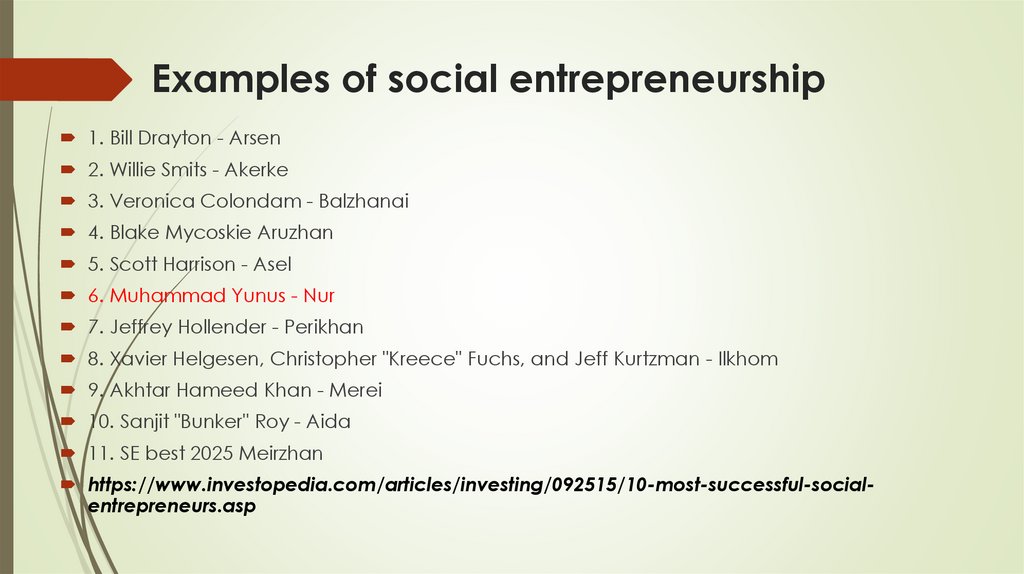
Examples of social entrepreneurship1. Bill Drayton - Arsen
2. Willie Smits - Akerke
3. Veronica Colondam - Balzhanai
4. Blake Mycoskie Aruzhan
5. Scott Harrison - Asel
6. Muhammad Yunus - Nur
7. Jeffrey Hollender - Perikhan
8. Xavier Helgesen, Christopher "Kreece" Fuchs, and Jeff Kurtzman - Ilkhom
9. Akhtar Hameed Khan - Merei
10. Sanjit "Bunker" Roy - Aida
11. SE best 2025 Meirzhan
https://www.investopedia.com/articles/investing/092515/10-most-successful-socialentrepreneurs.asp