 Лингвистика
Похожие презентации:




Synonyms, Euphemisms, Antonyms (Lecture 4)
1. Lecture 4
Synonyms, Euphemisms, Antonyms2. Outline of the lecture
1. Euphemisms2. Synonyms
3. Antonyms
3. Key Definitions
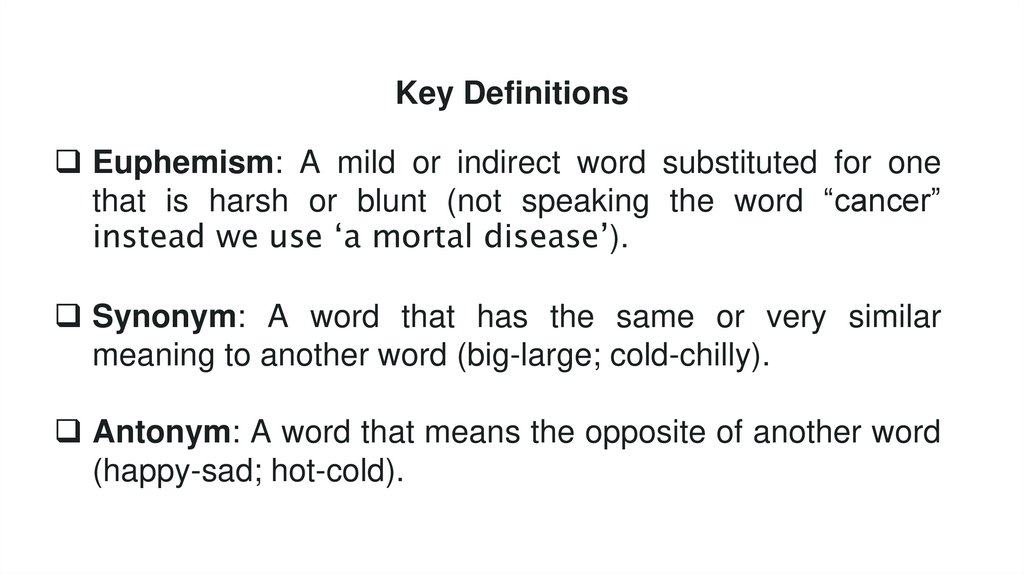
Euphemism: A mild or indirect word substituted for onethat is harsh or blunt (not speaking the word “cancer”
instead we use ‘a mortal disease’).
Synonym: A word that has the same or very similar
meaning to another word (big-large; cold-chilly).
Antonym: A word that means the opposite of another word
(happy-sad; hot-cold).
4. Euphemism
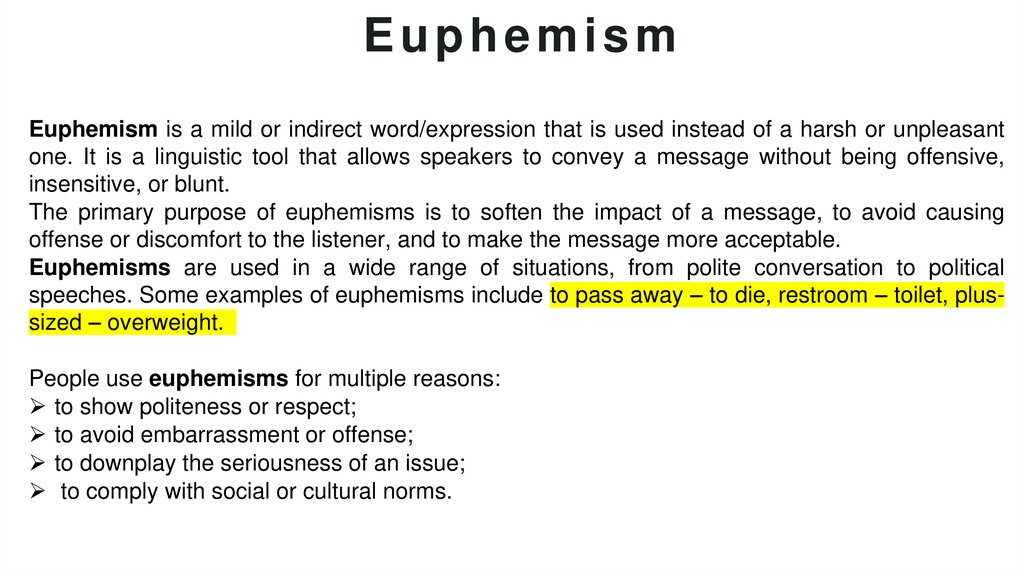
Euphemism is a mild or indirect word/expression that is used instead of a harsh or unpleasantone. It is a linguistic tool that allows speakers to convey a message without being offensive,
insensitive, or blunt.
The primary purpose of euphemisms is to soften the impact of a message, to avoid causing
offense or discomfort to the listener, and to make the message more acceptable.
Euphemisms are used in a wide range of situations, from polite conversation to political
speeches. Some examples of euphemisms include to pass away – to die, restroom – toilet, plussized – overweight.
People use euphemisms for multiple reasons:
to show politeness or respect;
to avoid embarrassment or offense;
to downplay the seriousness of an issue;
to comply with social or cultural norms.
5.
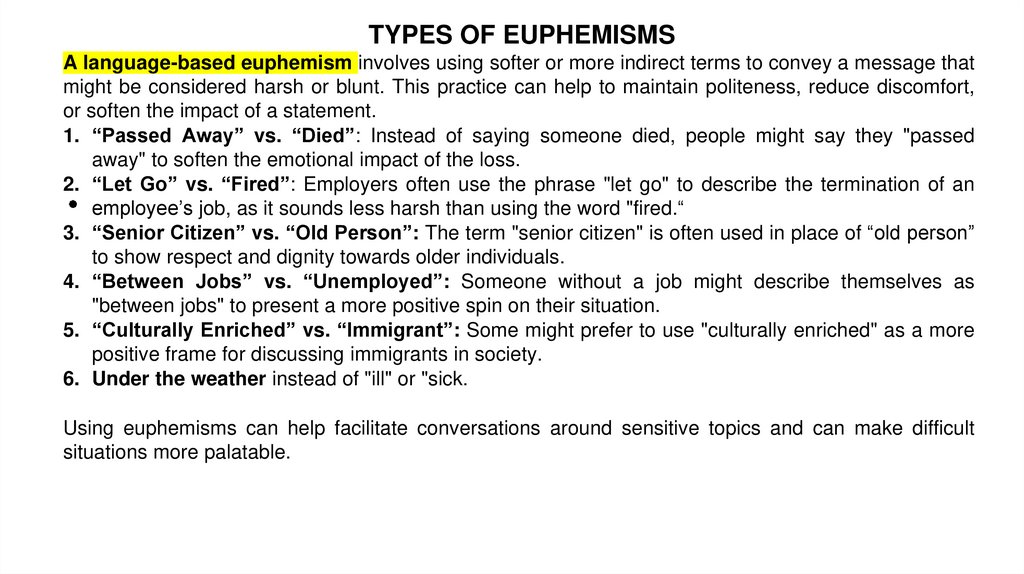
TYPES OF EUPHEMISMSA language-based euphemism involves using softer or more indirect terms to convey a message that
might be considered harsh or blunt. This practice can help to maintain politeness, reduce discomfort,
or soften the impact of a statement.
1. “Passed Away” vs. “Died”: Instead of saying someone died, people might say they "passed
away" to soften the emotional impact of the loss.
2. “Let Go” vs. “Fired”: Employers often use the phrase "let go" to describe the termination of an
employee’s job, as it sounds less harsh than using the word "fired.“
3. “Senior Citizen” vs. “Old Person”: The term "senior citizen" is often used in place of “old person”
to show respect and dignity towards older individuals.
4. “Between Jobs” vs. “Unemployed”: Someone without a job might describe themselves as
"between jobs" to present a more positive spin on their situation.
5. “Culturally Enriched” vs. “Immigrant”: Some might prefer to use "culturally enriched" as a more
positive frame for discussing immigrants in society.
6. Under the weather instead of "ill" or "sick.
Using euphemisms can help facilitate conversations around sensitive topics and can make difficult
situations more palatable.
6.
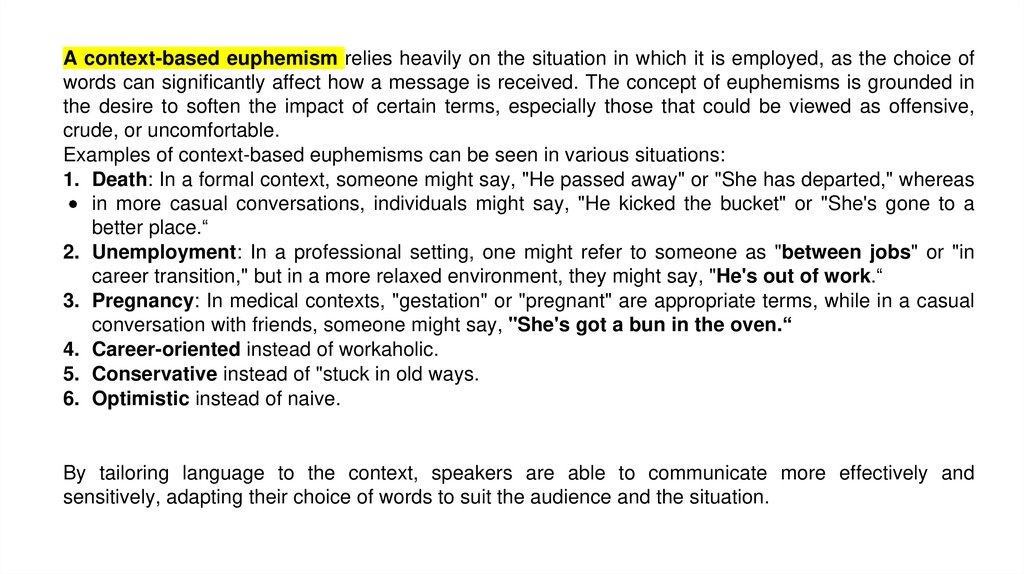
A context-based euphemism relies heavily on the situation in which it is employed, as the choice ofwords can significantly affect how a message is received. The concept of euphemisms is grounded in
the desire to soften the impact of certain terms, especially those that could be viewed as offensive,
crude, or uncomfortable.
Examples of context-based euphemisms can be seen in various situations:
1. Death: In a formal context, someone might say, "He passed away" or "She has departed," whereas
in more casual conversations, individuals might say, "He kicked the bucket" or "She's gone to a
better place.“
2. Unemployment: In a professional setting, one might refer to someone as "between jobs" or "in
career transition," but in a more relaxed environment, they might say, "He's out of work.“
3. Pregnancy: In medical contexts, "gestation" or "pregnant" are appropriate terms, while in a casual
conversation with friends, someone might say, "She's got a bun in the oven.“
4. Career-oriented instead of workaholic.
5. Conservative instead of "stuck in old ways.
6. Optimistic instead of naive.
By tailoring language to the context, speakers are able to communicate more effectively and
sensitively, adapting their choice of words to suit the audience and the situation.
7.
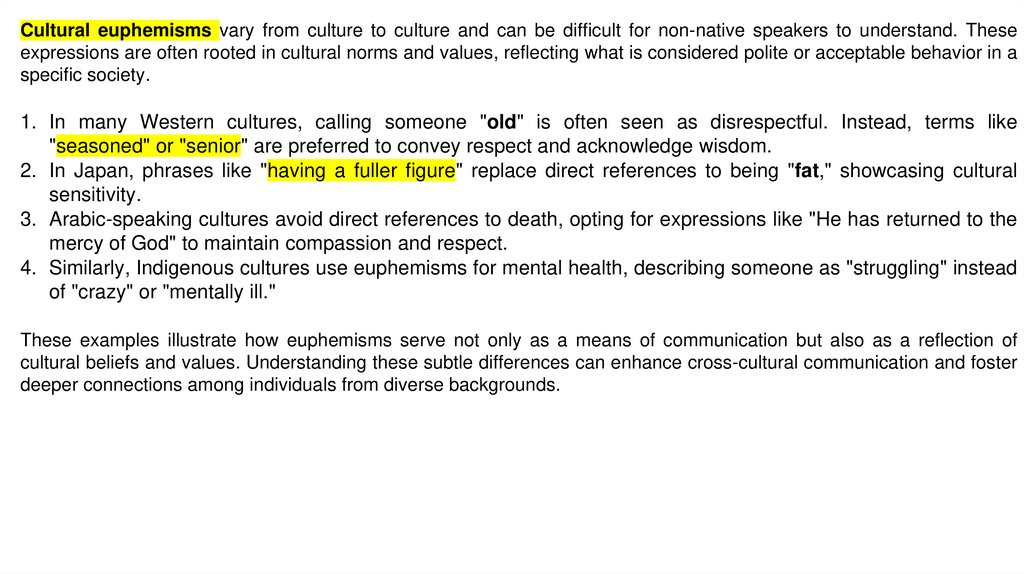
Cultural euphemisms vary from culture to culture and can be difficult for non-native speakers to understand. Theseexpressions are often rooted in cultural norms and values, reflecting what is considered polite or acceptable behavior in a
specific society.
1. In many Western cultures, calling someone "old" is often seen as disrespectful. Instead, terms like
"seasoned" or "senior" are preferred to convey respect and acknowledge wisdom.
2. In Japan, phrases like "having a fuller figure" replace direct references to being "fat," showcasing cultural
sensitivity.
3. Arabic-speaking cultures avoid direct references to death, opting for expressions like "He has returned to the
mercy of God" to maintain compassion and respect.
4. Similarly, Indigenous cultures use euphemisms for mental health, describing someone as "struggling" instead
of "crazy" or "mentally ill."
These examples illustrate how euphemisms serve not only as a means of communication but also as a reflection of
cultural beliefs and values. Understanding these subtle differences can enhance cross-cultural communication and foster
deeper connections among individuals from diverse backgrounds.
8. Synonyms
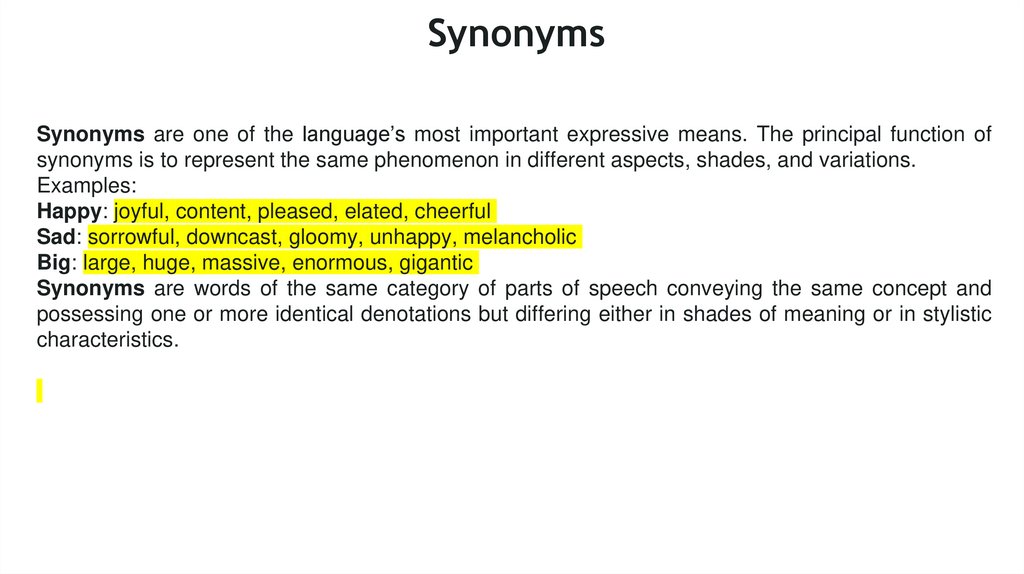
Synonyms are one of the language’s most important expressive means. The principal function ofsynonyms is to represent the same phenomenon in different aspects, shades, and variations.
Examples:
Happy: joyful, content, pleased, elated, cheerful
Sad: sorrowful, downcast, gloomy, unhappy, melancholic
Big: large, huge, massive, enormous, gigantic
Synonyms are words of the same category of parts of speech conveying the same concept and
possessing one or more identical denotations but differing either in shades of meaning or in stylistic
characteristics.
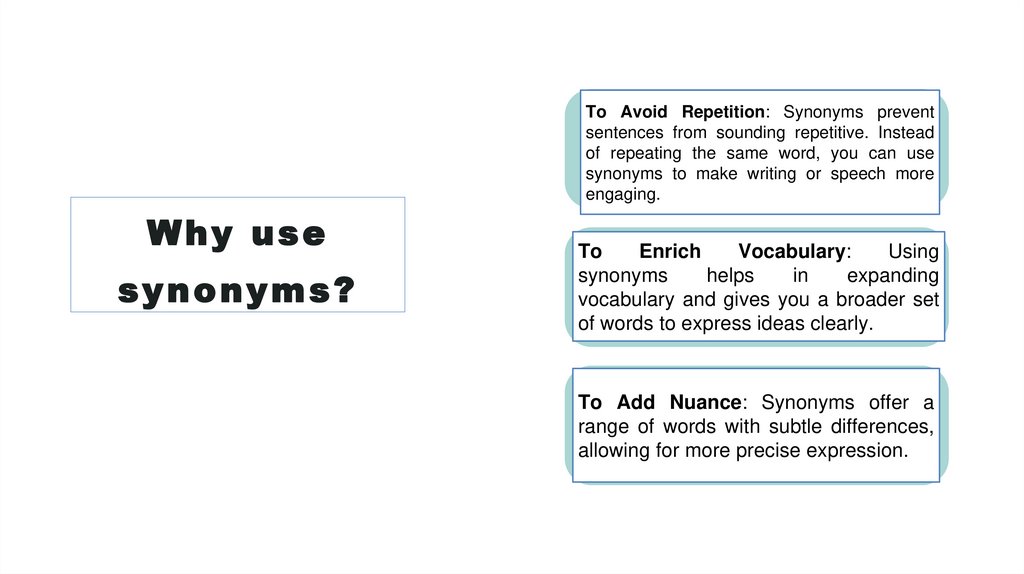
9. Why use synonyms?
To Avoid Repetition: Synonyms preventsentences from sounding repetitive. Instead
of repeating the same word, you can use
synonyms to make writing or speech more
engaging.
Why use
synonyms?
To
Enrich
Vocabulary:
Using
synonyms
helps
in
expanding
vocabulary and gives you a broader set
of words to express ideas clearly.
To Add Nuance: Synonyms offer a
range of words with subtle differences,
allowing for more precise expression.
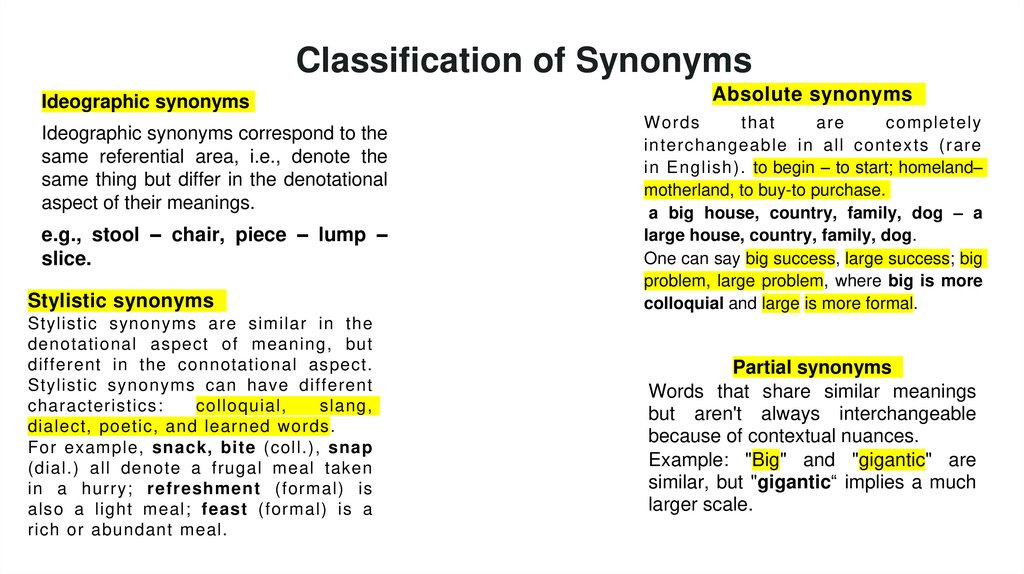
10. Classification of Synonyms
Ideographic synonymsIdeographic synonyms correspond to the
same referential area, i.e., denote the
same thing but differ in the denotational
aspect of their meanings.
e.g., stool – chair, piece – lump –
slice.
Stylistic synonyms
Stylistic synonyms are similar in the
denotational aspect of meaning, but
different in the connotational aspect.
Stylistic synonyms can have different
characteristics:
colloquial,
slang,
dialect, poetic, and learned words.
For example, snack, bite (coll.), snap
(dial.) all denote a frugal meal taken
in a hurry; refreshment (formal) is
also a light meal; feast (formal) is a
rich or abundant meal.
Absolute synonyms
Words
that
are
completely
interchangeable in all contexts (rare
in English). to begin – to start; homeland–
motherland, to buy-to purchase.
a big house, country, family, dog – a
large house, country, family, dog.
One can say big success, large success; big
problem, large problem, where big is more
colloquial and large is more formal.
Partial synonyms
Words that share similar meanings
but aren't always interchangeable
because of contextual nuances.
Example: "Big" and "gigantic" are
similar, but "gigantic“ implies a much
larger scale.
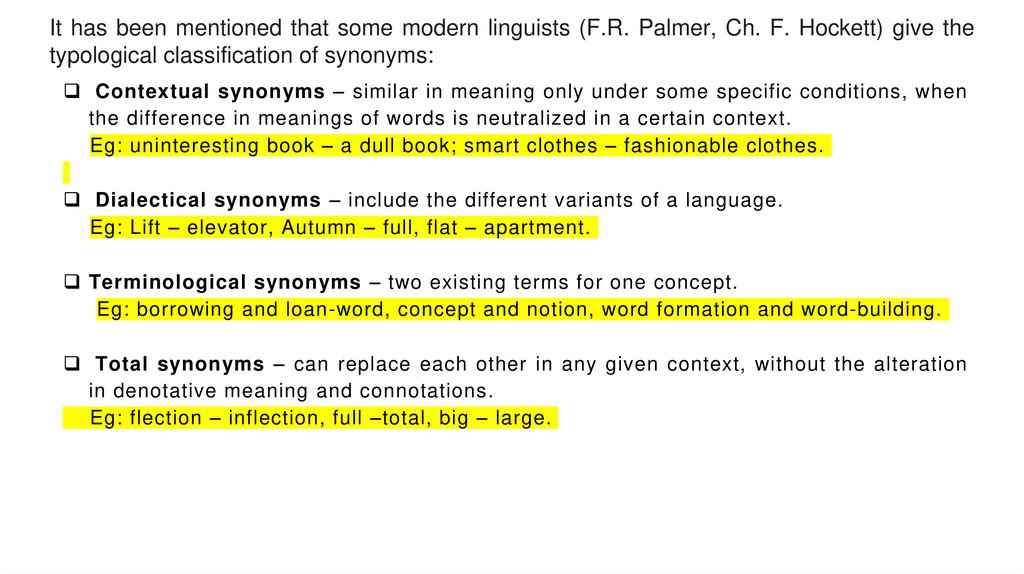
11. It has been mentioned that some modern linguists (F.R. Palmer, Ch. F. Hockett) give the typological classification of synonyms:
Contextual synonyms – similar in meaning only under some specific conditions, whenthe difference in meanings of words is neutralized in a certain context.
Eg: uninteresting book – a dull book; smart clothes – fashionable clothes.
Dialectical synonyms – include the different variants of a language.
Eg: Lift – elevator, Autumn – full, flat – apartment.
Terminological synonyms – two existing terms for one concept.
Eg: borrowing and loan-word, concept and notion, word formation and word-building.
Total synonyms – can replace each other in any given context, without the alteration
in denotative meaning and connotations.
Eg: flection – inflection, full –total, big – large.
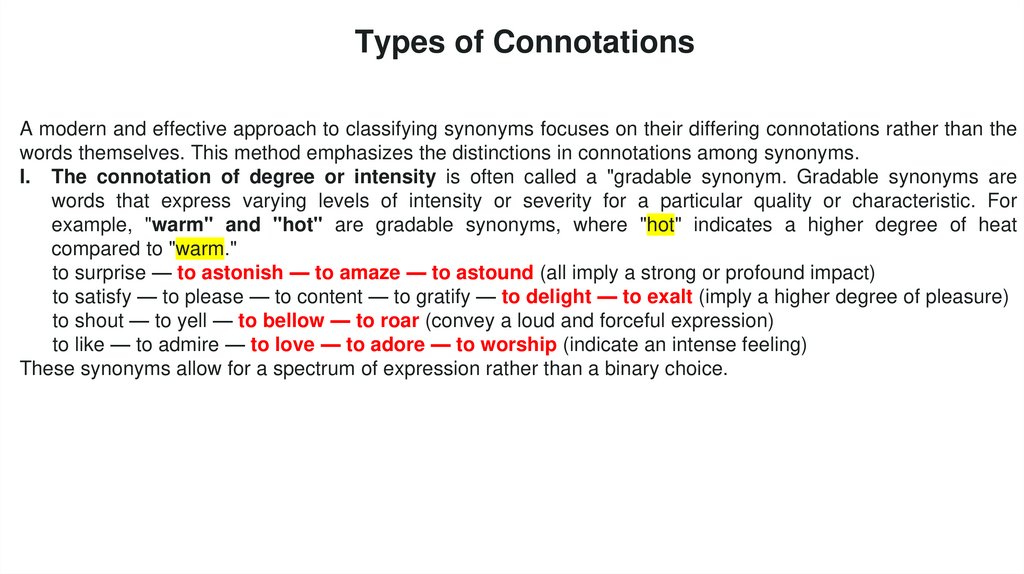
12. Types of Connotations
A modern and effective approach to classifying synonyms focuses on their differing connotations rather than thewords themselves. This method emphasizes the distinctions in connotations among synonyms.
I. The connotation of degree or intensity is often called a "gradable synonym. Gradable synonyms are
words that express varying levels of intensity or severity for a particular quality or characteristic. For
example, "warm" and "hot" are gradable synonyms, where "hot" indicates a higher degree of heat
compared to "warm."
to surprise — to astonish — to amaze — to astound (all imply a strong or profound impact)
to satisfy — to please — to content — to gratify — to delight — to exalt (imply a higher degree of pleasure)
to shout — to yell — to bellow — to roar (convey a loud and forceful expression)
to like — to admire — to love — to adore — to worship (indicate an intense feeling)
These synonyms allow for a spectrum of expression rather than a binary choice.
13.
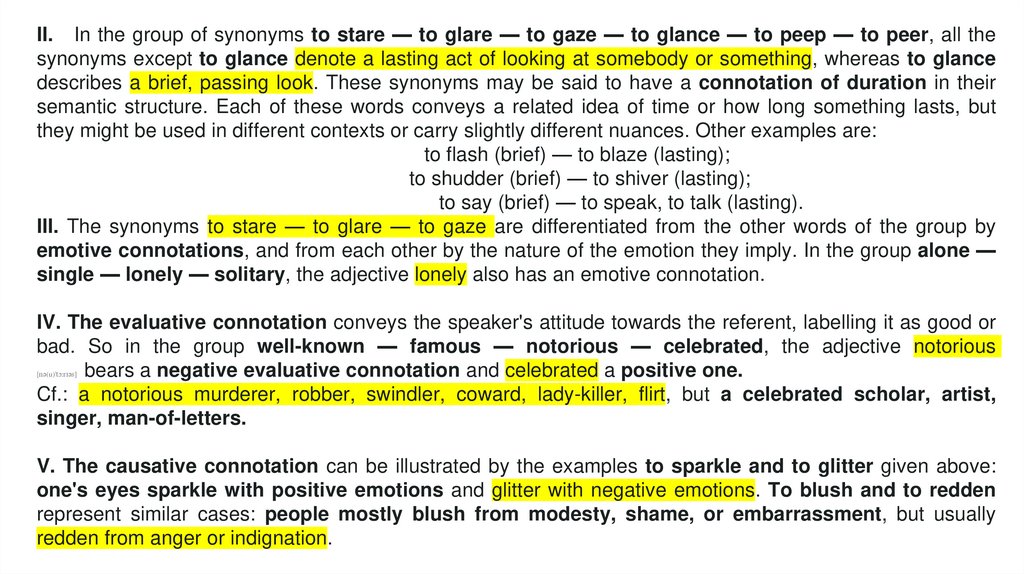
II. In the group of synonyms to stare — to glare — to gaze — to glance — to peep — to peer, all thesynonyms except to glance denote a lasting act of looking at somebody or something, whereas to glance
describes a brief, passing look. These synonyms may be said to have a connotation of duration in their
semantic structure. Each of these words conveys a related idea of time or how long something lasts, but
they might be used in different contexts or carry slightly different nuances. Other examples are:
to flash (brief) — to blaze (lasting);
to shudder (brief) — to shiver (lasting);
to say (brief) — to speak, to talk (lasting).
III. The synonyms to stare — to glare — to gaze are differentiated from the other words of the group by
emotive connotations, and from each other by the nature of the emotion they imply. In the group alone —
single — lonely — solitary, the adjective lonely also has an emotive connotation.
IV. The evaluative connotation conveys the speaker's attitude towards the referent, labelling it as good or
bad. So in the group well-known — famous — notorious — celebrated, the adjective notorious
bears a negative evaluative connotation and celebrated a positive one.
Cf.: a notorious murderer, robber, swindler, coward, lady-killer, flirt, but a celebrated scholar, artist,
singer, man-of-letters.
[nə(u)'tɔ:rɪəs]
V. The causative connotation can be illustrated by the examples to sparkle and to glitter given above:
one's eyes sparkle with positive emotions and glitter with negative emotions. To blush and to redden
represent similar cases: people mostly blush from modesty, shame, or embarrassment, but usually
redden from anger or indignation.
14.
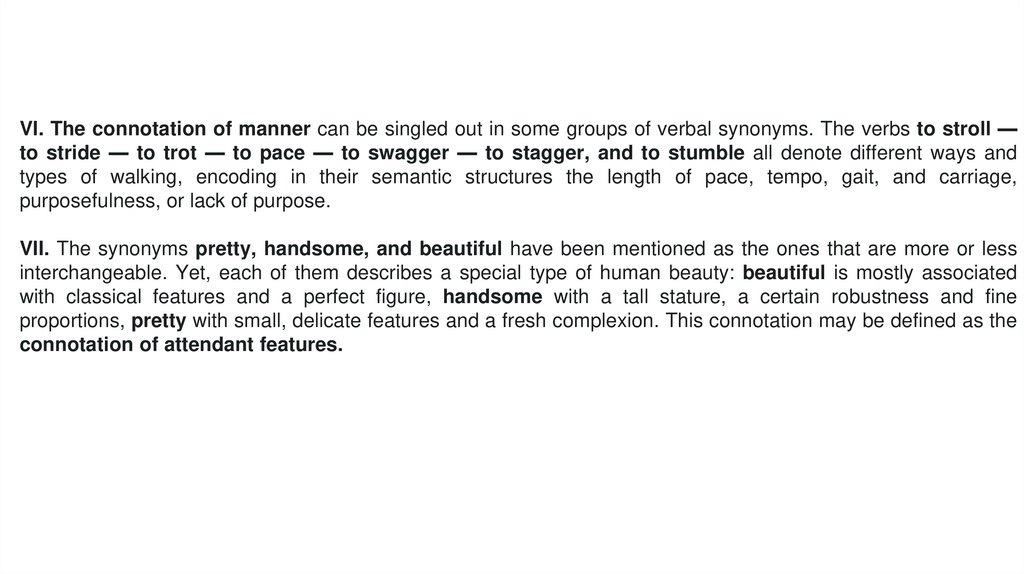
VI. The connotation of manner can be singled out in some groups of verbal synonyms. The verbs to stroll —to stride — to trot — to pace — to swagger — to stagger, and to stumble all denote different ways and
types of walking, encoding in their semantic structures the length of pace, tempo, gait, and carriage,
purposefulness, or lack of purpose.
VII. The synonyms pretty, handsome, and beautiful have been mentioned as the ones that are more or less
interchangeable. Yet, each of them describes a special type of human beauty: beautiful is mostly associated
with classical features and a perfect figure, handsome with a tall stature, a certain robustness and fine
proportions, pretty with small, delicate features and a fresh complexion. This connotation may be defined as the
connotation of attendant features.
15. The Dominant Synonym
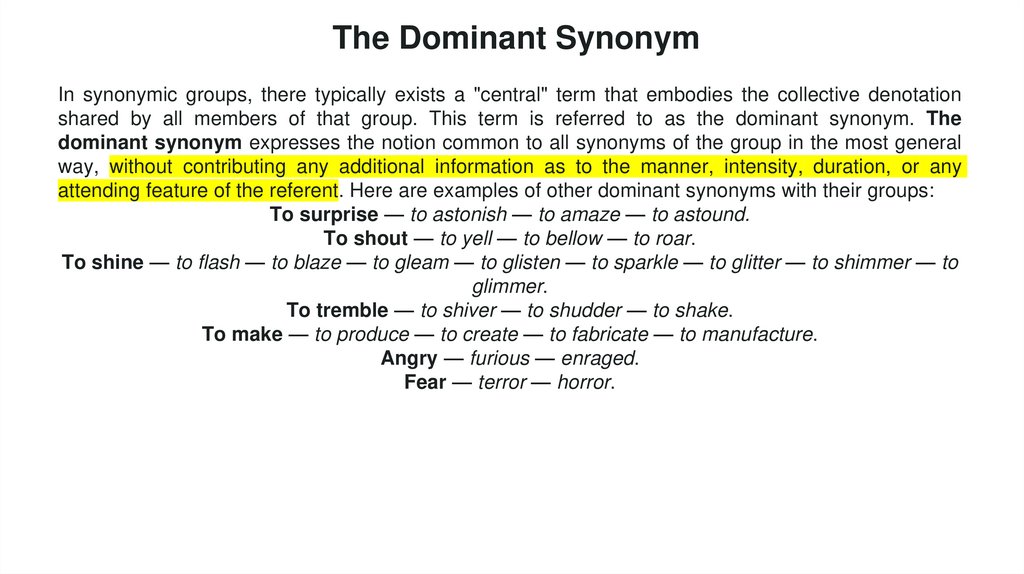
In synonymic groups, there typically exists a "central" term that embodies the collective denotationshared by all members of that group. This term is referred to as the dominant synonym. The
dominant synonym expresses the notion common to all synonyms of the group in the most general
way, without contributing any additional information as to the manner, intensity, duration, or any
attending feature of the referent. Here are examples of other dominant synonyms with their groups:
To surprise — to astonish — to amaze — to astound.
To shout — to yell — to bellow — to roar.
To shine — to flash — to blaze — to gleam — to glisten — to sparkle — to glitter — to shimmer — to
glimmer.
To tremble — to shiver — to shudder — to shake.
To make — to produce — to create — to fabricate — to manufacture.
Angry — furious — enraged.
Fear — terror — horror.
16. Antonyms
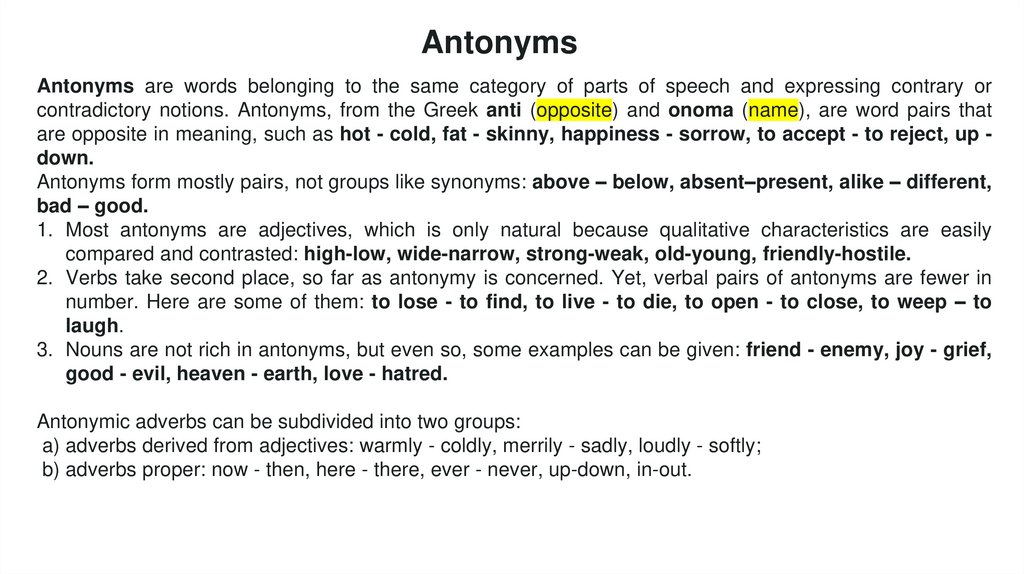
Antonyms are words belonging to the same category of parts of speech and expressing contrary orcontradictory notions. Antonyms, from the Greek anti (opposite) and onoma (name), are word pairs that
are opposite in meaning, such as hot - cold, fat - skinny, happiness - sorrow, to accept - to reject, up down.
Antonyms form mostly pairs, not groups like synonyms: above – below, absent–present, alike – different,
bad – good.
1. Most antonyms are adjectives, which is only natural because qualitative characteristics are easily
compared and contrasted: high-low, wide-narrow, strong-weak, old-young, friendly-hostile.
2. Verbs take second place, so far as antonymy is concerned. Yet, verbal pairs of antonyms are fewer in
number. Here are some of them: to lose - to find, to live - to die, to open - to close, to weep – to
laugh.
3. Nouns are not rich in antonyms, but even so, some examples can be given: friend - enemy, joy - grief,
good - evil, heaven - earth, love - hatred.
Antonymic adverbs can be subdivided into two groups:
a) adverbs derived from adjectives: warmly - coldly, merrily - sadly, loudly - softly;
b) adverbs proper: now - then, here - there, ever - never, up-down, in-out.
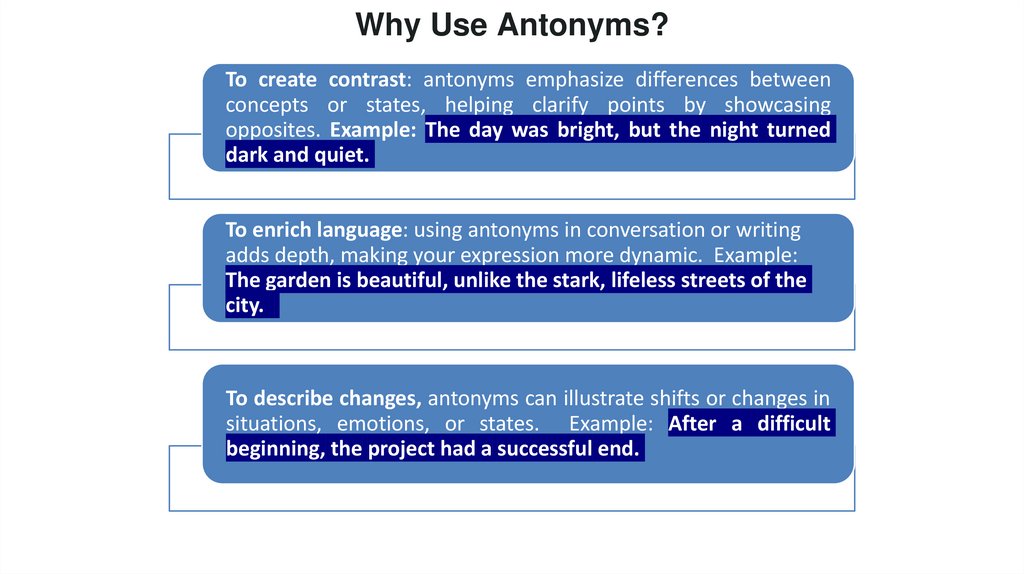
17. Why Use Antonyms?
To create contrast: antonyms emphasize differences betweenconcepts or states, helping clarify points by showcasing
opposites. Example: The day was bright, but the night turned
dark and quiet.
To enrich language: using antonyms in conversation or writing
adds depth, making your expression more dynamic. Example:
The garden is beautiful, unlike the stark, lifeless streets of the
city.
To describe changes, antonyms can illustrate shifts or changes in
situations, emotions, or states. Example: After a difficult
beginning, the project had a successful end.
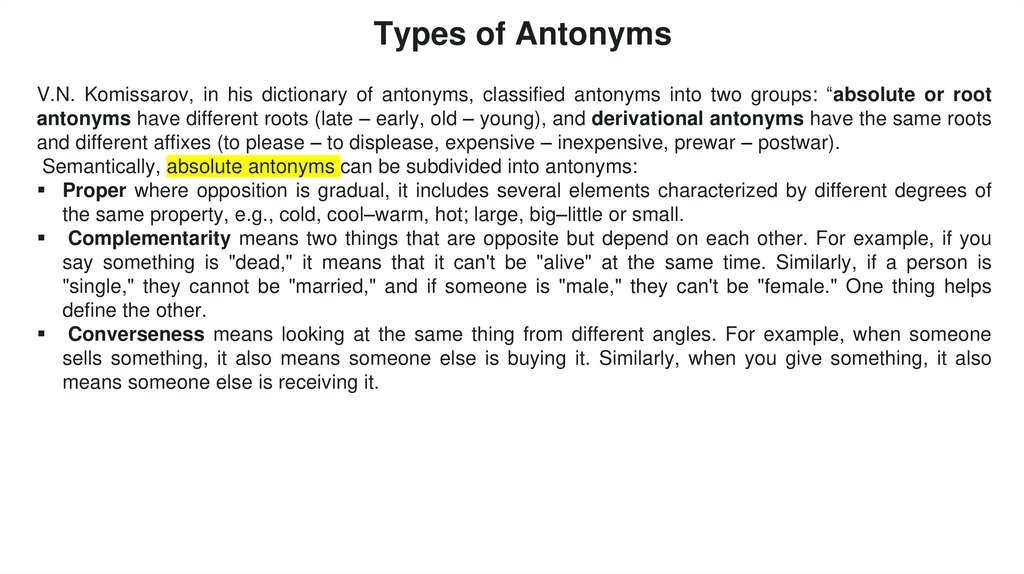
18. Types of Antonyms
V.N. Komissarov, in his dictionary of antonyms, classified antonyms into two groups: “absolute or rootantonyms have different roots (late – early, old – young), and derivational antonyms have the same roots
and different affixes (to please – to displease, expensive – inexpensive, prewar – postwar).
Semantically, absolute antonyms can be subdivided into antonyms:
Proper where opposition is gradual, it includes several elements characterized by different degrees of
the same property, e.g., cold, cool–warm, hot; large, big–little or small.
Complementarity means two things that are opposite but depend on each other. For example, if you
say something is "dead," it means that it can't be "alive" at the same time. Similarly, if a person is
"single," they cannot be "married," and if someone is "male," they can't be "female." One thing helps
define the other.
Converseness means looking at the same thing from different angles. For example, when someone
sells something, it also means someone else is buying it. Similarly, when you give something, it also
means someone else is receiving it.
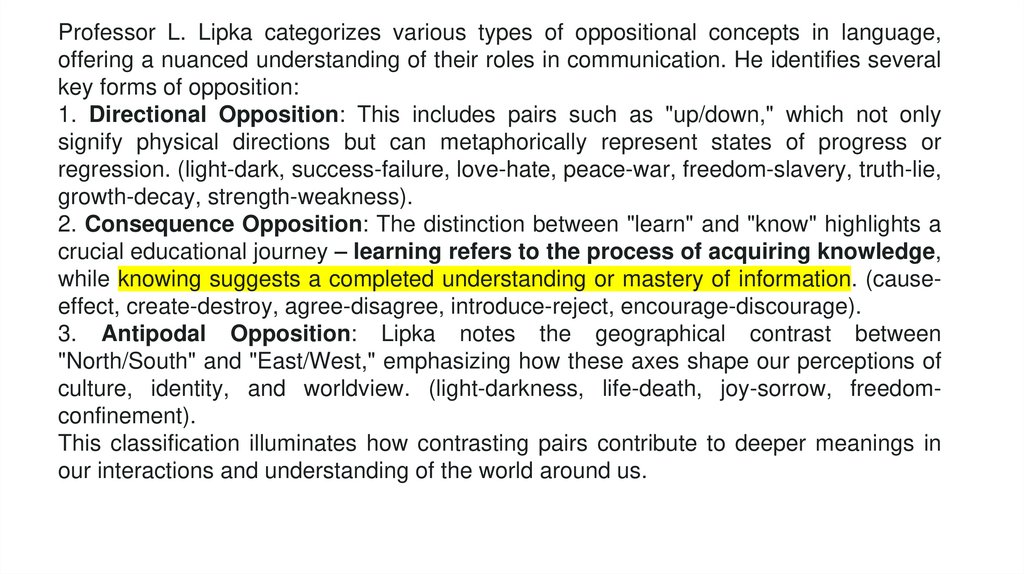
19.
Professor L. Lipka categorizes various types of oppositional concepts in language,offering a nuanced understanding of their roles in communication. He identifies several
key forms of opposition:
1. Directional Opposition: This includes pairs such as "up/down," which not only
signify physical directions but can metaphorically represent states of progress or
regression. (light-dark, success-failure, love-hate, peace-war, freedom-slavery, truth-lie,
growth-decay, strength-weakness).
2. Consequence Opposition: The distinction between "learn" and "know" highlights a
crucial educational journey – learning refers to the process of acquiring knowledge,
while knowing suggests a completed understanding or mastery of information. (causeeffect, create-destroy, agree-disagree, introduce-reject, encourage-discourage).
3. Antipodal Opposition: Lipka notes the geographical contrast between
"North/South" and "East/West," emphasizing how these axes shape our perceptions of
culture, identity, and worldview. (light-darkness, life-death, joy-sorrow, freedomconfinement).
This classification illuminates how contrasting pairs contribute to deeper meanings in
our interactions and understanding of the world around us.
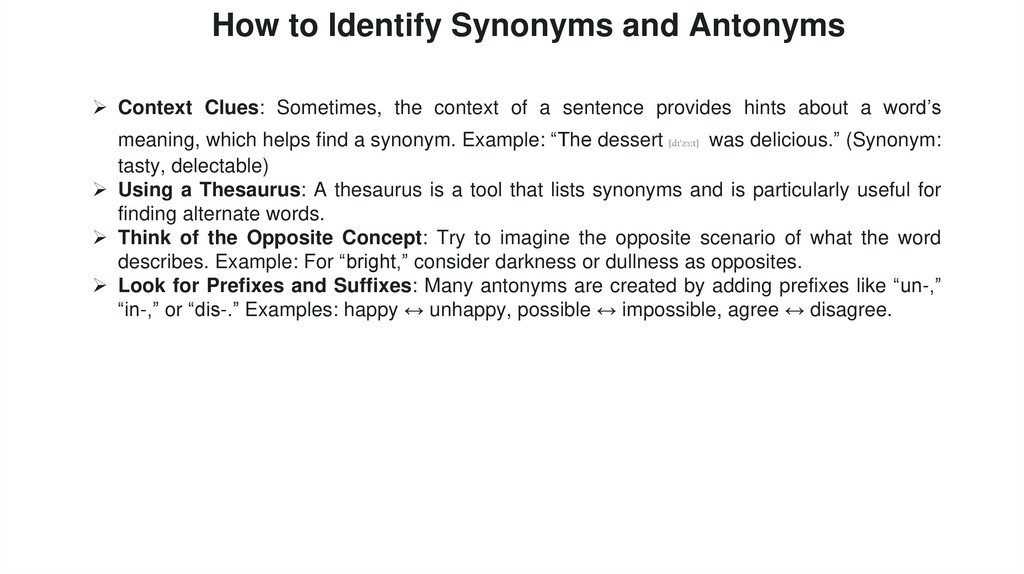
20. How to Identify Synonyms and Antonyms
Context Clues: Sometimes, the context of a sentence provides hints about a word’smeaning, which helps find a synonym. Example: “The dessert [dɪ'zɜ:t] was delicious.” (Synonym:
tasty, delectable)
Using a Thesaurus: A thesaurus is a tool that lists synonyms and is particularly useful for
finding alternate words.
Think of the Opposite Concept: Try to imagine the opposite scenario of what the word
describes. Example: For “bright,” consider darkness or dullness as opposites.
Look for Prefixes and Suffixes: Many antonyms are created by adding prefixes like “un-,”
“in-,” or “dis-.” Examples: happy ↔ unhappy, possible ↔ impossible, agree ↔ disagree.
21. Conclusion
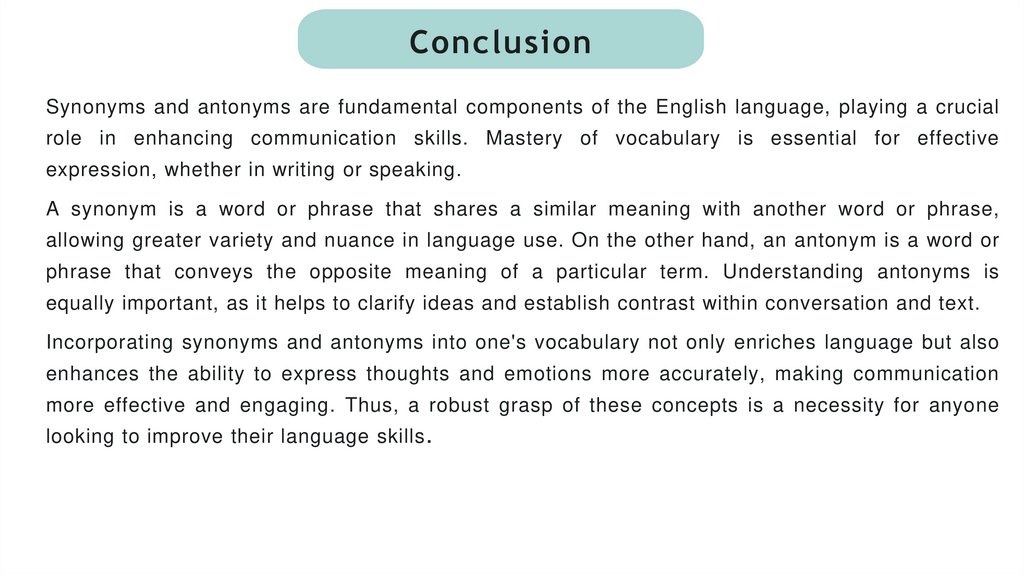
Synonyms and antonyms are fundamental components of the English language, playing a crucialrole in enhancing communication skills. Mastery of vocabulary is essential for effective
expression, whether in writing or speaking.
A synonym is a word or phrase that shares a similar meaning with another word or phrase,
allowing greater variety and nuance in language use. On the other hand, an antonym is a word or
phrase that conveys the opposite meaning of a particular term. Understanding antonyms is
equally important, as it helps to clarify ideas and establish contrast within conversation and text.
Incorporating synonyms and antonyms into one's vocabulary not only enriches language but also
enhances the ability to express thoughts and emotions more accurately, making communication
more effective and engaging. Thus, a robust grasp of these concepts is a necessity for anyone
looking to improve their language skills .