


 Педагогика
Похожие презентации:








CPD Programme for English Teachers: Accelerating English Language Learning in Central Asia
1. CPD Programme for English Teachers Cluster School CPD Day 9
Accelerating English Language Learning in Central AsiaCPD Programme for English Teachers
Cluster School CPD Day 9
“How can we engage all learners
through project-based learning?”
www.britishcouncil.org
2. Session outcomes
By the end of the day, teachers will be able to:Describe and use the steps of PBL to plan a project.
Break down a project into smaller tasks.
Identify appropriate scaffolding for tasks.
Discuss challenges and identify solutions.
www.britishcouncil.org
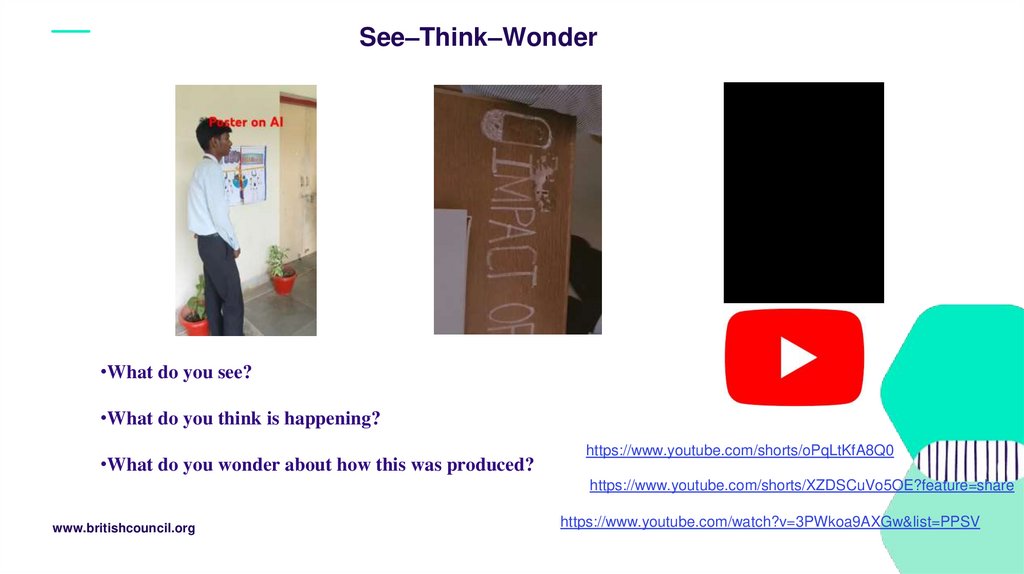
3. See–Think–Wonder
•What do you see?•What do you think is happening?
•What do you wonder about how this was produced?
https://www.youtube.com/shorts/oPqLtKfA8Q0
https://www.youtube.com/shorts/XZDSCuVo5OE?feature=share
www.britishcouncil.org
https://www.youtube.com/watch?v=3PWkoa9AXGw&list=PPSV
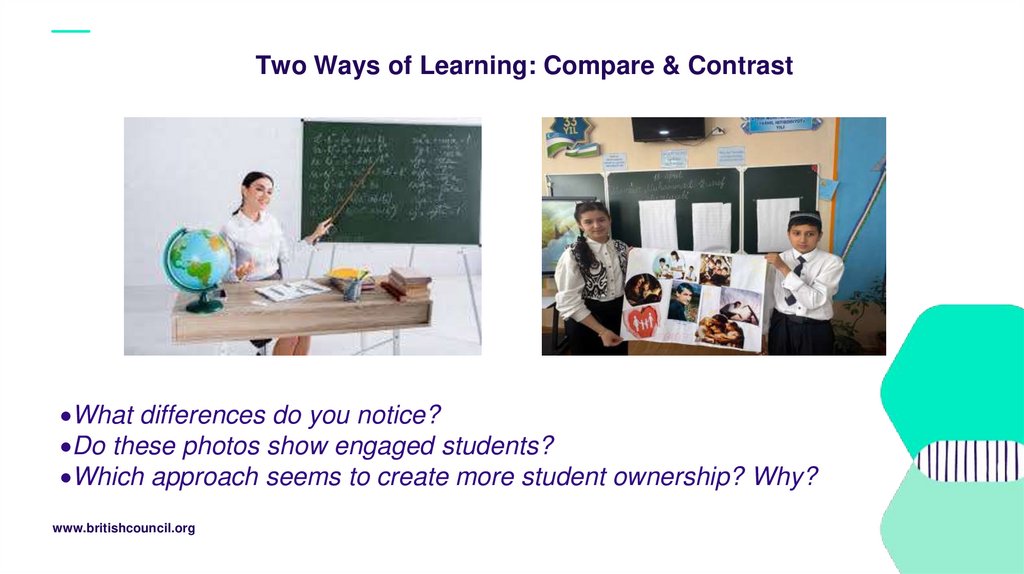
4. Two Ways of Learning: Compare & Contrast
Two Ways of Learning: Compare & ContrastWhat differences do you notice?
Do these photos show engaged students?
Which approach seems to create more student ownership? Why?
www.britishcouncil.org
5.
www.britishcouncil.org6. Group discussion
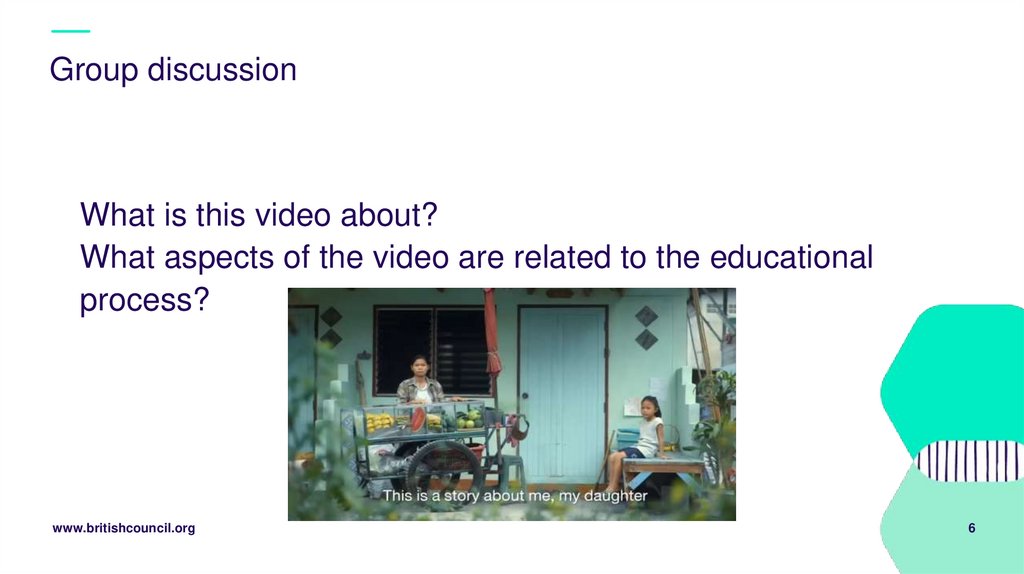
What is this video about?What aspects of the video are related to the educational
process?
www.britishcouncil.org
6
7.
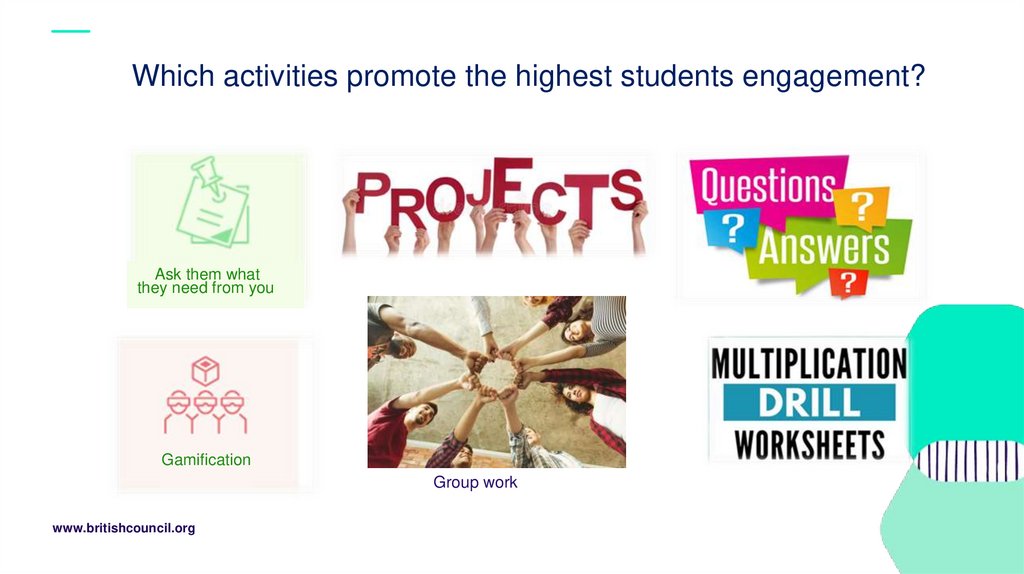
Which activities promote the highest students engagement?Ask them what
they need from you
Gamification
Group work
www.britishcouncil.org
8. What is Project-based Learning?
Project Based Learning (PBL) is ateaching method in which students
learn by actively engaging in realworld and personally meaningful
projects.
www.britishcouncil.org
9. Colour Corners
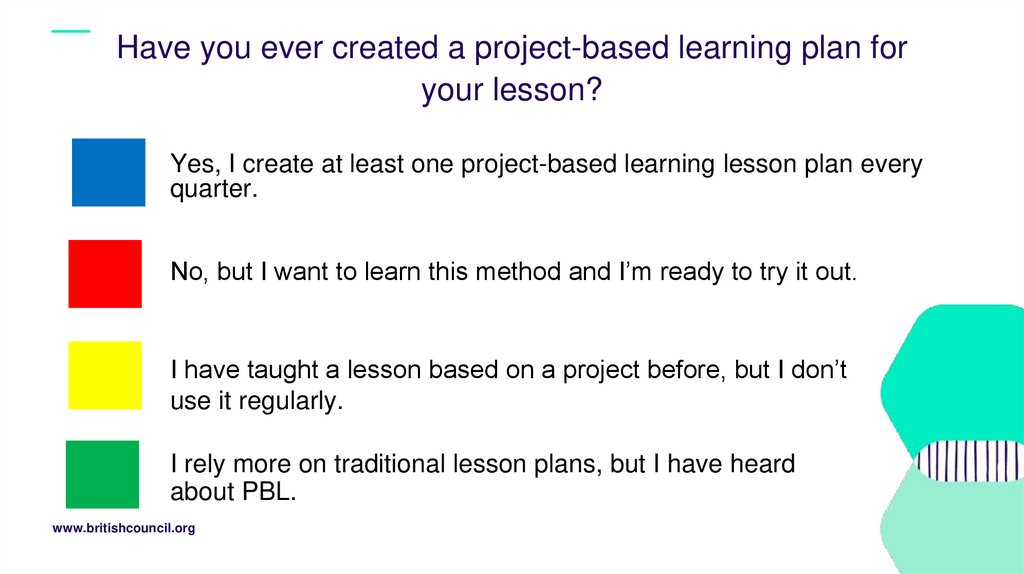
Read the questions and choose one of the colouredcorners based on your answer.
www.britishcouncil.org
10. Have you ever created a project-based learning plan for your lesson?
Yes, I create at least one project-based learning lesson plan everyquarter.
No, but I want to learn this method and I’m ready to try it out.
I have taught a lesson based on a project before, but I don’t
use it regularly.
I rely more on traditional lesson plans, but I have heard
about PBL.
www.britishcouncil.org
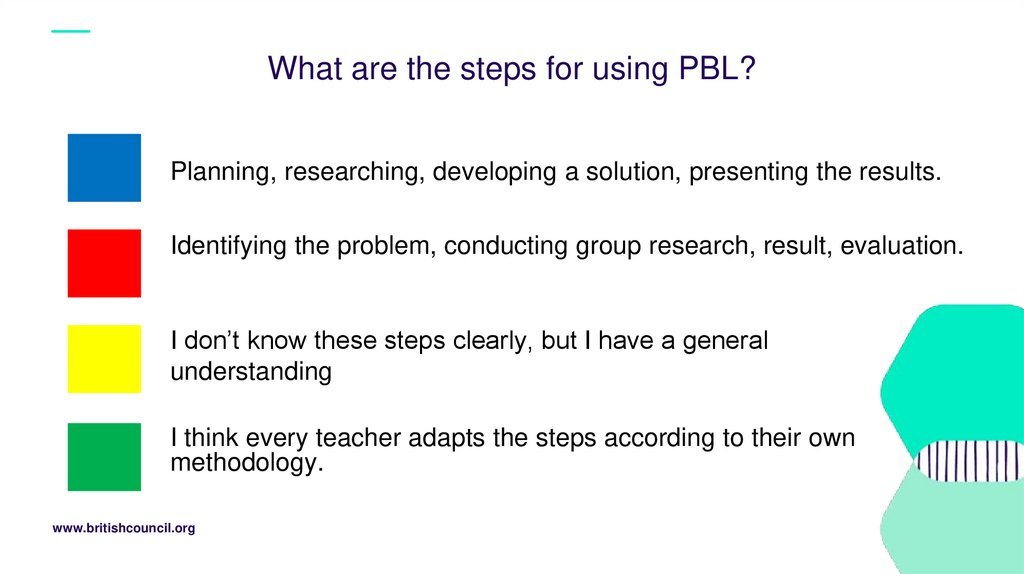
11. What are the steps for using PBL?
Planning, researching, developing a solution, presenting the results.Identifying the problem, conducting group research, result, evaluation.
I don’t know these steps clearly, but I have a general
understanding
I think every teacher adapts the steps according to their own
methodology.
www.britishcouncil.org
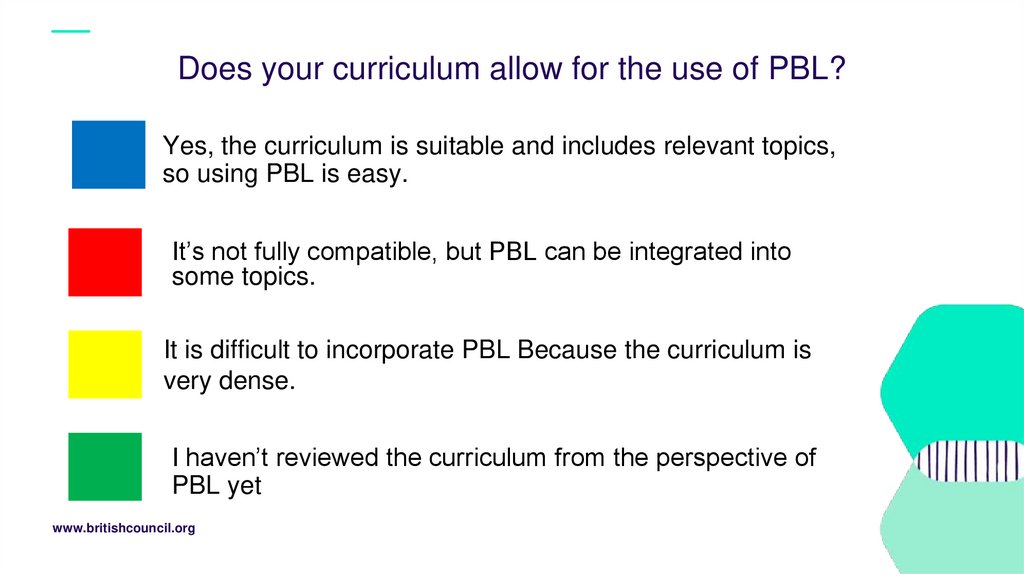
12. Does your curriculum allow for the use of PBL?
Yes, the curriculum is suitable and includes relevant topics,so using PBL is easy.
It’s not fully compatible, but PBL can be integrated into
some topics.
It is difficult to incorporate PBL Because the curriculum is
very dense.
I haven’t reviewed the curriculum from the perspective of
PBL yet
www.britishcouncil.org
13.
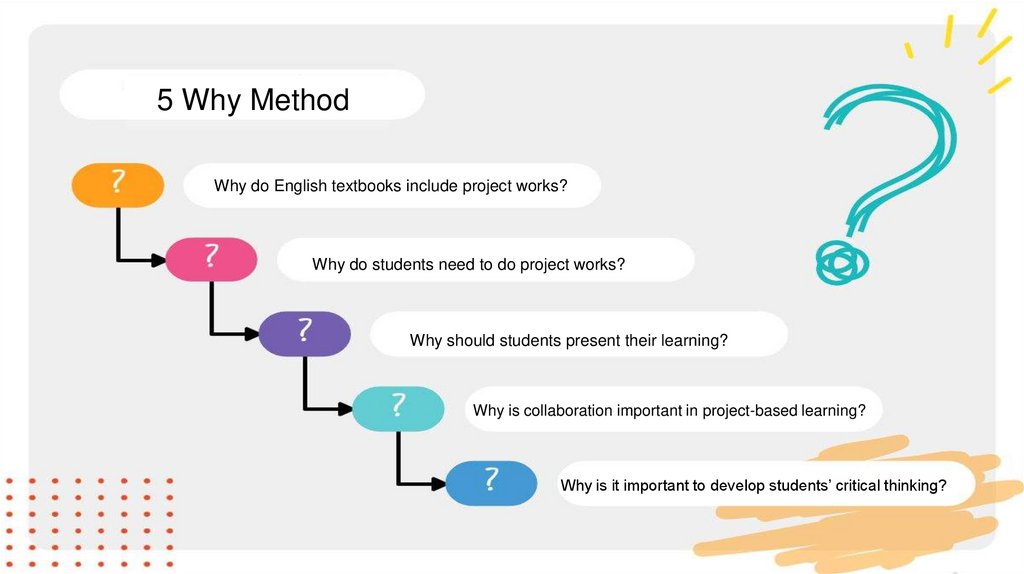
5 Why MethodWhy do English textbooks include project works?
Why do students need to do project works?
Why should students present their learning?
Why is collaboration important in project-based learning?
Why is it important to develop students’ critical thinking?
www.britishcouncil.org
14.
Teacher’s rolewww.britishcouncil.org
Students’ role
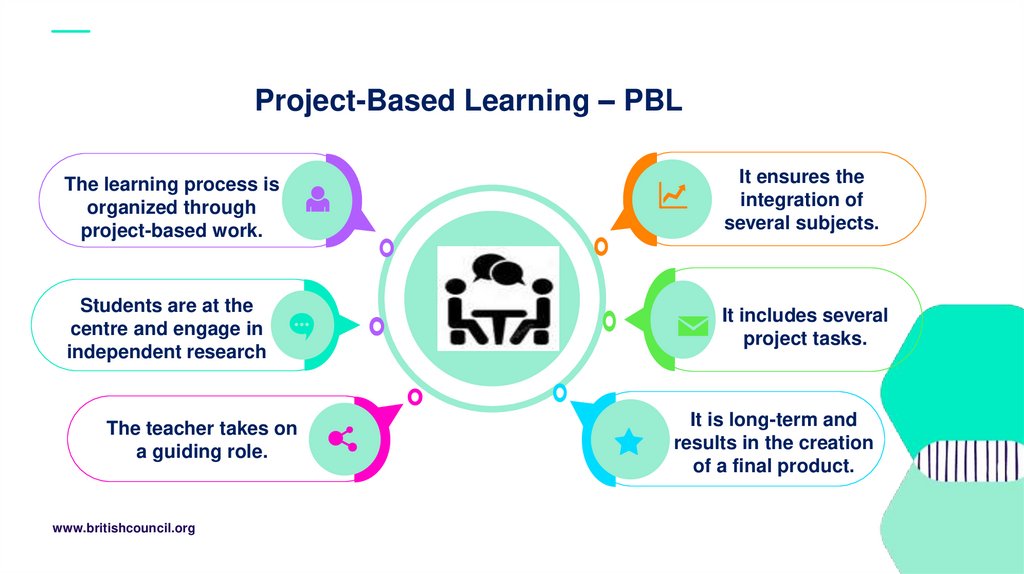
15. Project-Based Learning – PBL
The learning process isorganized through
project-based work.
It ensures the
integration of
several subjects.
Students are at the
centre and engage in
independent research
It includes several
project tasks.
The teacher takes on
a guiding role.
www.britishcouncil.org
It is long-term and
results in the creation
of a final product.
16. Wordwall Mini-Game: Decode the PBL Step
Decode → give a live classroom example — keep it concretehttps://wordwall.net/resource/96951704
www.britishcouncil.org
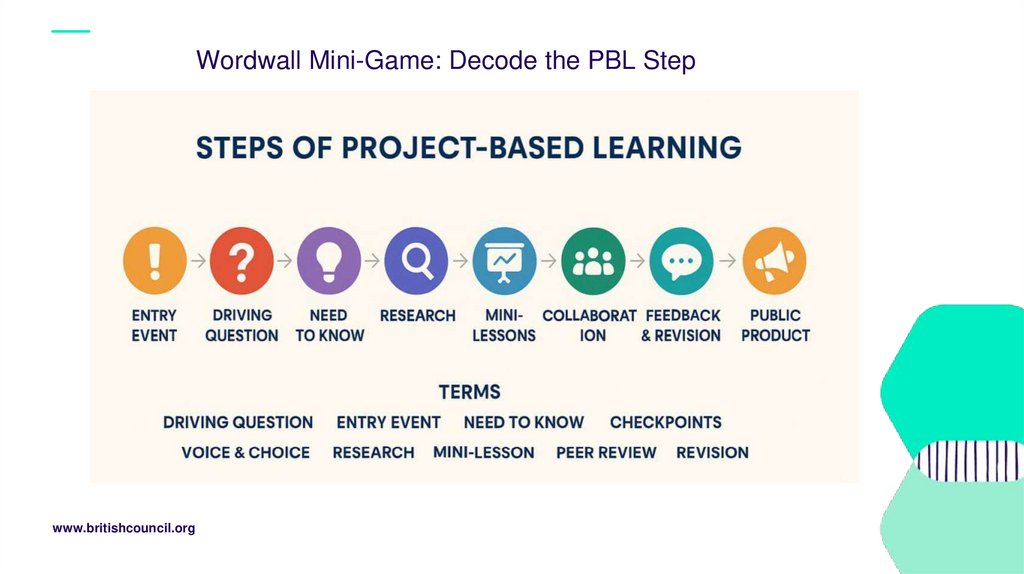
17. Wordwall Mini-Game: Decode the PBL Step
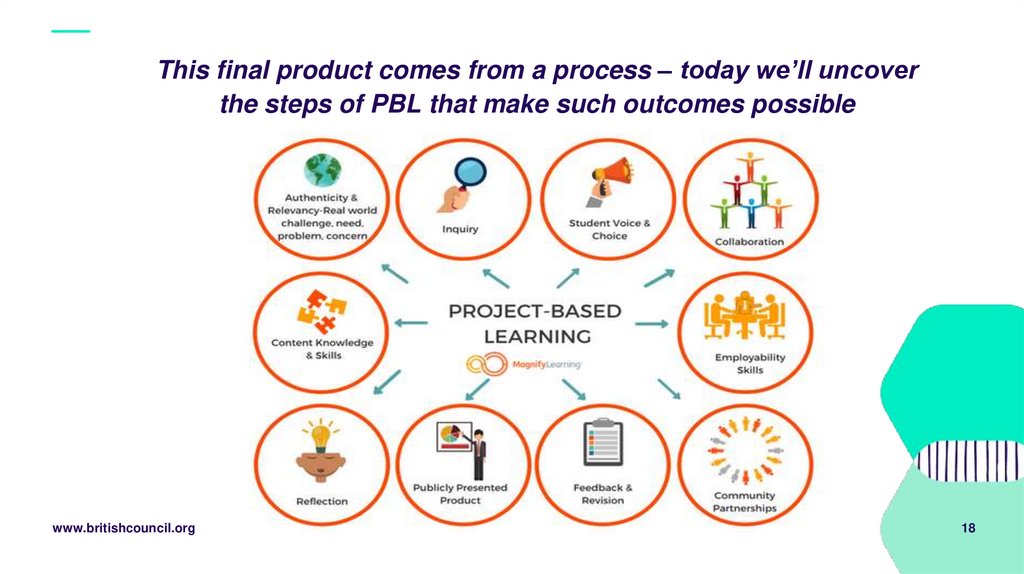
www.britishcouncil.org18. This final product comes from a process – today we’ll uncover the steps of PBL that make such outcomes possible
www.britishcouncil.org18
19. Deepening Understanding from the Webinar
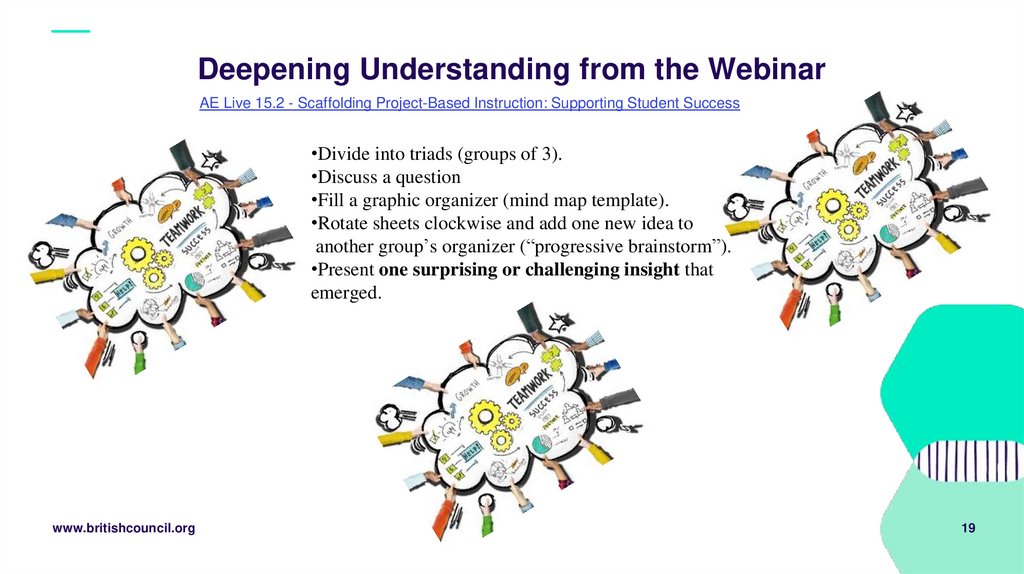
AE Live 15.2 - Scaffolding Project-Based Instruction: Supporting Student Success•Divide into triads (groups of 3).
•Discuss a question
•Fill a graphic organizer (mind map template).
•Rotate sheets clockwise and add one new idea to
another group’s organizer (“progressive brainstorm”).
•Present one surprising or challenging insight that
emerged.
www.britishcouncil.org
19
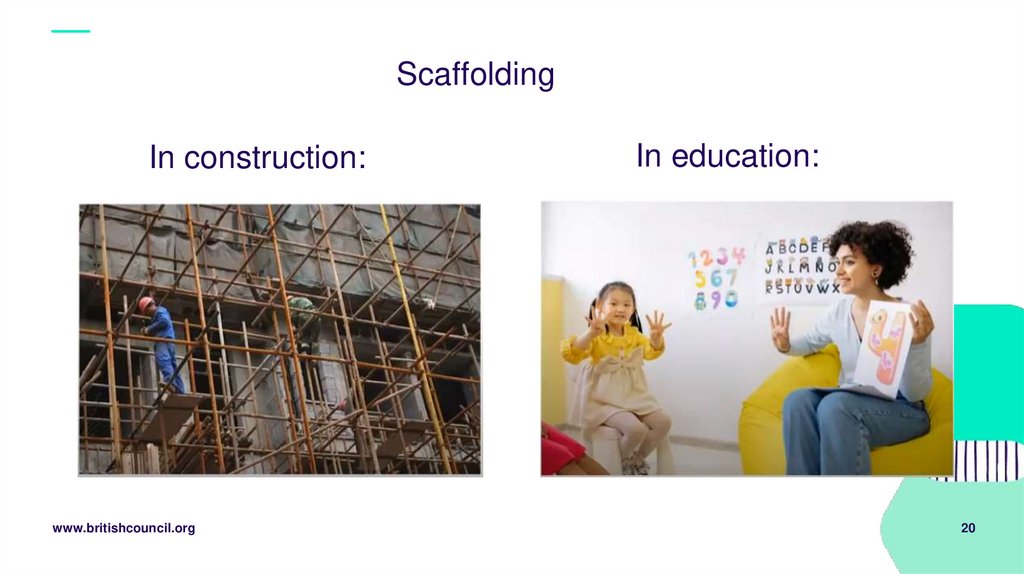
20. Scaffolding
In construction:www.britishcouncil.org
In education:
20
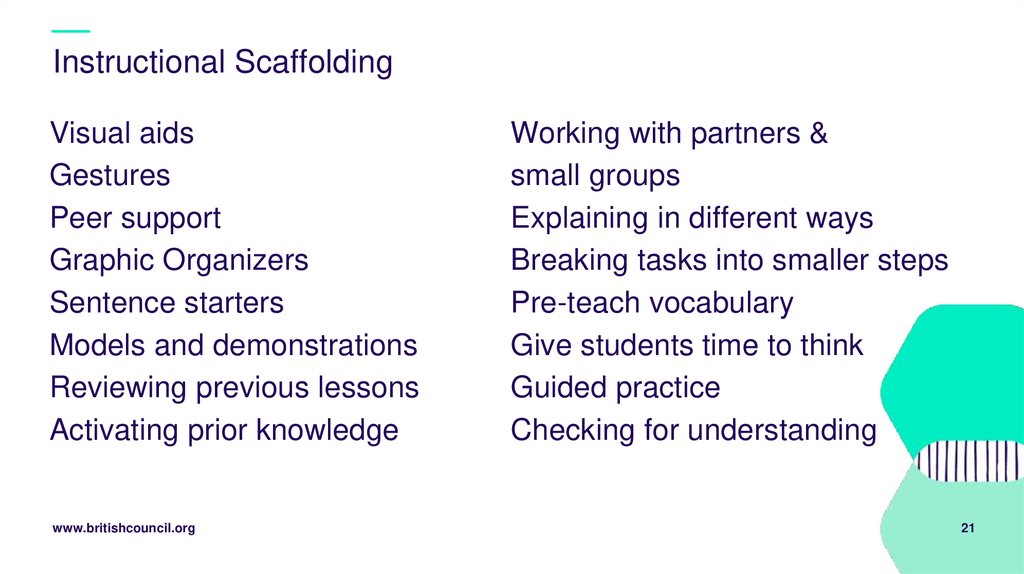
21. Instructional Scaffolding
Visual aidsGestures
Peer support
Graphic Organizers
Sentence starters
Models and demonstrations
Reviewing previous lessons
Activating prior knowledge
www.britishcouncil.org
Working with partners &
small groups
Explaining in different ways
Breaking tasks into smaller steps
Pre-teach vocabulary
Give students time to think
Guided practice
Checking for understanding
21
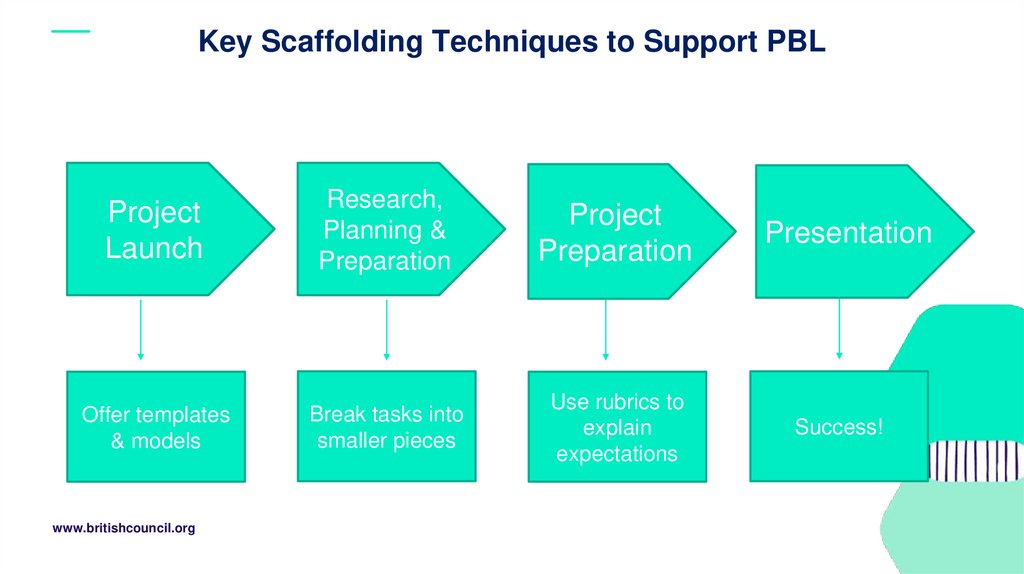
22. Key Scaffolding Techniques to Support PBL
ProjectLaunch
Research,
Planning &
Preparation
Project
Preparation
Presentation
Offer templates
& models
Break tasks into
smaller pieces
Use rubrics to
explain
expectations
Success!
www.britishcouncil.org
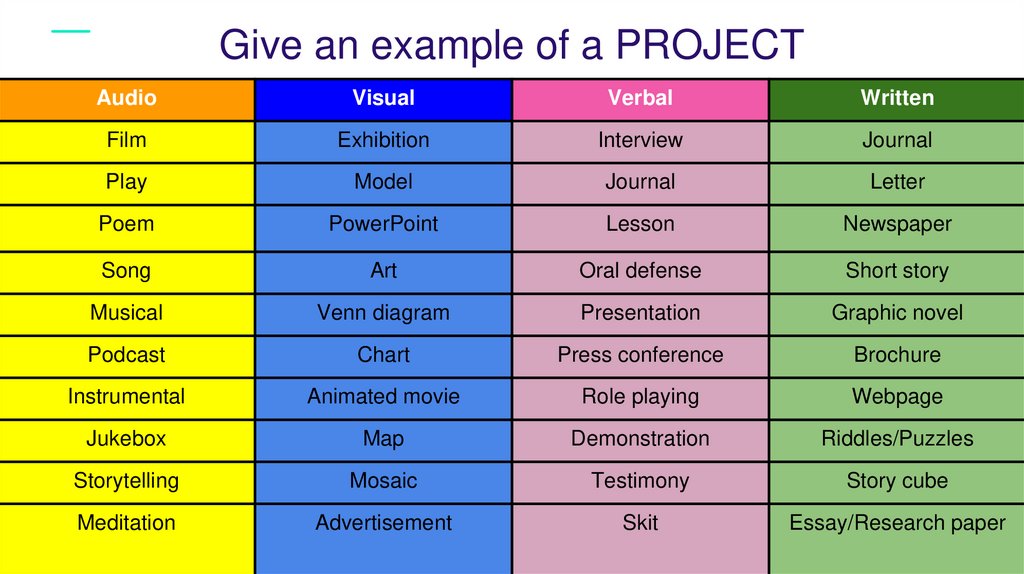
23. Give an example of a PROJECT
AudioVisual
Verbal
Written
Film
Exhibition
Interview
Journal
Play
Model
Journal
Letter
Poem
PowerPoint
Lesson
Newspaper
Song
Art
Oral defense
Short story
Musical
Venn diagram
Presentation
Graphic novel
Podcast
Chart
Press conference
Brochure
Instrumental
Animated movie
Role playing
Webpage
Jukebox
Map
Demonstration
Riddles/Puzzles
Storytelling
Mosaic
Testimony
Story cube
Meditation
Advertisement
Skit
Essay/Research paper
www.britishcouncil.org
24.
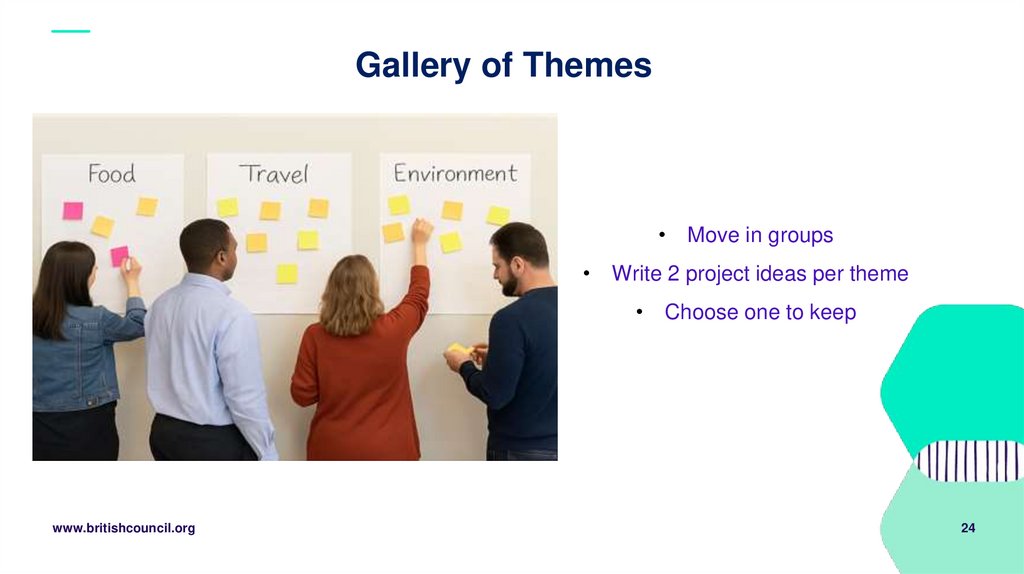
Gallery of Themes• Move in groups
• Write 2 project ideas per theme
• Choose one to keep
www.britishcouncil.org
24
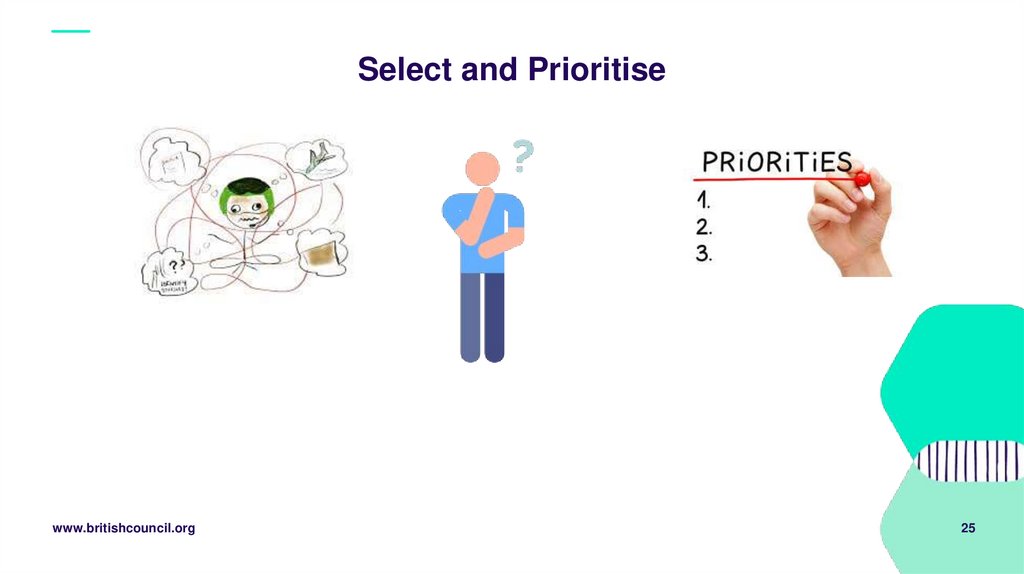
25. Select and Prioritise
www.britishcouncil.org25
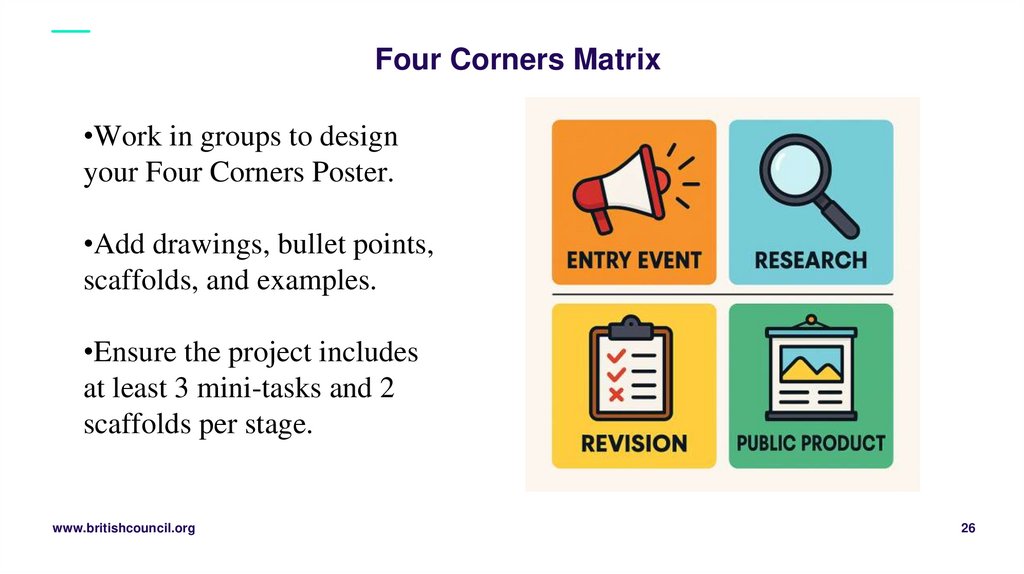
26. Four Corners Matrix
•Work in groups to designyour Four Corners Poster.
•Add drawings, bullet points,
scaffolds, and examples.
•Ensure the project includes
at least 3 mini-tasks and 2
scaffolds per stage.
www.britishcouncil.org
26
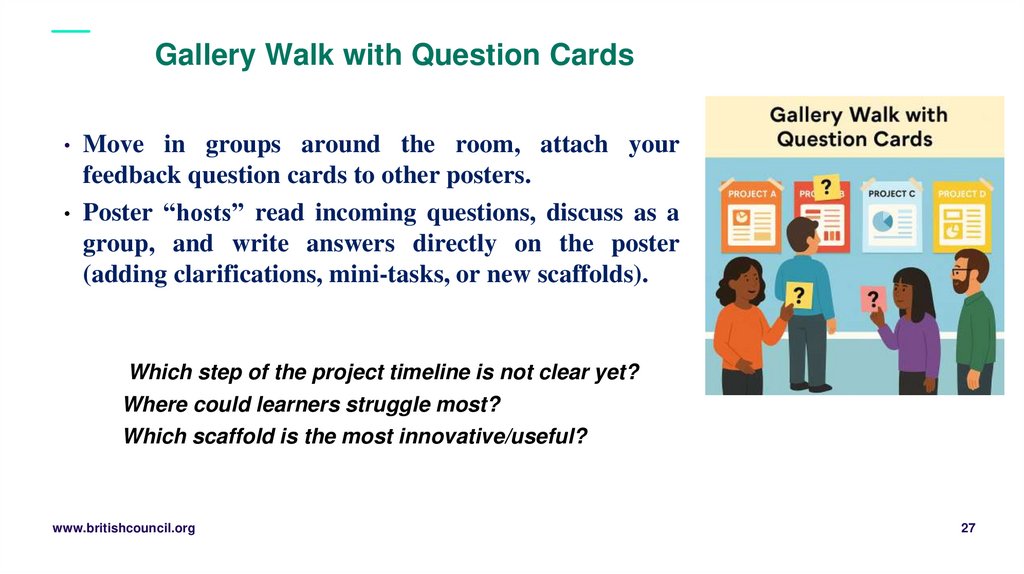
27. Gallery Walk with Question Cards
• Movein groups around the room, attach your
feedback question cards to other posters.
• Poster “hosts” read incoming questions, discuss as a
group, and write answers directly on the poster
(adding clarifications, mini-tasks, or new scaffolds).
Which step of the project timeline is not clear yet?
Where could learners struggle most?
Which scaffold is the most innovative/useful?
www.britishcouncil.org
27
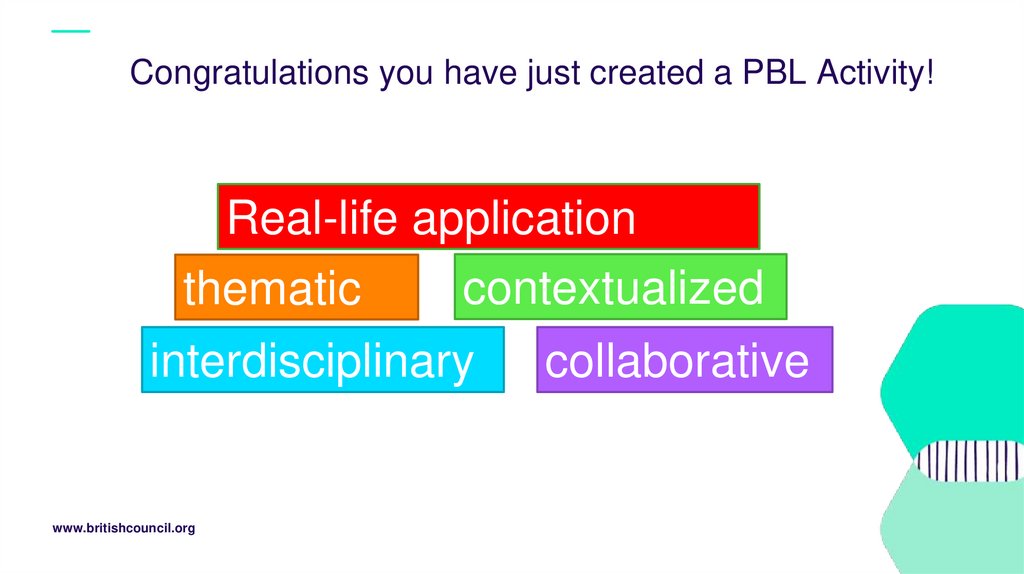
28. Congratulations you have just created a PBL Activity!
Real-life applicationcontextualized
thematic
interdisciplinary
www.britishcouncil.org
collaborative
29.
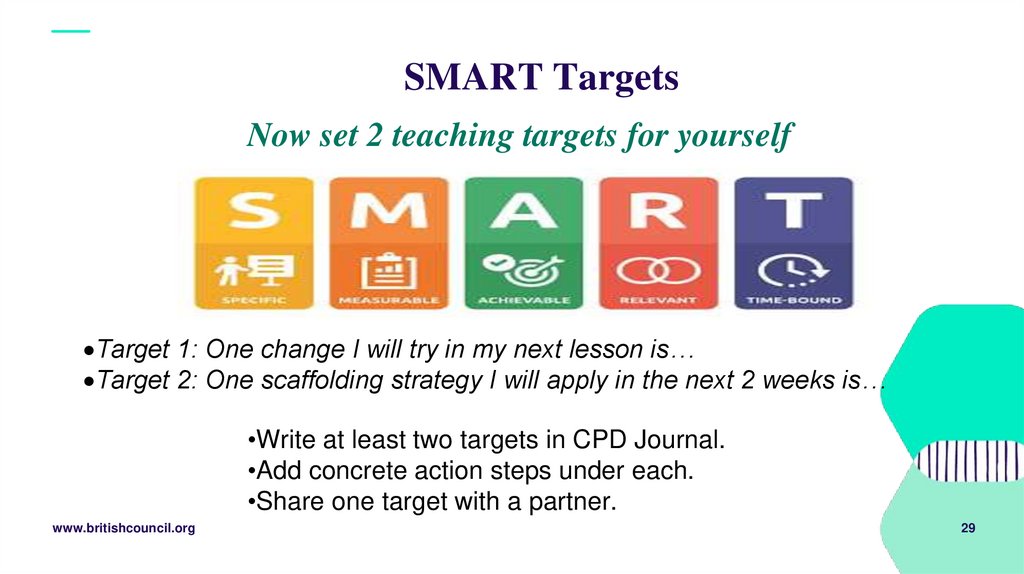
SMART TargetsNow set 2 teaching targets for yourself
Target 1: One change I will try in my next lesson is…
Target 2: One scaffolding strategy I will apply in the next 2 weeks is…
•Write at least two targets in CPD Journal.
•Add concrete action steps under each.
•Share one target with a partner.
www.britishcouncil.org
29
30. Thank you!!!
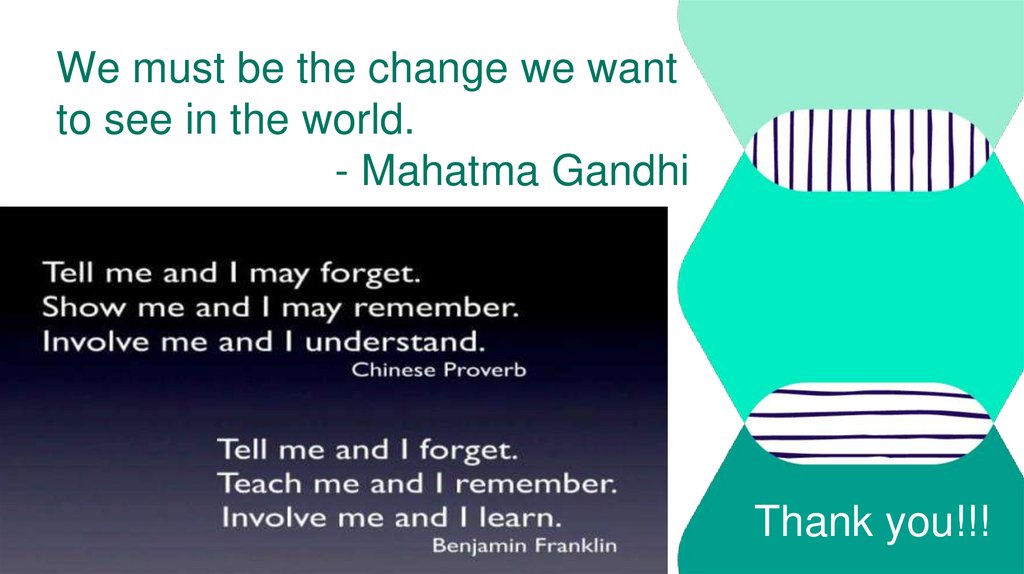
We must be the change we wantto see in the world.
- Mahatma Gandhi
www.britishcouncil.org
Thank you!!!