
 Менеджмент
Похожие презентации:





Communication and Expectation Management
1. Communication and Expectation Management
Communication success for teams and stakeholdersDesigned for chapter 5, pages 149-178 of Project Team Leadership and Communication by Samuel Malachowsky, ISBN 9781732378902, 9781732378919.
2. Project Communication
Important because:• Stakeholders affect projects whether you communicate or not
• Because of technology, customers expect more interaction
• Team members
– Leadership and motivation factors can have a huge effect on the project
– Often are split between multiple projects
• Interactive communication is considered ideal (each party is able to respond, ask for
clarification, etc.)
– This often is impossible or impractical, so one-way communication is used
Malachowsky, Samuel. Project Team Leadership and Communication. Lintwood Press. 2018. p. 149-150.
3. Channels of Communication
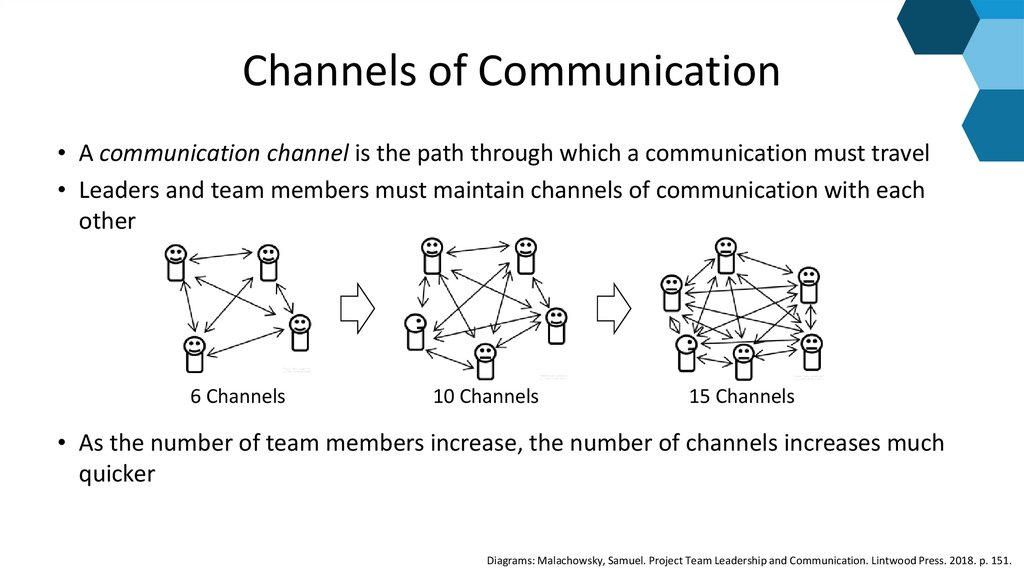
• A communication channel is the path through which a communication must travel• Leaders and team members must maintain channels of communication with each
other
6 Channels
10 Channels
15 Channels
• As the number of team members increase, the number of channels increases much
quicker
Diagrams: Malachowsky, Samuel. Project Team Leadership and Communication. Lintwood Press. 2018. p. 151.
4. Communication Concepts
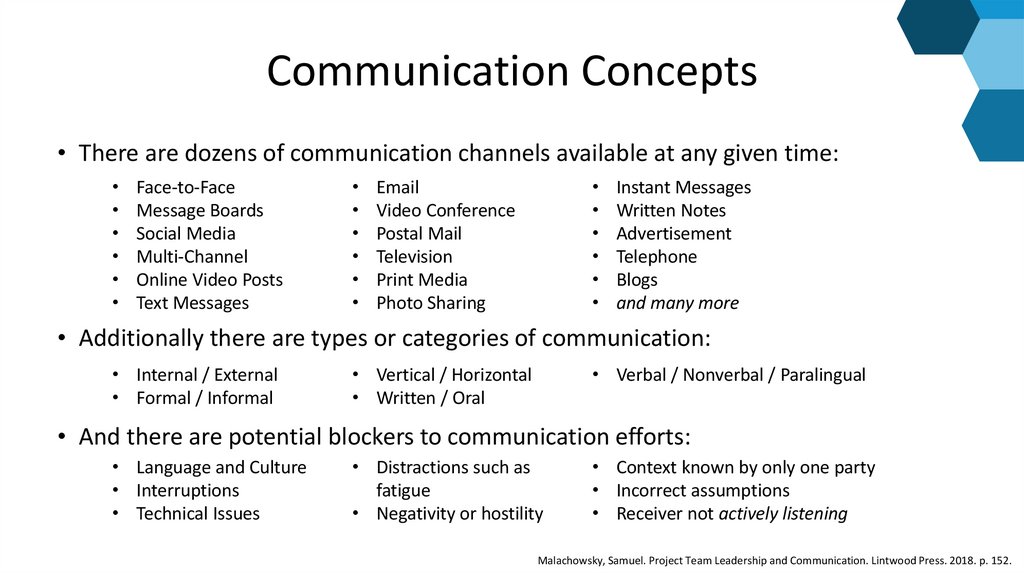
• There are dozens of communication channels available at any given time:Face-to-Face
Message Boards
Social Media
Multi-Channel
Online Video Posts
Text Messages
Video Conference
Postal Mail
Television
Print Media
Photo Sharing
Instant Messages
Written Notes
Advertisement
Telephone
Blogs
and many more
• Additionally there are types or categories of communication:
• Internal / External
• Formal / Informal
• Vertical / Horizontal
• Written / Oral
• Verbal / Nonverbal / Paralingual
• And there are potential blockers to communication efforts:
• Language and Culture
• Interruptions
• Technical Issues
• Distractions such as
fatigue
• Negativity or hostility
• Context known by only one party
• Incorrect assumptions
• Receiver not actively listening
Malachowsky, Samuel. Project Team Leadership and Communication. Lintwood Press. 2018. p. 152.
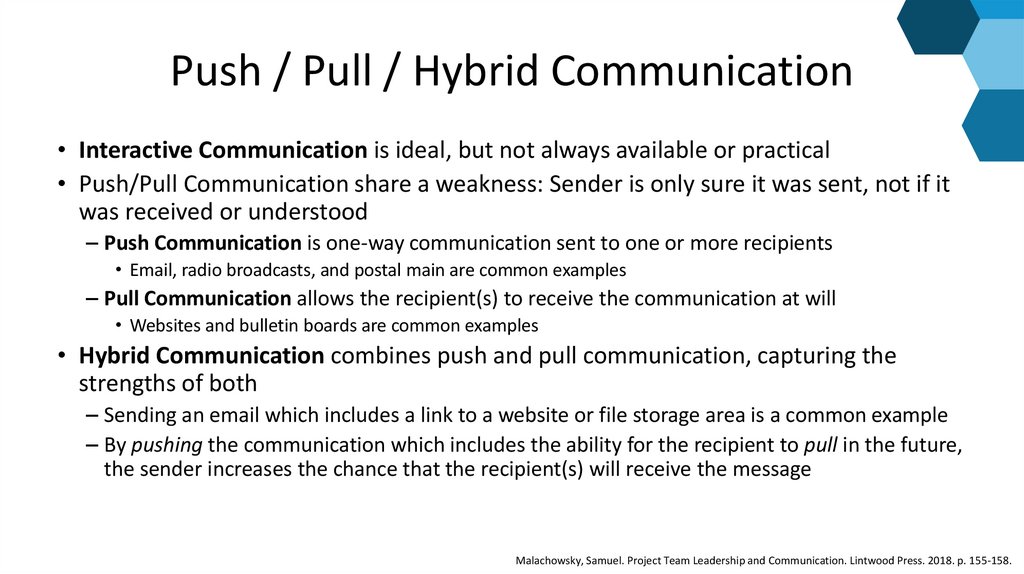
5. Push / Pull / Hybrid Communication
• Interactive Communication is ideal, but not always available or practical• Push/Pull Communication share a weakness: Sender is only sure it was sent, not if it
was received or understood
– Push Communication is one-way communication sent to one or more recipients
• Email, radio broadcasts, and postal main are common examples
– Pull Communication allows the recipient(s) to receive the communication at will
• Websites and bulletin boards are common examples
• Hybrid Communication combines push and pull communication, capturing the
strengths of both
– Sending an email which includes a link to a website or file storage area is a common example
– By pushing the communication which includes the ability for the recipient to pull in the future,
the sender increases the chance that the recipient(s) will receive the message
Malachowsky, Samuel. Project Team Leadership and Communication. Lintwood Press. 2018. p. 155-158.
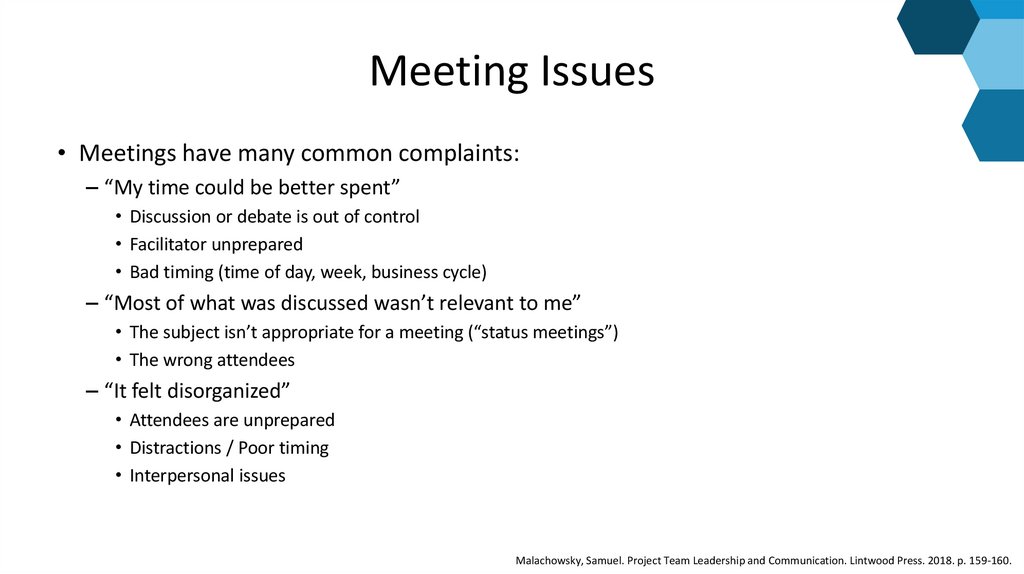
6. Meeting Issues
• Meetings have many common complaints:– “My time could be better spent”
• Discussion or debate is out of control
• Facilitator unprepared
• Bad timing (time of day, week, business cycle)
– “Most of what was discussed wasn’t relevant to me”
• The subject isn’t appropriate for a meeting (“status meetings”)
• The wrong attendees
– “It felt disorganized”
• Attendees are unprepared
• Distractions / Poor timing
• Interpersonal issues
Malachowsky, Samuel. Project Team Leadership and Communication. Lintwood Press. 2018. p. 159-160.
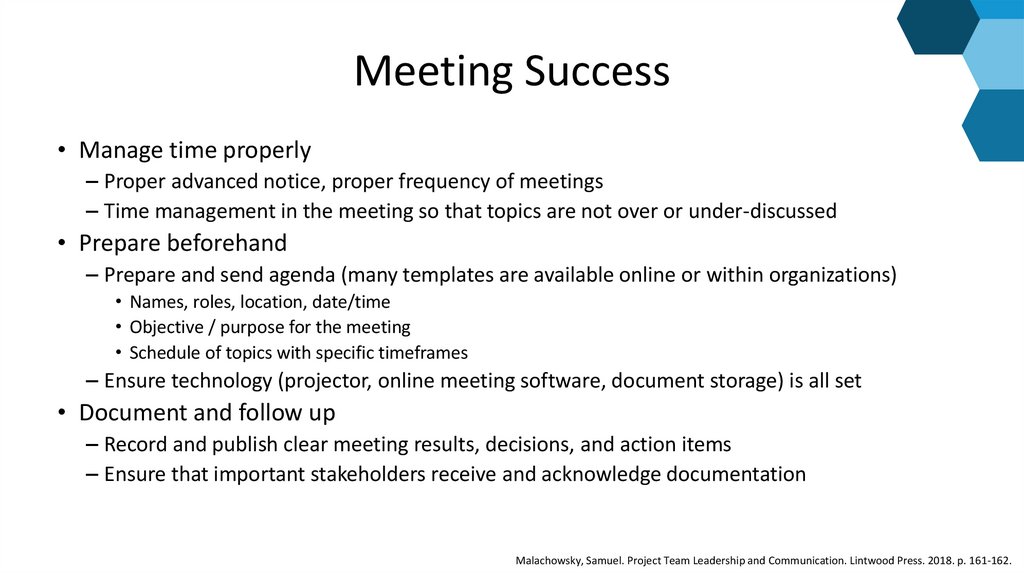
7. Meeting Success
• Manage time properly– Proper advanced notice, proper frequency of meetings
– Time management in the meeting so that topics are not over or under-discussed
• Prepare beforehand
– Prepare and send agenda (many templates are available online or within organizations)
• Names, roles, location, date/time
• Objective / purpose for the meeting
• Schedule of topics with specific timeframes
– Ensure technology (projector, online meeting software, document storage) is all set
• Document and follow up
– Record and publish clear meeting results, decisions, and action items
– Ensure that important stakeholders receive and acknowledge documentation
Malachowsky, Samuel. Project Team Leadership and Communication. Lintwood Press. 2018. p. 161-162.
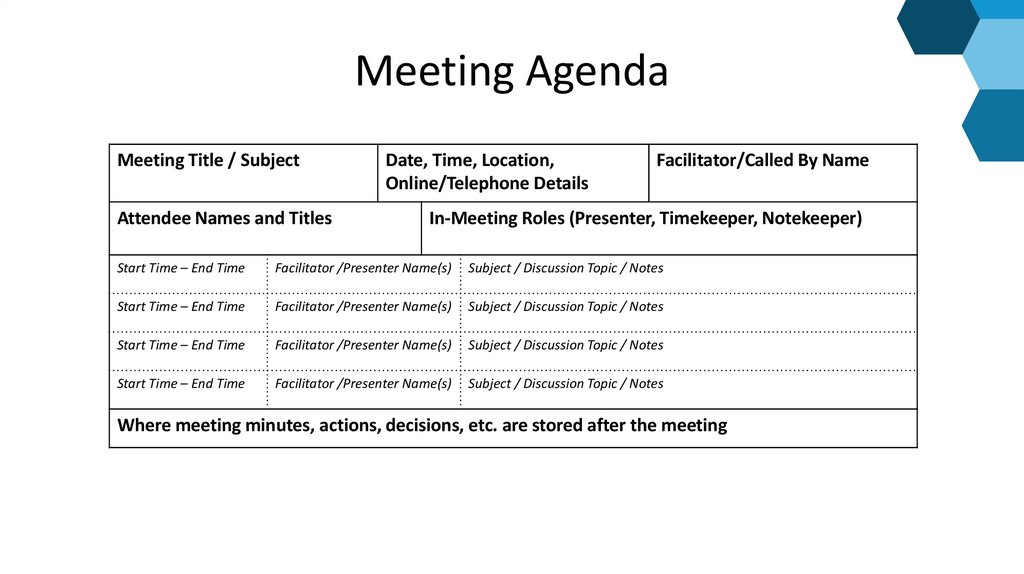
8. Meeting Agenda
Meeting Title / SubjectAttendee Names and Titles
Date, Time, Location,
Online/Telephone Details
Facilitator/Called By Name
In-Meeting Roles (Presenter, Timekeeper, Notekeeper)
Start Time – End Time
Facilitator /Presenter Name(s)
Subject / Discussion Topic / Notes
Start Time – End Time
Facilitator /Presenter Name(s)
Subject / Discussion Topic / Notes
Start Time – End Time
Facilitator /Presenter Name(s)
Subject / Discussion Topic / Notes
Start Time – End Time
Facilitator /Presenter Name(s)
Subject / Discussion Topic / Notes
Where meeting minutes, actions, decisions, etc. are stored after the meeting
9. Ethical Communication
• Communication presents the majority of ethical decisions for most individuals• Ethics focus on truthfulness
– Honesty before the project begins
• Ensuring that the project team and stakeholders are presented with an honest view of circumstances
– Trying to understand the truth
• Remember that perceptions can be inaccurate. Seek the whole truth
– Being truthful in all communications
• Stressful or less-than-ideal circumstances make this difficulty. Trust is built in the bad times, not the good
– Creating an environment where others tell the truth
• As a leader or peer, consistently telling the truth communicates to others that truthfulness is the only
acceptable option
Malachowsky, Samuel. Project Team Leadership and Communication. Lintwood Press. 2018. p. 162-163.
10. Communicating Metrics and Reports
• Metrics are a useful quantitative representation of a project attribute, which helpleaders or team members make decisions about the project
– Private metrics are known only to the team and risk misinterpretation if shared
– Public metrics are designed to be shared outside the team for comparison across projects
• Reports are more complex representations of the project designed to be
communicated to stakeholders and typically contain multiple metrics
• Making metrics and reports useful requires attention to several aspects
– Level of detail as well as ethical and appropriate interpretation for stakeholders
– Choosing an appropriate communication channel
– Considering the role of the recipient, as well as their preferences
– An appropriate understanding of what the information is ultimately going to be used for
Malachowsky, Samuel. Project Team Leadership and Communication. Lintwood Press. 2018. p. 164-165.
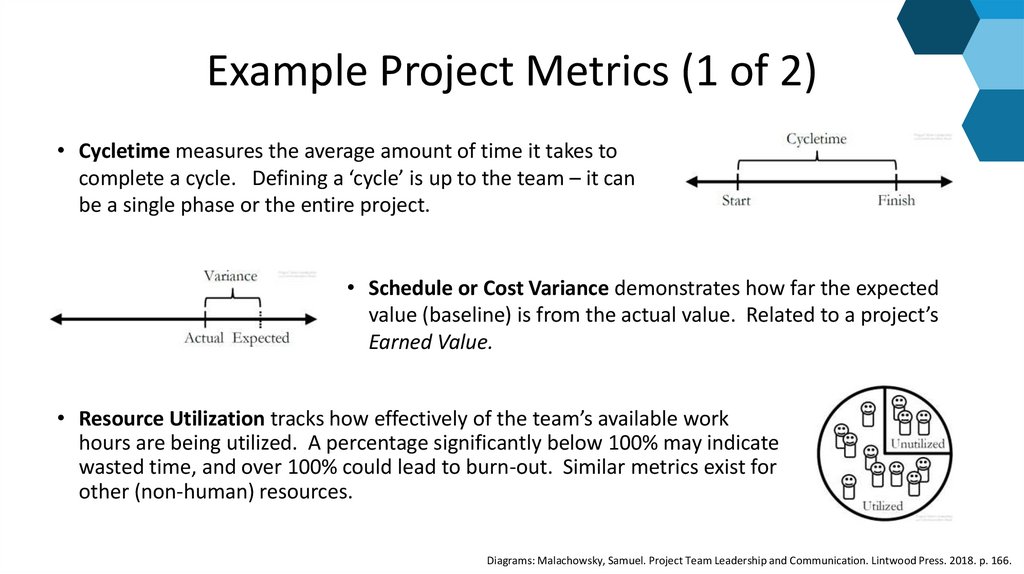
11. Example Project Metrics (1 of 2)
• Cycletime measures the average amount of time it takes tocomplete a cycle. Defining a ‘cycle’ is up to the team – it can
be a single phase or the entire project.
• Schedule or Cost Variance demonstrates how far the expected
value (baseline) is from the actual value. Related to a project’s
Earned Value.
• Resource Utilization tracks how effectively of the team’s available work
hours are being utilized. A percentage significantly below 100% may indicate
wasted time, and over 100% could lead to burn-out. Similar metrics exist for
other (non-human) resources.
Diagrams: Malachowsky, Samuel. Project Team Leadership and Communication. Lintwood Press. 2018. p. 166.
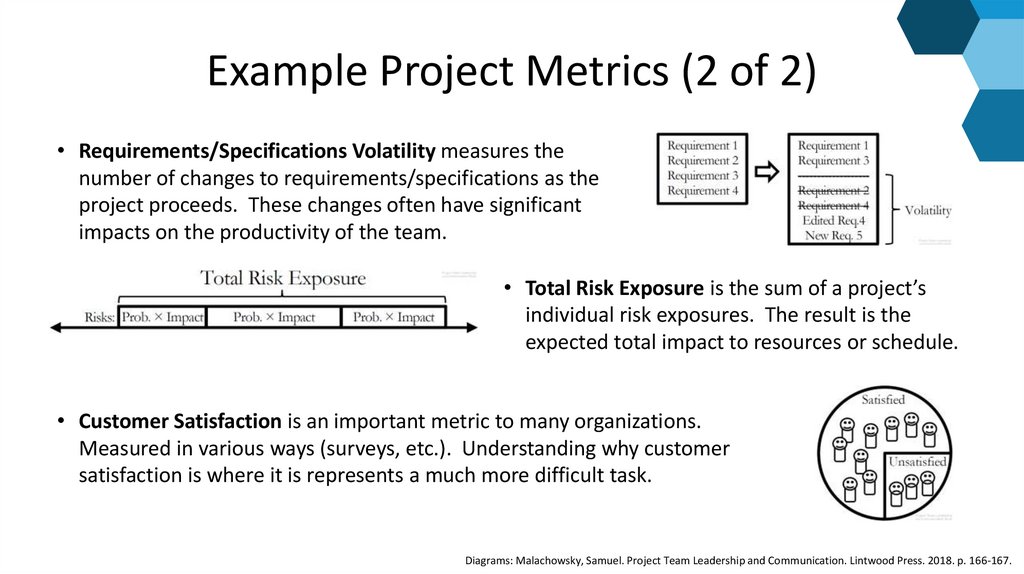
12. Example Project Metrics (2 of 2)
• Requirements/Specifications Volatility measures thenumber of changes to requirements/specifications as the
project proceeds. These changes often have significant
impacts on the productivity of the team.
• Total Risk Exposure is the sum of a project’s
individual risk exposures. The result is the
expected total impact to resources or schedule.
• Customer Satisfaction is an important metric to many organizations.
Measured in various ways (surveys, etc.). Understanding why customer
satisfaction is where it is represents a much more difficult task.
Diagrams: Malachowsky, Samuel. Project Team Leadership and Communication. Lintwood Press. 2018. p. 166-167.
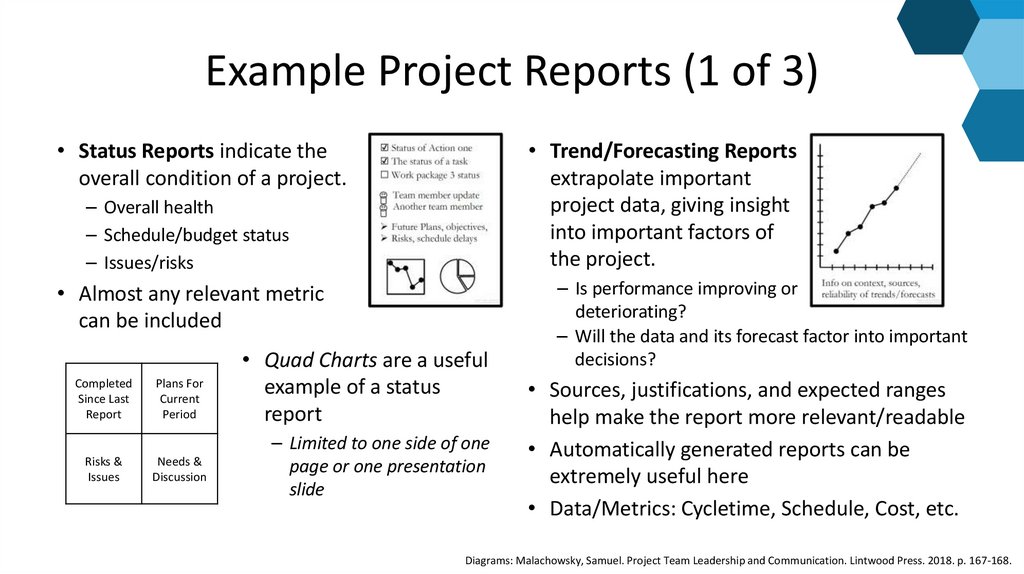
13. Example Project Reports (1 of 3)
• Status Reports indicate theoverall condition of a project.
• Trend/Forecasting Reports
extrapolate important
project data, giving insight
into important factors of
the project.
– Overall health
– Schedule/budget status
– Issues/risks
• Almost any relevant metric
can be included
Completed
Since Last
Report
Risks &
Issues
Plans For
Current
Period
Needs &
Discussion
• Quad Charts are a useful
example of a status
report
– Limited to one side of one
page or one presentation
slide
– Is performance improving or
deteriorating?
– Will the data and its forecast factor into important
decisions?
• Sources, justifications, and expected ranges
help make the report more relevant/readable
• Automatically generated reports can be
extremely useful here
• Data/Metrics: Cycletime, Schedule, Cost, etc.
Diagrams: Malachowsky, Samuel. Project Team Leadership and Communication. Lintwood Press. 2018. p. 167-168.
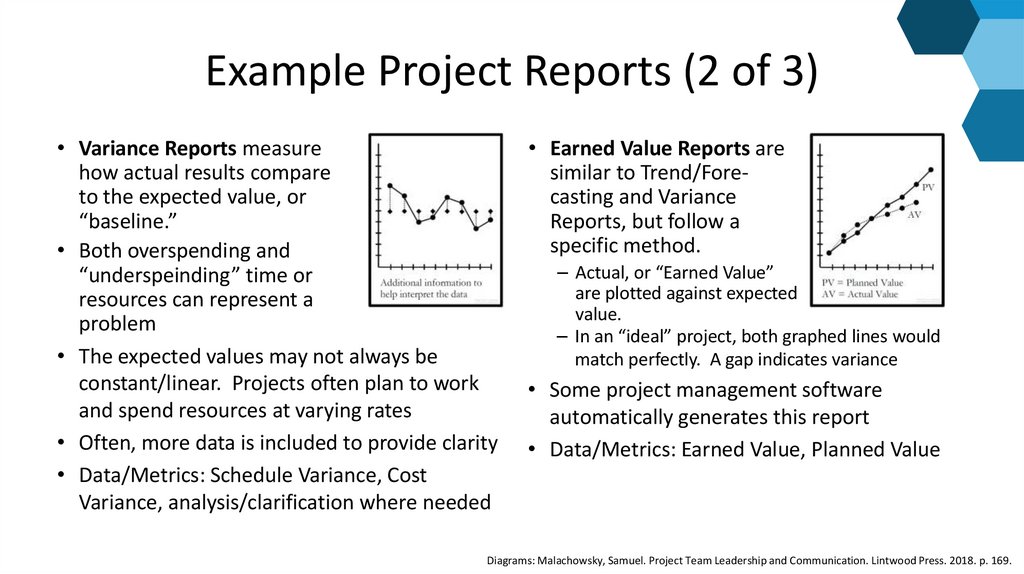
14. Example Project Reports (2 of 3)
• Variance Reports measurehow actual results compare
to the expected value, or
“baseline.”
• Both overspending and
“underspeinding” time or
resources can represent a
problem
• The expected values may not always be
constant/linear. Projects often plan to work
and spend resources at varying rates
• Often, more data is included to provide clarity
• Data/Metrics: Schedule Variance, Cost
Variance, analysis/clarification where needed
• Earned Value Reports are
similar to Trend/Forecasting and Variance
Reports, but follow a
specific method.
– Actual, or “Earned Value”
are plotted against expected
value.
– In an “ideal” project, both graphed lines would
match perfectly. A gap indicates variance
• Some project management software
automatically generates this report
• Data/Metrics: Earned Value, Planned Value
Diagrams: Malachowsky, Samuel. Project Team Leadership and Communication. Lintwood Press. 2018. p. 169.
15. Example Project Reports (3 of 3)
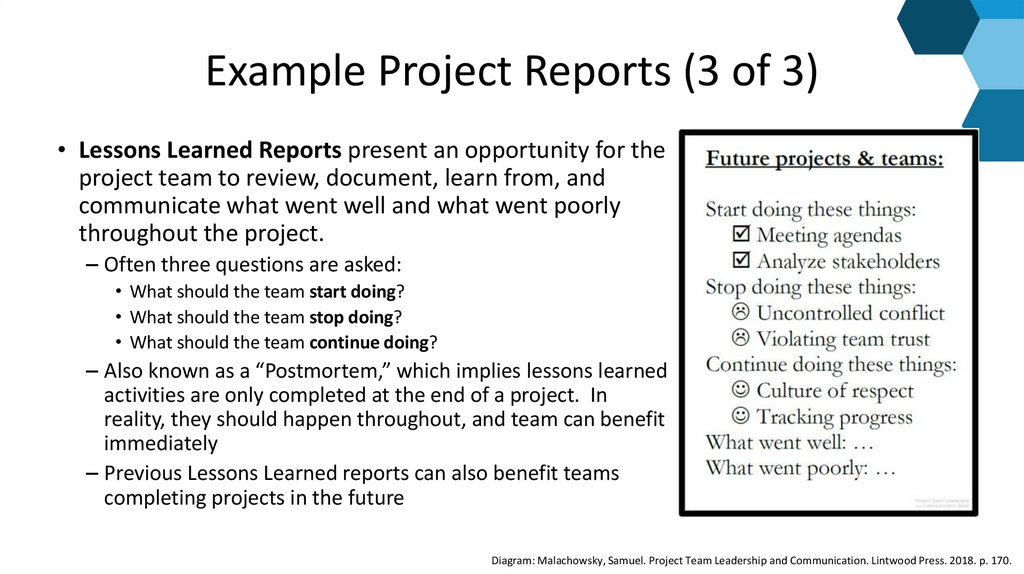
• Lessons Learned Reports present an opportunity for theproject team to review, document, learn from, and
communicate what went well and what went poorly
throughout the project.
– Often three questions are asked:
• What should the team start doing?
• What should the team stop doing?
• What should the team continue doing?
– Also known as a “Postmortem,” which implies lessons learned
activities are only completed at the end of a project. In
reality, they should happen throughout, and team can benefit
immediately
– Previous Lessons Learned reports can also benefit teams
completing projects in the future
Diagram: Malachowsky, Samuel. Project Team Leadership and Communication. Lintwood Press. 2018. p. 170.
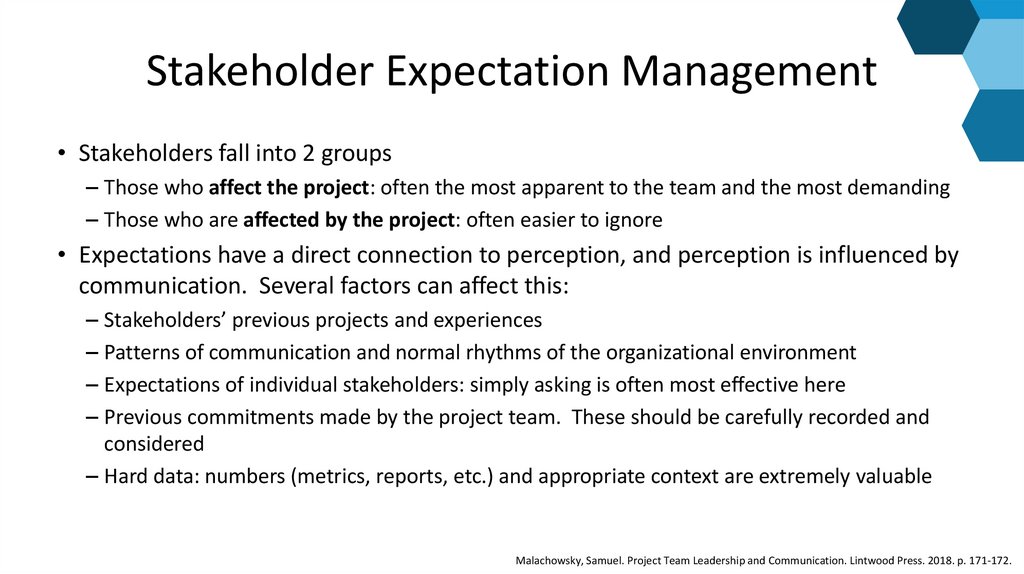
16. Stakeholder Expectation Management
• Stakeholders fall into 2 groups– Those who affect the project: often the most apparent to the team and the most demanding
– Those who are affected by the project: often easier to ignore
• Expectations have a direct connection to perception, and perception is influenced by
communication. Several factors can affect this:
– Stakeholders’ previous projects and experiences
– Patterns of communication and normal rhythms of the organizational environment
– Expectations of individual stakeholders: simply asking is often most effective here
– Previous commitments made by the project team. These should be carefully recorded and
considered
– Hard data: numbers (metrics, reports, etc.) and appropriate context are extremely valuable
Malachowsky, Samuel. Project Team Leadership and Communication. Lintwood Press. 2018. p. 171-172.
17. Summary and Conclusions
• Teams may not give communication enough consideration because in generalcommunication is a large part of everyday life
• Communication requires careful planning, and should consider factors such as the
appropriate channel and potential blockers.
• Carefully consider whether interactive, push, pull, and hybrid communication types
are appropriate
• Team meetings, a major area of difficulty, should be properly planned/executed
• External communication affects the expectations of stakeholders
• Communication represents the majority of ethical considerations for project teams
• When communicating with metrics and reports, special consideration must be given
to how they are perceived. Provide appropriate interpretation and context