
 Английский язык
Похожие презентации:







Lockdown
1.
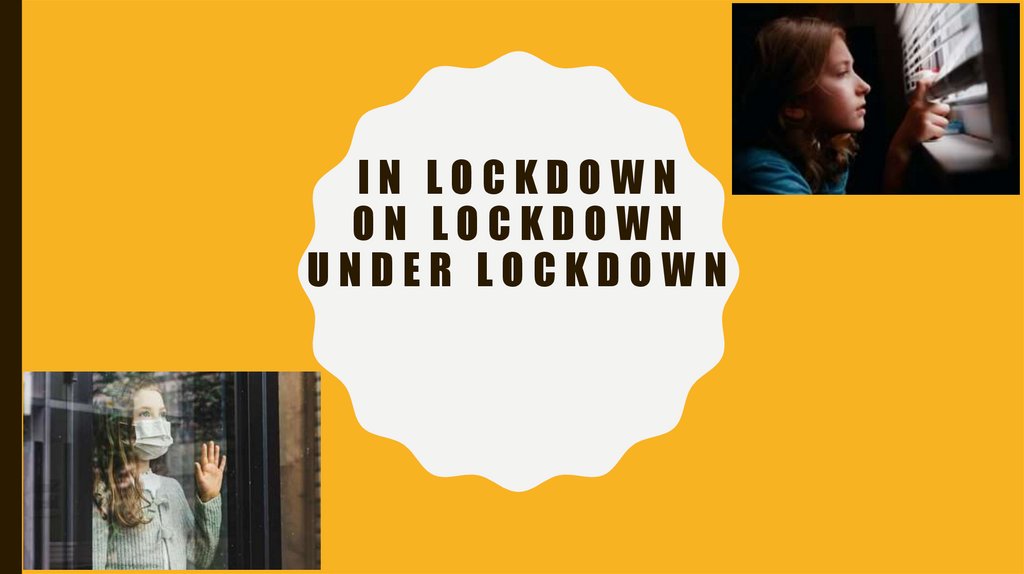
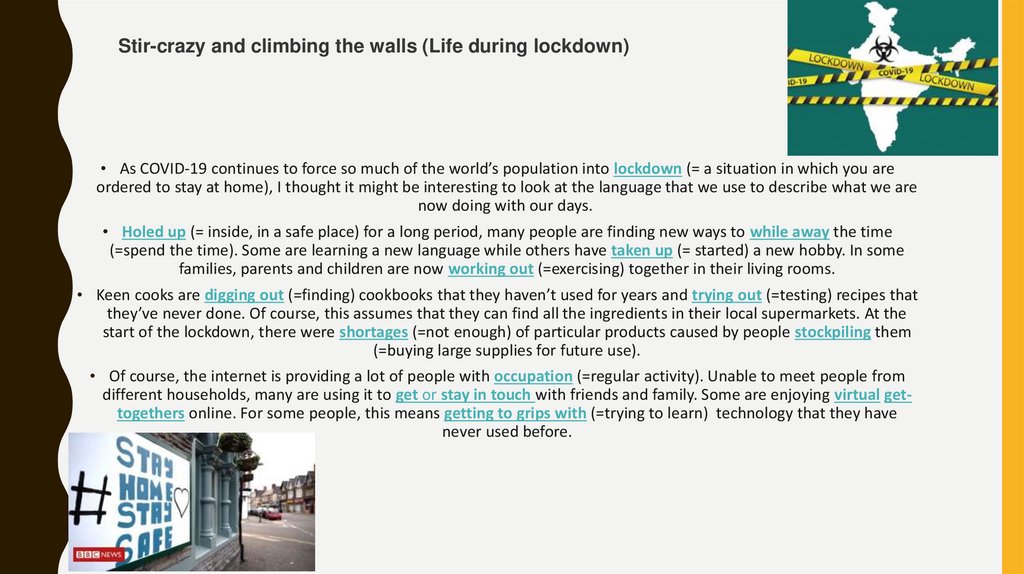
IN LOCKDOWNON LOCKDOWN
UNDER LOCKDOWN
2.
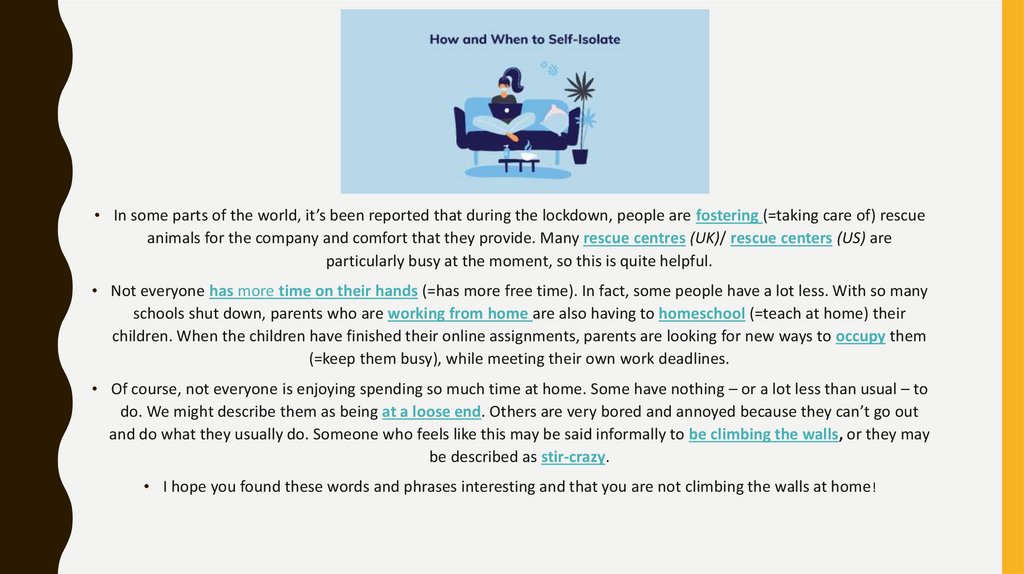
Stir-crazy and climbing the walls (Life during lockdown)• As COVID-19 continues to force so much of the world’s population into lockdown (= a situation in which you are
ordered to stay at home), I thought it might be interesting to look at the language that we use to describe what we are
now doing with our days.
• Holed up (= inside, in a safe place) for a long period, many people are finding new ways to while away the time
(=spend the time). Some are learning a new language while others have taken up (= started) a new hobby. In some
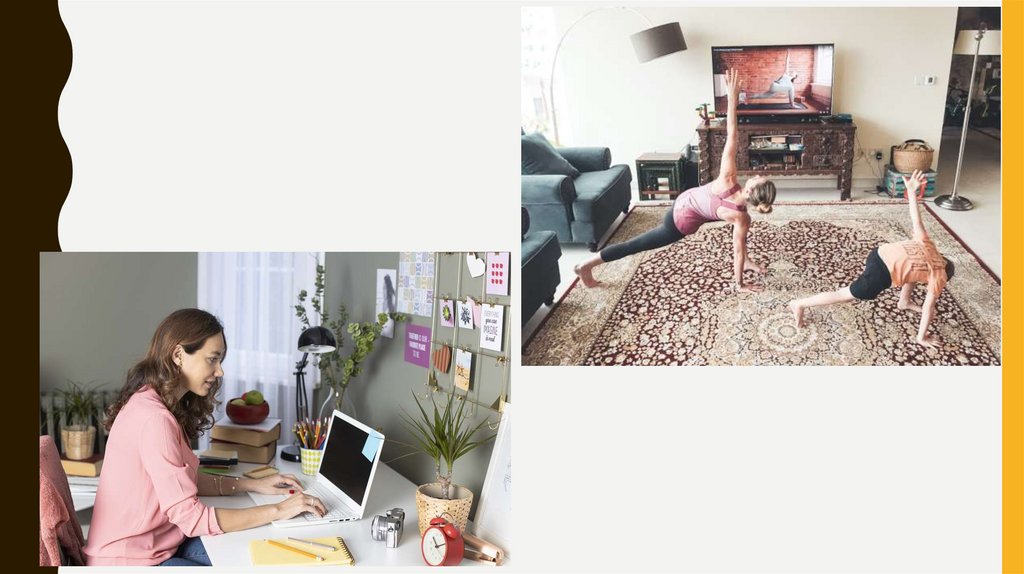
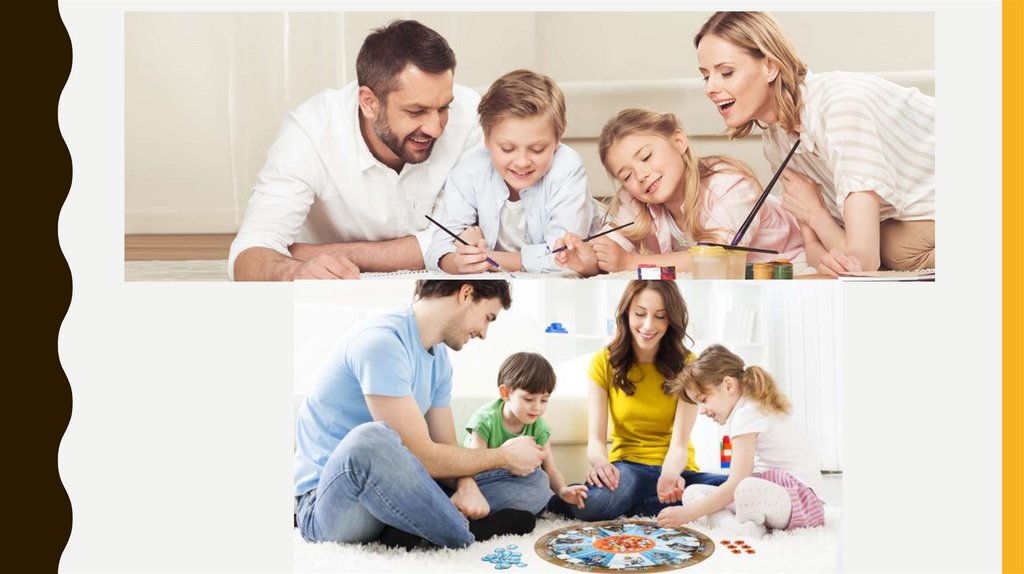
families, parents and children are now working out (=exercising) together in their living rooms.
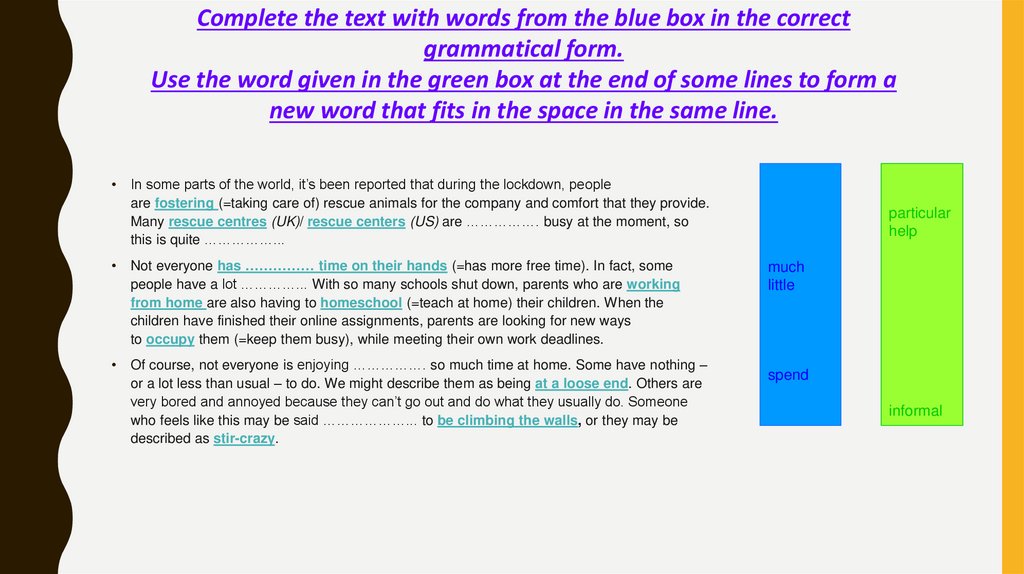
• Keen cooks are digging out (=finding) cookbooks that they haven’t used for years and trying out (=testing) recipes that
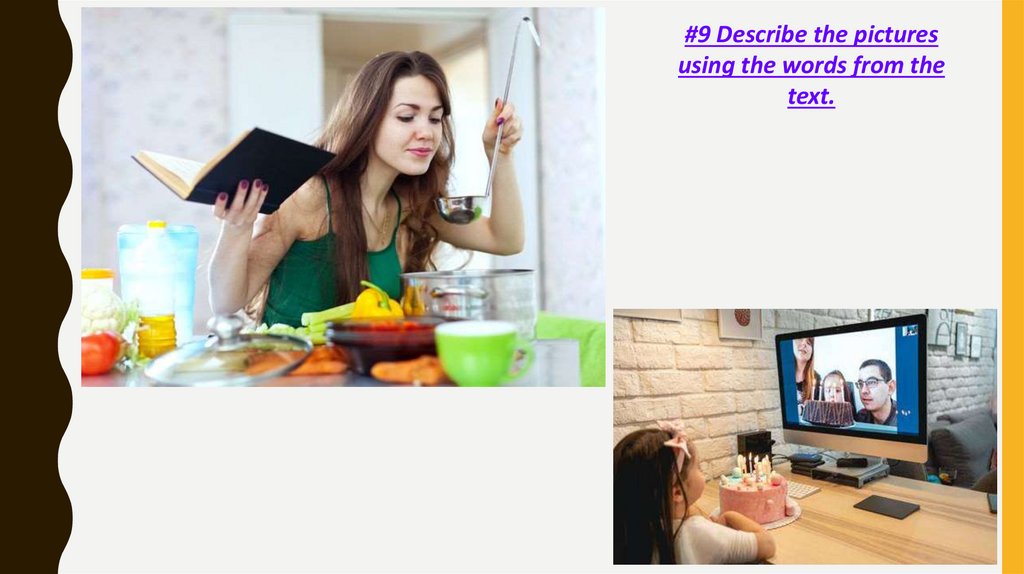
they’ve never done. Of course, this assumes that they can find all the ingredients in their local supermarkets. At the
start of the lockdown, there were shortages (=not enough) of particular products caused by people stockpiling them
(=buying large supplies for future use).
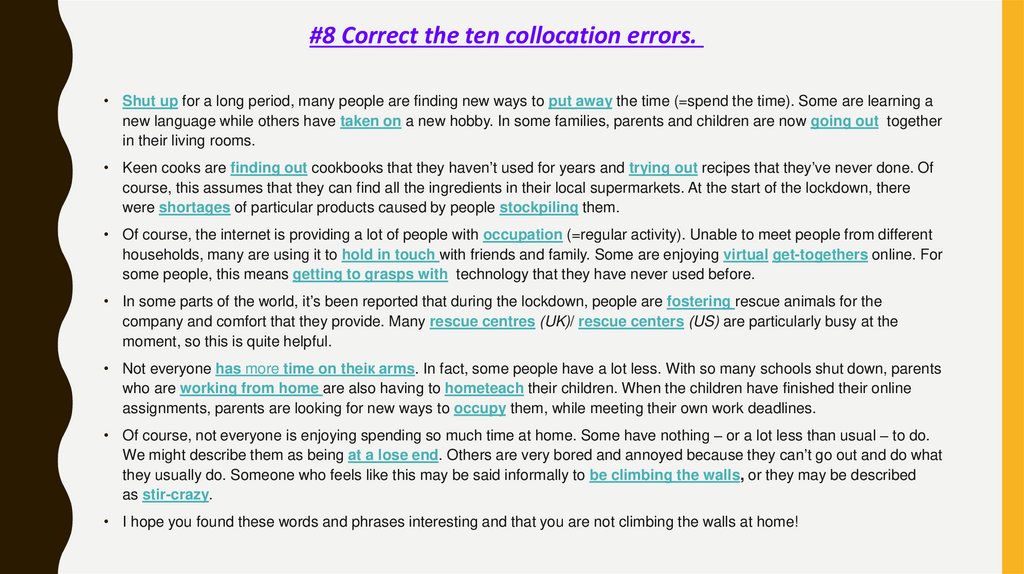
• Of course, the internet is providing a lot of people with occupation (=regular activity). Unable to meet people from
different households, many are using it to get or stay in touch with friends and family. Some are enjoying virtual gettogethers online. For some people, this means getting to grips with (=trying to learn) technology that they have
never used before.
3.
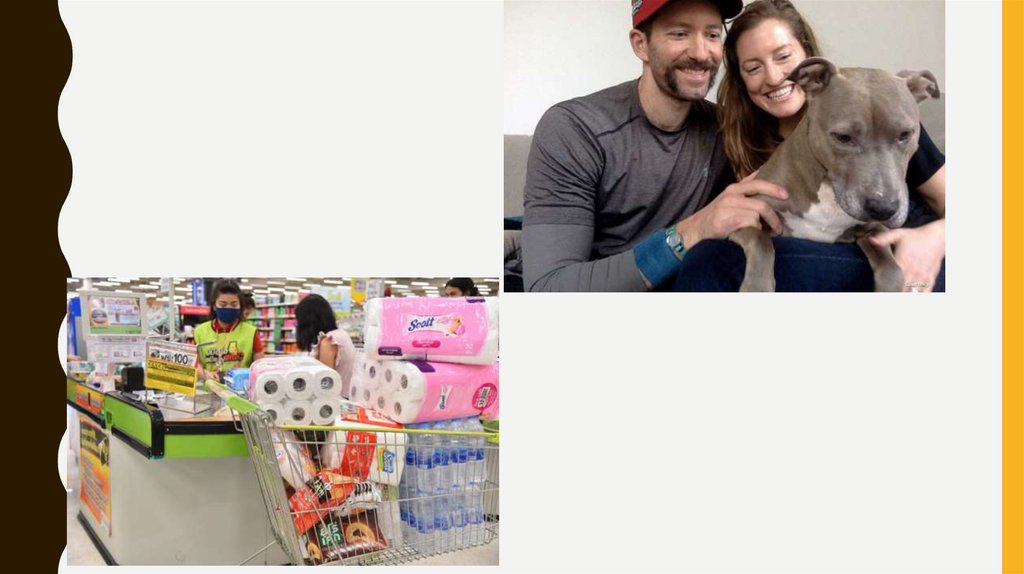
• In some parts of the world, it’s been reported that during the lockdown, people are fostering (=taking care of) rescueanimals for the company and comfort that they provide. Many rescue centres (UK)/ rescue centers (US) are
particularly busy at the moment, so this is quite helpful.
• Not everyone has more time on their hands (=has more free time). In fact, some people have a lot less. With so many
schools shut down, parents who are working from home are also having to homeschool (=teach at home) their
children. When the children have finished their online assignments, parents are looking for new ways to occupy them
(=keep them busy), while meeting their own work deadlines.
• Of course, not everyone is enjoying spending so much time at home. Some have nothing – or a lot less than usual – to
do. We might describe them as being at a loose end. Others are very bored and annoyed because they can’t go out
and do what they usually do. Someone who feels like this may be said informally to be climbing the walls, or they may
be described as stir-crazy.
• I hope you found these words and phrases interesting and that you are not climbing the walls at home!
4.
#1 Are these statements true or false? Correct the false sentences.• 1) Holed up for a long period, many people are finding new ways to while away the time.
• 2) In some families, parents and children are now working out together in their living rooms.
• 3) At the start of the lockdown, there were shortages of particular products caused by people shoplifting from
supermarkets.
• 4) Unable to meet people from different households, many are sending letters by post to get or stay in touch with friends
and family.
• 5) In some parts of the world, it’s been reported that during the lockdown, people are fostering rescue animals for the
money.
• 6) With so many schools shut down, parents are also having to place their children in boarding schools.
• 7) When the children have finished their online assignments, parents are looking for new ways to occupy them.
• 8) Some people are very bored and annoyed because they can’t go out and do what they usually do.
• 9) Someone who enjoys being on lockdown may be described as stir-crazy.
5.
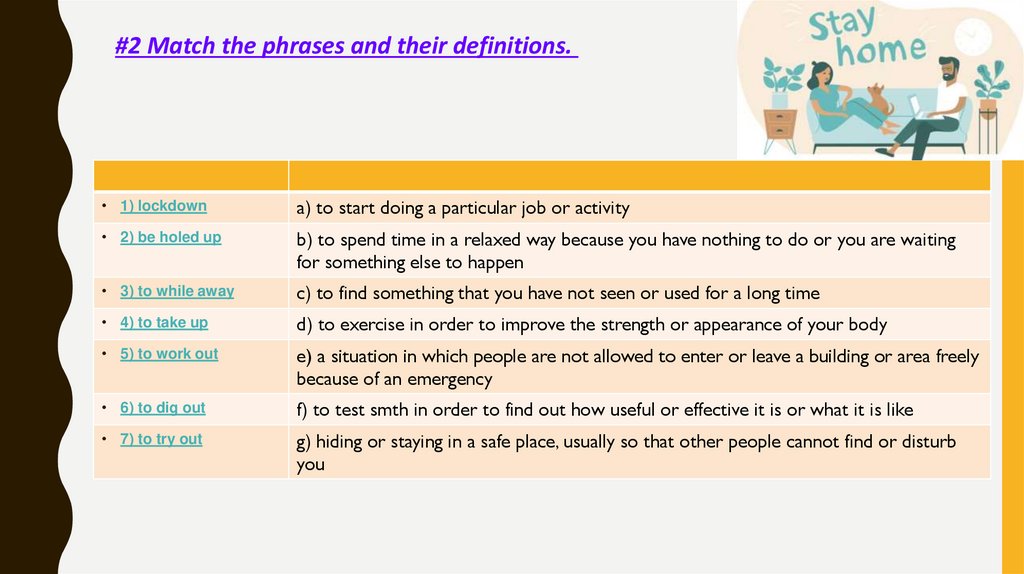
#2 Match the phrases and their definitions.• 1) lockdown
a) to start doing a particular job or activity
• 2) be holed up
b) to spend time in a relaxed way because you have nothing to do or you are waiting
for something else to happen
• 3) to while away
c) to find something that you have not seen or used for a long time
• 4) to take up
d) to exercise in order to improve the strength or appearance of your body
• 5) to work out
e) a situation in which people are not allowed to enter or leave a building or area freely
because of an emergency
• 6) to dig out
f) to test smth in order to find out how useful or effective it is or what it is like
• 7) to try out
g) hiding or staying in a safe place, usually so that other people cannot find or disturb
you
6.
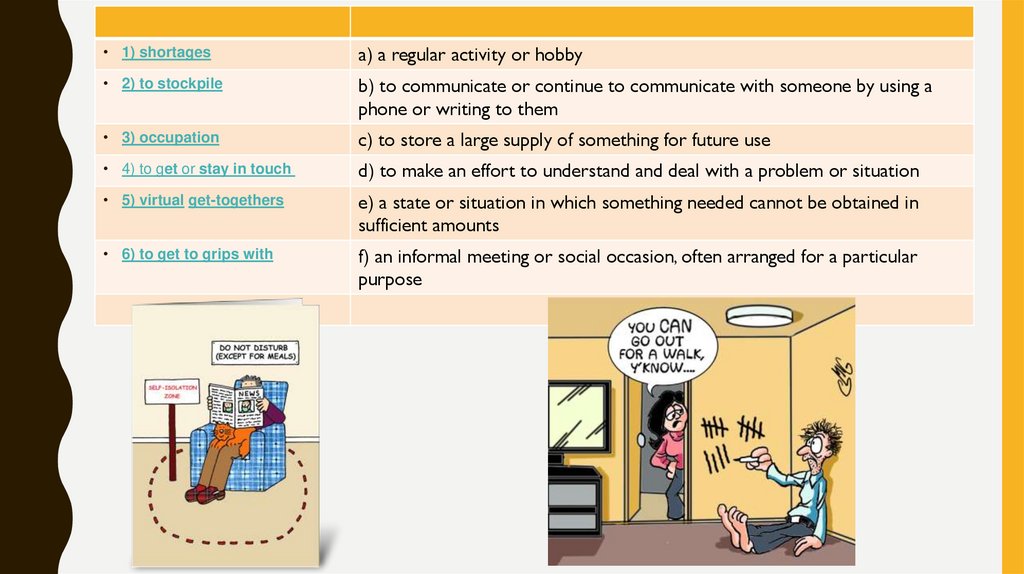
• 1) shortagesa) a regular activity or hobby
• 2) to stockpile
b) to communicate or continue to communicate with someone by using a
phone or writing to them
• 3) occupation
c) to store a large supply of something for future use
• 4) to get or stay in touch
d) to make an effort to understand and deal with a problem or situation
• 5) virtual get-togethers
e) a state or situation in which something needed cannot be obtained in
sufficient amounts
• 6) to get to grips with
f) an informal meeting or social occasion, often arranged for a particular
purpose
7.
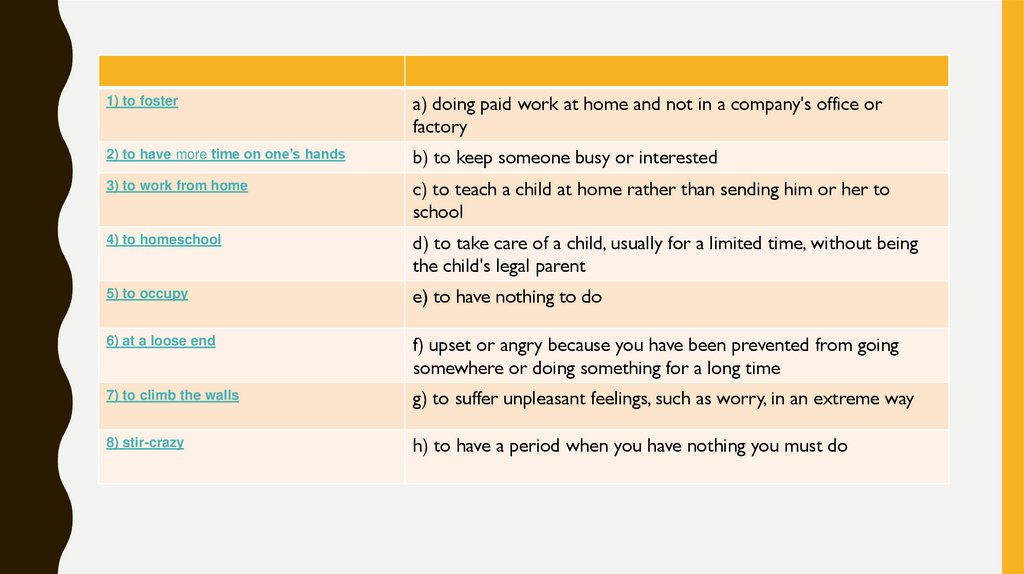
1) to fostera) doing paid work at home and not in a company's office or
factory
2) to have more time on one’s hands
b) to keep someone busy or interested
3) to work from home
c) to teach a child at home rather than sending him or her to
school
4) to homeschool
d) to take care of a child, usually for a limited time, without being
the child's legal parent
5) to occupy
e) to have nothing to do
6) at a loose end
f) upset or angry because you have been prevented from going
somewhere or doing something for a long time
7) to climb the walls
g) to suffer unpleasant feelings, such as worry, in an extreme way
8) stir-crazy
h) to have a period when you have nothing you must do
8.
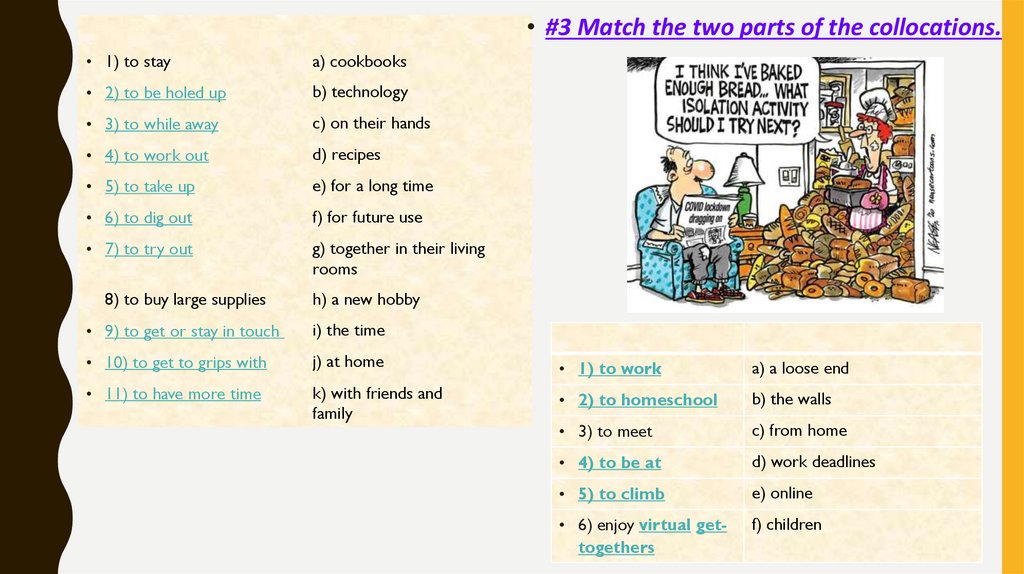
• #3 Match the two parts of the collocations.• 1) to stay
a) cookbooks
• 2) to be holed up
b) technology
• 3) to while away
c) on their hands
• 4) to work out
d) recipes
• 5) to take up
e) for a long time
• 6) to dig out
f) for future use
• 7) to try out
g) together in their living
rooms
8) to buy large supplies
h) a new hobby
• 9) to get or stay in touch
i) the time
• 10) to get to grips with
j) at home
• 1) to work
a) a loose end
• 11) to have more time
k) with friends and
family
• 2) to homeschool
b) the walls
• 3) to meet
c) from home
• 4) to be at
d) work deadlines
• 5) to climb
e) online
• 6) enjoy virtual gettogethers
f) children
9.
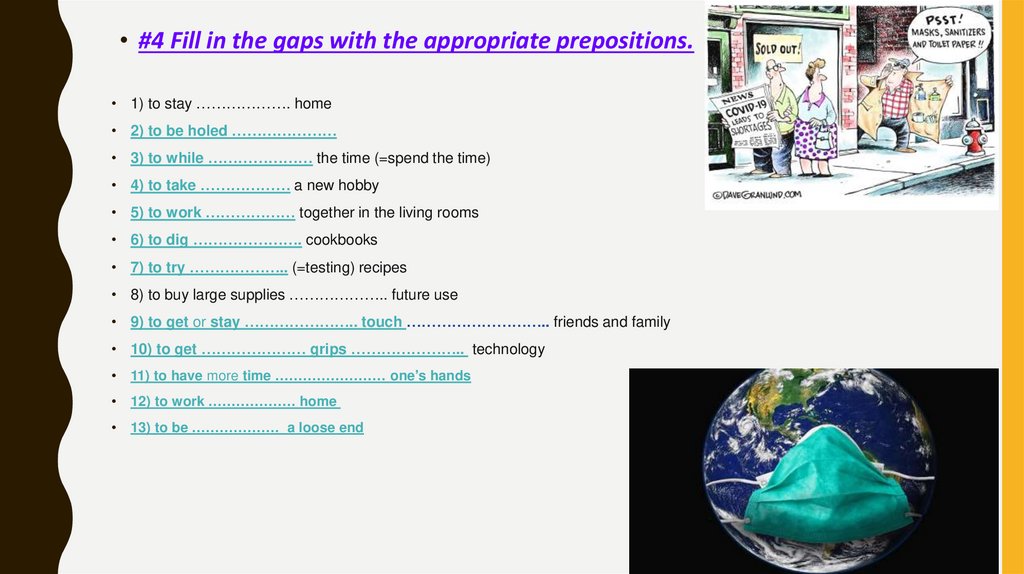
• #4 Fill in the gaps with the appropriate prepositions.• 1) to stay ………………. home
• 2) to be holed …………………
• 3) to while ………………… the time (=spend the time)
• 4) to take ……………… a new hobby
• 5) to work ……………… together in the living rooms
• 6) to dig …………………. cookbooks
• 7) to try ……………….. (=testing) recipes
• 8) to buy large supplies ……………….. future use
• 9) to get or stay ………………….. touch ……………………….. friends and family
• 10) to get ………………… grips ………………….. technology
11) to have more time …………………… one’s hands
12) to work ………………. home
13) to be ………………. a loose end
10.
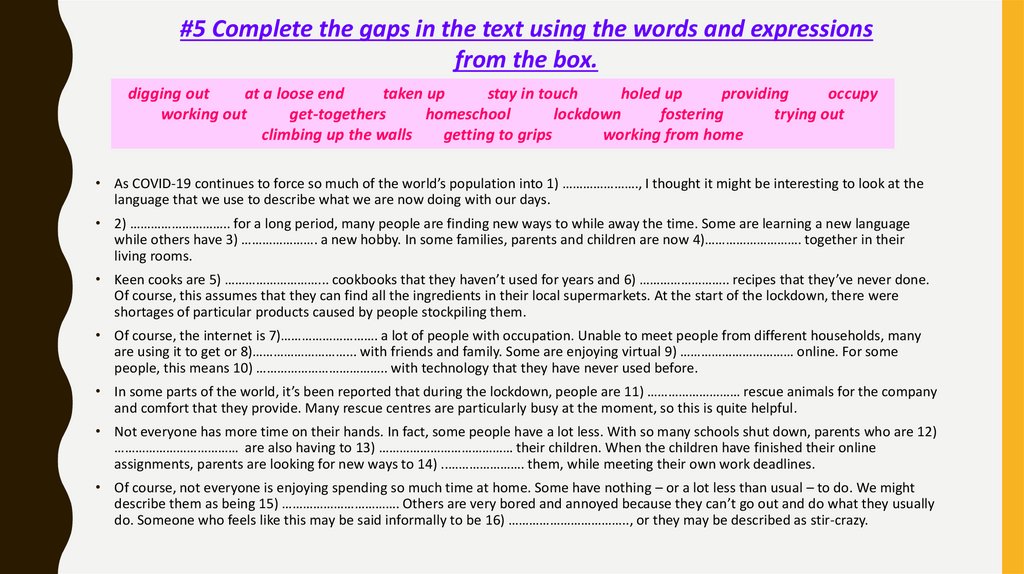
#5 Complete the gaps in the text using the words and expressionsfrom the box.
digging out
at a loose end
taken up
stay in touch
holed up
providing
occupy
working out
get-togethers
homeschool
lockdown
fostering
trying out
climbing up the walls
getting to grips
working from home
• As COVID-19 continues to force so much of the world’s population into 1) …………………., I thought it might be interesting to look at the
language that we use to describe what we are now doing with our days.
• 2) ……………………….. for a long period, many people are finding new ways to while away the time. Some are learning a new language
while others have 3) …………………. a new hobby. In some families, parents and children are now 4)………………………. together in their
living rooms.
• Keen cooks are 5) ………………………... cookbooks that they haven’t used for years and 6) …………………….. recipes that they’ve never done.
Of course, this assumes that they can find all the ingredients in their local supermarkets. At the start of the lockdown, there were
shortages of particular products caused by people stockpiling them.
• Of course, the internet is 7)………………………. a lot of people with occupation. Unable to meet people from different households, many
are using it to get or 8)………………………... with friends and family. Some are enjoying virtual 9) …………………………… online. For some
people, this means 10) ……………………………….. with technology that they have never used before.
• In some parts of the world, it’s been reported that during the lockdown, people are 11) ……………………… rescue animals for the company
and comfort that they provide. Many rescue centres are particularly busy at the moment, so this is quite helpful.
• Not everyone has more time on their hands. In fact, some people have a lot less. With so many schools shut down, parents who are 12)
……………………………… are also having to 13) ………………………………… their children. When the children have finished their online
assignments, parents are looking for new ways to 14) ..…………………. them, while meeting their own work deadlines.
• Of course, not everyone is enjoying spending so much time at home. Some have nothing – or a lot less than usual – to do. We might
describe them as being 15) ……………………………. Others are very bored and annoyed because they can’t go out and do what they usually
do. Someone who feels like this may be said informally to be 16) …………………………….., or they may be described as stir-crazy.
11.
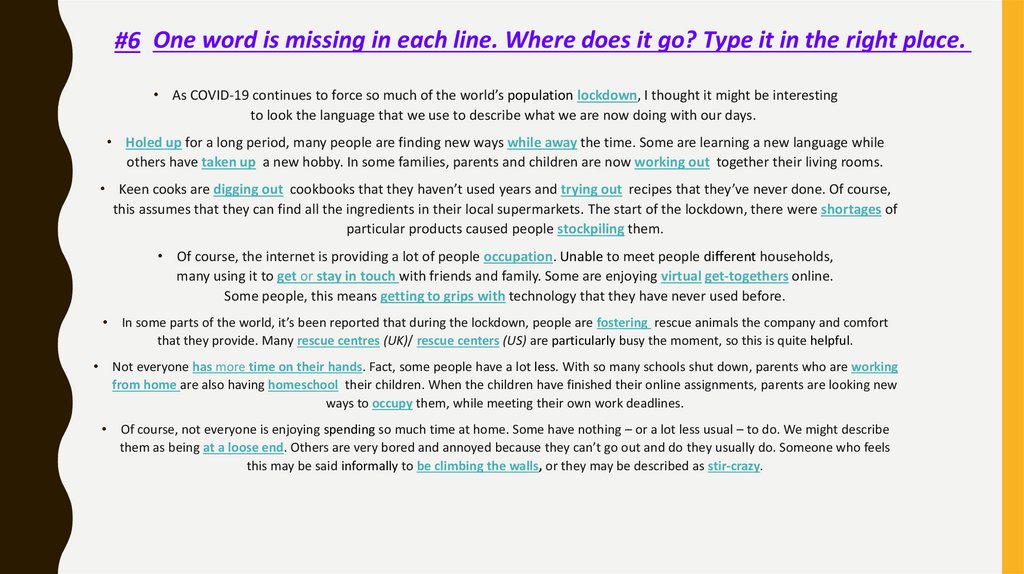
#6• As COVID-19 continues to force so much of the world’s population lockdown, I thought it might be interesting
to look the language that we use to describe what we are now doing with our days.
• Holed up for a long period, many people are finding new ways while away the time. Some are learning a new language while
others have taken up a new hobby. In some families, parents and children are now working out together their living rooms.
• Keen cooks are digging out cookbooks that they haven’t used years and trying out recipes that they’ve never done. Of course,
this assumes that they can find all the ingredients in their local supermarkets. The start of the lockdown, there were shortages of
particular products caused people stockpiling them.
• Of course, the internet is providing a lot of people occupation. Unable to meet people different households,
many using it to get or stay in touch with friends and family. Some are enjoying virtual get-togethers online.
Some people, this means getting to grips with technology that they have never used before.
In some parts of the world, it’s been reported that during the lockdown, people are fostering rescue animals the company and comfort
that they provide. Many rescue centres (UK)/ rescue centers (US) are particularly busy the moment, so this is quite helpful.
Not everyone has more time on their hands. Fact, some people have a lot less. With so many schools shut down, parents who are working
from home are also having homeschool their children. When the children have finished their online assignments, parents are looking new
ways to occupy them, while meeting their own work deadlines.
Of course, not everyone is enjoying spending so much time at home. Some have nothing – or a lot less usual – to do. We might describe
them as being at a loose end. Others are very bored and annoyed because they can’t go out and do they usually do. Someone who feels
this may be said informally to be climbing the walls, or they may be described as stir-crazy.
12.
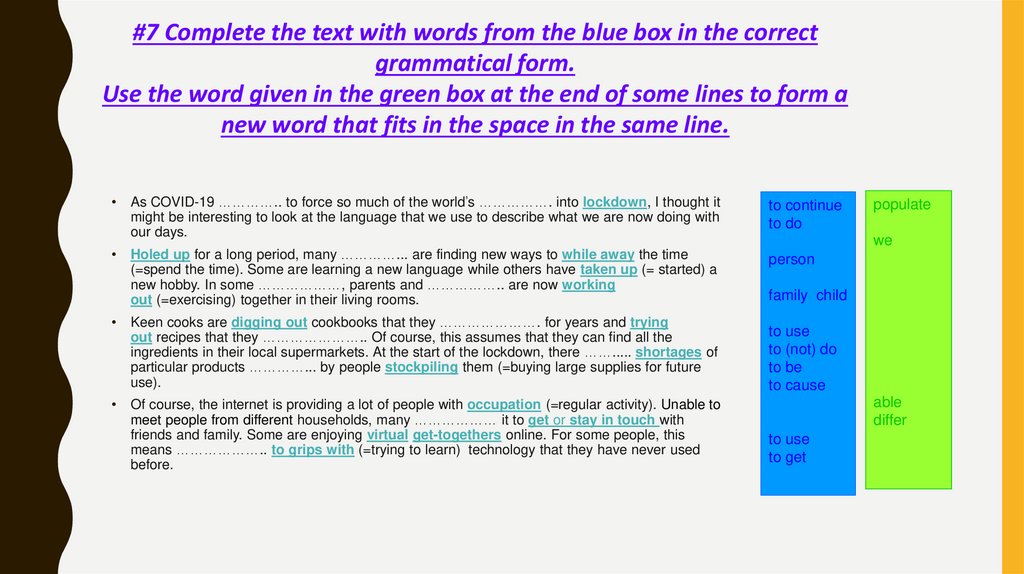
#7 Complete the text with words from the blue box in the correctgrammatical form.
Use the word given in the green box at the end of some lines to form a
new word that fits in the space in the same line.
As COVID-19 ………….. to force so much of the world’s ……………. into lockdown, I thought it
might be interesting to look at the language that we use to describe what we are now doing with
our days.
to continue
to do
Holed up for a long period, many …………... are finding new ways to while away the time
(=spend the time). Some are learning a new language while others have taken up (= started) a
new hobby. In some ………………, parents and …………….. are now working
out (=exercising) together in their living rooms.
person
Keen cooks are digging out cookbooks that they …………………. for years and trying
out recipes that they ………………….. Of course, this assumes that they can find all the
ingredients in their local supermarkets. At the start of the lockdown, there ……..... shortages of
particular products …………... by people stockpiling them (=buying large supplies for future
use).
Of course, the internet is providing a lot of people with occupation (=regular activity). Unable to
meet people from different households, many ……………… it to get or stay in touch with
friends and family. Some are enjoying virtual get-togethers online. For some people, this
means ……………….. to grips with (=trying to learn) technology that they have never used
before.
populate
we
family child
to use
to (not) do
to be
to cause
able
differ
to use
to get
13.
Complete the text with words from the blue box in the correctgrammatical form.
Use the word given in the green box at the end of some lines to form a
new word that fits in the space in the same line.
In some parts of the world, it’s been reported that during the lockdown, people
are fostering (=taking care of) rescue animals for the company and comfort that they provide.
Many rescue centres (UK)/ rescue centers (US) are ……………. busy at the moment, so
this is quite ……………...
Not everyone has …………… time on their hands (=has more free time). In fact, some
people have a lot …………... With so many schools shut down, parents who are working
from home are also having to homeschool (=teach at home) their children. When the
children have finished their online assignments, parents are looking for new ways
to occupy them (=keep them busy), while meeting their own work deadlines.
Of course, not everyone is enjoying ……………. so much time at home. Some have nothing –
or a lot less than usual – to do. We might describe them as being at a loose end. Others are
very bored and annoyed because they can’t go out and do what they usually do. Someone
who feels like this may be said ………………... to be climbing the walls, or they may be
described as stir-crazy.
particular
help
much
little
spend
informal
14.
#8 Correct the ten collocation errors.• Shut up for a long period, many people are finding new ways to put away the time (=spend the time). Some are learning a
new language while others have taken on a new hobby. In some families, parents and children are now going out together
in their living rooms.
• Keen cooks are finding out cookbooks that they haven’t used for years and trying out recipes that they’ve never done. Of
course, this assumes that they can find all the ingredients in their local supermarkets. At the start of the lockdown, there
were shortages of particular products caused by people stockpiling them.
• Of course, the internet is providing a lot of people with occupation (=regular activity). Unable to meet people from different
households, many are using it to hold in touch with friends and family. Some are enjoying virtual get-togethers online. For
some people, this means getting to grasps with technology that they have never used before.
• In some parts of the world, it’s been reported that during the lockdown, people are fostering rescue animals for the
company and comfort that they provide. Many rescue centres (UK)/ rescue centers (US) are particularly busy at the
moment, so this is quite helpful.
• Not everyone has more time on theiк arms. In fact, some people have a lot less. With so many schools shut down, parents
who are working from home are also having to hometeach their children. When the children have finished their online
assignments, parents are looking for new ways to occupy them, while meeting their own work deadlines.
• Of course, not everyone is enjoying spending so much time at home. Some have nothing – or a lot less than usual – to do.
We might describe them as being at a lose end. Others are very bored and annoyed because they can’t go out and do what
they usually do. Someone who feels like this may be said informally to be climbing the walls, or they may be described
as stir-crazy.
• I hope you found these words and phrases interesting and that you are not climbing the walls at home!
15.
#9 Describe the picturesusing the words from the
text.