
Похожие презентации:




Status of African-American English
1. Status of African-American English
STATUS OF AFRICANAMERICAN ENGLISHShishimorova Evgenia
2. African-American English
African-American English (AAE), also known as BlackEnglish in American linguistics, is the set of English
dialects primarily spoken by most black people in
the United States and many in Canada; most
commonly, it refers to a dialect continuum ranging
from African-American Vernacular English to a more
standard English.
3. Two major types of AAE:
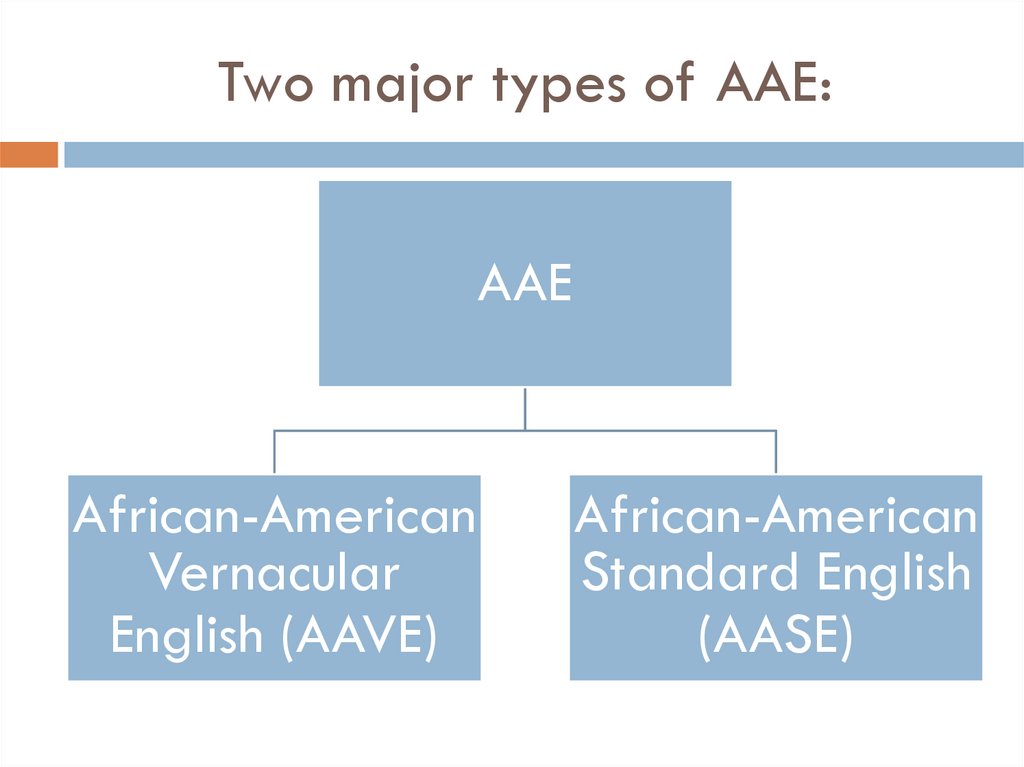
AAEAfrican-American
Vernacular
English (AAVE)
African-American
Standard English
(AASE)
4. African-American Vernacular English
African-American Vernacular English (AAVE) is thenative variety of the vast majority of working- and
middle-class African Americans, particularly in
urban areas, with its own unique accent, grammar,
and vocabulary features. AAVE is employed as the
more informal and casual end of a sociolinguistic
continuum; on the formal end of this continuum,
middle-class African-Americans switch to more
standard English grammar and vocabulary, usually
while retaining elements of the nonstandard accent.
5. African-American Standard English
African-American Standard English (AASE) is theprestigious end of the middle-class AfricanAmerican language continuum, used for more
formal, careful, or public settings than AAVE. This
variety exhibits standard English vocabulary and
grammar but often retains certain elements of the
unique AAVE accent, with intonational or rhythmic
features maintained more than phonological ones.
Most middle-class African Americans are typically
bi-dialectal between this standard variety and
AAVE.
6. Social context and usage
AAE is widely used in such social spheres as thelegal system, social media, education and music.
An important thing to know is that not all African
Americans use AAE and AAE is used not only by
African Americans.
7. In the legal system
The United States courts are divided over how toadmit statements of ambiguous tense made in AAE
under evidence. The United States Court of Appeals
for the Sixth Circuit held that "he finna shoot me"
was a statement made in the present tense, so it was
admissible hearsay under the excited utterance
exception; however, the dissent held that past or
present tense could not be determined by the
statement, so the statement should not have been
admitted into evidence.
8. In education
Educators traditionally have attempted to eliminate AAVE usage throughthe public education system, perceiving the dialect as grammatically
defective. In 1974, the teacher-led Conference on College Composition and
Communication issued a position statement affirming students' rights to their
own dialects and the validity of all dialects. Mainstream linguistics has long
agreed with this view about dialects. In 1979, a judge ordered the Ann
Arbor School District to find a way to identify AAVE speakers in the schools
and to "use that knowledge in teaching such students how to read standard
English." In 1996, Oakland Unified School District made a controversial
resolution for AAVE, which was later called "Ebonics." The Oakland School
board approved that Ebonics be recognized as a language independent
from English (though this particular view is not endorsed by linguists), that
teachers would participate in recognizing this language, and that it would
be used in theory to support the transition from Ebonics to Standard
American English in schools. This program lasted three years and then died
off.
9. Examples of AAE
10. Video examples:
1.2.
https://www.youtube.com/watch?v=j7_rihFMB78&
t=91s (Don't Judge My African American English)
https://www.youtube.com/watch?v=WxbEna_I7P
M&t=132s (American English Slang with Will
Smith)