Похожие презентации:


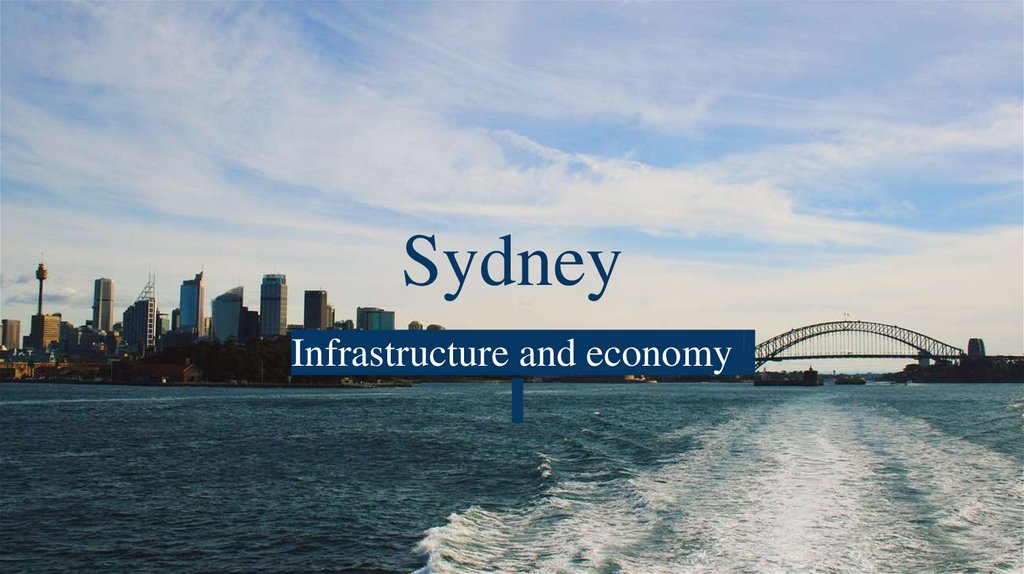
Sydney. Infrastructure and economy
1.
SydneyInfrastructure and economy
2.
EducationEducation became a proper focus for the colony from the 1870s when public
schools began to form and schooling became compulsory.The population of
Sydney is now highly educated. 90% of working age residents have completed
some schooling and 57% have completed the highest level of school. 1,390,703
people were enrolled in an educational institution in 2011 with 45.1% of these
attending school and 16.5% studying at a university. Undergraduate or
postgraduate qualifications are held by 22.5% of working age Sydney residents
and 40.2% of working age residents of the City of Sydney.The most common
fields of tertiary qualification are commerce (22.8%), engineering (13.4%), society
and culture (10.8%), health (7.8%), and education (6.6%).
There are six public universities based in Sydney: The University of Sydney,
University of New South Wales, University of Technology Sydney, Macquarie
University, Western Sydney University, and Australian Catholic University. Five
public universities maintain secondary campuses in the city for both domestic
and international students: the University of Notre Dame Australia, Central
Queensland University, Victoria University, University of Wollongong, and
University of Newcastle. Charles Sturt University and Southern Cross University,
both public universities, operate secondary campuses only designated for
international students. In addition, four public universities offer programmes in
Sydney through third-party education providers: University of the Sunshine
Coast, La Trobe University, Federation University Australia and Charles Darwin
University. 5.2% of residents of Sydney are attending a university.
3.
HealthThe first hospital in the new colony was a collection of
tents at The Rocks. Many of the convicts that survived the
trip from England continued to suffer from dysentery,
smallpox, scurvy, and typhoid. Healthcare facilities
remained hopelessly inadequate despite the arrival of a
prefabricated hospital with the Second Fleet and the
construction of brand new hospitals at Parramatta,
Windsor, and Liverpool in the 1790s.
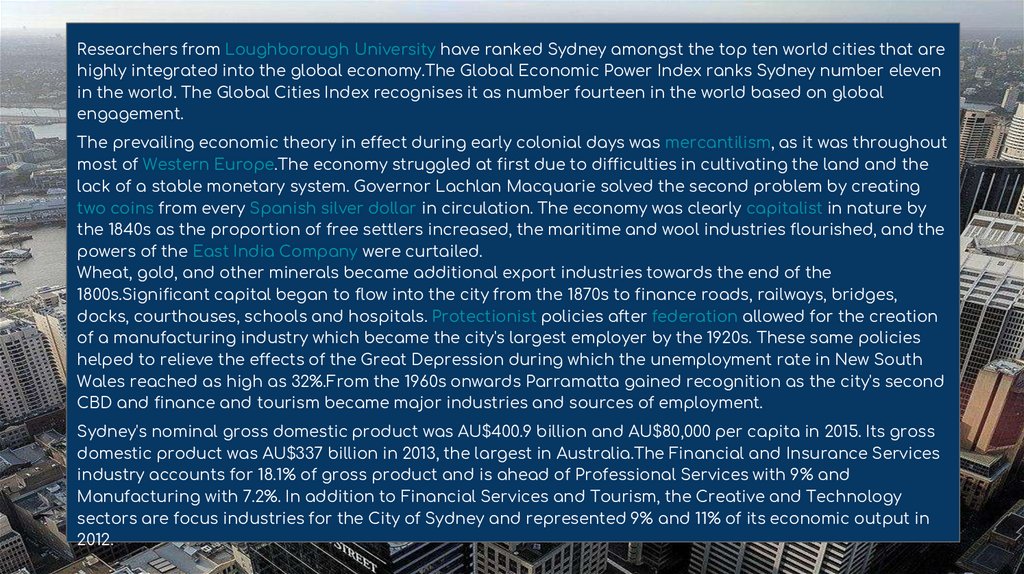
Governor Lachlan Macquarie arranged for the
construction of Sydney Hospital and saw it completed in
1816. Parts of the facility have been repurposed for use as
Parliament House but the hospital itself still operates to
this day. The city's first emergency department was
established at Sydney Hospital in 1870. Demand for
emergency medical care increased from 1895 with the
introduction of an ambulance service. The Sydney
Hospital also housed Australia's first teaching facility for
nurses, the Nightingale Wing, established with the input of
Florence Nightingale in 1868.
4.
Researchers from Loughborough University have ranked Sydney amongst the top ten world cities that arehighly integrated into the global economy.The Global Economic Power Index ranks Sydney number eleven
in the world. The Global Cities Index recognises it as number fourteen in the world based on global
engagement.
The prevailing economic theory in effect during early colonial days was mercantilism, as it was throughout
most of Western Europe.The economy struggled at first due to difficulties in cultivating the land and the
lack of a stable monetary system. Governor Lachlan Macquarie solved the second problem by creating
two coins from every Spanish silver dollar in circulation. The economy was clearly capitalist in nature by
the 1840s as the proportion of free settlers increased, the maritime and wool industries flourished, and the
powers of the East India Company were curtailed.
Wheat, gold, and other minerals became additional export industries towards the end of the
1800s.Significant capital began to flow into the city from the 1870s to finance roads, railways, bridges,
docks, courthouses, schools and hospitals. Protectionist policies after federation allowed for the creation
of a manufacturing industry which became the city's largest employer by the 1920s. These same policies
helped to relieve the effects of the Great Depression during which the unemployment rate in New South
Wales reached as high as 32%.From the 1960s onwards Parramatta gained recognition as the city's second
CBD and finance and tourism became major industries and sources of employment.
Sydney's nominal gross domestic product was AU$400.9 billion and AU$80,000 per capita in 2015. Its gross
domestic product was AU$337 billion in 2013, the largest in Australia.The Financial and Insurance Services
industry accounts for 18.1% of gross product and is ahead of Professional Services with 9% and
Manufacturing with 7.2%. In addition to Financial Services and Tourism, the Creative and Technology
sectors are focus industries for the City of Sydney and represented 9% and 11% of its economic output in
2012.