Похожие презентации:





Helen Flanders Dunbar (1902 – 1950) important early figure in U.S
1.
Penza State UniversityMedical Institute
Helen Flanders Dunbar (1902 – 1950) important early figure
in U.S.
Doctor: Gavrilova Tatiana
Student: Ahmed Hassan Alamoudi
Number of Group: 19лс2а
2020
2.
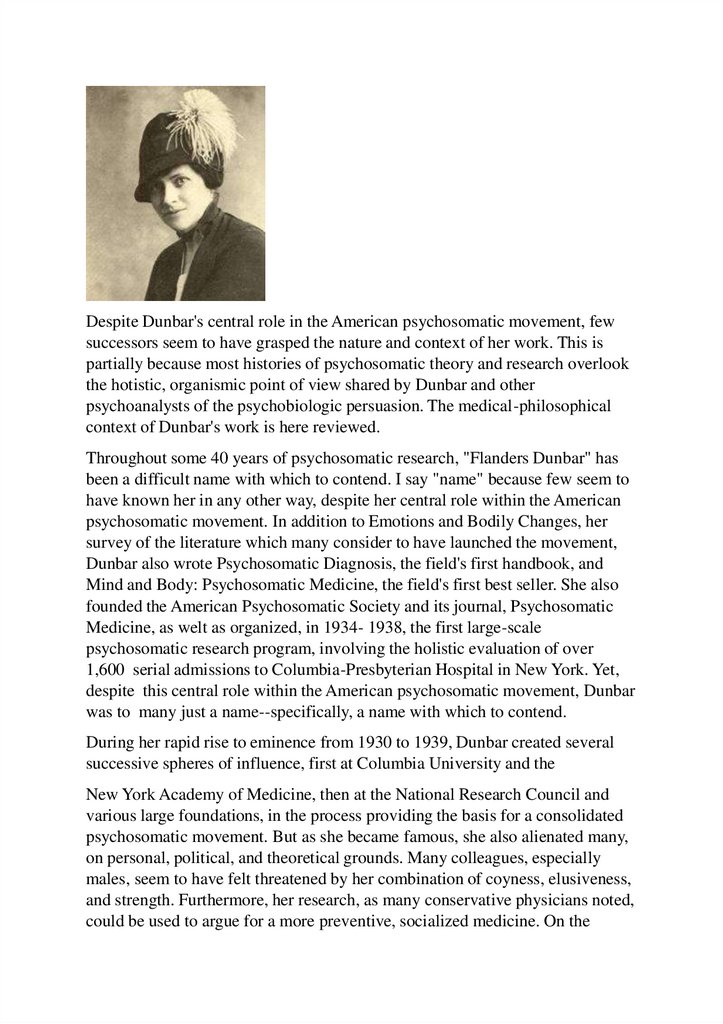
Despite Dunbar's central role in the American psychosomatic movement, fewsuccessors seem to have grasped the nature and context of her work. This is
partially because most histories of psychosomatic theory and research overlook
the hotistic, organismic point of view shared by Dunbar and other
psychoanalysts of the psychobiologic persuasion. The medical-philosophical
context of Dunbar's work is here reviewed.
Throughout some 40 years of psychosomatic research, "Flanders Dunbar" has
been a difficult name with which to contend. I say "name" because few seem to
have known her in any other way, despite her central role within the American
psychosomatic movement. In addition to Emotions and Bodily Changes, her
survey of the literature which many consider to have launched the movement,
Dunbar also wrote Psychosomatic Diagnosis, the field's first handbook, and
Mind and Body: Psychosomatic Medicine, the field's first best seller. She also
founded the American Psychosomatic Society and its journal, Psychosomatic
Medicine, as welt as organized, in 1934- 1938, the first large-scale
psychosomatic research program, involving the holistic evaluation of over
1,600 serial admissions to Columbia-Presbyterian Hospital in New York. Yet,
despite this central role within the American psychosomatic movement, Dunbar
was to many just a name--specifically, a name with which to contend.
During her rapid rise to eminence from 1930 to 1939, Dunbar created several
successive spheres of influence, first at Columbia University and the
New York Academy of Medicine, then at the National Research Council and
various large foundations, in the process providing the basis for a consolidated
psychosomatic movement. But as she became famous, she also alienated many,
on personal, political, and theoretical grounds. Many colleagues, especially
males, seem to have felt threatened by her combination of coyness, elusiveness,
and strength. Furthermore, her research, as many conservative physicians noted,
could be used to argue for a more preventive, socialized medicine. On the
3.
theoretical side, where this study will focus, as early as 1934 her work was seenin marked contrast to most of the research being pursued by either
psychoanalysts or psychophysiologists. In fact, the contrast was so marked that
few of her colleagues or successors seem able to have grasped the nature of her
research interests. Thus, after her rapid rise was followed by an equally rapid
fall, in 1947 Dunbar withdrew as a vastly misunderstood woman, out of step
with her time, while her ever-present name remained.
Who was Dunbar? This question even her closest friends asked and could not
answer. No one knew. One of her colleagues over a period of two decades
assured me that he never knew Dunbar as a person but only as a persona, as a
mask growing ever-more impenetrable over the years.
Another close associate admitted that "after more than a generation of
reflection" Dunbar still remained to him "basically an enigma. ''1° In addition,
while some colleagues have recalled, without being able to account for it, the
"sense of mission" with which she inspired them, others have recalled little but
enmity toward her, for reasons equally obscure.
Despite the difficulties thus involved in understanding either Dunbar or her
work---and I believe the two understandings must go hand-in hand---critics
have rarely, until recently, 11-1a hesitated to voice simplistic repudiations. 14
For example, one review 1~ summed up her work with a single comment,
"Subsequent... investigations have failed to support this.., position." Virtually
every young psychosomatic investigator thus "knows" that Dunbar's theories
and findings were "wrong." Part of the problem, however, might lie in the fact
that "wrong" was defined about
35-40 years ago by those whose own theories have since been held in question?
With all her books now again in print, and with a new generation of
investigators in the laboratory and at the bedside, relatively untouched by the
old personal, political, and theoretical squabbles, it may be time to take a fresh
look at Dunbar's writings and their context---mspecially since
Dunbar must rank among the century's most cited yet unread medical authors.
It is easy enough to deduce Dunbar's conceptual context, which I shall soon
consider in more detail. She shared the holistic, organismic viewpoint held by
many philosophers, psychologists, and physicians during the period from about
1906 to 1936, an era when phrases such as "the organism as a whole," "the
organism in its environment," and "mind-body unity" were used with a special
degree of sincerity. But histories taking into account this hotistic, organismic
approach to psychosomatic medicine simply do not exist--unless one wishes to
4.
refer to passages in Dunbar's own writings. Most sketches of the history ofpsychosomatic theory and research confine their attention to psychoanalytic and
psychophysiologic contributions, frequently introducing the parallel and
somewhat specious distinction between "specificity theorists" (usually analysts)
and "nonspecificity theorists" (usually physiologists), with "specificity"
referring to the notion that specific causes lead to specific diseases. To make
matters worse, many of these same accounts also distinguish two types of
specificity theory, i.e., that espoused by the psychoanalyst Franz Alexander
(1891-1964), asserting "specificity of [unconscious psychological] conflict" as
the determinant of various psychosomatic disorders, and that attributed to
Dunbar, supposedly focusing on "specificity of personality." It is rather difficult
to derive a specificity theory from Dunbar's writings, and this fact alone
prompts one to wonder whether a procrustean bed or two has slipped into the
history of this field. Was specificity the only issue? Was psychosomatic
medicine merely a matter of psychoanalysis and psychophysiology? One
becomes even more puzzled upon discovering that whereas a number of
physiologically oriented workers have criticized Dunbar's studies "because she
was an analyst," many analytically inclined researchers have brushed her work
aside "because she did not use psychoanalysis." Obviously something is wrong.
Could it be that there are more than two conceptual threads to the history of
psychosomatic medicine? Could it be that Dunbar, though an analyst, practiced
the "wrong" kind of psychoanalysis?
The comments of two "elder statesmen" in the field suggest a way out of this
dilemma. Looking to the past, Stanley Cobb once observed that psychosomatic
medicine "was conceived by the coming together of three fertile schools of
thought,
(1) Psychoanalysis
(2) The physiology of the emotions
(3) Psychobiology."
Looking to the future, Eric Wittkower has suggested three alternatives that
psychosomatic medicine might become,
(1) A narrow psychiatric specialty with a psychoanalytic orientation,
(2) A field of psychophysiologic research generally excluding the clinician, or
(3) "A comprehensive holistic approach to the problems of medicine."
It is not by coincidence that Wittkower's three options parallel Cobb's three
schools. Indeed, psychobiology, the holistic approach to medicine, represents
5.
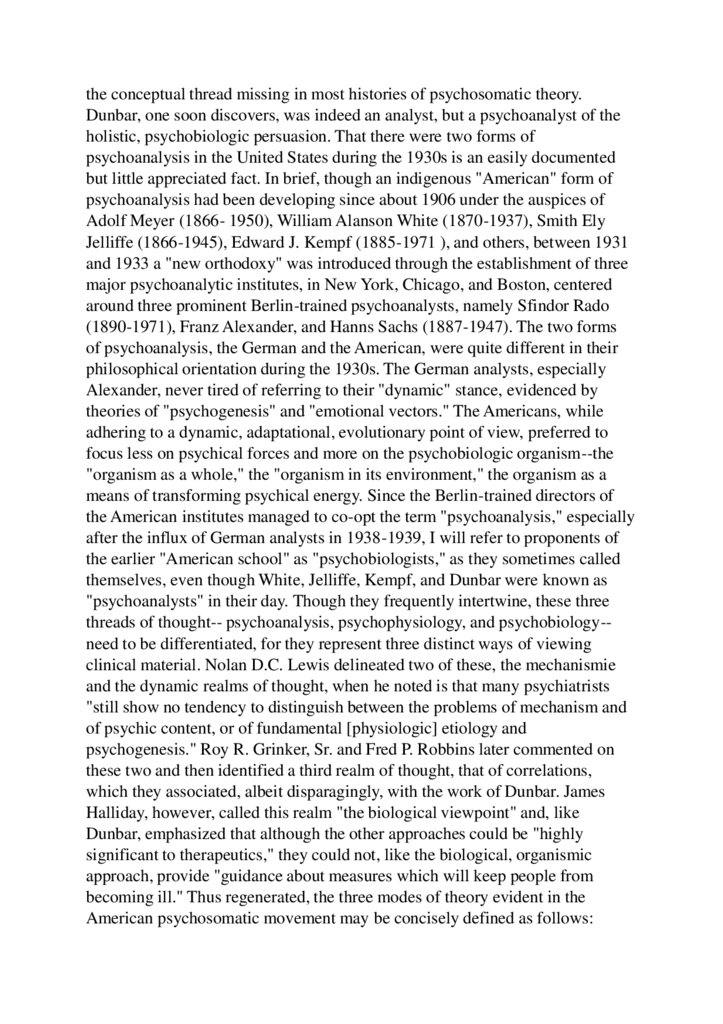
the conceptual thread missing in most histories of psychosomatic theory.Dunbar, one soon discovers, was indeed an analyst, but a psychoanalyst of the
holistic, psychobiologic persuasion. That there were two forms of
psychoanalysis in the United States during the 1930s is an easily documented
but little appreciated fact. In brief, though an indigenous "American" form of
psychoanalysis had been developing since about 1906 under the auspices of
Adolf Meyer (1866- 1950), William Alanson White (1870-1937), Smith Ely
Jelliffe (1866-1945), Edward J. Kempf (1885-1971 ), and others, between 1931
and 1933 a "new orthodoxy" was introduced through the establishment of three
major psychoanalytic institutes, in New York, Chicago, and Boston, centered
around three prominent Berlin-trained psychoanalysts, namely Sfindor Rado
(1890-1971), Franz Alexander, and Hanns Sachs (1887-1947). The two forms
of psychoanalysis, the German and the American, were quite different in their
philosophical orientation during the 1930s. The German analysts, especially
Alexander, never tired of referring to their "dynamic" stance, evidenced by
theories of "psychogenesis" and "emotional vectors." The Americans, while
adhering to a dynamic, adaptational, evolutionary point of view, preferred to
focus less on psychical forces and more on the psychobiologic organism--the
"organism as a whole," the "organism in its environment," the organism as a
means of transforming psychical energy. Since the Berlin-trained directors of
the American institutes managed to co-opt the term "psychoanalysis," especially
after the influx of German analysts in 1938-1939, I will refer to proponents of
the earlier "American school" as "psychobiologists," as they sometimes called
themselves, even though White, Jelliffe, Kempf, and Dunbar were known as
"psychoanalysts" in their day. Though they frequently intertwine, these three
threads of thought-- psychoanalysis, psychophysiology, and psychobiology-need to be differentiated, for they represent three distinct ways of viewing
clinical material. Nolan D.C. Lewis delineated two of these, the mechanismie
and the dynamic realms of thought, when he noted is that many psychiatrists
"still show no tendency to distinguish between the problems of mechanism and
of psychic content, or of fundamental [physiologic] etiology and
psychogenesis." Roy R. Grinker, Sr. and Fred P. Robbins later commented on
these two and then identified a third realm of thought, that of correlations,
which they associated, albeit disparagingly, with the work of Dunbar. James
Halliday, however, called this realm "the biological viewpoint" and, like
Dunbar, emphasized that although the other approaches could be "highly
significant to therapeutics," they could not, like the biological, organismic
approach, provide "guidance about measures which will keep people from
becoming ill." Thus regenerated, the three modes of theory evident in the
American psychosomatic movement may be concisely defined as follows:
6.
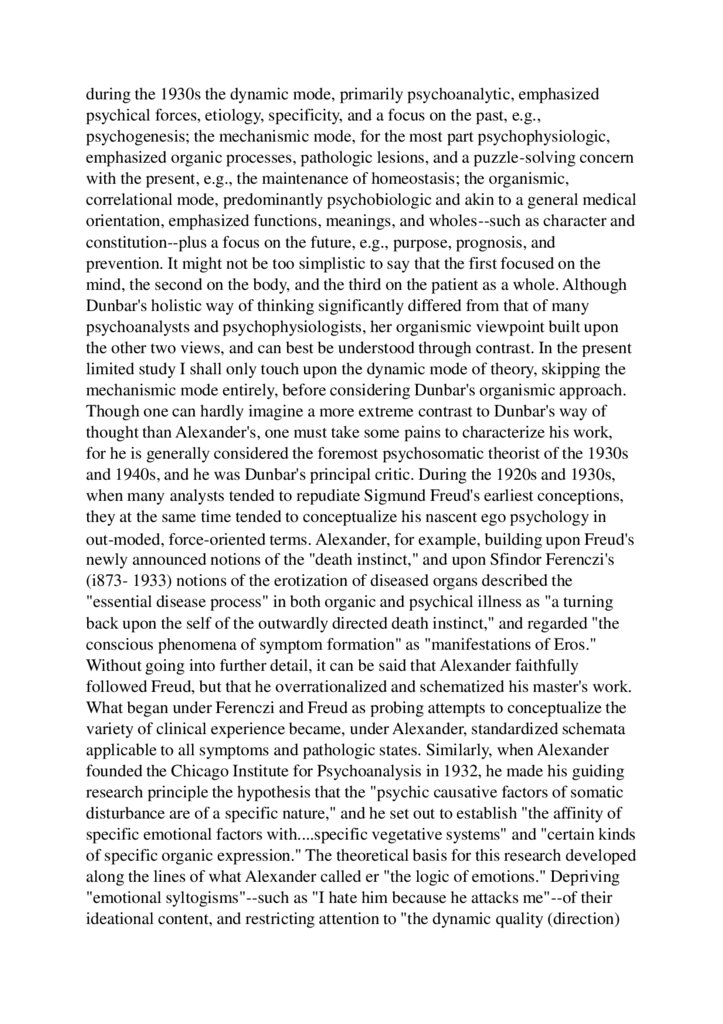
during the 1930s the dynamic mode, primarily psychoanalytic, emphasizedpsychical forces, etiology, specificity, and a focus on the past, e.g.,
psychogenesis; the mechanismic mode, for the most part psychophysiologic,
emphasized organic processes, pathologic lesions, and a puzzle-solving concern
with the present, e.g., the maintenance of homeostasis; the organismic,
correlational mode, predominantly psychobiologic and akin to a general medical
orientation, emphasized functions, meanings, and wholes--such as character and
constitution--plus a focus on the future, e.g., purpose, prognosis, and
prevention. It might not be too simplistic to say that the first focused on the
mind, the second on the body, and the third on the patient as a whole. Although
Dunbar's holistic way of thinking significantly differed from that of many
psychoanalysts and psychophysiologists, her organismic viewpoint built upon
the other two views, and can best be understood through contrast. In the present
limited study I shall only touch upon the dynamic mode of theory, skipping the
mechanismic mode entirely, before considering Dunbar's organismic approach.
Though one can hardly imagine a more extreme contrast to Dunbar's way of
thought than Alexander's, one must take some pains to characterize his work,
for he is generally considered the foremost psychosomatic theorist of the 1930s
and 1940s, and he was Dunbar's principal critic. During the 1920s and 1930s,
when many analysts tended to repudiate Sigmund Freud's earliest conceptions,
they at the same time tended to conceptualize his nascent ego psychology in
out-moded, force-oriented terms. Alexander, for example, building upon Freud's
newly announced notions of the "death instinct," and upon Sfindor Ferenczi's
(i873- 1933) notions of the erotization of diseased organs described the
"essential disease process" in both organic and psychical illness as "a turning
back upon the self of the outwardly directed death instinct," and regarded "the
conscious phenomena of symptom formation" as "manifestations of Eros."
Without going into further detail, it can be said that Alexander faithfully
followed Freud, but that he overrationalized and schematized his master's work.
What began under Ferenczi and Freud as probing attempts to conceptualize the
variety of clinical experience became, under Alexander, standardized schemata
applicable to all symptoms and pathologic states. Similarly, when Alexander
founded the Chicago Institute for Psychoanalysis in 1932, he made his guiding
research principle the hypothesis that the "psychic causative factors of somatic
disturbance are of a specific nature," and he set out to establish "the affinity of
specific emotional factors with....specific vegetative systems" and "certain kinds
of specific organic expression." The theoretical basis for this research developed
along the lines of what Alexander called er "the logic of emotions." Depriving
"emotional syltogisms"--such as "I hate him because he attacks me"--of their
ideational content, and restricting attention to "the dynamic quality (direction)
7.
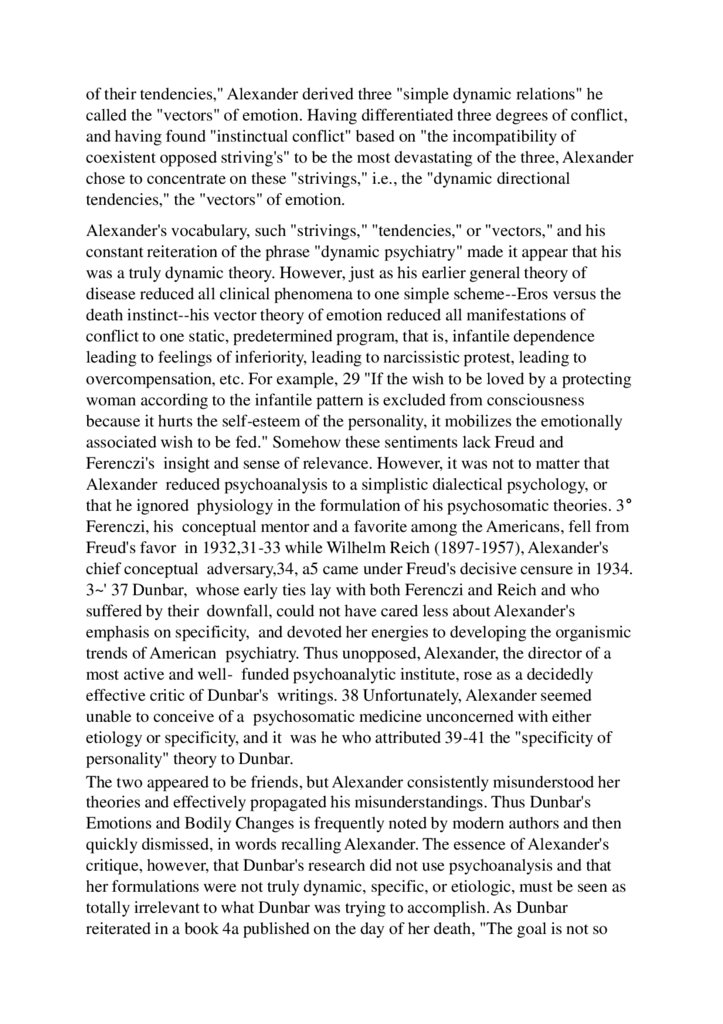
of their tendencies," Alexander derived three "simple dynamic relations" hecalled the "vectors" of emotion. Having differentiated three degrees of conflict,
and having found "instinctual conflict" based on "the incompatibility of
coexistent opposed striving's" to be the most devastating of the three, Alexander
chose to concentrate on these "strivings," i.e., the "dynamic directional
tendencies," the "vectors" of emotion.
Alexander's vocabulary, such "strivings," "tendencies," or "vectors," and his
constant reiteration of the phrase "dynamic psychiatry" made it appear that his
was a truly dynamic theory. However, just as his earlier general theory of
disease reduced all clinical phenomena to one simple scheme--Eros versus the
death instinct--his vector theory of emotion reduced all manifestations of
conflict to one static, predetermined program, that is, infantile dependence
leading to feelings of inferiority, leading to narcissistic protest, leading to
overcompensation, etc. For example, 29 "If the wish to be loved by a protecting
woman according to the infantile pattern is excluded from consciousness
because it hurts the self-esteem of the personality, it mobilizes the emotionally
associated wish to be fed." Somehow these sentiments lack Freud and
Ferenczi's insight and sense of relevance. However, it was not to matter that
Alexander reduced psychoanalysis to a simplistic dialectical psychology, or
that he ignored physiology in the formulation of his psychosomatic theories. 3°
Ferenczi, his conceptual mentor and a favorite among the Americans, fell from
Freud's favor in 1932,31-33 while Wilhelm Reich (1897-1957), Alexander's
chief conceptual adversary,34, a5 came under Freud's decisive censure in 1934.
3~' 37 Dunbar, whose early ties lay with both Ferenczi and Reich and who
suffered by their downfall, could not have cared less about Alexander's
emphasis on specificity, and devoted her energies to developing the organismic
trends of American psychiatry. Thus unopposed, Alexander, the director of a
most active and well- funded psychoanalytic institute, rose as a decidedly
effective critic of Dunbar's writings. 38 Unfortunately, Alexander seemed
unable to conceive of a psychosomatic medicine unconcerned with either
etiology or specificity, and it was he who attributed 39-41 the "specificity of
personality" theory to Dunbar.
The two appeared to be friends, but Alexander consistently misunderstood her
theories and effectively propagated his misunderstandings. Thus Dunbar's
Emotions and Bodily Changes is frequently noted by modern authors and then
quickly dismissed, in words recalling Alexander. The essence of Alexander's
critique, however, that Dunbar's research did not use psychoanalysis and that
her formulations were not truly dynamic, specific, or etiologic, must be seen as
totally irrelevant to what Dunbar was trying to accomplish. As Dunbar
reiterated in a book 4a published on the day of her death, "The goal is not so
8.
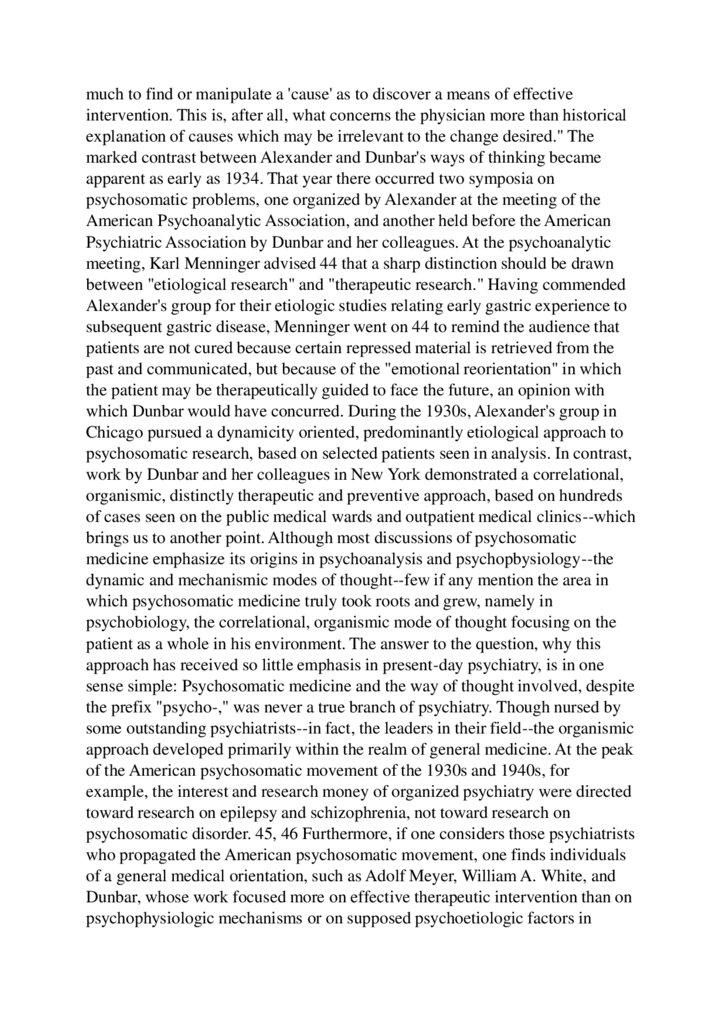
much to find or manipulate a 'cause' as to discover a means of effectiveintervention. This is, after all, what concerns the physician more than historical
explanation of causes which may be irrelevant to the change desired." The
marked contrast between Alexander and Dunbar's ways of thinking became
apparent as early as 1934. That year there occurred two symposia on
psychosomatic problems, one organized by Alexander at the meeting of the
American Psychoanalytic Association, and another held before the American
Psychiatric Association by Dunbar and her colleagues. At the psychoanalytic
meeting, Karl Menninger advised 44 that a sharp distinction should be drawn
between "etiological research" and "therapeutic research." Having commended
Alexander's group for their etiologic studies relating early gastric experience to
subsequent gastric disease, Menninger went on 44 to remind the audience that
patients are not cured because certain repressed material is retrieved from the
past and communicated, but because of the "emotional reorientation" in which
the patient may be therapeutically guided to face the future, an opinion with
which Dunbar would have concurred. During the 1930s, Alexander's group in
Chicago pursued a dynamicity oriented, predominantly etiological approach to
psychosomatic research, based on selected patients seen in analysis. In contrast,
work by Dunbar and her colleagues in New York demonstrated a correlational,
organismic, distinctly therapeutic and preventive approach, based on hundreds
of cases seen on the public medical wards and outpatient medical clinics--which
brings us to another point. Although most discussions of psychosomatic
medicine emphasize its origins in psychoanalysis and psychopbysiology--the
dynamic and mechanismic modes of thought--few if any mention the area in
which psychosomatic medicine truly took roots and grew, namely in
psychobiology, the correlational, organismic mode of thought focusing on the
patient as a whole in his environment. The answer to the question, why this
approach has received so little emphasis in present-day psychiatry, is in one
sense simple: Psychosomatic medicine and the way of thought involved, despite
the prefix "psycho-," was never a true branch of psychiatry. Though nursed by
some outstanding psychiatrists--in fact, the leaders in their field--the organismic
approach developed primarily within the realm of general medicine. At the peak
of the American psychosomatic movement of the 1930s and 1940s, for
example, the interest and research money of organized psychiatry were directed
toward research on epilepsy and schizophrenia, not toward research on
psychosomatic disorder. 45, 46 Furthermore, if one considers those psychiatrists
who propagated the American psychosomatic movement, one finds individuals
of a general medical orientation, such as Adolf Meyer, William A. White, and
Dunbar, whose work focused more on effective therapeutic intervention than on
psychophysiologic mechanisms or on supposed psychoetiologic factors in
9.
disease. In fact, psychosomatic medicine has been defined by one prominentpsychiatrist, 4r as "the psychobiologic approach of Adotf Meyer, not to the
psychoses and not to mental diseases, but to the disorders lying within the
domain of general medicine." This comment aptly conveys that Meyer, despite
his prestigious role as director of the Phipps Psychiatric Clinic in Baltimore,
exercised perhaps greater influence outside of psychiatry than within. White,
too, though superintendant of the sprawling Government Hospital for the Insane
in Washington DC, habitually drew from and contributed to areas outside the
bounds of traditional psychiatry. Perhaps even more effectively than Meyer,
White stressed 48-5° the relevance of organismic, symbolistic conceptions
borrowed from biology and Gestalt psychology. Then there was Dunbar. During
most of her years at Columbia she worked as a psychiatrist "on assignment to
the Department of Medicine," where her nonmedical background in religious
education and healing (which is another long story) helped ease psychoanalysishitherto so heavily associated with sex--into the public medical wards of
Columbia Presbyterian Hospital.
In summary
The dynamic, mechanismic, and organismic modes of thought in psychosomatic
medicine each had their origin in the late nineteenth century, and each
contributed to the American psychosomatic movement of the 1930s. Alexander
founded the first psychoanalytic institute devoted to psychosomatic research in
1932, the same year Walter B. Cannon (1871-1945) amplified the concept
"homeostasis," and the same year Dunbar began her major studies at Columbia.
Two years later interest warranted two symposia, and by 1935 the movement
had definitely begun to gain impetus. Alexander developed his vector theory in
"The logic of emotions," Wittkower's comprehensive "Studies on the influence
of emotions" appeared, and Dunbar published her organismic survey, Emotions
and Bodily Changes. In the mid to late 1930s, psychoanalysis gained hold of
American psychiatry with an influx of European analysts, while
psychophysiology also gained stature with the increased sophistication of
instruments and methods. Psychobiology, however, faced 1935 with the
disrepute of two possible leaders, Ferenczi and Reich, plus the virtual
retirement of four others, Meyer, White, Jelliffe, and Draper--none of whose
students effectively spread their word. Only Dunbar appeared to fill the
vacuum, and her medical career began at an unauspicious time, during the
ascendancy of both analysis and physiology, so that her work emerged in the
face of prevailing conceptual biases. That is, a holistic, organismic approach
that was readily
10.
accepted in 1925, or even the 1930s, would not have been able to commandattention after 1940, when the dynamic and mechanismic modes of thought
were to have their day. In terms of the medical context, Dunbar appeared on the
scene too late. But her fate--a rapid rise, due to her brillance, followed by a
rapid fall, due to her content~was not to be avoided, for Dunbar's nonmedical
views on "healing and wholeness" determined her career. Despite Dunbar's
medical role, one must look to her nonmedical background to grasp the full
meaning of her work.