 Право
ПравоПохожие презентации:






Fair Privacy
1.
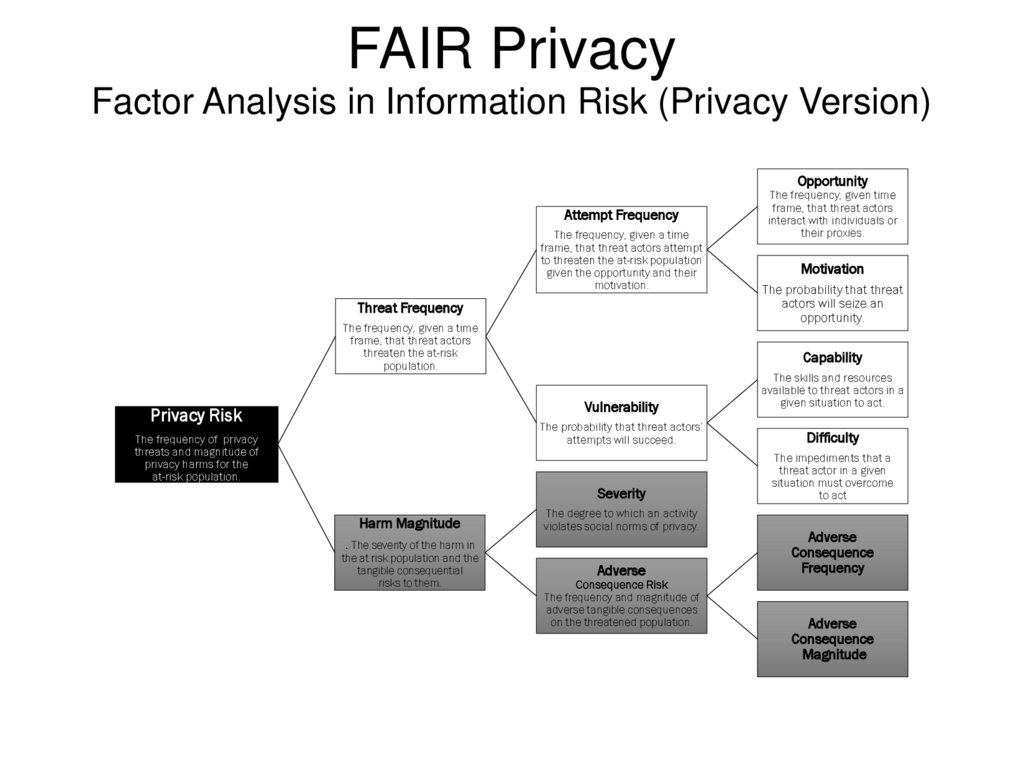
FAIR PrivacyFactor Analysis in Information Risk (Privacy Version)
Opportunity
Attempt Frequency
The frequency, given a time
frame, that threat actors attempt
to threaten the at-risk population
given the opportunity and their
motivation.
Threat Frequency
The frequency, given a time
frame, that threat actors
threaten the at-risk
population.
Privacy Risk
The frequency of privacy
threats and magnitude of
privacy harms for the
at-risk population.
Harm Magnitude
Motivation
The probability that threat
actors will seize an
opportunity.
Capability
Vulnerability
The skills and resources
available to threat actors in a
given situation to act.
The probability that threat actors’
attempts will succeed.
Difficulty
Severity
The impediments that a
threat actor in a given
situation must overcome
to act
The degree to which an activity
violates social norms of privacy.
. The severity of the harm in
the at risk population and the
tangible consequential
risks to them.
The frequency, given time
frame, that threat actors
interact with individuals or
their proxies.
Adverse
Consequence Risk
The frequency and magnitude of
adverse tangible consequences
on the threatened population.
Adverse
Consequence
Frequency
Adverse
Consequence
Magnitude
2.
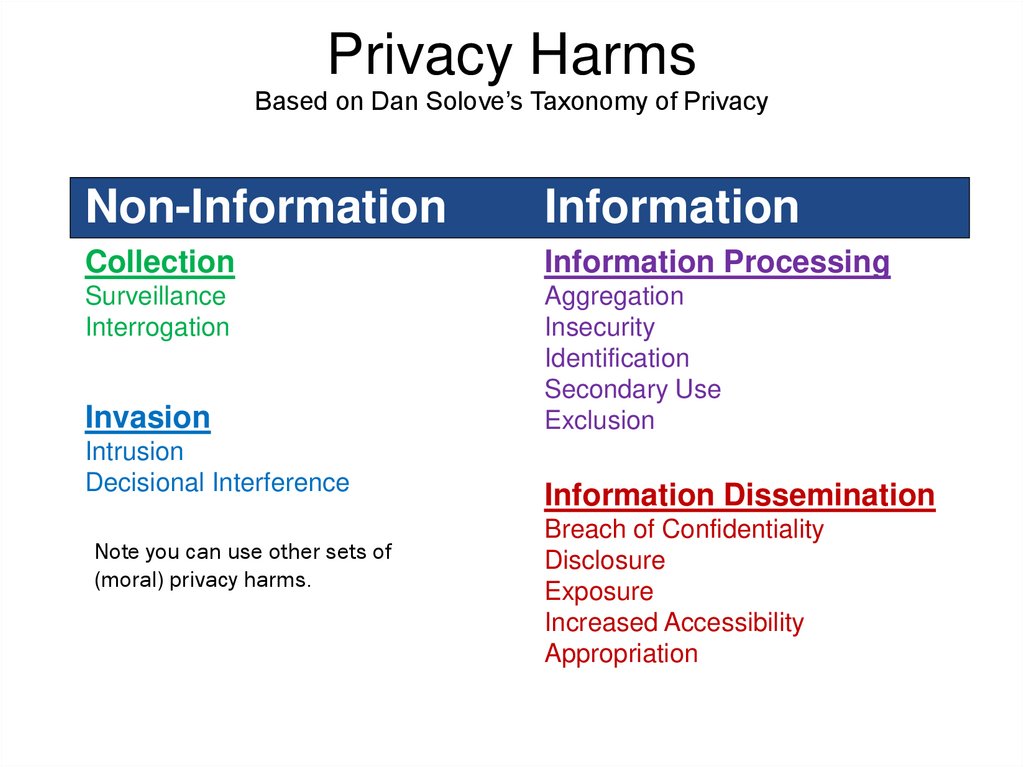
Privacy HarmsBased on Dan Solove’s Taxonomy of Privacy
Non-Information
Information
Collection
Information Processing
Surveillance
Interrogation
Aggregation
Insecurity
Identification
Secondary Use
Exclusion
Invasion
Intrusion
Decisional Interference
Note you can use other sets of
(moral) privacy harms.
Information Dissemination
Breach of Confidentiality
Disclosure
Exposure
Increased Accessibility
Appropriation
3.
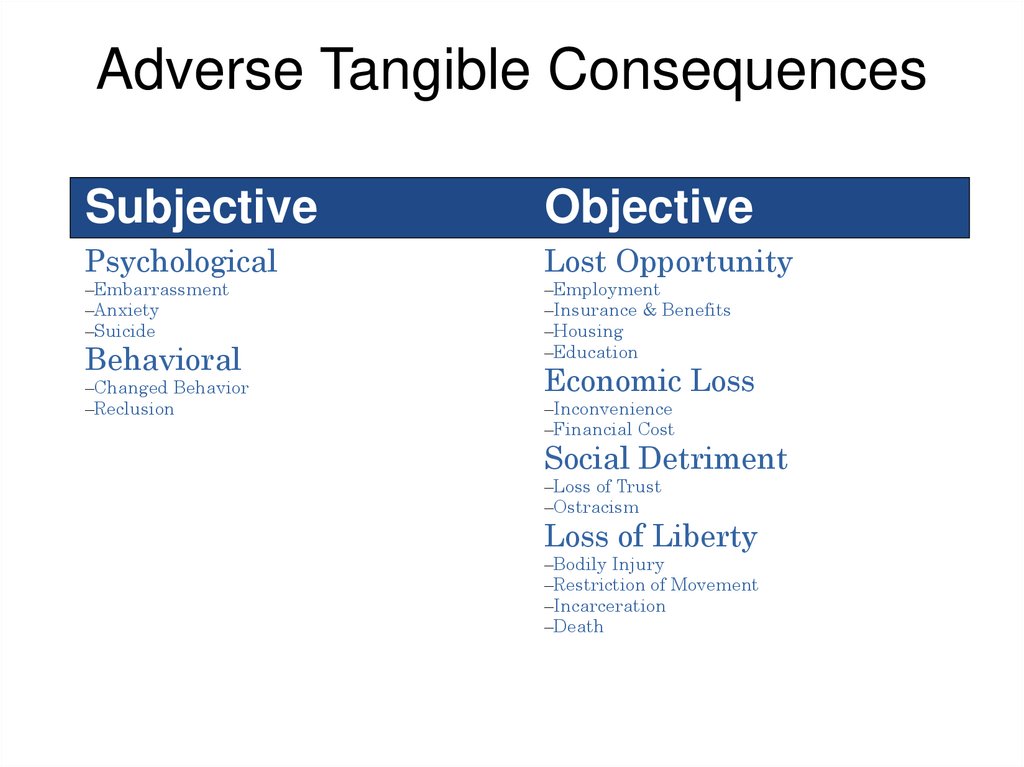
Adverse Tangible ConsequencesSubjective
Objective
Psychological
Lost Opportunity
–Embarrassment
–Anxiety
–Suicide
–Employment
–Insurance & Benefits
–Housing
–Education
Behavioral
–Changed Behavior
–Reclusion
Economic Loss
–Inconvenience
–Financial Cost
Social Detriment
–Loss of Trust
–Ostracism
Loss of Liberty
–Bodily Injury
–Restriction of Movement
–Incarceration
–Death
4.
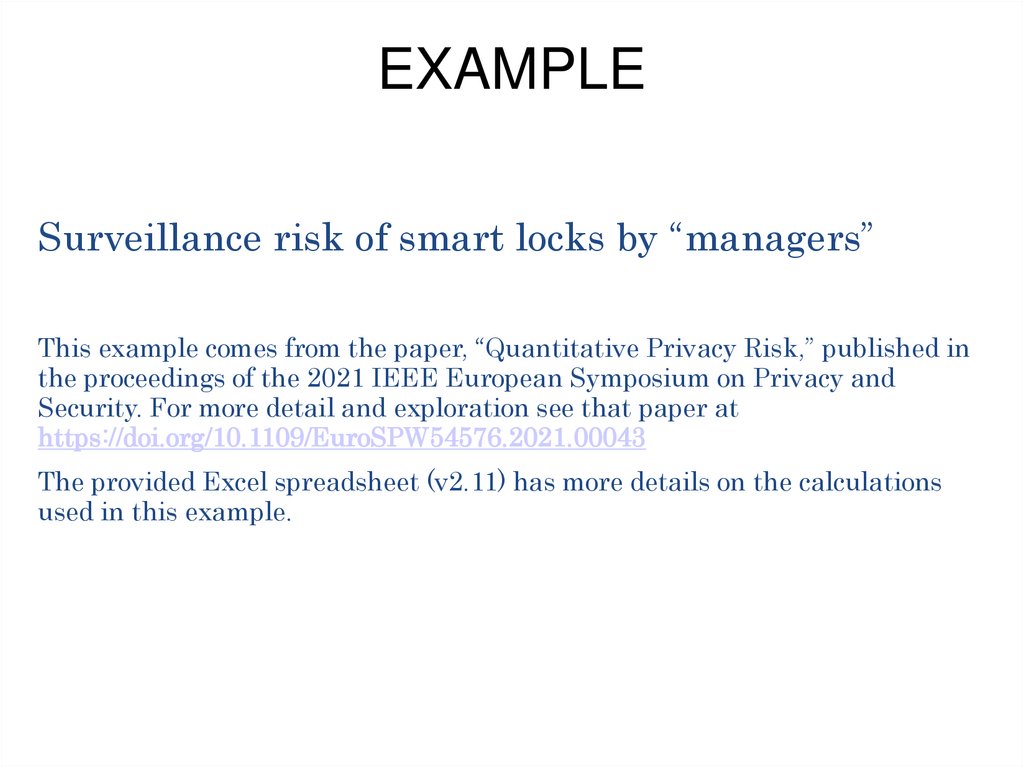
EXAMPLESurveillance risk of smart locks by “managers”
This example comes from the paper, “Quantitative Privacy Risk,” published in
the proceedings of the 2021 IEEE European Symposium on Privacy and
Security. For more detail and exploration see that paper at
https://doi.org/10.1109/EuroSPW54576.2021.00043
The provided Excel spreadsheet (v2.11) has more details on the calculations
used in this example.
5.
EXAMPLE: Surveillance Risk of Smart LocksBreakdown by factors
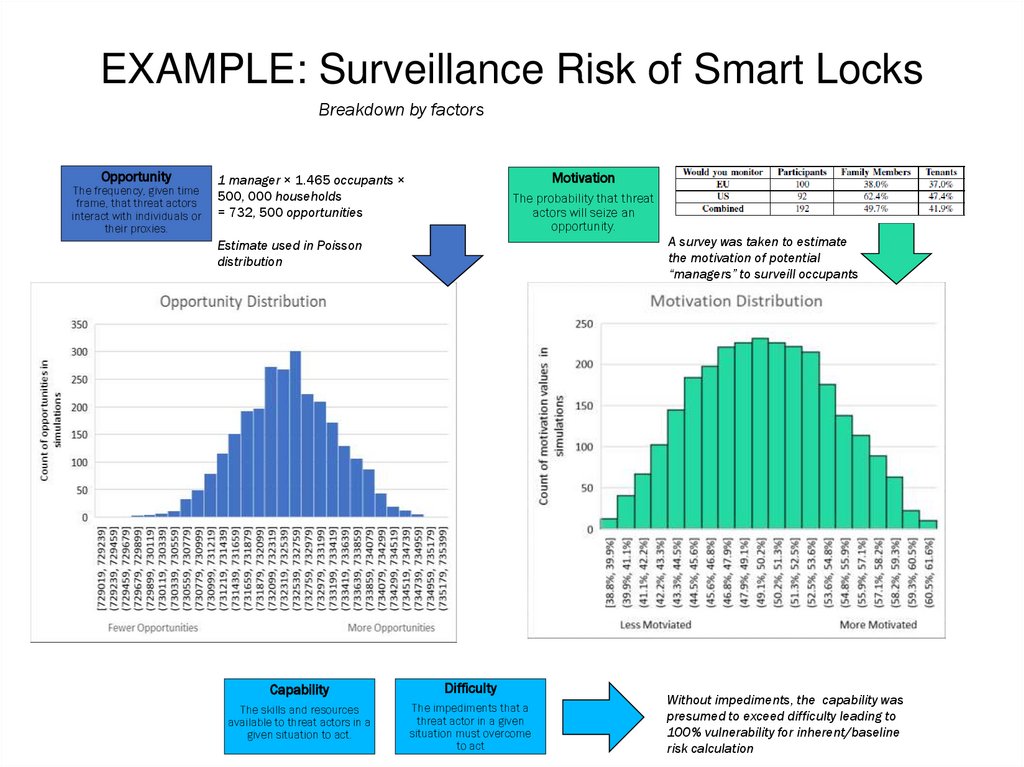
Opportunity
The frequency, given time
frame, that threat actors
interact with individuals or
their proxies.
Motivation
1 manager × 1.465 occupants ×
500, 000 households
= 732, 500 opportunities
The probability that threat
actors will seize an
opportunity.
A survey was taken to estimate
the motivation of potential
“managers” to surveill occupants
Estimate used in Poisson
distribution
Capability
Difficulty
The skills and resources
available to threat actors in a
given situation to act.
The impediments that a
threat actor in a given
situation must overcome
to act
Without impediments, the capability was
presumed to exceed difficulty leading to
100% vulnerability for inherent/baseline
risk calculation
6.
EXAMPLE: Surveillance Risk of Smart LocksBreakdown by factors
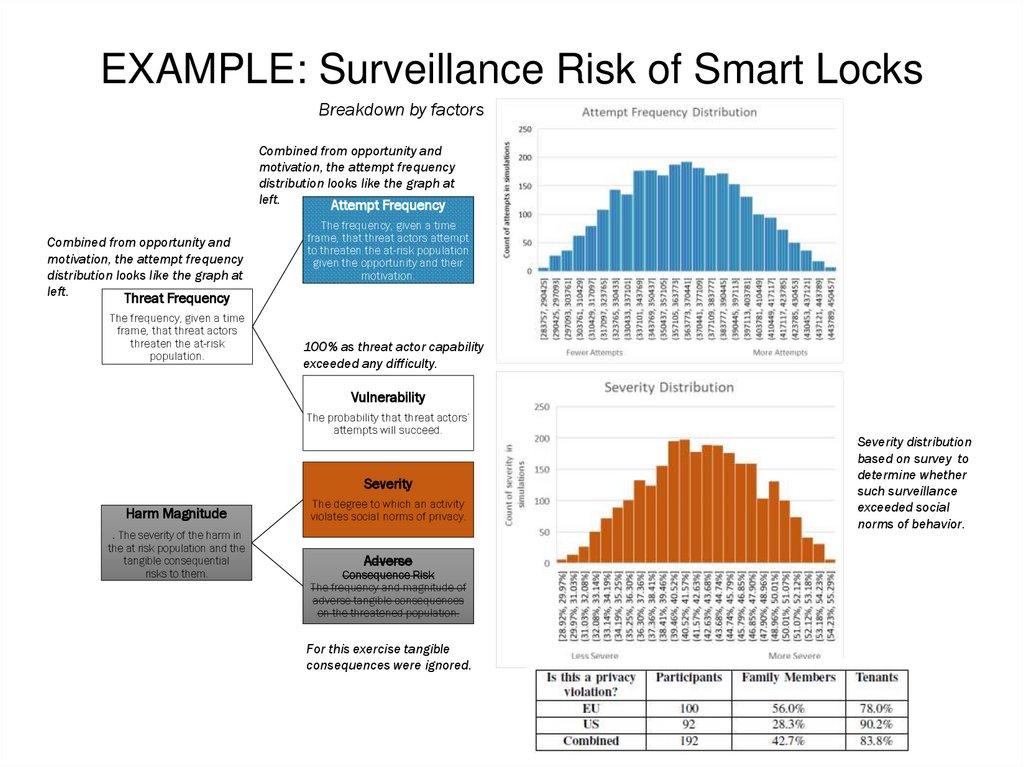
Combined from opportunity and
motivation, the attempt frequency
distribution looks like the graph at
left.
Attempt Frequency
Combined from opportunity and
motivation, the attempt frequency
distribution looks like the graph at
left.
Threat Frequency
The frequency, given a time
frame, that threat actors
threaten the at-risk
population.
The frequency, given a time
frame, that threat actors attempt
to threaten the at-risk population
given the opportunity and their
motivation.
100% as threat actor capability
exceeded any difficulty.
Vulnerability
The probability that threat actors’
attempts will succeed.
Severity
Harm Magnitude
. The severity of the harm in
the at risk population and the
tangible consequential
risks to them.
The degree to which an activity
violates social norms of privacy.
Adverse
Consequence Risk
The frequency and magnitude of
adverse tangible consequences
on the threatened population.
For this exercise tangible
consequences were ignored.
Severity distribution
based on survey to
determine whether
such surveillance
exceeded social
norms of behavior.
7.
EXAMPLE: Surveillance Risk of Smart LocksQuantification
Privacy Risk
250000
200000
Threat Frequency
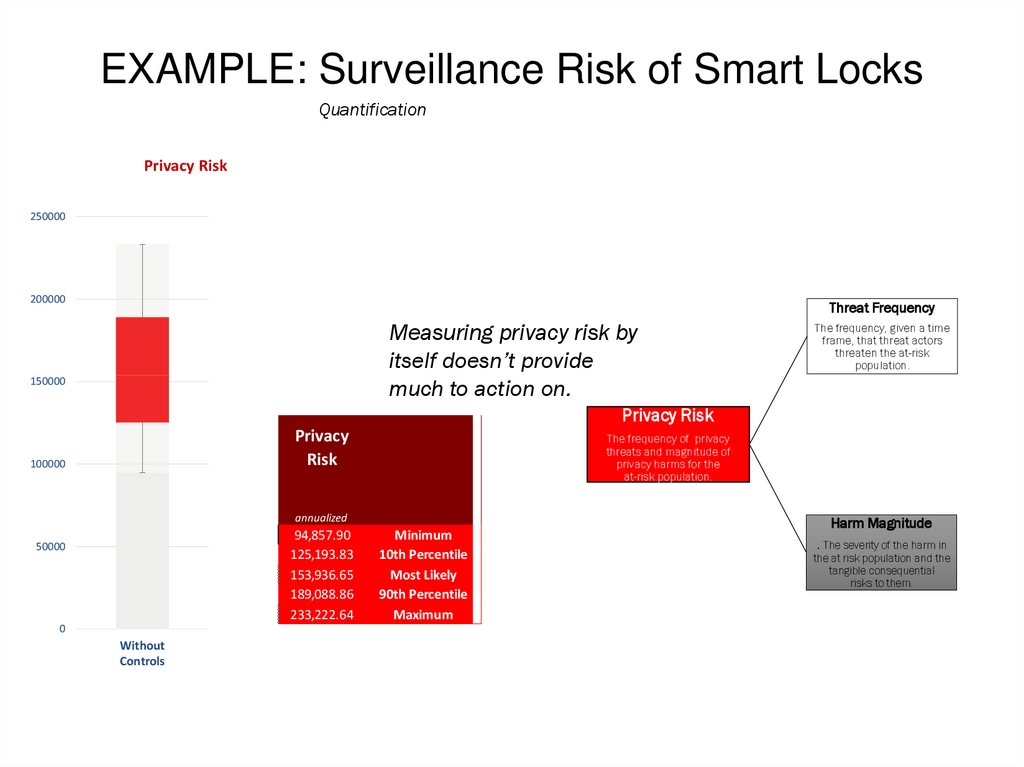
Measuring privacy risk by
itself doesn’t provide
much to action on.
150000
The frequency, given a time
frame, that threat actors
threaten the at-risk
population.
Privacy Risk
Privacy
Risk
100000
250000
annualized
94,857.90
125,193.83
153,936.65
189,088.86
233,222.64
50000
0
Without
Controls
Minimum
10th Percentile
Most Likely
90th Percentile
Maximum
The frequency of privacy
threats and magnitude of
privacy harms for the
at-risk population.
Harm Magnitude
200000
. The severity of the harm in
the at risk population and the
tangible consequential
risks to them.
8.
EXAMPLE: Surveillance Risk of Smart LocksComparisons
Threat Frequency
The frequency, given a time
frame, that threat actors
threaten the at-risk
population.
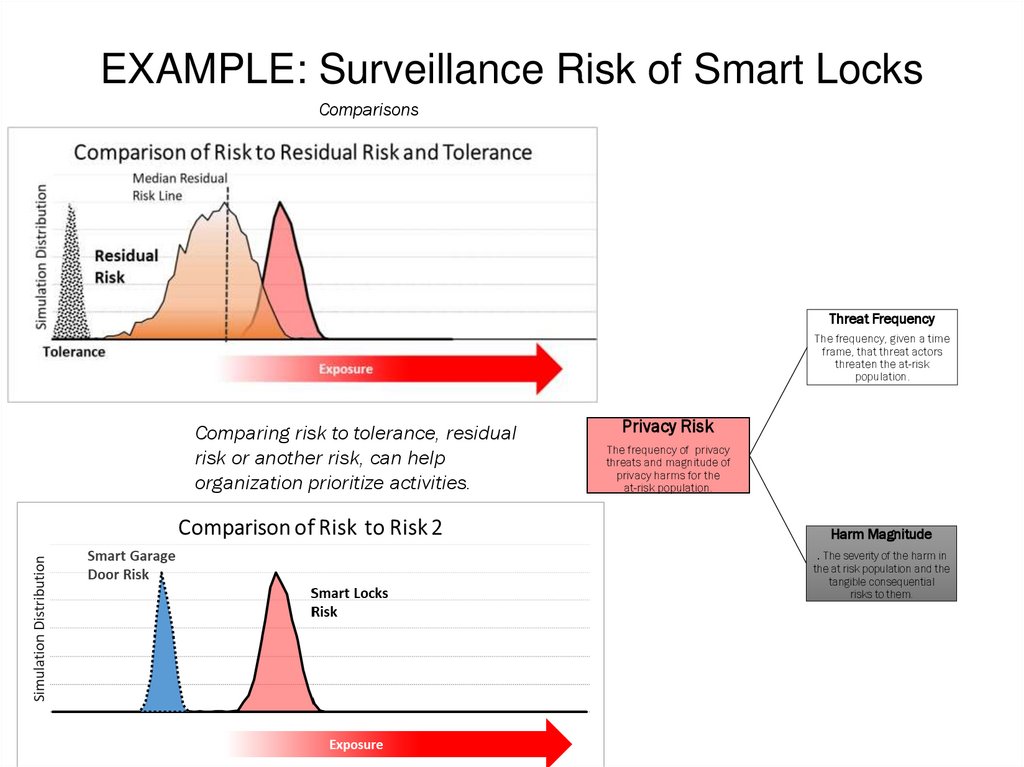
Comparing risk to tolerance, residual
risk or another risk, can help
organization prioritize activities.
Privacy Risk
The frequency of privacy
threats and magnitude of
privacy harms for the
at-risk population.
Harm Magnitude
. The severity of the harm in
the at risk population and the
tangible consequential
risks to them.
9.
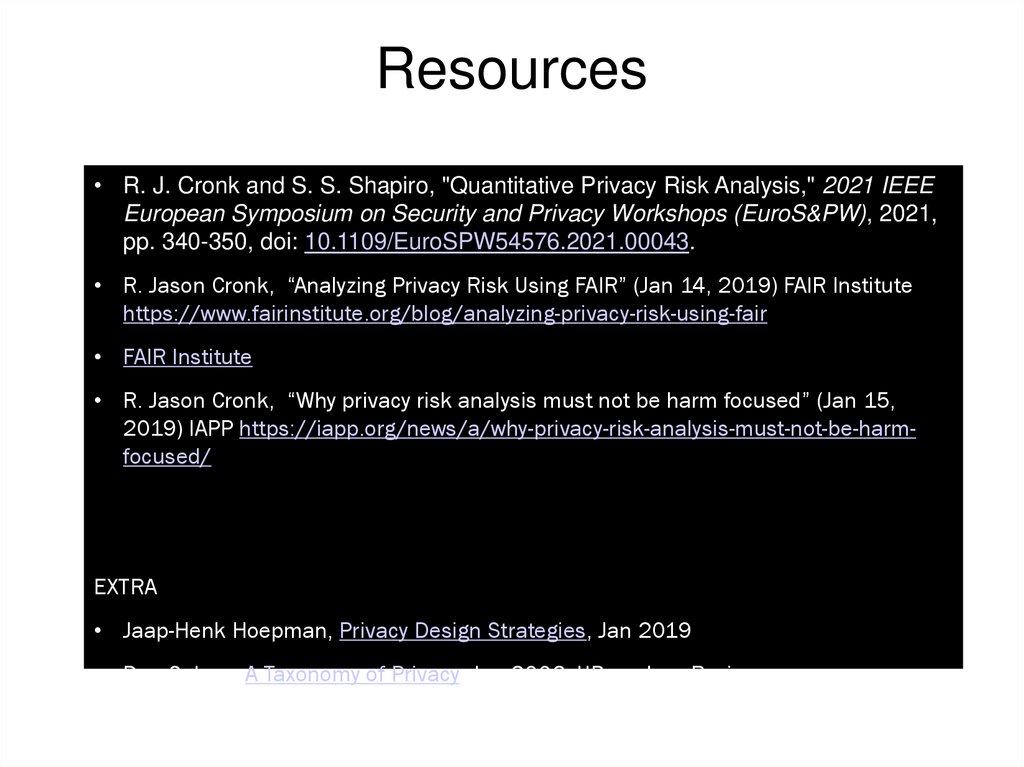
Resources• R. J. Cronk and S. S. Shapiro, "Quantitative Privacy Risk Analysis," 2021 IEEE
European Symposium on Security and Privacy Workshops (EuroS&PW), 2021,
pp. 340-350, doi: 10.1109/EuroSPW54576.2021.00043.
• R. Jason Cronk, “Analyzing Privacy Risk Using FAIR” (Jan 14, 2019) FAIR Institute
https://www.fairinstitute.org/blog/analyzing-privacy-risk-using-fair
• FAIR Institute
• R. Jason Cronk, “Why privacy risk analysis must not be harm focused” (Jan 15,
2019) IAPP https://iapp.org/news/a/why-privacy-risk-analysis-must-not-be-harmfocused/
EXTRA
• Jaap-Henk Hoepman, Privacy Design Strategies, Jan 2019
• Dan Solove, A Taxonomy of Privacy, Jan 2006, UPenn Law Review