
 Английский язык
Похожие презентации:



Power and Systems
1. Session 1. Part 2
Power and Systems2. Session 1
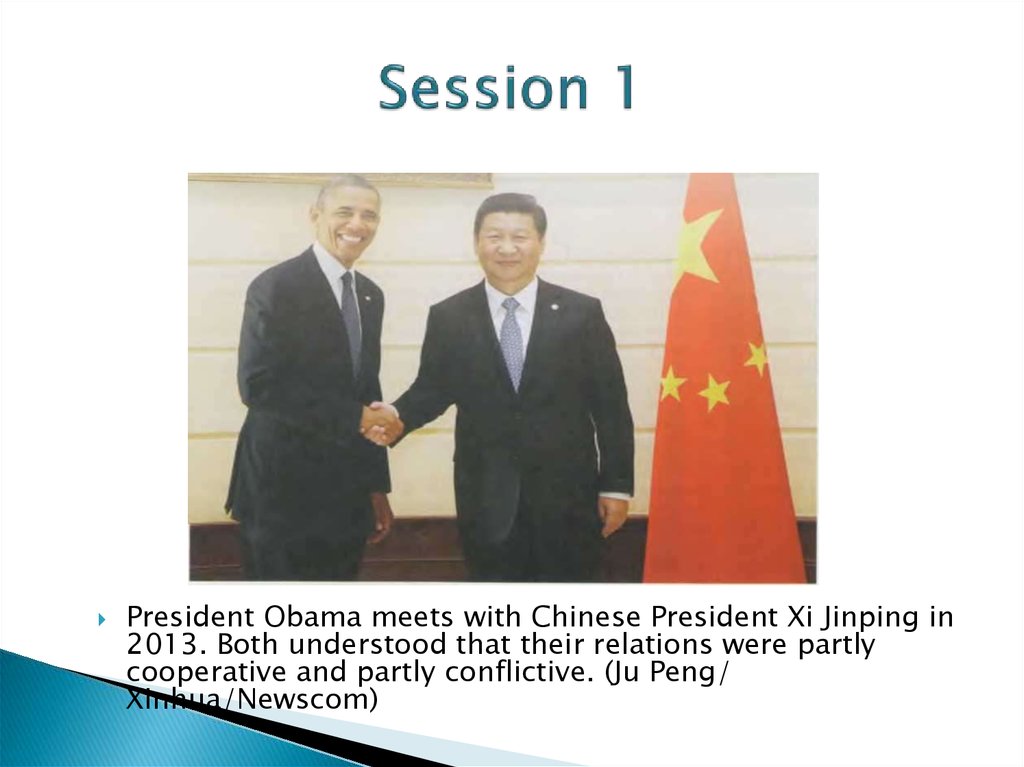
President Obama meets with Chinese President Xi Jinping in2013. Both understood that their relations were partly
cooperative and partly conflictive. (Ju Peng/
Xinhua/Newscom)
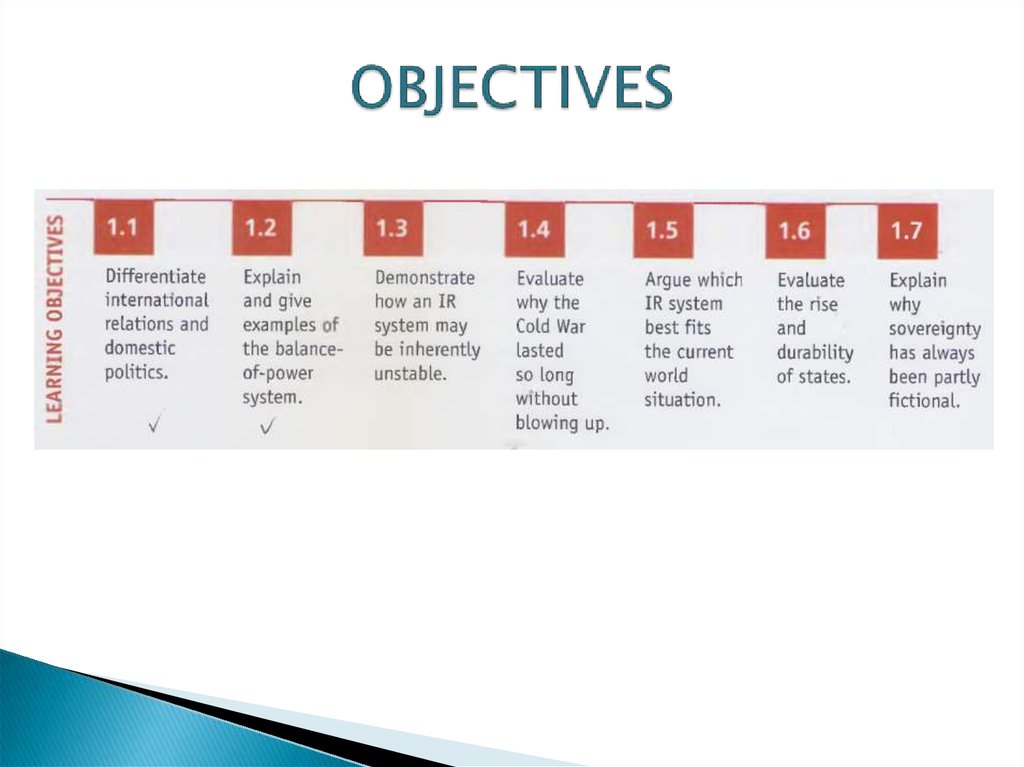
3. OBJECTIVES
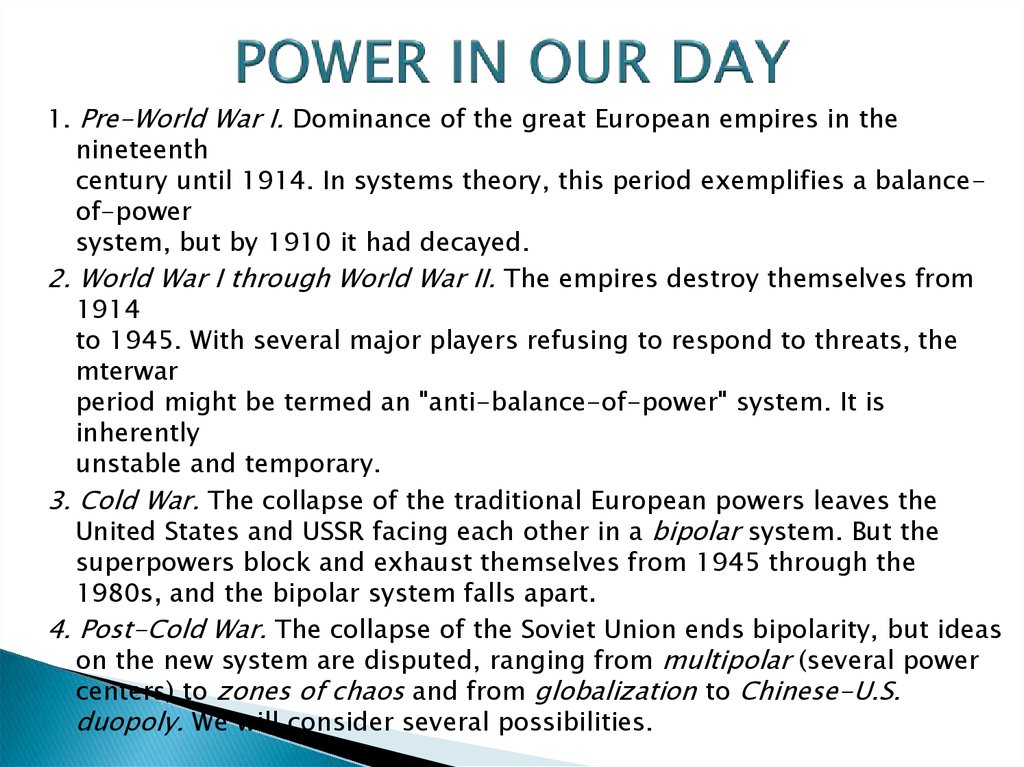
4. POWER IN OUR DAY
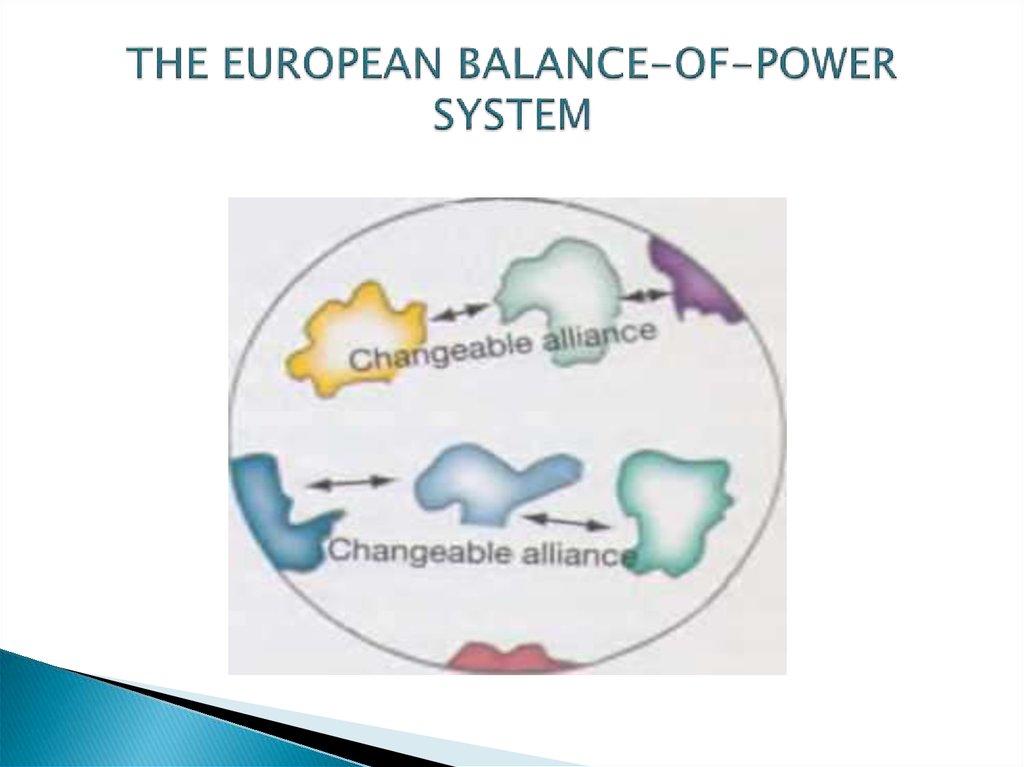
1. Pre-World War I. Dominance of the great European empires in thenineteenth
century until 1914. In systems theory, this period exemplifies a balanceof-power
system, but by 1910 it had decayed.
2. World War I through World War II. The empires destroy themselves from
1914
to 1945. With several major players refusing to respond to threats, the
mterwar
period might be termed an "anti-balance-of-power" system. It is
inherently
unstable and temporary.
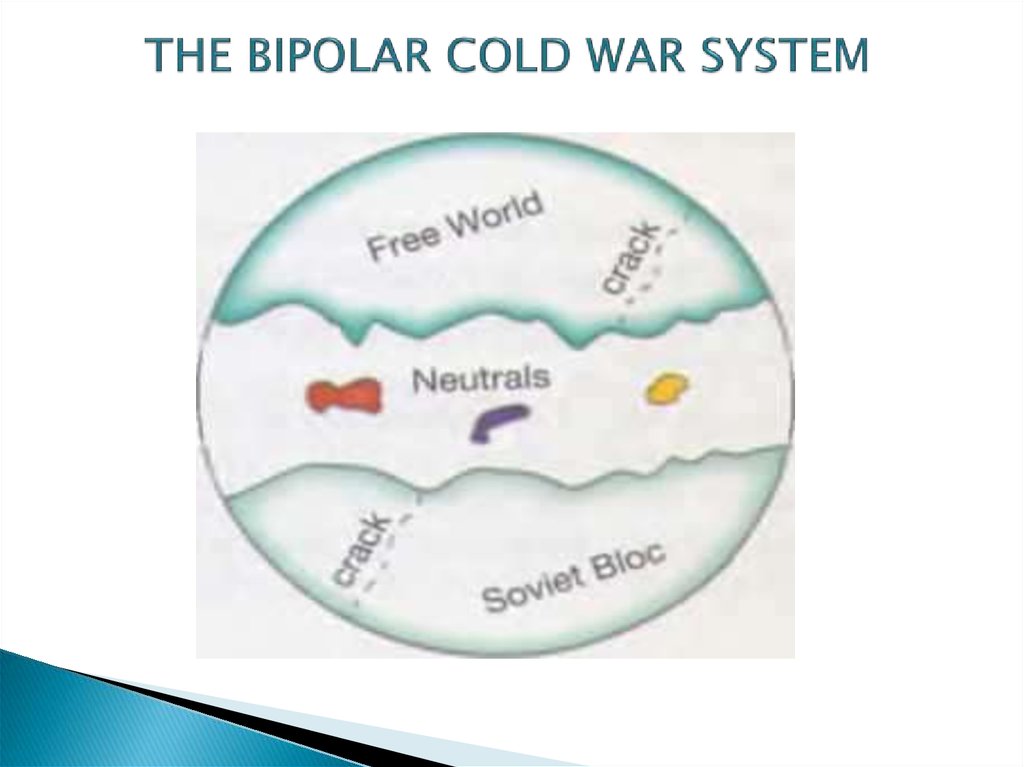
3. Cold War. The collapse of the traditional European powers leaves the
United States and USSR facing each other in a bipolar system. But the
superpowers block and exhaust themselves from 1945 through the
1980s, and the bipolar system falls apart.
4. Post-Cold War. The collapse of the Soviet Union ends bipolarity, but ideas
on the new system are disputed, ranging from multipolar (several power
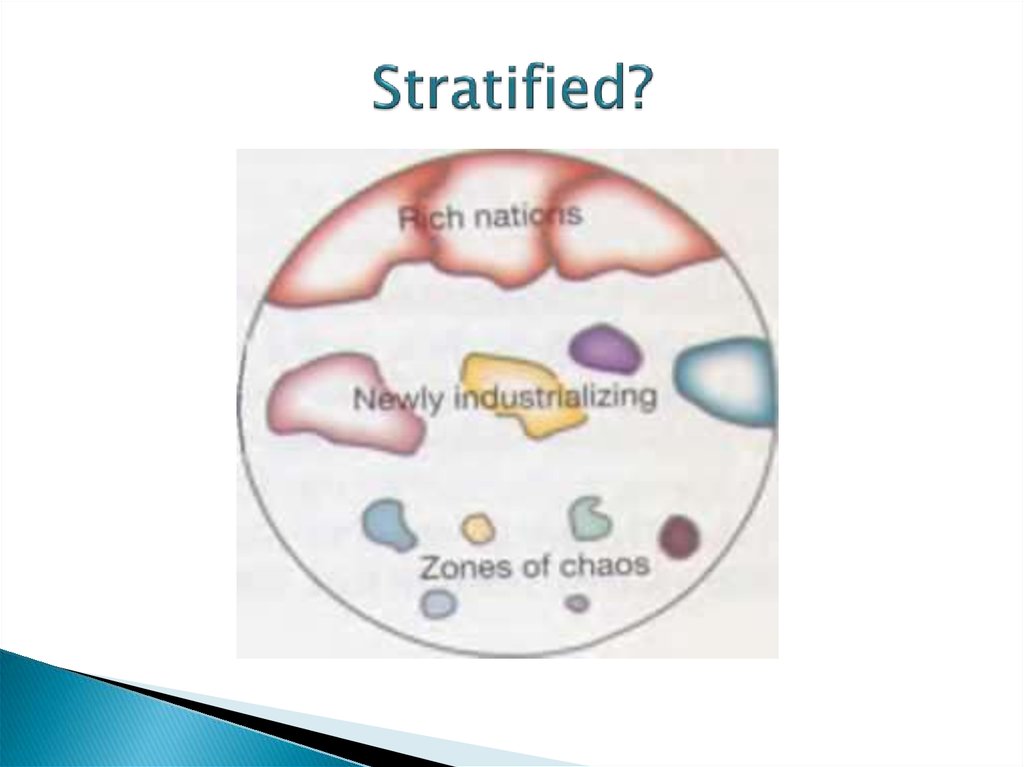
centers) to zones of chaos and from globalization to Chinese-U.S.
duopoly. We will consider several possibilities.
5. CONCEPTS : POWER
Power is widely misunderstood. It: is not big countries beating up littlecountries. Power is one country's ability to get another country to do
what it wants: A gets B to do what A wants. There are many kinds of
power: rational persuasion, economic, cultural, technological, and
military. Rational persuasion is the nicest but rarely works by itself.
Military power is the least nice and is typically used only as a last resort.
Then it becomes force, a subset of power. When Ethiopia and Eritrea
quarreled over their border, they mobilized their armies and got ready to
use force.
Countries use whatever kind of power they have. President Obama urges
Iran to put its nuclear program under international control. Tehran
demands conditions. U.S. military power is massive, but Tehran has oil
power. In our age, energy resources have become one of the most
important sources of power.
6. THE EUROPEAN BALANCE-OF-POWER SYSTEM
7. CONCEPTS : SYSTEM
A system is something composed of many components that interact andinfluence each other. If you can analyze the logic of a system, you can
roughly predict its evolution or at least understand what could go
wrong. Statesmen who grasp the current international system can react
cleverly to threats and opportunities. Those who do not can damage
their own country.
"The strong point about systems thinking is that it trains us to see the
world as a whole rather than just as a series of unrelated happenings
and problems. It also encourages us to see how a clever statesman may
create and manipulate events to get desired results. If he presses here,
what will come out there? Will it be bad or good?
8. THE UNSTABLE INTERWAR SYSTEM
9. THE BIPOLAR COLD WAR SYSTEM
10. 'Was the bipolar world stable? It did not blow up m nuclear war and lasted nearly half a century, but it could not endure, for at least five reasons:
1.2.
3.
4.
5.
The bipolar system locked the superpowers into frantic arms races that grew increasingly
expensive, especially for the weakening Soviet economy. More and more bought them less
and less security, for the armies and weapons could not protect the superpowers or extend
their power; their attempts to expand power collided with nationalism.
Third World nationalism arose, and both superpowers made the mistake of fighting it.
Playing their zero-sum game, the two superpowers tried to get or keep peripheral areas m
their "camps." They pushed their efforts into the Third World until they got burned—the
Americans in Vietnam and the Soviets m Afghanistan.
At least one of the two camps split. One of the polar "continents" cracked apart, and a large
piece drifted away: the Smo-Soviet dispute. Dominance breeds resentment. The other
"continent" developed some hairlme fractures, as NATO grew shakier.
The economic growth of the Pacific Run countries made both superpowers look foolish.
While the military giants frittered away their resources in expensive weapons and dubious
interventions, Japan, South Korea, Taiwan, and other Asian inlands boomed.
The expensive arms race on top of an inherently defective economy and botched reforms
led to the Soviet collapse m 1991. America, by outlasting its antagonist, in effect "won" the
Cold War. The world that emerged from the bipolar system, however, is not completely to
America's liking.
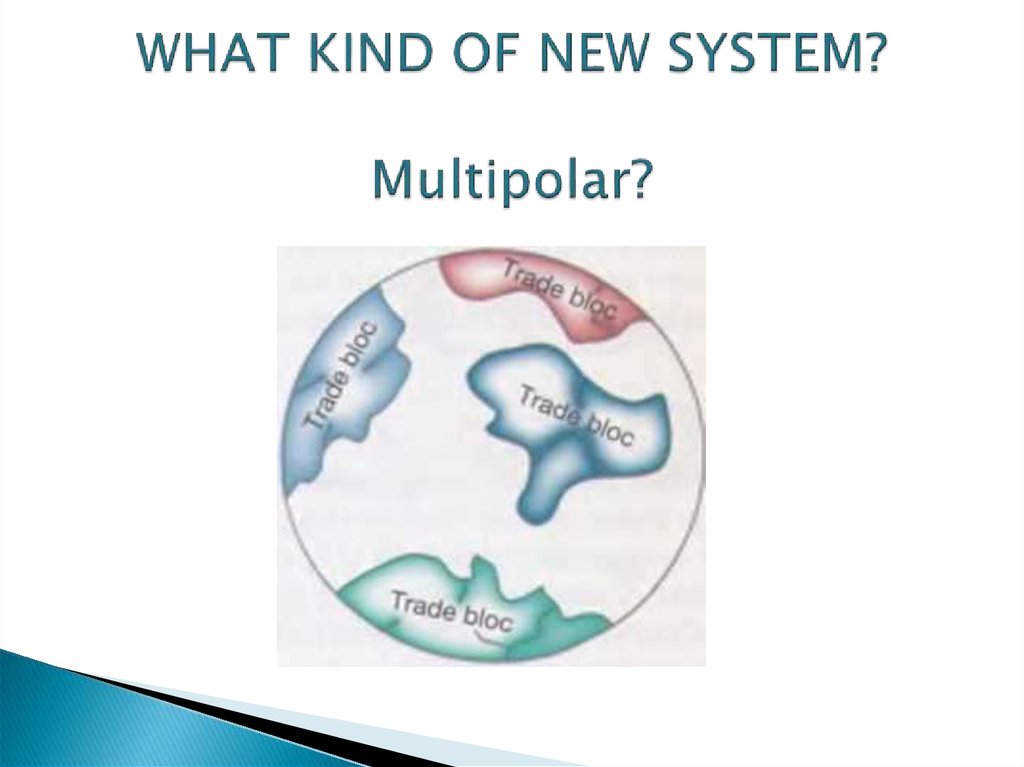
11. WHAT KIND OF NEW SYSTEM? Multipolar?
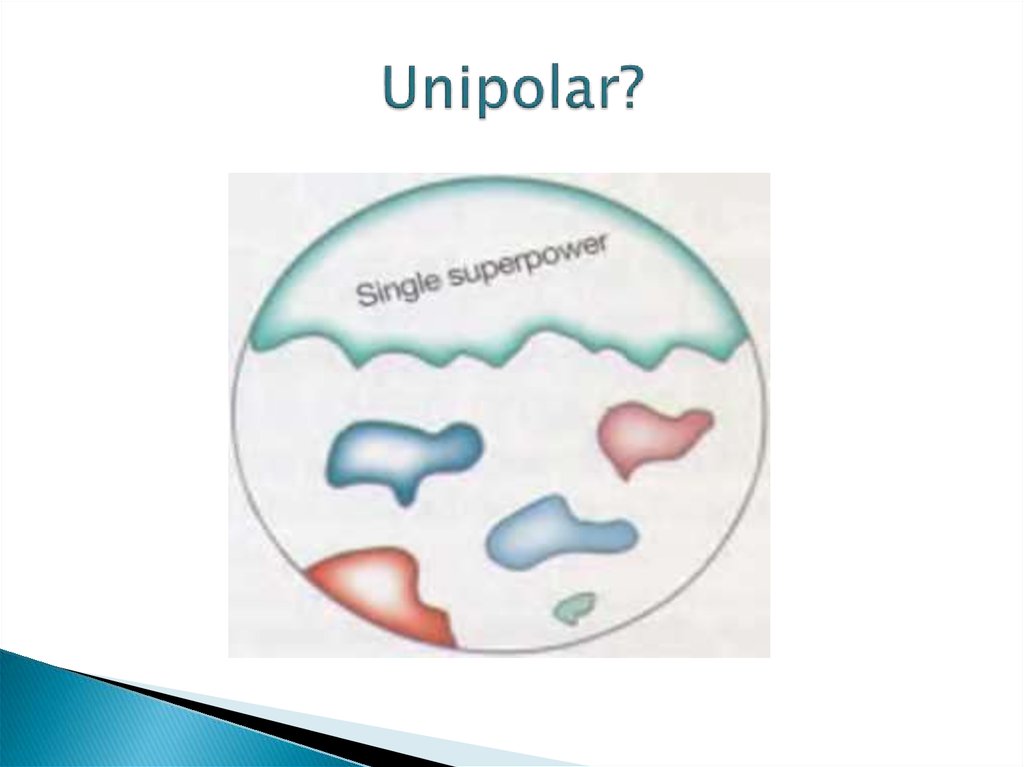
12. Unipolar?
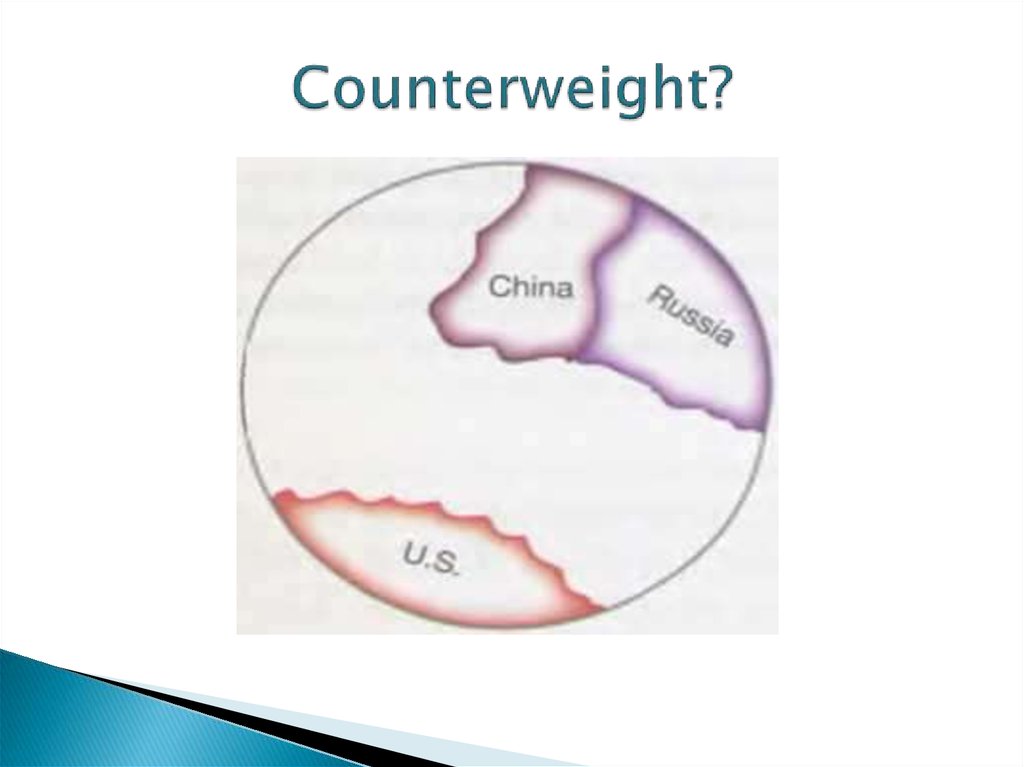
13. Counterweight?
14. Stratified?
15. U.S.-China Duopoly?
Some claim the new global system is aduopoly of power between the United States
and China, the so-called "G2" (Group of Two),
indicating they are the only ones that really
count now. G8 and G20 meetings are
unimportant because, compared to the
United States and China, the others are midsized players. The duopoly model envisions a
world jointly led by the United States and
China. But this so-called "Chimerica" is a
chimera.
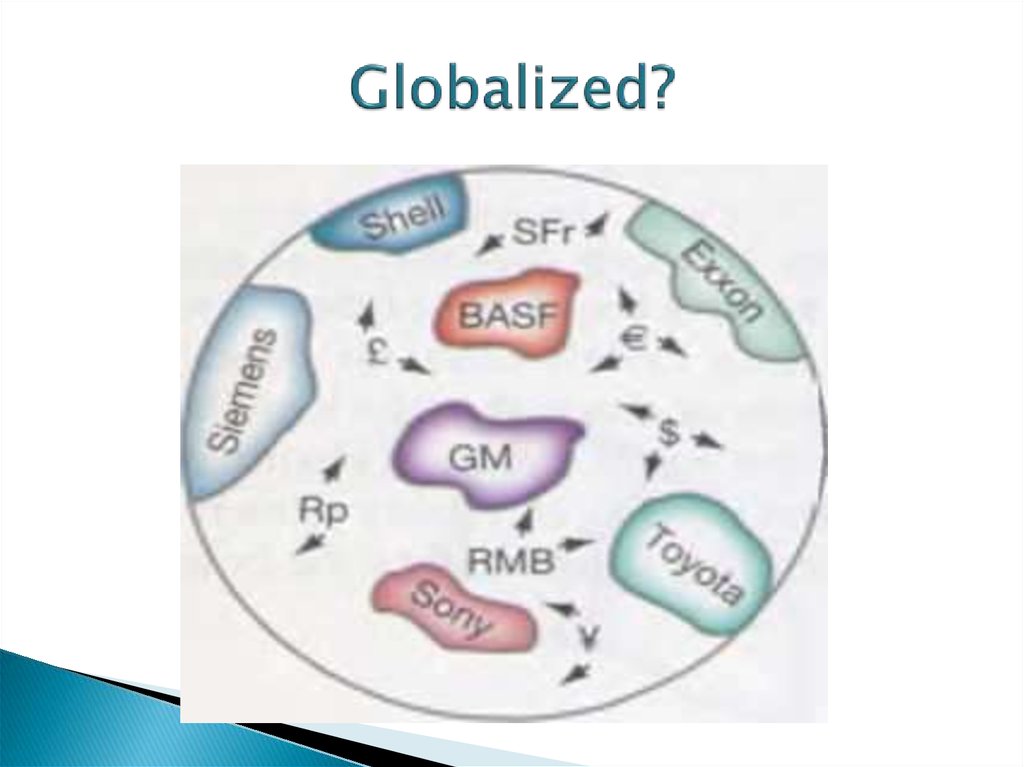
16. Globalized?
17. Resource Wars?
Some thinkers warn we are moving into an "ageof scarcity" marked by a scramble for natural
resources, especially petroleum. Rapidly
industrializing China needs ever-more resources,
lo secure them, China makes exclusive deals with
producing states (and never asks about their
human rights record). Instead of a free market,
this is a tied market that blocks the free flow of
natural resources to all customers, a bit like oldfashioned colonialism. The questions of who
owns the China Seas and who controls
transportation corridors from the Persian Gulf
and Central Asia loom larger. The 1991 and 2003
wars with Iraq might qualify as resource wars.
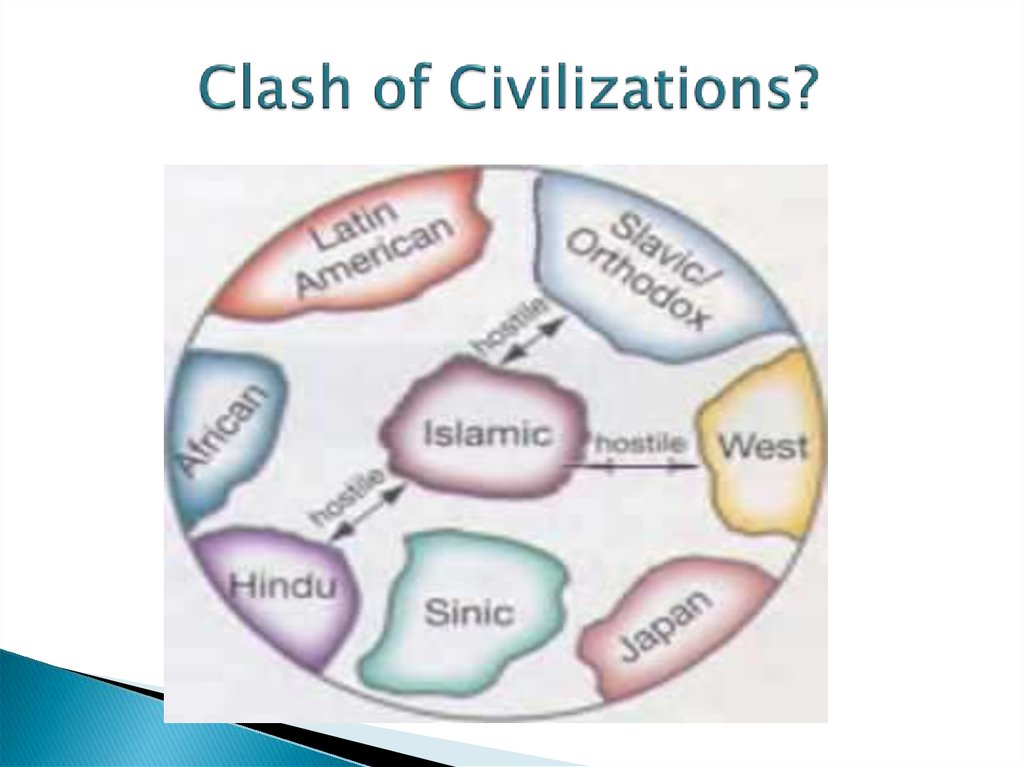
18. Clash of Civilizations?
19. ARE STATES HERE TO STAY?
One may hope that the emerginginternational system will be an improvement,
but its basic components are still sovereign
states, and they tend to trip up plans for a
peaceful, cooperative world. The concept of
the modern state, nation-state, or the
colloquial term "country" goes back about five
centuries, when important changes rippled
through West Europe.
20. CONCEPTS : THE STATE
States are generally defined as groups of humans having terntory andgovernment. This government, in turn, has the last word on law within
its borders (sovereignty, which we consider presently). Only the state
has a legitimate monopoly on coercion; that is, it can legally force
citizens to do something. The mafia, of course, can force you to repay
a debt, but it has no legal right to punish you. The Internal Revenue
Service, on the other hand, can legally send you to prison for
nonpayment of taxes.
Some use the term "nation-state," which adds the concept of nationality
to state. Members of a nation-state have a sense of identity as a
distinct people, often with their own language. Nation-states are fairly
modern creations, probably not more than half a millennium old.
International relations does not use "state" in the U.S. sense, such as
the "great state of Kansas." In IR, in fact, the 50 American states are
not states at all, because they lack sovereignty. They do not have the
last word on law within their borders; the federal government in
Washington does.
21. IS SOVEREIGNTY SLIPPING?
Sovereignty has always been partly fictional.Big, rich, and powerful countries routinely
influence and even dominate small, poor, and
weak countries. Lebanon, for example, lost its
sovereignty as it dissolved in civil war in
1975, its territory partitioned by politicoreligious militias and Syrian and Israeli
occupiers. Israel's pullout from the south of
Lebanon in 2000 scarcely helped, as the territory was occupied by Hezbollah fighters, not
by the Lebanese army.
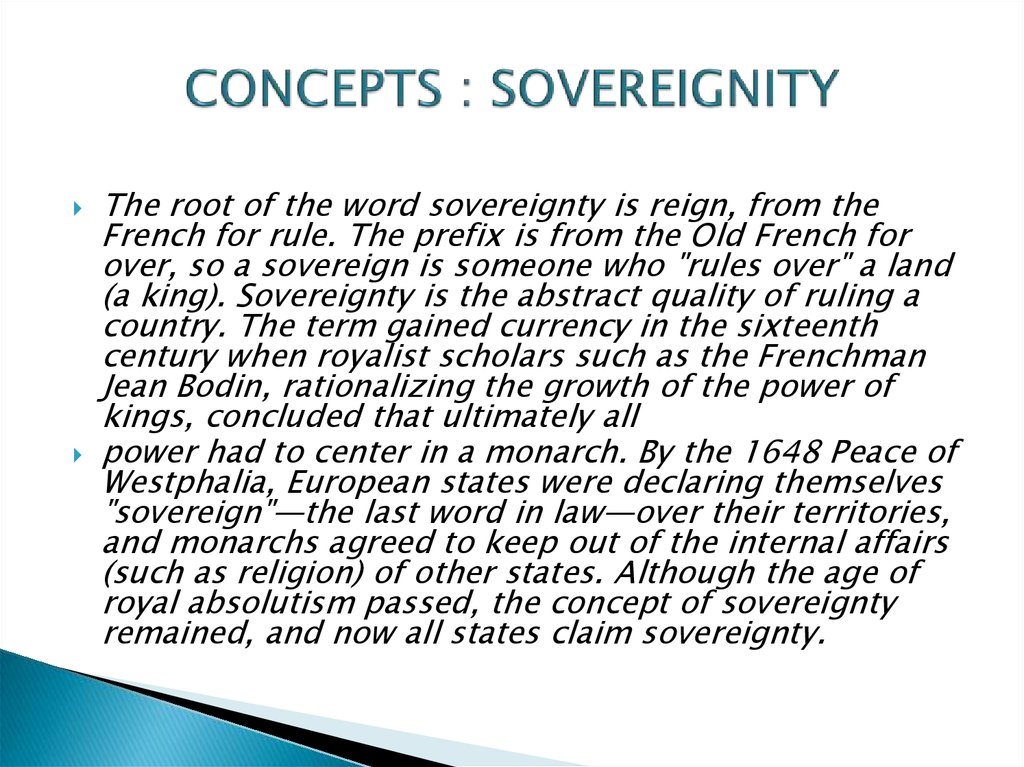
22. CONCEPTS : SOVEREIGNITY
The root of the word sovereignty is reign, from theFrench for rule. The prefix is from the Old French for
over, so a sovereign is someone who "rules over" a land
(a king). Sovereignty is the abstract quality of ruling a
country. The term gained currency in the sixteenth
century when royalist scholars such as the Frenchman
Jean Bodin, rationalizing the growth of the power of
kings, concluded that ultimately all
power had to center in a monarch. By the 1648 Peace of
Westphalia, European states were declaring themselves
"sovereign"—the last word in law—over their territories,
and monarchs agreed to keep out of the internal affairs
(such as religion) of other states. Although the age of
royal absolutism passed, the concept of sovereignty
remained, and now all states claim sovereignty.