


 Лингвистика
Похожие презентации:




Lexical Expressive Means and Stylistic Devices
1. Lexical Expressive Means and Stylistic Devices
2.
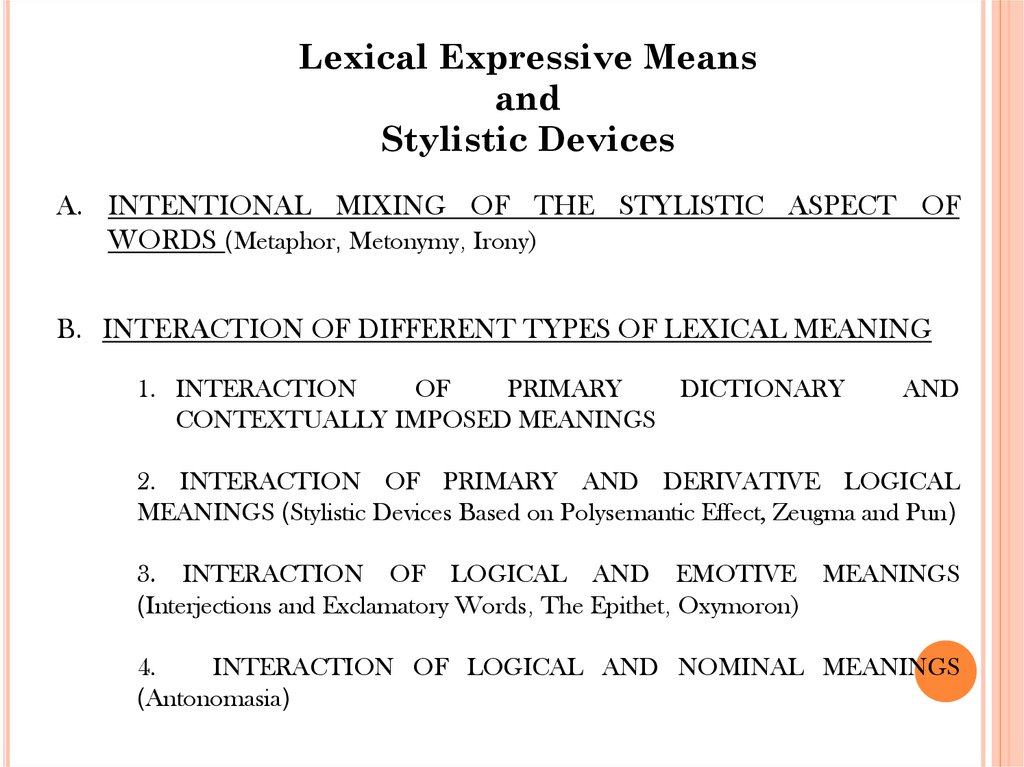
Lexical Expressive Meansand
Stylistic Devices
A. INTENTIONAL MIXING OF THE STYLISTIC ASPECT OF
WORDS (Metaphor, Metonymy, Irony)
B. INTERACTION OF DIFFERENT TYPES OF LEXICAL MEANING
1. INTERACTION
OF
PRIMARY
DICTIONARY
CONTEXTUALLY IMPOSED MEANINGS
AND
2. INTERACTION OF PRIMARY AND DERIVATIVE LOGICAL
MEANINGS (Stylistic Devices Based on Polysemantic Effect, Zeugma and Pun)
3. INTERACTION OF LOGICAL AND EMOTIVE MEANINGS
(Interjections and Exclamatory Words, The Epithet, Oxymoron)
4.
INTERACTION OF LOGICAL AND NOMINAL MEANINGS
(Antonomasia)
3.
A. INTENTIONAL MIXING OF THE STYLISTICASPECT OF WORDS
Heterogeneity of the component parts of the
utterance is the basis for a stylistic device called bathos.
Unrelated elements are brought together as if they
denoted things equal in rank or belonging to one class, as
if they were of the same stylistic aspect.
"Sooner shall heaven kiss earth— (here he fell sicker)
Whenever literary words come into collision with non-literary
ones there arises incongruity, which in any style is always
deliberate, inasmuch as a style presupposes a conscious
selection of language means.
4.
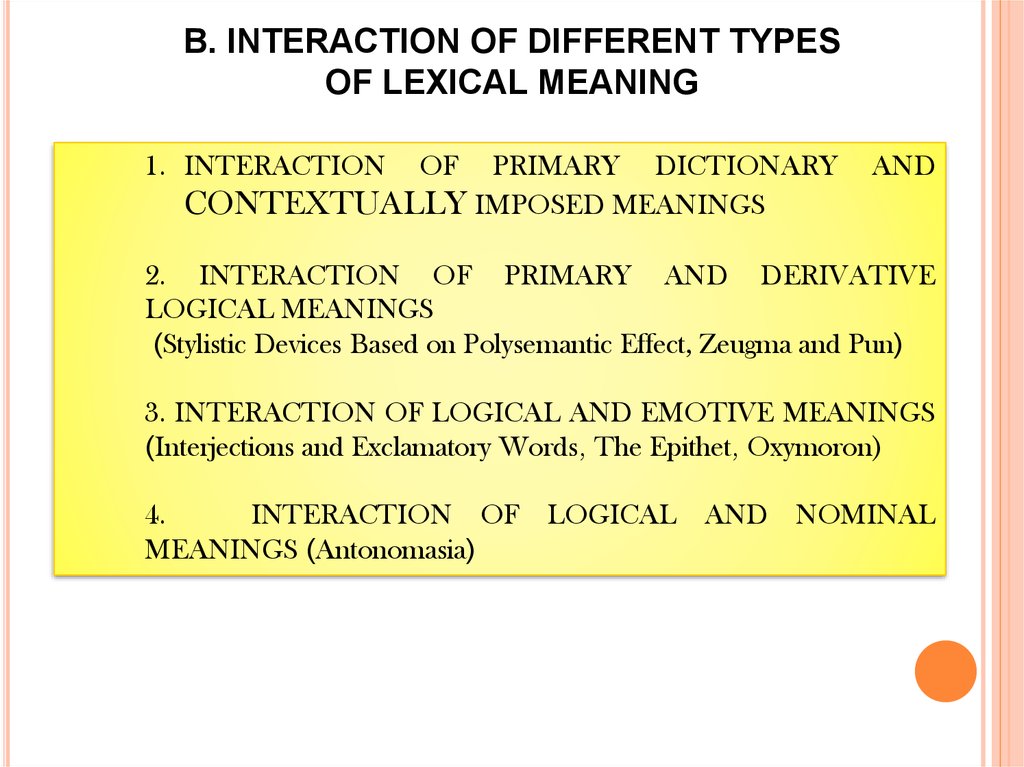
B. INTERACTION OF DIFFERENT TYPESOF LEXICAL MEANING
1. INTERACTION
OF
PRIMARY DICTIONARY
CONTEXTUALLY IMPOSED MEANINGS
AND
2. INTERACTION OF PRIMARY AND DERIVATIVE
LOGICAL MEANINGS
(Stylistic Devices Based on Polysemantic Effect, Zeugma and Pun)
3. INTERACTION OF LOGICAL AND EMOTIVE MEANINGS
(Interjections and Exclamatory Words, The Epithet, Oxymoron)
4.
INTERACTION OF LOGICAL AND NOMINAL
MEANINGS (Antonomasia)
5.
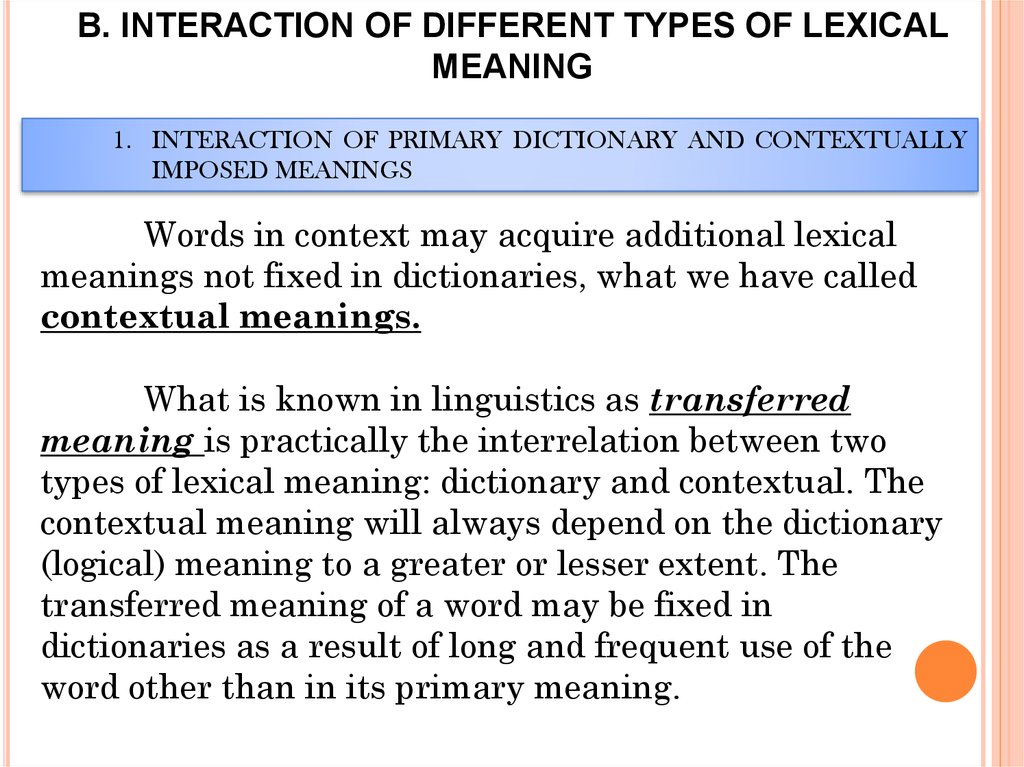
B. INTERACTION OF DIFFERENT TYPES OF LEXICALMEANING
1. INTERACTION OF PRIMARY DICTIONARY AND CONTEXTUALLY
IMPOSED MEANINGS
Words in context may acquire additional lexical
meanings not fixed in dictionaries, what we have called
contextual meanings.
What is known in linguistics as transferred
meaning is practically the interrelation between two
types of lexical meaning: dictionary and contextual. The
contextual meaning will always depend on the dictionary
(logical) meaning to a greater or lesser extent. The
transferred meaning of a word may be fixed in
dictionaries as a result of long and frequent use of the
word other than in its primary meaning.
6.
B. INTERACTION OF DIFFERENT TYPES OF LEXICALMEANING
1. INTERACTION OF PRIMARY DICTIONARY AND CONTEXTUALLY
IMPOSED MEANINGS
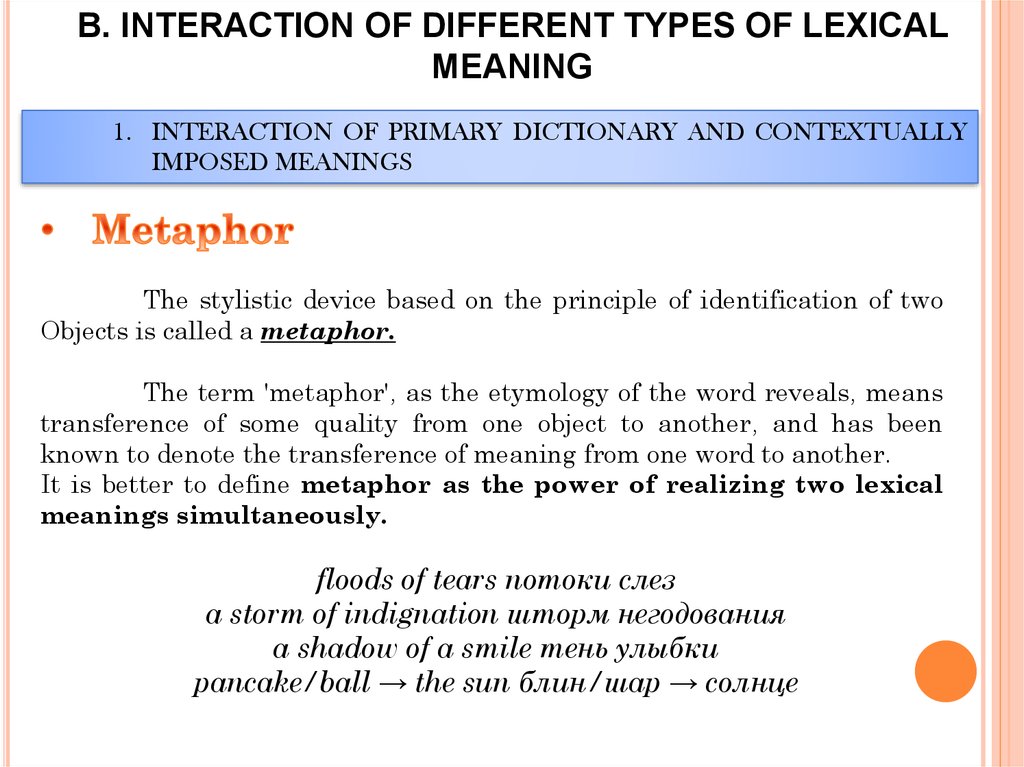
The stylistic device based on the principle of identification of two
Objects is called a metaphоr.
The term 'metaphor', as the etymology of the word reveals, means
transference of some quality from one object to another, and has been
known to denote the transference of meaning from one word to another.
It is better to define metaphor as the power of realizing two lexical
meanings simultaneously.
floods of tears потоки слез
a storm of indignation шторм негодования
a shadow of a smile тень улыбки
pancake/ball → the sun блин/шар → солнце
7.
B. INTERACTION OF DIFFERENT TYPES OF LEXICALMEANING
1. INTERACTION OF PRIMARY DICTIONARY AND CONTEXTUALLY
IMPOSED MEANINGS
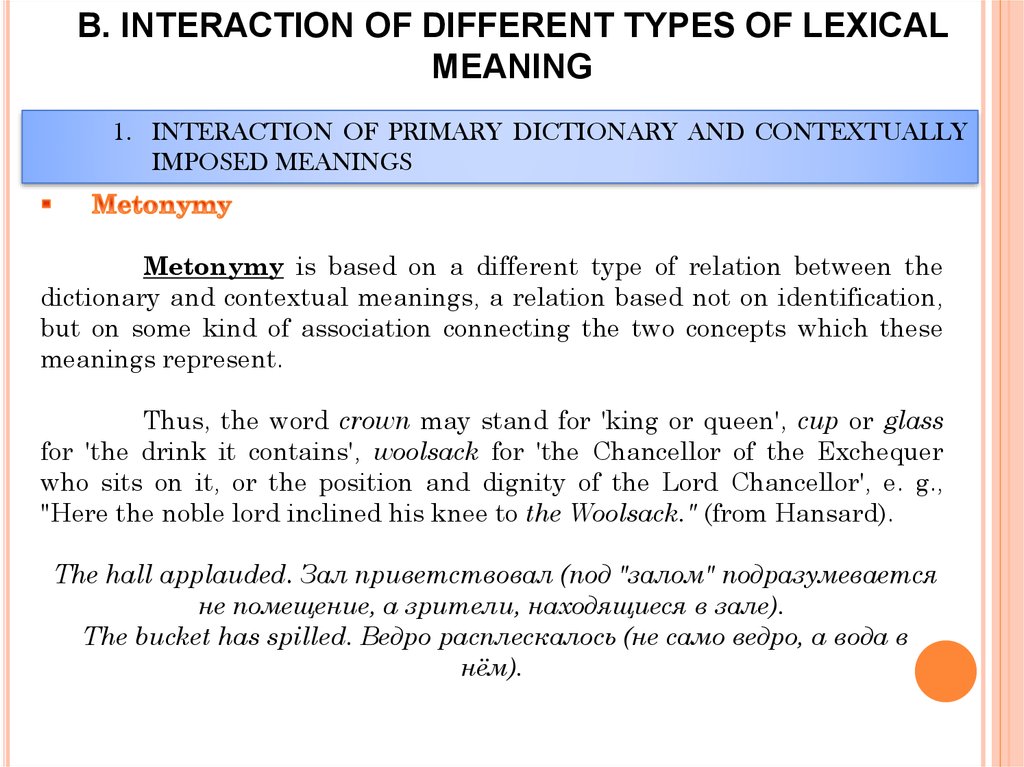
Metonymy is based on a different type of relation between the
dictionary and contextual meanings, a relation based not on identification,
but on some kind of association connecting the two concepts which these
meanings represent.
Thus, the word crown may stand for 'king or queen', cup or glass
for 'the drink it contains', woolsack for 'the Chancellor of the Exchequer
who sits on it, or the position and dignity of the Lord Chancellor', e. g.,
"Here the noble lord inclined his knee to the Woolsack." (from Hansard).
The hall applauded. Зал приветствовал (под "залом" подразумевается
не помещение, а зрители, находящиеся в зале).
The bucket has spilled. Ведро расплескалось (не само ведро, а вода в
нём).
8.
B. INTERACTION OF DIFFERENT TYPES OF LEXICALMEANING
1. INTERACTION OF PRIMARY DICTIONARY AND CONTEXTUALLY
IMPOSED MEANINGS
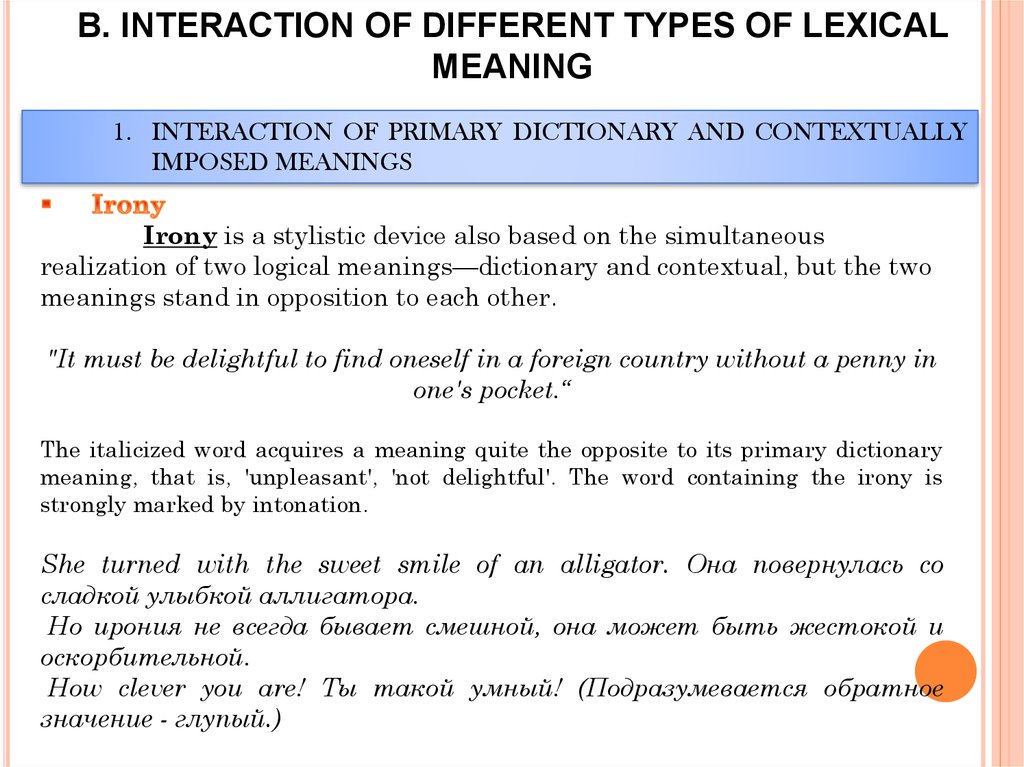
Irony is a stylistic device also based on the simultaneous
realization of two logical meanings—dictionary and contextual, but the two
meanings stand in opposition to each other.
"It must be delightful to find oneself in a foreign country without a penny in
one's pocket.“
The italicized word acquires a meaning quite the opposite to its primary dictionary
meaning, that is, 'unpleasant', 'not delightful'. The word containing the irony is
strongly marked by intonation.
She turned with the sweet smile of an alligator. Она повернулась со
сладкой улыбкой аллигатора.
Но ирония не всегда бывает смешной, она может быть жестокой и
оскорбительной.
How clever you are! Ты такой умный! (Подразумевается обратное
значение - глупый.)
9.
B. INTERACTION OF DIFFERENT TYPES OF LEXICALMEANING
2. INTERACTION OF PRIMARY AND DERIVATIVE LOGICAL
MEANINGS
Polysemy is a category of lexicology and as such belongs to
language-as-a-system. In actual everyday speech polysemy vanishes
unless it is deliberately retained for certain stylistic purposes. A
context that does not seek to produce any particular stylistic effect
generally materializes but one definite meaning.
"Then hate me if thou wilt, if ever now.
Now while the world is bent my deeds to cross."
The word 'hate' materializes several meanings in this context.
10.
B. INTERACTION OF DIFFERENT TYPES OF LEXICALMEANING
2. INTERACTION OF PRIMARY AND DERIVATIVE LOGICAL
MEANINGS
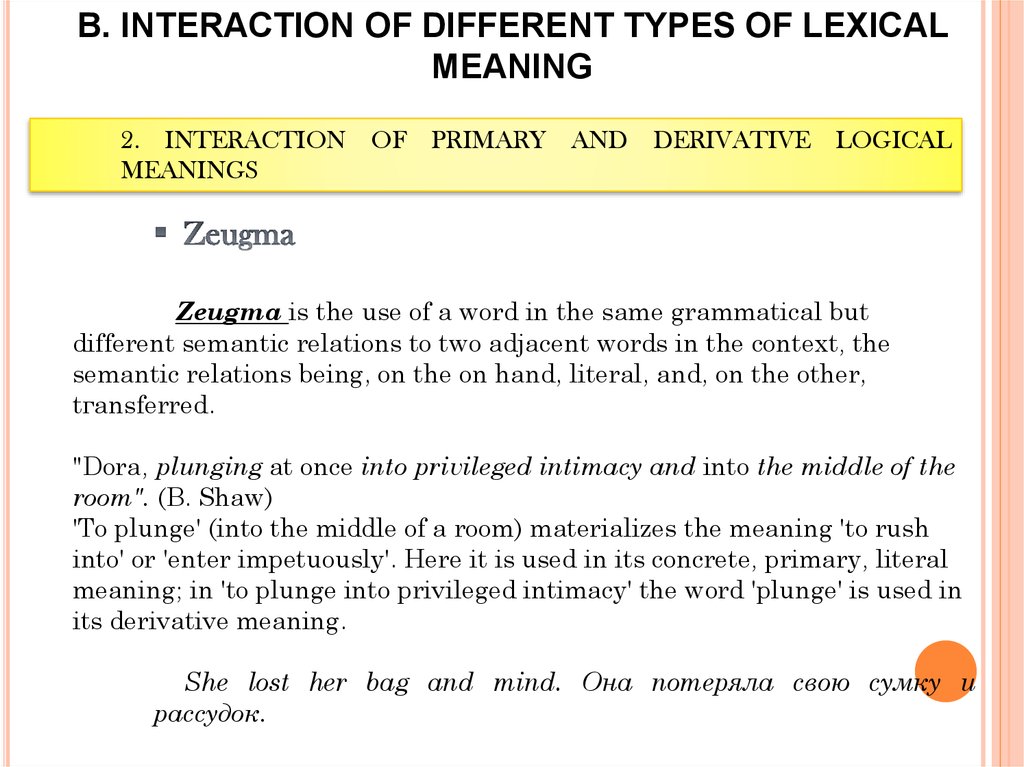
Zeugma is the use of a word in the same grammatical but
different semantic relations to two adjacent words in the context, the
semantic relations being, on the on hand, literal, and, on the other,
tгаnsferred.
"Dora, plunging at once into privileged intimacy and into the middle of the
room". (B. Shaw)
'To plunge' (into the middle of a room) materializes the meaning 'to rush
into' or 'enter impetuously'. Here it is used in its concrete, primary, literal
meaning; in 'to plunge into privileged intimacy' the word 'plunge' is used in
its derivative meaning.
She lost her bag and mind. Она потеряла свою сумку и
рассудок.
11.
B. INTERACTION OF DIFFERENT TYPES OF LEXICALMEANING
2. INTERACTION OF PRIMARY AND DERIVATIVE LOGICAL
MEANINGS
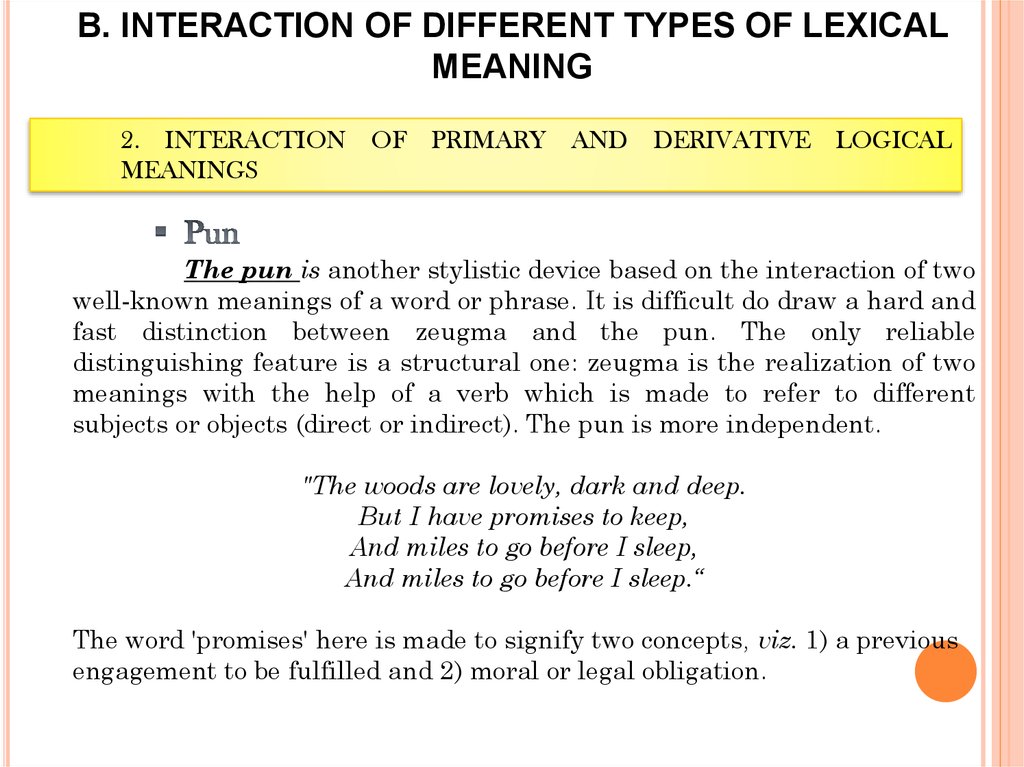
The pиn is another stylistic device based on the interaction of two
well-known meanings of a word or phrase. It is difficult do draw a hard and
fast distinction between zeugma and the pun. The only reliable
distinguishing feature is a structural one: zeugma is the realization of two
meanings with the help of a verb which is made to refer to different
subjects or objects (direct or indirect). The pun is more independent.
"The woods are lovely, dark and deep.
But I have promises to keep,
And miles to go before I sleep,
And miles to go before I sleep.“
The word 'promises' here is made to signify two concepts, viz. 1) a previous
engagement to be fulfilled and 2) moral or legal obligation.
12.
B. INTERACTION OF DIFFERENT TYPES OF LEXICALMEANING
3. INTERACTION OF LOGICAL AND EMOTIVE MEANINGS
Interjections and Exclamatory Words
Interjections are words we use when we express our feelings strongly
and which may be said to exist in language as conventional symbols of
human emotions. The role of interjections in creating emotive meanings has
already been dealt with. It remains only to show how the logical and
emotive meanings interact and to ascertain their general functions and
spheres of application.
Oh, where are you going to, all you Big Steamers? (Kipling)
The interjection oh by itself may express various feelings, such as regret,
despair, disappointment, sorrow, woe, surprise, astonishment, lamentation,
entreaty and many others. Here it precedes a definite sentence and must be
regarded as a part of it. It denotes the ardent tone of the question.
13.
B. INTERACTION OF DIFFERENT TYPES OF LEXICALMEANING
3. INTERACTION OF LOGICAL AND EMOTIVE MEANINGS
The Epithet
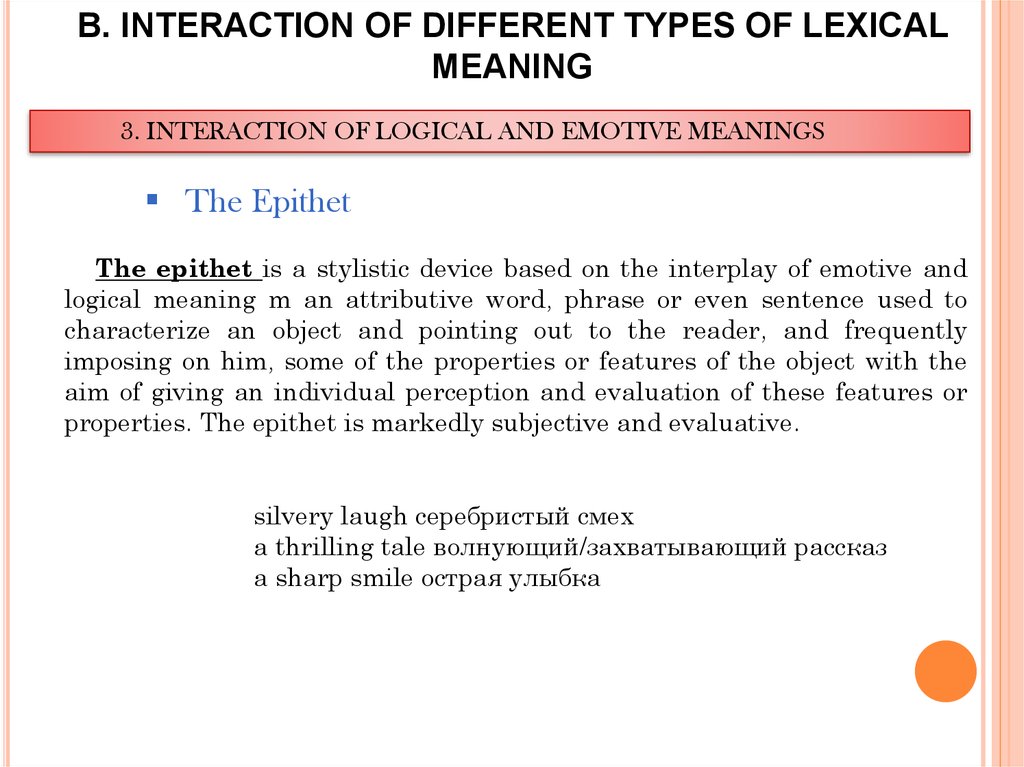
The epithet is a stylistic device based on the interplay of emotive and
logical meaning m an attributive word, phrase or even sentence used to
characterize an object and pointing out to the reader, and frequently
imposing on him, some of the properties or features of the object with the
aim of giving an individual perception and evaluation of these features or
properties. The epithet is markedly subjective and evaluative.
silvery laugh серебристый смех
a thrilling tale волнующий/захватывающий рассказ
a sharp smile острая улыбка
14.
B. INTERACTION OF DIFFERENT TYPES OF LEXICALMEANING
3. INTERACTION OF LOGICAL AND EMOTIVE MEANINGS
Oxymoron
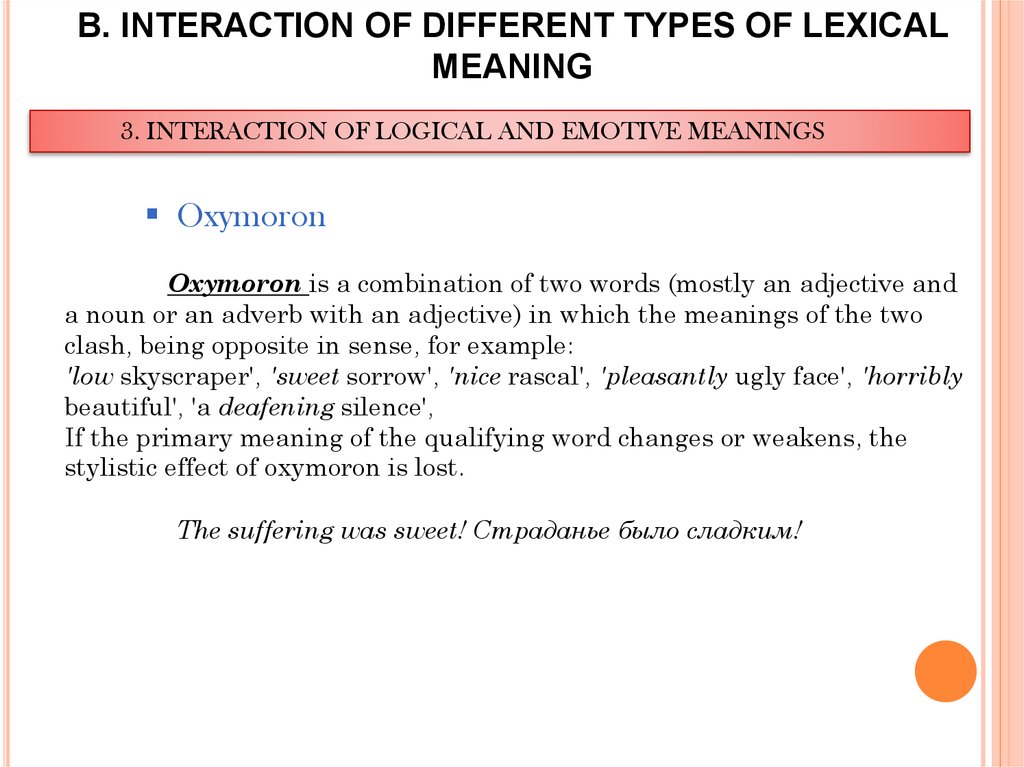
Oxymoron is a combination of two words (mostly an adjective and
a noun or an adverb with an adjective) in which the meanings of the two
clash, being opposite in sense, for example:
'low skyscraper', 'sweet sorrow', 'nice rascal', 'pleasantly ugly face', 'horribly
beautiful', 'a deafening silence',
If the primary meaning of the qualifying word changes or weakens, the
stylistic effect of oxymoron is lost.
The suffering was sweet! Страданье было сладким!
15.
B. INTERACTION OF DIFFERENT TYPES OF LEXICALMEANING
4. INTERACTION OF LOGICAL AND NOMINAL MEANINGS
Antonomasia
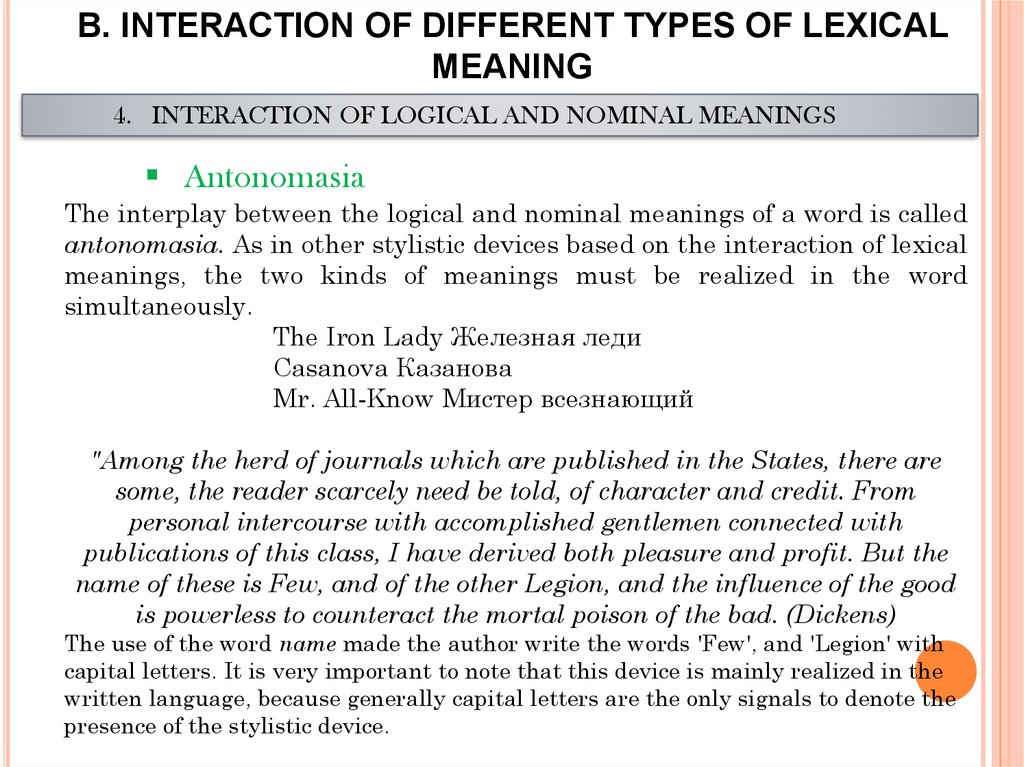
The interplay between the logical and nominal meanings of a word is called
antоnomasia. As in other stylistic devices based on the interaction of lexical
meanings, the two kinds of meanings must be realized in the word
simultaneously.
The Iron Lady Железная леди
Casanova Казанова
Mr. All-Know Мистер всезнающий
"Among the herd of journals which are published in the States, there are
some, the reader scarcely need be told, of character and credit. From
personal intercourse with accomplished gentlemen connected with
publications of this class, I have derived both pleasure and profit. But the
name of these is Few, and of the other Legion, and the influence of the good
is powerless to counteract the mortal poison of the bad. (Dickens)
The use of the word name made the author write the words 'Few', and 'Legion' with
capital letters. It is very important to note that this device is mainly realized in the
written language, because generally capital letters are the only signals to denote the
presence of the stylistic device.