

 Английский язык
Похожие презентации:





Typology of Grammatical Categories
1.
Typology of GrammaticalCategories
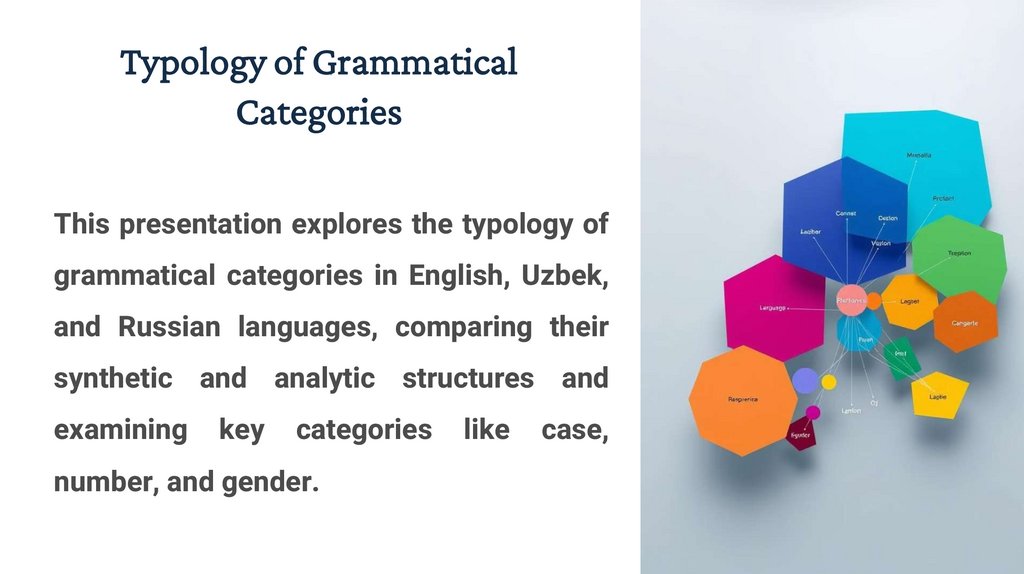
This presentation explores the typology of
grammatical categories in English, Uzbek,
and Russian languages, comparing their
synthetic and analytic structures and
examining
key
categories
number, and gender.
like
case,
2.
Plan of the lecture:Synthetic and analytic structure of languages
Typology of grammatical categories in the English and
native languages
Typology of some grammatical categories
3.
Synthetic and analytic structure of languages. The problem of syntheticand analytic structure of languages can be analyzed in various ways:
1. according to the morphology of languages;
2. according to syntactical relations;
3. according to the classification of grammatical means.
All grammatical means are divided into two types:
1. Grammatical means expressing grammatical meanings within words;
2. Grammatical means expressing grammatical meanings outside
words.
4.
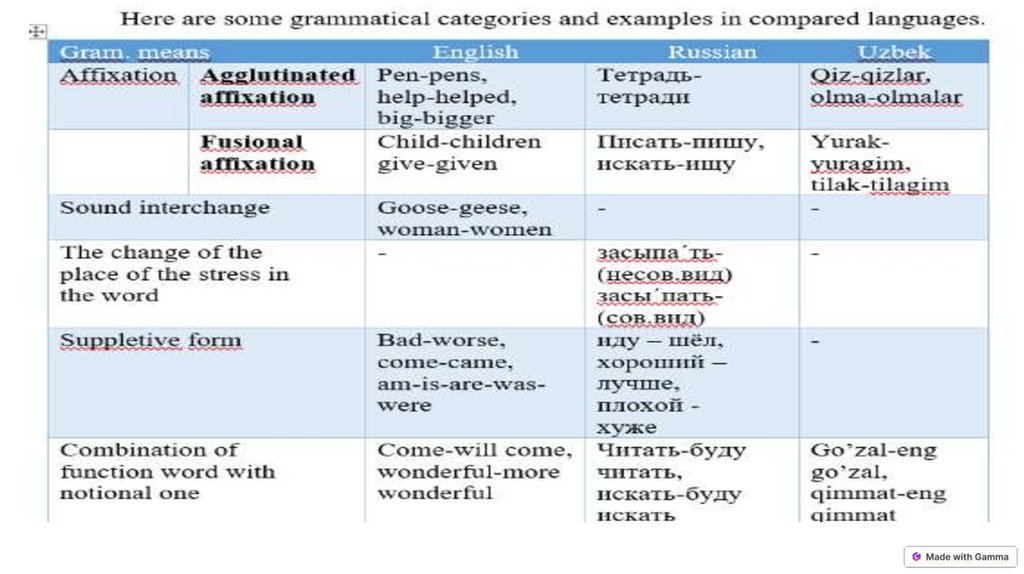
1. Inner fusion, outer fusion, affixation followed by flexion, the change of the placeof the stress in the word (засыпа’ть – несов. вид, засы’пать. – сов. вид), suppletive
forms (go-went; good-better, bad-worse). These are grammatical means expressing
grammatical meanings inside words and they are called synthetic forms.
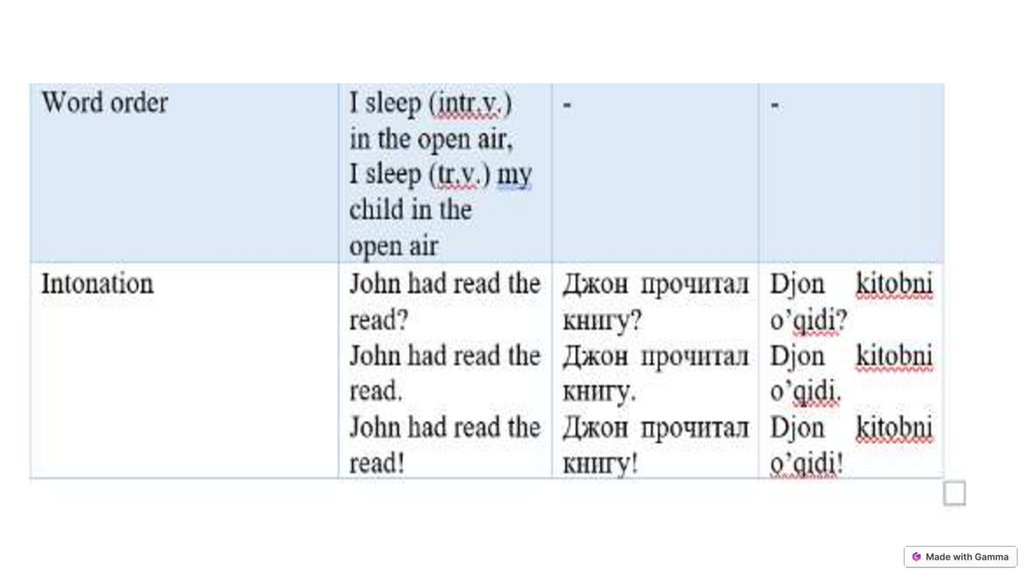
2. Combination of function (auxiliary) words with the notional ones, the order of
words in the sentence, intonation, repetition (orang-orang: человек – люди in the
Indonesian language). These are grammatical means expressing grammatical
meanings outside words, they are called analytic forms.
5.
Synthetic vs. Analytic StructureSynthetic Languages
Grammatical meanings are expressed within words using
inflections, affixes, and other internal changes.
Examples include: child-children, keep-kept, breakbroken, rise-risen.
Analytic Languages
Grammatical meanings are expressed outside words
using function words, word order, and intonation.
Examples include: I go – I shall go, beautiful – the most
beautiful.
6.
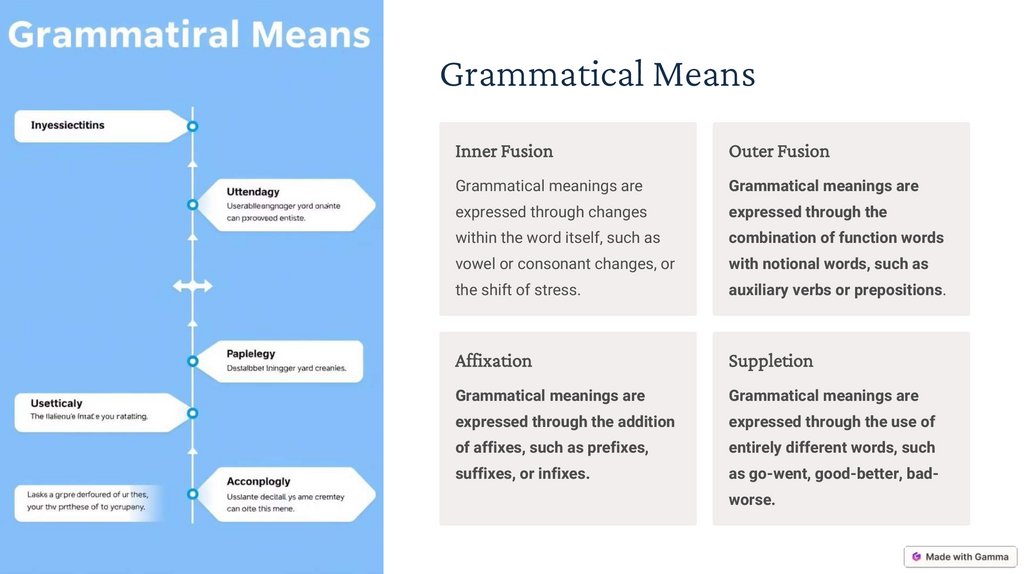
Grammatical MeansInner Fusion
Outer Fusion
Grammatical meanings are
Grammatical meanings are
expressed through changes
expressed through the
within the word itself, such as
combination of function words
vowel or consonant changes, or
with notional words, such as
the shift of stress.
auxiliary verbs or prepositions.
Affixation
Suppletion
Grammatical meanings are
Grammatical meanings are
expressed through the addition
expressed through the use of
of affixes, such as prefixes,
entirely different words, such
suffixes, or infixes.
as go-went, good-better, badworse.
7.
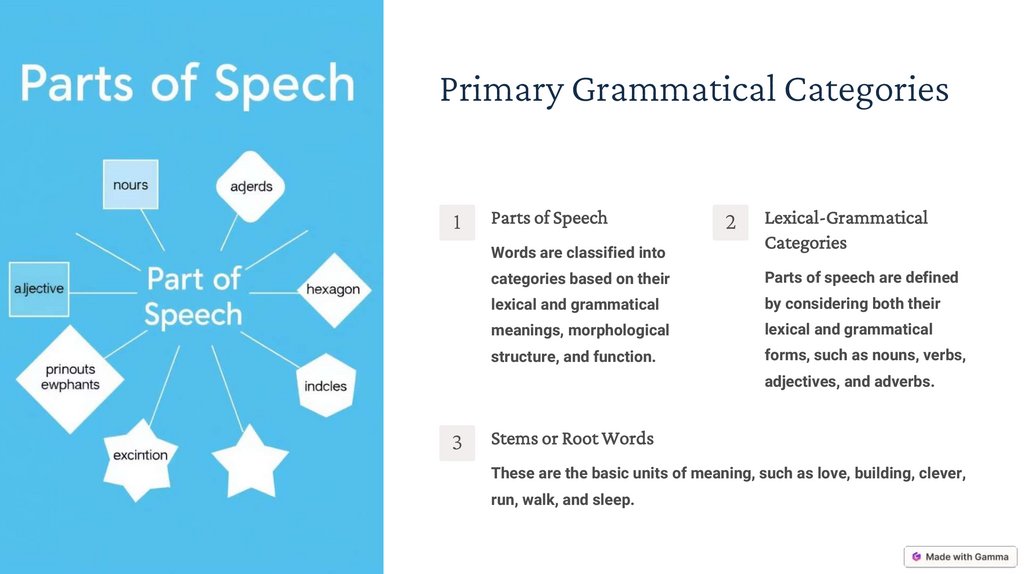
Primary Grammatical Categories1
Parts of Speech
Words are classified into
2
Lexical-Grammatical
Categories
categories based on their
Parts of speech are defined
lexical and grammatical
by considering both their
meanings, morphological
lexical and grammatical
structure, and function.
forms, such as nouns, verbs,
adjectives, and adverbs.
3
Stems or Root Words
These are the basic units of meaning, such as love, building, clever,
run, walk, and sleep.
8.
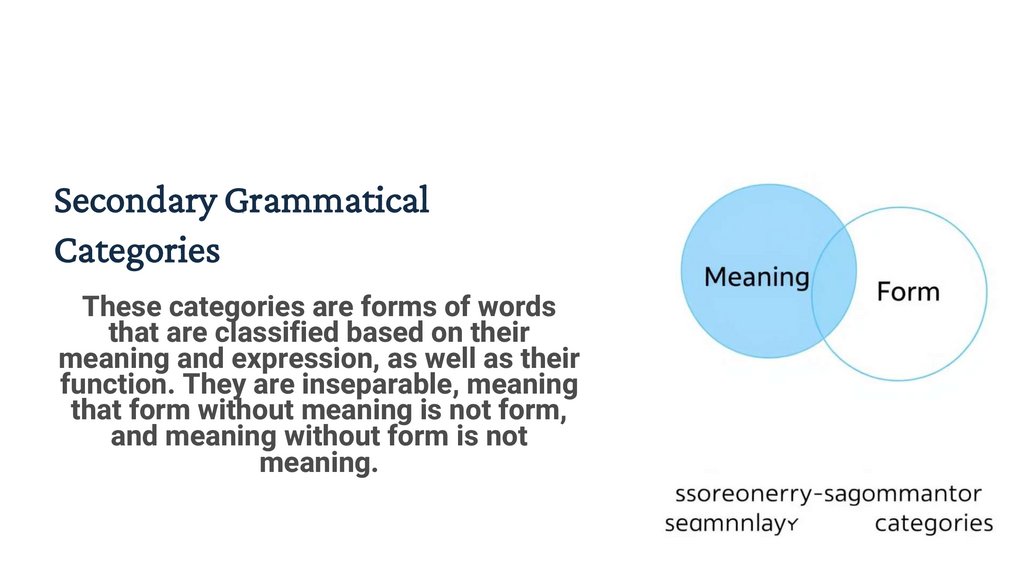
Secondary GrammaticalCategories
These categories are forms of words
that are classified based on their
meaning and expression, as well as their
function. They are inseparable, meaning
that form without meaning is not form,
and meaning without form is not
meaning.
9.
10.
11.
Typological category of case of nounsUnder the category of case we understand the meaning denoting
relation between objects, actions, signs and means of their material
expression. This category is formed by case forms consisted of sound
combination or a sound giving concrete meaning to the word it is united
with.
12.
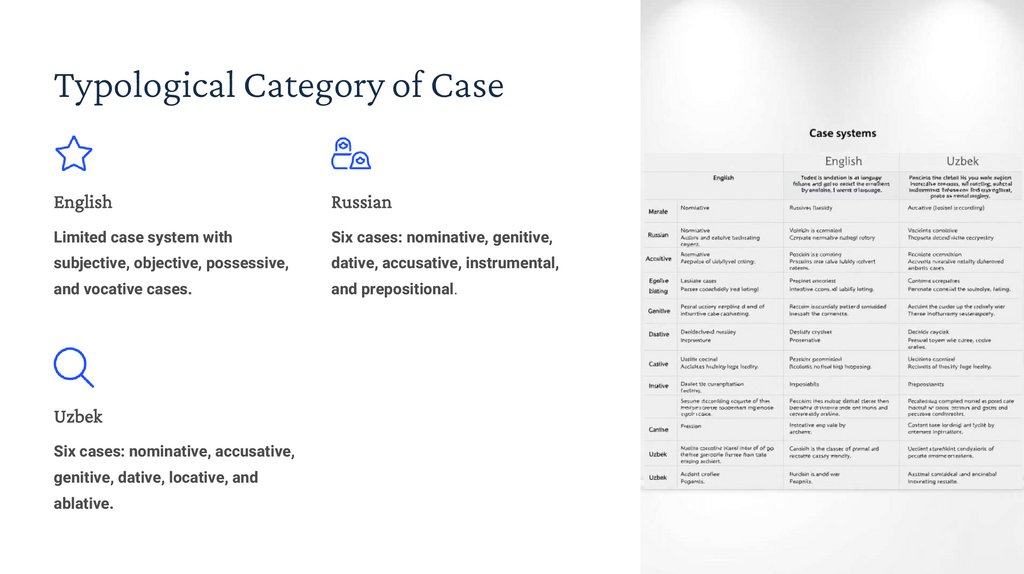
Typological Category of CaseEnglish
Russian
Limited case system with
Six cases: nominative, genitive,
subjective, objective, possessive,
dative, accusative, instrumental,
and vocative cases.
and prepositional.
Uzbek
Six cases: nominative, accusative,
genitive, dative, locative, and
ablative.
13.
The category of case of nouns in Uzbek corresponds only to thefirst characteristic in Russian that is the meaning of objectness. It
doesn't possess 2nd, 3rd, 4th characteristics. Because case forms
in Uzbek are monosemantic, case forms in Russian are
polysemantic. There is a typological similarity between the Uzbek
and English languages, as English case forms: common case and
genitive case are monosemantic too.
14.
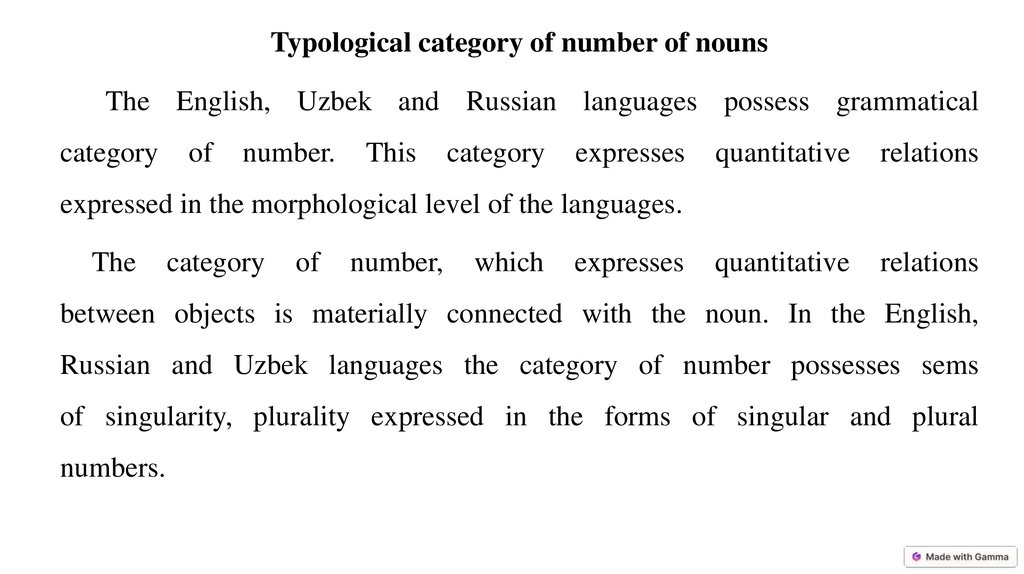
Typological category of number of nounsThe English, Uzbek and Russian languages possess grammatical
category
of
number.
This
category
expresses
quantitative
relations
quantitative
relations
expressed in the morphological level of the languages.
The
category
of
number,
which
expresses
between objects is materially connected with the noun. In the English,
Russian and Uzbek languages the category of number possesses sems
of singularity, plurality expressed in the forms of singular and plural
numbers.
15.
Typological Category of Number1
Singularity
Expressed by the zero morpheme in English and
Uzbek, and by case forms in Russian.
2
Plurality
Expressed by special morphemes in English and
Uzbek, and by various morphemes in Russian.
16.
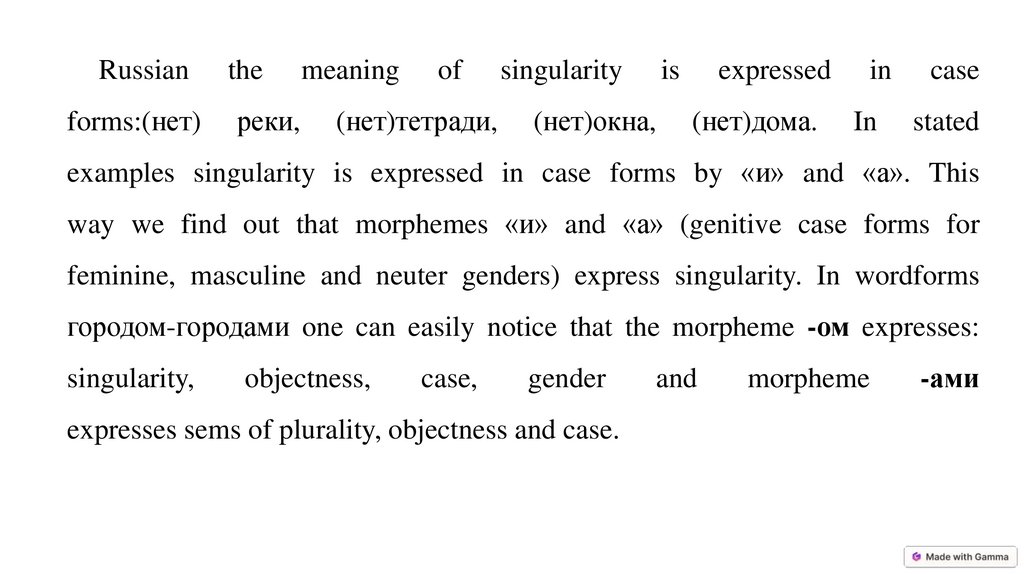
Russianforms:(нет)
the
реки,
meaning
of
(нет)тетради,
singularity
is
(нет)окна,
expressed
in
case
(нет)дома.
In
stated
examples singularity is expressed in case forms by «и» and «a». This
way we find out that morphemes «и» and «a» (genitive case forms for
feminine, masculine and neuter genders) express singularity. In wordforms
городом-городами one can easily notice that the morpheme -ом expresses:
singularity,
objectness,
case,
gender
expresses sems of plurality, objectness and case.
and
morpheme
-ами
17.
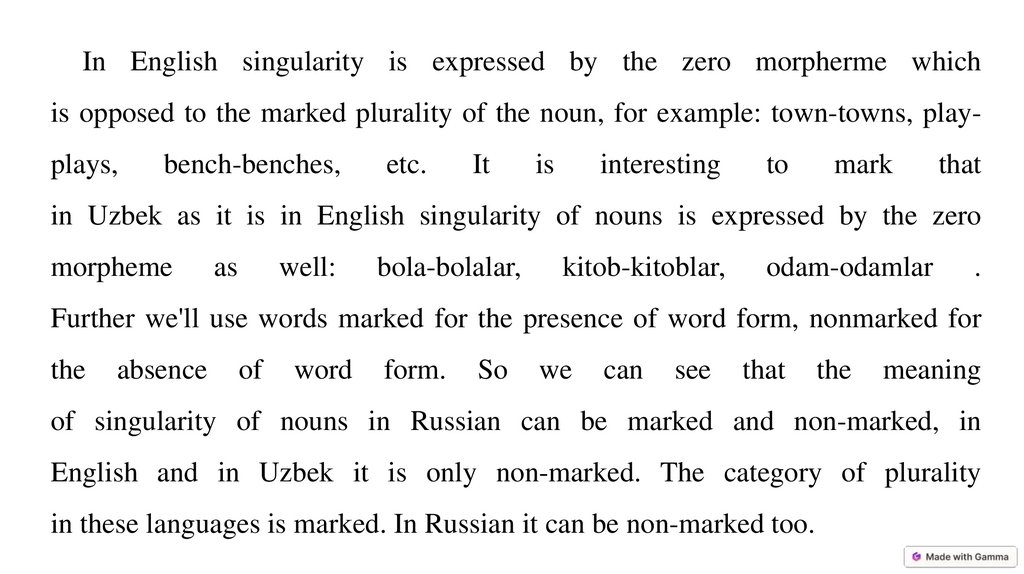
In English singularity is expressed by the zero morpherme whichis opposed to the marked plurality of the noun, for example: town-towns, play-
plays,
bench-benches,
etc.
It
is
interesting
to
mark
that
in Uzbek as it is in English singularity of nouns is expressed by the zero
morpheme
as
well:
bola-bolalar,
kitob-kitoblar,
odam-odamlar
.
Further we'll use words marked for the presence of word form, nonmarked for
the
absence
of
word
form.
So
we
can
see
that
the
meaning
of singularity of nouns in Russian can be marked and non-marked, in
English and in Uzbek it is only non-marked. The category of plurality
in these languages is marked. In Russian it can be non-marked too.
18.
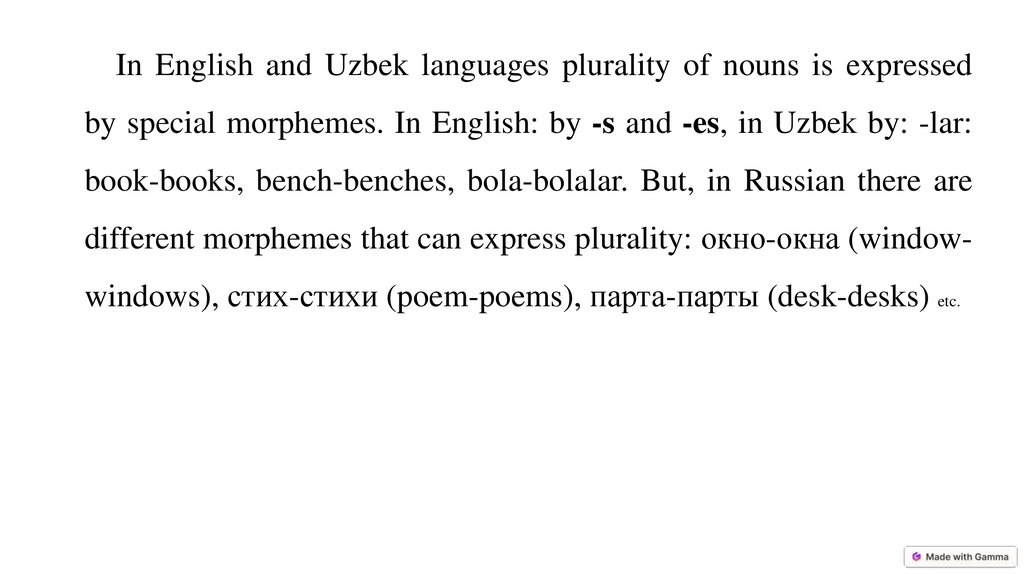
In English and Uzbek languages plurality of nouns is expressedby special morphemes. In English: by -s and -es, in Uzbek by: -lar:
book-books, bench-benches, bola-bolalar. But, in Russian there are
different morphemes that can express plurality: окно-окна (window-
windows), стих-стихи (poem-poems), парта-парты (desk-desks) etc.
19.
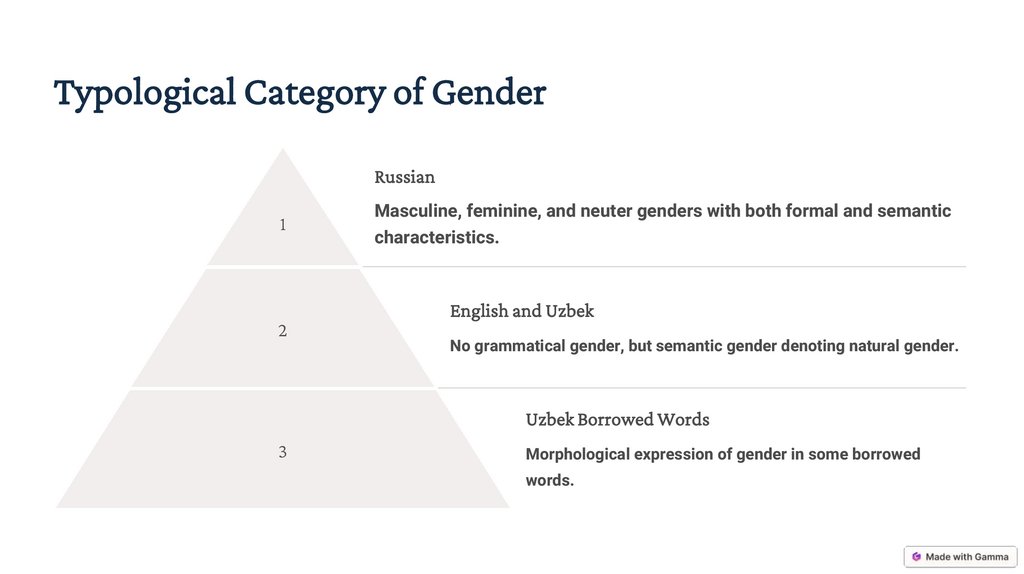
Typological Category of GenderRussian
1
2
Masculine, feminine, and neuter genders with both formal and semantic
characteristics.
English and Uzbek
No grammatical gender, but semantic gender denoting natural gender.
Uzbek Borrowed Words
3
Morphological expression of gender in some borrowed
words.
20.
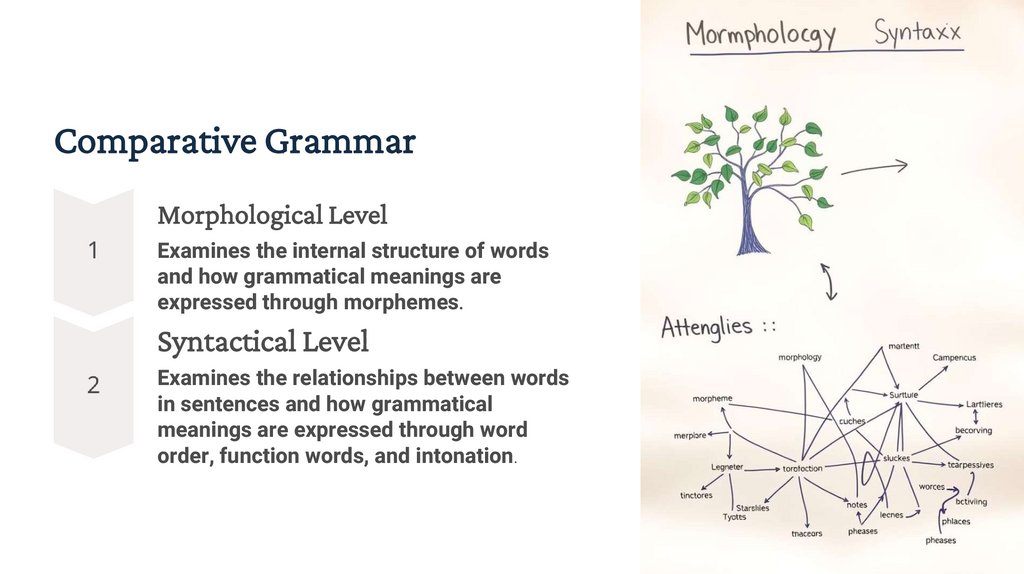
Comparative GrammarMorphological Level
Examines the internal structure of words
and how grammatical meanings are
expressed through morphemes.
Syntactical Level
Examines the relationships between words
in sentences and how grammatical
meanings are expressed through word
order, function words, and intonation.
21.
Key Takeaways1
2
Language Diversity
Typological Analysis
Languages exhibit a wide range of
Comparing languages helps us
grammatical categories and structures.
understand the similarities and
differences in their grammatical
systems.
3
Cross-Linguistic Insights
Studying grammatical categories across
languages provides valuable insights
into the nature of language and human
cognition.