
 Право
ПравоПохожие презентации:




Forensic pathology. Structure
1.
FORENSICPATHOLOGY
Completed by Larionova Z.O.
Student of O.E. Kutafin University (MSAL) of the Institute of Forensic
Examinations
2.
Structure1. Introduction
2. Vocabulary
3. Definition of forensic pathology
4. Medicolegal Investigative System
5. Forensic pathology in Switzerland
6. Types of the death
7. Times of the death
8. Conclusion
3.
IntroductionDetection of types, methods and causes of death is impossible for
ordinary people. People die every day and not always may determine
is that a murder or a natural death. For fixing that position was
developed certain branch of forensic science- forensic pathology.
This article will be reveal most important themes as a place of
forensic pathology in our modern world, causes of death, types of
death and other branches of forensic science which connected with
forensic pathology.
4.
Vocabulary01
legal framework
04
medicolegal
investigative system
02
forensic pathology
05
medical examiner
03
forensic medicine
06
diseases and injuries
5.
Definition of forensic pathologyForensic pathology
is the branch of medicine that applies the
principles and knowledge of the medical
sciences to the many legal issues within the
field of law.
6.
The medical examiner is responsible for determining the cause and mannerof death, identifying the deceased if unknown, determining the approximate
time of death and injury, collecting evidence from the body that can be used
to prove or disprove an individual's guilt or innocence and to confirm or deny
the account of how the death occurred, documenting injuries or lack of
them, documenting any natural disease present and so one in official
autopsy report e.t.c.
7.
Definition of a medical examinerA medical
examiner
is a licensed physician who is appointed or
elected to investigate deaths within a
particular jurisdiction.
8.
Medicolegal Investigative SystemThe major duties of a medicolegal system in handling deaths falling under
its jurisdiction are:
● to determine the cause and manner of death
● to identify the deceased if unknown
● to determine the time of death and injury
● to collect evidence from the body that can be used to prove or disprove
an individual's guilt or innocence
● to document injuries or lack of them
● to deduce how the injuries occurred
● to provide expert testimony if the case goes to trial and so one.
9.
Forensic pathology in SwitzerlandThen we discuss what level of education people need for becoming a
forensic pathology in Switzerland. To become a forensic pathologist you
must obtain the federal doctor's diploma (6 years of medical studies), as
well as experience required by the Swiss Medical Association (FMH) for
training as a specialist in legal medicine (mainly autopsies, clinical
examinations and expert evaluations) . This specialization lasts 5 years,
of which four are spent in an approved legal medicine training
establishment.
10.
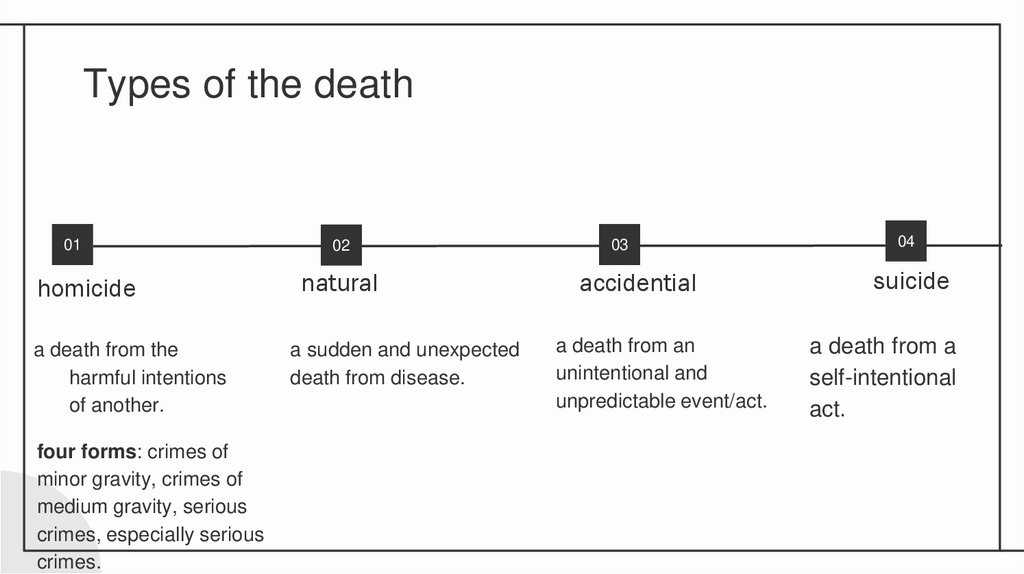
Types of the death01
02
homicide
natural
a death from the
harmful intentions
of another.
a sudden and unexpected
death from disease.
four forms: crimes of
minor gravity, crimes of
medium gravity, serious
crimes, especially serious
crimes.
03
accidential
a death from an
unintentional and
unpredictable event/act.
04
suicide
a death from a
self-intentional
act.
11.
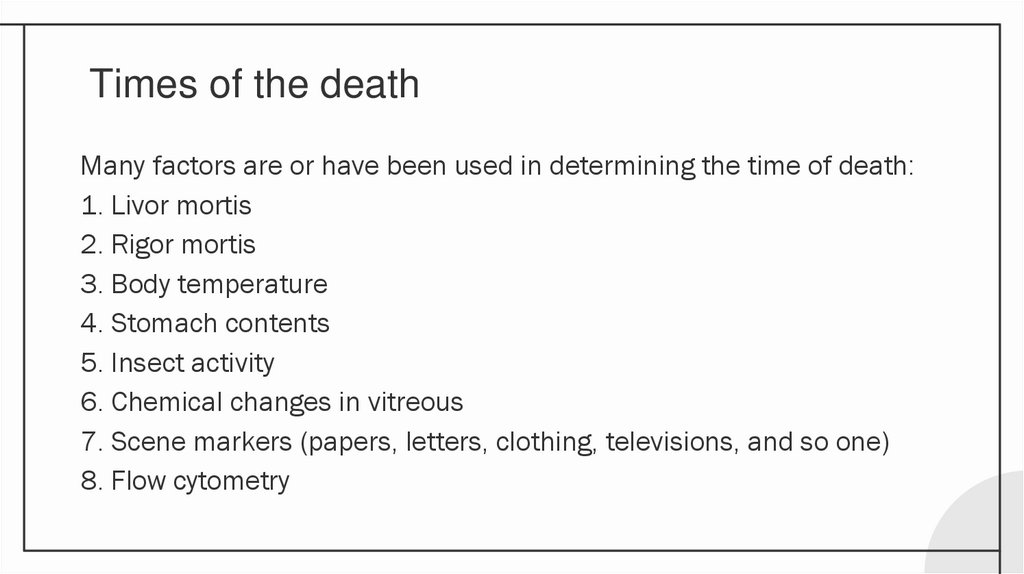
Times of the deathMany factors are or have been used in determining the time of death:
1. Livor mortis
2. Rigor mortis
3. Body temperature
4. Stomach contents
5. Insect activity
6. Chemical changes in vitreous
7. Scene markers (papers, letters, clothing, televisions, and so one)
8. Flow cytometry