 Биология
Похожие презентации:


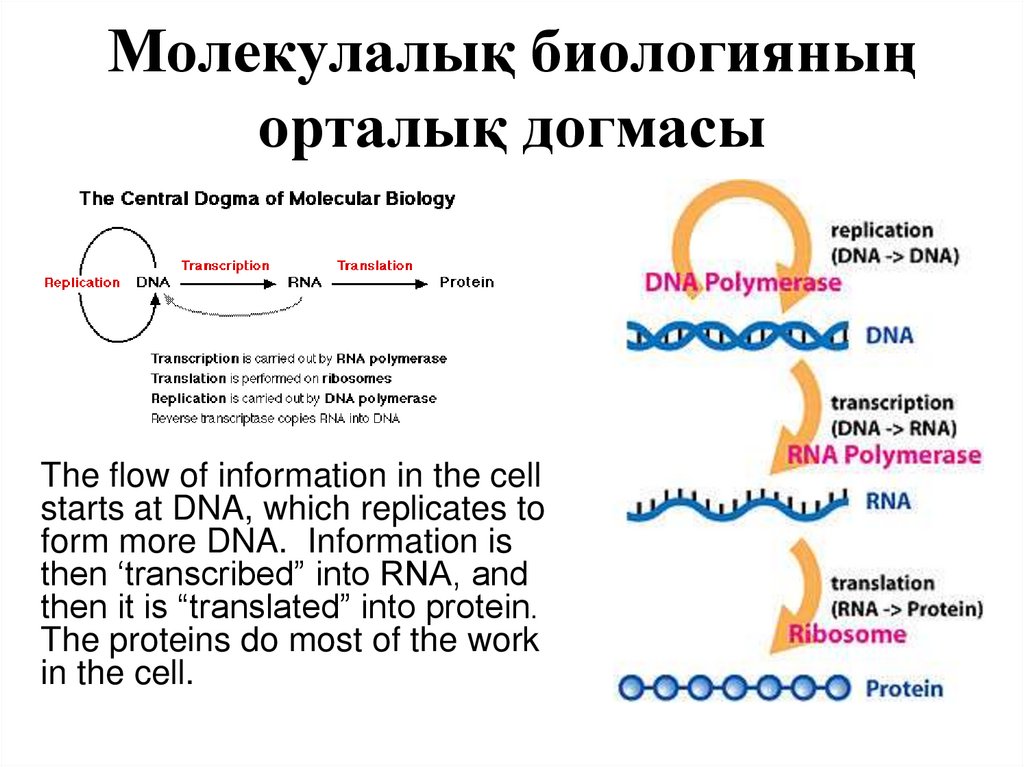
Молекулалық биологияның орталық догмасы
1. Молекулалық биологияның орталық догмасы
The flow of information in the cellstarts at DNA, which replicates to
form more DNA. Information is
then ‘transcribed” into RNA, and
then it is “translated” into protein.
The proteins do most of the work
in the cell.
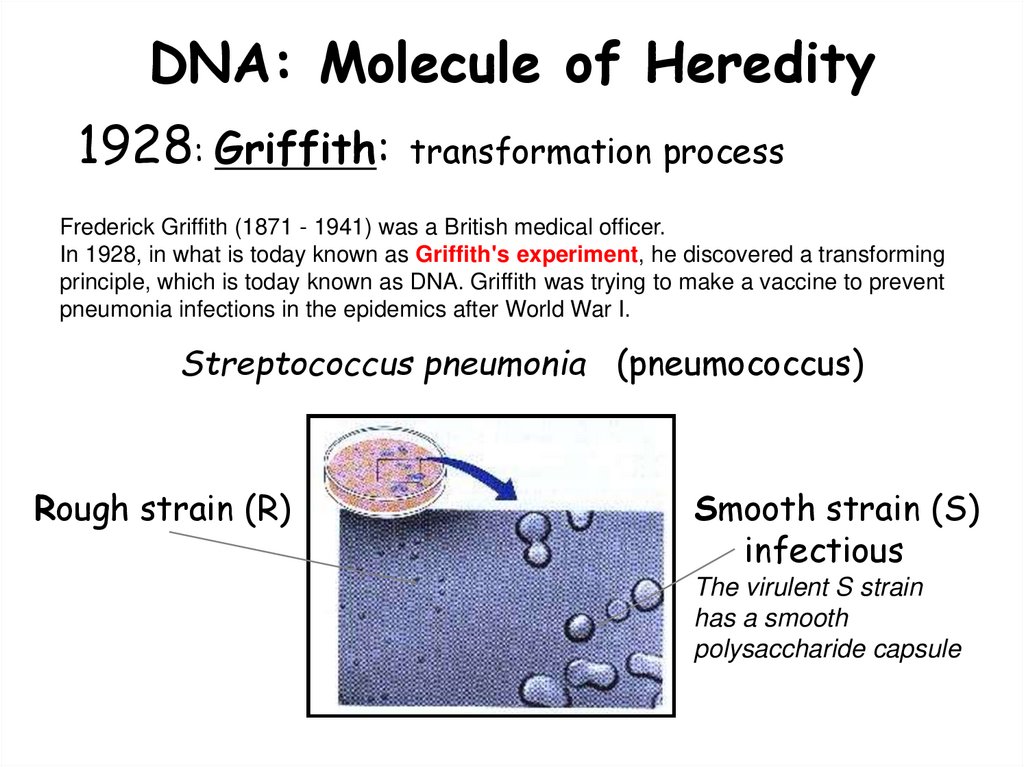
2. DNA: Molecule of Heredity
1928: Griffith: transformation processFrederick Griffith (1871 - 1941) was a British medical officer.
In 1928, in what is today known as Griffith's experiment, he discovered a transforming
principle, which is today known as DNA. Griffith was trying to make a vaccine to prevent
pneumonia infections in the epidemics after World War I.
Streptococcus pneumonia (pneumococcus)
Rough strain (R)
Smooth strain (S)
infectious
The virulent S strain
has a smooth
polysaccharide capsule
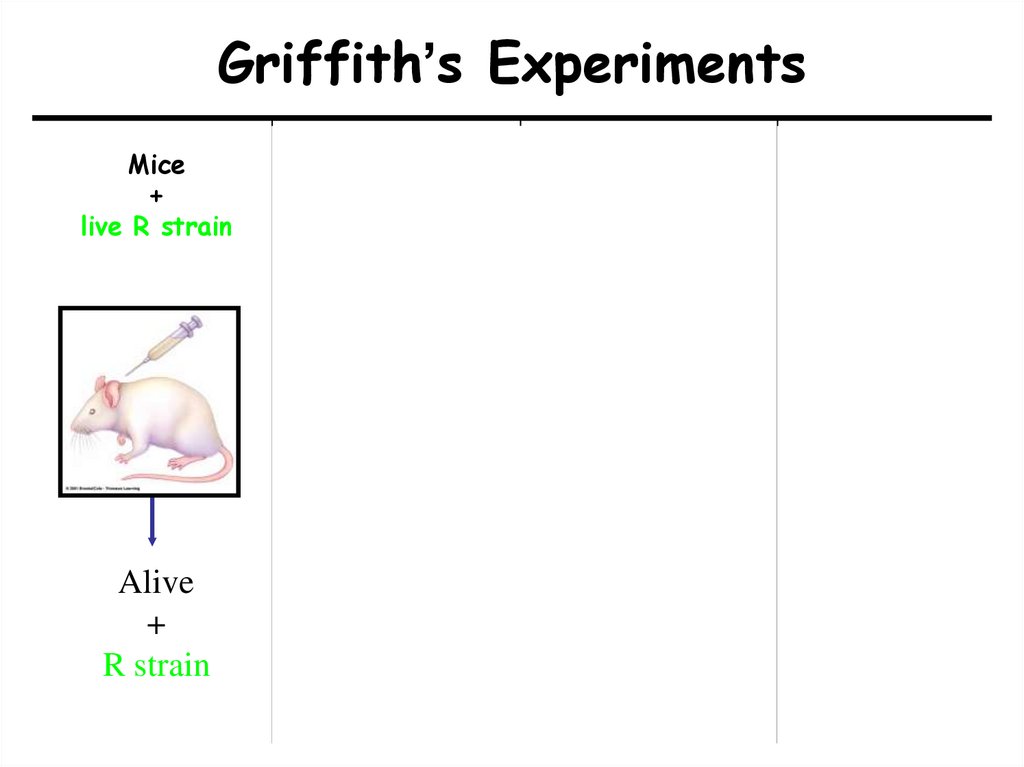
3. Griffith’s Experiments
Mice+
live R strain
Alive
+
R strain
Mice
+
live S strain
+
S strain
Mice
+
heat-killed
S strain
Alive
+
no culture
Mice
+
live R strain
+ HK S strain
+
S strain
4.
There are two possibilities:1. Resurrection, dead pneumococci had come back to life,
2. The harmless strain had transformed into the harmful strain.
5.
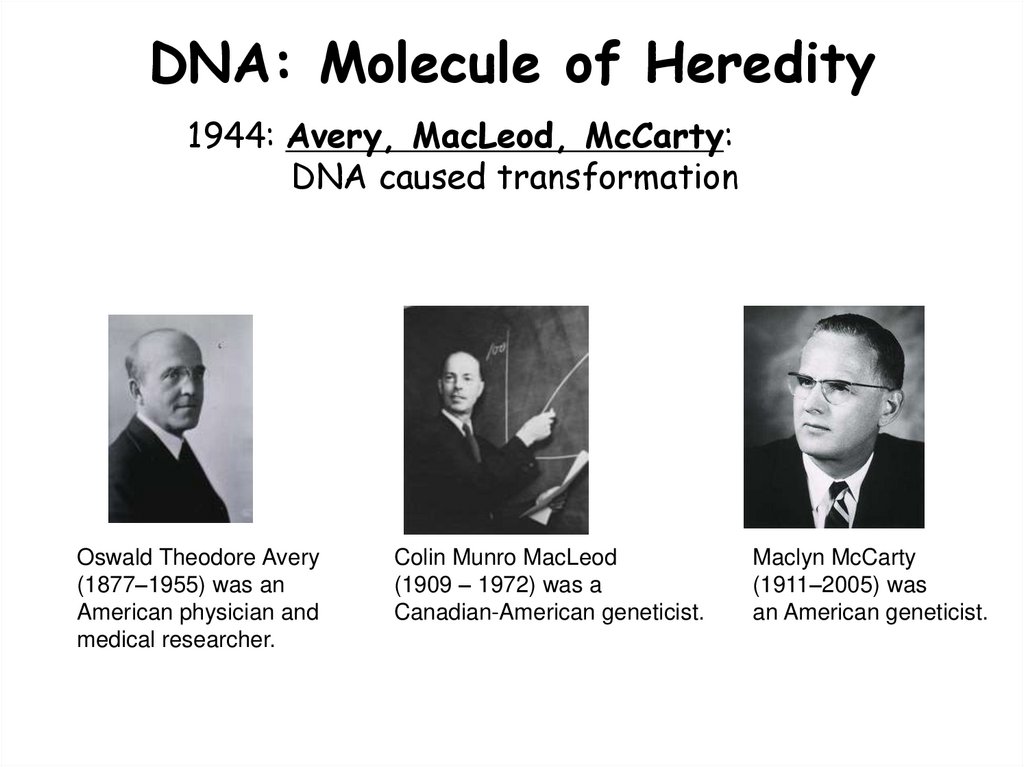
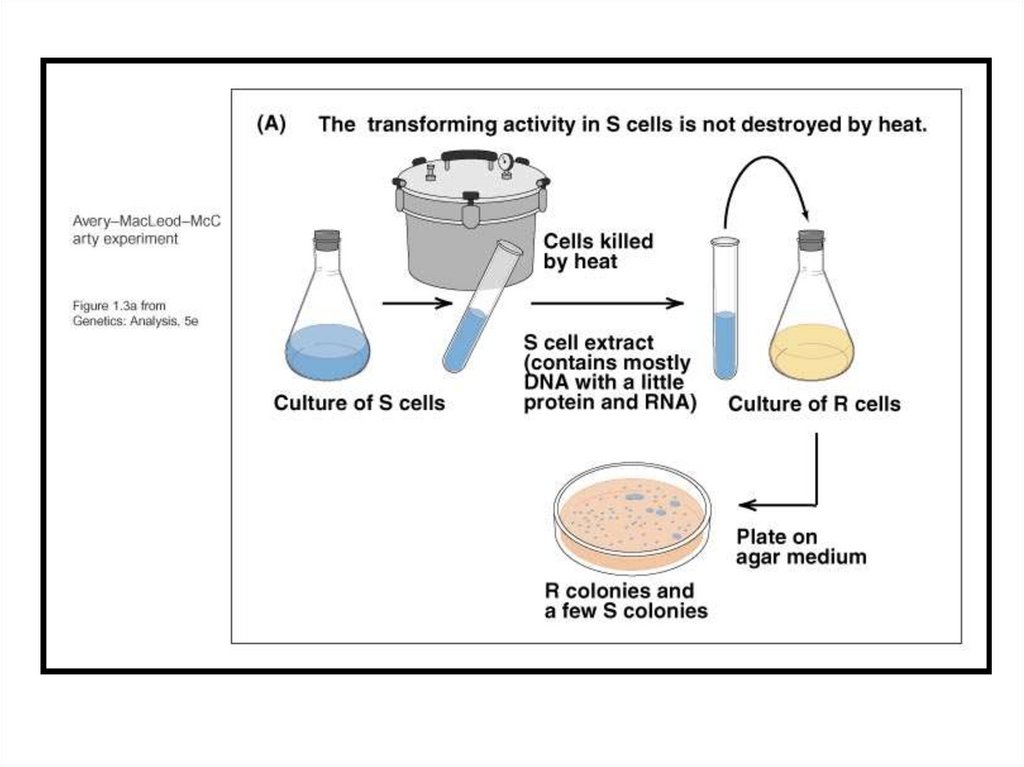
DNA: Molecule of Heredity1944: Avery, MacLeod, McCarty:
DNA caused transformation
Oswald Theodore Avery
(1877–1955) was an
American physician and
medical researcher.
Colin Munro MacLeod
(1909 – 1972) was a
Canadian-American geneticist.
Maclyn McCarty
(1911–2005) was
an American geneticist.
6.
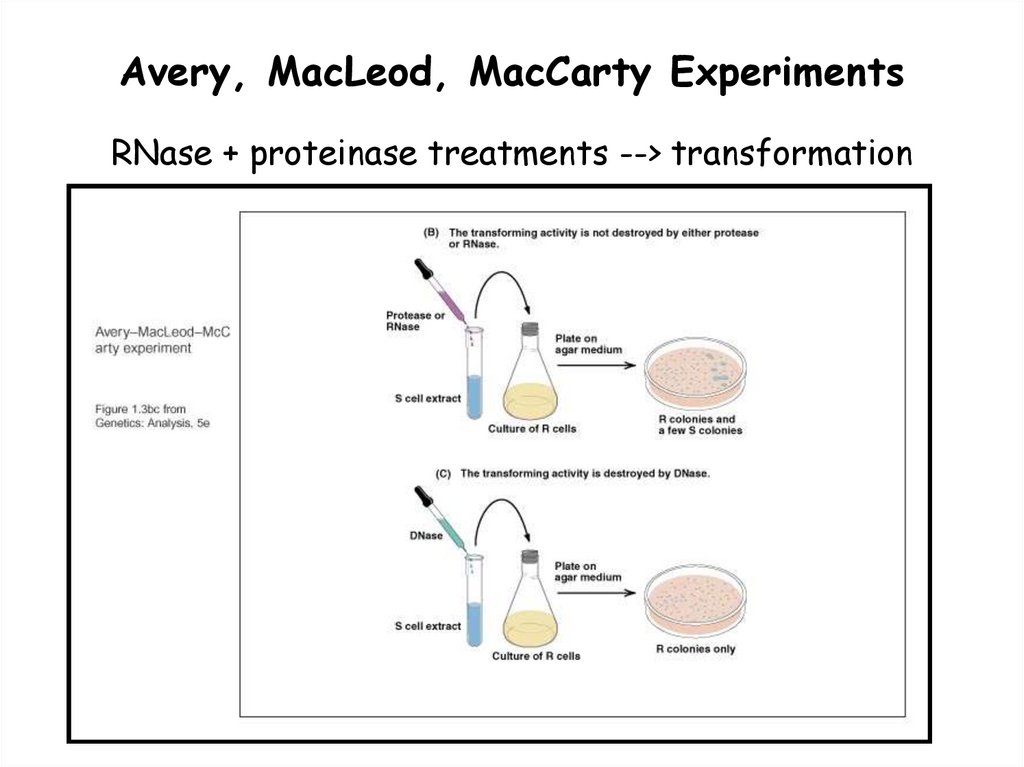
7. Avery, MacLeod, MacCarty Experiments
RNase + proteinase treatments --> transformation8. Conclusion: DNA is the Molecule of Heredity
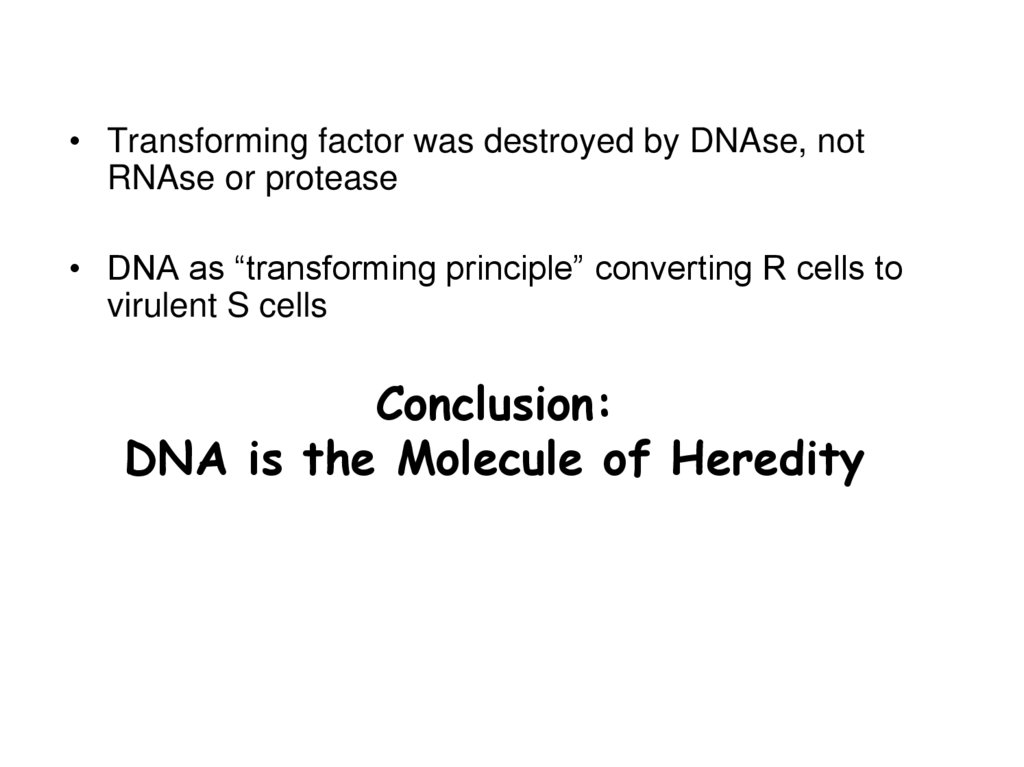
• Transforming factor was destroyed by DNAse, notRNAse or protease
• DNA as “transforming principle” converting R cells to
virulent S cells
Conclusion:
DNA is the Molecule of Heredity
9.
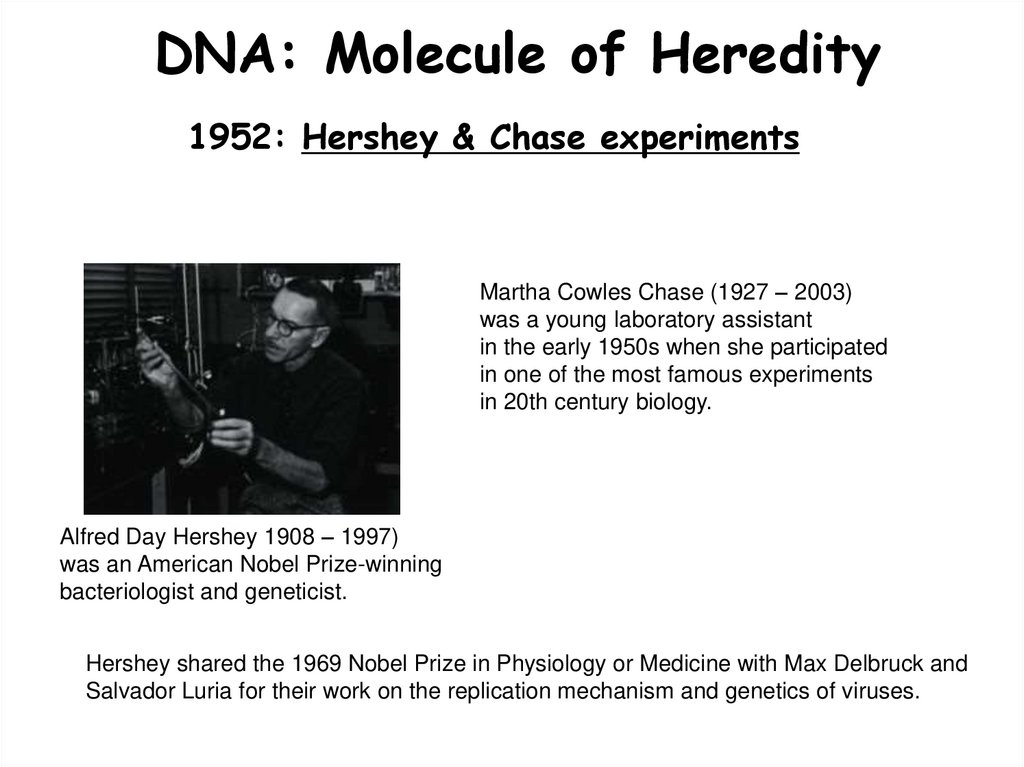
DNA: Molecule of Heredity1952: Hershey & Chase experiments
Martha Cowles Chase (1927 – 2003)
was a young laboratory assistant
in the early 1950s when she participated
in one of the most famous experiments
in 20th century biology.
Alfred Day Hershey 1908 – 1997)
was an American Nobel Prize-winning
bacteriologist and geneticist.
Hershey shared the 1969 Nobel Prize in Physiology or Medicine with Max Delbruck and
Salvador Luria for their work on the replication mechanism and genetics of viruses.
10. DNA: Molecule of Heredity
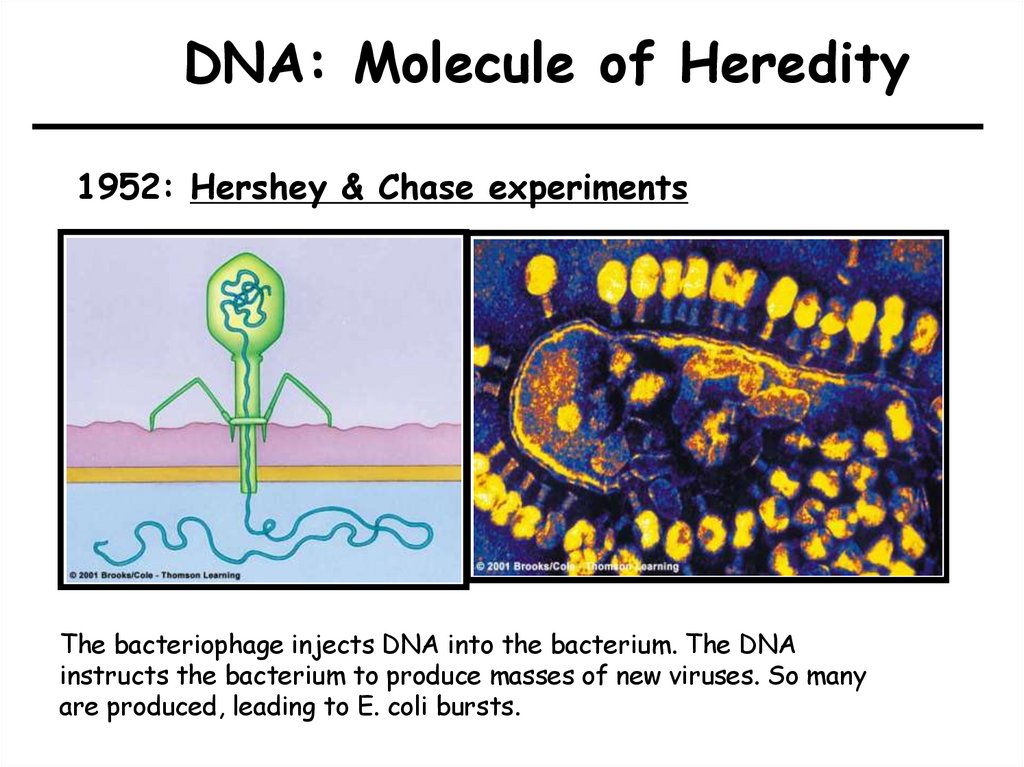
1952: Hershey & Chase experimentsThe bacteriophage injects DNA into the bacterium. The DNA
instructs the bacterium to produce masses of new viruses. So many
are produced, leading to E. coli bursts.
11.
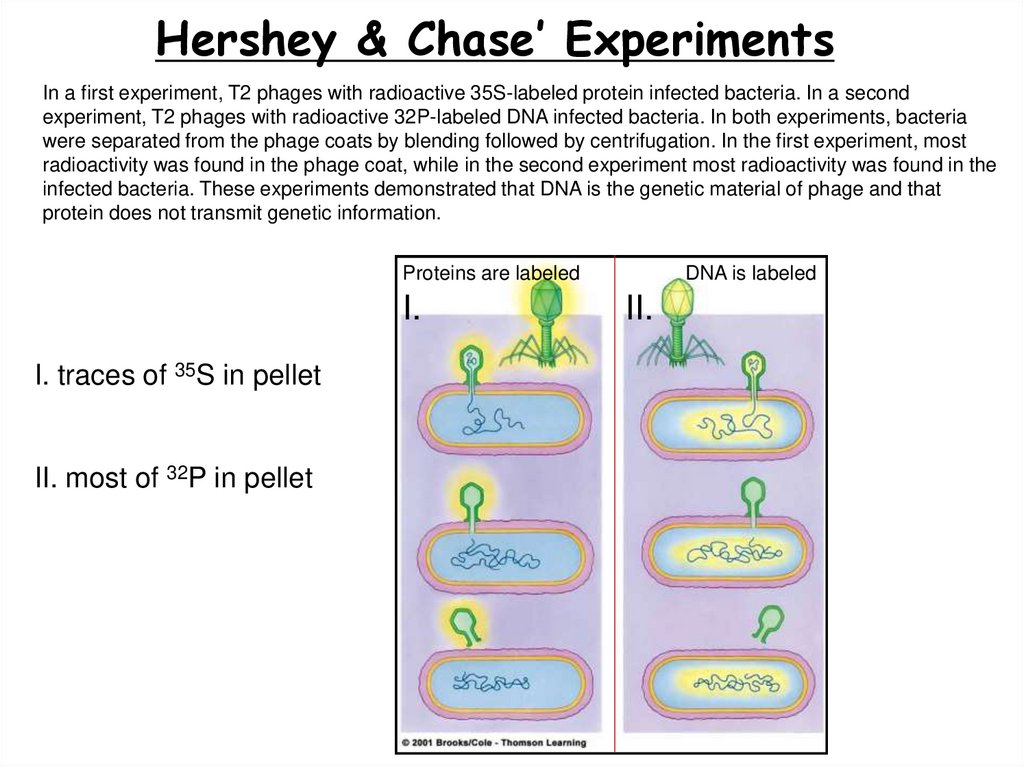
Hershey & Chase’ ExperimentsIn a first experiment, T2 phages with radioactive 35S-labeled protein infected bacteria. In a second
experiment, T2 phages with radioactive 32P-labeled DNA infected bacteria. In both experiments, bacteria
were separated from the phage coats by blending followed by centrifugation. In the first experiment, most
radioactivity was found in the phage coat, while in the second experiment most radioactivity was found in the
infected bacteria. These experiments demonstrated that DNA is the genetic material of phage and that
protein does not transmit genetic information.
Proteins are labeled
I.
I. traces of 35S in pellet
II. most of 32P in pellet
DNA is labeled
II.
12. Мезельсон мен Стальдің тәжірибесі
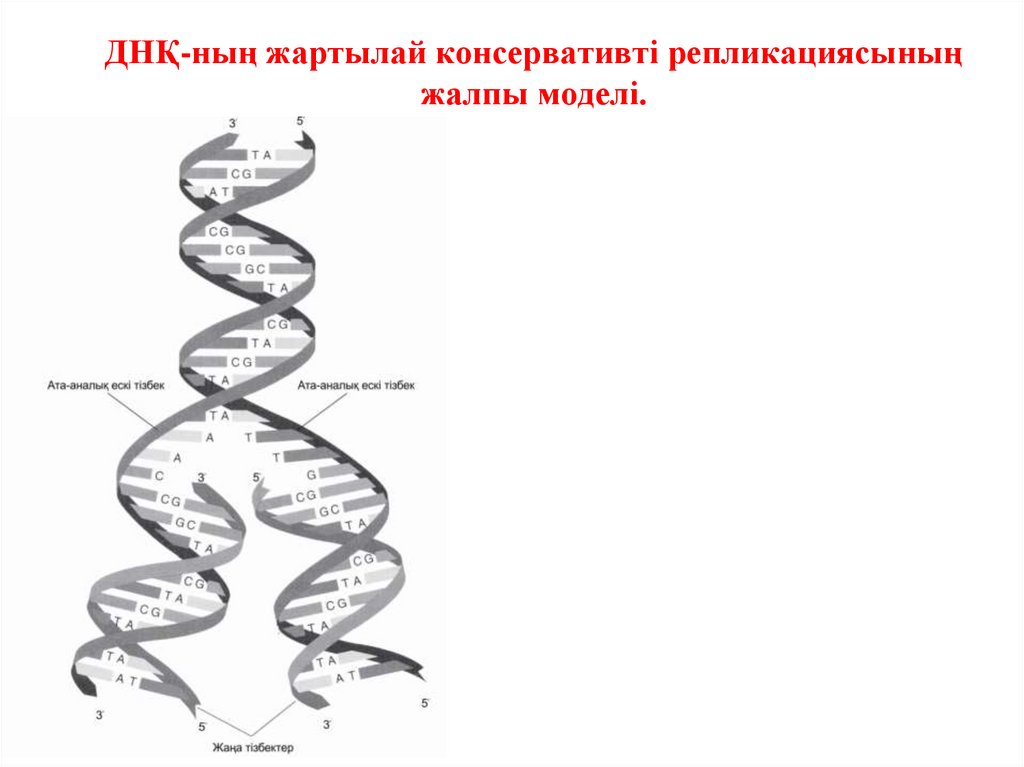
ДНҚ молекуласының құрылымын ашып көрсету оның клеткадағырепликациялану (екі еселену) принципін түсіндіруге мүмкіндік туғызды.
Уотсон-Крик үлгісіне (моделіне) сәйкес ДНҚ-ның әр тізбегі жаңа
комплементарлы тізбектің түзілуінде матрица қызметін атқарады, ал сол
тізбектегі азотты негіздердің орналасу реті матрица тізбегіндегі
комплементарлы негіздердің орналасу ретіне сай болады. Нәтижесінде бір қос
тізбекті молекуланың негізінде бір-біріне ұқсас екі қос тізбекті молекулалар
пайда болады және олардың әрқайсысының бір тізбегі бұрынғы ескі, ал екіншісі
жаңадан түзілген болып табылады. ДНҚ репликациясының мұндай жолы
жартылай консервативті деп аталады.