





 Английский язык
Похожие презентации:




From understanding titles to editing. The writing process: proofreading and punctuation
1.
WEEK 9LESSON 1-2
From understanding titles to editing.
The writing process: proofreading and punctuation
Foreign Language 2
Astana IT University, 2025
2.
OUTLINEEssay editing and proofreading process
Punctuation
3.
Objectives01
Describe an effective essay editing process and
do peer-review editing
02
Identify and correct punctuation errors
4.
Warm-upWhat is editing?
What is proofreading?
What is the difference between them?
5.
Editing processThe process of editing an academic essay involves
ensuring:
coherence
overall structure
consistency
… in the style of the written work.
6.
Essay editingThe editing process is when you read over your essay carefully, checking for accuracy in
concepts, ideas, and arguments.
When editing you also make sure that your essay is logically ordered, cohesive, and
coherent, and that all elements such as thesis statement and topic sentences connect an
d support each other.
Some sentences may need rewriting, some pieces of evidence removed, or some ideas
and arguments changing altogether.
7.
Essay editing1. Start by reading the essay from beginning to end to get a sense of the overall content and structure.
2. Check the essay’s structure and organization if the introduction provides a hook, sufficient
background information, and rationale and if the conclusion effectively summarizes the main points
and gives recommendations. Look for logical flow between paragraphs.
3. Make sure that the thesis is clear, concise, and accurately represents the main arguments or focus
of the essay.
4. Analyze individual paragraphs for cohesion and unity. Each paragraph should have a clear topic
sentence, supporting evidence, a concluding sentence, and transitions between ideas. Consider
whether any paragraphs need to be reorganized or combined.
8.
Essay editing5. Examine each paragraph sentence for clarity, grammar, and syntax. Check if
sentences are concise, well-constructed, and easy to understand. Look for any run-on
sentences, sentence fragments, or awkward phrasing.
6. Check the accuracy and completeness of in-text citations and references in APA
citation style.
9.
ProofreadingProofreading is identifying and correcting errors in the text before it is submitted.
Typos and spelling errors: scan the text for any typographical errors, misspelled words,
or inconsistencies in spelling.
Grammar and punctuation: check for grammatical mistakes, punctuation errors, and
issues with capitalization, proper usage of commas, periods, apostrophes, and other
punctuation marks.
Formatting and layout: ensure consistency in formatting, font styles, headings, overall
document layout, proper indentation, spacing, and alignment of text.
Page numbers and headers/footers: verify that page numbers, headers, footers, and
other document elements are correctly placed and formatted.
10.
11.
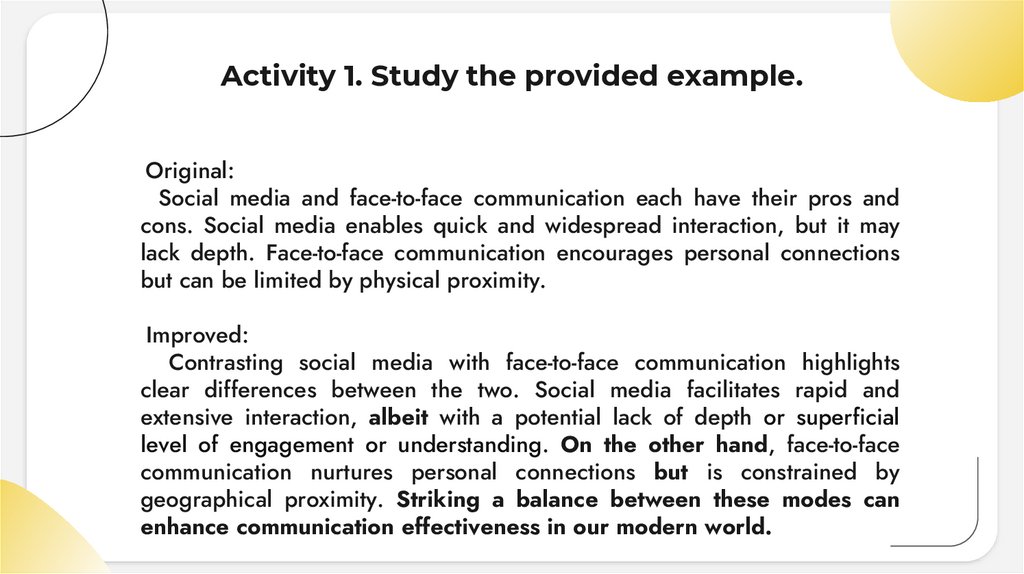
Activity 1. Study the provided example.Original:
Social media and face-to-face communication each have their pros and
cons. Social media enables quick and widespread interaction, but it may
lack depth. Face-to-face communication encourages personal connections
but can be limited by physical proximity.
Improved:
Contrasting social media with face-to-face communication highlights
clear differences between the two. Social media facilitates rapid and
extensive interaction, albeit with a potential lack of depth or superficial
level of engagement or understanding. On the other hand, face-to-face
communication nurtures personal connections but is constrained by
geographical proximity. Striking a balance between these modes can
enhance communication effectiveness in our modern world.
12.
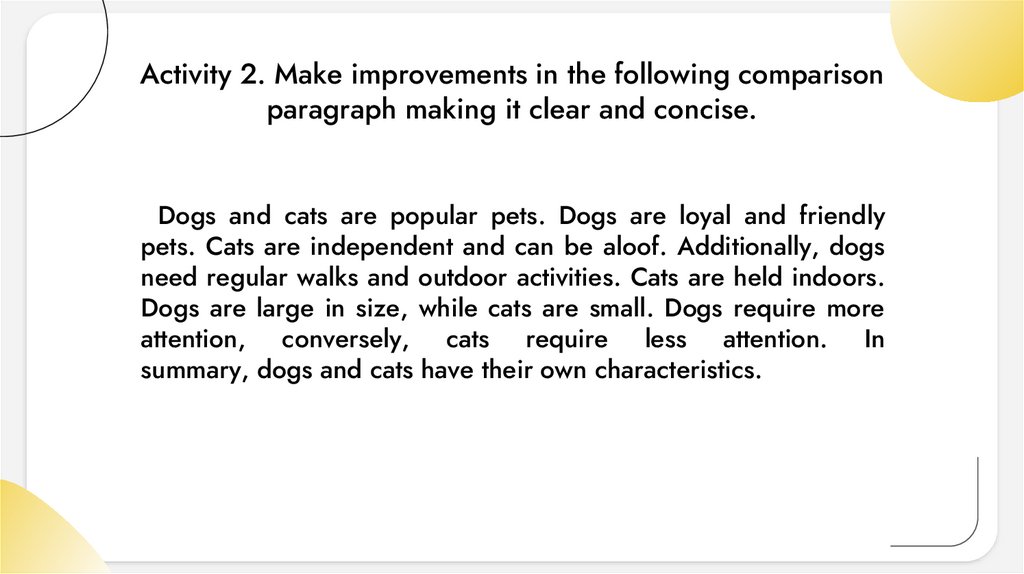
Activity 2. Make improvements in the following comparisonparagraph making it clear and concise.
Dogs and cats are popular pets. Dogs are loyal and friendly
pets. Cats are independent and can be aloof. Additionally, dogs
need regular walks and outdoor activities. Cats are held indoors.
Dogs are large in size, while cats are small. Dogs require more
attention, conversely, cats require less attention. In
summary, dogs and cats have their own characteristics.
13.
Lesson 2Proofreading and punctuation
14.
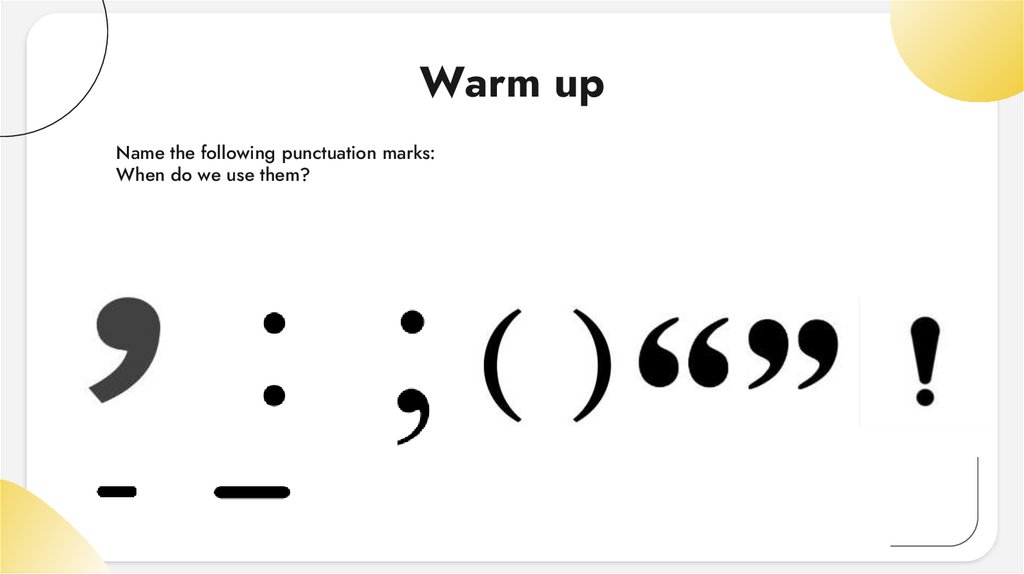
Warm upName the following punctuation marks:
When do we use them?
15.
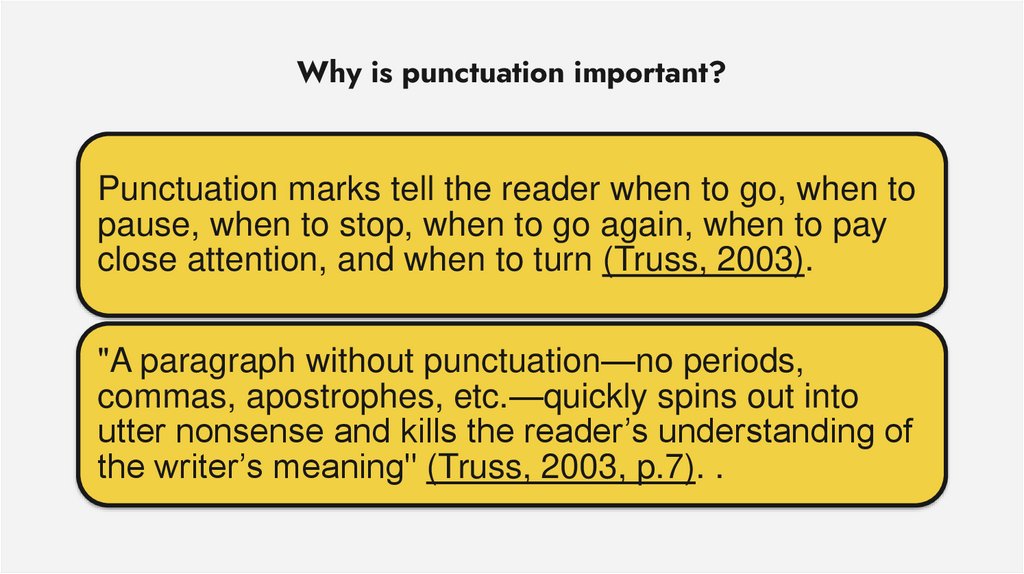
Why is punctuation important?Punctuation marks tell the reader when to go, when to
pause, when to stop, when to go again, when to pay
close attention, and when to turn (Truss, 2003).
"A paragraph without punctuation—no periods,
commas, apostrophes, etc.—quickly spins out into
utter nonsense and kills the reader’s understanding of
the writer’s meaning" (Truss, 2003, p.7). .
16.
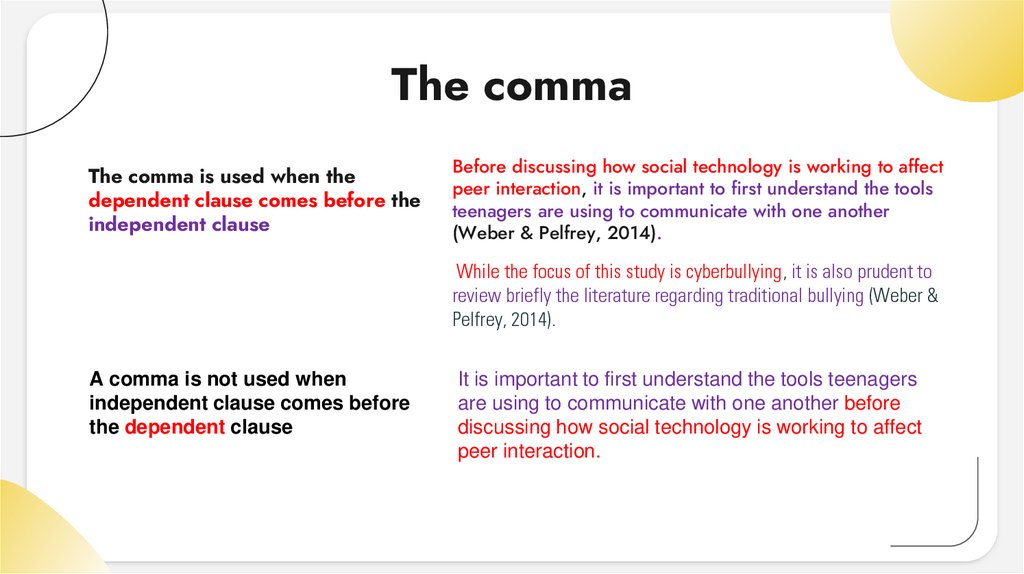
The commaThe comma is used when the
dependent clause comes before the
independent clause
Before discussing how social technology is working to affect
peer interaction, it is important to first understand the tools
teenagers are using to communicate with one another
(Weber & Pelfrey, 2014).
While the focus of this study is cyberbullying, it is also prudent to
review briefly the literature regarding traditional bullying (Weber &
Pelfrey, 2014).
A comma is not used when
independent clause comes before
the dependent clause
It is important to first understand the tools teenagers
are using to communicate with one another before
discussing how social technology is working to affect
peer interaction.
17.
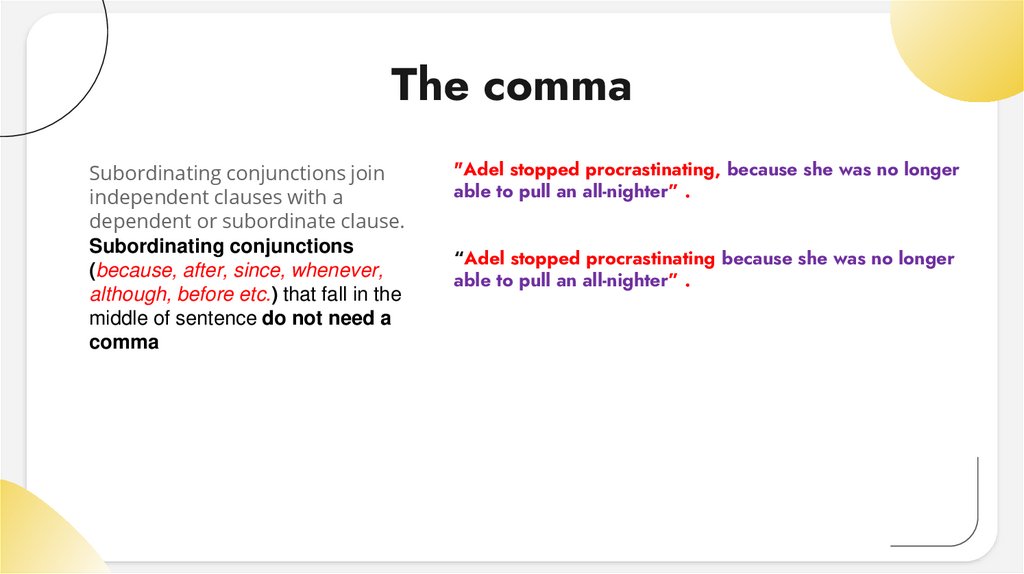
The commaSubordinating conjunctions join
independent clauses with a
dependent or subordinate clause.
Subordinating conjunctions
(because, after, since, whenever,
although, before etc.) that fall in the
middle of sentence do not need a
comma
"Adel stopped procrastinating, because she was no longer
able to pull an all-nighter” .
“Adel stopped procrastinating because she was no longer
able to pull an all-nighter” .
18.
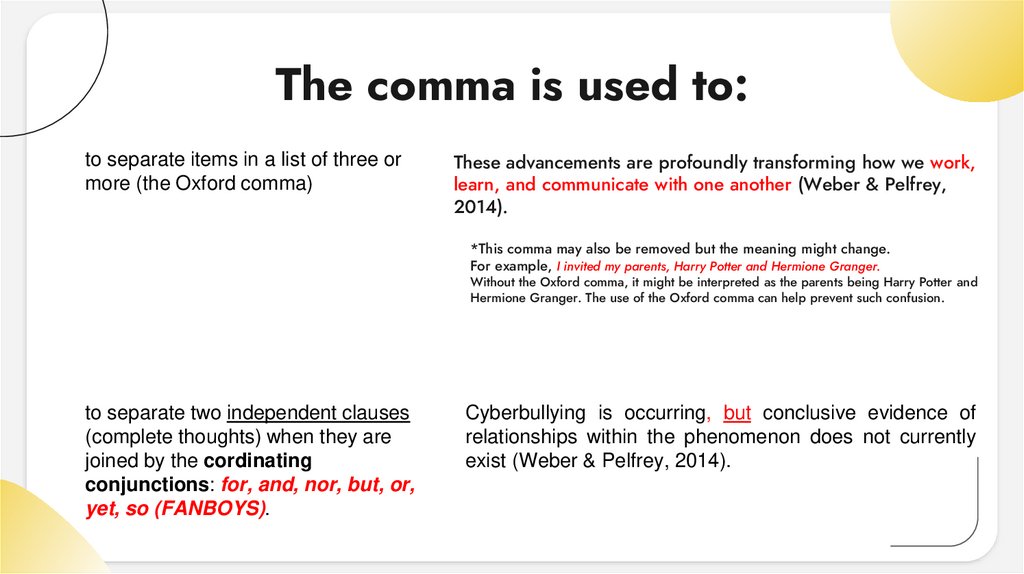
The comma is used to:to separate items in a list of three or
more (the Oxford comma)
These advancements are profoundly transforming how we work,
learn, and communicate with one another (Weber & Pelfrey,
2014).
*This comma may also be removed but the meaning might change.
For example, I invited my parents, Harry Potter and Hermione Granger.
Without the Oxford comma, it might be interpreted as the parents being Harry Potter and
Hermione Granger. The use of the Oxford comma can help prevent such confusion.
to separate two independent clauses
(complete thoughts) when they are
joined by the cordinating
conjunctions: for, and, nor, but, or,
yet, so (FANBOYS).
Cyberbullying is occurring, but conclusive evidence of
relationships within the phenomenon does not currently
exist (Weber & Pelfrey, 2014).
19.
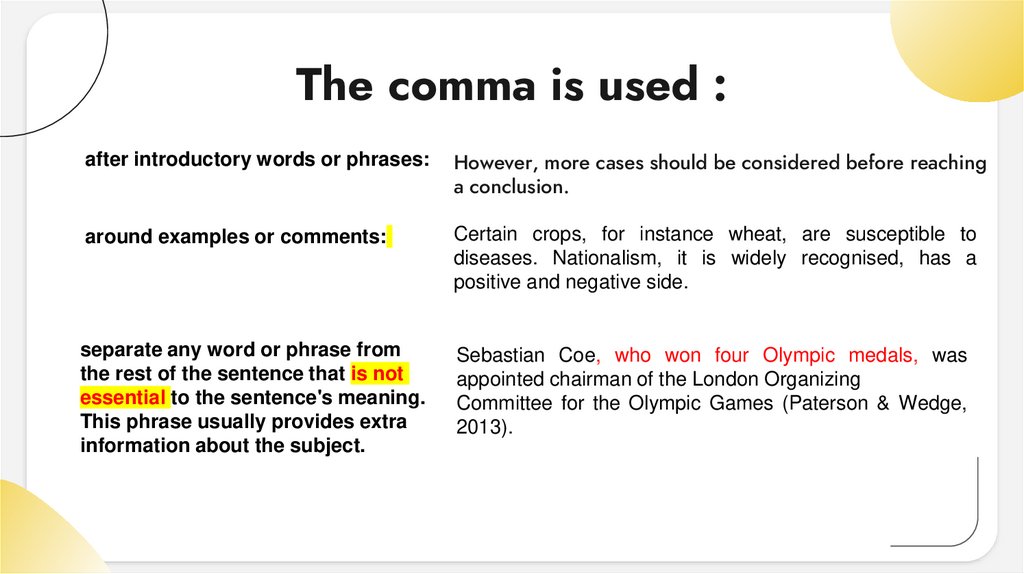
The comma is used :after introductory words or phrases:
However, more cases should be considered before reaching
a conclusion.
around examples or comments:
Certain crops, for instance wheat, are susceptible to
diseases. Nationalism, it is widely recognised, has a
positive and negative side.
separate any word or phrase from
the rest of the sentence that is not
essential to the sentence's meaning.
This phrase usually provides extra
information about the subject.
Sebastian Coe, who won four Olympic medals, was
appointed chairman of the London Organizing
Committee for the Olympic Games (Paterson & Wedge,
2013).
20.
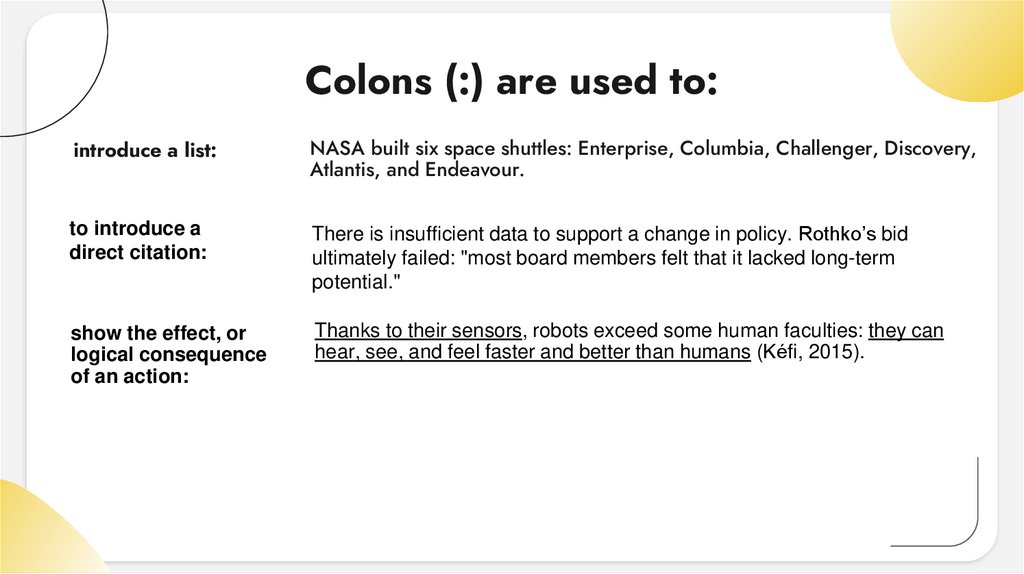
Colons (:) are used to:introduce a list:
NASA built six space shuttles: Enterprise, Columbia, Challenger, Discovery,
Atlantis, and Endeavour.
to introduce a
direct citation:
There is insufficient data to support a change in policy. Rothko’s bid
ultimately failed: "most board members felt that it lacked long-term
potential."
show the effect, or
logical consequence
of an action:
Thanks to their sensors, robots exceed some human faculties: they can
hear, see, and feel faster and better than humans (Kéfi, 2015).
21.
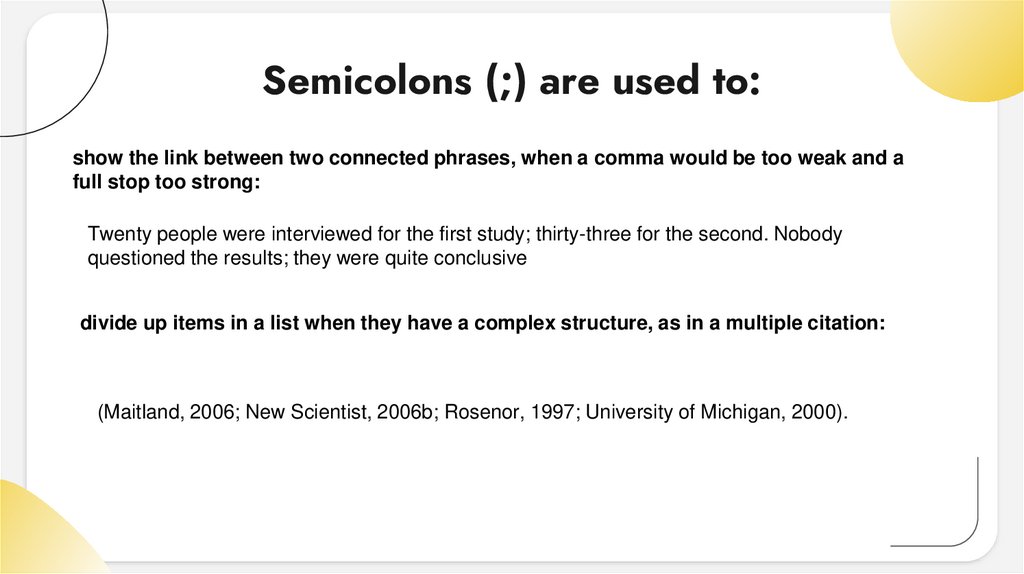
Semicolons (;) are used to:show the link between two connected phrases, when a comma would be too weak and a
full stop too strong:
Twenty people were interviewed for the first study; thirty-three for the second. Nobody
questioned the results; they were quite conclusive
divide up items in a list when they have a complex structure, as in a multiple citation:
(Maitland, 2006; New Scientist, 2006b; Rosenor, 1997; University of Michigan, 2000).
22.
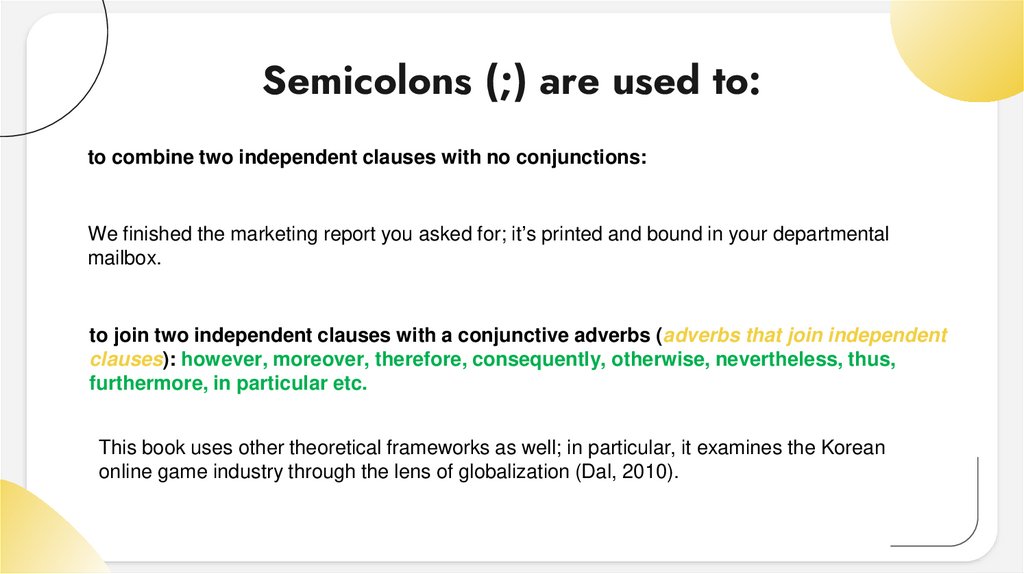
Semicolons (;) are used to:to combine two independent clauses with no conjunctions:
We finished the marketing report you asked for; it’s printed and bound in your departmental
mailbox.
to join two independent clauses with a conjunctive adverbs (adverbs that join independent
clauses): however, moreover, therefore, consequently, otherwise, nevertheless, thus,
furthermore, in particular etc.
This book uses other theoretical frameworks as well; in particular, it examines the Korean
online game industry through the lens of globalization (Dal, 2010).
23.
Hyphens (-) and Dashes (—)Hyphens are used with certain words, such as compound nouns, and certain structures:
A well-researched, thought-provoking book. Her three-year-old daughter is learning to read.
Dashes are not common in academic English, but may sometimes be used instead of
commas or brackets to give additional information:
Hideo Suzuki — one of Japan's leading entrepreneurs — was Senco’s main financial backer.
It would be more common to see this written like this:
Hideo Suzuki, one of Japan's leading entrepreneurs, was Senco’s main financial backer.
24.
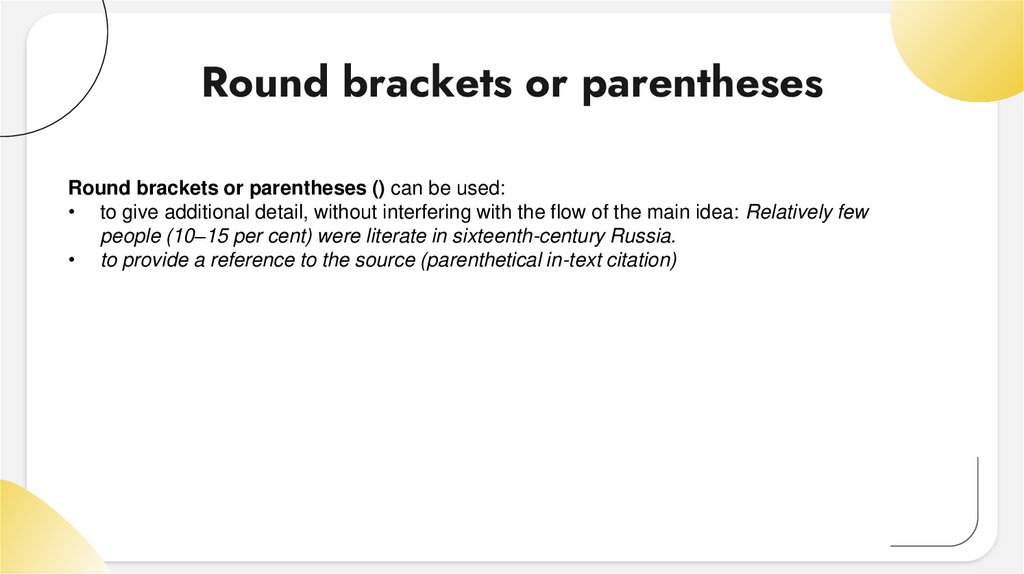
Round brackets or parenthesesRound brackets or parentheses () can be used:
• to give additional detail, without interfering with the flow of the main idea: Relatively few
people (10–15 per cent) were literate in sixteenth-century Russia.
• to provide a reference to the source (parenthetical in-text citation)
25.
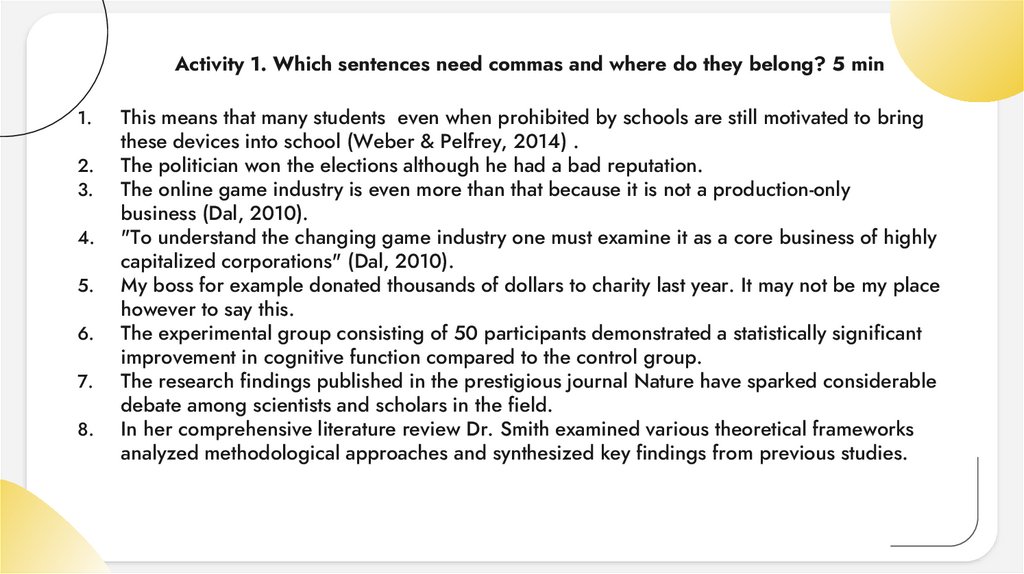
Activity 1. Which sentences need commas and where do they belong? 5 min1.
2.
3.
4.
5.
6.
7.
8.
This means that many students even when prohibited by schools are still motivated to bring
these devices into school (Weber & Pelfrey, 2014) .
The politician won the elections although he had a bad reputation.
The online game industry is even more than that because it is not a production-only
business (Dal, 2010).
"To understand the changing game industry one must examine it as a core business of highly
capitalized corporations" (Dal, 2010).
My boss for example donated thousands of dollars to charity last year. It may not be my place
however to say this.
The experimental group consisting of 50 participants demonstrated a statistically significant
improvement in cognitive function compared to the control group.
The research findings published in the prestigious journal Nature have sparked considerable
debate among scientists and scholars in the field.
In her comprehensive literature review Dr. Smith examined various theoretical frameworks
analyzed methodological approaches and synthesized key findings from previous studies.
26.
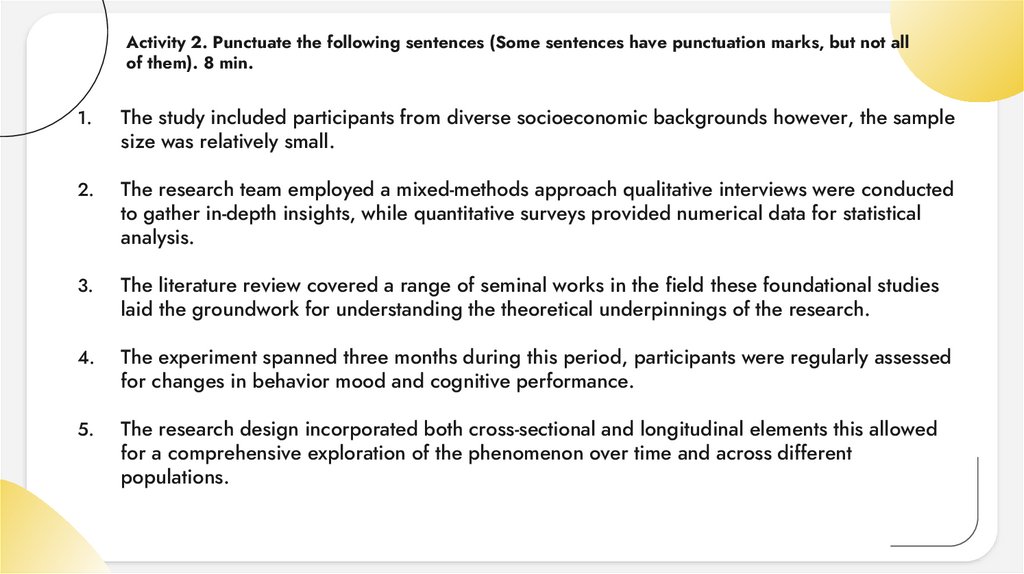
Activity 2. Punctuate the following sentences (Some sentences have punctuation marks, but not allof them). 8 min.
1.
The study included participants from diverse socioeconomic backgrounds however, the sample
size was relatively small.
2.
The research team employed a mixed-methods approach qualitative interviews were conducted
to gather in-depth insights, while quantitative surveys provided numerical data for statistical
analysis.
3.
The literature review covered a range of seminal works in the field these foundational studies
laid the groundwork for understanding the theoretical underpinnings of the research.
4.
The experiment spanned three months during this period, participants were regularly assessed
for changes in behavior mood and cognitive performance.
5.
The research design incorporated both cross-sectional and longitudinal elements this allowed
for a comprehensive exploration of the phenomenon over time and across different
populations.
27.
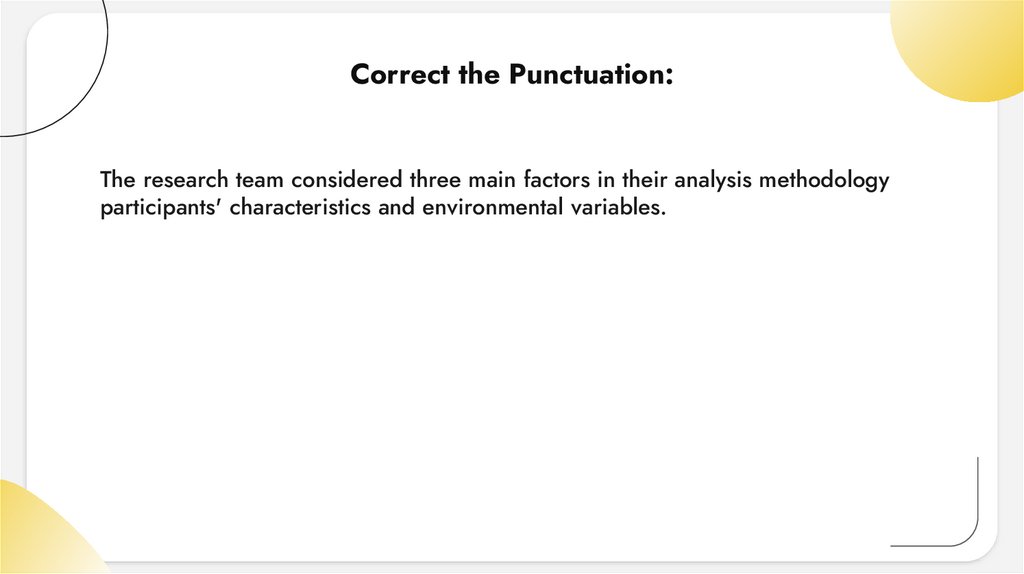
Correct the Punctuation:The research team considered three main factors in their analysis methodology
participants' characteristics and environmental variables.
28.
Correct the Punctuation:The literature review covered a range of topics for example, cognitive theories,
neurobiological perspectives, and behavioral models.
The literature review covered a range of topics, for example: cognitive theories,
neurobiological perspectives, and behavioral models.
29.
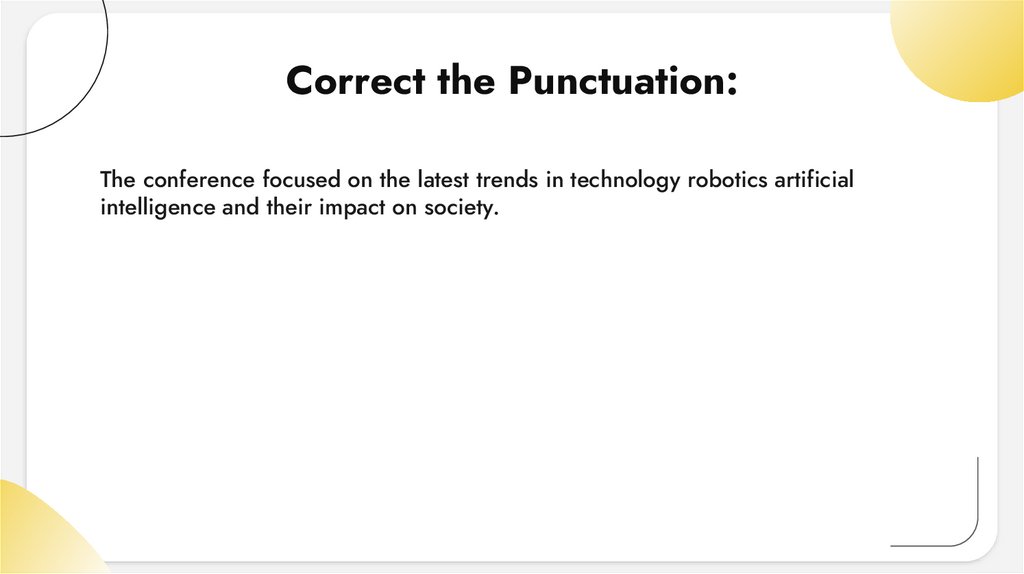
Correct the Punctuation:The conference focused on the latest trends in technology robotics artificial
intelligence and their impact on society.
30.
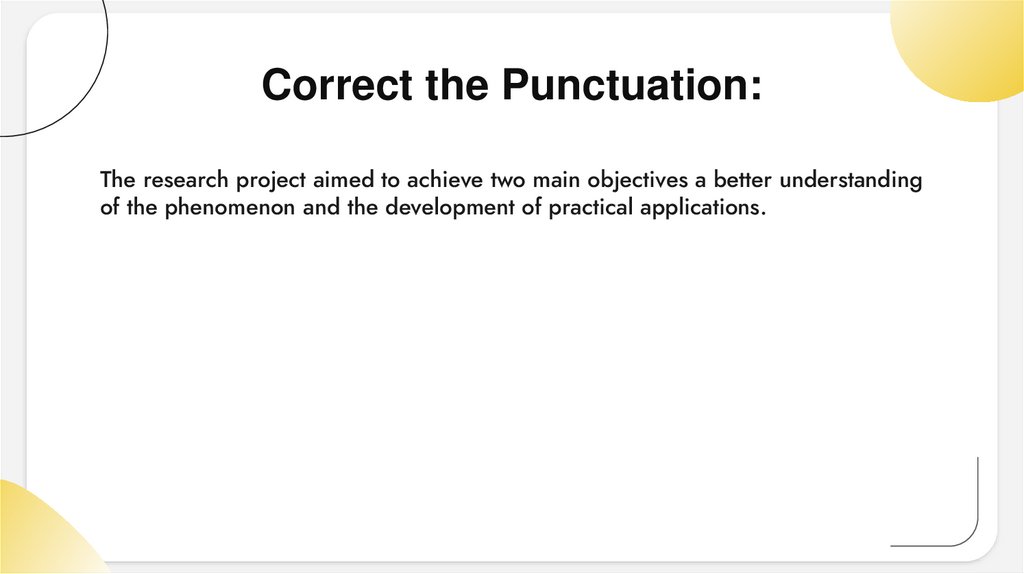
Correct the Punctuation:The research project aimed to achieve two main objectives a better understanding
of the phenomenon and the development of practical applications.
31.
Correct the Punctuation:The course covered a variety of topics such as research design statistical analysis
and ethical considerations.
32.
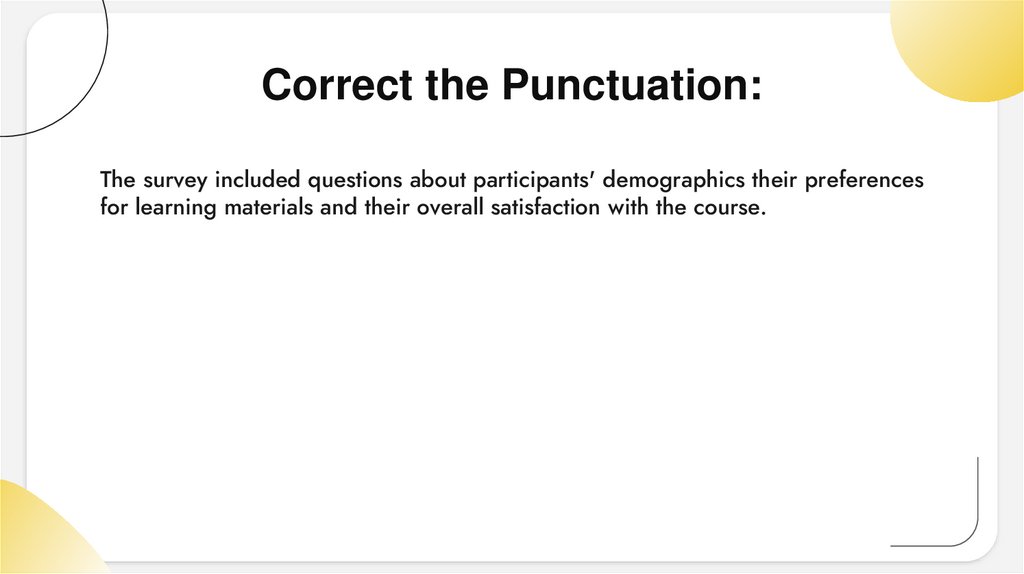
Correct the Punctuation:The survey included questions about participants' demographics their preferences
for learning materials and their overall satisfaction with the course.
33.
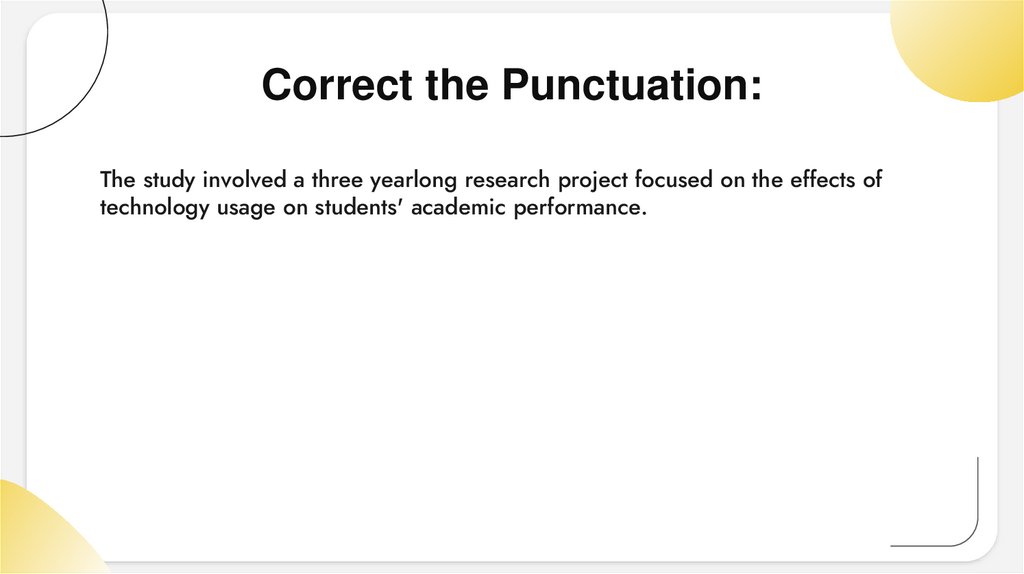
Correct the Punctuation:The study involved a three yearlong research project focused on the effects of
technology usage on students' academic performance.
34.
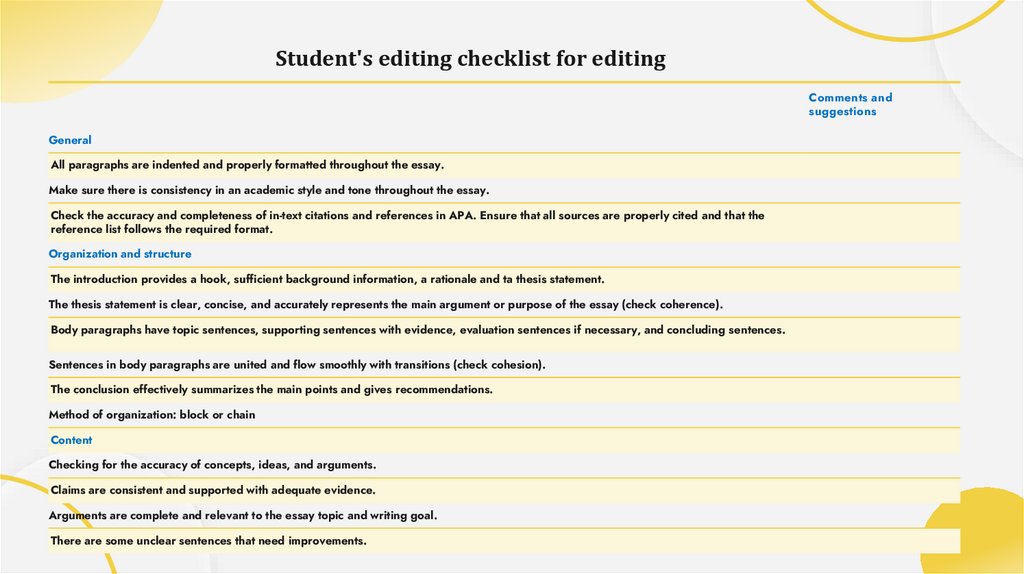
Student's editing checklist for editingComments and
suggestions
General
All paragraphs are indented and properly formatted throughout the essay.
Make sure there is consistency in an academic style and tone throughout the essay.
Check the accuracy and completeness of in-text citations and references in APA. Ensure that all sources are properly cited and that the
reference list follows the required format.
Organization and structure
The introduction provides a hook, sufficient background information, a rationale and ta thesis statement.
The thesis statement is clear, concise, and accurately represents the main argument or purpose of the essay (check coherence).
Body paragraphs have topic sentences, supporting sentences with evidence, evaluation sentences if necessary, and concluding sentences.
Sentences in body paragraphs are united and flow smoothly with transitions (check cohesion).
The conclusion effectively summarizes the main points and gives recommendations.
Method of organization: block or chain
Content
Checking for the accuracy of concepts, ideas, and arguments.
Claims are consistent and supported with adequate evidence.
Arguments are complete and relevant to the essay topic and writing goal.
There are some unclear sentences that need improvements.
35.
Written ChroniclesUse the peer review editing checklist to assist your groupmate's editing process based on an organization
and structure.
Write down your comments and suggestions on a piece of paper and submit it to your instructor.
You are given 10-15 minutes.
Peer Editor’s comments
and suggestions
Organization and structure
The introduction provides a hook, sufficient background information, a rationale and ta thesis statement.
The thesis statement is clear, concise, and accurately represents the main argument or purpose of the essay (check coherence).
Body paragraphs have topic sentences, supporting sentences with evidence, evaluation sentences if necessary, and concluding
sentences.
Sentences in body paragraphs are united and flow smoothly with transitions (check cohesion).
The conclusion effectively summarizes the main points and gives recommendations.
36.
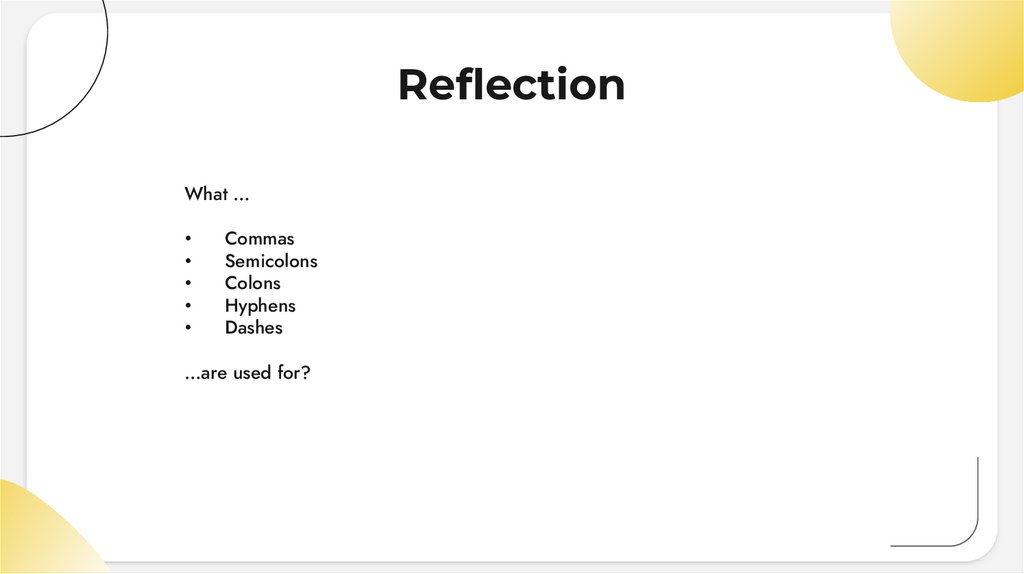
ReflectionWhat …
Commas
Semicolons
Colons
Hyphens
Dashes
…are used for?
37.
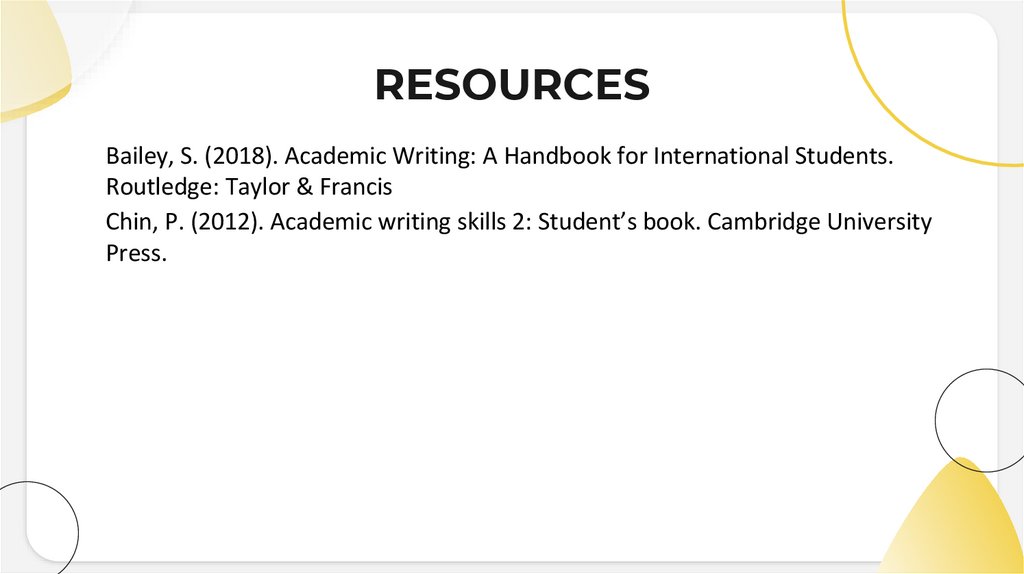
RESOURCESBailey, S. (2018). Academic Writing: A Handbook for International Students.
Routledge: Taylor & Francis
Chin, P. (2012). Academic writing skills 2: Student’s book. Cambridge University
Press.
38.
Thank you foryour
attention!