

 Английский язык
Похожие презентации:










Five - minute - warm - up - speaking activities
1.
2.
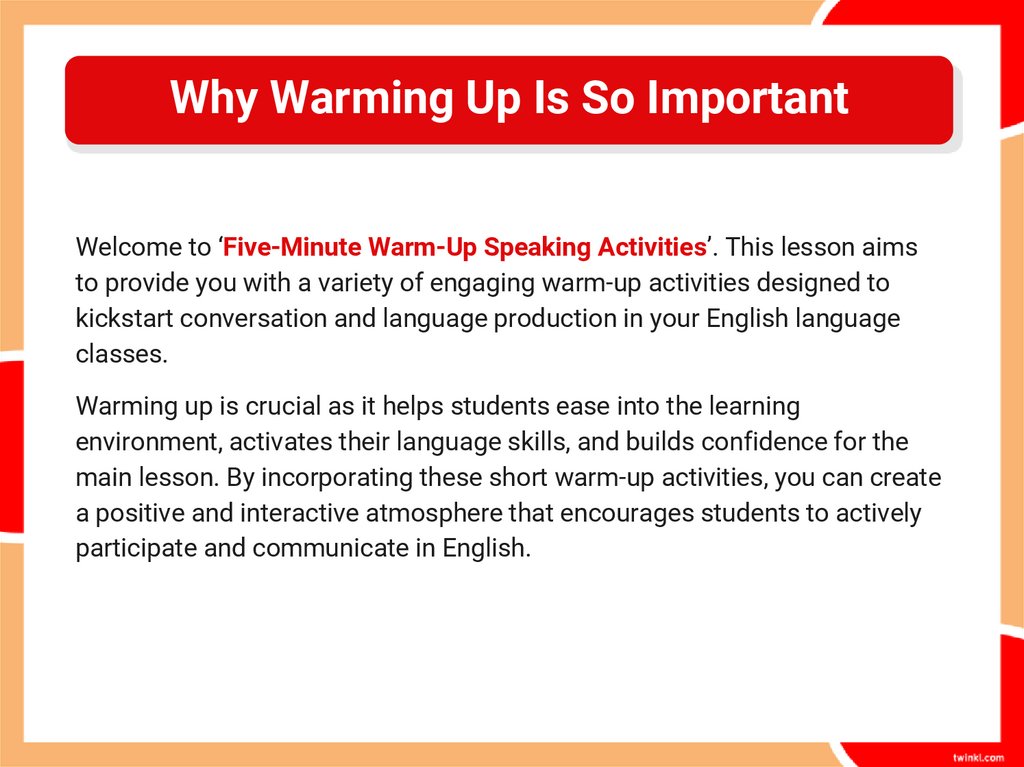
Why Warming Up Is So ImportantWelcome to ‘Five-Minute Warm-Up Speaking Activities’. This lesson aims
to provide you with a variety of engaging warm-up activities designed to
kickstart conversation and language production in your English language
classes.
Warming up is crucial as it helps students ease into the learning
environment, activates their language skills, and builds confidence for the
main lesson. By incorporating these short warm-up activities, you can create
a positive and interactive atmosphere that encourages students to actively
participate and communicate in English.
3.
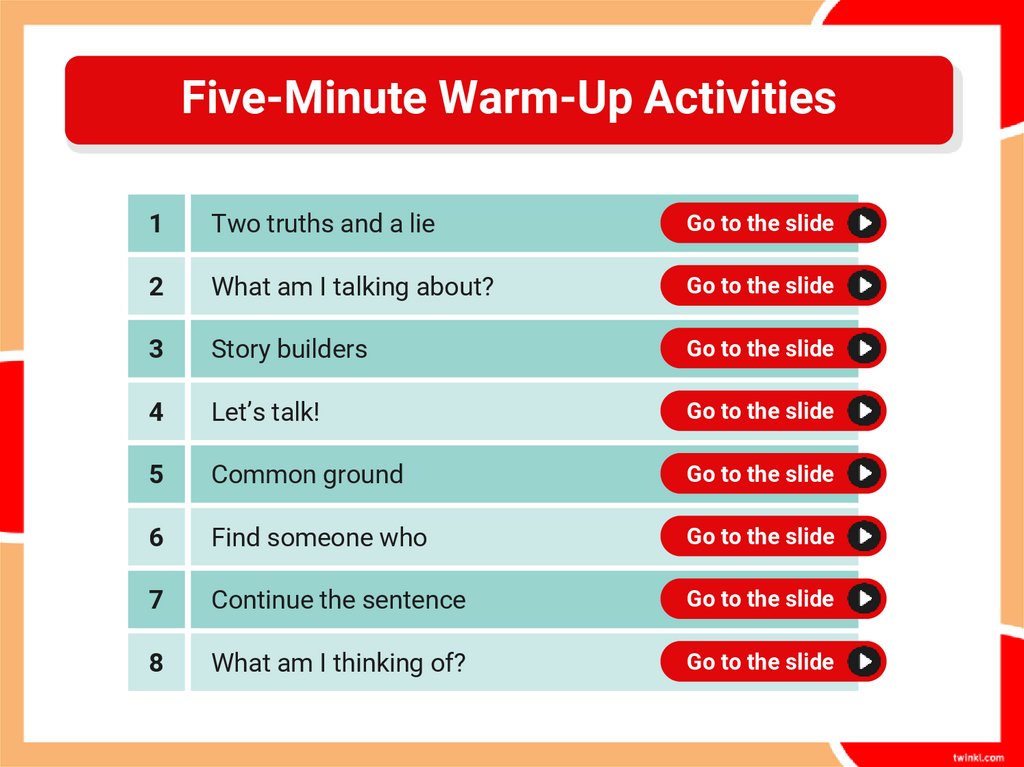
Five-Minute Warm-Up Activities1
Two truths and a lie
Go to the slide
2
What am I talking about?
Go to the slide
3
Story builders
Go to the slide
4
Let’s talk!
Go to the slide
5
Common ground
Go to the slide
6
Find someone who
Go to the slide
7
Continue the sentence
Go to the slide
8
What am I thinking of?
Go to the slide
4.
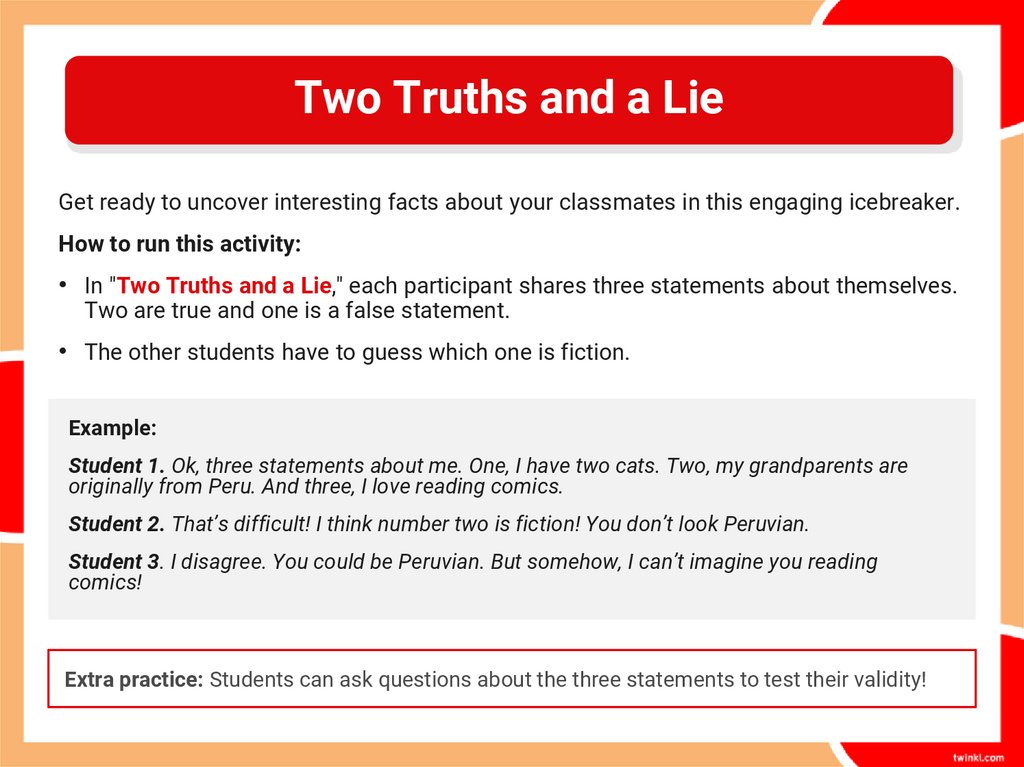
Two Truths and a LieGet ready to uncover interesting facts about your classmates in this engaging icebreaker.
How to run this activity:
• In "Two Truths and a Lie," each participant shares three statements about themselves.
Two are true and one is a false statement.
• The other students have to guess which one is fiction.
Example:
Student 1. Ok, three statements about me. One, I have two cats. Two, my grandparents are
originally from Peru. And three, I love reading comics.
Student 2. That’s difficult! I think number two is fiction! You don’t look Peruvian.
Student 3. I disagree. You could be Peruvian. But somehow, I can’t imagine you reading
comics!
Extra practice: Students can ask questions about the three statements to test their validity!
5.
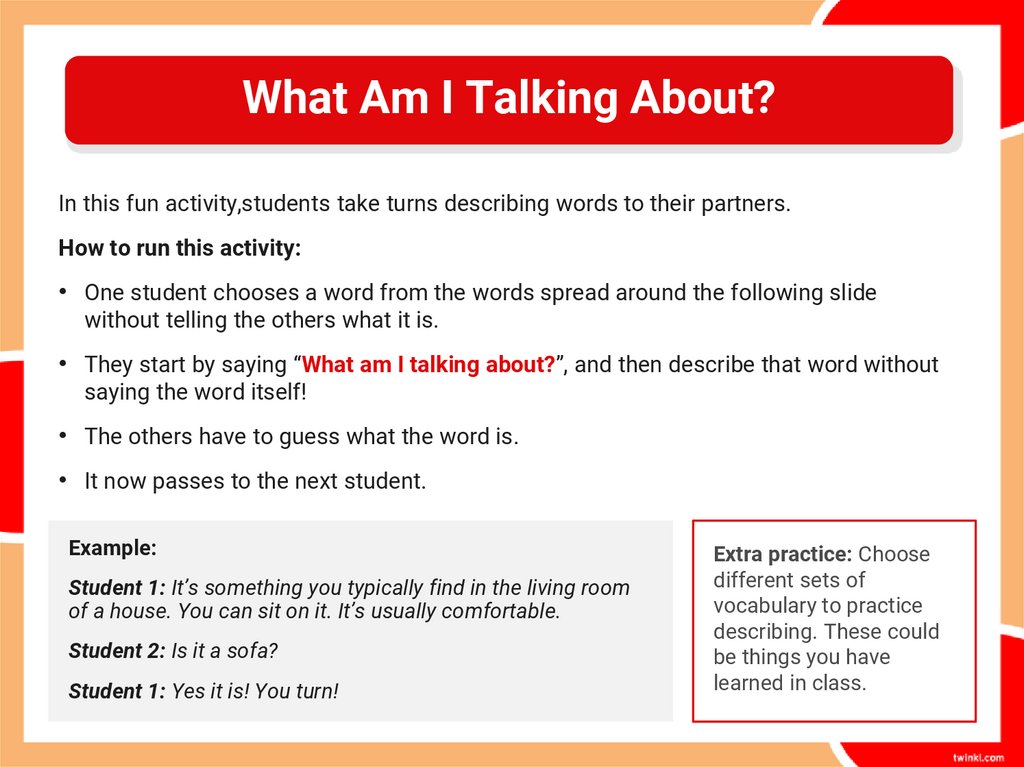
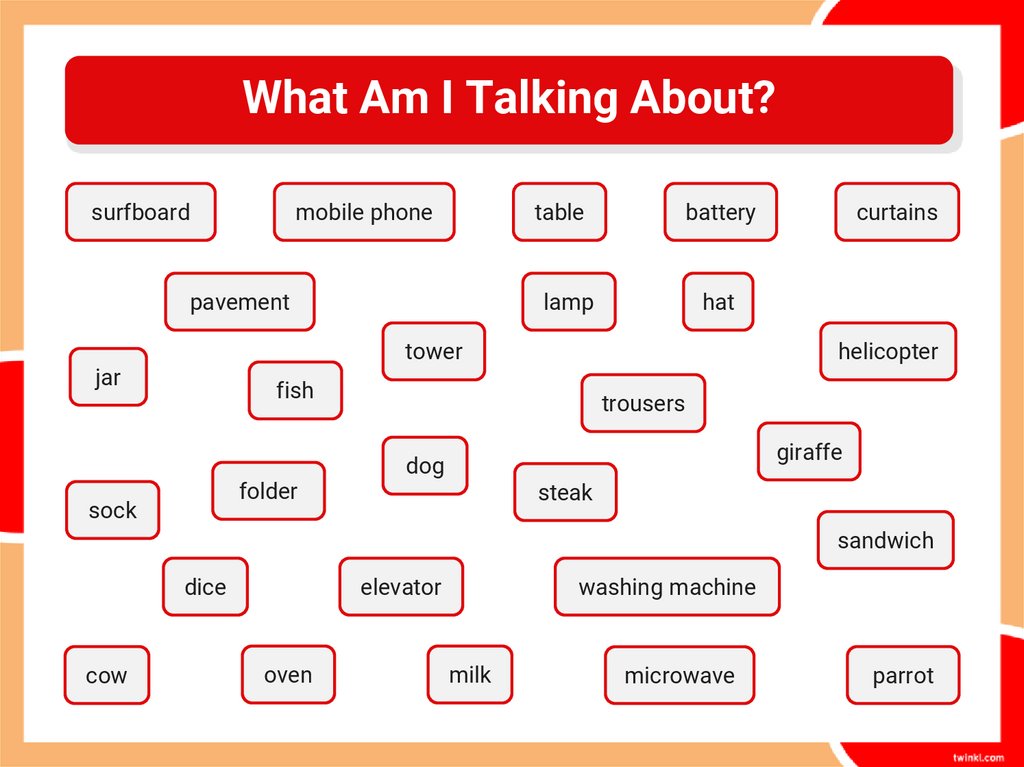
What Am I Talking About?In this fun activity,students take turns describing words to their partners.
How to run this activity:
• One student chooses a word from the words spread around the following slide
without telling the others what it is.
• They start by saying “What am I talking about?”, and then describe that word without
saying the word itself!
• The others have to guess what the word is.
• It now passes to the next student.
Example:
Student 1: It’s something you typically find in the living room
of a house. You can sit on it. It’s usually comfortable.
Student 2: Is it a sofa?
Student 1: Yes it is! You turn!
Extra practice: Choose
different sets of
vocabulary to practice
describing. These could
be things you have
learned in class.
6.
What Am I Talking About?surfboard
mobile phone
pavement
table
battery
lamp
hat
helicopter
tower
jar
fish
folder
sock
curtains
trousers
giraffe
dog
steak
sandwich
dice
cow
elevator
oven
washing machine
milk
microwave
parrot
7.
Story BuildersJumpstart creativity and narrative skills with "Story Builders". Each participant
contributes a sentence to collectively build an engaging story, encouraging
spontaneous speaking, grammar practice, and storytelling abilities.
How to run this activity:
• You can do this activity with the whole class or in smaller groups and even pairs.
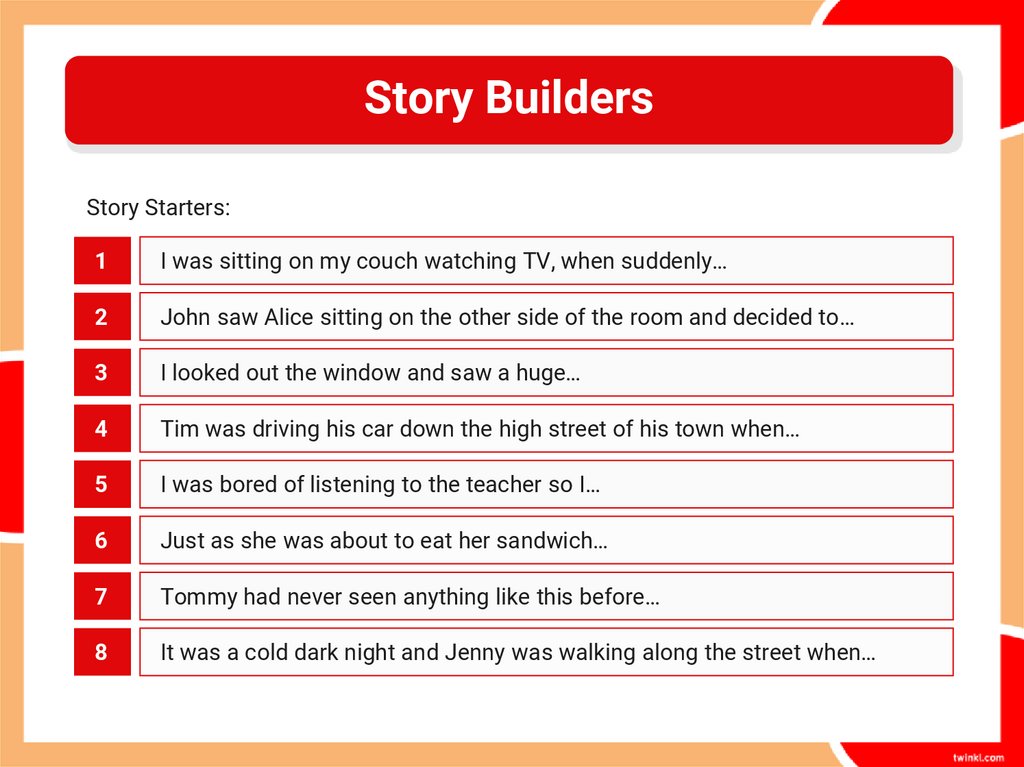
• The teacher or a student starts by choosing one of the story starters on the
following slide and reading it out loud.
• The next student continues the story by inventing a sentence.
• Students continue adding to the story as you go round.
Extra practice: Students can invent their own story starters to encourage more
creativity and speaking practice.
8.
Story BuildersStory Starters:
1
I was sitting on my couch watching TV, when suddenly…
2
John saw Alice sitting on the other side of the room and decided to…
3
I looked out the window and saw a huge…
4
Tim was driving his car down the high street of his town when…
5
I was bored of listening to the teacher so I…
6
Just as she was about to eat her sandwich…
7
Tommy had never seen anything like this before…
8
It was a cold dark night and Jenny was walking along the street when…
9.
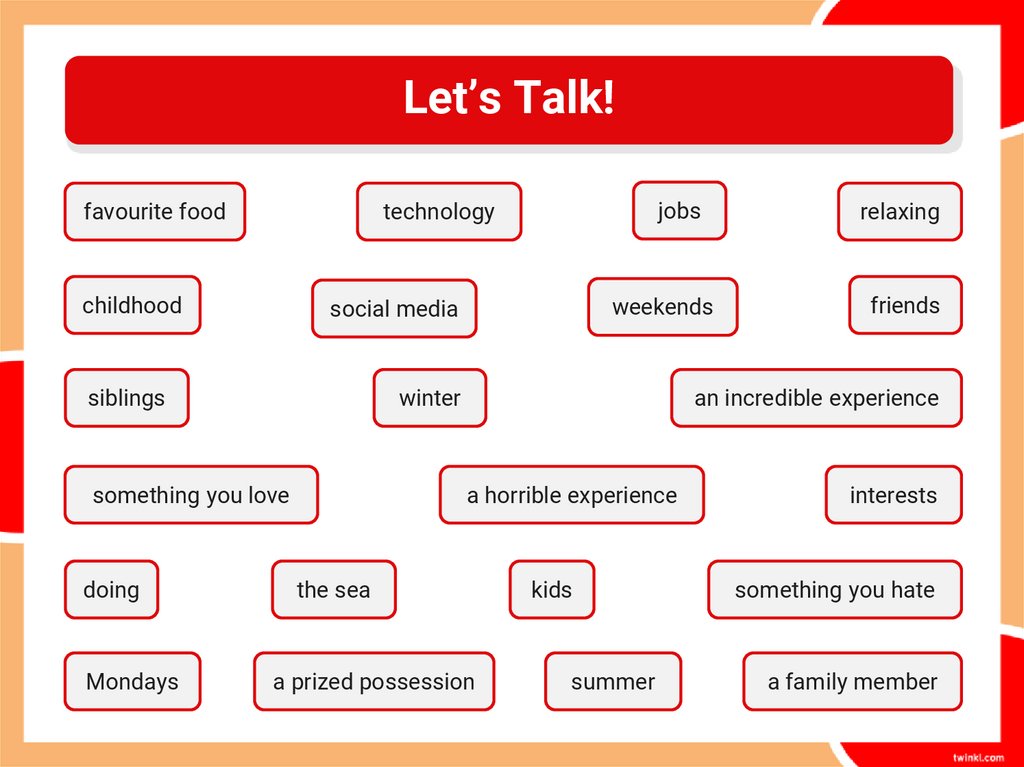
Let’s Talk!This fun activity encourages students to talk about a wide range of different topics.
How to run this activity:
• Divide the class into two sides. This could be the whole class or in small groups.
• Side A chooses a topic for Side B to talk about from the topics on the following
slide.
• Side B must talk about that topic for two minutes with no long pauses.
• When Side B has finished talking they must choose a topic for side A and so on.
Extra practice: Extra practice: Students can brainstorm more topics to include in
the list of things to talk about.
10.
Let’s Talk!favourite food
childhood
social media
siblings
Mondays
relaxing
weekends
friends
winter
something you love
doing
jobs
technology
an incredible experience
a horrible experience
the sea
a prized possession
kids
summer
interests
something you hate
a family member
11.
Common GroundIn this short, dynamic speaking activity, students will speak and get to know each other
better. It’s a great activity to practice question forms.
How to run this activity:
• Put students in pairs or small groups.
• They have three minutes to find out as many things that they have in common as
possible
Example:
Student 1: Do you enjoy playing tennis?
Student 2: Yes! I love playing tennis. I play every weekend in a local tennis club.
Student 1: Oh me too! How about football? Do you like it?
Extra practice: Students can report back to the whole class the things they
discovered they had in common.
12.
Find Someone Who…This is a great game to get students mingling and practice question forms.
How to run this activity:
• Students write the experiences and characteristics listed on the following slide.
• They then go around the class asking questions to different partners.
• They have to find people in the class who have had the experiences or match the
characteristics listed.
• When they find someone, they ask them a bit more about that experience and write
down their name next to the description.
• After five-ten ten minutes, stop the activity and students report their findings to the
whole class (optional)
Extra practice: Students can create their own experiences and characteristic to add
to the activity.
13.
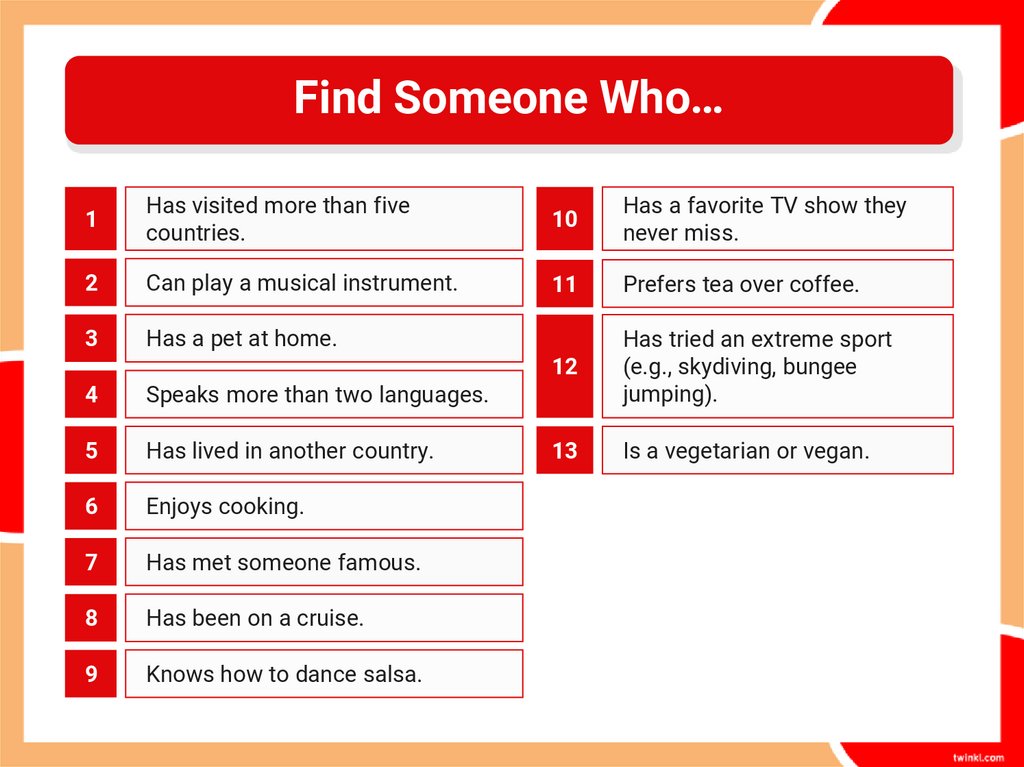
Find Someone Who…1
Has visited more than five
countries.
10
Has a favorite TV show they
never miss.
2
Can play a musical instrument.
11
Prefers tea over coffee.
3
Has a pet at home.
12
Has tried an extreme sport
(e.g., skydiving, bungee
jumping).
13
Is a vegetarian or vegan.
4
Speaks more than two languages.
5
Has lived in another country.
6
Enjoys cooking.
7
Has met someone famous.
8
Has been on a cruise.
9
Knows how to dance salsa.
14.
Continue The SentenceEncourage speaking and creativity with this fun ice-breaking activity.
How to run this activity:
• Students take turns to choose one of the sentence starters listed on the following
slide and read it out loud.
• The other students have a few seconds to improvise an ending to the sentence and
read their full sentences out loud
• The students vote on who created the most inventive or fun sentence and that
student gets a point.
• The next student chooses another sentence starter and so on.
Extra practice: Students can create their own sentence starters to test their
classmates.
15.
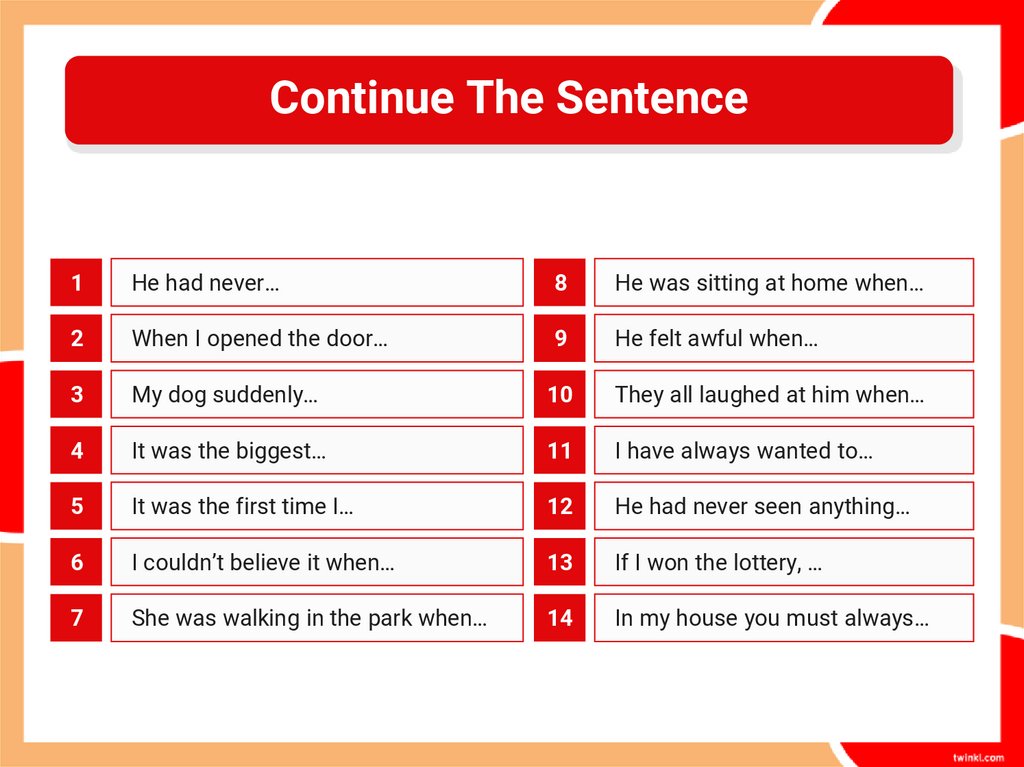
Continue The Sentence1
He had never…
8
He was sitting at home when…
2
When I opened the door…
9
He felt awful when…
3
My dog suddenly…
10
They all laughed at him when…
4
It was the biggest…
11
I have always wanted to…
5
It was the first time I…
12
He had never seen anything…
6
I couldn’t believe it when…
13
If I won the lottery, …
7
She was walking in the park when…
14
In my house you must always…
16.
What Am I Thinking Of?This is a fun and engaging game where one participant thinks of an object or thing, and
the others have to guess what it is by asking yes or no questions.
How to run this activity:
• Start by selecting one student to be the "Thinker." This person will think of an object,
animal, or concept that the others will try to guess.
• Encourage participants to ask questions that help narrow down the options. For
example, they might ask questions like, "Is it alive?" or "Can you find it in a kitchen?"
The Thinker can only answer "yes" or "no" to these questions.
• Participants continue asking questions until someone is confident enough to guess
what the Thinker is thinking of. Making a guess counts as a turn!
• Once the object has been guessed correctly or the group gives up, choose a new
Thinker and start the game again.
Extra practice: You can also play this in reverse, where the “Thinker” gives short
clues to the rest of the group and they have to guess what it is.