 Литература
Похожие презентации:






Writing short stories Demo lesson
1.
Writing short storiesDemo lesson
2.
Creative writingCreative writing is any writing that goes outside
the bounds of normal forms of literature, typically
identified by an emphasis on narrative craft,
character development, and the use of literary
devices or with various traditions of poetry. Both
fictional and non-fictional works fall into this
category, including such forms as
Novels
Poems
Short stories
3.
Short storyA short story is a type of fiction writing that is
distinguished by its briefness. A short story is
generally between 3,000 and 7,000 words long,
with the average length being about 5,000 words.
4.
The lion and the mouseA Lion lay asleep in the forest, his great head
resting on his paws. A timid little Mouse came
upon him unexpectedly, and in her fright and haste
to get away, ran across the Lion’s nose. Roused
from his nap, the Lion laid his huge paw angrily on
the tiny creature to kill her.
"Spare me!" begged the poor Mouse. "Please let
me go and some day I will surely repay you."
The Lion was much amused to think that a Mouse
could ever help him. But he was generous and
finally let the Mouse go.
5.
The lion and the mouseSome days later, while stalking his prey in the
forest, the Lion was caught in the toils of a hunter’s
net. Unable to free himself, he filled the forest with
his angry roaring. The Mouse knew the voice and
quickly found the Lion struggling in the net.
Running to one of the great ropes that bound him,
she gnawed it until it parted, and soon the Lion was
free.
"You laughed when I said I would repay you," said
the Mouse. "Now you see that even a Mouse can
help a Lion."
6.
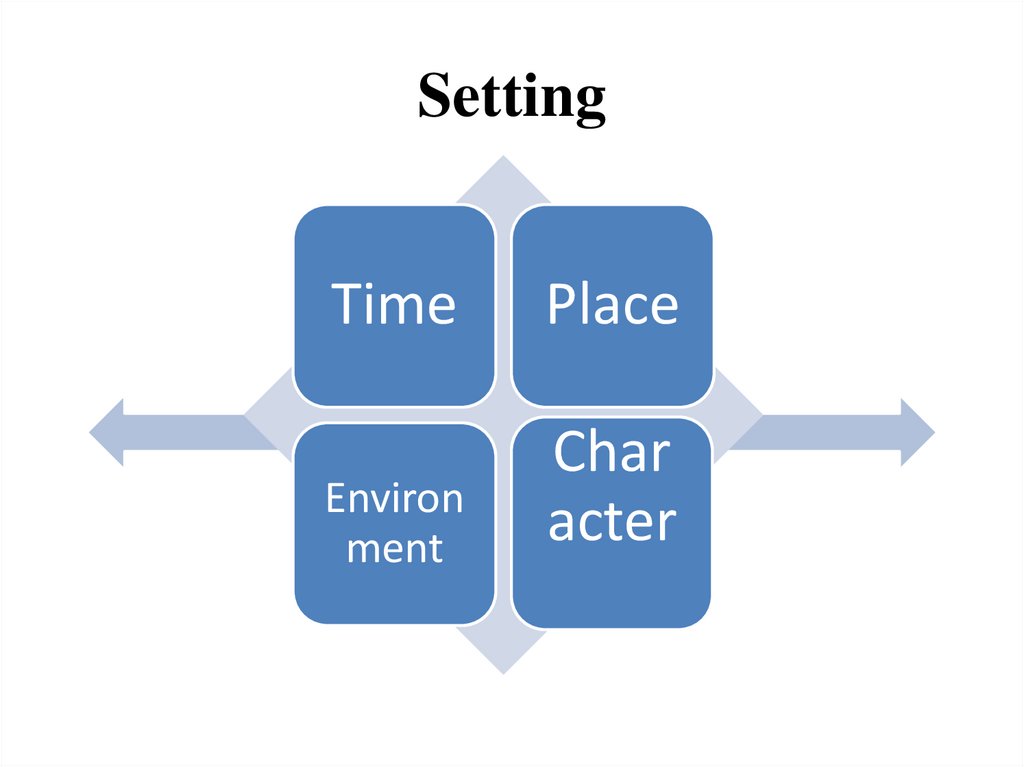
SettingTime
Place
Environ
ment
Char
acter
7.
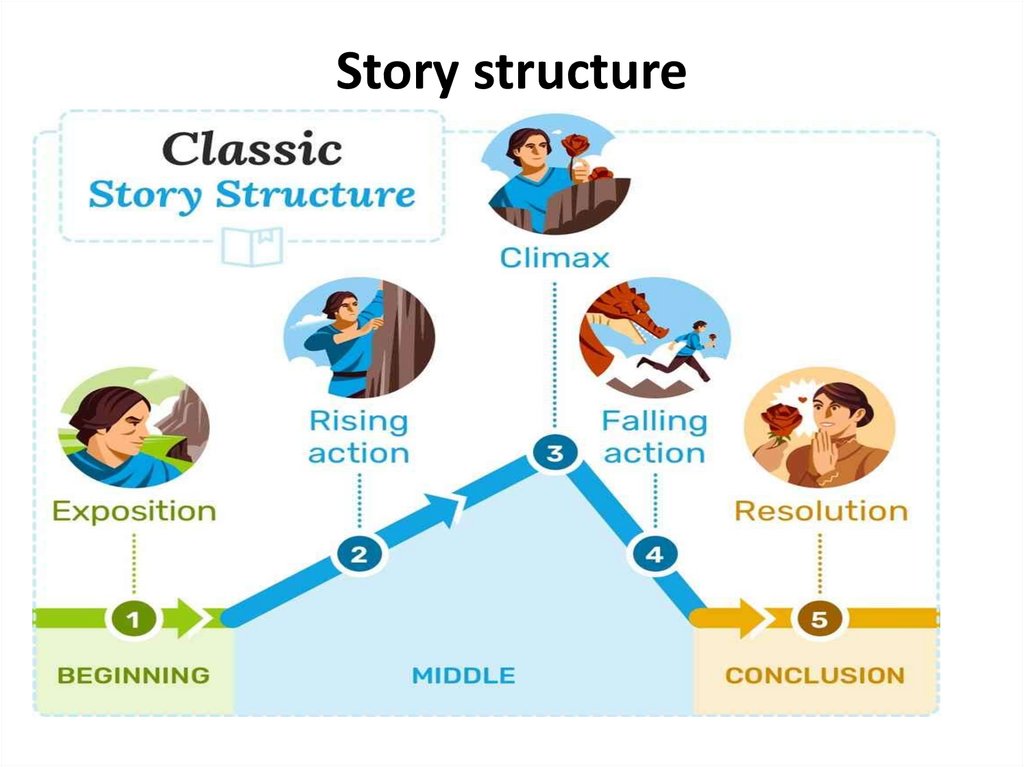
Story structure8.
ExpositionExposition is the description or explanation of background
information within a work of literature. Exposition can cover
characters and their relationship to one another, the setting
or time and place of events, as well as any relevant ideas,
details, or historical context.
Some additional key details about exposition:
• Writers can introduce exposition into a story in a variety of
ways, but it appears across all genres and styles of
storytelling.
• The individual pieces of background information that
writers use to create exposition are known as expository
details.
• The word exposition comes from the Latin word exponere,
which means to put out, exhibit, or explain.
• Questions: Who, What, When, Where?
9.
The dog and his reflectionA Dog, to whom the butcher had thrown a bone,
was hurrying home with his prize as fast as he
could go. As he crossed a narrow footbridge, he
happened to look down and saw himself
reflected in the quiet water as if in a mirror. But
the greedy Dog thought he saw a real Dog
carrying a bone much bigger than his own. …..
10.
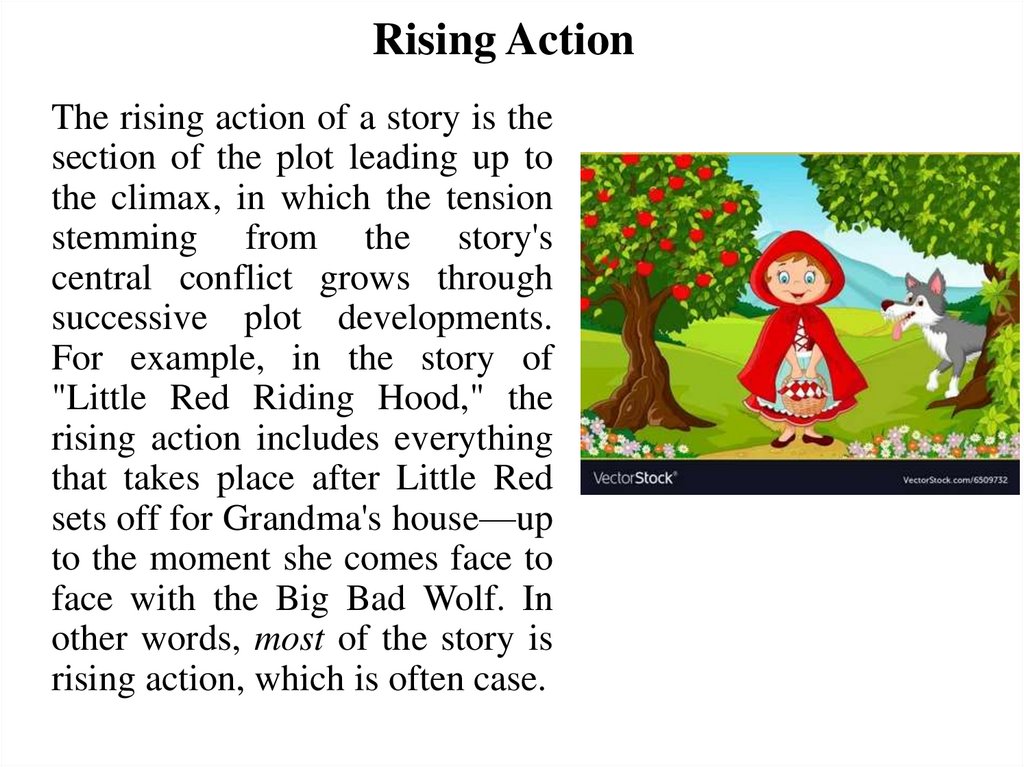
Rising ActionThe rising action of a story is the
section of the plot leading up to
the climax, in which the tension
stemming from the story's
central conflict grows through
successive plot developments.
For example, in the story of
"Little Red Riding Hood," the
rising action includes everything
that takes place after Little Red
sets off for Grandma's house—up
to the moment she comes face to
face with the Big Bad Wolf. In
other words, most of the story is
rising action, which is often case.
11.
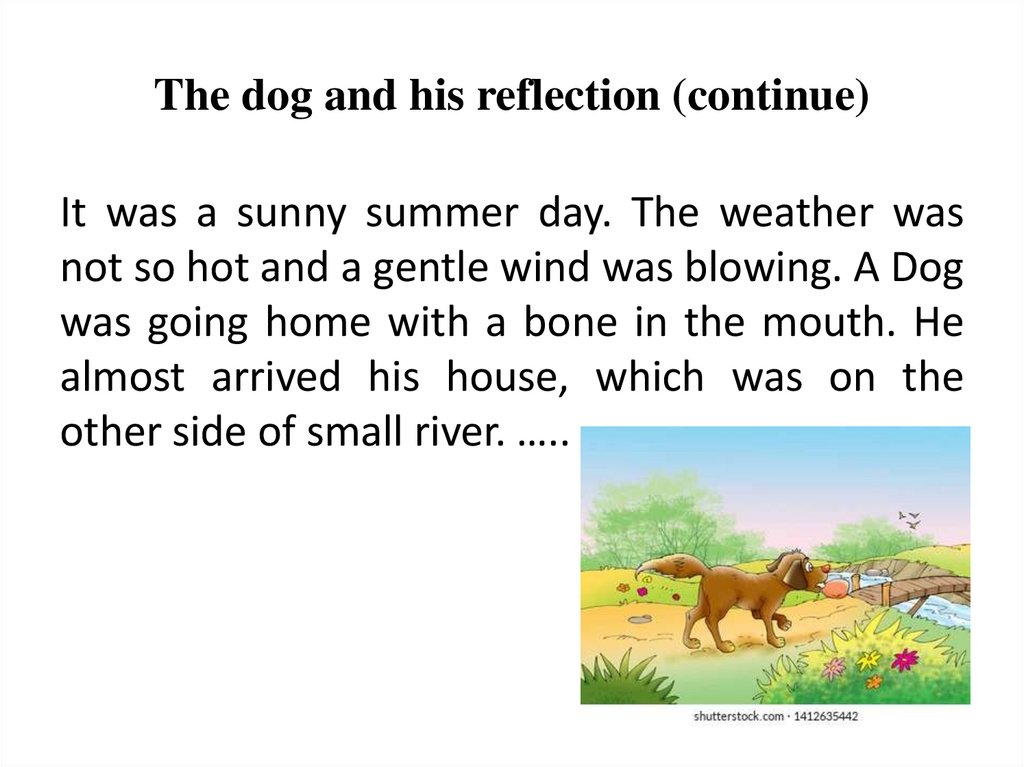
The dog and his reflection (continue)It was a sunny summer day. The weather was
not so hot and a gentle wind was blowing. A Dog
was going home with a bone in the mouth. He
almost arrived his house, which was on the
other side of small river. …..
12.
The climaxThe climax of a story is the dramatic turning
point when tension is at an all-time high. In
most modern stories, this crucial story
beat takes place toward the end of the story and
will see the protagonist on the cusp between
failure and success — though this is not always
the case.
13.
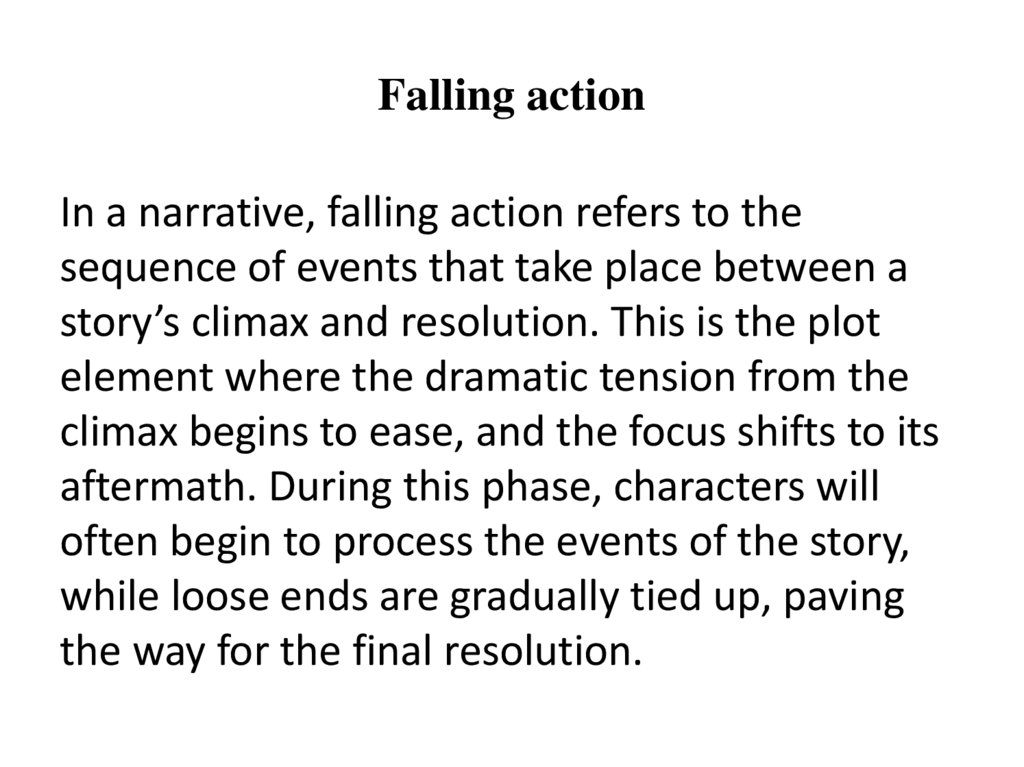
Falling actionIn a narrative, falling action refers to the
sequence of events that take place between a
story’s climax and resolution. This is the plot
element where the dramatic tension from the
climax begins to ease, and the focus shifts to its
aftermath. During this phase, characters will
often begin to process the events of the story,
while loose ends are gradually tied up, paving
the way for the final resolution.
14.
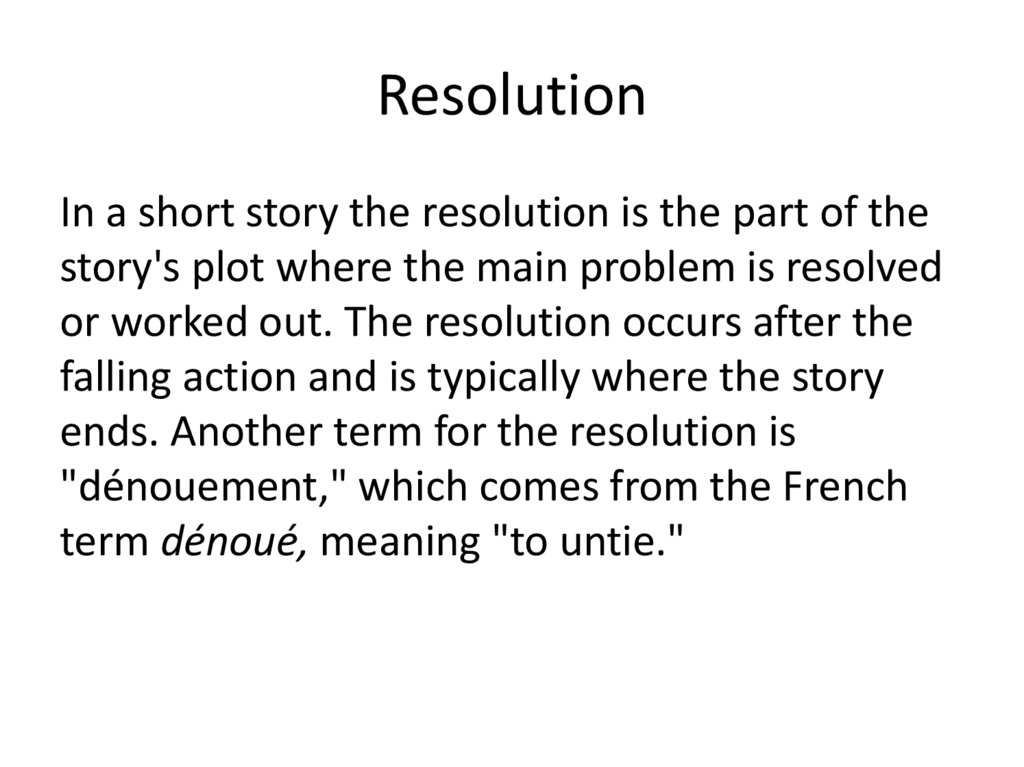
ResolutionIn a short story the resolution is the part of the
story's plot where the main problem is resolved
or worked out. The resolution occurs after the
falling action and is typically where the story
ends. Another term for the resolution is
"dénouement," which comes from the French
term dénoué, meaning "to untie."