


 Английский язык
 Образование
Похожие презентации:








The International English Language Testing System
1.
IELTS Top Tipstakeielts.org
2.
IELTS isThe International English Language Testing System is designed to help you work, study or
migrate to a country where English is the native language. This includes countries such as
Australia, Canada, New Zealand, the UK and USA.
Ways of taking the test
IELTS on computer
IELTS on paper
takeielts.org
3.
AcademicGeneral Training
The IELTS Academic test is suitable for those wanting to
study in an English-speaking environment or university
(higher education). You can also take IELTS Academic
for professional registration purposes.
The IELTS General Training test is suitable for those
applying to study below degree level. This includes an
English-speaking school or college. It can also be taken
for work experience or other employment training.
The test measures if you are ready to begin studying in
English. It features vocabulary that is familiar within an
academic setting.
IELTS General Training is also required for migration to
Australia, Canada, New Zealand and the UK. The test
features everyday English language skills that you will
need in social and workplace environments.
takeielts.org
4.
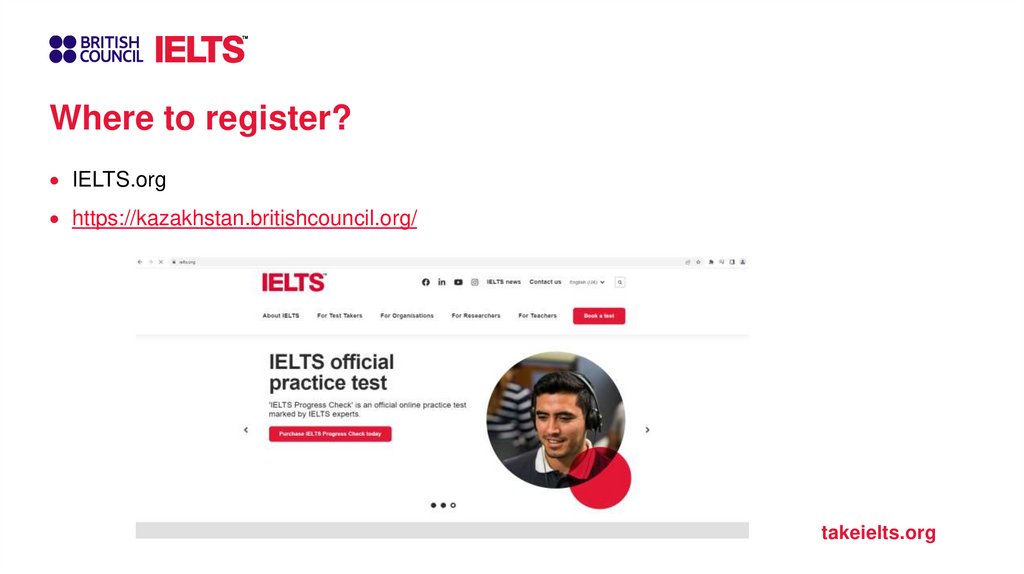
Where to register?IELTS.org
https://kazakhstan.britishcouncil.org/
takeielts.org
5.
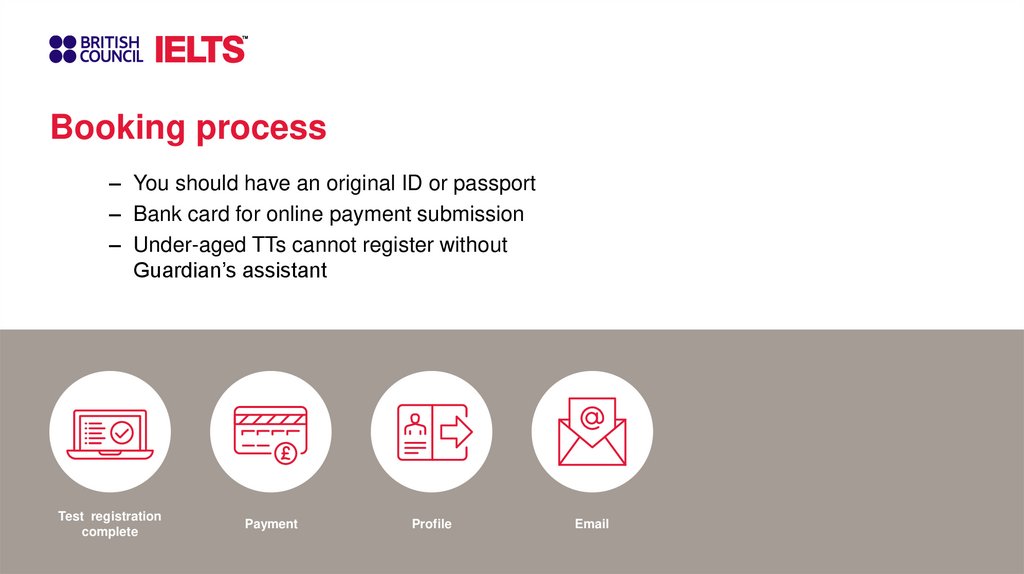
Booking process– You should have an original ID or passport
– Bank card for online payment submission
– Under-aged TTs cannot register without
Guardian’s assistant
Test registration
complete
Payment
Profile
6.
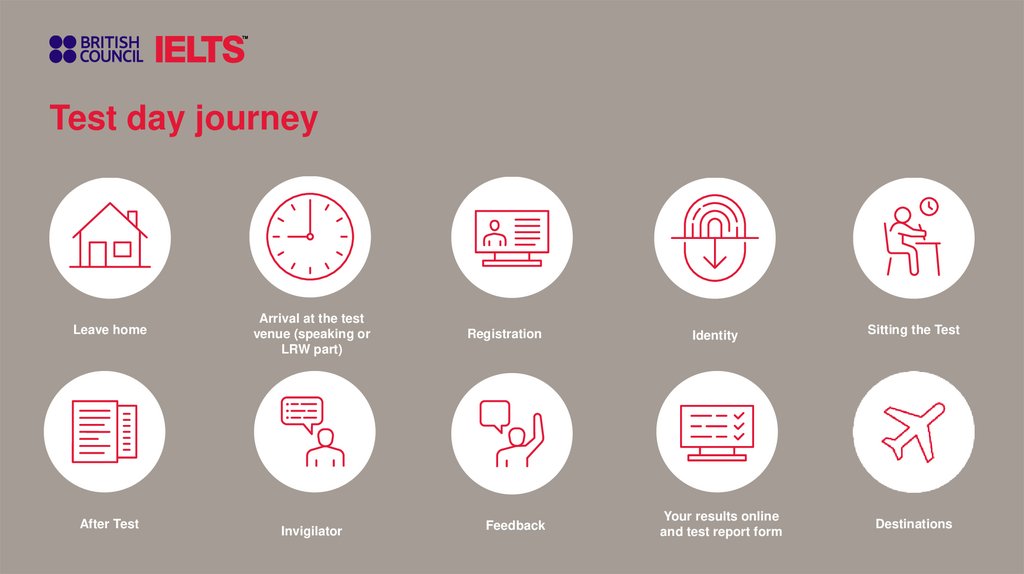
Test day journeyLeave home
After Test
Arrival at the test
venue (speaking or
LRW part)
Invigilator
Registration
Feedback
Identity
Sitting the Test
Your results online
and test report form
Destinations
7.
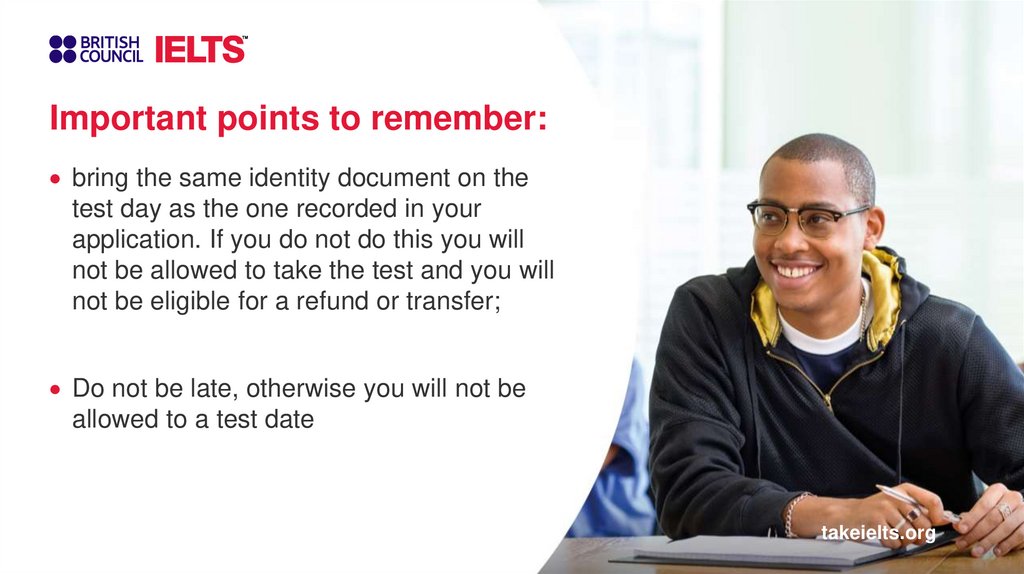
Important points to remember:bring the same identity document on the
test day as the one recorded in your
application. If you do not do this you will
not be allowed to take the test and you will
not be eligible for a refund or transfer;
Do not be late, otherwise you will not be
allowed to a test date
takeielts.org
8.
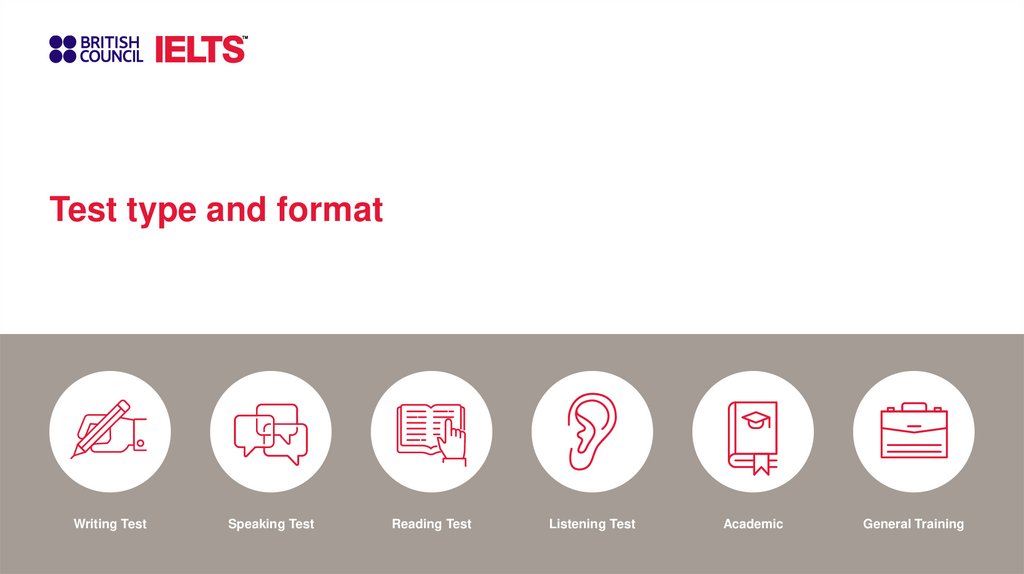
Test type and formatWriting Test
Speaking Test
Reading Test
Listening Test
Academic
General Training
9.
Listening• 30 minutes plus 10 minutes to transfer
answers
• 40 questions divided into 4 sections
• You hear the audio once only
• The questions get progressively more difficult
• Answers appear in the order of the questions
takeielts.org
10.
Sections 1 and 2 - situations set ineveryday social contexts
• Section 1 - conversation between two speakers
e.g. a person buying tickets for a concert
• Section 2 - a monologue
e.g. a speech about local facilities
takeielts.org
11.
Section 3 and 4 - situations set ineducational and training contexts
• Section 3 - conversation between 3-4 speakers
e.g. university students discussing an assignment
• Section 4 - monologue on an academic subject
e.g. talk by an university professor
takeielts.org
12.
Before the exam• Build up your vocabulary - 3 to 4 new words a
day
• Build up concentration skills - listening in
English comfortably for 30 minutes
• Listen to a range of accents
http://www.bbc.co.uk/worldservice/learningenglish/
• Do exam questions
takeielts.org
13.
During the examBefore each of the 4 sections you have time to read the questions
underline the key words
anticipate the answers
e.g. The museum closes during the summer at _____
(time)
Do not panic if too difficult or too fast - relax and tune in
If you do not know the answer to a question, guess but do not waste time move quickly to the next one
Multi-task: listen - answer - read ahead
Be careful with your spelling and grammar
takeielts.org
14.
During the examPay attention to the word limit
e.g.
Instructions: Complete the sentence using no more than
two words
Answer: leather coat
not
coat made of leather
Always write an answer - there are no penalties for wrong
answers
takeielts.org
15.
Reading• 60 minutes NO extra time to transfer answers
• 3 reading passages
• 40 questions
• Timing is crucial!
takeielts.org
16.
Before the examRead as much as possible - focus on reading short articles in
newspapers and magazines, this helps build up your vocabulary
Improve your reading speed:
Problem - text length
Solution - improve key skills by:
Skimming - reading quickly for general meaning - shows you
which paragraph(s) the answer can be found in
Scanning - looking for specific information relating to the
question
Reading in detail - tells you what the answer is
takeielts.org
17.
Before the examLearn the exam - before the exam, you should make yourself
familiar with each type of question
Train yourself, don’t test yourself
• Problem - too many tests in exam conditions
• Solution - do some “open book” tests where you can see the
answers as you do the questions so you can learn how to
answer the questions
takeielts.org
18.
During the examTime management - the texts are long so you need to have a definite strategy for how you
manage your time in the exam
Focus on the question - avoid careless errors
Problem - easy to miss a word such as “always” in the question
Solution - go back and read question carefully, and make sure that the question says what
you think it says!
e.g. Please answer True / False / Not Given
1. The animals will sometimes be taken out their cages at night.
Answer: False
Text: The zookeeper always moves the animals from their cages after dark.
takeielts.org
19.
WritingTask 1: description task – 150 words
Task 2: opinion essay – 250 words
Be strict with your timings:
Task 1: 20 minutes
Task 2: 40 minutes
Plan - which task first?
takeielts.org
20.
Writing task 1Structure
Introduction - make sure the introduction describes:
what / when / where and gives a general overview statement
Body - then look for possible ways to group the information:
• similarities and differences
• time periods
• groups
takeielts.org
21.
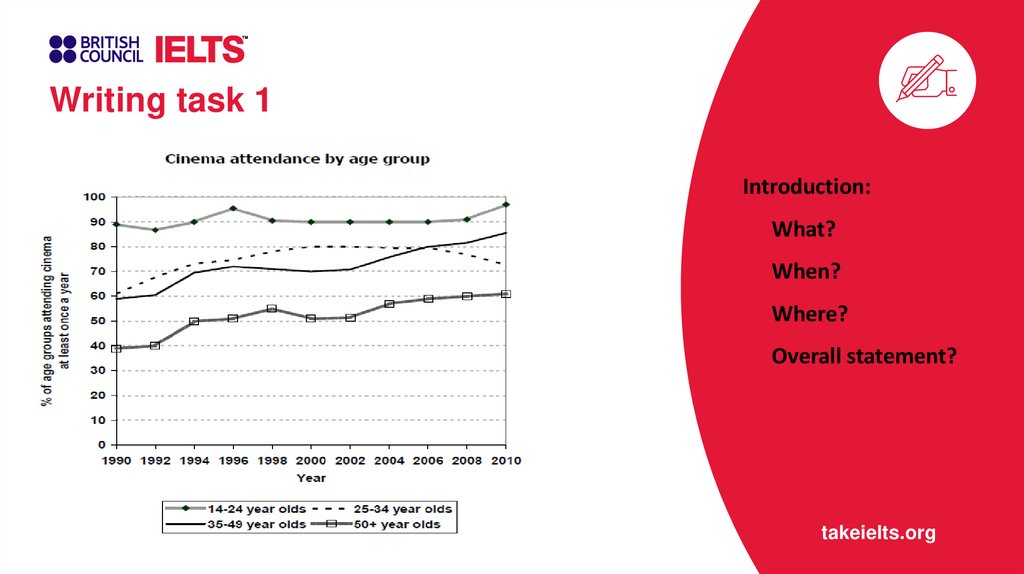
Writing task 1Introduction:
What?
When?
Where?
Overall statement?
takeielts.org
22.
Writing task 1Introduction:
• What
• When
• Where
• Overall statement
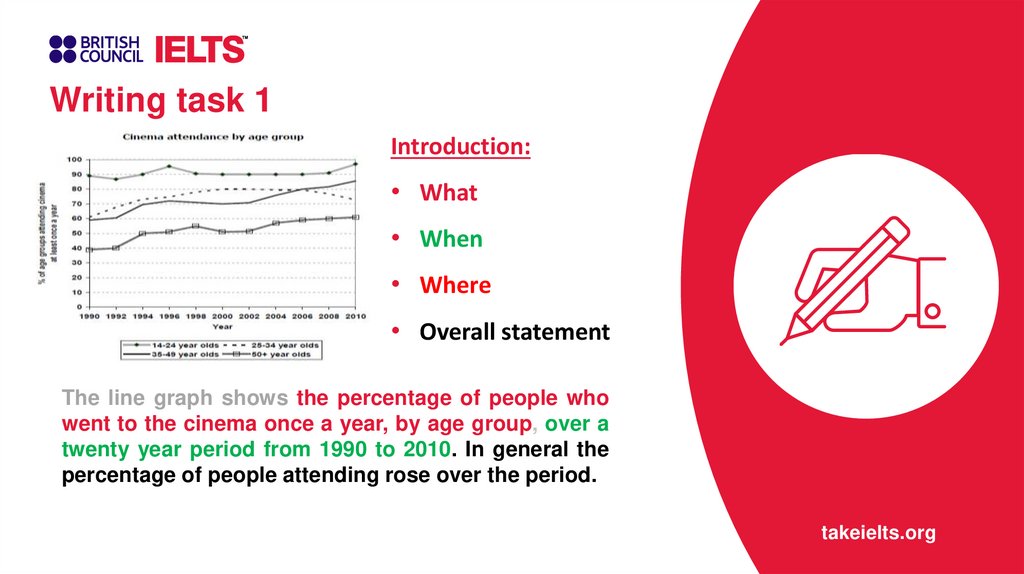
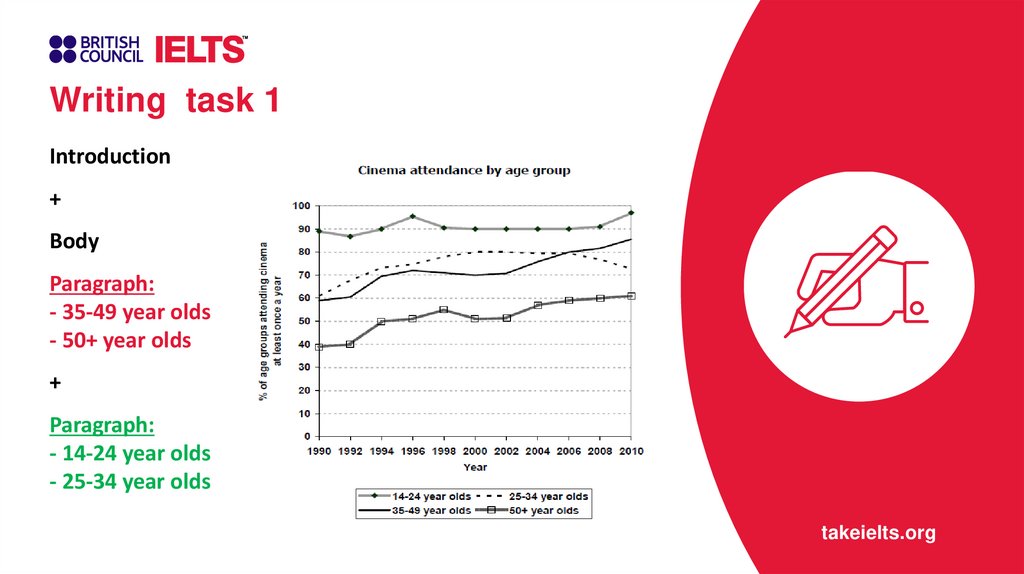
The line graph shows the percentage of people who
went to the cinema once a year, by age group, over a
twenty year period from 1990 to 2010. In general the
percentage of people attending rose over the period.
takeielts.org
23.
Writing task 1Introduction
+
Body
Paragraph:
- 35-49 year olds
- 50+ year olds
+
Paragraph:
- 14-24 year olds
- 25-34 year olds
takeielts.org
24.
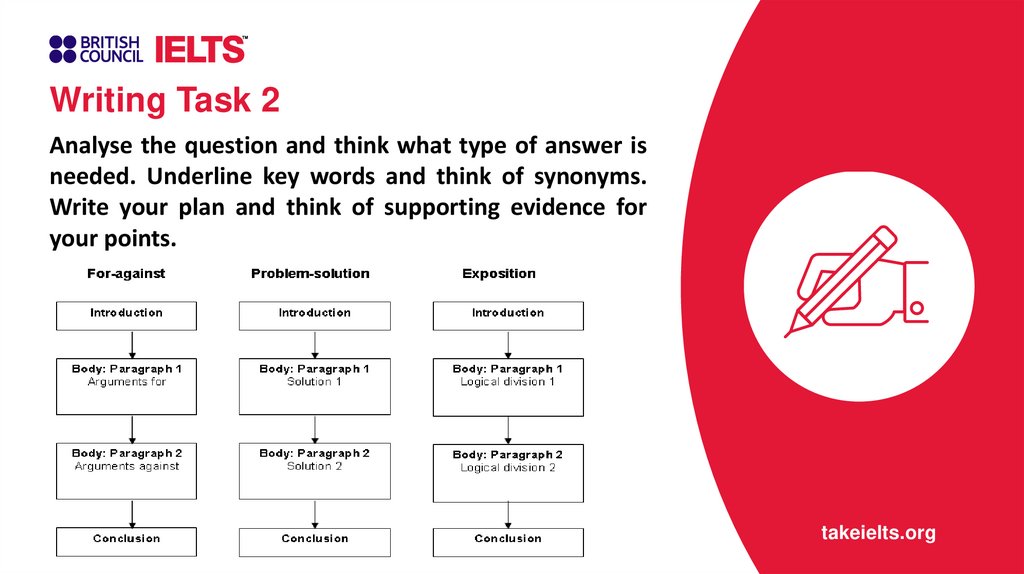
Writing Task 2Analyse the question and think what type of answer is
needed. Underline key words and think of synonyms.
Write your plan and think of supporting evidence for
your points.
takeielts.org
25.
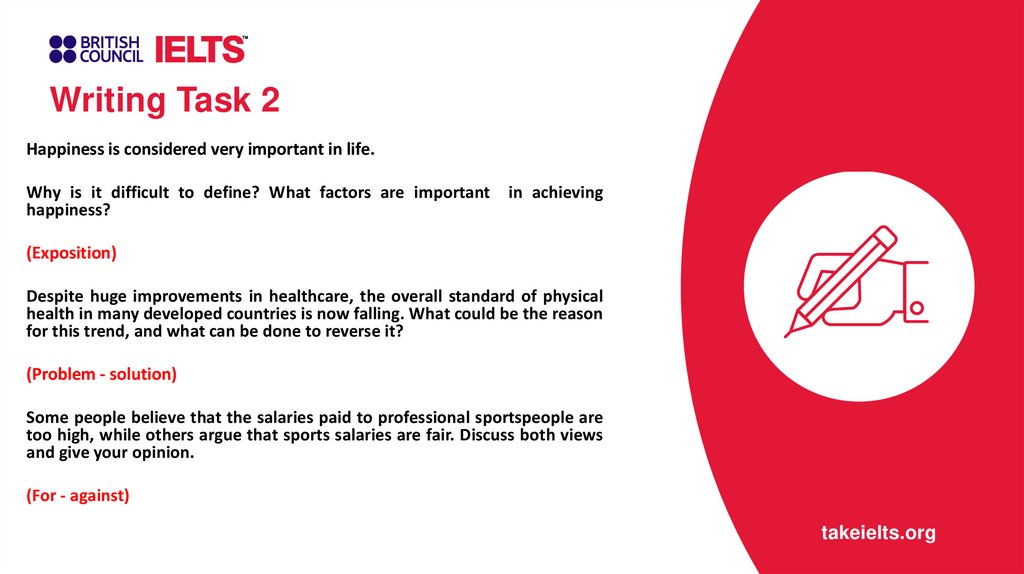
Writing Task 2Happiness is considered very important in life.
Why is it difficult to define? What factors are important
happiness?
in achieving
(Exposition)
Despite huge improvements in healthcare, the overall standard of physical
health in many developed countries is now falling. What could be the reason
for this trend, and what can be done to reverse it?
(Problem - solution)
Some people believe that the salaries paid to professional sportspeople are
too high, while others argue that sports salaries are fair. Discuss both views
and give your opinion.
(For - against)
takeielts.org
26.
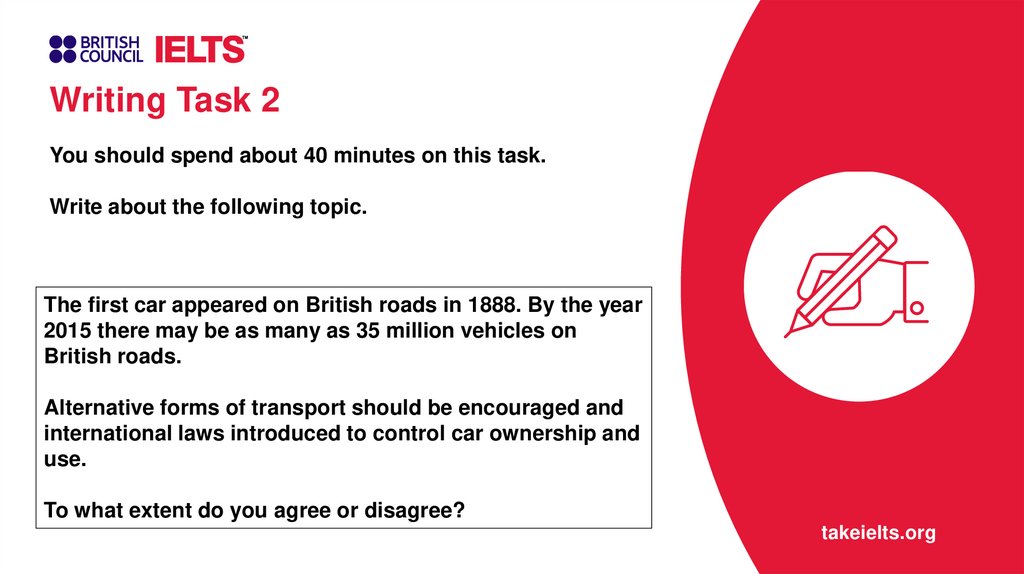
Writing Task 2You should spend about 40 minutes on this task.
Write about the following topic.
The first car appeared on British roads in 1888. By the year
2015 there may be as many as 35 million vehicles on
British roads.
Alternative forms of transport should be encouraged and
international laws introduced to control car ownership and
use.
To what extent do you agree or disagree?
takeielts.org
27.
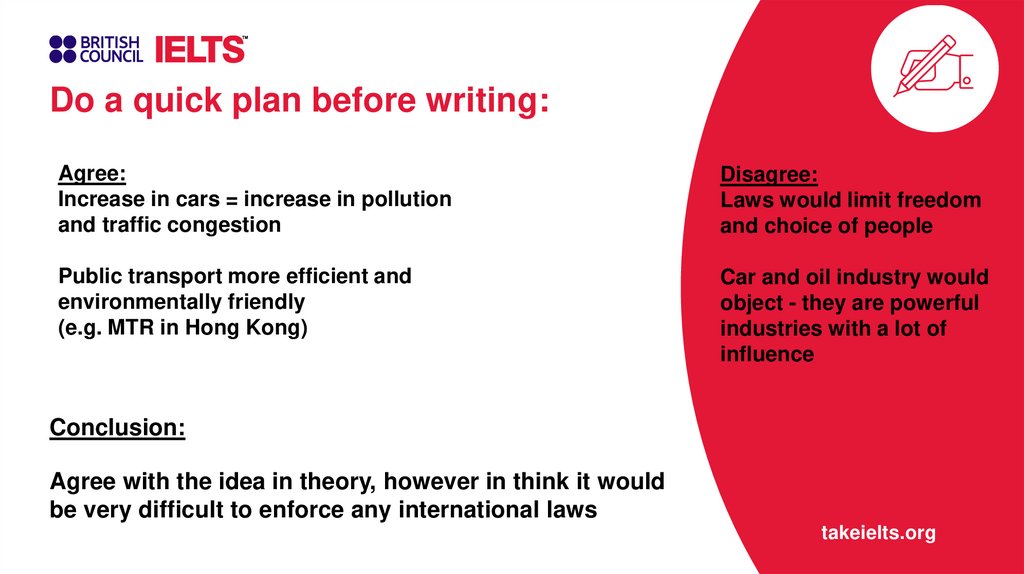
Do a quick plan before writing:Agree:
Increase in cars = increase in pollution
and traffic congestion
Disagree:
Laws would limit freedom
and choice of people
Public transport more efficient and
environmentally friendly
(e.g. MTR in Hong Kong)
Car and oil industry would
object - they are powerful
industries with a lot of
influence
Conclusion:
Agree with the idea in theory, however in think it would
be very difficult to enforce any international laws
takeielts.org
28.
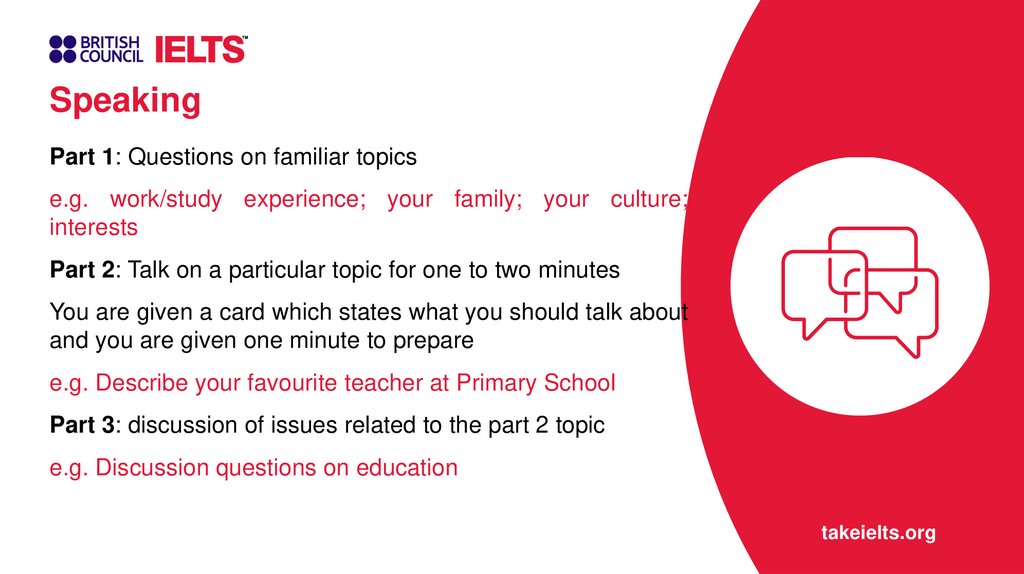
SpeakingPart 1: Questions on familiar topics
e.g. work/study experience; your family; your culture;
interests
Part 2: Talk on a particular topic for one to two minutes
You are given a card which states what you should talk about
and you are given one minute to prepare
e.g. Describe your favourite teacher at Primary School
Part 3: discussion of issues related to the part 2 topic
e.g. Discussion questions on education
takeielts.org
29.
Before the exam• Try to talk in English as much as possible
• Practise at home and record yourself - how do you sound?
takeielts.org
30.
During the exam• Try to give detailed answers
• Do not learn prepared answers
• Talk as fluently as possible and be spontaneous
• Relax, be confident, look at the examiner
takeielts.org
31.
During the exam• Ask for clarification if necessary
• Develop your answers
• Express your opinions; you will be assessed on your ability to
communicate
This is your time to show off!
You have 11-14 minutes to
impress the examiner!
takeielts.org
32.
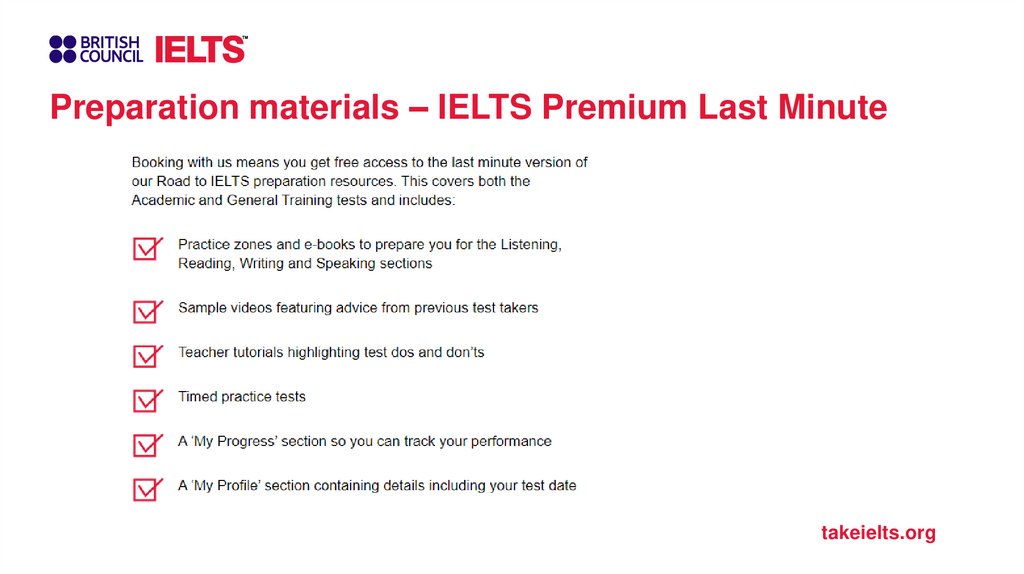
Preparation materials – IELTS Premium Last Minutetakeielts.org
33.
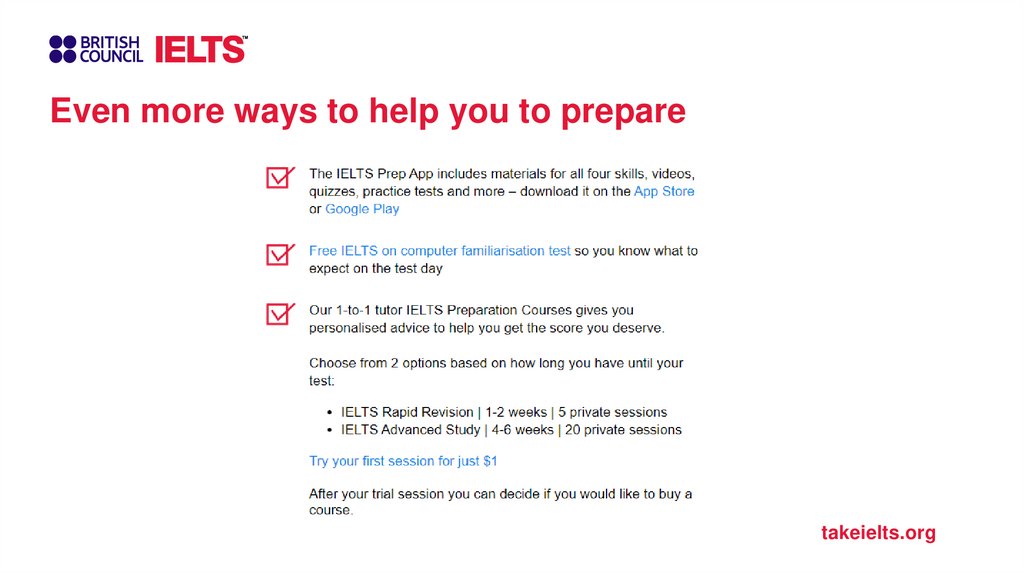
Even more ways to help you to preparetakeielts.org
34.
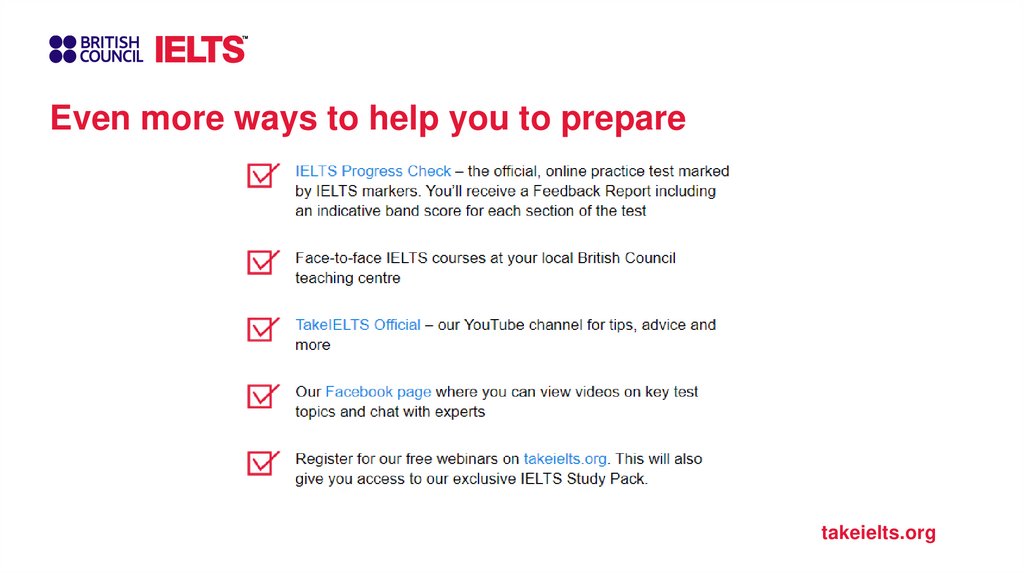
Even more ways to help you to preparetakeielts.org
35.
Thank youBritish Council is a proud co-owner of IELTS.
takeielts.org