




 Финансы
Похожие презентации:










Group Project 1: Startup Concept - The Guide Introduction to Entrepreneurship
1.
Group Project 1:Startup Concept - The Guide
Introduction to Entrepreneurship
2.
Introduction to EntrepreneurshipTable of
Contents
Startup Concept Guide
I.
The Slides You MUST Include slide
I.
Recapping: What to Include in a Presentation?
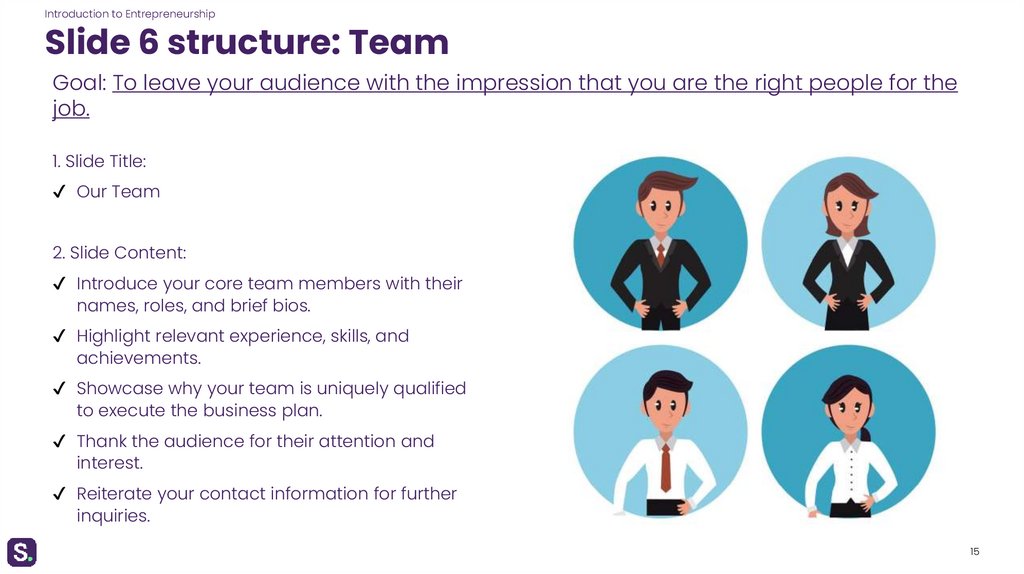
I.
The Do’s and Don’ts of a Startup Deck
I.
Presentation DO’s
I.
Presentation DON’T’s
1) Introduction slide
2) Problem slide
3) Solution slide
4) Product / service slide
5) Target Market slide
6) Team slide
2
3.
Introduction to EntrepreneurshipThe 6 slides you MUST include
Startup Concept Guide Introduction
The structure of a presentation is one of the most important aspects to get right. Most startup investors go
through a very large amount of decks. This means that it is in your best interest to cover all the topics that
audience expect to see.
If you have a weird structure, you risk hitting fewer checkboxes on the list, in which case the investors won’t have
a reason to consider your project more closely. Moreover, a weird structure increases the chance that your
audience will be left confused.
The keys to a successful presentation are:
1.
To present your idea as clearly and concisely
as possible.
2. To differentiate your idea from other startups.
3. To convince your audience of the high
potential and high chances of success of
your idea.
3
4.
Introduction to EntrepreneurshipSlide 1 explanation: Introduction
Goal: To communicate extremely clearly and concisely what your business is offering.
In a way, this is the most important slide
because it establishes the first impression. After
seeing it, your audience should have no doubt
in their mind what your business is about.
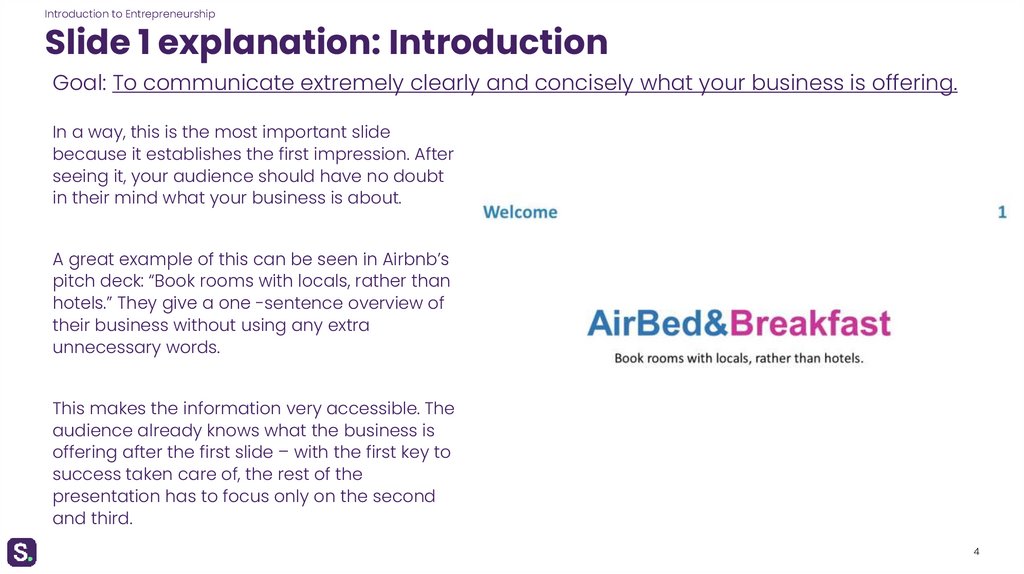
A great example of this can be seen in Airbnb’s
pitch deck: “Book rooms with locals, rather than
hotels.” They give a one -sentence overview of
their business without using any extra
unnecessary words.
This makes the information very accessible. The
audience already knows what the business is
offering after the first slide – with the first key to
success taken care of, the rest of the
presentation has to focus only on the second
and third.
4
5.
Introduction to EntrepreneurshipSlide 1 structure: Introduction
Goal: To communicate extremely clearly and concisely what your business is offering.
1. Slide Title:
✔ Your Company Name
✔ Your Logo
2. Slide Content:
✔ A striking visual or tagline that represents your brand.
✔ A brief introduction to your startup, including your
name, the problem you're solving, and a teaser of
your solution.
✔ Contact information (email, website, social media).
5
6.
Introduction to EntrepreneurshipSlide 2 explanation: Problem
Goal: To convince people you are solving a real, acute pain.
The number one reason for startup failure is the lack of product-market fit. In other words, you are building
something that nobody is willing to pay for.
The job of this slide is to convince your audience that this is not the case. This means the people you are
presenting to need to empathize with your target customer. They need to understand the problem
rationally, but also emotionally.
A great tip regarding the problem is to focus:
solve one problem, rather than many.
1) A pitch deck usually doesn’t give you
enough time to talk about multiple
problems.
2) solving a single problem is hard enough,
and early -stage startups shouldn’t spread
their resources too thinly. It’s much better
to solve one problem well, rather than to
solve 10 problems badly.
6
7.
Introduction to EntrepreneurshipSlide 2 structure: Problem
Goal: To convince people you are solving a real, acute pain.
1. Slide Title:
✔ The Problem
2. Slide Content:
✔ Clearly articulate the problem or pain point your
target audience faces.
✔ Use data, statistics, or real-life examples to
illustrate the severity and significance of the
problem.
✔ Make the audience empathize with the issue.
7
8.
Introduction to EntrepreneurshipSlide 3 explanation: Solution
Goal: To clearly present your business offering and your unique value proposition.
Hopefully, your introductory slide has already explained
what your business does, which would leave you with the
opportunity to emphasize the uniqueness and benefits of
your offering.
Don’t talk about features. Instead, talk about what makes
your offering valuable to your customers, and what makes it
unique compared to other solutions that are out there.
Ideally, your solution would be simple and highly scalable.
As an early-stage startup you don’t have the capacity to
deal with a lot of complexity. Also because scalability is a
prerequisite to rapid growth. Remember that growth
potential is a mandatory quality for startups that are aiming
to attract startup funding.
8
9.
Introduction to EntrepreneurshipSlide 3 structure: Solution
Goal: To clearly present your business offering and your unique value proposition.
1. Slide Title:
✔ Our Solution
2. Slide Content:
✔ Explain how your product or service
addresses the problem.
✔ Highlight the key features and benefits.
✔ Use visuals, diagrams, or a product
demo to make your solution tangible.
9
10.
Introduction to EntrepreneurshipSlide 4 explanation: Product or Service
Goal: To explain how your idea will work.
While the solution slide focuses more on your
offering and value proposition, the product
slide needs to give your audience a good idea
of what you’re building.
In this slide, you can name the key features of
your product, but don’t go in-depth. Remember
that this is a high-level overview, and keep in
mind that features change often when
customer feedback demands it.
10
11.
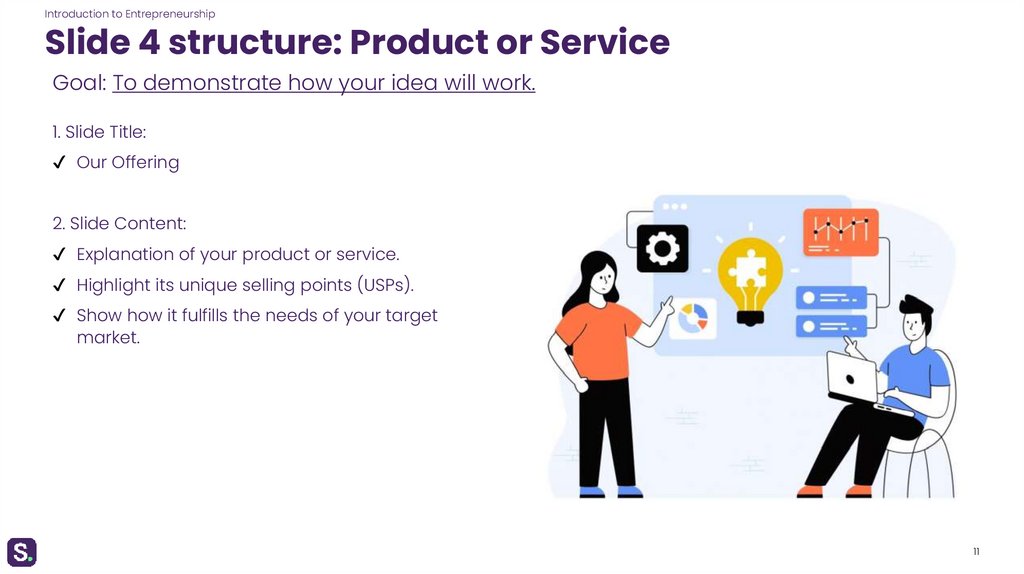
Introduction to EntrepreneurshipSlide 4 structure: Product or Service
Goal: To demonstrate how your idea will work.
1. Slide Title:
✔ Our Offering
2. Slide Content:
✔ Explanation of your product or service.
✔ Highlight its unique selling points (USPs).
✔ Show how it fulfills the needs of your target
market.
11
12.
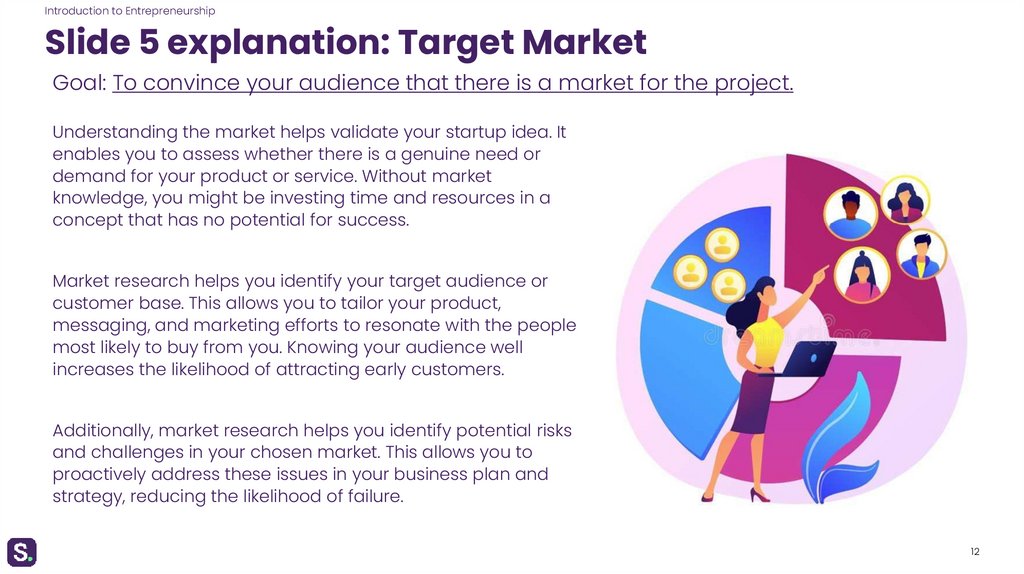
Introduction to EntrepreneurshipSlide 5 explanation: Target Market
Goal: To convince your audience that there is a market for the project.
Understanding the market helps validate your startup idea. It
enables you to assess whether there is a genuine need or
demand for your product or service. Without market
knowledge, you might be investing time and resources in a
concept that has no potential for success.
Market research helps you identify your target audience or
customer base. This allows you to tailor your product,
messaging, and marketing efforts to resonate with the people
most likely to buy from you. Knowing your audience well
increases the likelihood of attracting early customers.
Additionally, market research helps you identify potential risks
and challenges in your chosen market. This allows you to
proactively address these issues in your business plan and
strategy, reducing the likelihood of failure.
12
13.
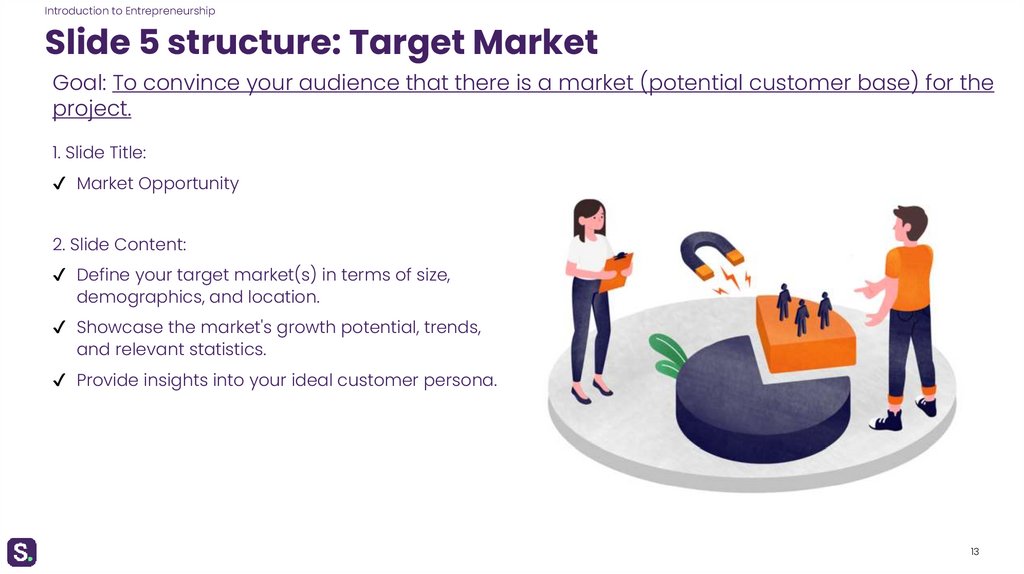
Introduction to EntrepreneurshipSlide 5 structure: Target Market
Goal: To convince your audience that there is a market (potential customer base) for the
project.
1. Slide Title:
✔ Market Opportunity
2. Slide Content:
✔ Define your target market(s) in terms of size,
demographics, and location.
✔ Showcase the market's growth potential, trends,
and relevant statistics.
✔ Provide insights into your ideal customer persona.
13
14.
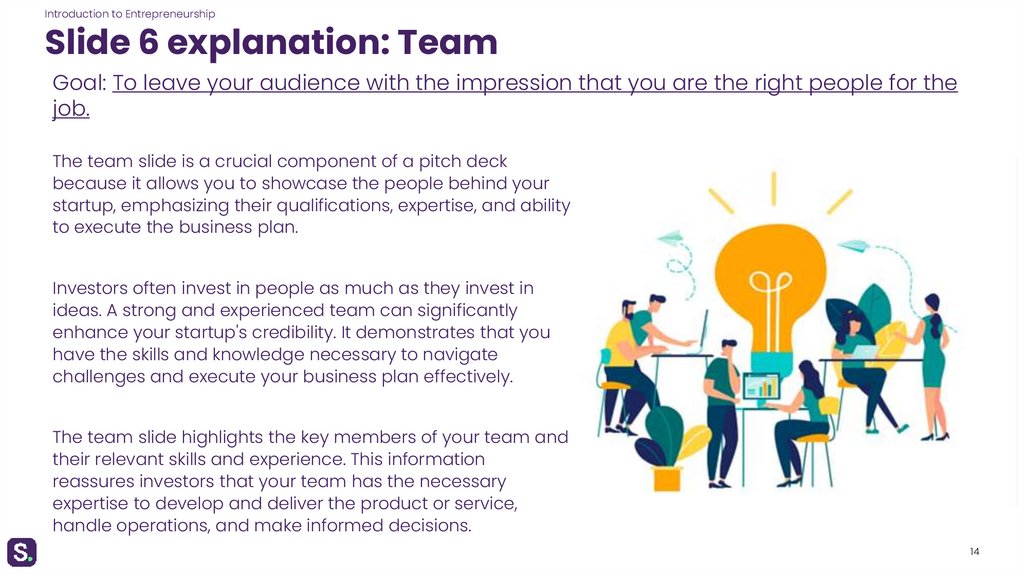
Introduction to EntrepreneurshipSlide 6 explanation: Team
Goal: To leave your audience with the impression that you are the right people for the
job.
The team slide is a crucial component of a pitch deck
because it allows you to showcase the people behind your
startup, emphasizing their qualifications, expertise, and ability
to execute the business plan.
Investors often invest in people as much as they invest in
ideas. A strong and experienced team can significantly
enhance your startup's credibility. It demonstrates that you
have the skills and knowledge necessary to navigate
challenges and execute your business plan effectively.
The team slide highlights the key members of your team and
their relevant skills and experience. This information
reassures investors that your team has the necessary
expertise to develop and deliver the product or service,
handle operations, and make informed decisions.
14
15.
Introduction to EntrepreneurshipSlide 6 structure: Team
Goal: To leave your audience with the impression that you are the right people for the
job.
1. Slide Title:
✔ Our Team
2. Slide Content:
✔ Introduce your core team members with their
names, roles, and brief bios.
✔ Highlight relevant experience, skills, and
achievements.
✔ Showcase why your team is uniquely qualified
to execute the business plan.
✔ Thank the audience for their attention and
interest.
✔ Reiterate your contact information for further
inquiries.
15
16.
Introduction to EntrepreneurshipTo Sum Up ☺
16
17.
Introduction to EntrepreneurshipSummary of the Startup Concept Guide
Remember to keep the slides visually appealing, concise, and easy to follow. Use compelling visuals,
graphics, and a consistent design theme throughout the pitch deck. Practice your presentation to ensure
a confident and engaging delivery.
1.
Introduction - Communicate clearly and concisely what your business is
offering.
2.
Problem - Convince people you are solving a real, acute pain.
3.
Solution - Present your business offering and unique value proposition.
4.
Product / Service - Demonstrate your product or service.
5.
Market – Convince your audience that there is a market (potential
customer base) for the project
6.
Team - Show you are the right people for the job.
17
18.
Introduction to EntrepreneurshipThe DO’s and DON’T’s ☺
18
19.
Introduction to EntrepreneurshipThe DO’s
✔ Use a large font and exclusively short information-dense
sentences.
✔ Use bullet points, don’t write whole paragraphs. The text on
the slides is meant to provide key information and structure.
✔ Use narrative – it’s easier to keep the audience engaged if
you’re telling a story rather than presenting dry facts.
✔ Use pictures and other visuals (charts, graphical elements,
etc.). The advantage of visual information is that it can
communicate information at a glance.
✔ Add contact details on the last slide.
✔ Exercise making the pitch in front of people – it’s crucial that
you present fluently and you can deal well with time
restrictions at pitching events.
19
20.
Introduction to EntrepreneurshipThe DON’T’s
✔ Add too much information on the slides. There’s no time
to read it all during a presentation.
✔ Use an overly unique and creative structure. The audience
expects certain information, you have to give it to them as
clearly as possible.
✔ Add too many details for a single topic. Time constraints
you, and it’s better to focus on the most important pieces
of information in a bit more depth, rather than to list a lot
of things without covering them at all.
20