Похожие презентации:






Lecture 6. The encyclopedic view of meaning
1. Lecture 6. The encyclopedic view of meaning
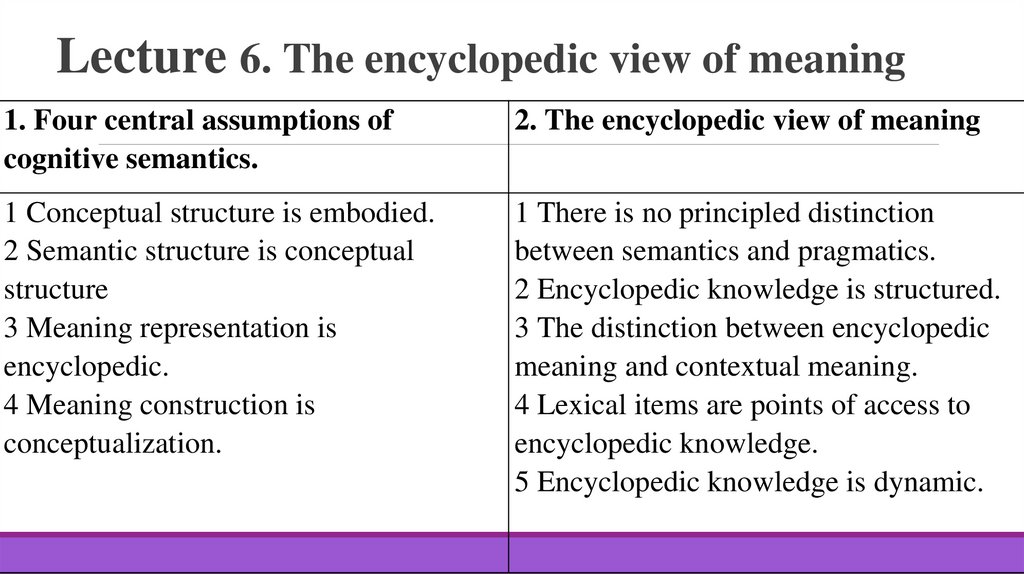
1. Four central assumptions ofcognitive semantics.
2. The encyclopedic view of meaning
1 Conceptual structure is embodied.
2 Semantic structure is conceptual
structure
3 Meaning representation is
encyclopedic.
4 Meaning construction is
conceptualization.
1 There is no principled distinction
between semantics and pragmatics.
2 Encyclopedic knowledge is structured.
3 The distinction between encyclopedic
meaning and contextual meaning.
4 Lexical items are points of access to
encyclopedic knowledge.
5 Encyclopedic knowledge is dynamic.
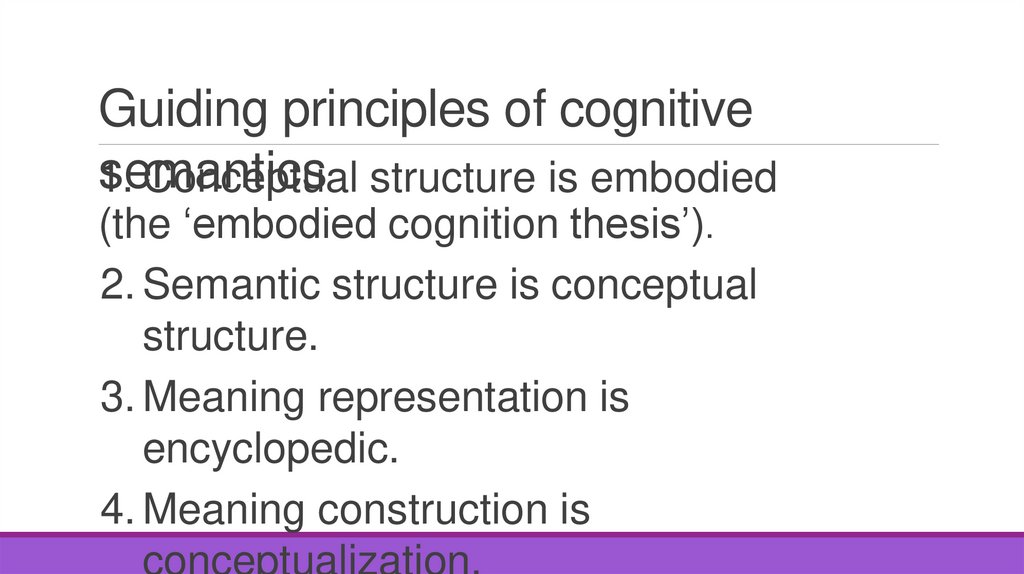
2. Guiding principles of cognitive semantics
1. Conceptual structure is embodied(the ‘embodied cognition thesis’).
2. Semantic structure is conceptual
structure.
3. Meaning representation is
encyclopedic.
4. Meaning construction is
conceptualization.
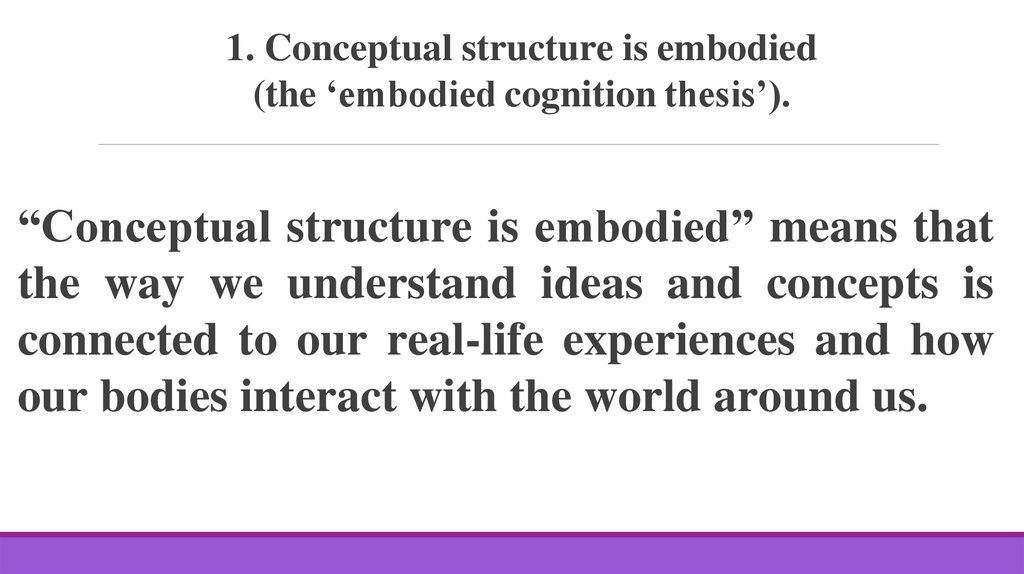
3. 1. Conceptual structure is embodied (the ‘embodied cognition thesis’).
“Conceptual structure is embodied” means thatthe way we understand ideas and concepts is
connected to our real-life experiences and how
our bodies interact with the world around us.
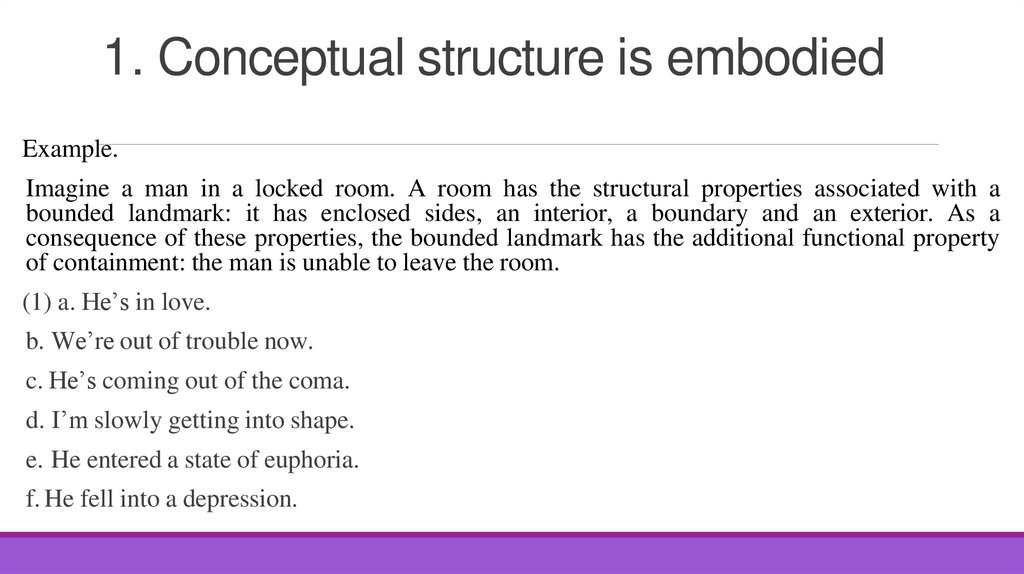
4. 1. Conceptual structure is embodied
Example.Imagine a man in a locked room. A room has the structural properties associated with a
bounded landmark: it has enclosed sides, an interior, a boundary and an exterior. As a
consequence of these properties, the bounded landmark has the additional functional property
of containment: the man is unable to leave the room.
(1) a. He’s in love.
b. We’re out of trouble now.
c. He’s coming out of the coma.
d. I’m slowly getting into shape.
e. He entered a state of euphoria.
f. He fell into a depression.
5. 2. Semantic structure is conceptual structure
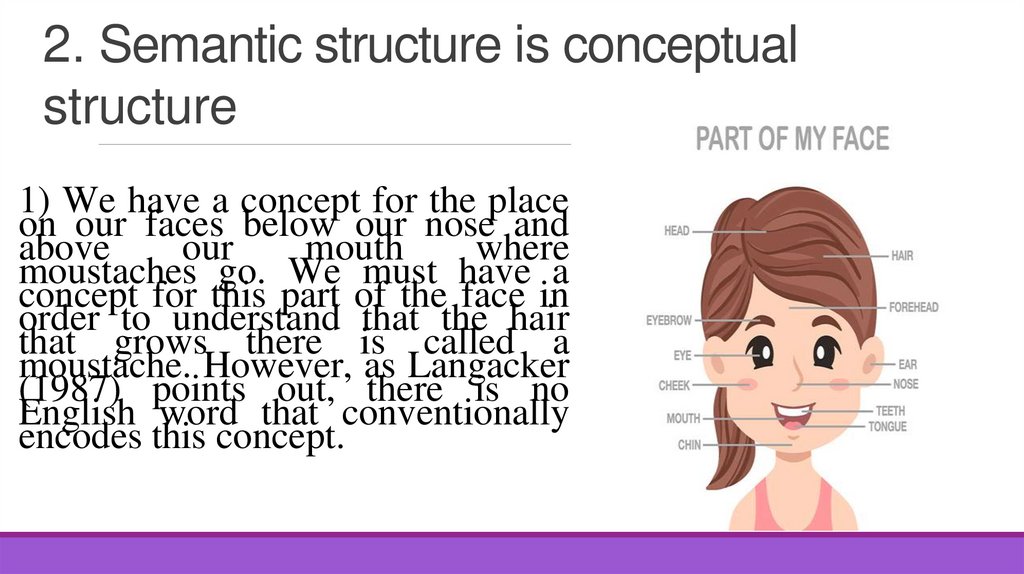
1) We have a concept for the placeon our faces below our nose and
above
our
mouth
where
moustaches go. We must have a
concept for this part of the face in
order to understand that the hair
that grows there is called a
moustache. However, as Langacker
(1987) points out, there is no
English word that conventionally
encodes this concept.
6. 2. Semantic structure is conceptual structure
Semantic structure relates not just to words but to all linguistic units.A linguistic unit might be a word like cat, a bound morpheme such
as -er, as in driver or teacher, or indeed a larger conventional pattern,
like the structure of an active sentence (2) or a passive sentence (3):
2. William Shakespeare wrote Romeo and Juliet. [active]
3. Romeo and Juliet was written by William Shakespeare. [passive]
7. 2. Semantic structure is conceptual structure
Firstly, it is important to point out that cognitive semanticists are notclaiming that language relates to concepts internal to the mind of the
speaker and nothing else.
Secondly, it concerns the notion of semantic structure. It has been
assumed so far that the meanings associated with words can be
defined.
e.g. The concept of BACHELOR - ‘unmarried adult male’.
8.
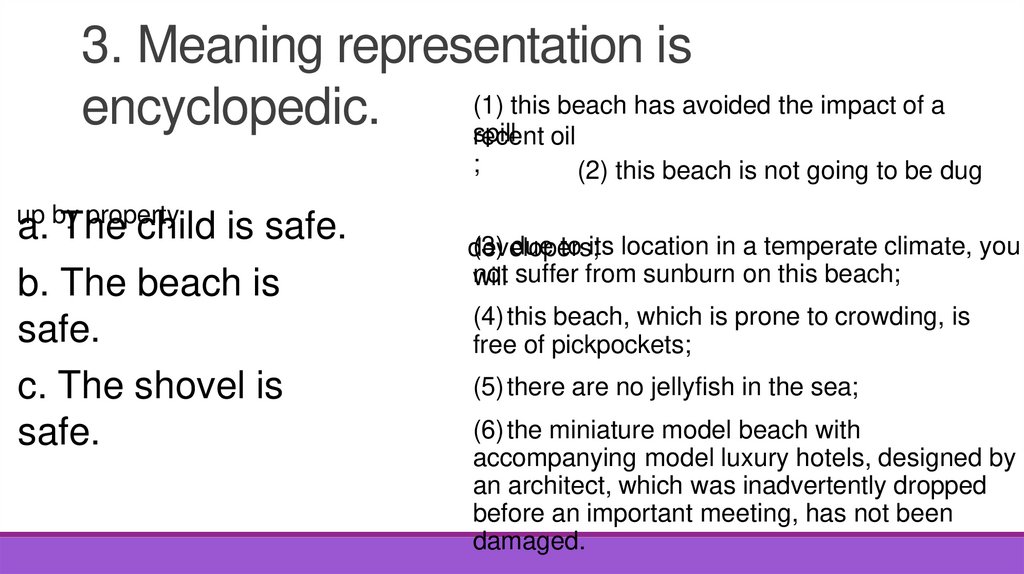
3. Meaning representation is encyclopedic.The third central principle of cognitive semantics holds that
semantic structure is encyclopaedic in nature. This means that
words do not represent neatly packaged bundles of meaning
(the dictionary view), but serve as ‘points of access’ to vast
repositories of knowledge relating to a particular concept or
conceptual domain (e.g. Langacker 1987).
e.g. John is safe.
John is happy.
9.
3. Meaning representation is(1) this beach has avoided the impact of a
encyclopedic.
spill
recent oil
;
(2) this beach is not going to be dug
up by property
a. The child is safe.
b. The beach is
safe.
c. The shovel is
safe.
(3) due to its location in a temperate climate, you
developers;
not
will suffer from sunburn on this beach;
(4) this beach, which is prone to crowding, is
free of pickpockets;
(5) there are no jellyfish in the sea;
(6) the miniature model beach with
accompanying model luxury hotels, designed by
an architect, which was inadvertently dropped
before an important meeting, has not been
damaged.
10. 4. Meaning construction is conceptualization
The fourth principle associated with cognitive semanticsis that language itself does not encode meaning. Instead, words
(and other linguistic units) are only ‘prompts’ for the
construction of meaning.
According to this view, meaning is constructed at the
conceptual level: meaning construction is equated with
conceptualisation, a dynamic process whereby linguistic units
serve as prompts for an array of conceptual operations and the
recruitment of background knowledge.
11. 4. Meaning construction is conceptualization
4. Meaning construction isInconceptualization
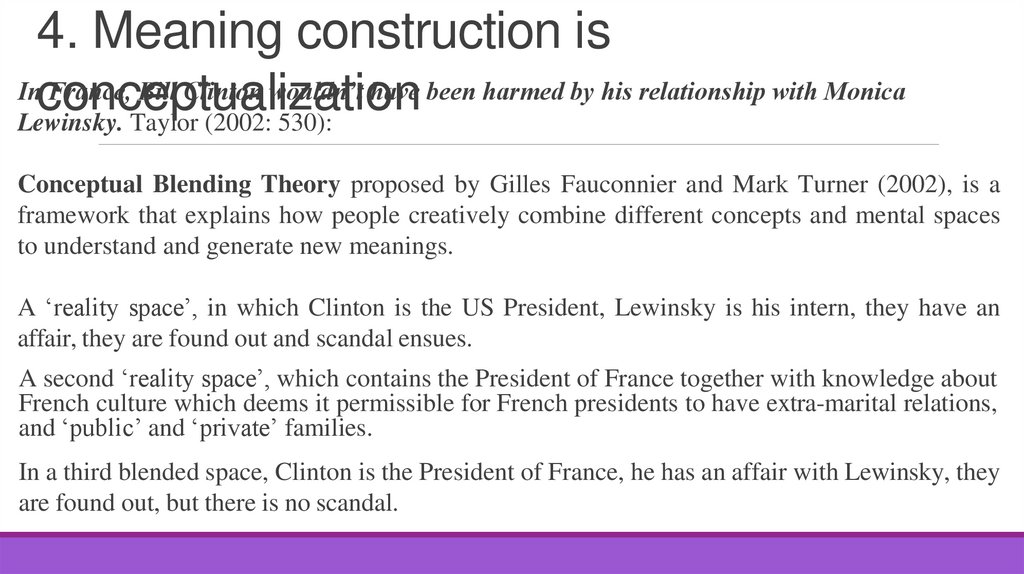
France, Bill Clinton wouldn’t have been harmed by his relationship with Monica
Lewinsky. Taylor (2002: 530):
Conceptual Blending Theory proposed by Gilles Fauconnier and Mark Turner (2002), is a
framework that explains how people creatively combine different concepts and mental spaces
to understand and generate new meanings.
A ‘reality space’, in which Clinton is the US President, Lewinsky is his intern, they have an
affair, they are found out and scandal ensues.
A second ‘reality space’, which contains the President of France together with knowledge about
French culture which deems it permissible for French presidents to have extra-marital relations,
and ‘public’ and ‘private’ families.
In a third blended space, Clinton is the President of France, he has an affair with Lewinsky, they
are found out, but there is no scandal.
12.
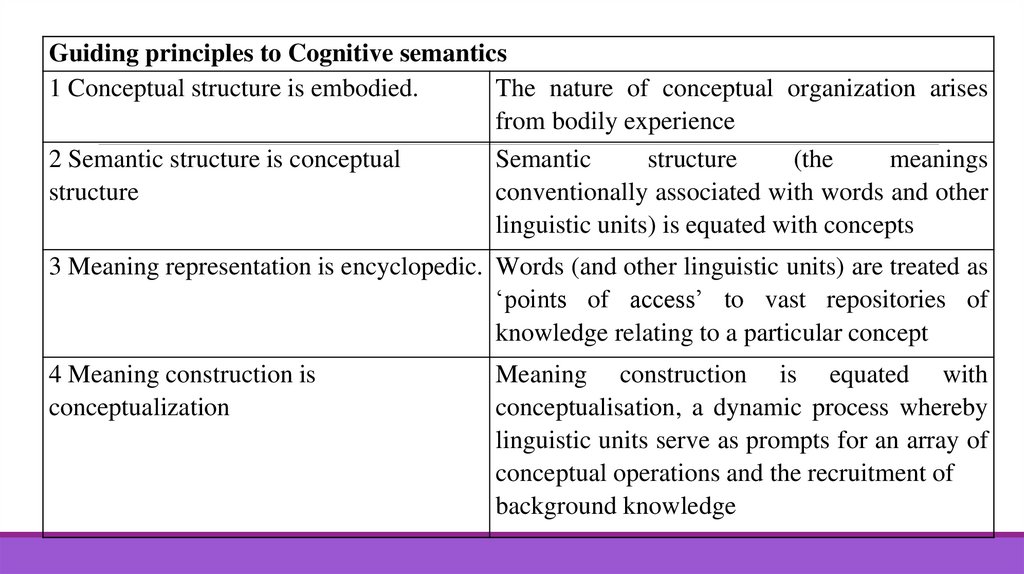
Guiding principles to Cognitive semantics1 Conceptual structure is embodied.
The nature of conceptual organization arises
from bodily experience
2 Semantic structure is conceptual
Semantic
structure
(the
meanings
structure
conventionally associated with words and other
linguistic units) is equated with concepts
3 Meaning representation is encyclopedic. Words (and other linguistic units) are treated as
‘points of access’ to vast repositories of
knowledge relating to a particular concept
4 Meaning construction is
conceptualization
Meaning construction is equated with
conceptualisation, a dynamic process whereby
linguistic units serve as prompts for an array of
conceptual operations and the recruitment of
background knowledge
13. 2. The encyclopedic view of meaning
1 There is no principled distinction between semantics andpragmatics.
2 Encyclopedic knowledge is structured.
3 The distinction between encyclopedic meaning and contextual
meaning.
4 Lexical items are points of access to encyclopedic knowledge.
5 Encyclopedic knowledge is dynamic
14. 1. There is no principled distinction between semantics and pragmatics.
Semantics deals with the inherent meaning of words and sentences.Pragmatics concerns how context influences this meaning.
Cognitive linguistics posits that meaning is not just about dictionary definitions (semantics) but
also how words are used in specific contexts (pragmatics).
Examples:
"Can you pass the salt?" Semantically, it's a question about ability. Pragmatically, it's a request for
the salt.
"I'm freezing." Semantically, it describes a state of being. Pragmatically, it can be a subtle request
to close a window or turn up the heat.
15. 2. Encyclopedic Knowledge is Structured
• Encyclopedic knowledge is considered to be a structured system ofknowledge, organized as a network.
• Not all aspects of the knowledge that is, in principle, accessible by a single
word have equal status.
Example:
The word banana includes information concerning its shape, colour, smell,
texture and taste; whether we like or hate bananas; information about how and
where bananas are grown and harvested; details relating to funny cartoons
involving banana skins; and so on. However, certain aspects of this knowledge
are more central than others to the meaning of banana.
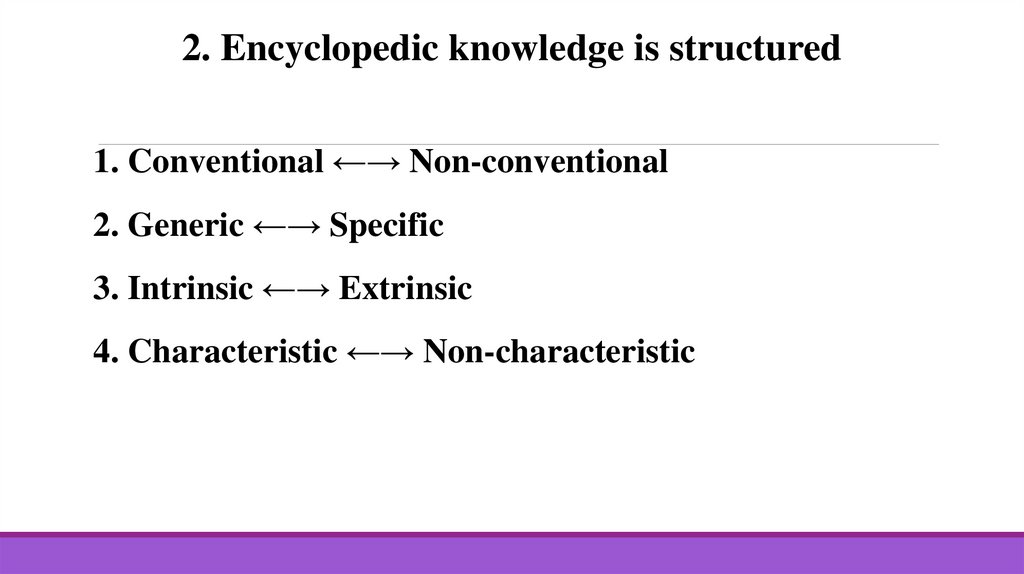
16. 2. Encyclopedic knowledge is structured
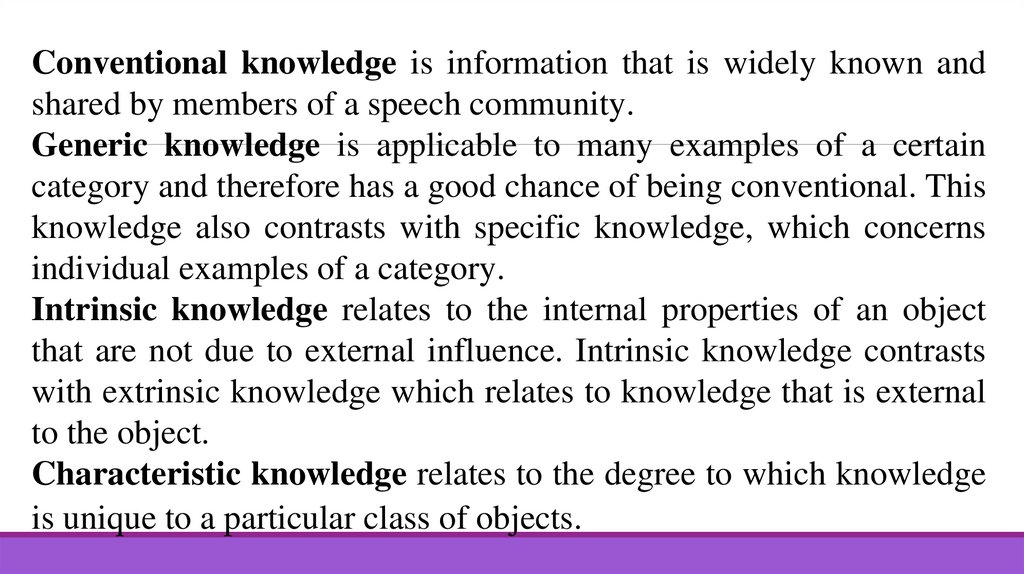
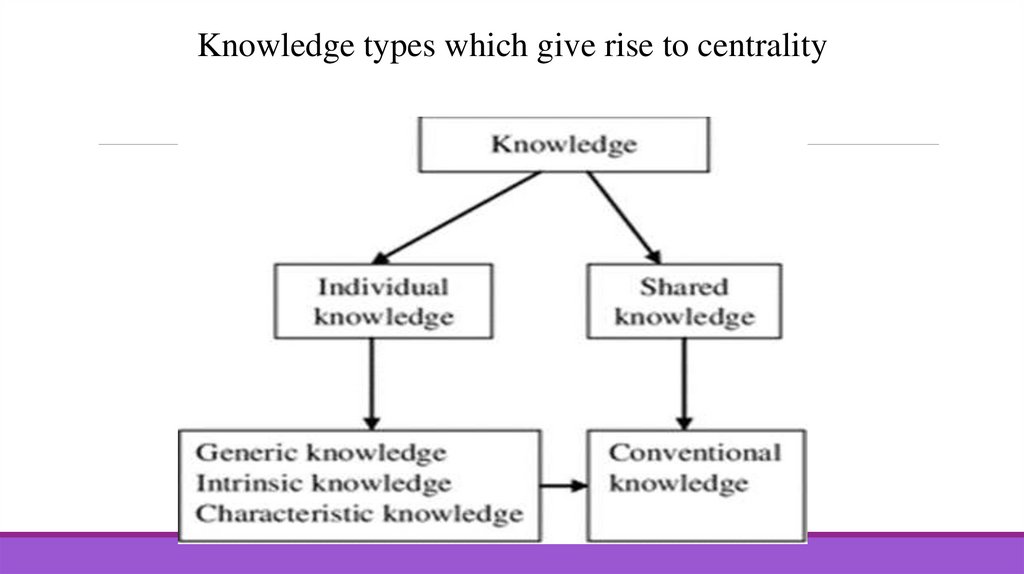
• Langacker (1987) divides the types of knowledge thatmake up the encyclopaedic network into four types:
• (1) conventional ;
• (2) generic;
• (3) intrinsic;
• (4) characteristic.
17.
Conventional knowledge is information that is widely known andshared by members of a speech community.
Generic knowledge is applicable to many examples of a certain
category and therefore has a good chance of being conventional. This
knowledge also contrasts with specific knowledge, which concerns
individual examples of a category.
Intrinsic knowledge relates to the internal properties of an object
that are not due to external influence. Intrinsic knowledge contrasts
with extrinsic knowledge which relates to knowledge that is external
to the object.
Characteristic knowledge relates to the degree to which knowledge
is unique to a particular class of objects.
18. 2. Encyclopedic knowledge is structured
1. Conventional ←→ Non-conventional2. Generic ←→ Specific
3. Intrinsic ←→ Extrinsic
4. Characteristic ←→ Non-characteristic
19. Knowledge types which give rise to centrality
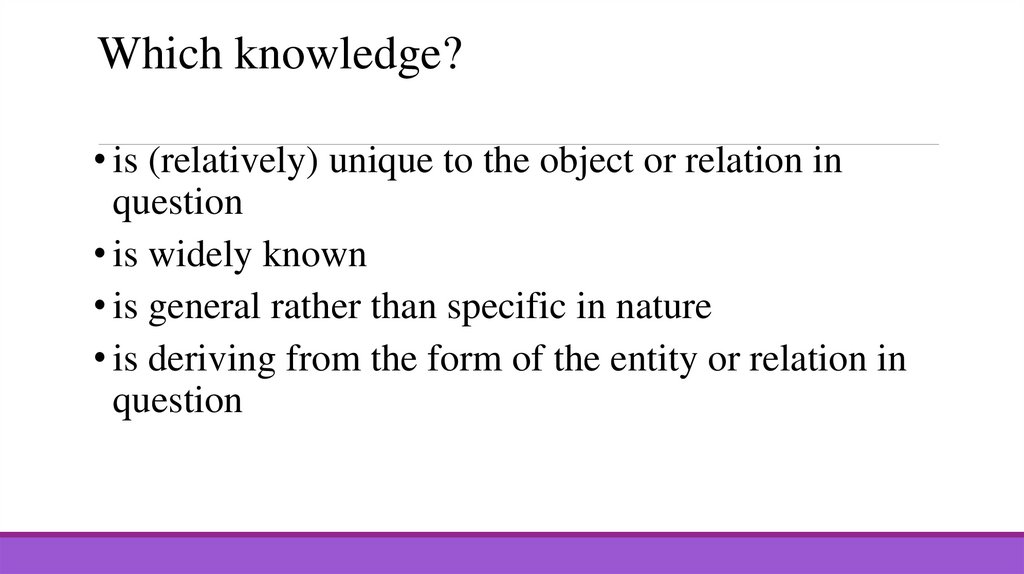
20. Which knowledge?
• is (relatively) unique to the object or relation inquestion
• is widely known
• is general rather than specific in nature
• is deriving from the form of the entity or relation in
question
21. 3. The Distinction between Encyclopedic Meaning and Contextual Meaning.
Encyclopaedicmeaning
arises in context(s) of use.
The “selection” of actual situational meaning is informed and maybe even
determined by contextual factors.
In the dictionary view of meaning, there is a separation of core meaning
(semantics) from non-core actual meaning (pragmatics).
The encyclopaedic view, however claims that encyclopaedic knowledge is
included in semantics, and meaning is determined by context.
According to this approach, there is no definable, pre-existing word meaning
because the meaning of a word in context is selected and shaped by
encyclopaedic knowledge.
22. 4. Lexical Items as Points of Access to Encyclopedic Knowledge.
Definition: Words (or lexical items) act as entry points or gateways into ourvast structured encyclopedic knowledge.
Role in Cognition: They trigger associations, memories, and a wealth of related
information when encountered.
Examples:
"Wedding": This might evoke thoughts of ceremonies, love, dresses, cakes,
personal memories of weddings attended, cultural variations of wedding
ceremonies, and so on.
"Holiday": Beyond just a day of celebration, it might bring forth memories of
specific holidays, traditional foods, songs, or rituals associated with certain
holidays.
23. 5. Encyclopedic Knowledge is Dynamic.
Finally, it is important to note that while the central meaning associatedwith a word is relatively stable, the encyclopaedic knowledge that each
word provides access to, its encylopaedic network, is dynamic.
Examples:
The term "web" once predominantly meant a spider's creation. With the
advent of the internet, its encyclopedic knowledge expanded to include
the World Wide Web.
"Virus" had biological associations. Today, it can also mean a malicious
software, altering its encyclopedic footprint.
24. The Encyclopedic View of Meaning:
Our lecture has underscored five critical aspects of theencyclopedic view. We've unraveled the notion that there's
no clear division between semantics and pragmatics, that
our encyclopedic knowledge is well-structured, that
contextual meaning dynamically interacts with our stable
encyclopedic knowledge, that words are our portals into this
vast knowledge, and that our understanding of the world
constantly evolves, mirroring the dynamic nature of
encyclopedic knowledge.
25. References
1. Evans V., Green M. (2006). CognitiveLinguistics. An Introduction. EDINBURGH
UNIVERSITY PRESS.
Guiding Principles:
1. Lakoff, G. (1987). Women, Fire, and Dangerous
Things: What Categories Reveal About the Mind.
Chicago: University of Chicago Press.
2. Langacker, R. W. (1987). Foundations of Cognitive
Grammar: Theoretical Prerequisites. Stanford:
Stanford University Press.
The Encyclopedic View:
1. Fillmore, C. J. (1982). Frame Semantics.
Linguistic Society of Korea.
2. Geeraerts, D. (2006). Cognitive Linguistics:
Basic Readings. Berlin: Mouton de Gruyter.
3. Langacker, R. W. (1991). Concept, Image, and
Symbol: The Cognitive Basis of Grammar. Berlin:
Mouton de Gruyter.