


 Английский язык
Похожие презентации:







Jobs and Professions
1.
2.
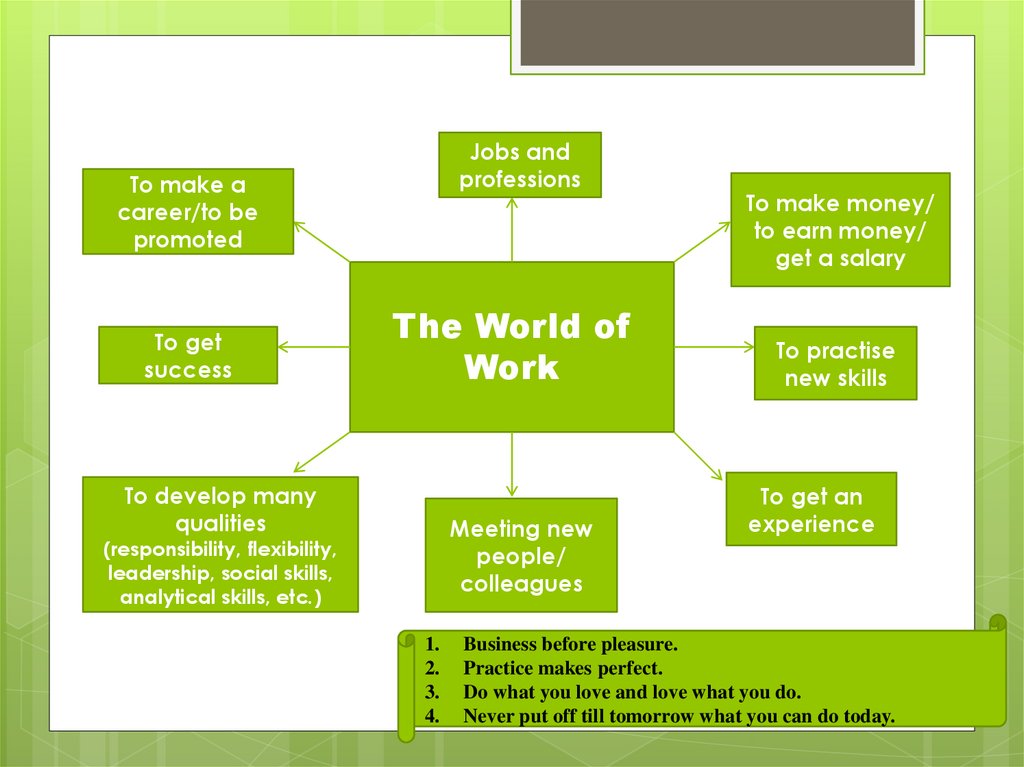
Jobs andprofessions
To make a
career/to be
promoted
To get
success
The World of
Work
To develop many
qualities
Meeting new
people/
colleagues
(responsibility, flexibility,
leadership, social skills,
analytical skills, etc.)
1.
2.
3.
4.
To make money/
to earn money/
get a salary
To practise
new skills
To get an
experience
Business before pleasure.
Practice makes perfect.
Do what you love and love what you do.
Never put off till tomorrow what you can do today.
3.
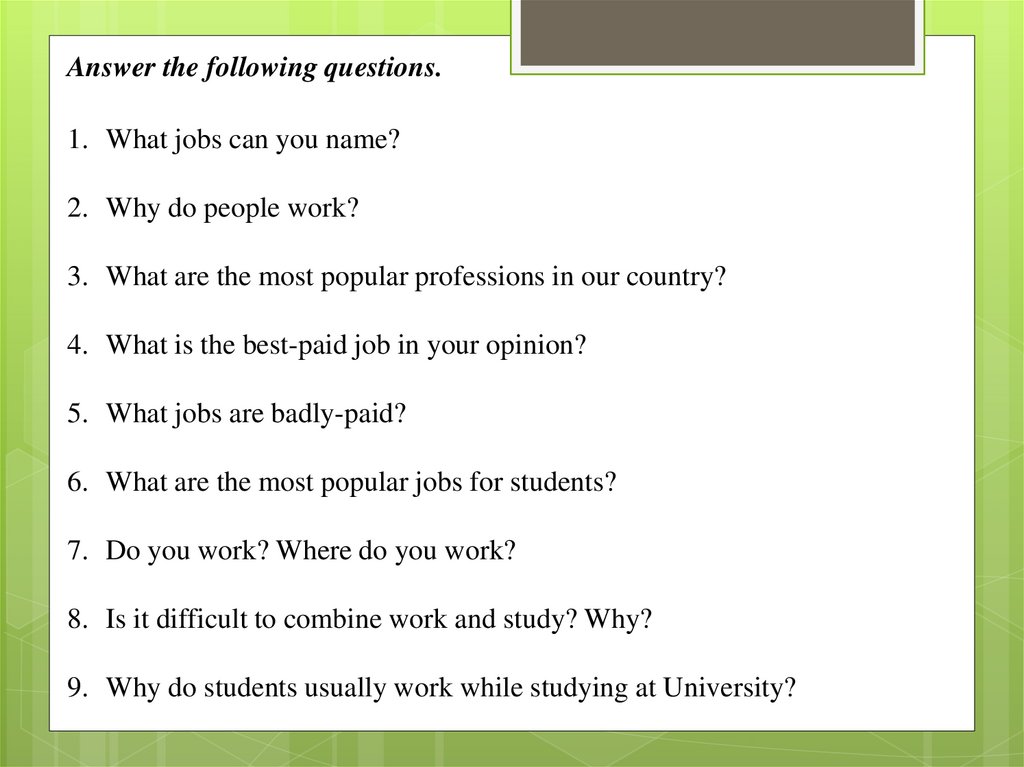
Answer the following questions.1. What jobs can you name?
2. Why do people work?
3. What are the most popular professions in our country?
4. What is the best-paid job in your opinion?
5. What jobs are badly-paid?
6. What are the most popular jobs for students?
7. Do you work? Where do you work?
8. Is it difficult to combine work and study? Why?
9. Why do students usually work while studying at University?
4.
5.
6.
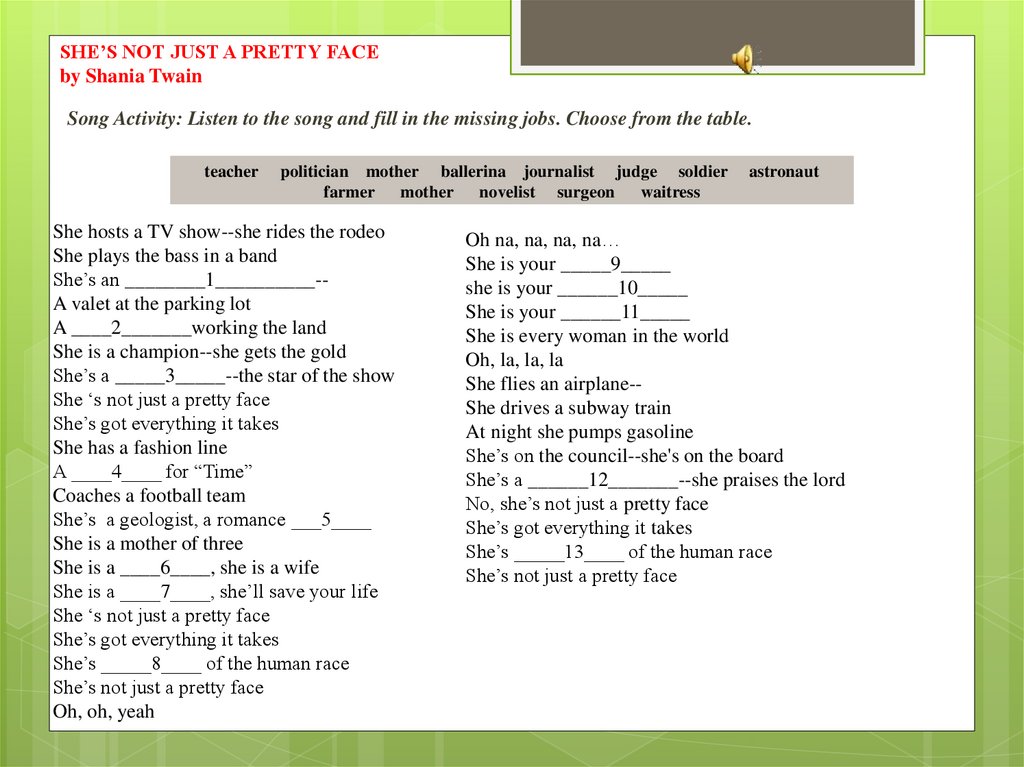
7. SHE’S NOT JUST A PRETTY FACE by Shania Twain
Song Activity: Listen to the song and fill in the missing jobs. Choose from the table.teacher
politician mother ballerina journalist judge soldier
farmer
mother
novelist surgeon
waitress
She hosts a TV show--she rides the rodeo
She plays the bass in a band
She’s an ________1__________-A valet at the parking lot
A ____2_______working the land
She is a champion--she gets the gold
She’s a _____3_____--the star of the show
She ‘s not just a pretty face
She’s got everything it takes
She has a fashion line
A ____4____ for “Time”
Coaches a football team
She’s a geologist, a romance ___5____
She is a mother of three
She is a ____6____, she is a wife
She is a ____7____, she’ll save your life
She ‘s not just a pretty face
She’s got everything it takes
She’s _____8____ of the human race
She’s not just a pretty face
Oh, oh, yeah
astronaut
Oh na, na, na, na…
She is your _____9_____
she is your ______10_____
She is your ______11_____
She is every woman in the world
Oh, la, la, la
She flies an airplane-She drives a subway train
At night she pumps gasoline
She’s on the council--she's on the board
She’s a ______12_______--she praises the lord
No, she’s not just a pretty face
She’s got everything it takes
She’s _____13____ of the human race
She’s not just a pretty face
8.
9.
10.
11.
12.
13.
14.
15.
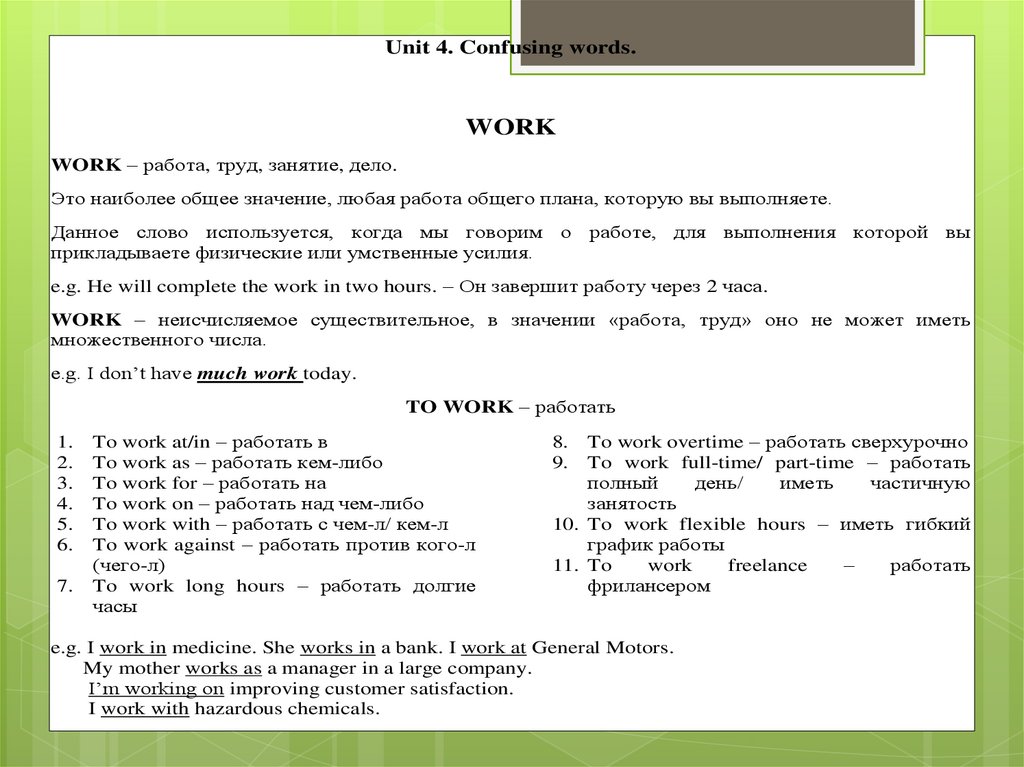
Unit 4. Confusing words.WORK
WORK – работа, труд, занятие, дело.
Это наиболее общее значение, любая работа общего плана, которую вы выполняете.
Данное слово используется, когда мы говорим о работе, для выполнения которой вы
прикладываете физические или умственные усилия.
e.g. He will complete the work in two hours. – Он завершит работу через 2 часа.
WORK – неисчисляемое существительное, в значении «работа, труд» оно не может иметь
множественного числа.
e.g. I don’t have much work today.
TO WORK – работать
1.
2.
3.
4.
5.
6.
7.
To work at/in – работать в
To work as – работать кем-либо
To work for – работать на
To work on – работать над чем-либо
To work with – работать с чем-л/ кем-л
To work against – работать против кого-л
(чего-л)
To work long hours – работать долгие
часы
To work overtime – работать сверхурочно
To work full-time/ part-time – работать
полный
день/
иметь
частичную
занятость
10. To work flexible hours – иметь гибкий
график работы
11. To
work
freelance
–
работать
фрилансером
8.
9.
e.g. I work in medicine. She works in a bank. I work at General Motors.
My mother works as a manager in a large company.
I’m working on improving customer satisfaction.
I work with hazardous chemicals.
16.
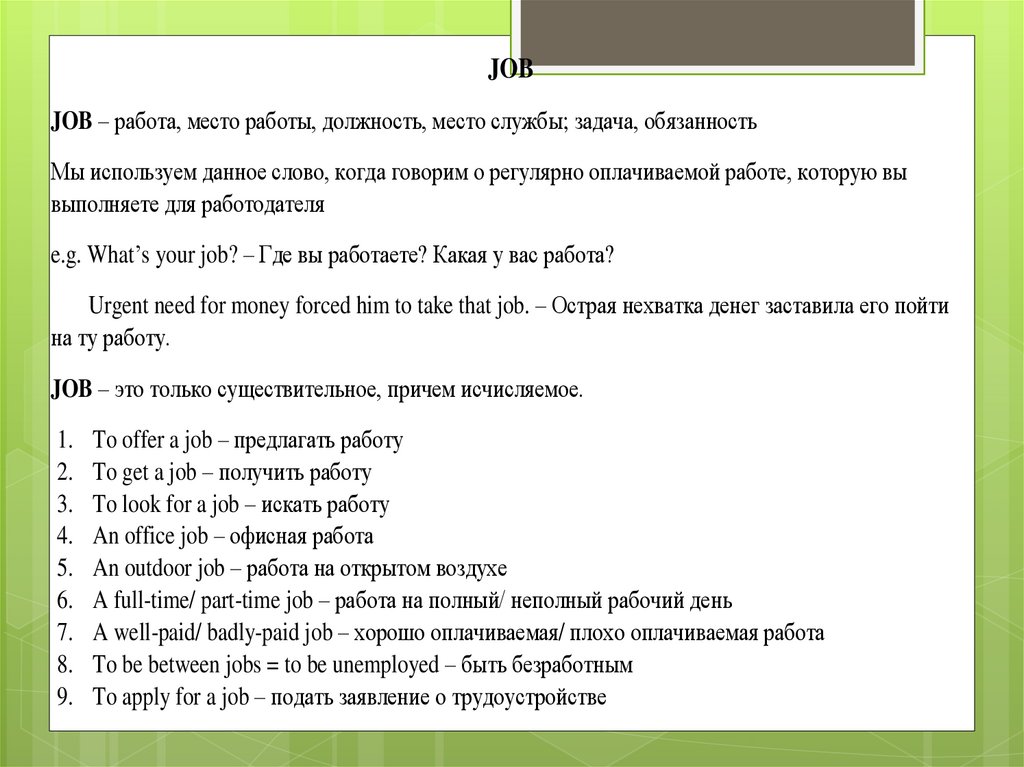
JOBJOB – работа, место работы, должность, место службы; задача, обязанность
Мы используем данное слово, когда говорим о регулярно оплачиваемой работе, которую вы
выполняете для работодателя
e.g. What’s your job? – Где вы работаете? Какая у вас работа?
Urgent need for money forced him to take that job. – Острая нехватка денег заставила его пойти
на ту работу.
JOB – это только существительное, причем исчисляемое.
1.
2.
3.
4.
5.
6.
7.
8.
9.
To offer a job – предлагать работу
To get a job – получить работу
To look for a job – искать работу
An office job – офисная работа
An outdoor job – работа на открытом воздухе
A full-time/ part-time job – работа на полный/ неполный рабочий день
A well-paid/ badly-paid job – хорошо оплачиваемая/ плохо оплачиваемая работа
To be between jobs = to be unemployed – быть безработным
To apply for a job – подать заявление о трудоустройстве
17.
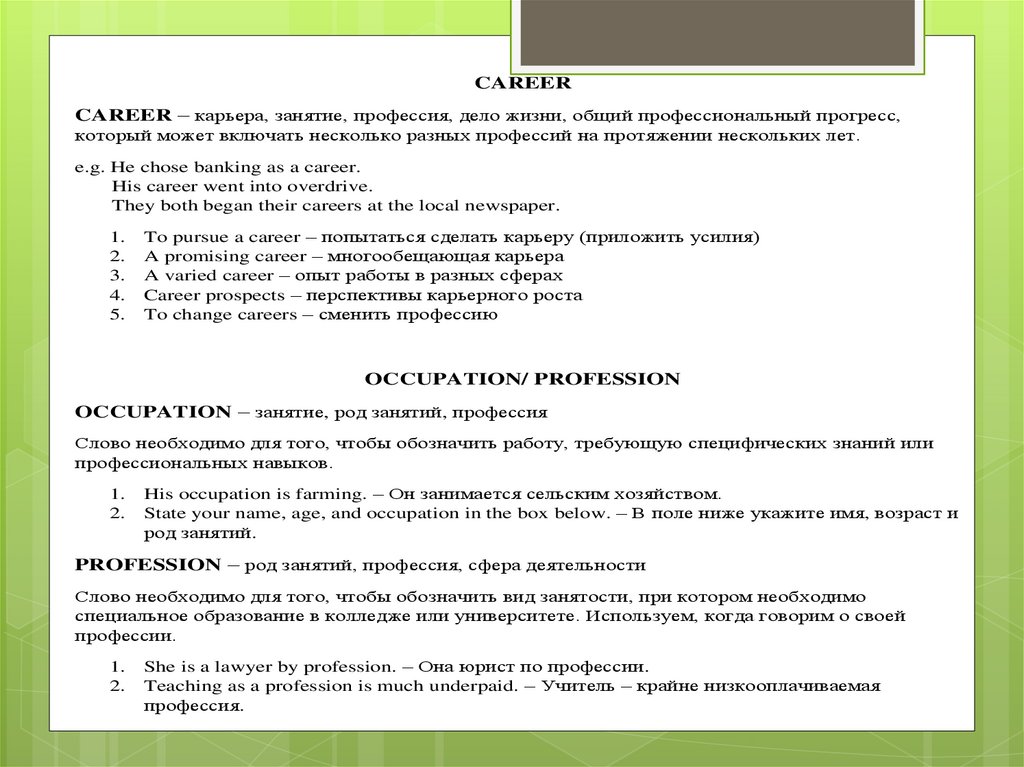
CAREERCAREER – карьера, занятие, профессия, дело жизни, общий профессиональный прогресс,
который может включать несколько разных профессий на протяжении нескольких лет.
e.g. He chose banking as a career.
His career went into overdrive.
They both began their careers at the local newspaper.
1.
2.
3.
4.
5.
To pursue a career – попытаться сделать карьеру (приложить усилия)
A promising career – многообещающая карьера
A varied career – опыт работы в разных сферах
Career prospects – перспективы карьерного роста
To change careers – сменить профессию
OCCUPATION/ PROFESSION
OCCUPATION – занятие, род занятий, профессия
Слово необходимо для того, чтобы обозначить работу, требующую специфических знаний или
профессиональных навыков.
1.
2.
His occupation is farming. – Он занимается сельским хозяйством.
State your name, age, and occupation in the box below. – В поле ниже укажите имя, возраст и
род занятий.
PROFESSION – род занятий, профессия, сфера деятельности
Слово необходимо для того, чтобы обозначить вид занятости, при котором необходимо
специальное образование в колледже или университете. Используем, когда говорим о своей
профессии.
1.
2.
She is a lawyer by profession. – Она юрист по профессии.
Teaching as a profession is much underpaid. – Учитель – крайне низкооплачиваемая
профессия.
18.
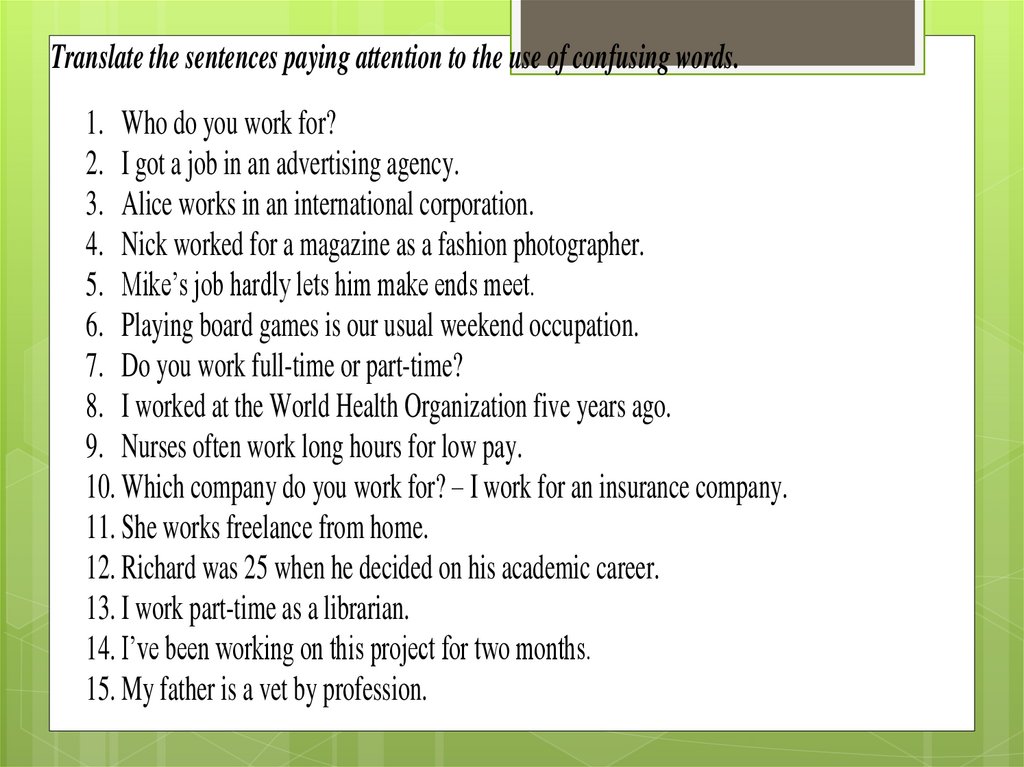
Translate the sentences paying attention to the use of confusing words.1. Who do you work for?
2. I got a job in an advertising agency.
3. Alice works in an international corporation.
4. Nick worked for a magazine as a fashion photographer.
5. Mike’s job hardly lets him make ends meet.
6. Playing board games is our usual weekend occupation.
7. Do you work full-time or part-time?
8. I worked at the World Health Organization five years ago.
9. Nurses often work long hours for low pay.
10. Which company do you work for? – I work for an insurance company.
11. She works freelance from home.
12. Richard was 25 when he decided on his academic career.
13. I work part-time as a librarian.
14. I’ve been working on this project for two months.
15. My father is a vet by profession.
19.
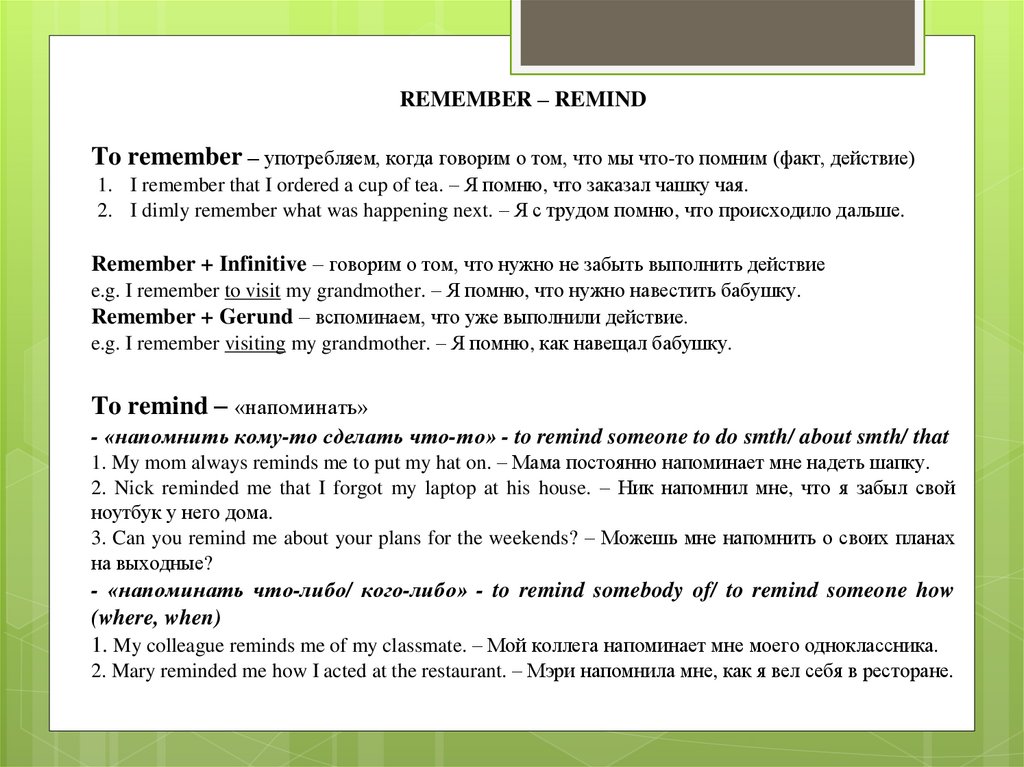
REMEMBER – REMINDTo remember – употребляем, когда говорим о том, что мы что-то помним (факт, действие)
1. I remember that I ordered a cup of tea. – Я помню, что заказал чашку чая.
2. I dimly remember what was happening next. – Я с трудом помню, что происходило дальше.
Remember + Infinitive – говорим о том, что нужно не забыть выполнить действие
e.g. I remember to visit my grandmother. – Я помню, что нужно навестить бабушку.
Remember + Gerund – вспоминаем, что уже выполнили действие.
e.g. I remember visiting my grandmother. – Я помню, как навещал бабушку.
To remind – «напоминать»
- «напомнить кому-то сделать что-то» - to remind someone to do smth/ about smth/ that
1. My mom always reminds me to put my hat on. – Мама постоянно напоминает мне надеть шапку.
2. Nick reminded me that I forgot my laptop at his house. – Ник напомнил мне, что я забыл свой
ноутбук у него дома.
3. Can you remind me about your plans for the weekends? – Можешь мне напомнить о своих планах
на выходные?
- «напоминать что-либо/ кого-либо» - to remind somebody of/ to remind someone how
(where, when)
1. My colleague reminds me of my classmate. – Мой коллега напоминает мне моего одноклассника.
2. Mary reminded me how I acted at the restaurant. – Мэри напомнила мне, как я вел себя в ресторане.
20.
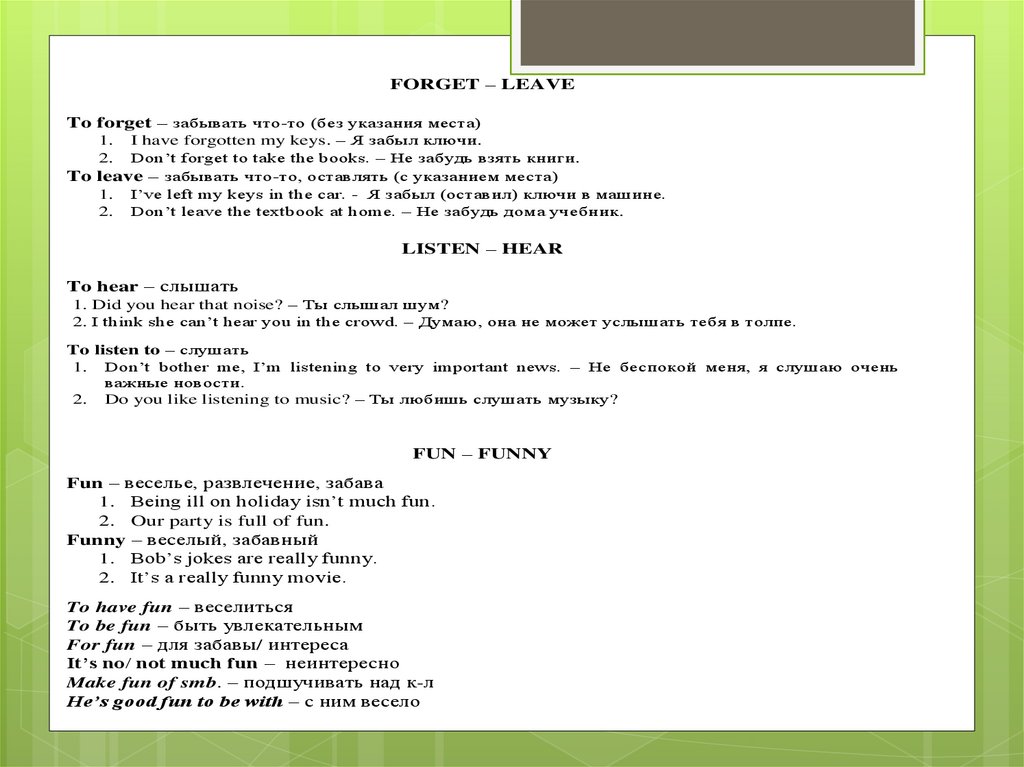
FORGET – LEAVETo forget – забывать что-то (без указания места)
I have forgotten my keys. – Я забыл ключи.
Don’t forget to take the books. – Не забудь взять книги.
To leave – забывать что-то, оставлять (с указанием места)
1. I’ve left my keys in the car. - Я забыл (оставил) ключи в машине.
2. Don’t leave the textbook at home. – Не забудь дома учебник.
1.
2.
LISTEN – HEAR
To hear – слышать
1. Did you hear that noise? – Ты слышал шум?
2. I think she can’t hear you in the crowd. – Думаю, она не может услышать тебя в толпе.
To listen to – слушать
1. Don’t bother me, I’m listening to very important news. – Не беспокой меня, я слушаю очень
важные новости.
2. Do you like listening to music? – Ты любишь слушать музыку?
FUN – FUNNY
Fun – веселье, развлечение, забава
1. Being ill on holiday isn’t much fun.
2. Our party is full of fun.
Funny – веселый, забавный
1. Bob’s jokes are really funny.
2. It’s a really funny movie.
To have fun – веселиться
To be fun – быть увлекательным
For fun – для забавы/ интереса
It’s no/ not much fun – неинтересно
Make fun of smb. – подшучивать над к-л
He’s good fun to be with – с ним весело
21.
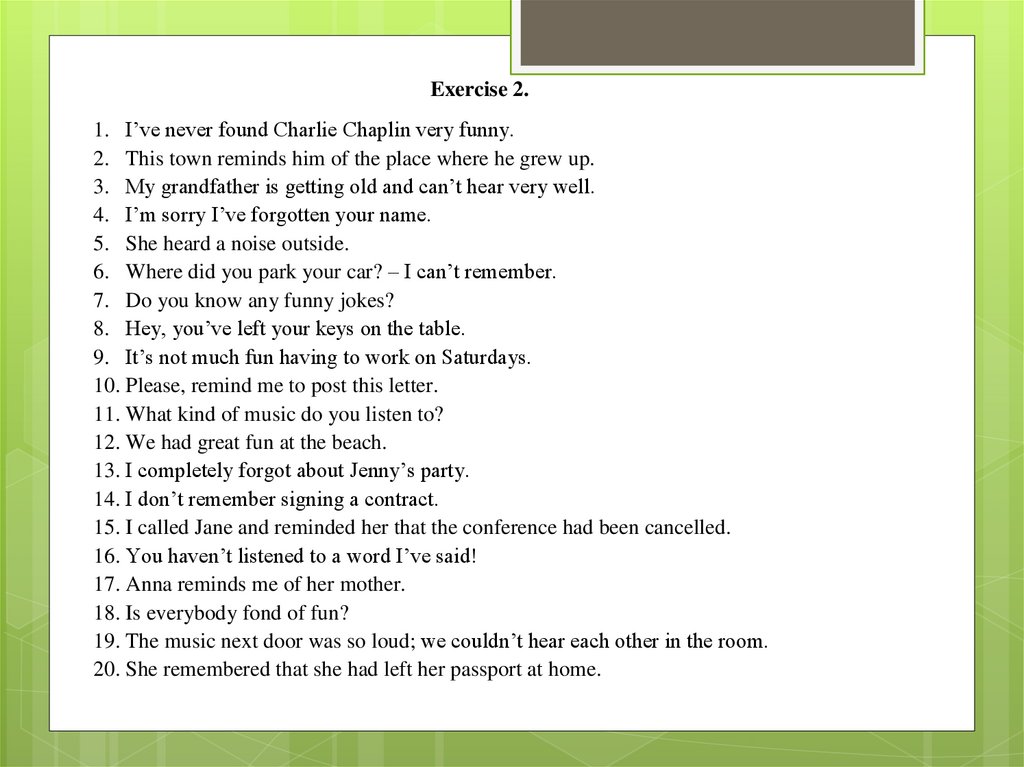
Exercise 2.1. I’ve never found Charlie Chaplin very funny.
2. This town reminds him of the place where he grew up.
3. My grandfather is getting old and can’t hear very well.
4. I’m sorry I’ve forgotten your name.
5. She heard a noise outside.
6. Where did you park your car? – I can’t remember.
7. Do you know any funny jokes?
8. Hey, you’ve left your keys on the table.
9. It’s not much fun having to work on Saturdays.
10. Please, remind me to post this letter.
11. What kind of music do you listen to?
12. We had great fun at the beach.
13. I completely forgot about Jenny’s party.
14. I don’t remember signing a contract.
15. I called Jane and reminded her that the conference had been cancelled.
16. You haven’t listened to a word I’ve said!
17. Anna reminds me of her mother.
18. Is everybody fond of fun?
19. The music next door was so loud; we couldn’t hear each other in the room.
20. She remembered that she had left her passport at home.
22.
23.
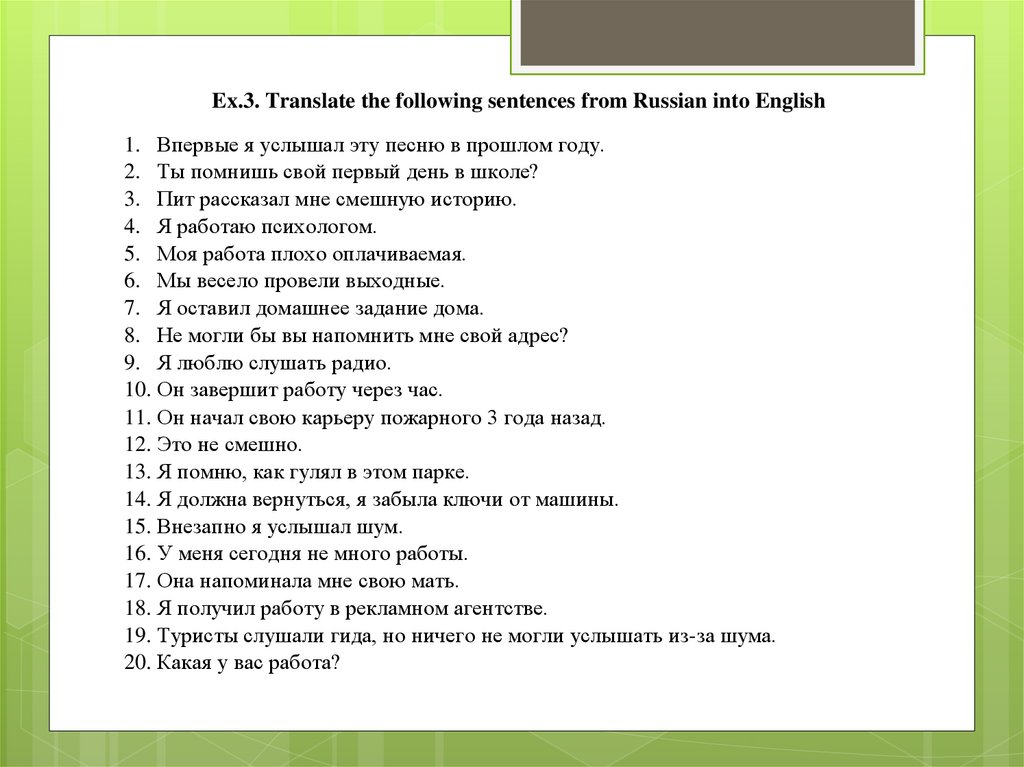
Ex.3. Translate the following sentences from Russian into English1. Впервые я услышал эту песню в прошлом году.
2. Ты помнишь свой первый день в школе?
3. Пит рассказал мне смешную историю.
4. Я работаю психологом.
5. Моя работа плохо оплачиваемая.
6. Мы весело провели выходные.
7. Я оставил домашнее задание дома.
8. Не могли бы вы напомнить мне свой адрес?
9. Я люблю слушать радио.
10. Он завершит работу через час.
11. Он начал свою карьеру пожарного 3 года назад.
12. Это не смешно.
13. Я помню, как гулял в этом парке.
14. Я должна вернуться, я забыла ключи от машины.
15. Внезапно я услышал шум.
16. У меня сегодня не много работы.
17. Она напоминала мне свою мать.
18. Я получил работу в рекламном агентстве.
19. Туристы слушали гида, но ничего не могли услышать из-за шума.
20. Какая у вас работа?
24.
25.
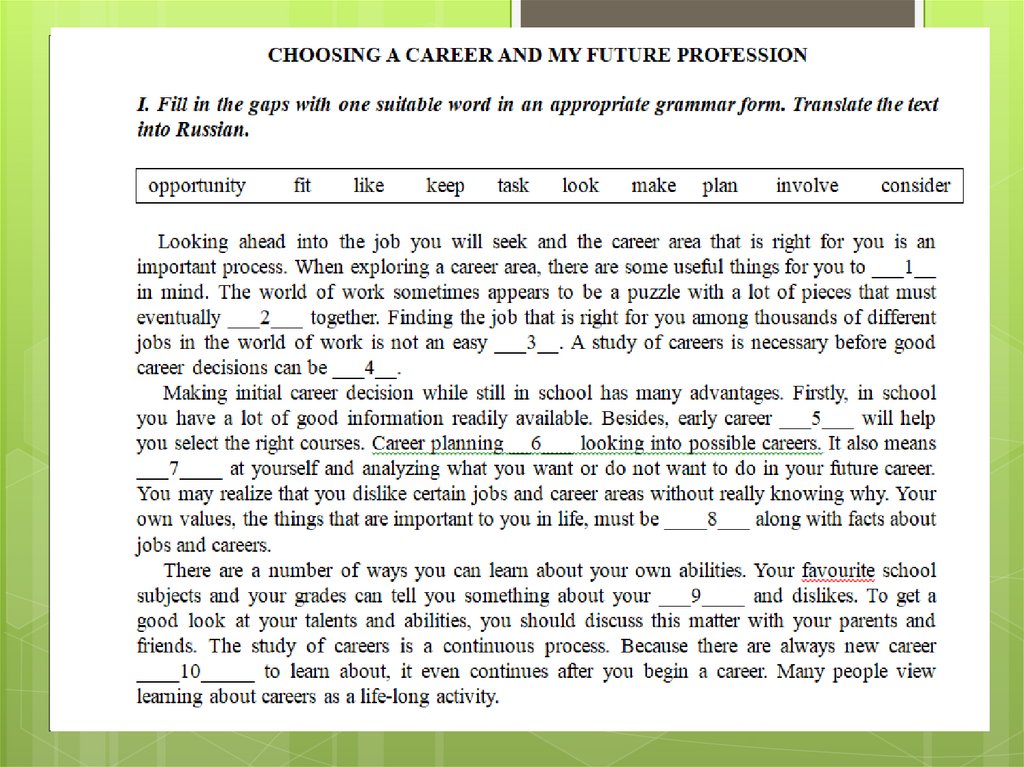
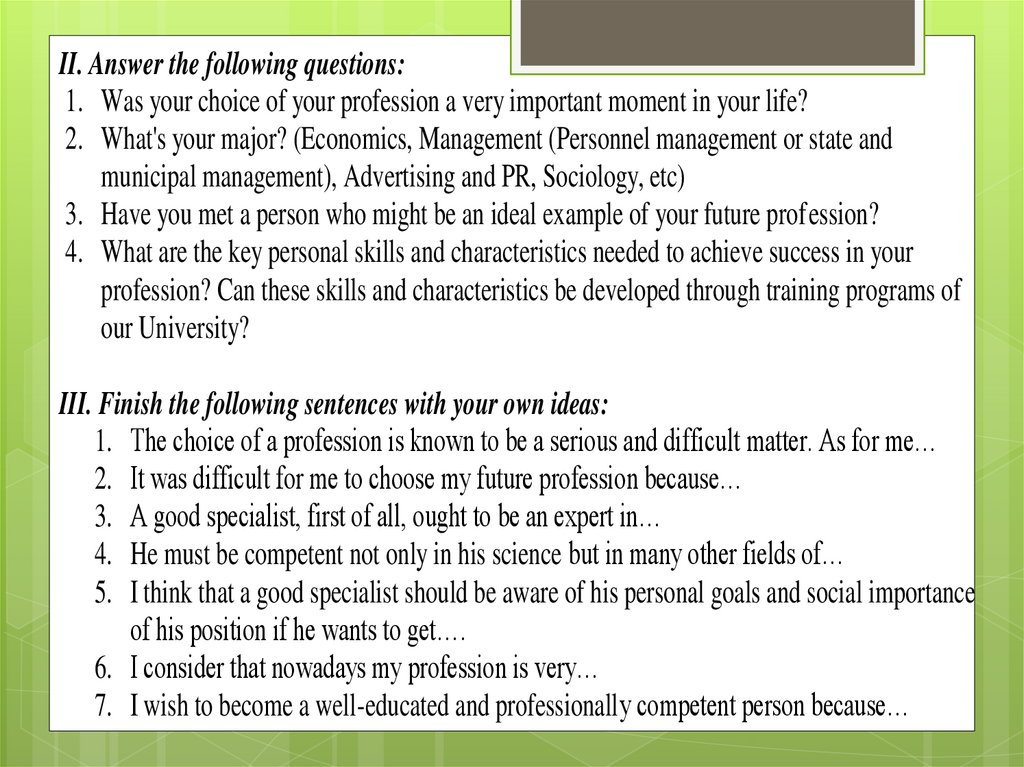
II. Answer the following questions:1. Was your choice of your profession a very important moment in your life?
2. What's your major? (Economics, Management (Personnel management or state and
municipal management), Advertising and PR, Sociology, etc)
3. Have you met a person who might be an ideal example of your future profession?
4. What are the key personal skills and characteristics needed to achieve success in your
profession? Can these skills and characteristics be developed through training programs of
our University?
III. Finish the following sentences with your own ideas:
1. The choice of a profession is known to be a serious and difficult matter. As for me…
2. It was difficult for me to choose my future profession because…
3. A good specialist, first of all, ought to be an expert in…
4. He must be competent not only in his science but in many other fields of…
5. I think that a good specialist should be aware of his personal goals and social importance
of his position if he wants to get….
6. I consider that nowadays my profession is very…
7. I wish to become a well-educated and professionally competent person because…