


 Менеджмент
Похожие презентации:










5. Managing innovation and development of a new product
1. 5. Managing innovation and development of a new product
USTSINOVICH IRINAMANAGERIAL ECONOMICS
5. MANAGING INNOVATION AND
DEVELOPMENT OF A NEW PRODUCT
2. 5. Managing innovation and development of a new product
5. MANAGING INNOVATION AND DEVELOPMENT OF A NEW PRODUCT1. The essence of innovation
2. The innovation life cycle of
3. Types of innovative projects and their management principles
4. Innovation statistics
Ustsinovich I.V.
2
3. 1. The essence of innovation
1. THE ESSENCE OF INNOVATIONUstsinovich I.V.
3
4. description
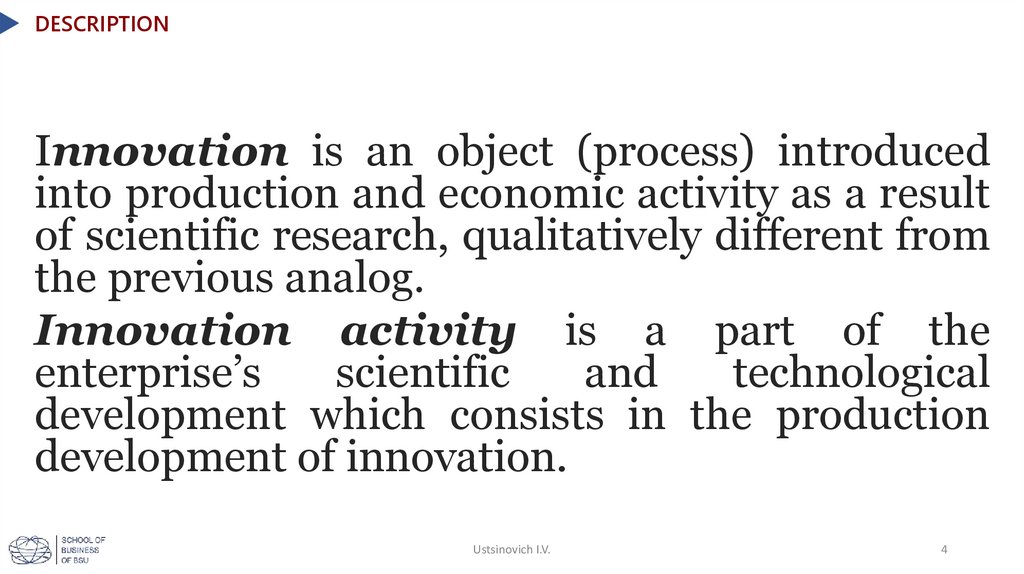
DESCRIPTIONInnovation is an object (process) introduced
into production and economic activity as a result
of scientific research, qualitatively different from
the previous analog.
Innovation activity is a part of the
enterprise’s
scientific
and
technological
development which consists in the production
development of innovation.
Ustsinovich I.V.
4
5. Methods
METHODS• general scientific approach- systemic approach, induction,
deduction, analysis, synthesis, comparison, generalization,
observation, description;
• special -testing, modeling, generalization of experience.
Ustsinovich I.V.
5
6. The innovation development (ID) problems of the Republic of Belarus at the present stage :
THE INNOVATION DEVELOPMENT (ID) PROBLEMS OF THE REPUBLIC OF BELARUS ATTHE PRESENT STAGE :
• the ID paths contradiction;
• low level of ID subjects interaction;
• low level of world innovation;
• the industrial policy focus on product innovation.
Ustsinovich I.V.
6
7. The industrial organizations innovative development (IOID) trends
THE INDUSTRIAL ORGANIZATIONS INNOVATIVE DEVELOPMENT (IOID) TRENDS• 1) Planning for the industrial organizations innovative
development is usually carried out by the state body;
• 2) Low-tech production demonstrates a higher
intensity of technological innovation costs than hightech ones;
• 3) Funding decisions are made by the state body, and
the private sector is almost non-financial.
Ustsinovich I.V.
7
8. The industrial organization's innovation development indicators
THE INDUSTRIAL ORGANIZATION'S INNOVATION DEVELOPMENT INDICATORS• share of new production in industrial production;
• share of certified products in industrial production;
• degree of the main industrial assets tear;
• share of innovative products in industrial production;
• quality management systems creation and certification;
• share of equipment, tools and inventory costs in fixed
investment.
Ustsinovich I.V.
8
9. Classification
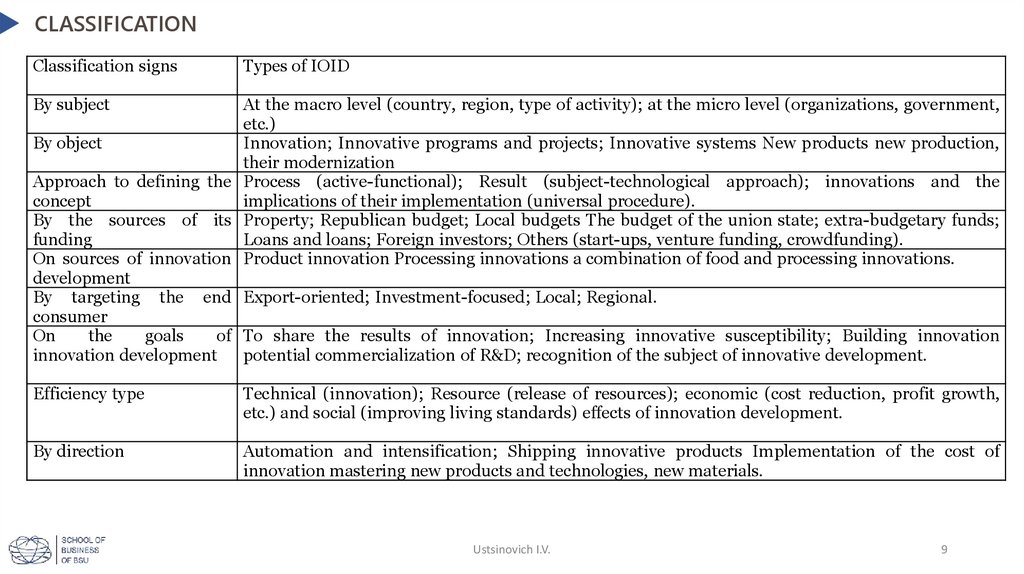
CLASSIFICATIONClassification signs
Types of IOID
By subject
At the macro level (country, region, type of activity); at the micro level (organizations, government,
etc.)
By object
Innovation; Innovative programs and projects; Innovative systems New products new production,
their modernization
Approach to defining the Process (active-functional); Result (subject-technological approach); innovations and the
concept
implications of their implementation (universal procedure).
By the sources of its Property; Republican budget; Local budgets The budget of the union state; extra-budgetary funds;
funding
Loans and loans; Foreign investors; Others (start-ups, venture funding, crowdfunding).
On sources of innovation Product innovation Processing innovations a combination of food and processing innovations.
development
By targeting the end Export-oriented; Investment-focused; Local; Regional.
consumer
On
the
goals
of To share the results of innovation; Increasing innovative susceptibility; Building innovation
innovation development
potential commercialization of R&D; recognition of the subject of innovative development.
Efficiency type
Technical (innovation); Resource (release of resources); economic (cost reduction, profit growth,
etc.) and social (improving living standards) effects of innovation development.
By direction
Automation and intensification; Shipping innovative products Implementation of the cost of
innovation mastering new products and technologies, new materials.
Ustsinovich I.V.
9
10. Theoretical base
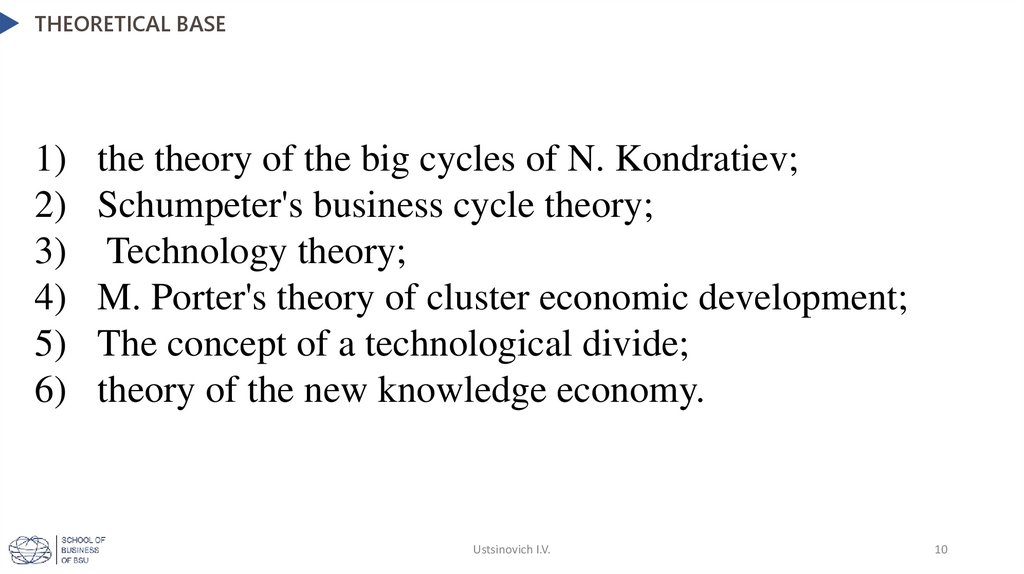
THEORETICAL BASE1)
2)
3)
4)
5)
6)
the theory of the big cycles of N. Kondratiev;
Schumpeter's business cycle theory;
Technology theory;
M. Porter's theory of cluster economic development;
The concept of a technological divide;
theory of the new knowledge economy.
Ustsinovich I.V.
10
11. mechanism for managing the development of new products
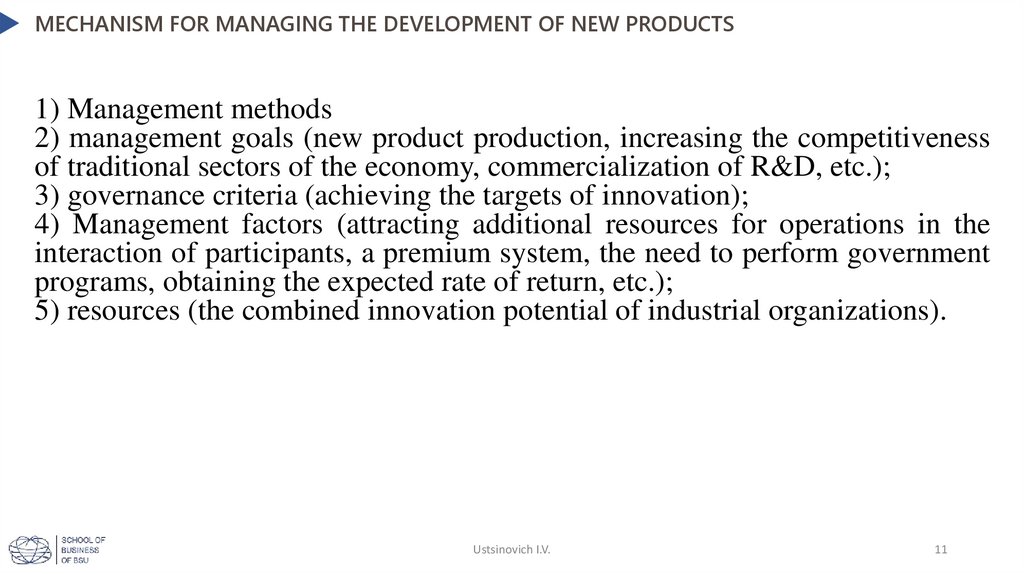
MECHANISM FOR MANAGING THE DEVELOPMENT OF NEW PRODUCTS1) Management methods
2) management goals (new product production, increasing the competitiveness
of traditional sectors of the economy, commercialization of R&D, etc.);
3) governance criteria (achieving the targets of innovation);
4) Management factors (attracting additional resources for operations in the
interaction of participants, a premium system, the need to perform government
programs, obtaining the expected rate of return, etc.);
5) resources (the combined innovation potential of industrial organizations).
Ustsinovich I.V.
11
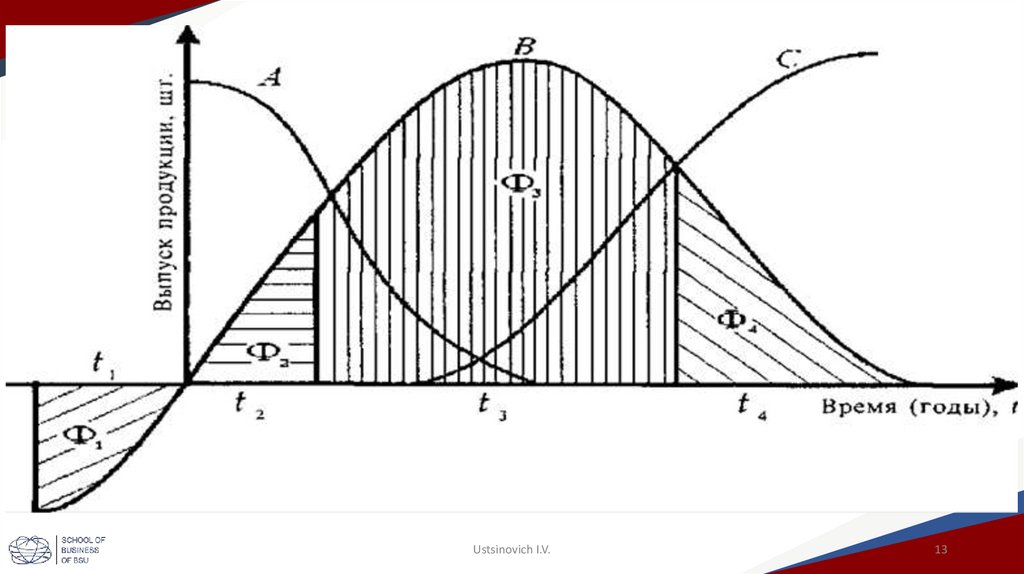
12. 2. The innovation life cycle
2. THE INNOVATION LIFE CYCLEUstsinovich I.V.
12
13.
Ustsinovich I.V.13
14. Innovative process
INNOVATIVE PROCESSThe innovation process can be divided into two main
stages:
the first stage (it is the longest) includes research and
development,
the second stage is the life cycle of the product.
Ustsinovich I.V.
14
15. four key stages of innovation
FOUR KEY STAGES OF INNOVATIONStage 1. Ideation – Basic research and conception.
Stage 2. Project Selection – The decision to invest.
Stage 3. Product Development – Building the product
or service.
Stage 4. Commercialization – Bringing the product or
service to market and adapting it to customer demands.
Ustsinovich I.V.
15
16. 3. Types of innovative projects and their management principles
3. TYPES OF INNOVATIVE PROJECTS AND THEIR MANAGEMENTPRINCIPLES
Ustsinovich I.V.
16
17. Types of innovative projects (1)
TYPES OF INNOVATIVE PROJECTS (1)1. According to the project period, there may be:
Short-term (1-2 years);
medium-term (up to 5 years);
long-term (more than 5 years).
2. By the nature of the project's objectives, there may be:
ultimate - to reflect goals, solutions to the problem as a whole;
Intermediate.
3. By the kind of needs met, they can be targeted
to meet existing needs;
to create new needs.
Ustsinovich I.V.
17
18. Types of innovative projects (2)
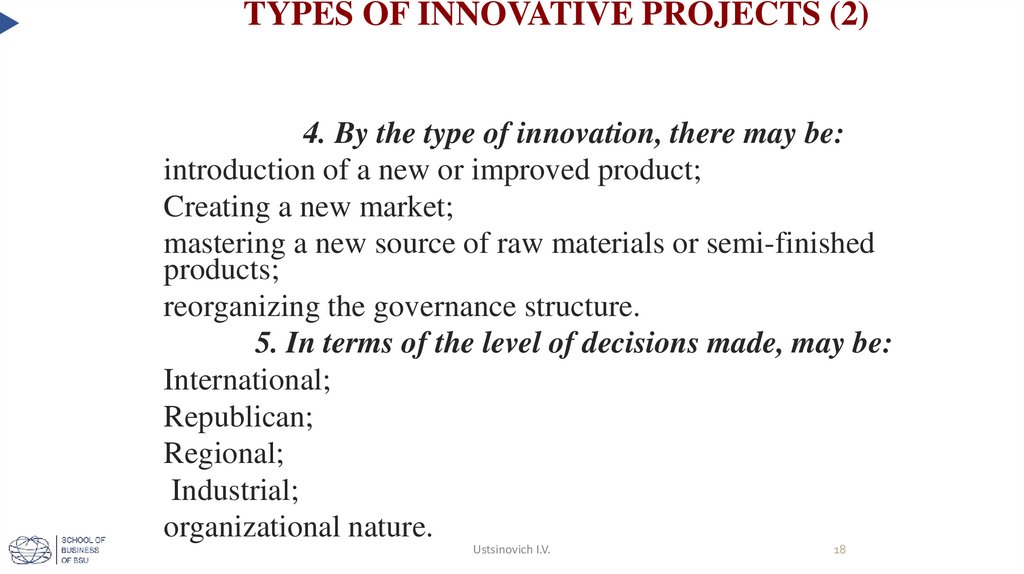
TYPES OF INNOVATIVE PROJECTS (2)4. By the type of innovation, there may be:
introduction of a new or improved product;
Creating a new market;
mastering a new source of raw materials or semi-finished
products;
reorganizing the governance structure.
5. In terms of the level of decisions made, may be:
International;
Republican;
Regional;
Industrial;
organizational nature.
Ustsinovich I.V.
18
19. management principles:
MANAGEMENT PRINCIPLES:The principle of selective management. The point is to choose priority areas; targeted support
for innovative firms and innovators.
The principle of targeting projects to achieve end goals. It involves the relationship between
the need to create innovation and the possibilities for their implementation.
The principle of complete project management cycle.
The principle of project management processes.
The principle of innovative processes hierarchical organization of. All levels of activity are
consistent with each other.
The principle of multivariability in the choice of management decisions.
The principle of systemicity. A set of measures is being developed to organize the project
(organizational, administrative, etc.).
The principle of security or balance. All activities must be provided with the necessary
resources
Ustsinovich I.V.
19
20. Managing innovative projects
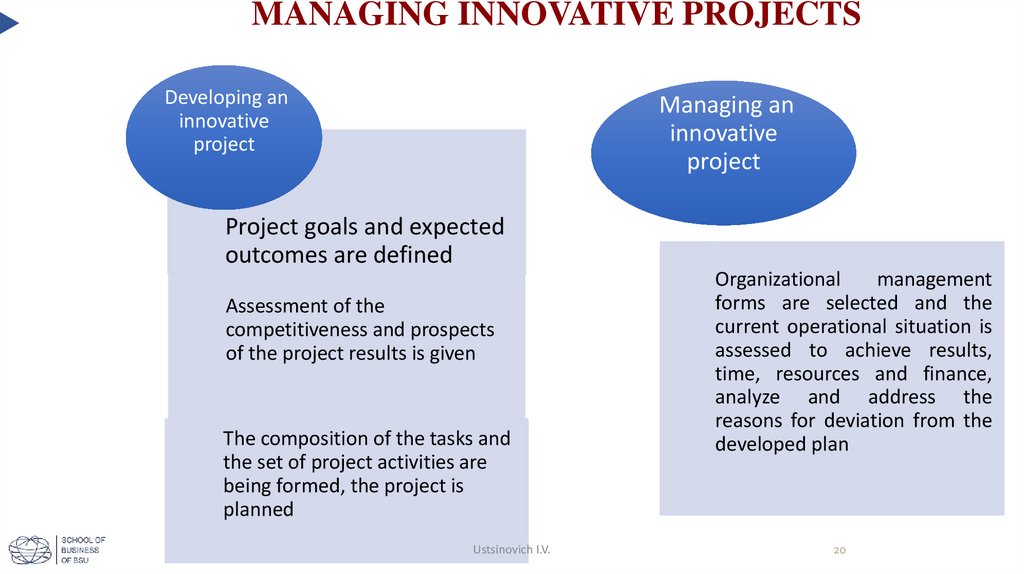
MANAGING INNOVATIVE PROJECTSDeveloping an
innovative
project
Managing an
innovative
project
Project goals and expected
outcomes are defined
Assessment of the
competitiveness and prospects
of the project results is given
The composition of the tasks and
the set of project activities are
being formed, the project is
planned
Ustsinovich I.V.
Organizational
management
forms are selected and the
current operational situation is
assessed to achieve results,
time, resources and finance,
analyze and address the
reasons for deviation from the
developed plan
20
21. Managing innovative projects
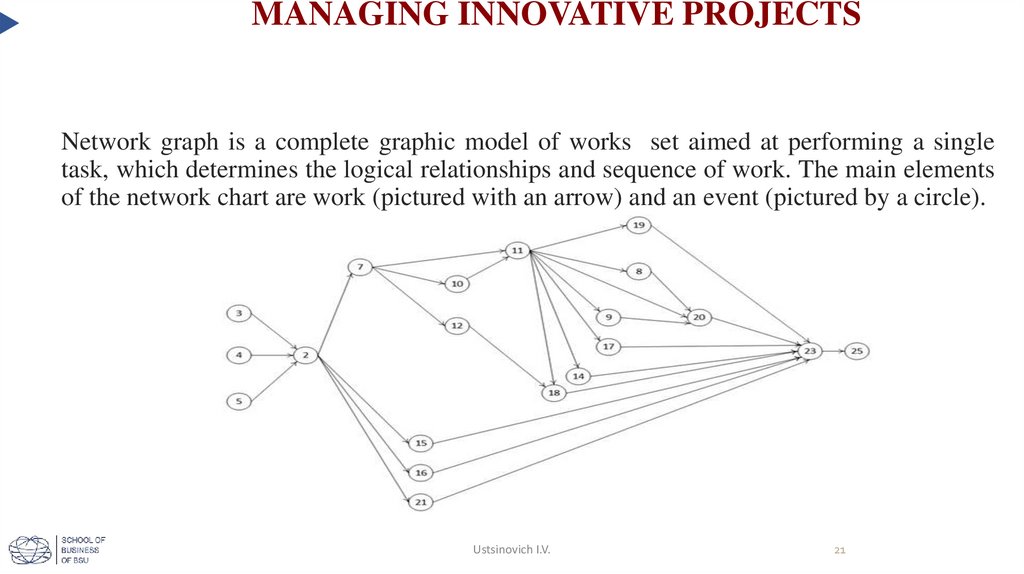
MANAGING INNOVATIVE PROJECTSNetwork graph is a complete graphic model of works set aimed at performing a single
task, which determines the logical relationships and sequence of work. The main elements
of the network chart are work (pictured with an arrow) and an event (pictured by a circle).
Ustsinovich I.V.
21
22. Managing innovative projects
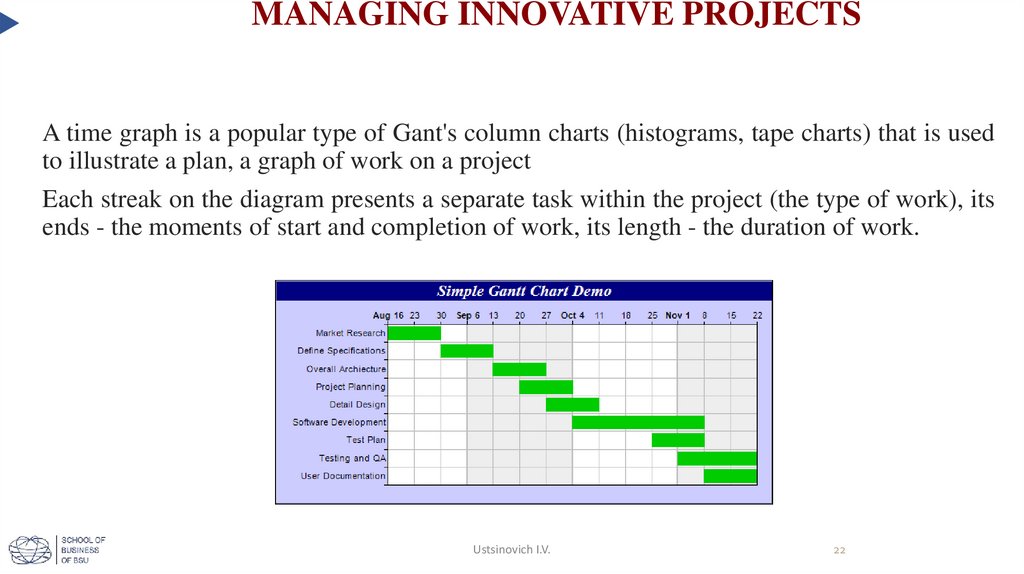
MANAGING INNOVATIVE PROJECTSA time graph is a popular type of Gant's column charts (histograms, tape charts) that is used
to illustrate a plan, a graph of work on a project
Each streak on the diagram presents a separate task within the project (the type of work), its
ends - the moments of start and completion of work, its length - the duration of work.
Ustsinovich I.V.
22
23. Evaluating the effectiveness of innovative projects
EVALUATING THE EFFECTIVENESS OF INNOVATIVE PROJECTSStatic methods are based on the assessment of cash flows occurring at
different points in time as equivalent: static performance criteria do
not take into account changes in the cost of funds over time.
It is recommended that innovative projects be applied in the early
stages, as well as for projects with a relatively short investment period.
Static criteria for the effectiveness of innovative projects:
"given costs" for the implementation of an innovative project;
Total (or average annual) profit from the implementation of the
innovative project;
Roost (return on investment) of an innovative project;
The efficiency of additional investment in innovation;
static period (term) of return on capital investment in the project;
the break-even point of production innovation.
Ustsinovich I.V.
23
24. Evaluating the effectiveness of innovative projects
EVALUATING THE EFFECTIVENESS OF INNOVATIVE PROJECTSDynamic methods of evaluating the costeffectiveness of an innovative project are based
on taking into account the different costs and
bringing them to a single period of time discounting (discounting rates):
Integral effect.
Profitability index.
The rate of profitability.
Payback period
Ustsinovich I.V.
24
25. 4. Innovation statistics
4. INNOVATION STATISTICSUstsinovich I.V.
25
26. Innovative Infrastructure: General Characteristics and Structural Content
INNOVATIVE INFRASTRUCTURE: GENERAL CHARACTERISTICS AND STRUCTURAL CONTENTInnovative Infrastructure:
Science and Technology Parks (Technoparks);
Technology transfer centers;
Venture capital firms;
other legal entities in cases under the law.
Ustsinovich I.V.
26
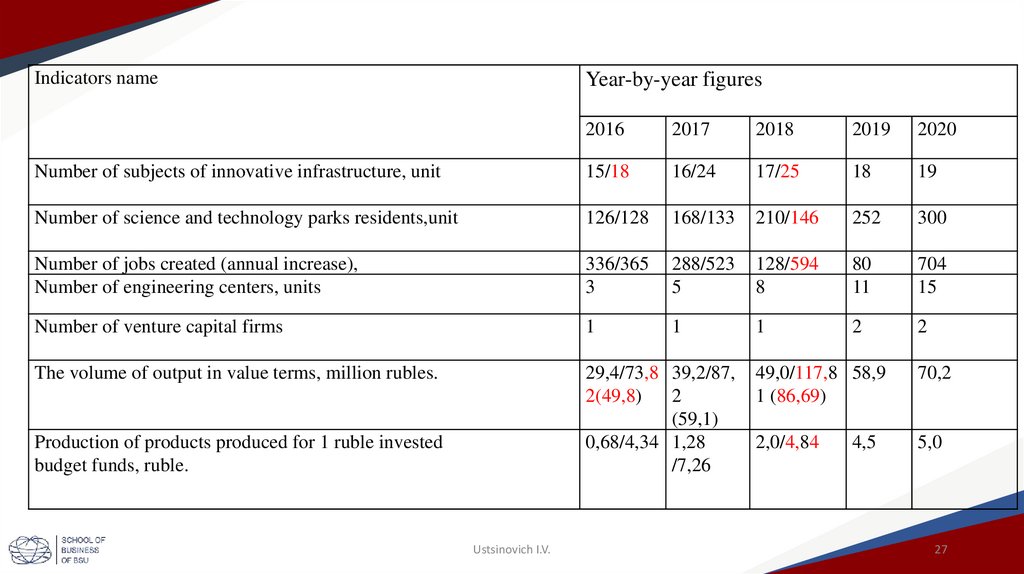
27.
Indicators nameYear-by-year figures
2016
2017
2018
2019
2020
Number of subjects of innovative infrastructure, unit
15/18
16/24
17/25
18
19
Number of science and technology parks residents,unit
126/128
168/133
210/146
252
300
Number of jobs created (annual increase),
Number of engineering centers, units
336/365
3
288/523
5
128/594
8
80
11
704
15
Number of venture capital firms
1
1
1
2
2
The volume of output in value terms, million rubles.
29,4/73,8 39,2/87,
2(49,8)
2
(59,1)
0,68/4,34 1,28
/7,26
Production of products produced for 1 ruble invested
budget funds, ruble.
Ustsinovich I.V.
49,0/117,8 58,9
1 (86,69)
70,2
2,0/4,84
5,0
4,5
27
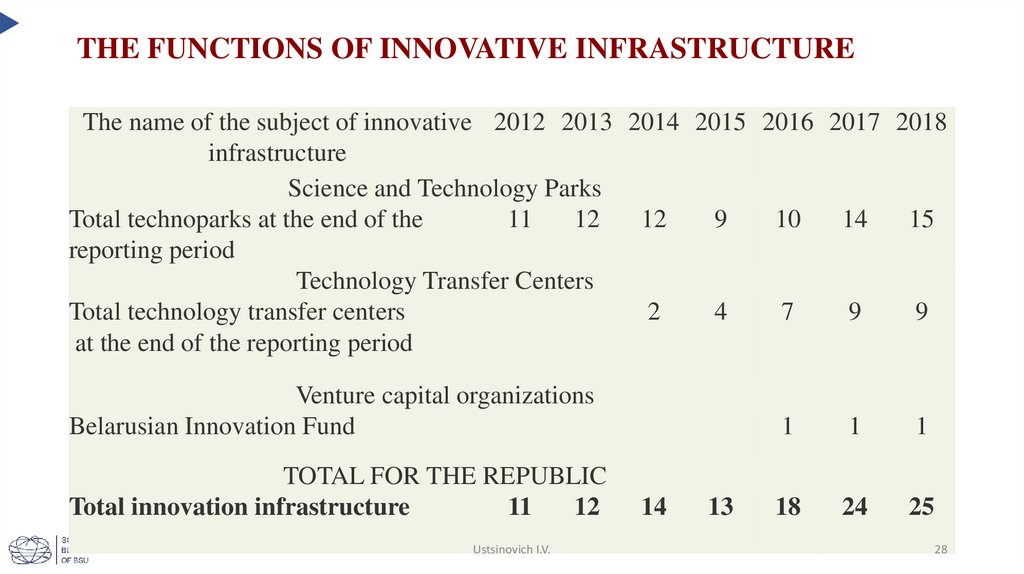
28. The functions of innovative infrastructure
THE FUNCTIONS OF INNOVATIVE INFRASTRUCTUREThe name of the subject of innovative 2012 2013 2014 2015 2016 2017 2018
infrastructure
Science and Technology Parks
Total technoparks at the end of the
11
12
12
9
10
14
15
reporting period
Technology Transfer Centers
Total technology transfer centers
2
4
7
9
9
at the end of the reporting period
Venture capital organizations
Belarusian Innovation Fund
TOTAL FOR THE REPUBLIC
Total innovation infrastructure
11
12
Ustsinovich I.V.
14
13
1
1
1
18
24
25
28
29.
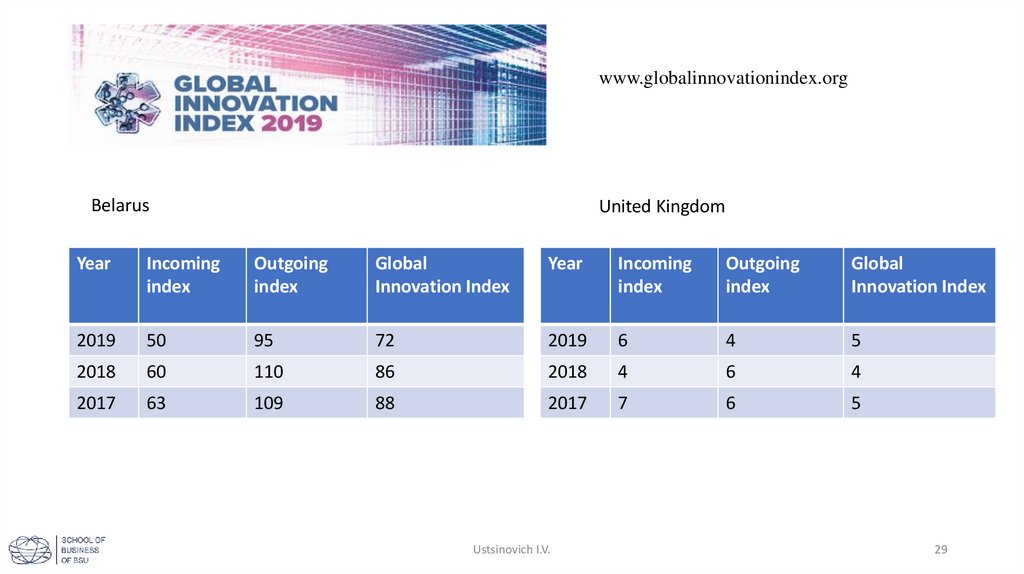
www.globalinnovationindex.orgBelarus
United Kingdom
Year
Incoming
index
Outgoing
index
Global
Innovation Index
Year
Incoming
index
Outgoing
index
Global
Innovation Index
2019
50
95
72
2019
6
4
5
2018
60
110
86
2018
4
6
4
2017
63
109
88
2017
7
6
5
Ustsinovich I.V.
29
30. Thank you for your attention!
THANK YOU FOR YOUR ATTENTION!Irina Valeryevna Ustsinovitch, Ph.D. in Economics, Associate Professor
+375 (29) 7785456
i.ustinovich@yandex.ru
Ustsinovich I.V.
30