





 Менеджмент
Похожие презентации:








Formation of management and development of management theory
1.
1. Formation of management anddevelopment of management theory
2.
"Revolutionary" way of management development.The first managerial revolution
(religious and commercial).
Production in Egypt, Sumer, Akkad
3. What was the driver of progress in the Ancient world? What can bring a civilization down or make it prosper like never before?
QUESTIONWhat was the driver of progress in the Ancient world?
What can bring a civilization down or make it prosper like
never before?
4. The answer is
THE INVENTIONOF WRITING
5.
For the era of the AncientWorld, writing is an
energetically very expensive
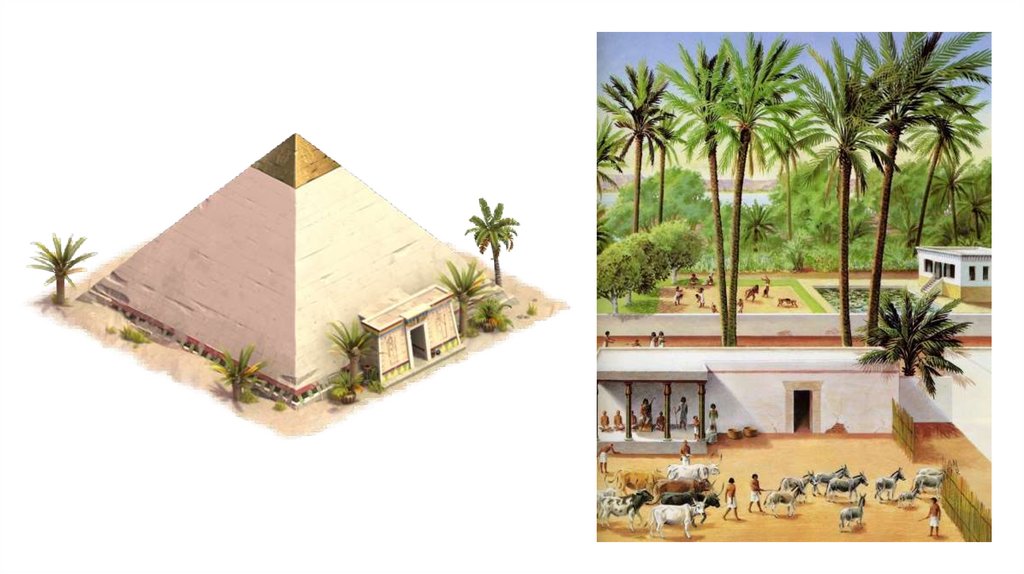
technology. Only societies with
high agricultural productivity,
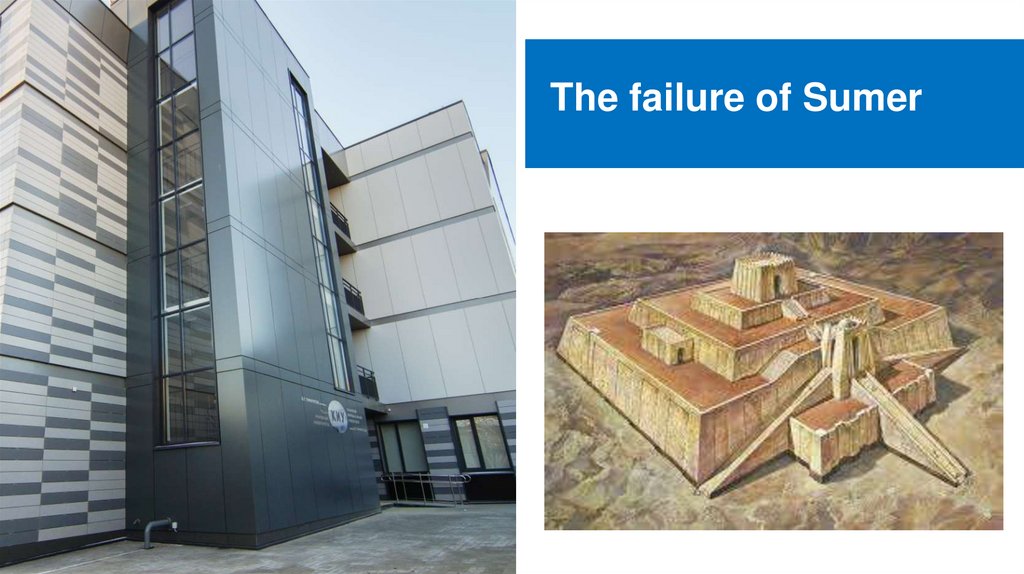
which was achieved exclusively
in warm regions permeated by
deep rivers, could afford it.
6.
The technology, despite itshigh resource cost, proved to
be in demand, since, starting
from the level of tribal
structures and nomes, it was
impossible to continue their
further integration into even
larger societies without
writing.
7.
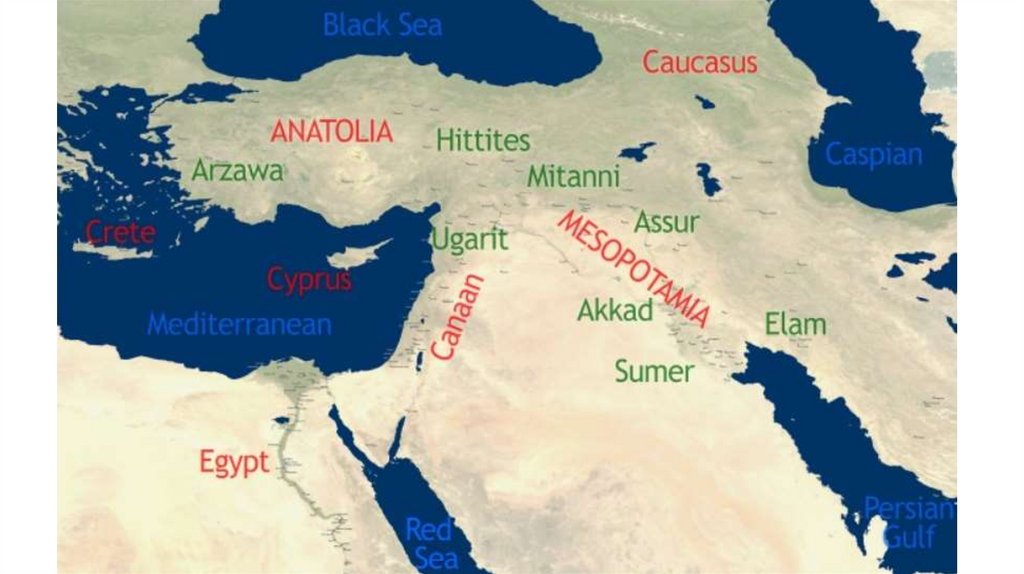
Arena of the comparativeevolution of two civilizations
The Nile Delta and the lower
mesopotamia of Tyre and
Euphrates became the core of two
major ancient civilizations:
Egypt and Sumer.
8.
9.
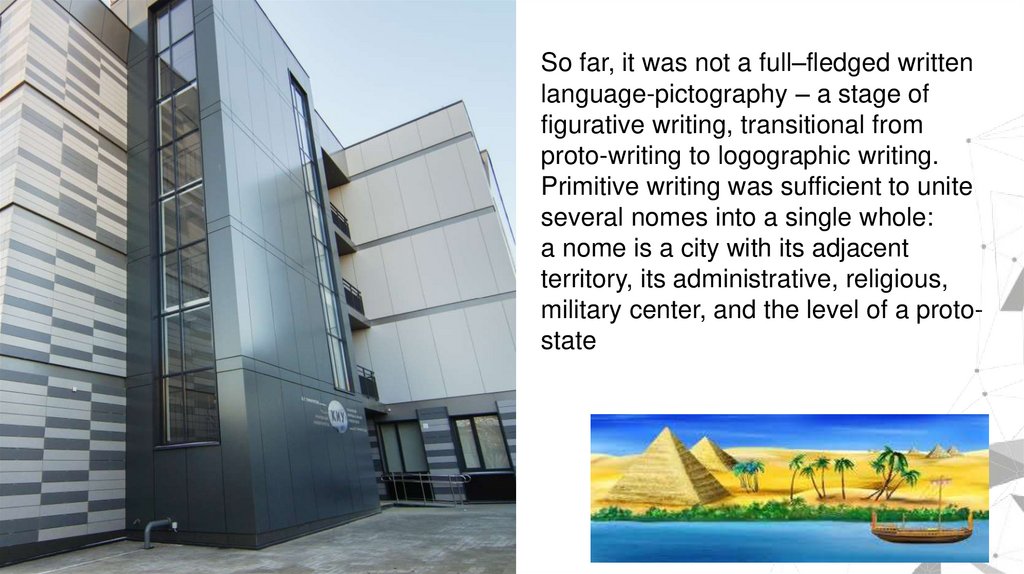
So far, it was not a full–fledged writtenlanguage-pictography – a stage of
figurative writing, transitional from
proto-writing to logographic writing.
Primitive writing was sufficient to unite
several nomes into a single whole:
a nome is a city with its adjacent
territory, its administrative, religious,
military center, and the level of a protostate
10. What is the best material in the ancient world to write on?
QUESTIONWhat is the best material
in the ancient world to write on?
11.
Here comes PAPYRUS12.
13.
The production of papyrus providedAncient Egypt with a huge
breakthrough in the productivity and
quality of information fixation, as well
as low costs for moving, storing,
accessing, and analytical processing.
All together, this led to the almost
instantaneous emergence of the state
and hieroglyphic writing on paper
after 3200 BC.
14.
Advanced technology, which madeinformation encoding energyefficient, opened a window of
opportunity for a huge increase in
the volume of information
recording, which made it possible
to increase the efficiency and
quality of management
15.
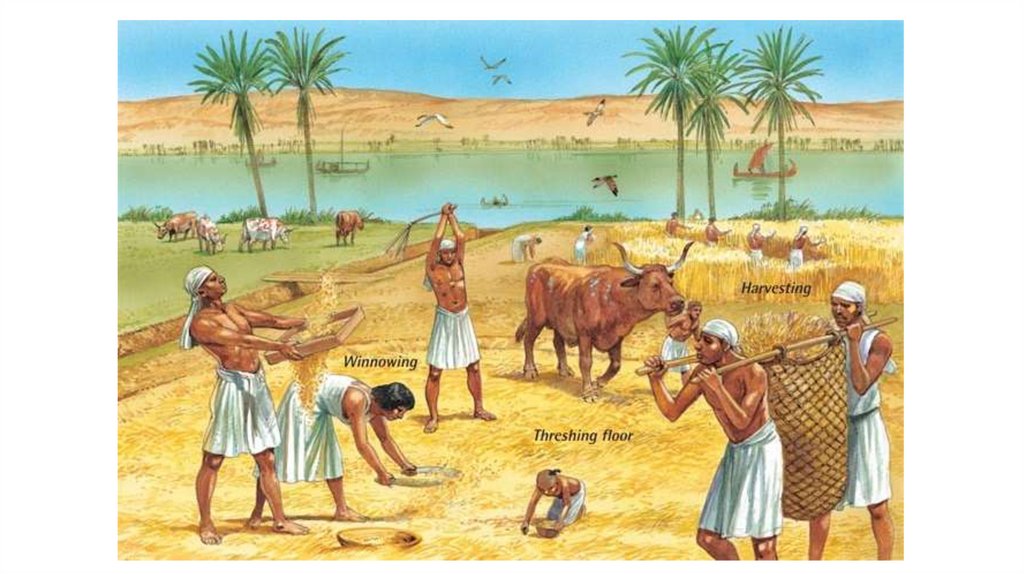
A feature of agricultural production inAncient Egypt was the complete
delivery of the harvested crop to
warehouses, after which the surplus
over the delivery rate was returned to
farmers. Grain was collected,
transported, delivered to central
storage facilities, and then distributed
to farms – royal and temple, and each
stage was taken into account and
controlled
16.
17.
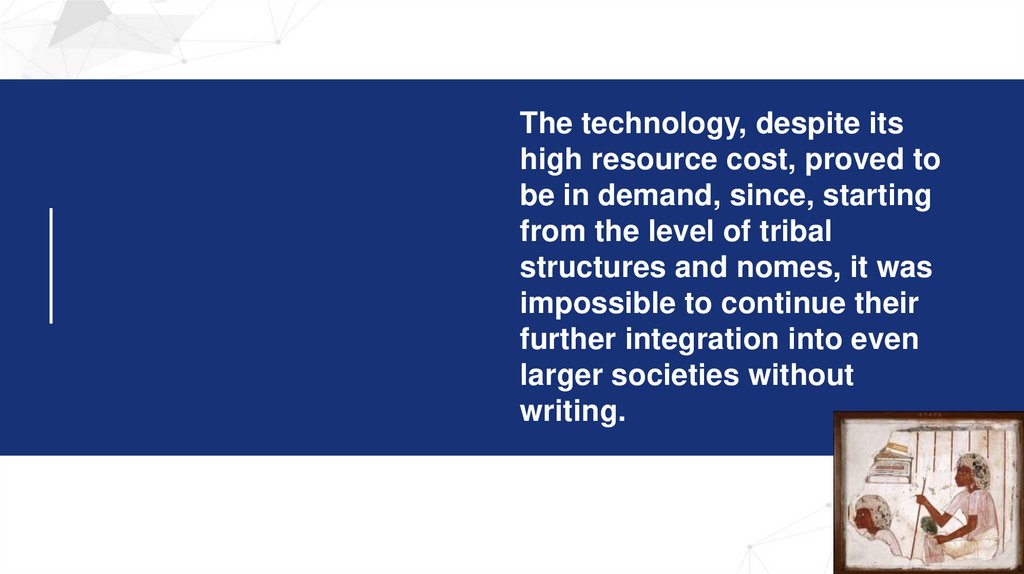
Constantly practicing groups ofscribes quickly improved the written
language, which led to its further
optimization, therefore, to a decrease
in the resource cost of information,
and therefore to an increase in the
efficiency of the state. In turn, this
allowed him to increase the staff of
scribes, who further improved writing
– a kind of autocatalytic cycle was
obtained, which ensured the rapid
development of writing and the state
18.
Advanced writing madeEgypt the most
energetically efficient
monarchy in the Ancient
World. This is evidenced
by the level of culture and
incredible engineering
structures - irrigation
systems, temples,
pyramids
19.
20.
The failure of Sumer21.
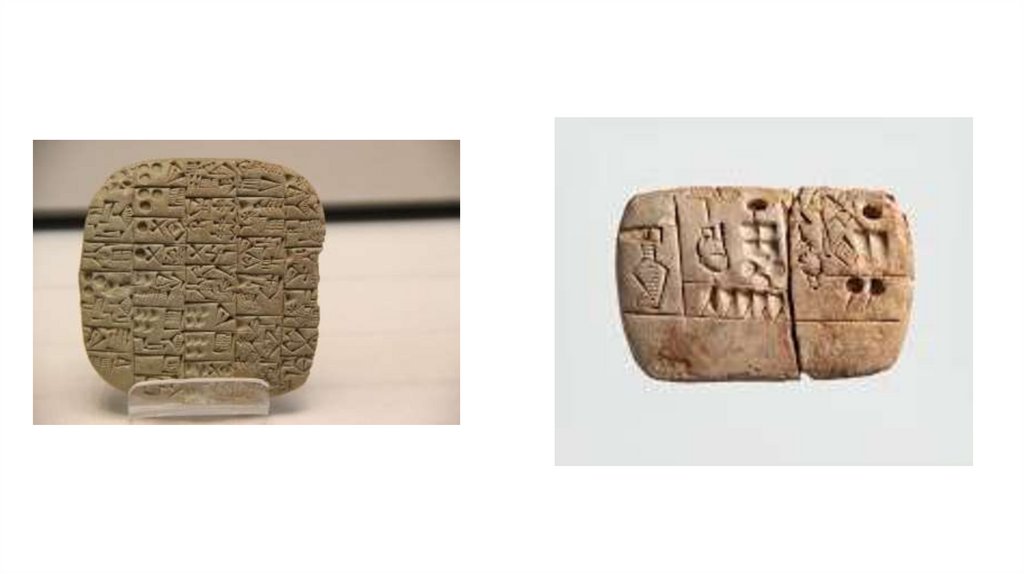
In Sumer and the succeeding kingdoms ofAkkad and Babylon, the main physical
medium of information remained a clay
tablet.
From the standpoint of sociogenesis, this
was a technological failure. The plate is
suitable for a limited time, after drying, it
was impossible to add anything. The
information was very heavy in the direct
physical sense of the word, as a result of
its production, storage, movement,
processing, access to it were very energyintensive processes
22.
23.
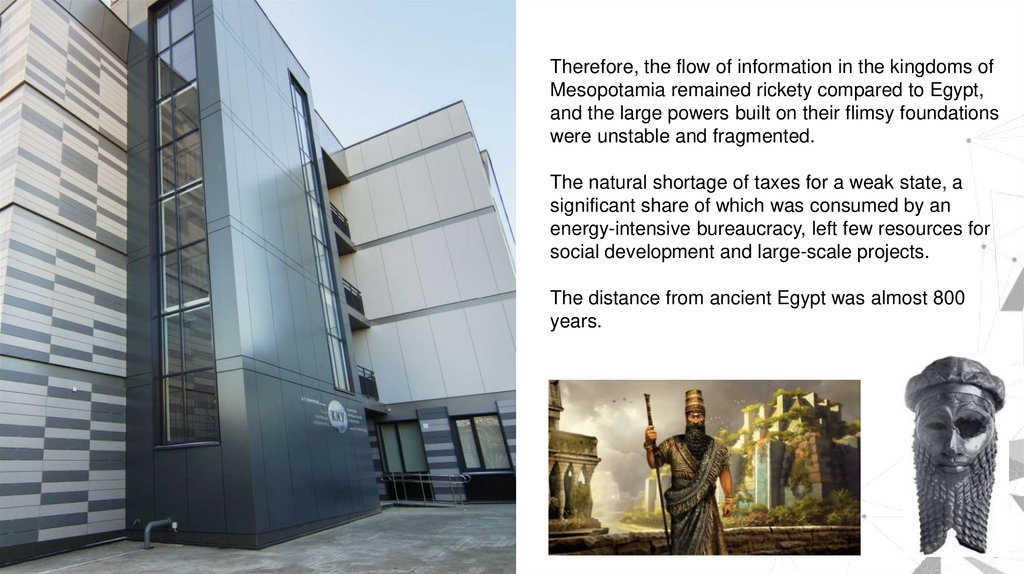
Therefore, the flow of information in the kingdoms ofMesopotamia remained rickety compared to Egypt,
and the large powers built on their flimsy foundations
were unstable and fragmented.
The natural shortage of taxes for a weak state, a
significant share of which was consumed by an
energy-intensive bureaucracy, left few resources for
social development and large-scale projects.
The distance from ancient Egypt was almost 800
years.
24.
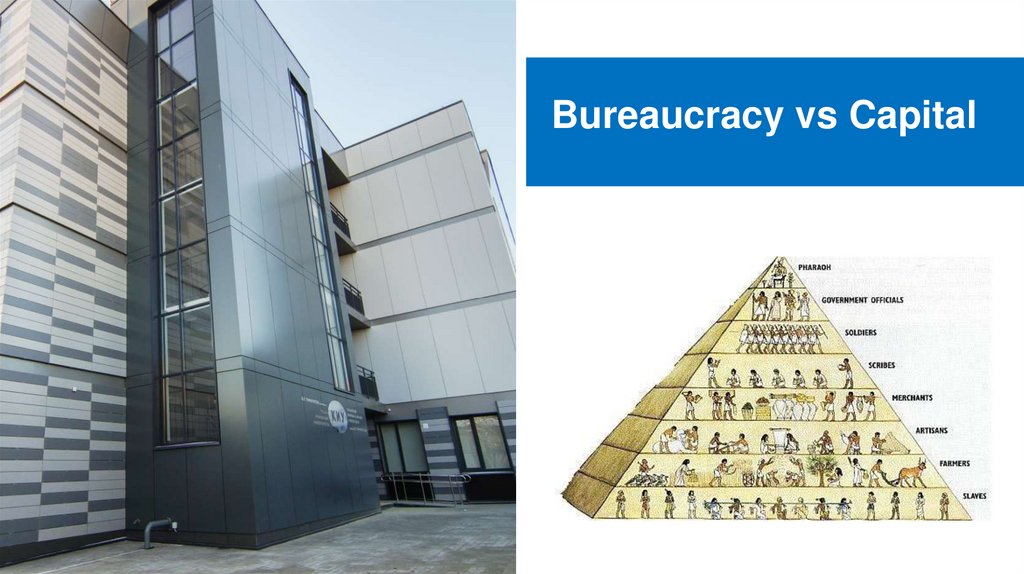
Bureaucracy vs Capital25.
The instability of the weak states of antiquity is a sad outcome of thepermanent internal confrontation «Bureaucracy vs Capital".
Before the establishment of commodity-money exchange in the XIII century
BC, the additional product received by Capital could not be converted from a
commodity into money. As a result, it was basically impossible to save
profit, the lion's share of which was grain – it was quickly destroyed by
bugs, mold and other mice, and the storage itself cost a lot of resources.
The profit had to be consumed before it lost its consumer properties, so the
task was always to invest it quickly. The main question is: where to?
26. Where would you invest your assets to in the ancient world?
QUESTIONWhere would you invest your assets to
in the ancient world?
27.
Investment in innovation was absent as a class, as new technologies andproduct niches were extremely rare. The basic productive asset – land - in
the conditions of irrigation farming was in a huge deficit, so it could not
absorb even a tiny share of the profits produced. It was possible to invest in
war, but such an investment was risky, and the distribution of profits from it,
if any, was usually in the monarch's will. Therefore, the answer to the
question: "Where to invest the profit?" – was reduced in the end to the
dilemma of
1) use it for consumption
2) invest in power.
28.
Consumption, by utilizing profits, slows down the expandedreproduction of Capital, so his natural aspiration was the
second way - to invest in power in order to gain access to
administrative rents that allow him to increase himself. But
administrative rent is the domain of the monarchs, who dictated
to the bureaucracy the task of closing Capital's access to the
treasury. So much for the objective reason for the
confrontation.
29.
Capital, with its resources, always tried to break through thedefenses that were being built, so it could only be resisted by
an effective bureaucracy with a high level of control over
internal processes. An inefficient bureaucracy could not
possibly be a barrier to Capital on the second path. Therefore,
the first option (consumption) is the way of Egypt, the second
(investment in power) - Sumer and post-Sumer.
30.
The way of Egyptand the way of Sumer
31.
An effective written language and writingmedium allowed Ancient Egypt to
immediately build an effective bureaucracy.
Its quality and stability made the struggle
against the monarch an extremely
dangerous enterprise, which inclined the
nome aristocracy to refuse to invest in
power.
The high quality of accounting and control
allowed not only to establish a high rate of
taxes, but also to actually collect them,
which significantly replenished the treasury
and reduced the rate of savings of the
nome aristocracy.
32.
Capital's remaining profits were divertedto consumption. Since domestic
consumption, even elite consumption, is
not able to utilize large amounts of profit
on a permanent basis, an industry of
monumental architectural luxury was
created in Egypt.
Thus, religious cults served the Egyptian
state another indirect service – they
provided a theological justification for an
effective mechanism for profit utilization.
33.
During the Middle 2050-1750 BC andNew 1560-1070 BC kingdoms, when
the scale of investment in the burial
industry weakened, they were
compensated by huge investments in
irrigation projects and the
construction of grandiose palaces
and religious buildings – symbols of
power and success, repeated after
the pharaohs.
34.
Sumer was destined for a different path: weakwriting and the shortcomings of the writing
medium predetermined the inefficiency of the
bureaucracy, which allowed Capital to choose
another alternative that was closer to its spirit
– investment in power. The redistribution of a
significant part of administrative rent in favor of
Large Capitals reduced the already small
resources of the state. As a result, its ability to
consolidate society, implement projects,
sustain expansion, and defend the state – all
characteristic features of the great kingdoms
of Sumer, Akkad, and Babylon-has degraded.
35.
Lessons from Egypt and Sumer1. Energy-efficient writing, which provided a low resource price for a unit of
information circulating in the system, was a necessary condition for the emergence
of a large state.
2. In the case of a shortage of investment niches, which is constantly reproduced at
all stages of capitalism, Capital begins to consider the state as an investment object
in order to gain access to administrative rent.
3. Only an efficient (with a high level of internal control) bureaucracy can protect the
state from Capital attacks.
4. Efficient bureaucracy and Capital are innate antagonists.
36.
Priests as the first capitalists37.
The first management revolution tookplace 4-5 thousand years ago — during
the formation of slave states in the
Ancient East. In Sumer, Egypt, and
Akkad, management historians have
noted the first transformation — the
transformation of the priestly caste into a
caste of religious functionaries, i.e.
managers. This was done thanks to their
successful reformulation of religious
principles. If earlier the gods demanded
human sacrifices, now, as the priests
stated, they are not needed
38.
As a result, a fundamentally new typeof business person was born — not
yet a commercial businessman or a
capitalist entrepreneur, but no longer
a religious figure who is alien to all
profit. Tribute collected from the
population, under the guise of
departure a religious rite, was not
wasted. It accumulated, exchanged,
and went into action.
The shapeshifting Sumerian priests
soon became the richest and most
influential class.
39.
Thank you for your attention!a