

 Лингвистика
Похожие презентации:


Adjectives: Describing the World Around Us
1.
Adjectives: Describing theWorld Around Us
Adjectives are the spice of language, enriching our sentences with
vivid details and specific qualities. They transform ordinary
descriptions into engaging narratives, allowing us to paint mental
pictures with words. This presentation explores the world of
adjectives, covering their definition, functions, and types. Join us on
this voyage as we explore the essence of adjectives and their crucial
role in effective communication.
by Forever Young
2.
Definition: What is an Adjective?Modifying Nouns and Pronouns
Adding Detail and Specificity
Adjectives serve as modifiers, enriching nouns and
Consider the difference between "the car" and "the blue
pronouns with descriptive details. They provide clarity
car." The adjective "blue" transforms a general noun into a
and specificity, transforming general statements into
specific image. Without adjectives, our language would
vivid and precise descriptions. These modifiers add depth
be bland and lack nuance. "The fluffy, white dog" paints a
and dimension to our language, helping us to paint more
much richer mental image than just "the dog."
precise pictures with our words.
3.
Function of AdjectivesDescribing Qualities
Adjectives provide
Answering Key
Questions
information about
Adjectives answer
qualities, characteristics,
questions like: What
and states of being. They
kind? Which one? and
allow us to express
How many? For example,
attributes such as color,
"What kind of dog?" A
size, shape, and
happy dog. "Which
condition, enriching our
building?" The tall
descriptions and enabling
building. "How many
more vivid
apples?" Three apples.
communication.
Examples in Action
Think of a "happy dog," a "tall building," or "three apples." These
examples show adjectives bringing nouns to life. Adjectives
are indispensable tools for precise and descriptive language,
enhancing clarity and creating engaging imagery.
4.
Types of Adjectives:Descriptive
Qualities Defined
The Fluffy Cat Example
Descriptive adjectives
Consider the sentence, "The
specify the qualities of
fluffy cat slept on the warm
nouns, covering aspects
rug." The adjectives "fluffy"
such as size (large), color
and "warm" enrich the
(red), shape (round), and
sentence. Without these
taste (sweet). They add
descriptive words, the
depth and detail, enabling
sentence would lack the
us to create vivid and
texture and comfort they
nuanced descriptions.
convey.
Enhancing Descriptions
Descriptive adjectives are essential for creating engaging and
precise language. They transform simple statements into vibrant
images, allowing us to communicate more effectively and vividly.
5.
Types of Adjectives:Quantitative
Indicating
Amount
Quantity of
Nouns
78% Struggle
Quantitative adjectives specify the amount or number of nouns.
Examples include "one," "few," "many," "all," and "some." They give
precise numerical information, making descriptions clearer and more
specific. For example, "I have five books and some pencils."
A significant 78% of English language learners find quantitative
adjectives challenging. This difficulty often arises from the subtle
differences in usage and the need for precision in numerical
descriptions. However, mastering these adjectives is essential for
effective communication.
6.
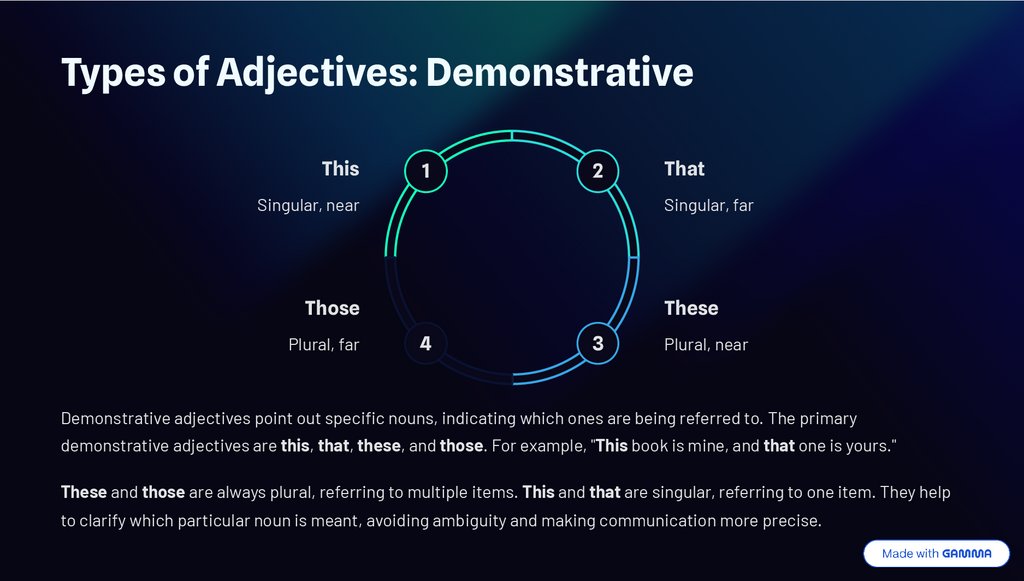
Types of Adjectives: DemonstrativeThis
1
2
Singular, near
Singular, far
Those
Plural, far
That
These
4
3
Plural, near
Demonstrative adjectives point out specific nouns, indicating which ones are being referred to. The primary
demonstrative adjectives are this, that, these, and those. For example, "This book is mine, and that one is yours."
These and those are always plural, referring to multiple items. This and that are singular, referring to one item. They help
to clarify which particular noun is meant, avoiding ambiguity and making communication more precise.
7.
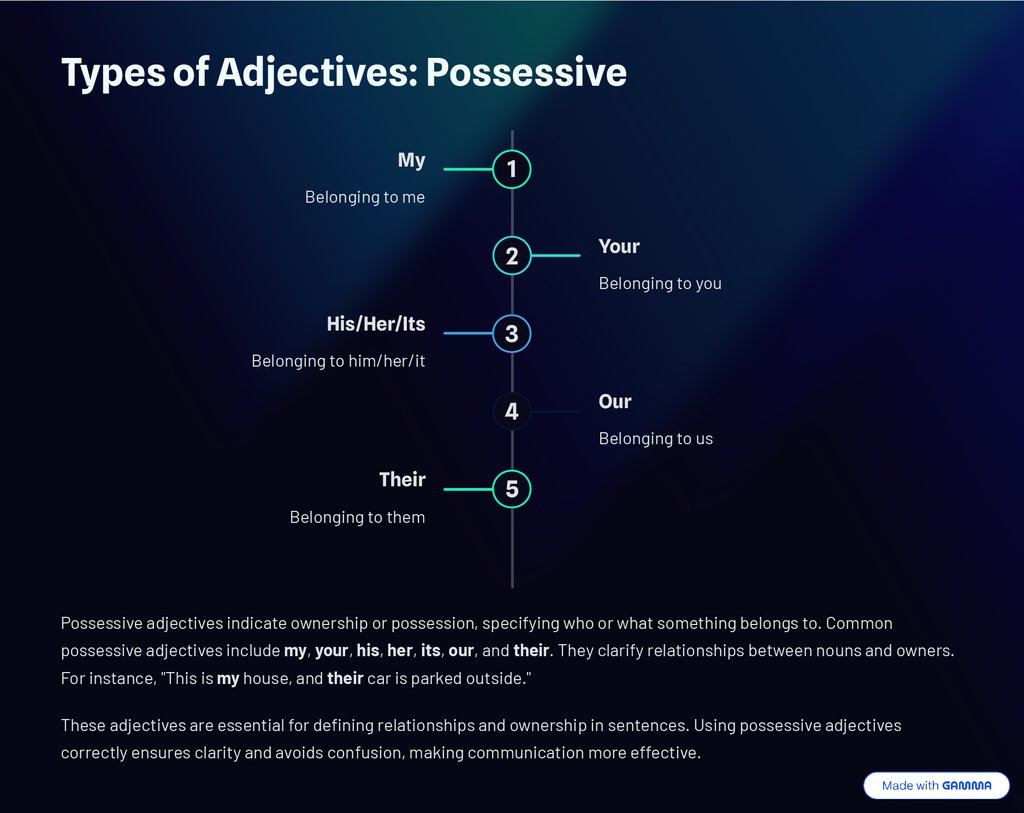
Types of Adjectives: PossessiveMy
1
Belonging to me
2
His/Her/Its
Belonging to him/her/it
Belonging to you
3
4
Their
Your
Our
Belonging to us
5
Belonging to them
Possessive adjectives indicate ownership or possession, specifying who or what something belongs to. Common
possessive adjectives include my, your, his, her, its, our, and their. They clarify relationships between nouns and owners.
For instance, "This is my house, and their car is parked outside."
These adjectives are essential for defining relationships and ownership in sentences. Using possessive adjectives
correctly ensures clarity and avoids confusion, making communication more effective.
8.
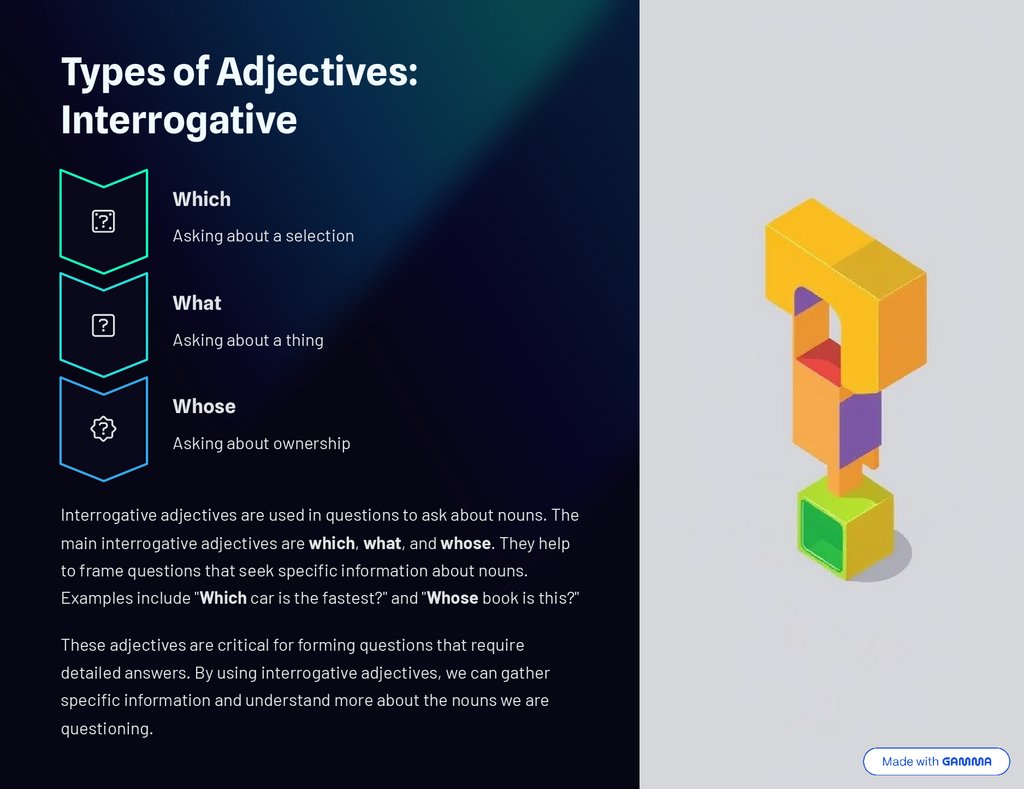
Types of Adjectives:Interrogative
Which
Asking about a selection
What
Asking about a thing
Whose
Asking about ownership
Interrogative adjectives are used in questions to ask about nouns. The
main interrogative adjectives are which, what, and whose. They help
to frame questions that seek specific information about nouns.
Examples include "Which car is the fastest?" and "Whose book is this?"
These adjectives are critical for forming questions that require
detailed answers. By using interrogative adjectives, we can gather
specific information and understand more about the nouns we are
questioning.
9.
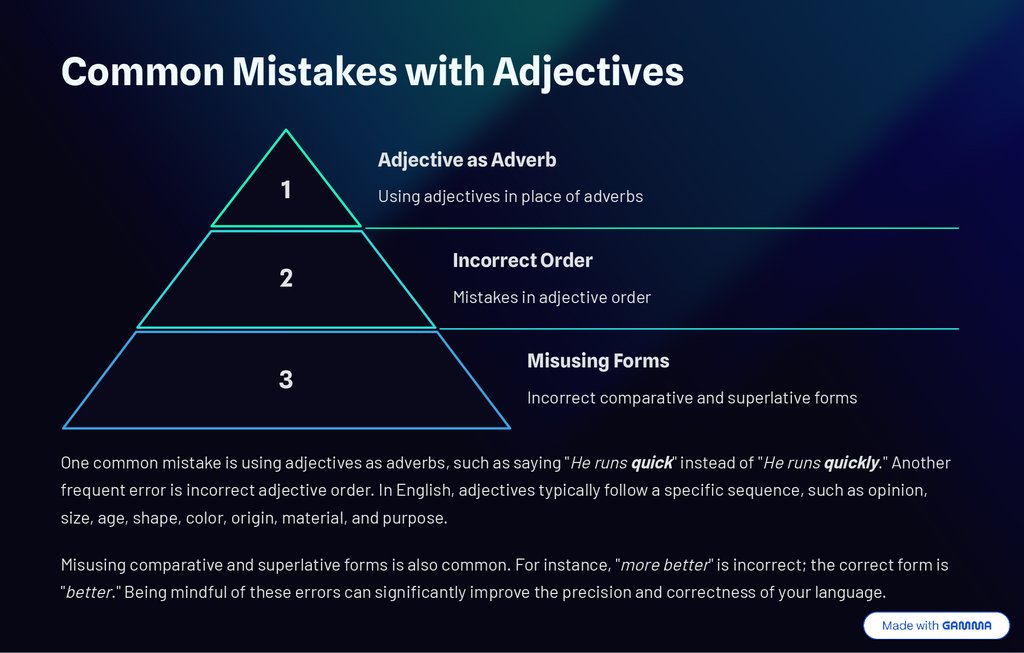
Common Mistakes with AdjectivesAdjective as Adverb
1
Using adjectives in place of adverbs
2
3
Incorrect Order
Mistakes in adjective order
Misusing Forms
Incorrect comparative and superlative forms
One common mistake is using adjectives as adverbs, such as saying "He runs quick" instead of "He runs quickly." Another
frequent error is incorrect adjective order. In English, adjectives typically follow a specific sequence, such as opinion,
size, age, shape, color, origin, material, and purpose.
Misusing comparative and superlative forms is also common. For instance, "more better" is incorrect; the correct form is
"better." Being mindful of these errors can significantly improve the precision and correctness of your language.
10.
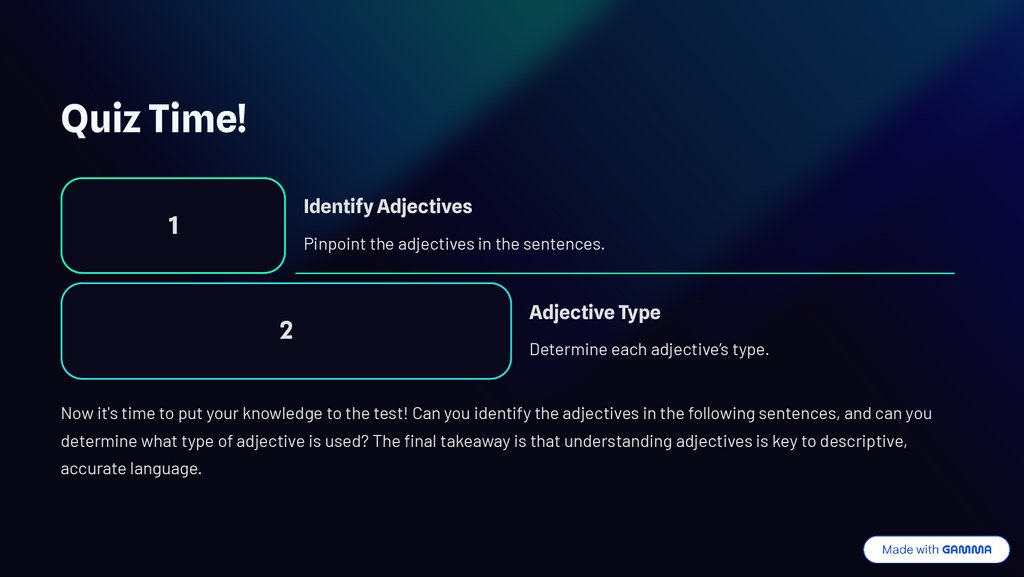
Quiz Time!Identify Adjectives
1
Pinpoint the adjectives in the sentences.
2
Adjective Type
Determine each adjective’s type.
Now it's time to put your knowledge to the test! Can you identify the adjectives in the following sentences, and can you
determine what type of adjective is used? The final takeaway is that understanding adjectives is key to descriptive,
accurate language.