 Менеджмент
Похожие презентации:





Topic 6 Organisation Structure
1. Introduction to Management BM007-3-1-IMT (VD1)
Topic 6Organisational Structure
2.
Learning OutcomesAt the end of this chapter, YOU should be able to know:
• Describe six key elements in organizational design.
• Contrast mechanistic and organic structures
Module Code & Module Title
Slide Title
SLIDE 2
3.
Key Terms you must be able touse
If you have mastered this topic, you should be able to use
the following terms correctly in your assignments and
exams:
•Authority
•Responsibility
•Span of Control
•Delegation
•Centralisation and decentralisation
Module Code & Module Title
Slide Title
SLIDE 3
4. Definition
Organising• Management function that involves arranging and
structuring work to accomplish the organization’s
goals
Organisational structure
• The formal arrangement of jobs within an
organization
Organisational chart
• The visual representation of an organization’s
structure
Organisational design
• Creating or changing an organization’s structure. A
process that involves decisions about six key
elements:
Module Code & Module Title
Slide Title
SLIDE 4
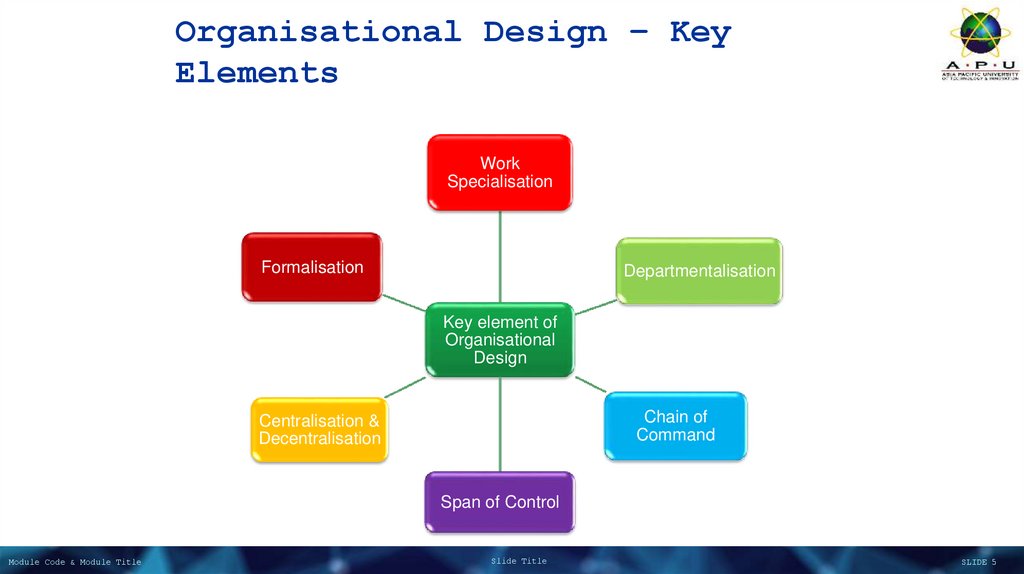
5. Organisational Design – Key Elements
WorkSpecialisation
Formalisation
Departmentalisation
Key element of
Organisational
Design
Chain of
Command
Centralisation &
Decentralisation
Span of Control
Module Code & Module Title
Slide Title
SLIDE 5
6. Work Specialisation
• Dividing work activities into separate job tasks• Individual employees “specialize” in doing part
of an activity rather than the entire activity in
order to increase work output.
• Also known as division of labor
• Work specialization makes efficient use of the
diversity of skills that workers have.
• At some point, the human diseconomies from
division of labor—boredom, fatigue, stress, low
productivity, poor quality, increased absenteeism,
and high turnover
Module Code & Module Title
Slide Title
SLIDE 6
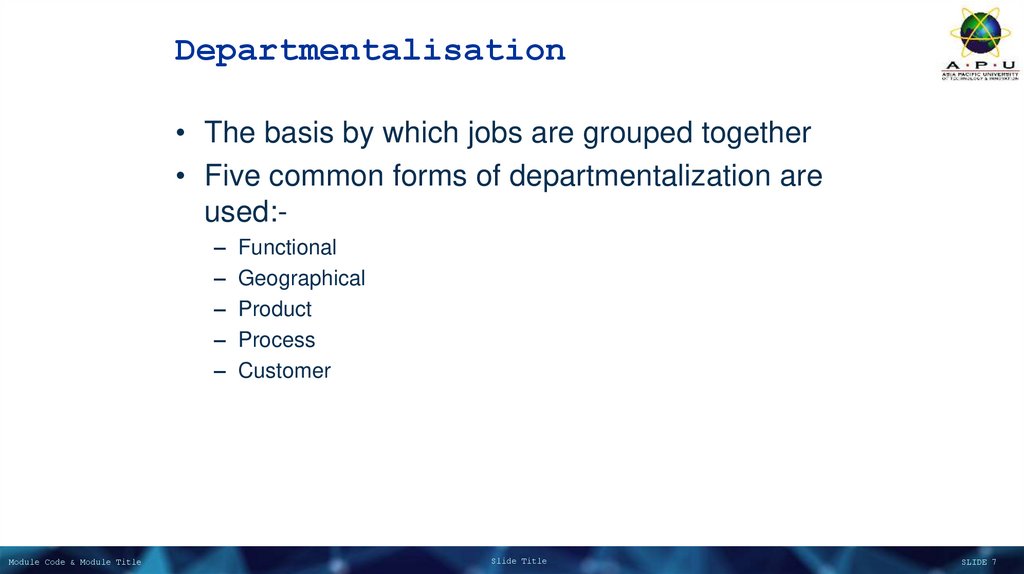
7. Departmentalisation
• The basis by which jobs are grouped together• Five common forms of departmentalization are
used:– Functional
– Geographical
– Product
– Process
– Customer
Module Code & Module Title
Slide Title
SLIDE 7
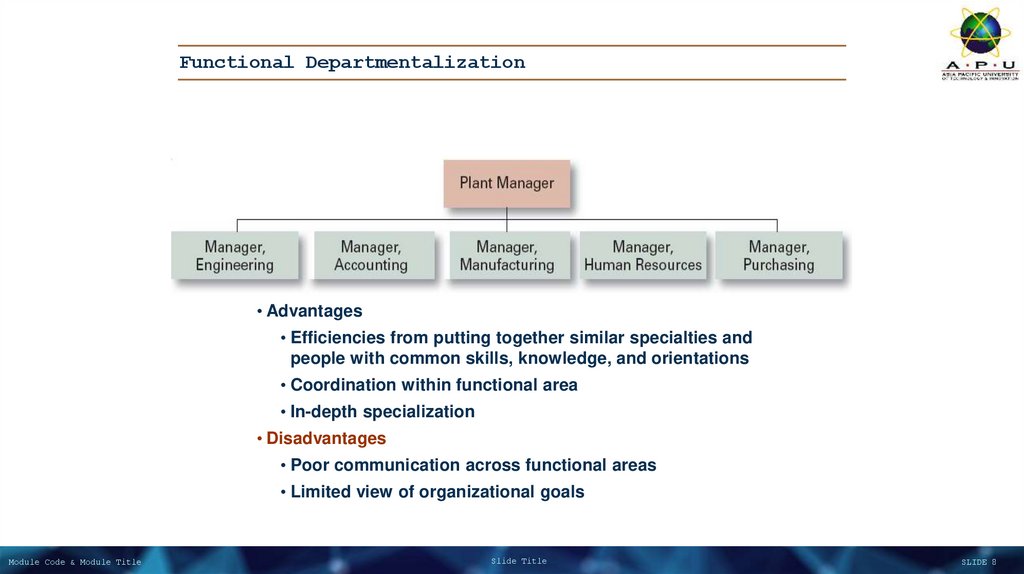
8. Functional Departmentalization
• Advantages• Efficiencies from putting together similar specialties and
people with common skills, knowledge, and orientations
• Coordination within functional area
• In-depth specialization
• Disadvantages
• Poor communication across functional areas
• Limited view of organizational goals
Module Code & Module Title
Slide Title
SLIDE 8
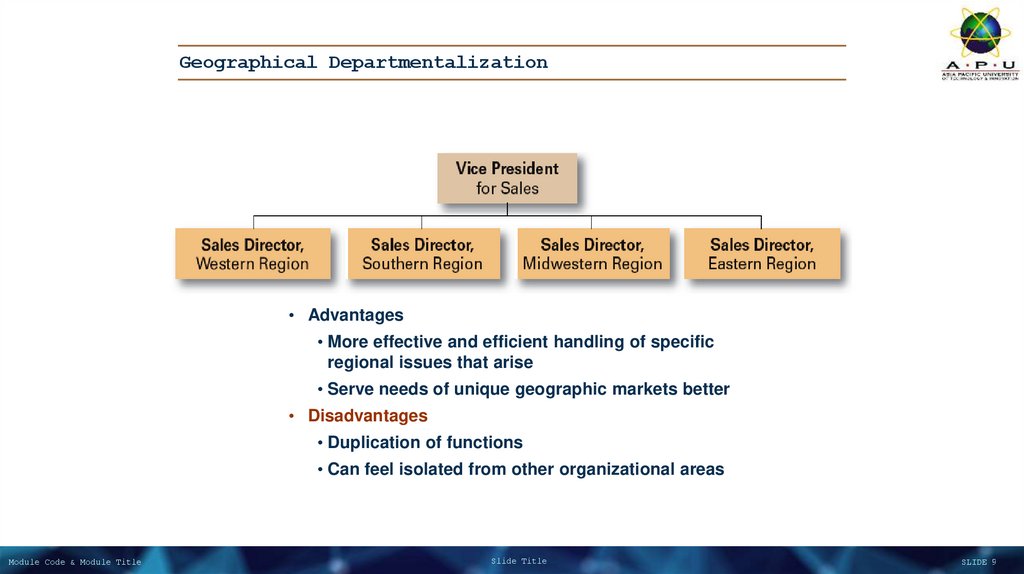
9. Geographical Departmentalization
• Advantages• More effective and efficient handling of specific
regional issues that arise
• Serve needs of unique geographic markets better
• Disadvantages
• Duplication of functions
• Can feel isolated from other organizational areas
Module Code & Module Title
Slide Title
SLIDE 9
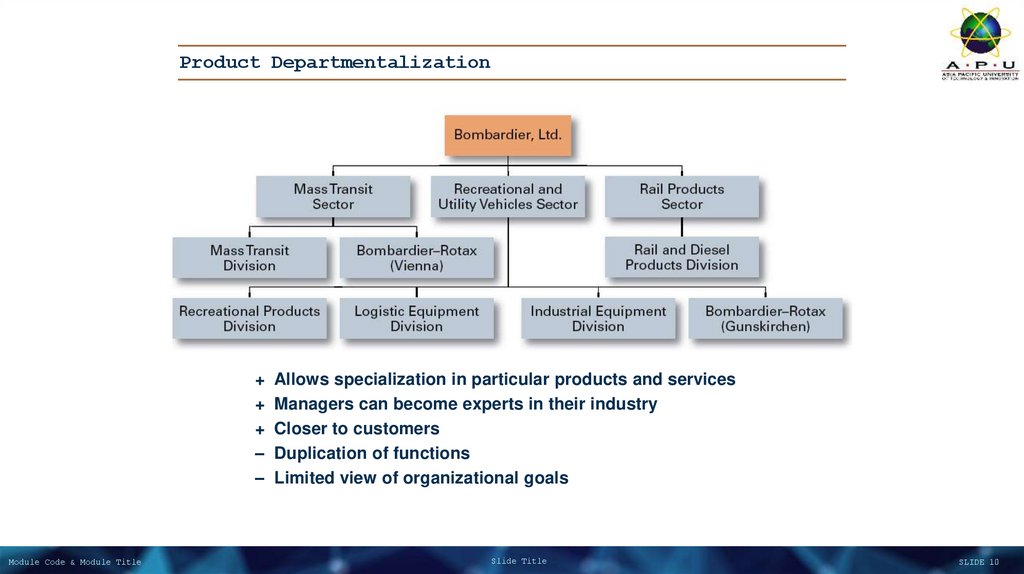
10. Product Departmentalization
+ Allows specialization in particular products and services+ Managers can become experts in their industry
+ Closer to customers
– Duplication of functions
– Limited view of organizational goals
Module Code & Module Title
Slide Title
SLIDE 10
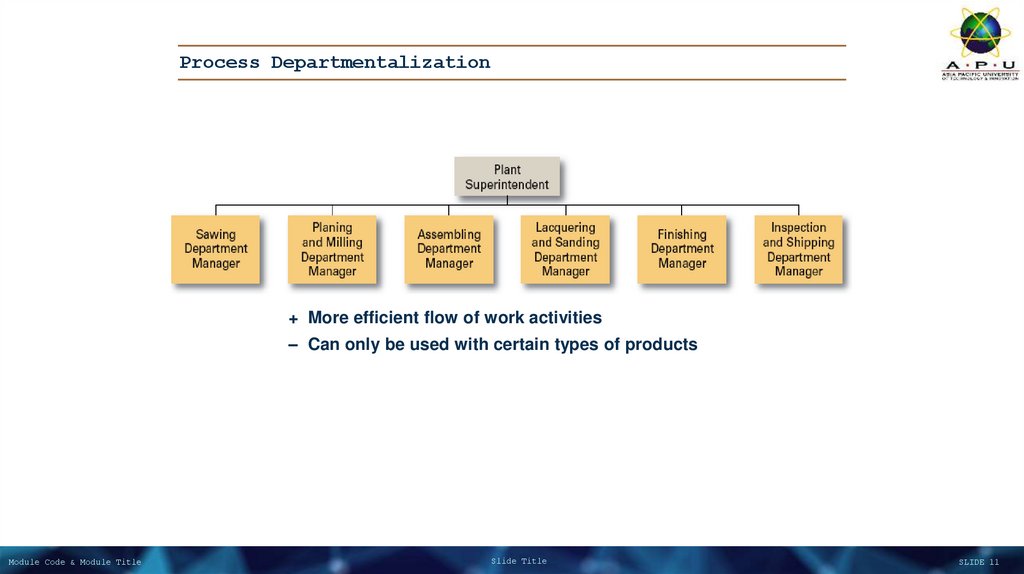
11. Process Departmentalization
+ More efficient flow of work activities– Can only be used with certain types of products
Module Code & Module Title
Slide Title
SLIDE 11
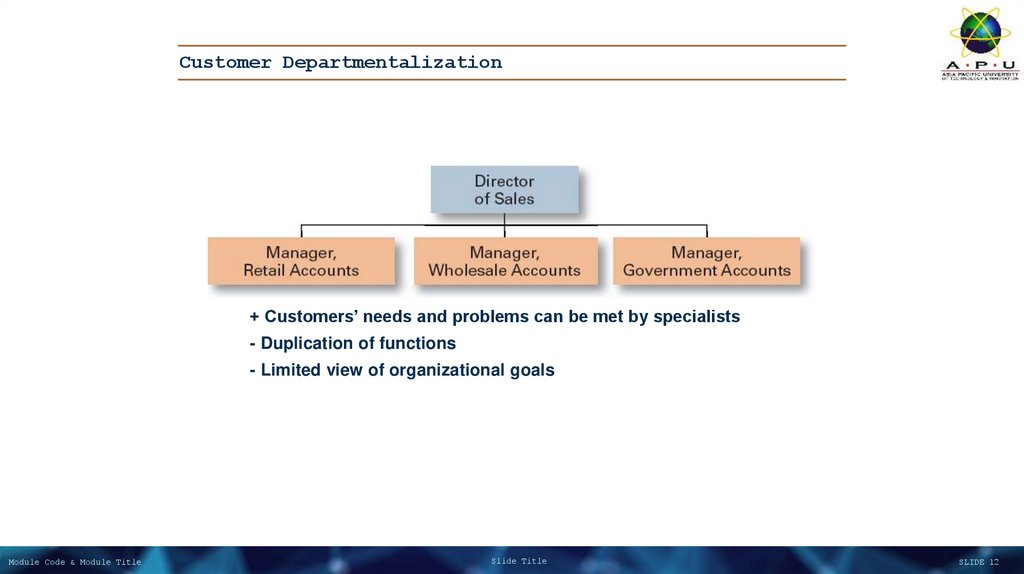
12. Customer Departmentalization
+ Customers’ needs and problems can be met by specialists- Duplication of functions
- Limited view of organizational goals
Module Code & Module Title
Slide Title
SLIDE 12
13. Chain of Command
• The line of authority extending from upperorganizational levels to the lowest levels, which
clarifies who reports to whom
• Managers need to consider it when organizing work
because it helps employees with questions such as:
– “Who do I report to?” or
– “Who do I go to if I have a problem?”
• When the COC is too long;
– Complexity in communication
– Message gets distorted
– Depersonalized employee relations
Module Code & Module Title
Slide Title
SLIDE 13
14. Chain of Command: Three Important Concepts
1. Authority• The rights inherent in a managerial position to tell people
what to do and to expect them to do it.
• Two forms of authority:
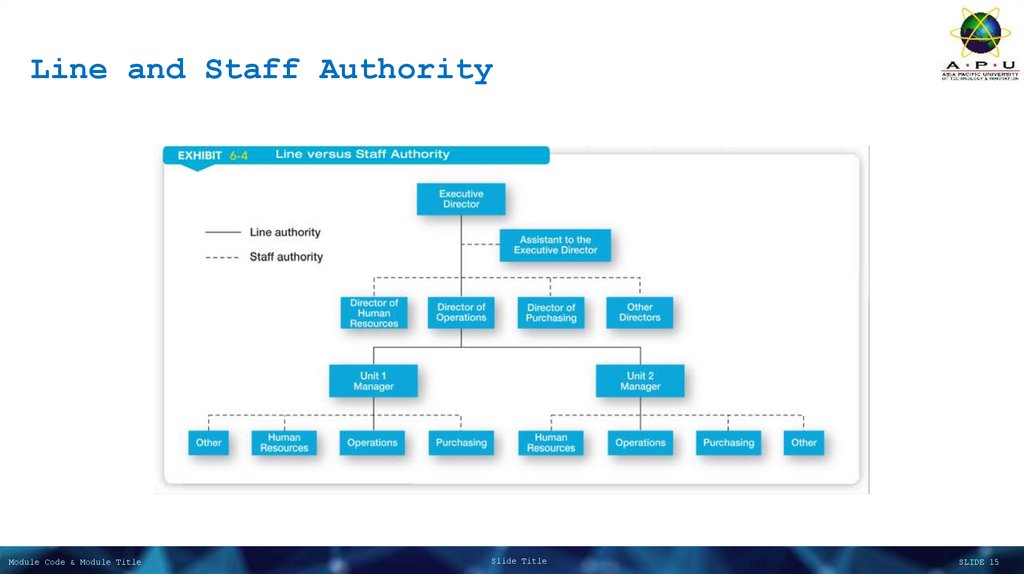
– Line authority: Authority that entitles a manager to direct the
work of an employee
– Staff authority: Positions with some authority that have been
created to support, assist, and advise those holding line authority
2.
3.
Module Code & Module Title
Responsibility
The obligation or expectation to perform any assigned duties
Unity of command
The management principle that each person should report to
only one manager
Slide Title
SLIDE 14
15. Line and Staff Authority
Module Code & Module TitleSlide Title
SLIDE 15
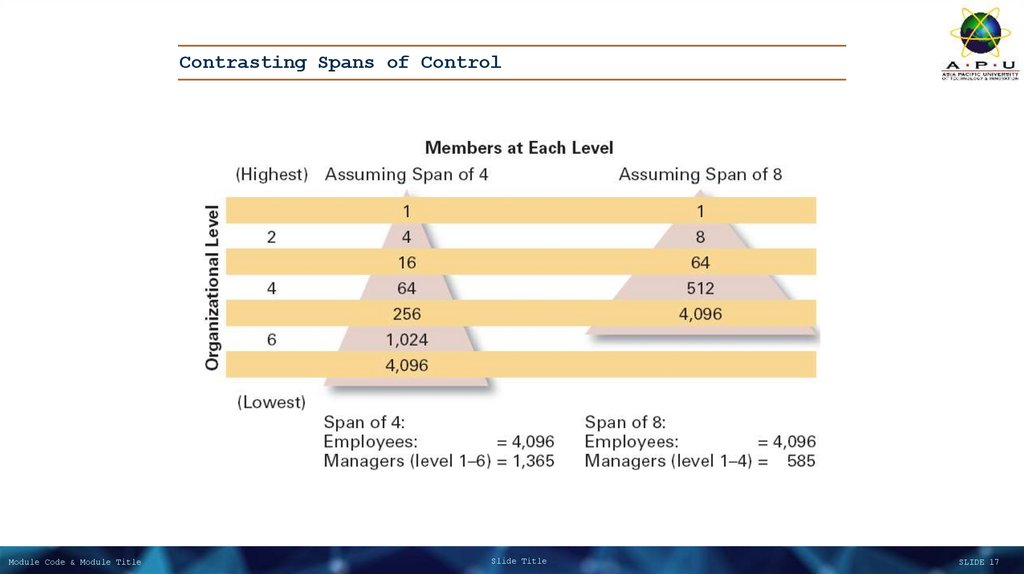
16. Span of Control
• The number of employees a manager canefficiently and effectively manage
• Determining the span of control is important
because to a large degree, it determines the
number of levels and managers in an
organization
– an important consideration in how efficient an organization will be
• Two types of span of Control
1. Narrow
2. Wide
Module Code & Module Title
Slide Title
SLIDE 16
17. Contrasting Spans of Control
Module Code & Module TitleSlide Title
SLIDE 17
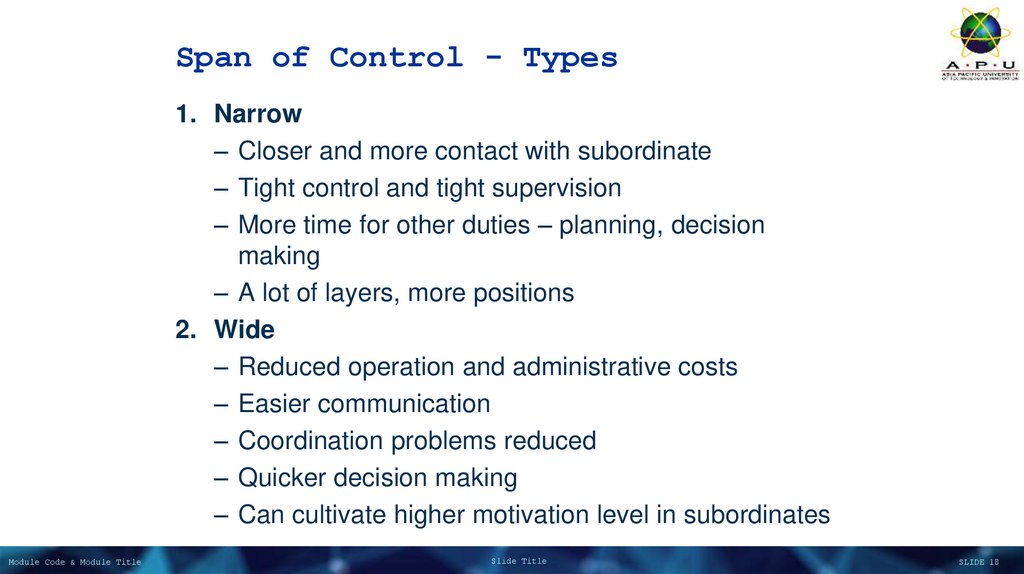
18. Span of Control - Types
1. Narrow– Closer and more contact with subordinate
– Tight control and tight supervision
– More time for other duties – planning, decision
making
– A lot of layers, more positions
2. Wide
– Reduced operation and administrative costs
– Easier communication
– Coordination problems reduced
– Quicker decision making
– Can cultivate higher motivation level in subordinates
Module Code & Module Title
Slide Title
SLIDE 18
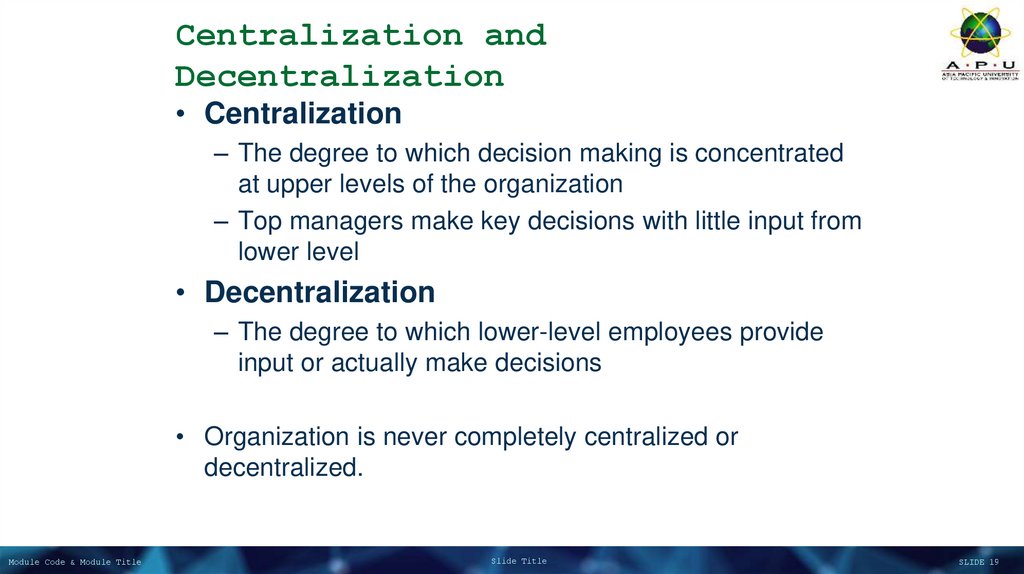
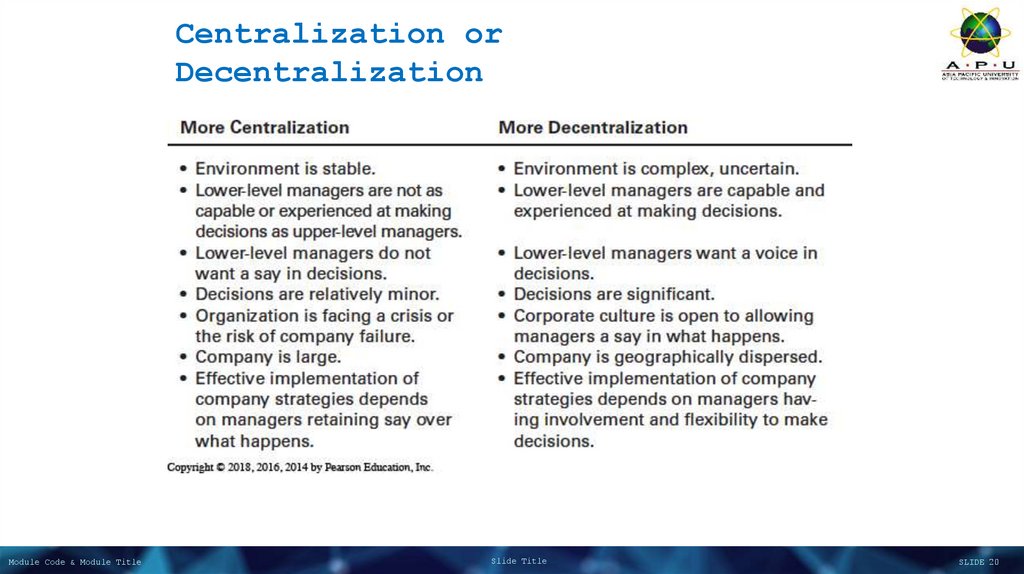
19. Centralization and Decentralization
• Centralization– The degree to which decision making is concentrated
at upper levels of the organization
– Top managers make key decisions with little input from
lower level
• Decentralization
– The degree to which lower-level employees provide
input or actually make decisions
• Organization is never completely centralized or
decentralized.
Module Code & Module Title
Slide Title
SLIDE 19
20. Centralization or Decentralization
Module Code & Module TitleSlide Title
SLIDE 20
21. Formalisation
• How standardised an organization’s jobs are andthe extent to which employee behavior is guided
by rules and procedures
• In highly formalized organizations, there are
explicit job descriptions, numerous
organizational rules, and clearly defined
procedures
Module Code & Module Title
Slide Title
SLIDE 21
22. Mechanistic and Organic Structures
Mechanistic organization• An organizational design that’s rigid and tightly controlled
Organic organization
• An organizational design that’s highly adaptive and flexible
Module Code & Module Title
Slide Title
SLIDE 22
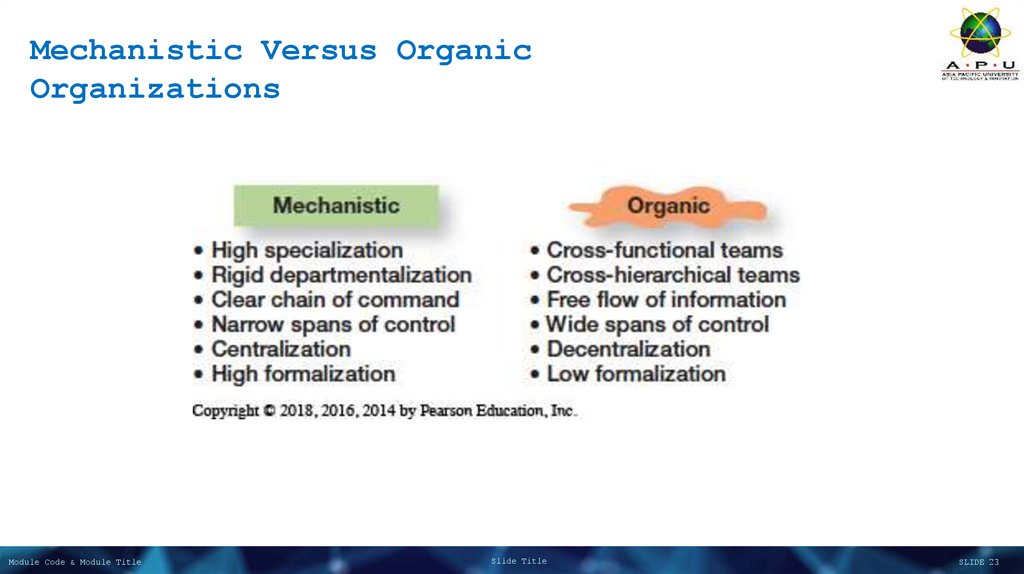
23. Mechanistic Versus Organic Organizations
Module Code & Module TitleSlide Title
SLIDE 23
24.
Quick Review Question• Describe six key elements in organizational design.
• Contrast mechanistic and organic structures.
Module Code & Module Title
Slide Title
SLIDE 24
25.
Question and Answer SessionQ&A
Module Code & Module Title
Slide Title
SLIDE 25