

 Менеджмент
Похожие презентации:








Organizational aspects of logistics management. Topic 3
1.
ORGANIZATIONALASPECTS OF
LOGISTICS
MANAGEMENT
TOPIC 3
2.
Lecture outline:1. Organizational structure of logistics system
2. Centralized and decentralized logistics structure
3. Types of logistics organizational structures
4. The competences of logistics staff and their assessment
3.
1. Organizational structure of logistics system4.
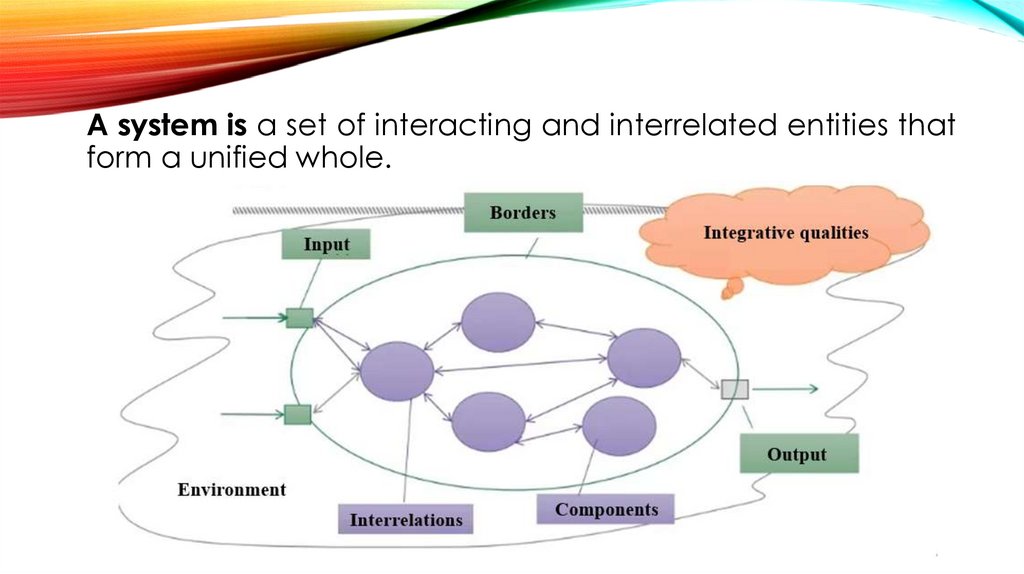
A system is a set of interacting and interrelated entities thatform a unified whole.
5.
Organization (organizing) is a function of logisticsmanagement, including a set of actions aimed at the
development, formation and improvement of the
logistics system structure based on:
• allocation of subsystems (links, elements), logistics
business processes,
• determination of management levels,
• establishment
of
employees’
powers
and
responsibilities.
6.
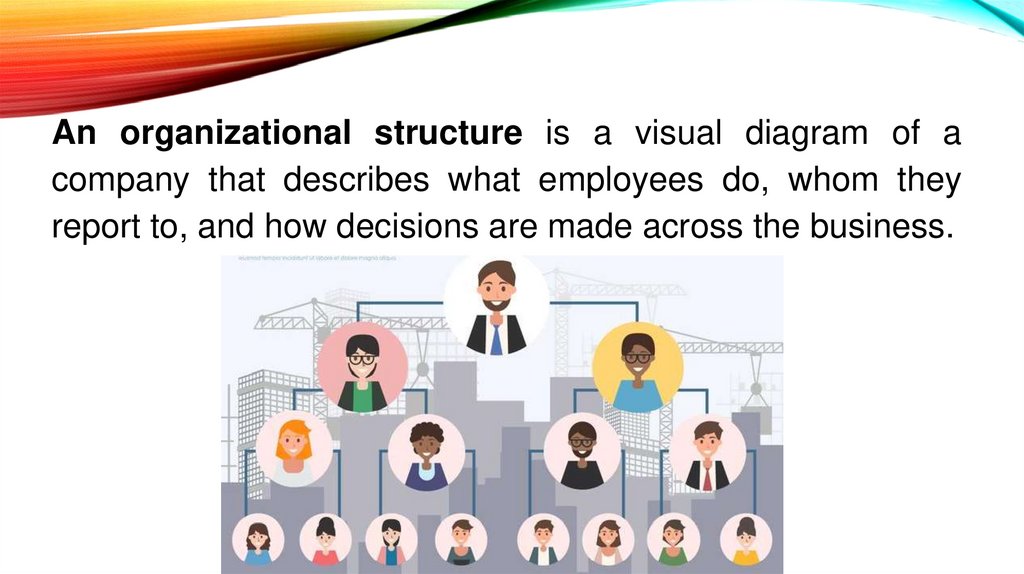
An organizational structure is a visual diagram of acompany that describes what employees do, whom they
report to, and how decisions are made across the business.
7.
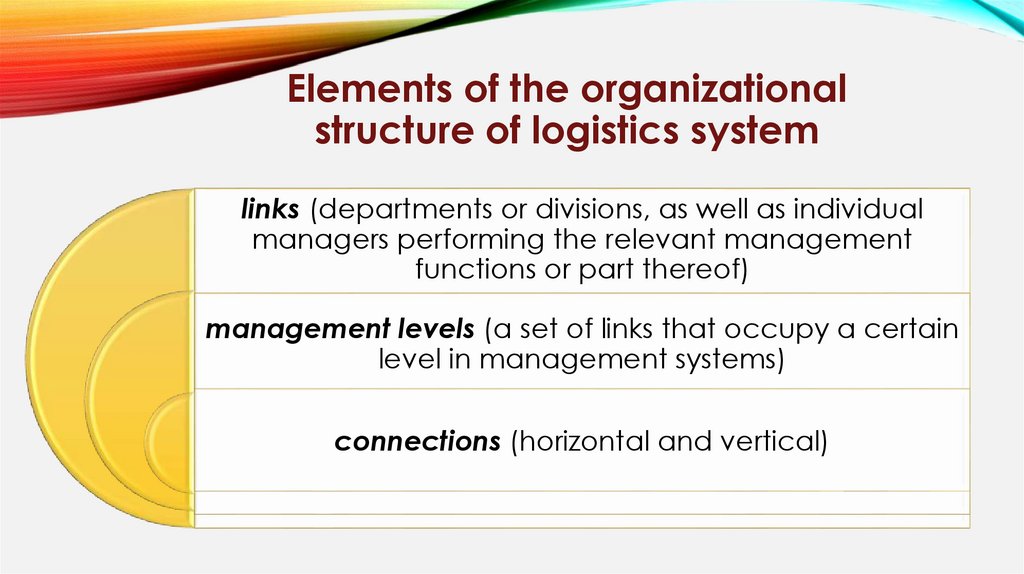
Elements of the organizationalstructure of logistics system
links (departments or divisions, as well as individual
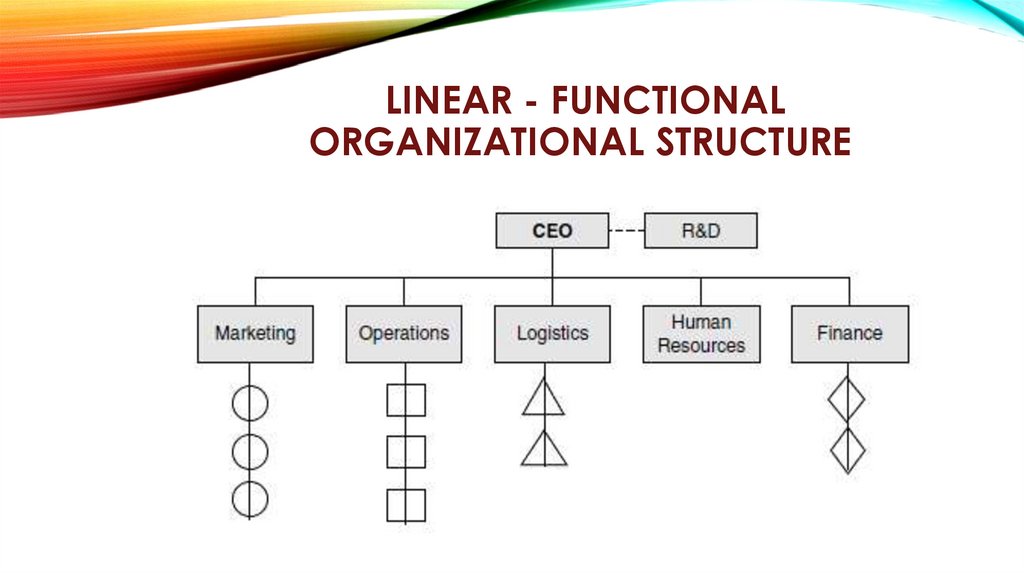
managers performing the relevant management
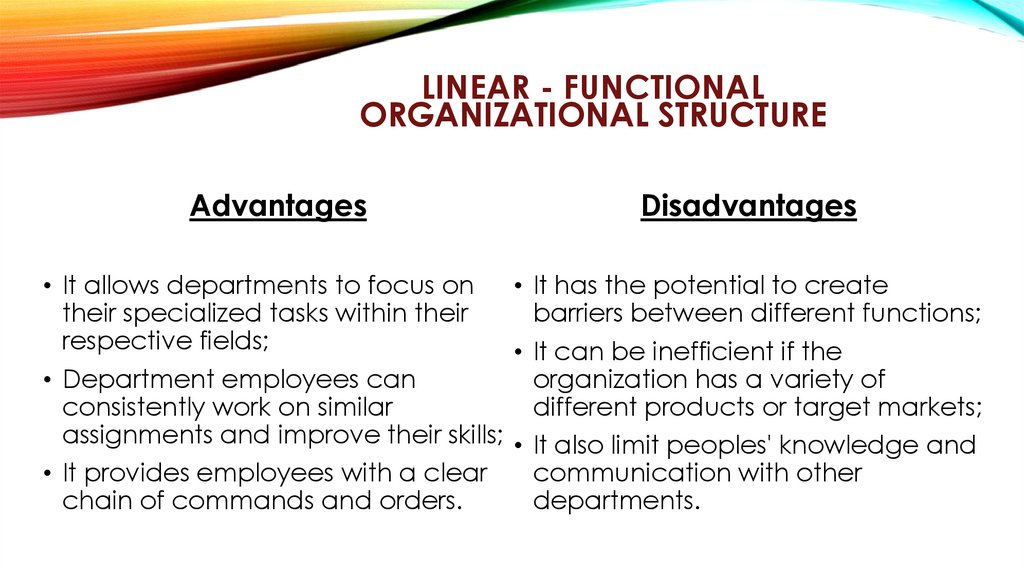
functions or part thereof)
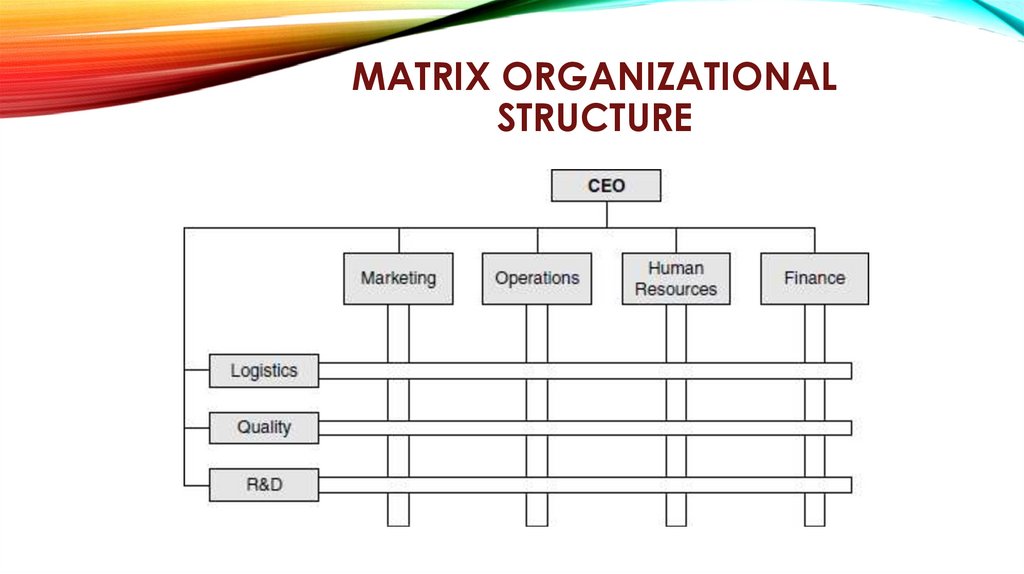
management levels (a set of links that occupy a certain
level in management systems)
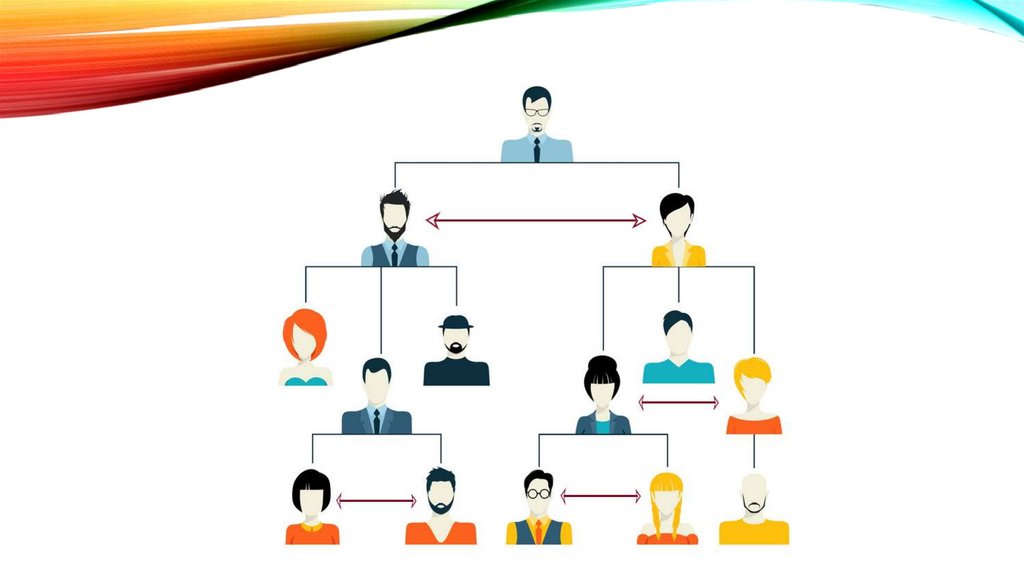
connections (horizontal and vertical)
8.
9.
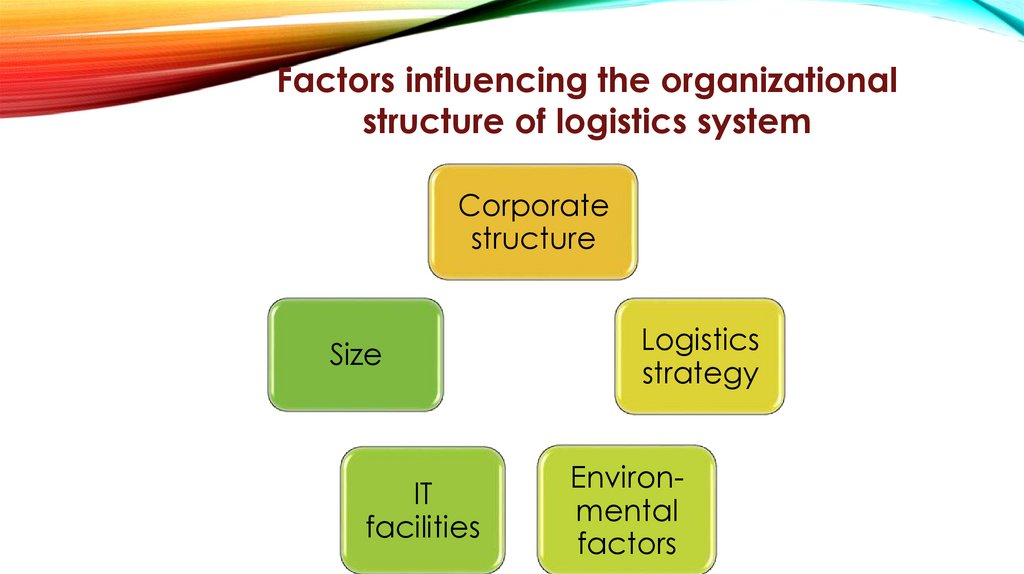
Factors influencing the organizationalstructure of logistics system
Corporate
structure
Size
IT
facilities
Logistics
strategy
Environmental
factors
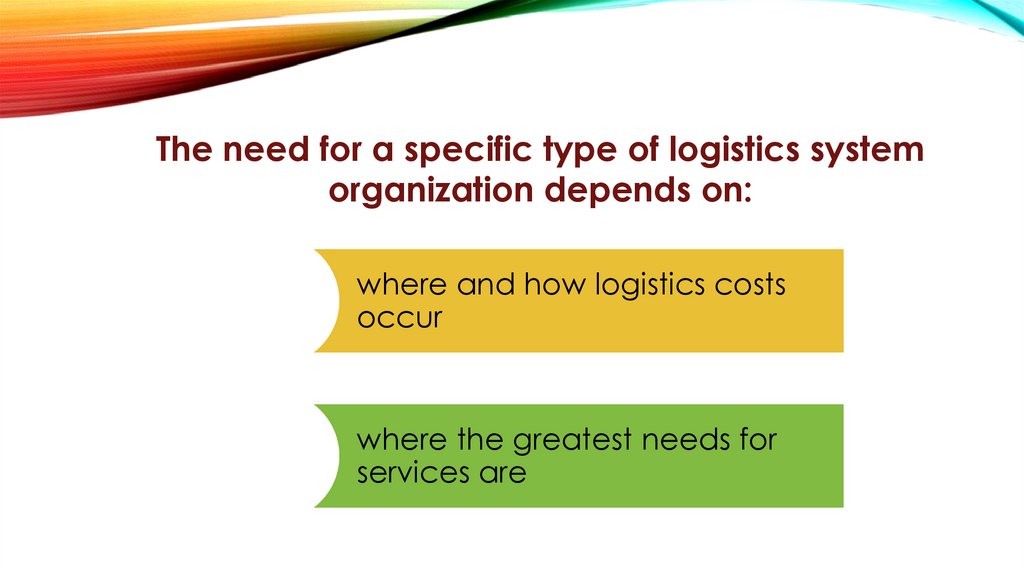
10.
The need for a specific type of logistics systemorganization depends on:
where and how logistics costs
occur
where the greatest needs for
services are
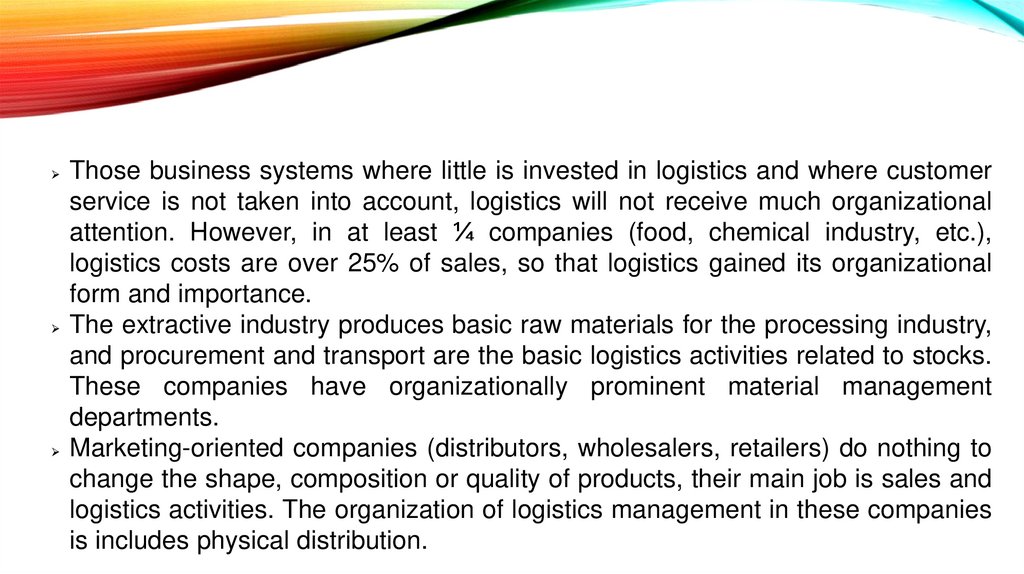
11.
Those business systems where little is invested in logistics and where customerservice is not taken into account, logistics will not receive much organizational
attention. However, in at least ¼ companies (food, chemical industry, etc.),
logistics costs are over 25% of sales, so that logistics gained its organizational
form and importance.
The extractive industry produces basic raw materials for the processing industry,
and procurement and transport are the basic logistics activities related to stocks.
These companies have organizationally prominent material management
departments.
Marketing-oriented companies (distributors, wholesalers, retailers) do nothing to
change the shape, composition or quality of products, their main job is sales and
logistics activities. The organization of logistics management in these companies
is includes physical distribution.
12.
2. Centralized and decentralized logisticsstructure
13.
Centralized logistics is an organizational model where a centralheadquarters (the logistics department) manages all core
logistics functions. This department is responsible for setting
standardized rules and processes across the whole company.
Decentralized logistics is an organizational model where
logistics functions are delegated to individual divisions, branches,
or regions. Each of them independently manages its own
inventory, procurement, and selects logistics partners.
14.
Advantages of Centralizedlogistics:
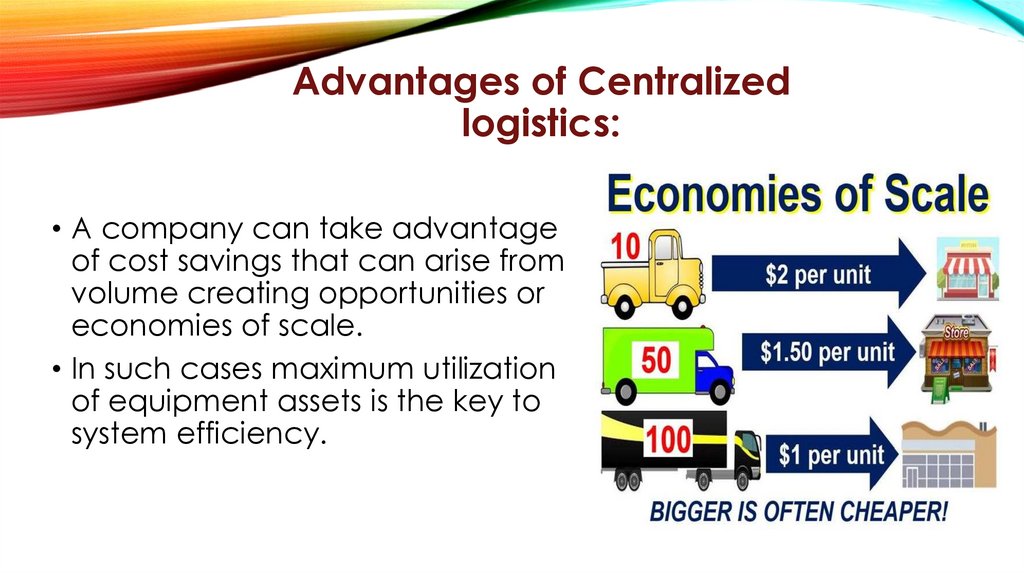
• A company can take advantage
of cost savings that can arise from
volume creating opportunities or
economies of scale.
• In such cases maximum utilization
of equipment assets is the key to
system efficiency.
15.
Advantages of Centralizedlogistics:
• Centralized logistics are easier to manage because it usually has
tracking and monitoring systems. Since the system isn't
complicated, managers have good real-time information on
what's happening.
• It may also be easier to improve centralized operations. There are
fewer facilities that require updates, whether it's recruiting new
employees, acquiring new assets, or upgrading existing
technology.
• Standardized quality control measures are also inherent in
centralized processes. Teams can ensure consistency in product
or service delivery. This means customers can expect the same
high standards regardless of location.
16.
Disadvantages of Centralizedlogistics:
It's vulnerable to disruptions. Failures at the center can lead to
widespread and severe consequences downstream.
Centralized systems also face challenges in adapting swiftly to
changes. This lack of agility can hinder responsiveness to
dynamic market conditions.
Concentrating distribution in a central location may require
products to travel longer distances to reach diverse markets,
leading to increased transportation expenses. This can be
particularly
disadvantageous
when
dealing
with
a
geographically dispersed customer base or diverse regional
markets.
17.
Decentralized logisticsorganization
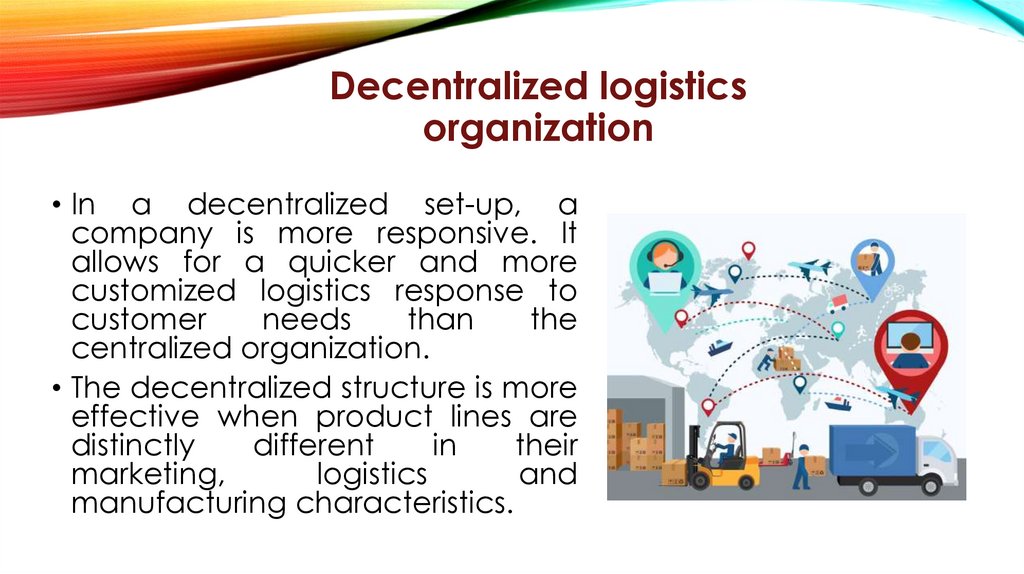
• In a decentralized set-up, a
company is more responsive. It
allows for a quicker and more
customized logistics response to
customer
needs
than
the
centralized organization.
• The decentralized structure is more
effective when product lines are
distinctly
different
in
their
marketing,
logistics
and
manufacturing characteristics.
18.
Advantages of Decentralizedlogistics:
• Decentralized logistics also offers better scalability. As resources
and systems are distributed across multiple locations, the
organization can easily grow and handle more work as needed.
Each point can independently adjust to increased demands,
making it more adaptable than centralized systems.
• Companies can also greatly reduce transportation costs by
spreading out their distribution centers. This not only reduces
transportation costs but also provides quicker deliveries. The result
is a more cost-effective and resource-efficient logistics operation,
enhancing customer satisfaction and operational sustainability.
• The biggest advantage of decentralized logistics is its ability to
rapidly adapt to local trends and regulations.
19.
Disadvantages ofDecentralized logistics:
• Decentralized logistics might increase inbound costs. Suppliers
aren't always eager to divide goods among sites. Companies that
are unable to locate local suppliers may be unable to negotiate
the lowest rates or may be forced to pay the additional shipping
expenses associated with LTL shipments distributed over a
network.
• It is difficult to have full oversight in decentralized logistics. When a
company has numerous sites responsible for holding inventory or
fulfilling orders, it'll need to devote a significant amount of effort
to conducting regular audits of its facilities to ensure quality
control and employee training.
20.
Hybrid modelA company may reap some of the benefits of both centralized and
decentralized logistics approaches while minimizing the drawbacks.
While not as beneficial as a decentralized logistics network, a hybrid
organizational model may be simpler to sell to a leadership team
that prefers a centralized logistics solution.
Example of a hybrid model:
• Strategic and international purchasing - centralized (to get
maximum discounts from suppliers and carriers).
• Inventory management and last mile delivery - decentralized (to
quickly and flexibly respond to demand in each country).
21.
Decentralizedlogistics
Centralized
logistics
22.
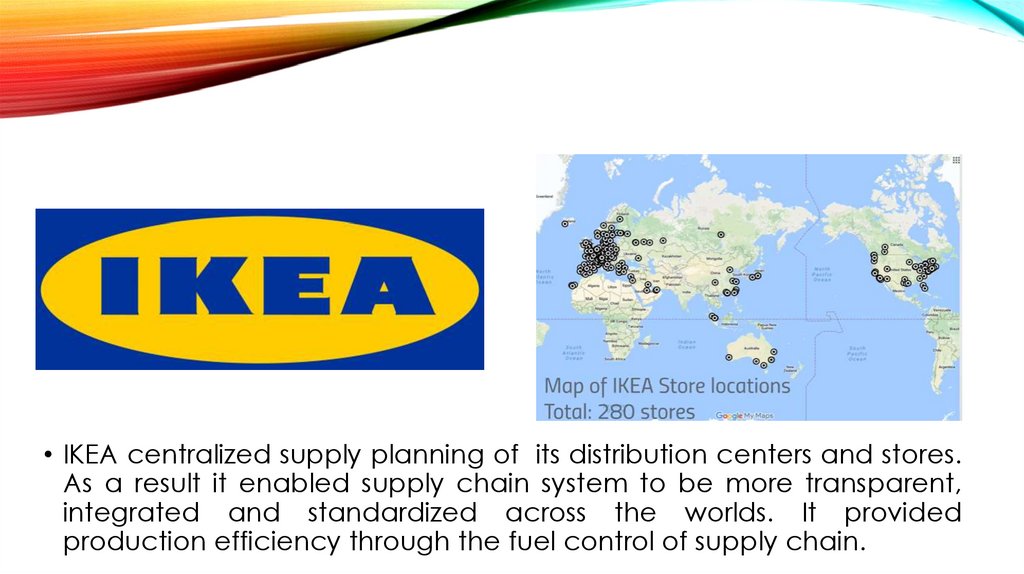
• IKEA centralized supply planning of its distribution centers and stores.As a result it enabled supply chain system to be more transparent,
integrated and standardized across the worlds. It provided
production efficiency through the fuel control of supply chain.
23.
• The Coca-Cola Company is a prime example of a highlysuccessful decentralized and franchised logistics model. The
company itself does not manufacture or distribute its final beverages
worldwide. Instead, this process is delegated to a network of
independent bottling partners. They own and manage the local
manufacturing, warehousing, and distribution, allowing for massive
global scale and local agility, while The Coca-Cola Company
centralizes brand management and product development.
24.
25.
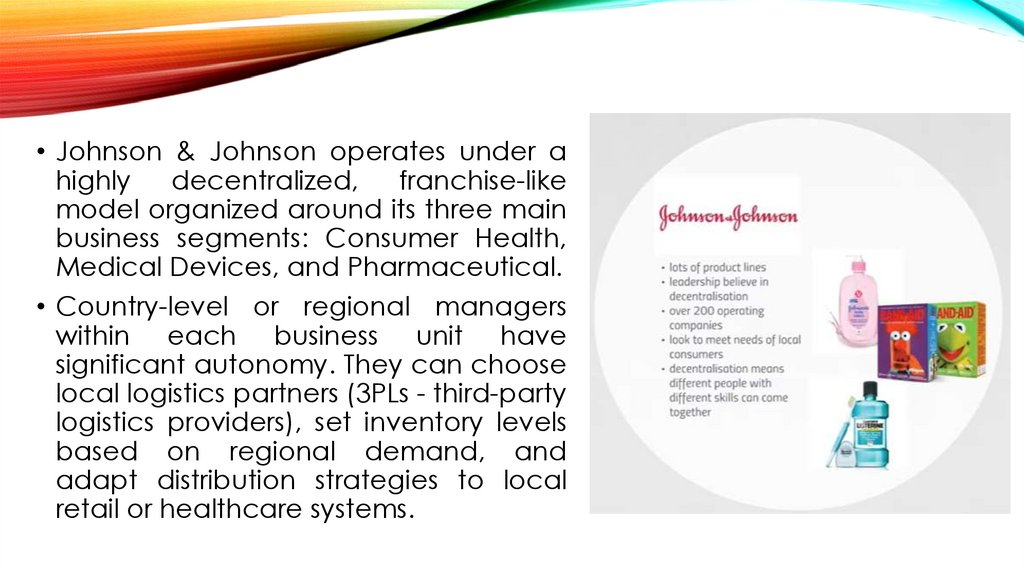
• Johnson & Johnson operates under ahighly
decentralized,
franchise-like
model organized around its three main
business segments: Consumer Health,
Medical Devices, and Pharmaceutical.
• Country-level or regional managers
within each business unit have
significant autonomy. They can choose
local logistics partners (3PLs - third-party
logistics providers), set inventory levels
based on regional demand, and
adapt distribution strategies to local
retail or healthcare systems.
26.
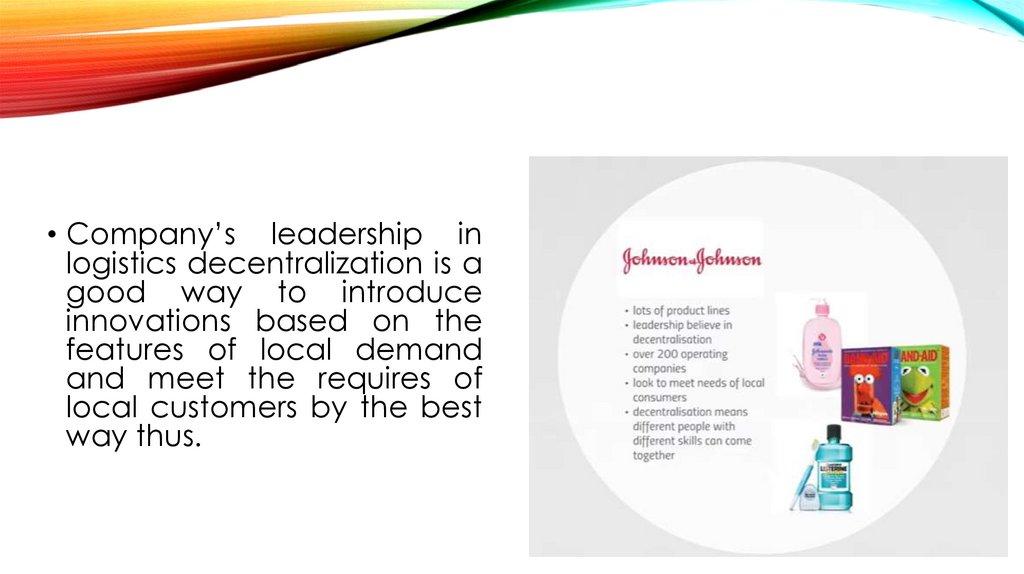
• Company’s leadership inlogistics decentralization is a
good way to introduce
innovations based on the
features of local demand
and meet the requires of
local customers by the best
way thus.
27.
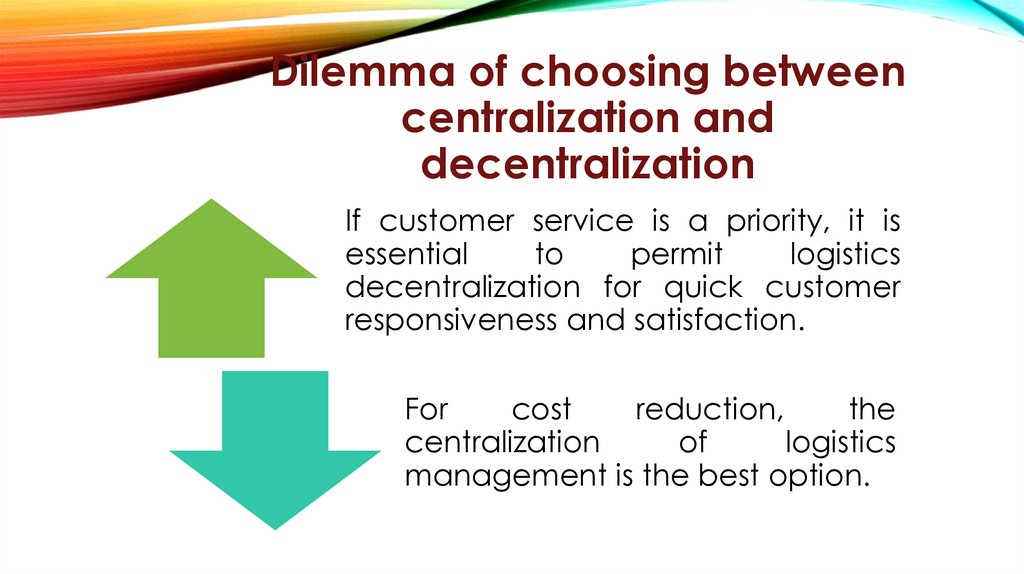
Dilemma of choosing betweencentralization and
decentralization
If customer service is a priority, it is
essential
to
permit
logistics
decentralization for quick customer
responsiveness and satisfaction.
For
cost
reduction,
the
centralization
of
logistics
management is the best option.
28.
Key selection factorsCompany size: Large corporations can more easily benefit
from centralization.
Geography: The wider the geography, the more arguments
there are for decentralization or a hybrid model.
Nature of demand: Stable demand leads to centralization,
volatile and localized demand leads to decentralization.
Assortment: A wide assortment with low turnover often
requires decentralization, while a narrow assortment with
high turnover requires centralization.
29.
3. Types of logistics organizational structures30.
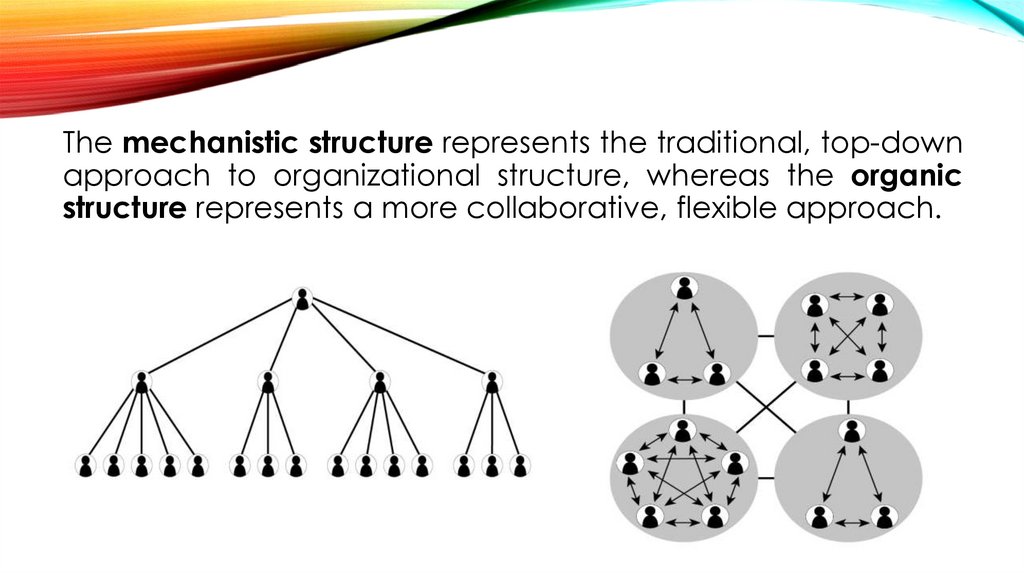
The mechanistic structure represents the traditional, top-downapproach to organizational structure, whereas the organic
structure represents a more collaborative, flexible approach.
31.
MECHANISTIC STRUCTUREIt is known for having narrow spans of control, as well as high
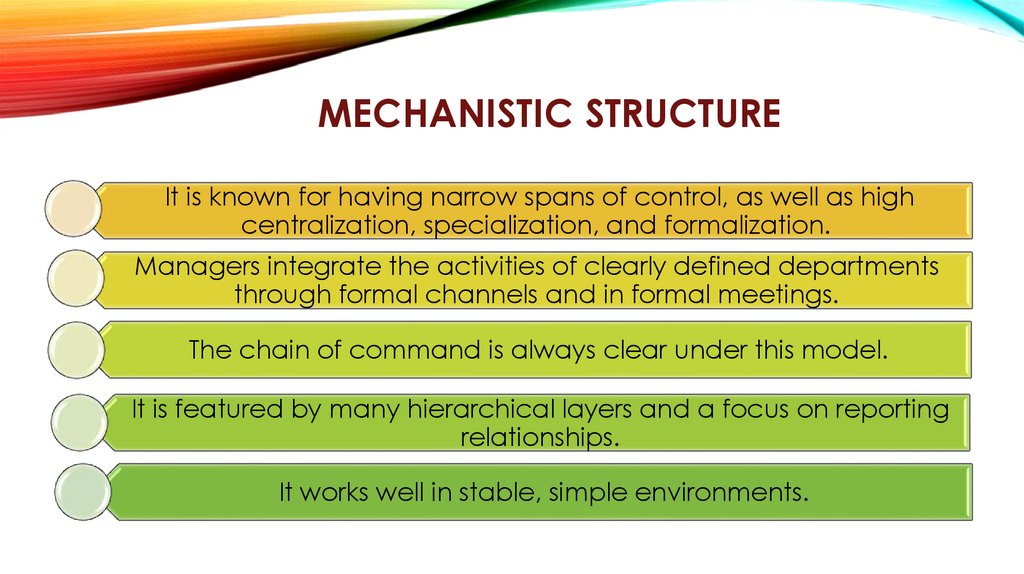
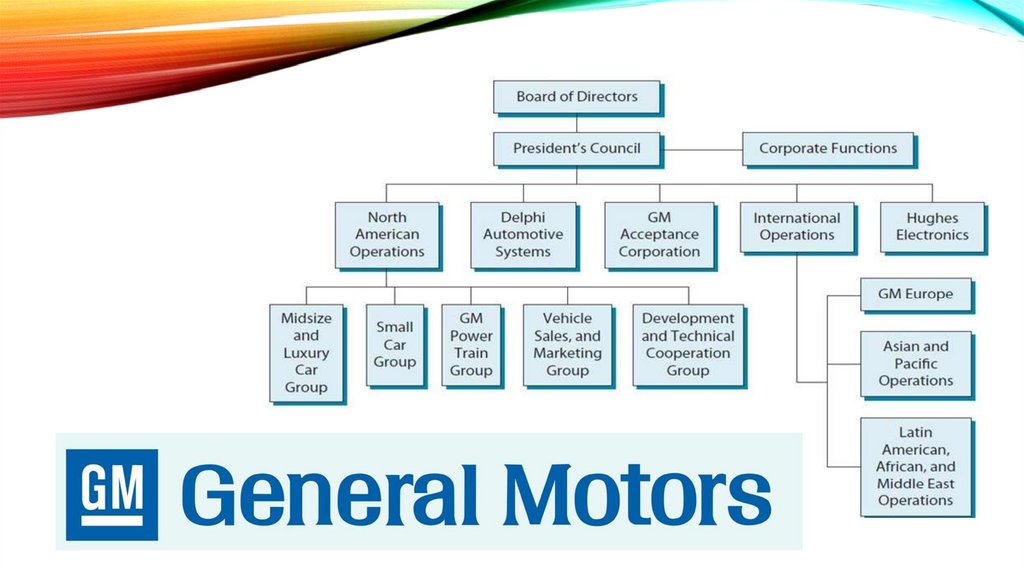
centralization, specialization, and formalization.
Managers integrate the activities of clearly defined departments
through formal channels and in formal meetings.
The chain of command is always clear under this model.
It is featured by many hierarchical layers and a focus on reporting
relationships.
It works well in stable, simple environments.
32.
33.
ORGANIC STRUCTUREIt has a low degree of formality, specialization and
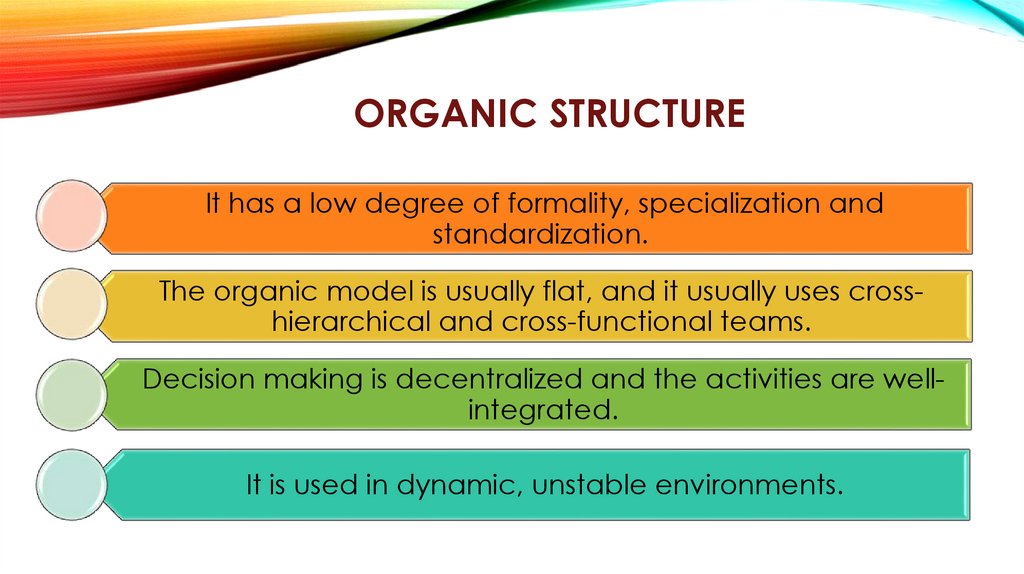
standardization.
The organic model is usually flat, and it usually uses crosshierarchical and cross-functional teams.
Decision making is decentralized and the activities are wellintegrated.
It is used in dynamic, unstable environments.
34.
• Consulting firms want to respond to change quickly, soby choosing an organic structure they’re able to be
nimble and address their customers’ needs.
35.
LINEAR - FUNCTIONALORGANIZATIONAL STRUCTURE
36.
LINEAR - FUNCTIONALORGANIZATIONAL STRUCTURE
Advantages
Disadvantages
• It allows departments to focus on
• It has the potential to create
their specialized tasks within their
barriers between different functions;
respective fields;
• It can be inefficient if the
• Department employees can
organization has a variety of
consistently work on similar
different products or target markets;
assignments and improve their skills; • It also limit peoples' knowledge and
• It provides employees with a clear
communication with other
chain of commands and orders.
departments.
37.
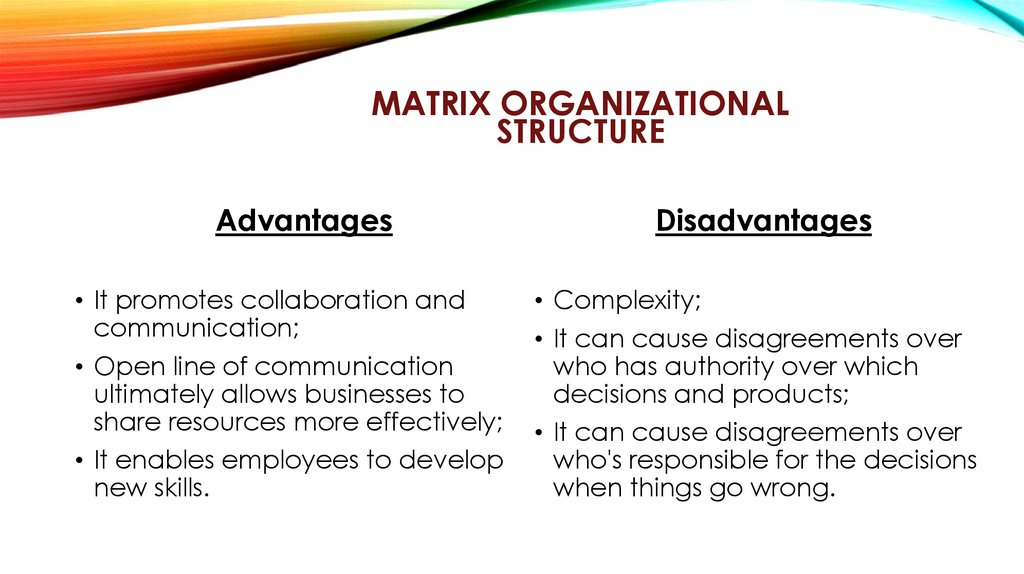
MATRIX ORGANIZATIONALSTRUCTURE
38.
MATRIX ORGANIZATIONALSTRUCTURE
Advantages
Disadvantages
• It promotes collaboration and
communication;
• Open line of communication
ultimately allows businesses to
share resources more effectively;
• It enables employees to develop
new skills.
• Complexity;
• It can cause disagreements over
who has authority over which
decisions and products;
• It can cause disagreements over
who's responsible for the decisions
when things go wrong.
39.
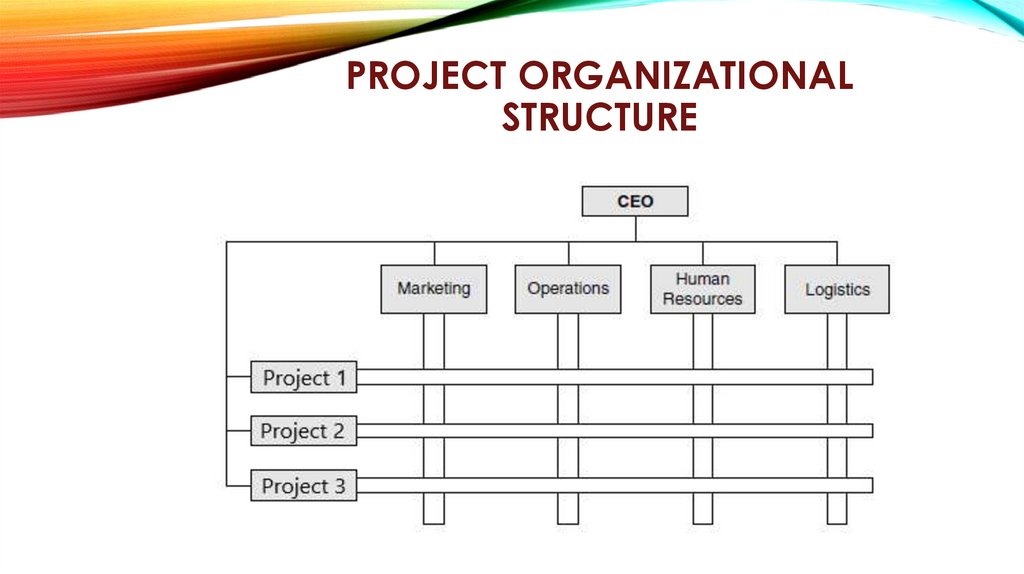
PROJECT ORGANIZATIONALSTRUCTURE
40.
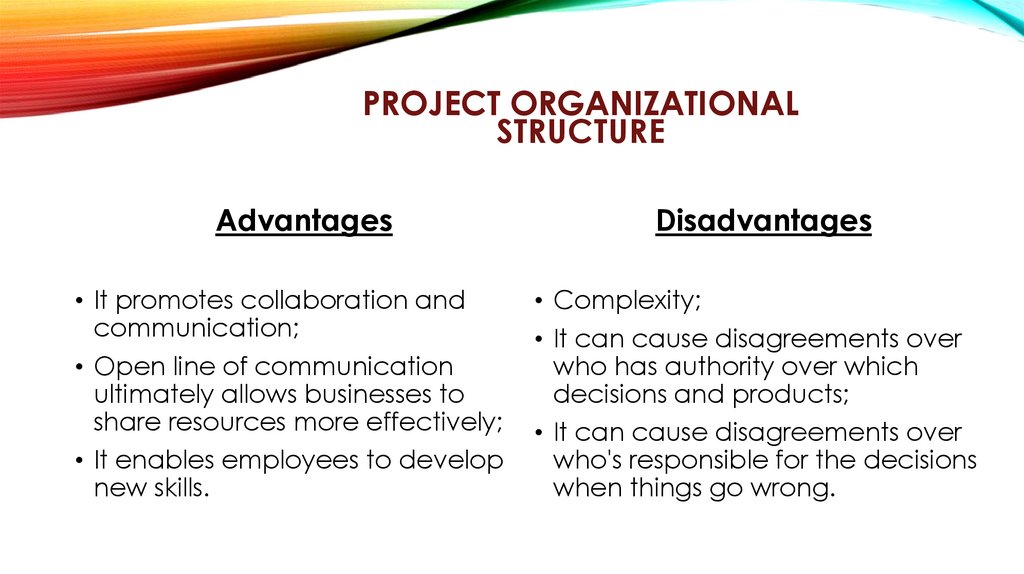
PROJECT ORGANIZATIONALSTRUCTURE
Advantages
Disadvantages
• It promotes collaboration and
communication;
• Open line of communication
ultimately allows businesses to
share resources more effectively;
• It enables employees to develop
new skills.
• Complexity;
• It can cause disagreements over
who has authority over which
decisions and products;
• It can cause disagreements over
who's responsible for the decisions
when things go wrong.
41.
Which organizational structureis most common in Belarus?
42.
4. The competences of logistics staff and theirassessment
43.
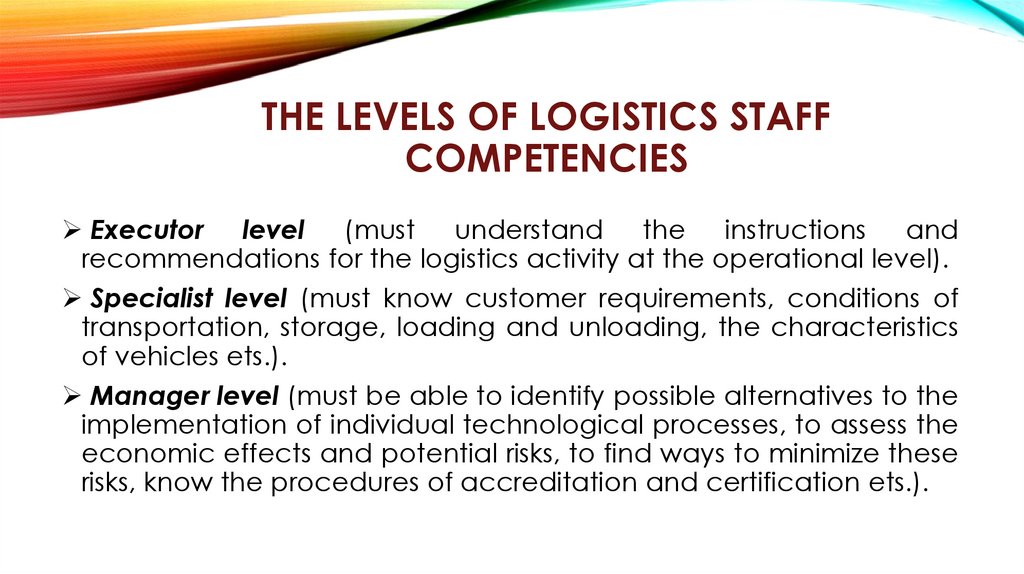
THE LEVELS OF LOGISTICS STAFFCOMPETENCIES
Executor level (must understand the instructions and
recommendations for the logistics activity at the operational level).
Specialist level (must know customer requirements, conditions of
transportation, storage, loading and unloading, the characteristics
of vehicles ets.).
Manager level (must be able to identify possible alternatives to the
implementation of individual technological processes, to assess the
economic effects and potential risks, to find ways to minimize these
risks, know the procedures of accreditation and certification ets.).
44.
To assess the competence, i.e.the ability of an employee to
apply their knowledge and skills,
it is necessary to create a
control testing system at the
company.
45.
STB 2345-2013 "Logistics activities. Requirements for theprofessional competence of personnel performing
logistics services and certification procedure"
It sets out the requirements for the
professional
competence
of
logisticians in our republic.
46.
• STB 2345-2013 is based on theexperience developed by the
European Logistics Association
(ELA).
• The ELA Standards of Logistics
Competence reflect the
expectations of workplace
performance for logisticians and
they have been developed with
and agreed by the industry.
47.
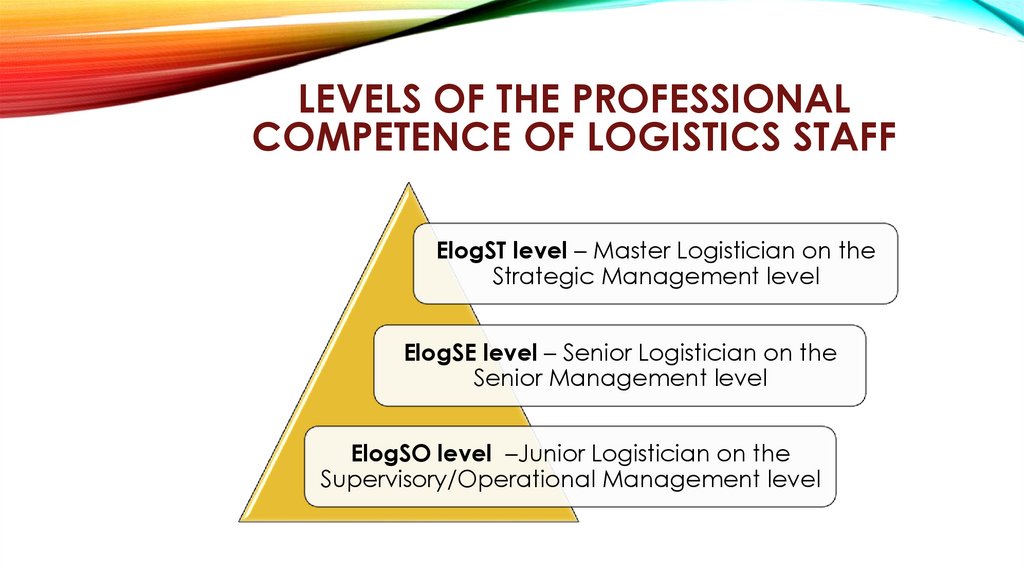
LEVELS OF THE PROFESSIONALCOMPETENCE OF LOGISTICS STAFF
ElogST level – Master Logistician on the
Strategic Management level
ElogSE level – Senior Logistician on the
Senior Management level
ElogSO level –Junior Logistician on the
Supervisory/Operational Management level
48.
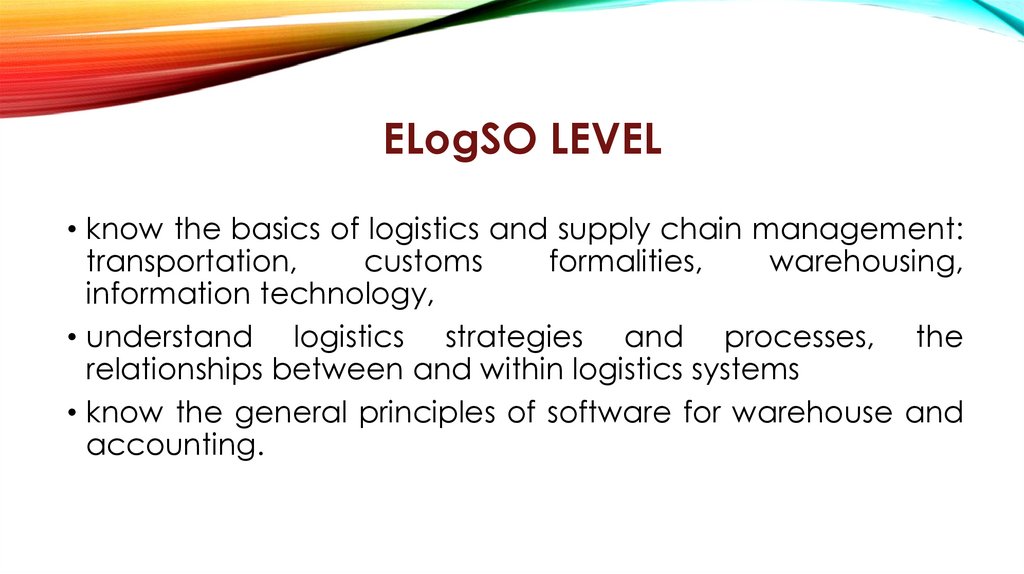
ELogSO LEVEL• know the basics of logistics and supply chain management:
transportation,
customs
formalities,
warehousing,
information technology,
• understand logistics strategies and processes, the
relationships between and within logistics systems
• know the general principles of software for warehouse and
accounting.
49.
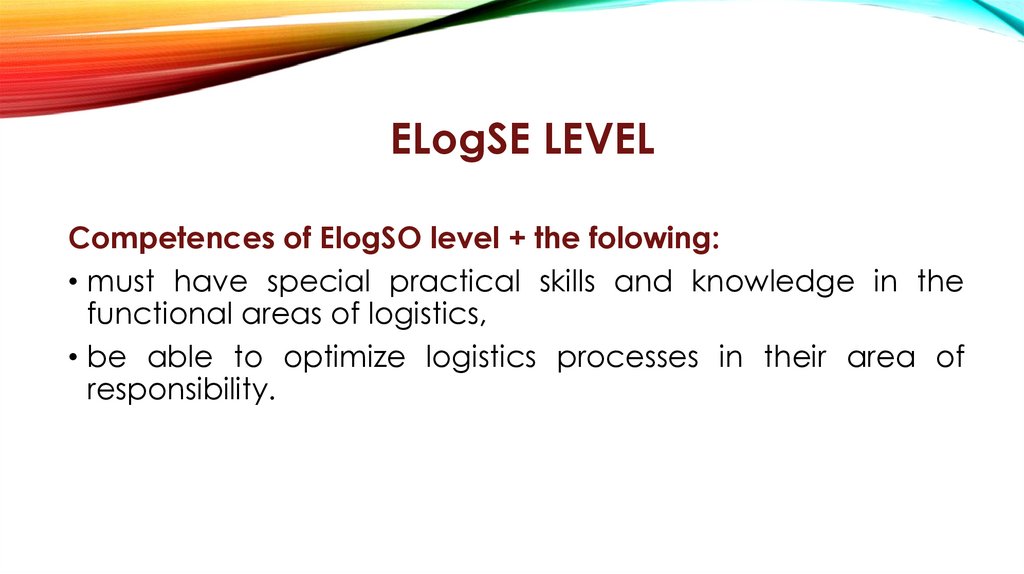
ELogSE LEVELCompetences of ElogSO level + the folowing:
• must have special practical skills and knowledge in the
functional areas of logistics,
• be able to optimize logistics processes in their area of
responsibility.
50.
ELogST LEVELCompetences of ElogSE level + the folowing:
• must know the procurement methodology,
• must know international and national transport law,
international and national customs law,
• must know information technology for electronic data
exchange, principles of automated logistics support
systems,
• be responsible for other personnel of the logistics services
provider.
51.
THANK YOU FORYOUR ATTENTION!