 Физика
Похожие презентации:


Scientist physicist Evgeniy Zavoisky
1.
Kazan Volga Region Federal UniversityInstitute of Physics
Scientist physicist Evgeniy Zavoisky
Kudayaorv Timur
06-445
Kazan – 2025
2.
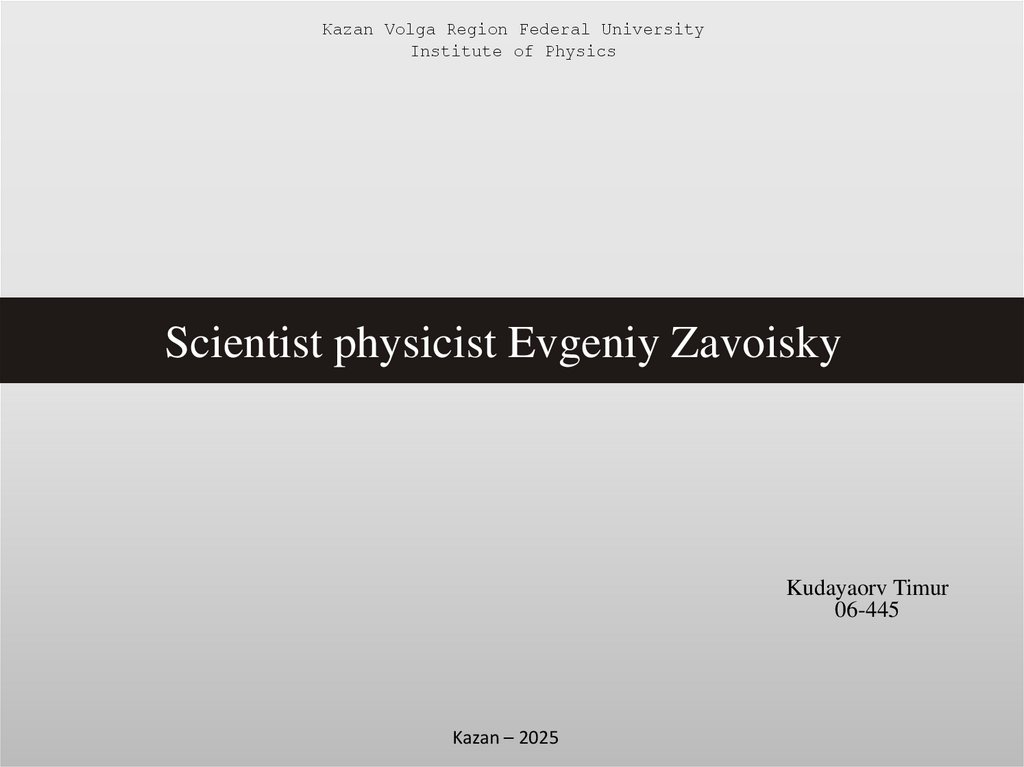
Evgeniy Zavoisky: The Scientist Who Saw the InvisibleEvgeniy Zavoisky was born on September 28, 1907,
in Mogilev, a city then part of the Russian Empire
(now in Belarus). His early years were spent in a
middle-class family, where his father, Konstantin
Zavoisky, worked as a civil engineer, and his mother,
Maria Zavoyskaya, was a homemaker. The family
valued education, which influenced young Evgeniy’s
intellectual curiosity. After completing secondary
school, he moved to Kazan in 1926 to pursue higher
education. Though his later career became deeply tied
to science, his formative years in Mogilev and Kazan
shaped his disciplined character and passion for
learning. He passed away on October 9, 1976, in
Moscow, leaving behind a legacy rooted in his early
life experiences.
Evgeniy Zavoisky
1
3.
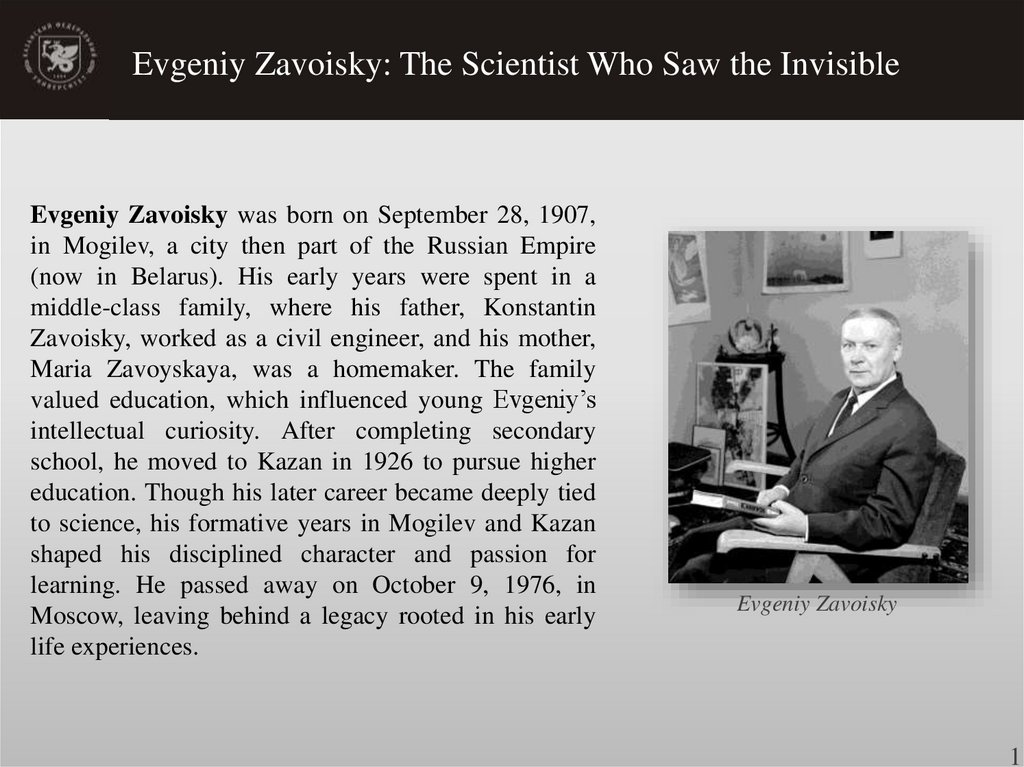
Evgeniy Zavoisky’s Scientific CareerEvgeniy Zavoisky’s groundbreaking contributions began at Kazan Federal University (KFU),
where he later taught. Amid World War II, as Soviet institutions evacuated to Kazan, he
persisted in his research despite scarce resources. In 1944, at KFU, he achieved his defining
breakthrough: the discovery of electron paramagnetic resonance (EPR). This phenomenon—
unpaired electrons interacting with magnetic fields—revolutionized spectroscopy, impacting
physics, chemistry, and materials science.
Post-war, he pioneered controlled thermonuclear fusion research, advancing Soviet plasma
physics. Though initially met with skepticism, his EPR work earned global acclaim and
Nobel Prize nominations. His wartime resolve and innovations solidified KFU’s status as a
scientific leader. Today, KFU’s Zavoisky Physical-Technical Institute and annual conferences
uphold his legacy as a visionary who reshaped science in war and peace.
2
4.
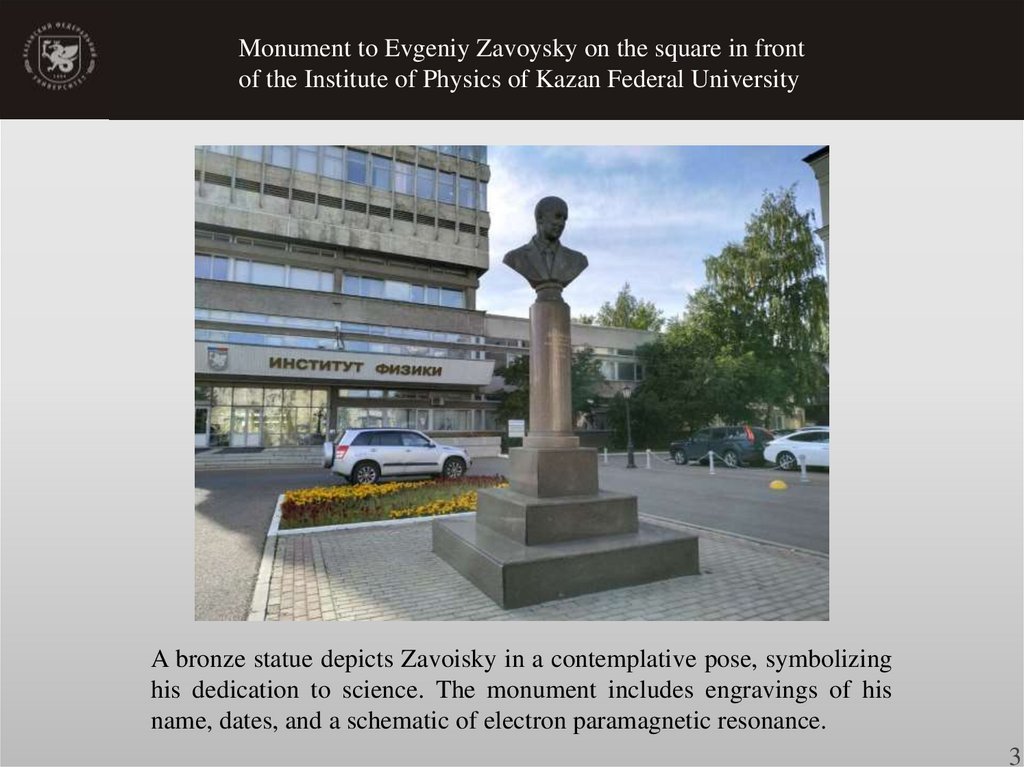
Monument to Evgeniy Zavoysky on the square in frontof the Institute of Physics of Kazan Federal University
A bronze statue depicts Zavoisky in a contemplative pose, symbolizing
his dedication to science. The monument includes engravings of his
name, dates, and a schematic of electron paramagnetic resonance.
3
5.
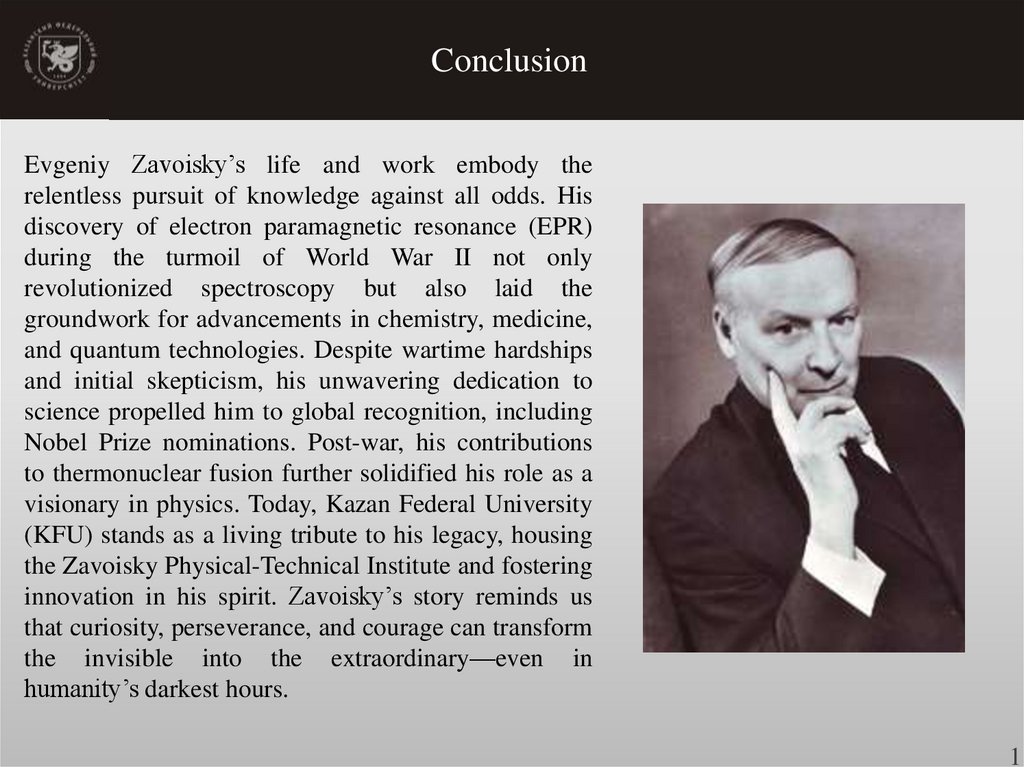
ConclusionEvgeniy Zavoisky’s life and work embody the
relentless pursuit of knowledge against all odds. His
discovery of electron paramagnetic resonance (EPR)
during the turmoil of World War II not only
revolutionized spectroscopy but also laid the
groundwork for advancements in chemistry, medicine,
and quantum technologies. Despite wartime hardships
and initial skepticism, his unwavering dedication to
science propelled him to global recognition, including
Nobel Prize nominations. Post-war, his contributions
to thermonuclear fusion further solidified his role as a
visionary in physics. Today, Kazan Federal University
(KFU) stands as a living tribute to his legacy, housing
the Zavoisky Physical-Technical Institute and fostering
innovation in his spirit. Zavoisky’s story reminds us
that curiosity, perseverance, and courage can transform
the invisible into the extraordinary—even in
humanity’s darkest hours.
1
6.
References1. Zavoisky, E. K. (1944). Paramagnetic Relaxation in Radiofrequency Fields. Journal of
Physics (USSR), 9(3), 211–216. (Original paper on EPR discovery).
2. Kazan Federal University (KFU). (n.d.). Evgeniy Zavoisky: Legacy and Achievements.
Retrieved from KFU Zavoisky Institute
3. Josephson, P. R. (1991). Physics and Politics in Revolutionary Russia. Princeton
University Press. (Context on Soviet science during WWII).
4. Soviet Science Review (1977). In Memoriam: Evgeniy Zavoisky. 12(4), 45–50. (Obituary
detailing his career).
5. Nobel Prize Archive. (1958–1965). Nomination Database – Physics. (Mentions
Zavoisky’s nominations; access via Nobel Prize).
Additional Resources:
• Monument at KFU: Kazan Federal University Press Office. (2015). The Unveiling of
Zavoisky’s Statue. Photo Archive.
• EPR Applications: Eaton, G. R. et al. (2010). Foundations of Modern EPR. World
Scientific.
Image Credits:
• Zavoisky’s portrait: KFU Historical Archives.
• EPR diagram: Adapted from Principles of Magnetic Resonance (Slichter, 1990).
1
7.
Thank you!Kudayaorv Timur
06-445
Kazan – 2025