 Информатика
Похожие презентации:








Cryptographic Protocols
1. Cryptographic Protocols
2.
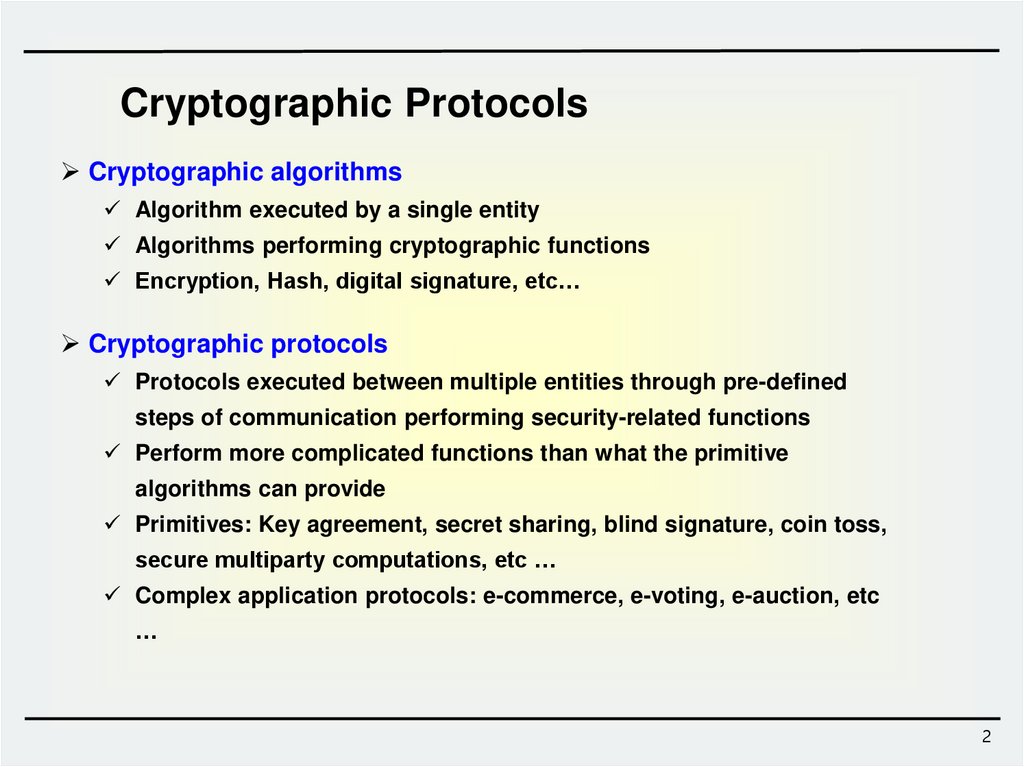
Cryptographic ProtocolsCryptographic algorithms
Algorithm executed by a single entity
Algorithms performing cryptographic functions
Encryption, Hash, digital signature, etc…
Cryptographic protocols
Protocols executed between multiple entities through pre-defined
steps of communication performing security-related functions
Perform more complicated functions than what the primitive
algorithms can provide
Primitives: Key agreement, secret sharing, blind signature, coin toss,
secure multiparty computations, etc …
Complex application protocols: e-commerce, e-voting, e-auction, etc
…
2
3.
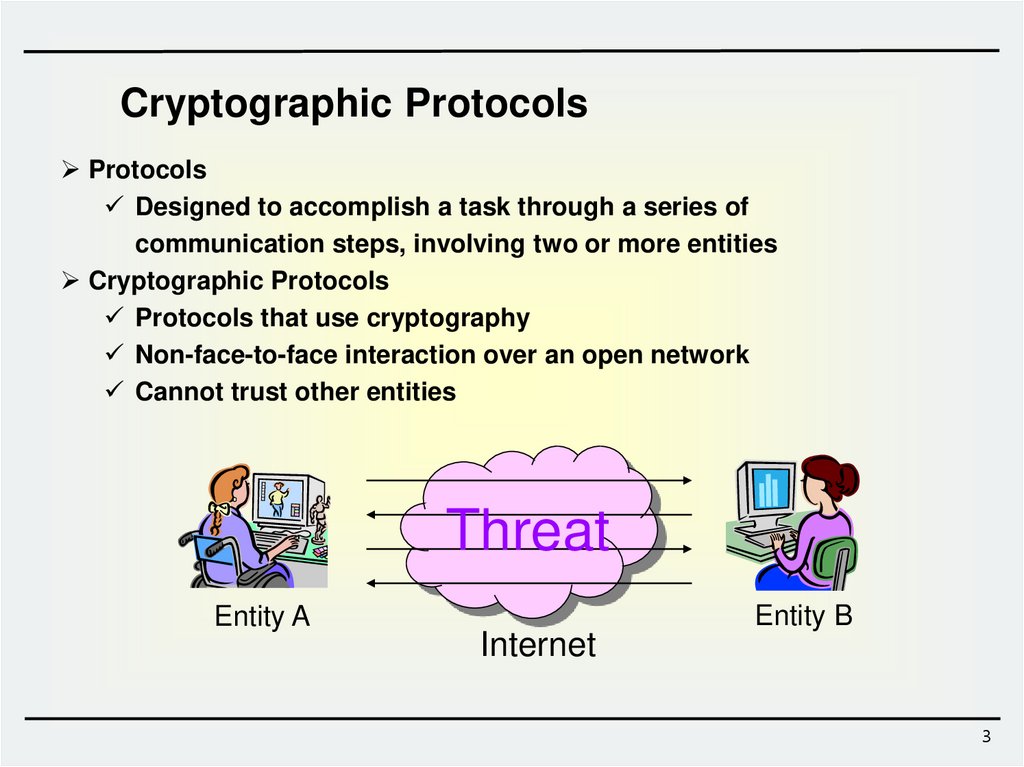
Cryptographic ProtocolsProtocols
Designed to accomplish a task through a series of
communication steps, involving two or more entities
Cryptographic Protocols
Protocols that use cryptography
Non-face-to-face interaction over an open network
Cannot trust other entities
Threat
Entity A
Entity B
Internet
3
4.
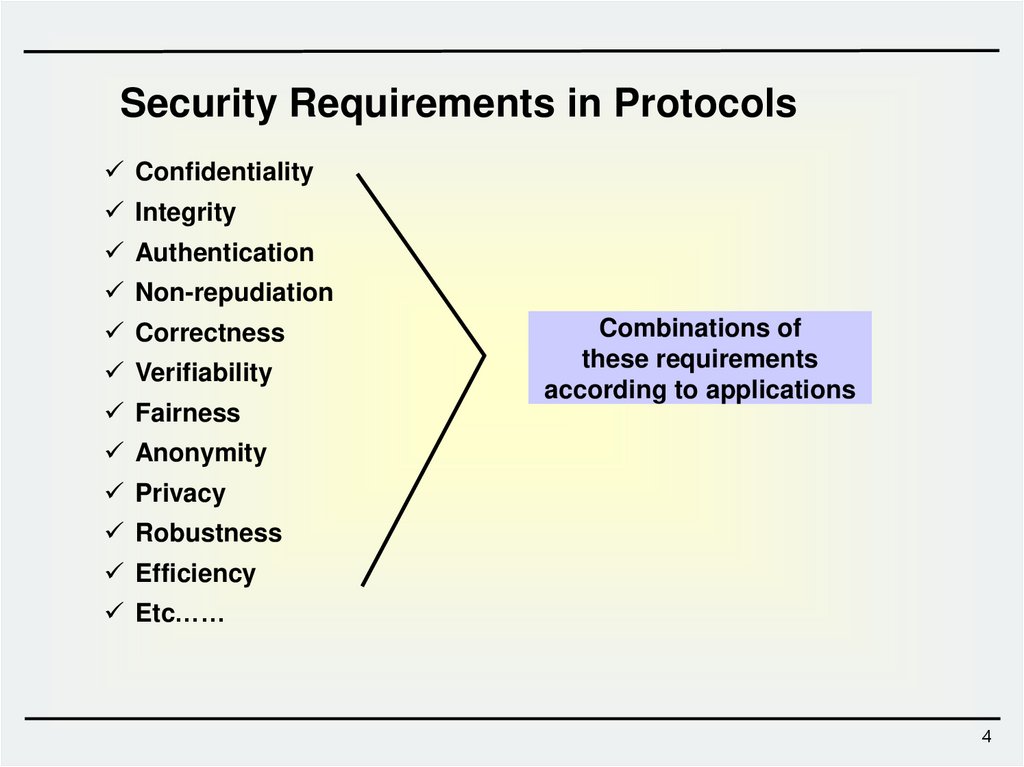
Security Requirements in ProtocolsConfidentiality
Integrity
Authentication
Non-repudiation
Correctness
Verifiability
Fairness
Combinations of
these requirements
according to applications
Anonymity
Privacy
Robustness
Efficiency
Etc……
4
5.
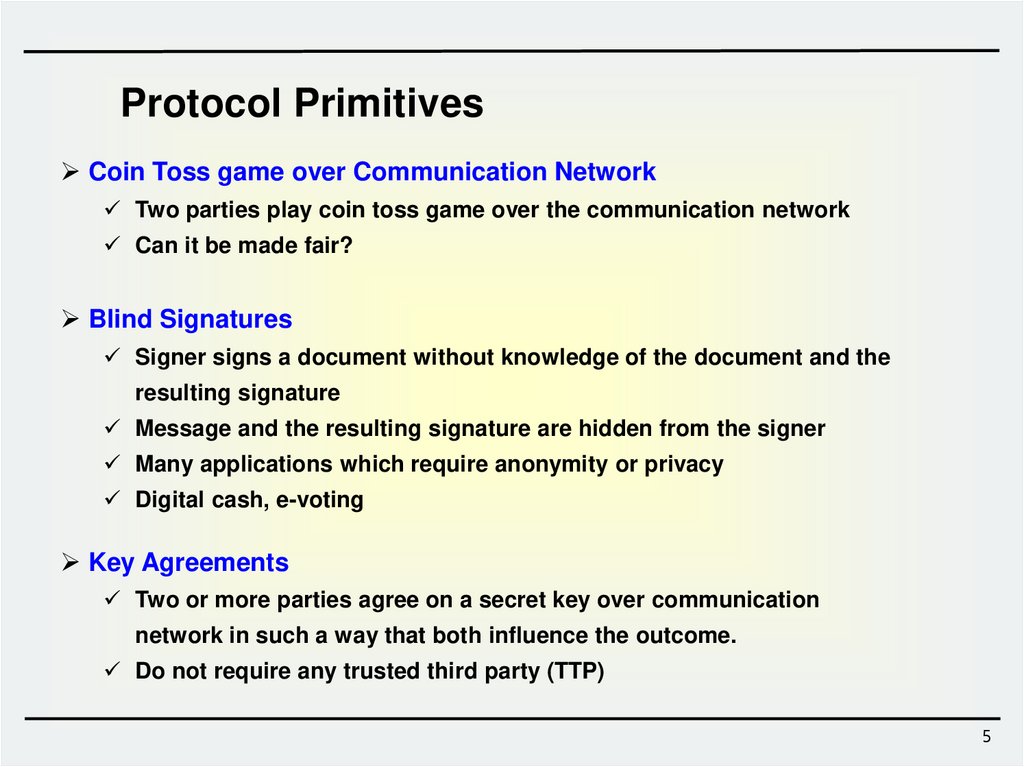
Protocol PrimitivesCoin Toss game over Communication Network
Two parties play coin toss game over the communication network
Can it be made fair?
Blind Signatures
Signer signs a document without knowledge of the document and the
resulting signature
Message and the resulting signature are hidden from the signer
Many applications which require anonymity or privacy
Digital cash, e-voting
Key Agreements
Two or more parties agree on a secret key over communication
network in such a way that both influence the outcome.
Do not require any trusted third party (TTP)
5
6.
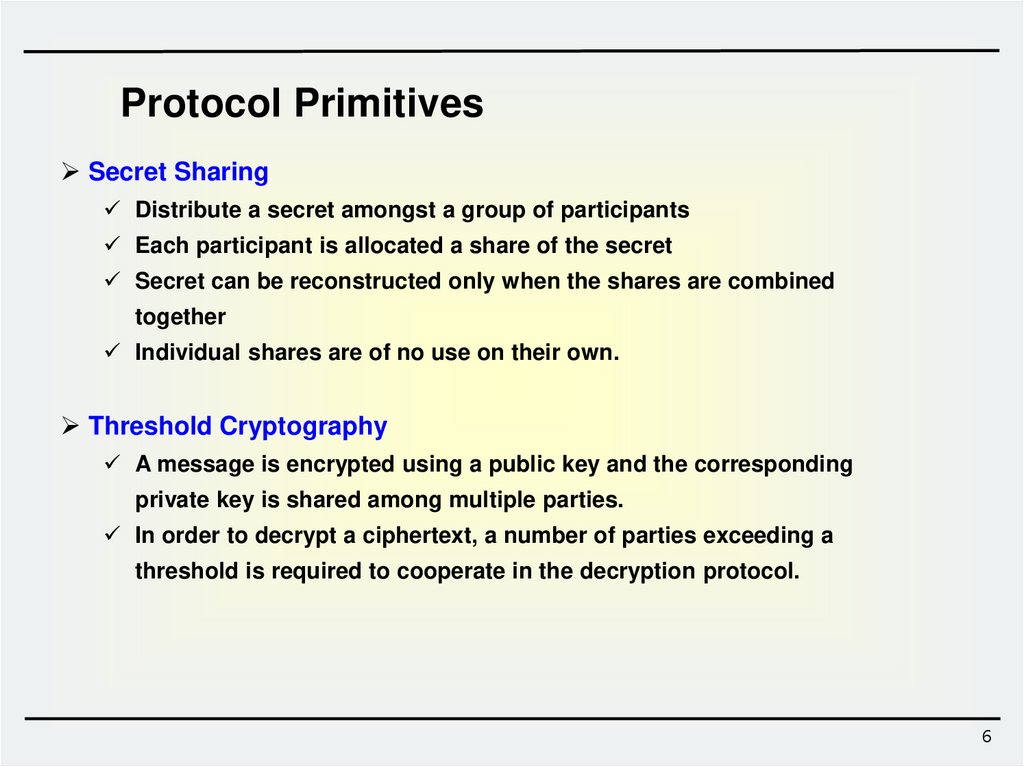
Protocol PrimitivesSecret Sharing
Distribute a secret amongst a group of participants
Each participant is allocated a share of the secret
Secret can be reconstructed only when the shares are combined
together
Individual shares are of no use on their own.
Threshold Cryptography
A message is encrypted using a public key and the corresponding
private key is shared among multiple parties.
In order to decrypt a ciphertext, a number of parties exceeding a
threshold is required to cooperate in the decryption protocol.
6
7.
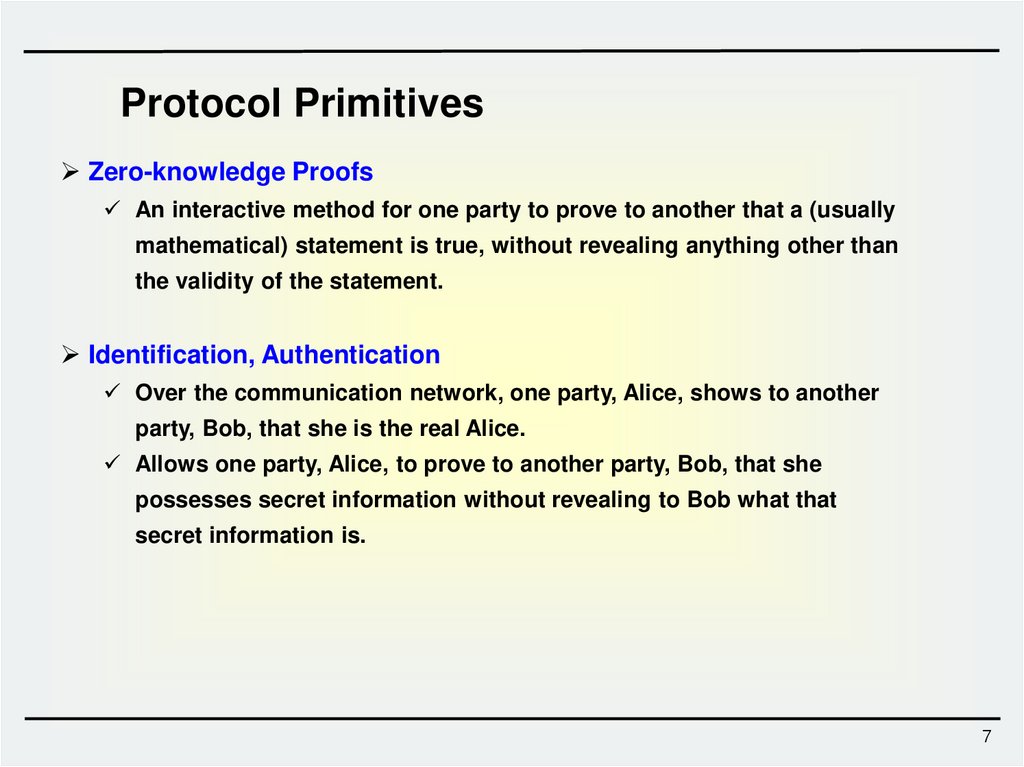
Protocol PrimitivesZero-knowledge Proofs
An interactive method for one party to prove to another that a (usually
mathematical) statement is true, without revealing anything other than
the validity of the statement.
Identification, Authentication
Over the communication network, one party, Alice, shows to another
party, Bob, that she is the real Alice.
Allows one party, Alice, to prove to another party, Bob, that she
possesses secret information without revealing to Bob what that
secret information is.
7
8.
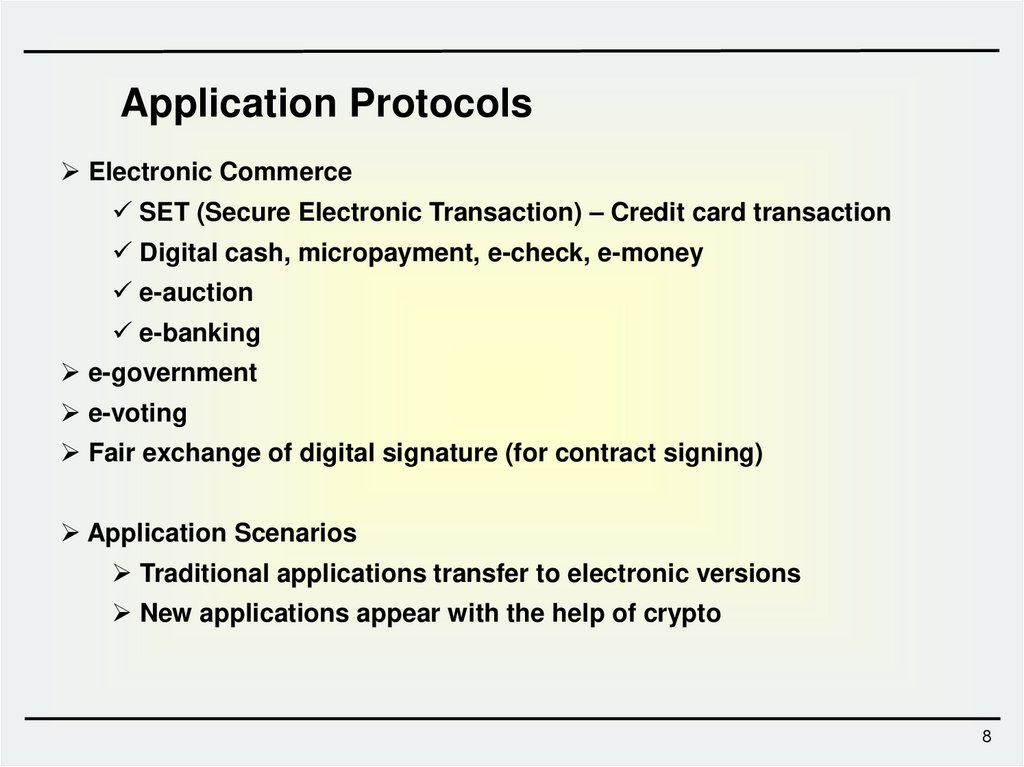
Application ProtocolsElectronic Commerce
SET (Secure Electronic Transaction) – Credit card transaction
Digital cash, micropayment, e-check, e-money
e-auction
e-banking
e-government
e-voting
Fair exchange of digital signature (for contract signing)
Application Scenarios
Traditional applications transfer to electronic versions
New applications appear with the help of crypto
8