

 Религия
Похожие презентации:



Core knowledge and skills in the Academic Study of Religion(s) and RE
1. Core knowledge and skills in the Academic Study of Religion(s) and RE
Karna KjeldsenPh.d. As. Professor,
Absalon University
College
Ljubljana F2025
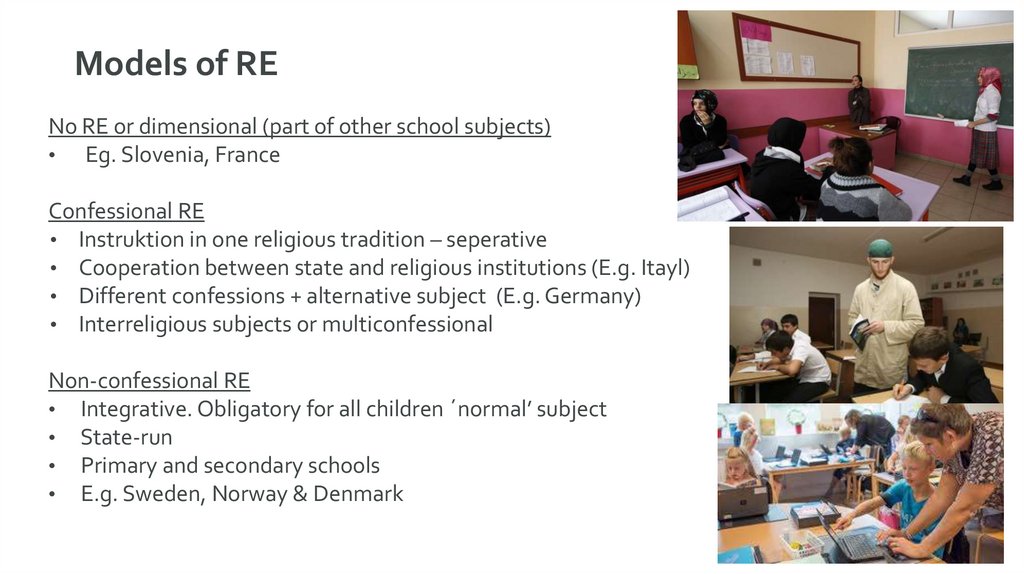
2. Models of RE
No RE or dimensional (part of other school subjects)• Eg. Slovenia, France
Confessional RE
• Instruktion in one religious tradition – seperative
• Cooperation between state and religious institutions (E.g. Itayl)
• Different confessions + alternative subject (E.g. Germany)
• Interreligious subjects or multiconfessional
Non-confessional RE
• Integrative. Obligatory for all children ´normal’ subject
• State-run
• Primary and secondary schools
• E.g. Sweden, Norway & Denmark
2
3. RE in Denmark
Primary and lower-secondary school: 0 – 9 grade levelRE: 1 – 9 grade level, compulsory. ALL students/pupils
‘Normal’ school subject, exam, ‘normal’ teachers educated at University Colleges
Upper secondary school: ‘Gymnasium’
‘Religion’, compulsory, exam
Teachers major or minor Study of Religion at Universities
3
4. Subject didactics for Religion Education (RE)
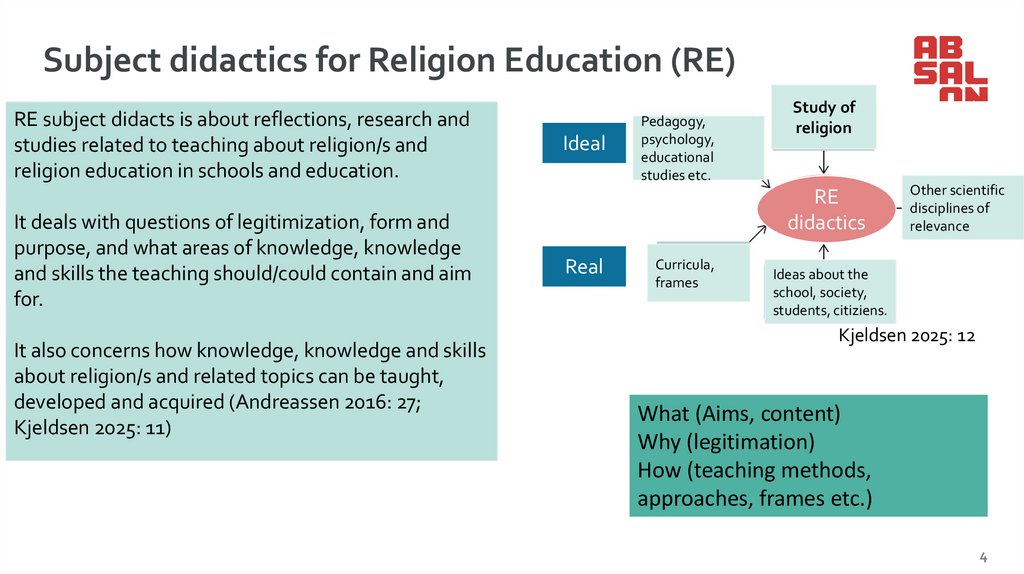
RE subject didacts is about reflections, research andstudies related to teaching about religion/s and
religion education in schools and education.
It deals with questions of legitimization, form and
purpose, and what areas of knowledge, knowledge
and skills the teaching should/could contain and aim
for.
It also concerns how knowledge, knowledge and skills
about religion/s and related topics can be taught,
developed and acquired (Andreassen 2016: 27;
Kjeldsen 2025: 11)
Ideal
Pedagogy,
psychology,
educational
studies etc.
Study of
religion
RE
didactics
Real
Curricula,
frames
Other scientific
disciplines of
relevance
Ideas about the
school, society,
students, citiziens.
Kjeldsen 2025: 12
What (Aims, content)
Why (legitimation)
How (teaching methods,
approaches, frames etc.)
4
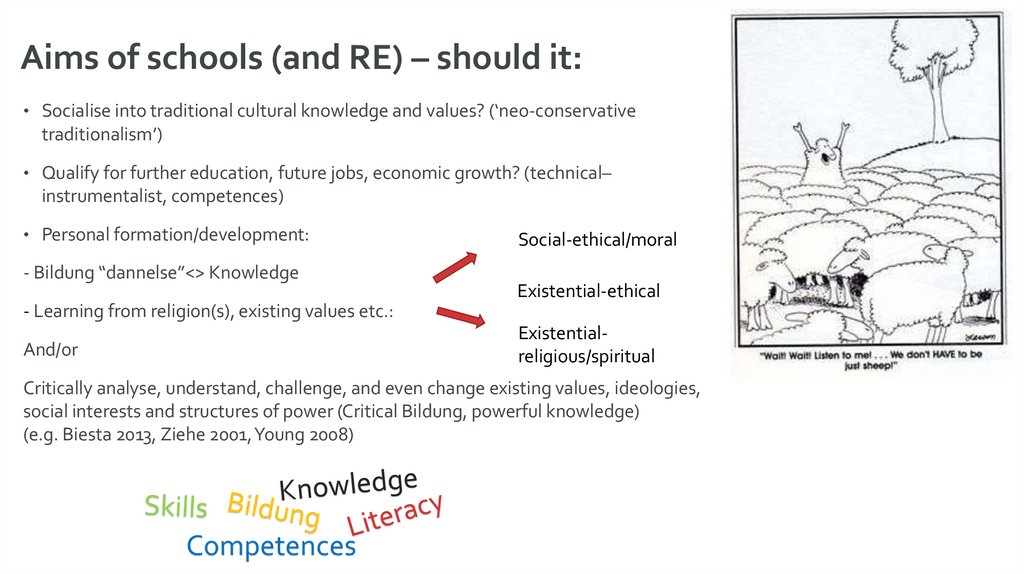
5. Aims of schools (and RE) – should it:
• Socialise into traditional cultural knowledge and values? (‘neo-conservativetraditionalism’)
• Qualify for further education, future jobs, economic growth? (technical–
instrumentalist, competences)
• Personal formation/development:
- Bildung “dannelse”<> Knowledge
Social-ethical/moral
Existential-ethical
- Learning from religion(s), existing values etc.:
Existentialreligious/spiritual
And/or
Critically analyse, understand, challenge, and even change existing values, ideologies,
social interests and structures of power (Critical Bildung, powerful knowledge)
(e.g. Biesta 2013, Ziehe 2001, Young 2008)
Competences
6. Discussion: Why?
MENUFirst course
What should be the main argument for RE in public education?
What should be the main aim(s) of RE?
Main course
What would you consider to be the main challenges of nonconfessional RE?
6
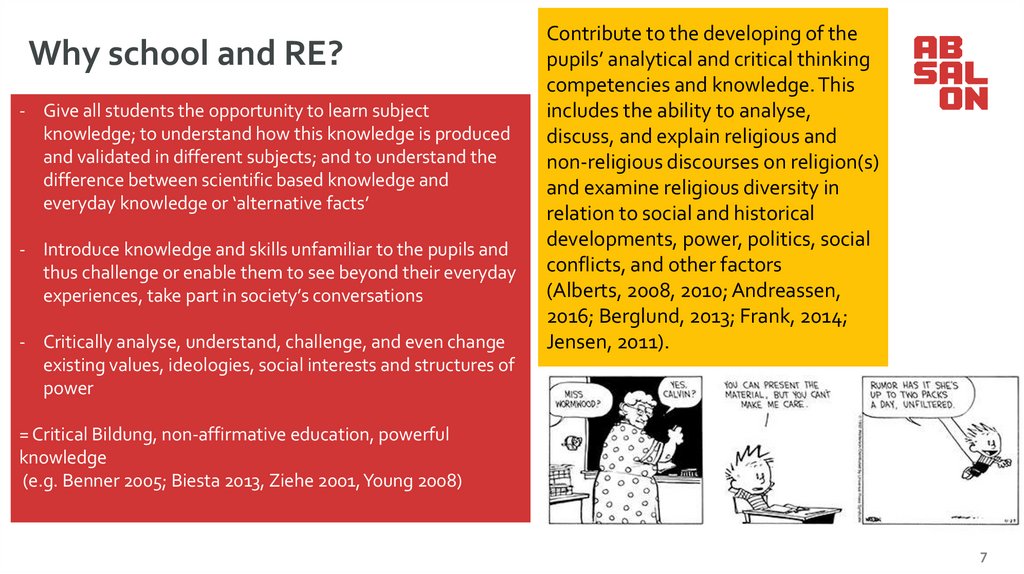
7. Why school and RE?
- Give all students the opportunity to learn subjectknowledge; to understand how this knowledge is produced
and validated in different subjects; and to understand the
difference between scientific based knowledge and
everyday knowledge or ‘alternative facts’
- Introduce knowledge and skills unfamiliar to the pupils and
thus challenge or enable them to see beyond their everyday
experiences, take part in society’s conversations
- Critically analyse, understand, challenge, and even change
existing values, ideologies, social interests and structures of
power
Contribute to the developing of the
pupils’ analytical and critical thinking
competencies and knowledge. This
includes the ability to analyse,
discuss, and explain religious and
non-religious discourses on religion(s)
and examine religious diversity in
relation to social and historical
developments, power, politics, social
conflicts, and other factors
(Alberts, 2008, 2010; Andreassen,
2016; Berglund, 2013; Frank, 2014;
Jensen, 2011).
= Critical Bildung, non-affirmative education, powerful
knowledge
(e.g. Benner 2005; Biesta 2013, Ziehe 2001, Young 2008)
7
8. RE in the Danish Gymnasium
The identity:On a scientific, non-confessional basis,
religions and their central phenomena, seen in
relation to individuals, groups, society, culture
and nature are described, analysed and
interpreted. The subject includes the origins
of religions, their historical development, their
contemporary configurations and the history
of their impact. The subject's perspective is
global. Particular attention is paid to the role
of religions in European and Danish history of
ideas and identity formation.
Aims
The subject provides students with knowledge and
understanding of religions and the significance of religions
for human beings and society, and it thus strengthens their
general education and skills.
They gain insight into similarities and differences within the
individual religions and across the various religions.
The general study competences of the students are improved
and they acquire the prerequisites for analysing, as well as
for having a qualified opinion on and taking a stand in
relation to debates on the role of religion(s) in a
contemporary local, national and global context, and the
subject provides an understanding of how one's own and
others' attitudes may be influenced by different religious and
secular traditions.
Students gain insight into how academically-based
knowledge of religion contributes to a qualified performance
of several different functions and professions in a globalised
8
and multicultural world.
9. Types of subject-specific general knowledge and skills
1) Subject-specific generalknowledge/metacognitive knowledge
- important general knowledge about the subject’s
field and how to learn/produce knowledge
Knowing that…
2) Subject-specific skills
- to study the subject’s field from an academic
perspective.
Knowing how to
3) Subject-specific conceptual knowledge
- theories, methods and concepts pertaining to the
academic discipline, including the criticism and
developments of theories and concepts
Knowing about
4) Subject-specific content knowledge
- particular content-areas
Knowing about
(Inspired by Marcus & Ralph, 2021; Young, 2013)
9
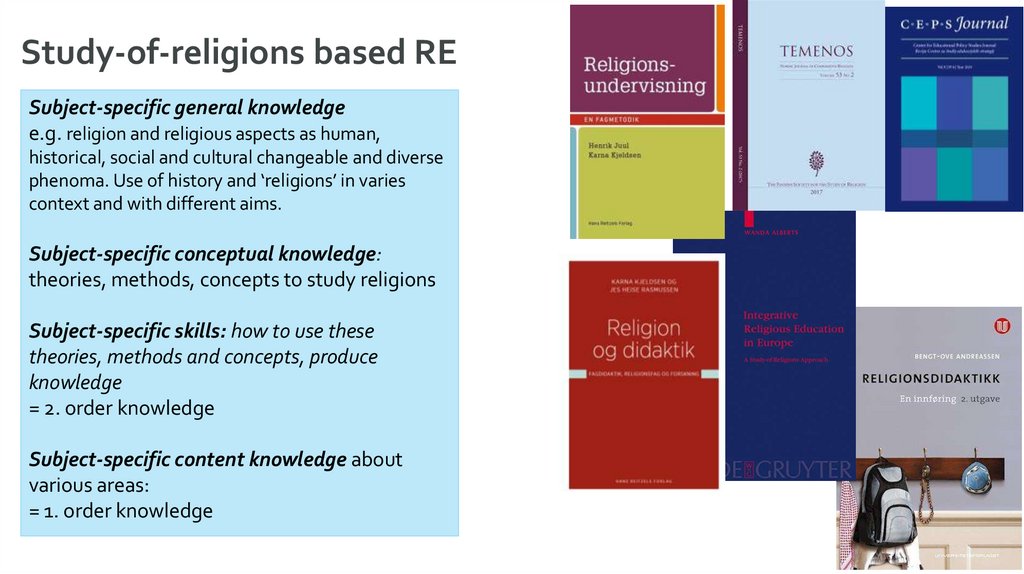
10. Study-of-religions based RE
Subject-specific general knowledgee.g. religion and religious aspects as human,
historical, social and cultural changeable and diverse
phenoma. Use of history and ‘religions’ in varies
context and with different aims.
Subject-specific conceptual knowledge:
theories, methods, concepts to study religions
Subject-specific skills: how to use these
theories, methods and concepts, produce
knowledge
= 2. order knowledge
Subject-specific content knowledge about
various areas:
= 1. order knowledge
10
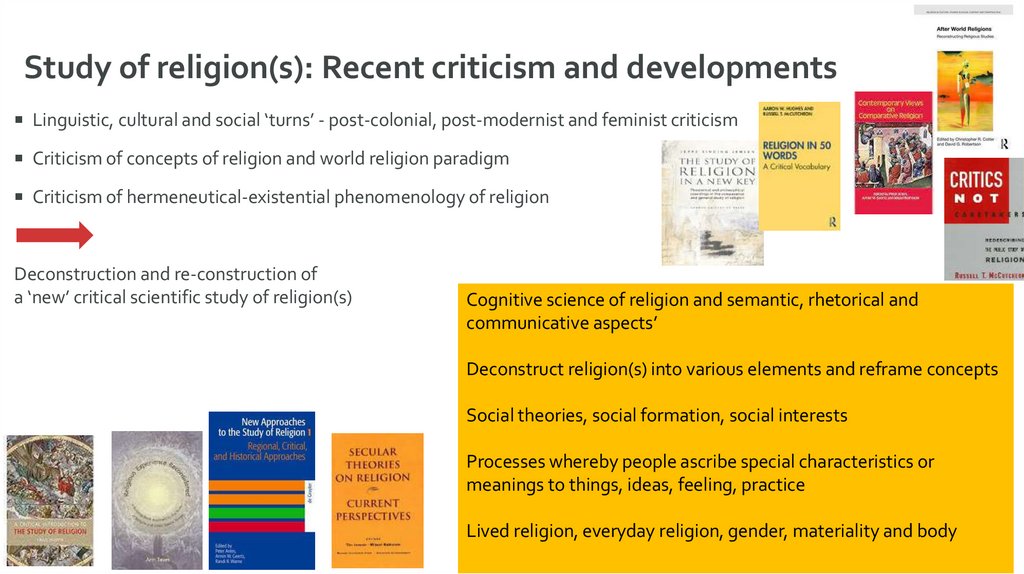
11. Study of religion(s): Recent criticism and developments
Linguistic, cultural and social ‘turns’ - post-colonial, post-modernist and feminist criticismCriticism of concepts of religion and world religion paradigm
Criticism of hermeneutical-existential phenomenology of religion
Deconstruction and re-construction of
a ‘new’ critical scientific study of religion(s)
Cognitive science of religion and semantic, rhetorical and
communicative aspects’
Deconstruct religion(s) into various elements and reframe concepts
Social theories, social formation, social interests
Processes whereby people ascribe special characteristics or
meanings to things, ideas, feeling, practice
Lived religion, everyday religion, gender, materiality and body
11
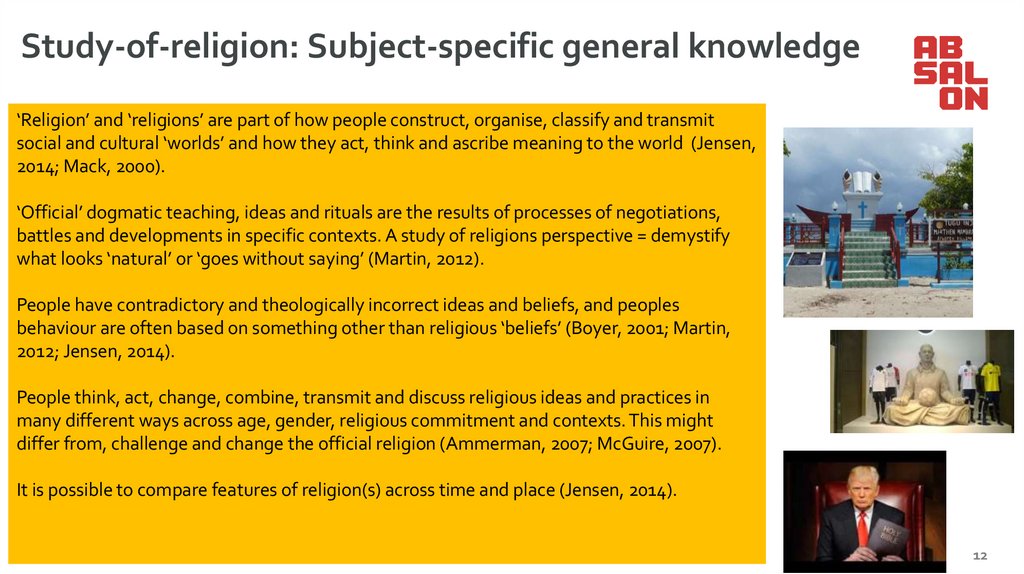
12. Study-of-religion: Subject-specific general knowledge
‘Religion’ and ‘religions’ are part of how people construct, organise, classify and transmitsocial and cultural ‘worlds’ and how they act, think and ascribe meaning to the world (Jensen,
2014; Mack, 2000).
‘Official’ dogmatic teaching, ideas and rituals are the results of processes of negotiations,
battles and developments in specific contexts. A study of religions perspective = demystify
what looks ‘natural’ or ‘goes without saying’ (Martin, 2012).
People have contradictory and theologically incorrect ideas and beliefs, and peoples
behaviour are often based on something other than religious ‘beliefs’ (Boyer, 2001; Martin,
2012; Jensen, 2014).
People think, act, change, combine, transmit and discuss religious ideas and practices in
many different ways across age, gender, religious commitment and contexts. This might
differ from, challenge and change the official religion (Ammerman, 2007; McGuire, 2007).
It is possible to compare features of religion(s) across time and place (Jensen, 2014).
12
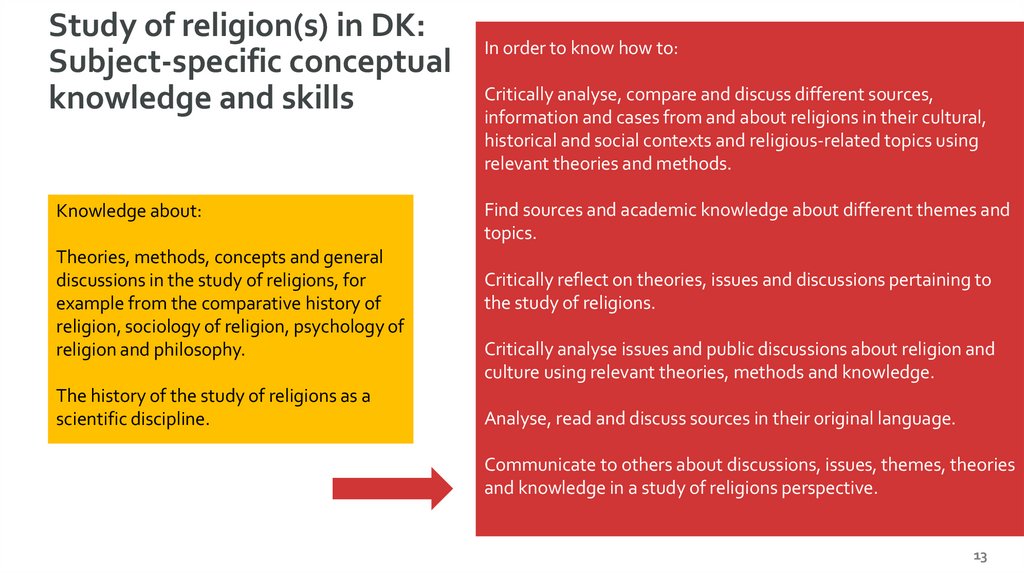
13. Study of religion(s) in DK: Subject-specific conceptual knowledge and skills
Knowledge about:Theories, methods, concepts and general
discussions in the study of religions, for
example from the comparative history of
religion, sociology of religion, psychology of
religion and philosophy.
The history of the study of religions as a
scientific discipline.
In order to know how to:
Critically analyse, compare and discuss different sources,
information and cases from and about religions in their cultural,
historical and social contexts and religious-related topics using
relevant theories and methods.
Find sources and academic knowledge about different themes and
topics.
Critically reflect on theories, issues and discussions pertaining to
the study of religions.
Critically analyse issues and public discussions about religion and
culture using relevant theories, methods and knowledge.
Analyse, read and discuss sources in their original language.
Communicate to others about discussions, issues, themes, theories
and knowledge in a study of religions perspective.
13
14. Study of religion(s) DK: Subject-specific content knowledge
Christianity, Islam and another contemporary(major) religion.
Different forms of religions and spiritual streams
Study of religions-based knowledge of ‘religion’,
various religions and religious phenomena and
communication on religion(s) in relation to
political, cultural and social contexts and issues
past and present.
Philosophy of religion-related issues
Theories and methods
Philosophy, comparative history of religion and
phenomenology,
Indigenous religions, Ancient religions,
Religious and spiritual innovation,
Popular and alternative forms of religion,
Representation and the communication and
teaching of religion(s) in various contexts
Issues related to RE or communication on
religion
14
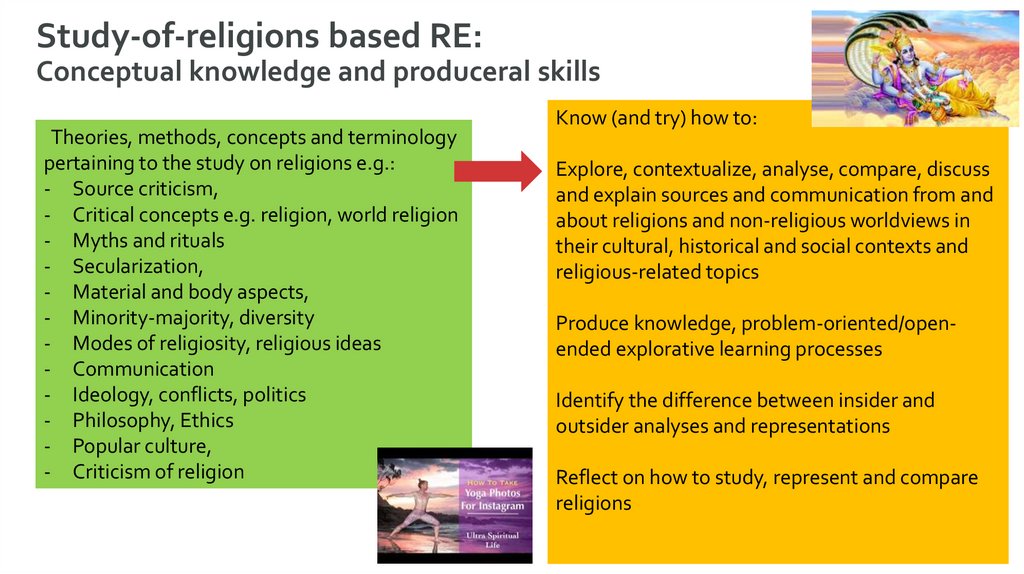
15. Study-of-religions based RE: Conceptual knowledge and produceral skills
Theories, methods, concepts and terminologypertaining to the study on religions e.g.:
- Source criticism,
- Critical concepts e.g. religion, world religion
- Myths and rituals
- Secularization,
- Material and body aspects,
- Minority-majority, diversity
- Modes of religiosity, religious ideas
- Communication
- Ideology, conflicts, politics
- Philosophy, Ethics
- Popular culture,
- Criticism of religion
Know (and try) how to:
Explore, contextualize, analyse, compare, discuss
and explain sources and communication from and
about religions and non-religious worldviews in
their cultural, historical and social contexts and
religious-related topics
Produce knowledge, problem-oriented/openended explorative learning processes
Identify the difference between insider and
outsider analyses and representations
Reflect on how to study, represent and compare
religions
15
16. RE Upper secondary schools:
Students must be able to:characterise and analyse diverse materials using study-of-religion/s concepts
characterise and analyse religious and non-religious views, including ethical
ones, as well as current discussions of subject-related relevance, using both
insider and outsider perspectives
characterise and analyse significant issues concerning the relationship
between religion and contemporary societies in a global context, as well as
applying study-of-religion/s approaches in order to better understand and deal
with current issues and conflicts
address issues in interaction with other school subjects
demonstrate knowledge of the subject's identity and methods
16
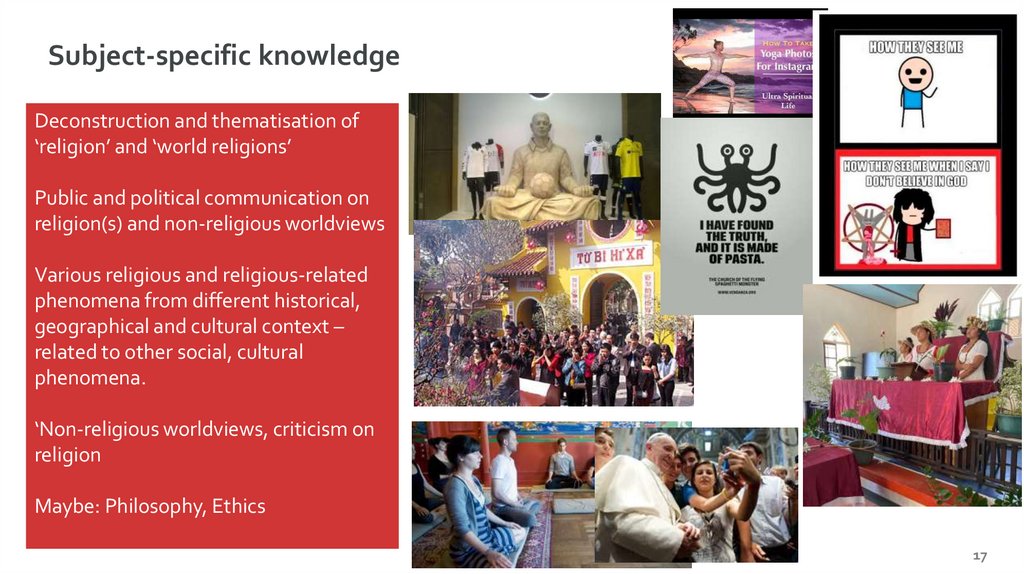
17. Subject-specific knowledge
Deconstruction and thematisation of‘religion’ and ‘world religions’
Public and political communication on
religion(s) and non-religious worldviews
Various religious and religious-related
phenomena from different historical,
geographical and cultural context –
related to other social, cultural
phenomena.
‘Non-religious worldviews, criticism on
religion
Maybe: Philosophy, Ethics
17
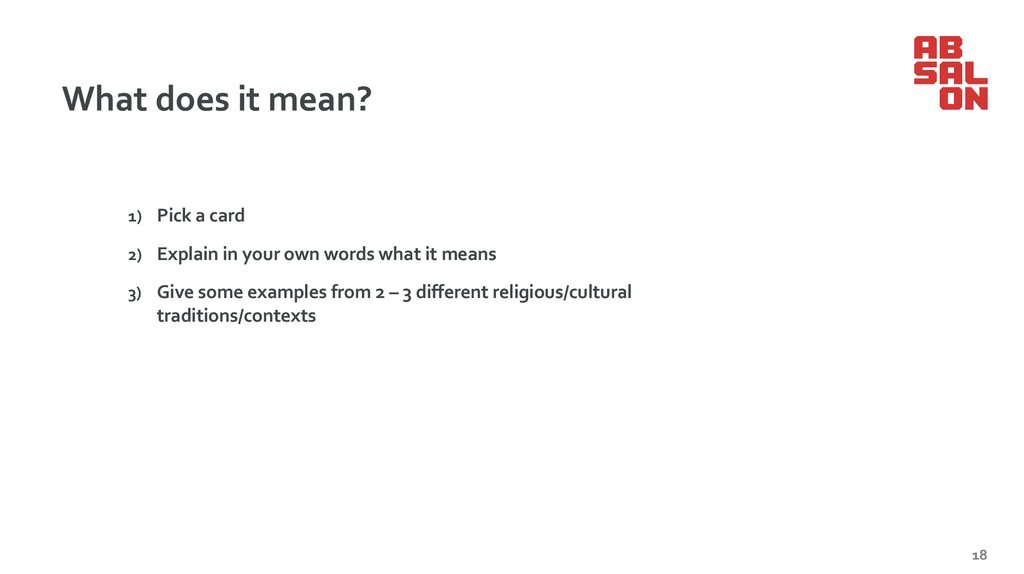
18. What does it mean?
1) Pick a card2) Explain in your own words what it means
3) Give some examples from 2 – 3 different religious/cultural
traditions/contexts
18
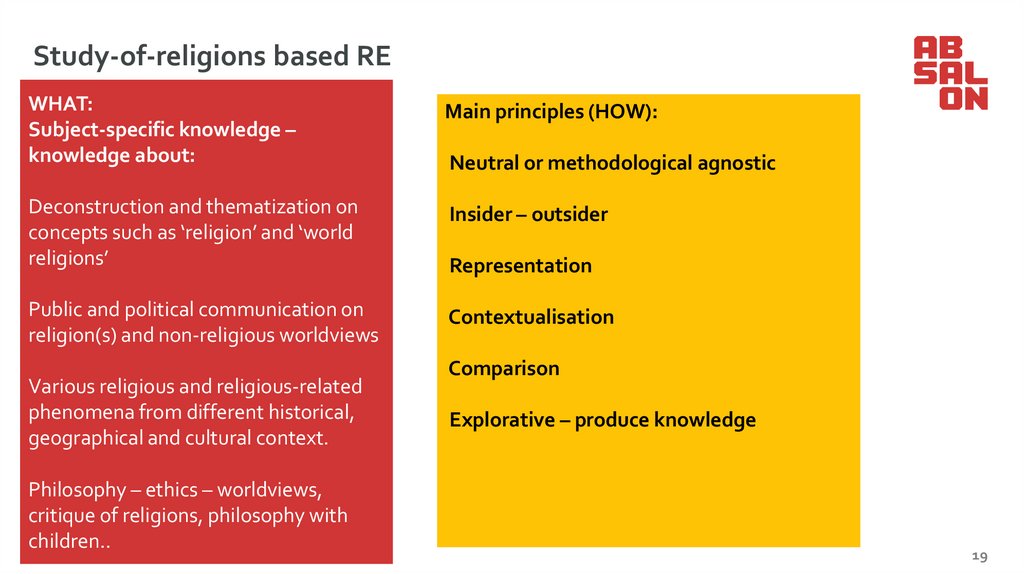
19. Study-of-religions based RE
WHAT:Subject-specific knowledge –
knowledge about:
Main principles (HOW):
Deconstruction and thematization on
concepts such as ‘religion’ and ‘world
religions’
Insider – outsider
Public and political communication on
religion(s) and non-religious worldviews
Contextualisation
Various religious and religious-related
phenomena from different historical,
geographical and cultural context.
Philosophy – ethics – worldviews,
critique of religions, philosophy with
children..
Neutral or methodological agnostic
Representation
Comparison
Explorative – produce knowledge
19
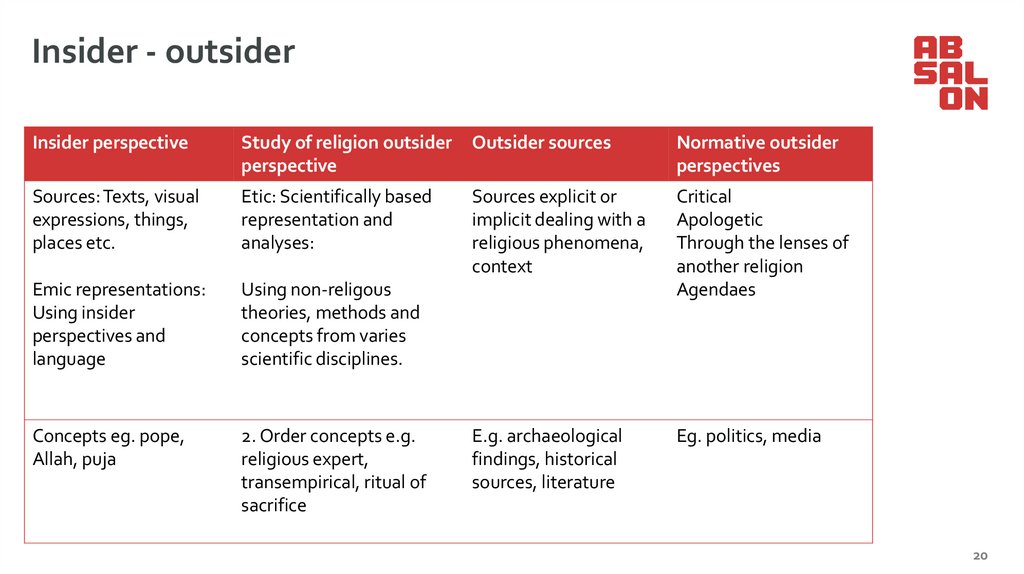
20. Insider - outsider
Insider perspectiveStudy of religion outsider
perspective
Outsider sources
Normative outsider
perspectives
Sources: Texts, visual
expressions, things,
places etc.
Etic: Scientifically based
representation and
analyses:
Sources explicit or
implicit dealing with a
religious phenomena,
context
Emic representations:
Using insider
perspectives and
language
Using non-religous
theories, methods and
concepts from varies
scientific disciplines.
Critical
Apologetic
Through the lenses of
another religion
Agendaes
Concepts eg. pope,
Allah, puja
2. Order concepts e.g.
religious expert,
transempirical, ritual of
sacrifice
E.g. archaeological
findings, historical
sources, literature
Eg. politics, media
20
21. Concepts
Deconstruction and thematization of:- Religion, World Religions
- Culture, ethnicity - stereotypes
- Societal changes
- Cultural and religious diversity
- Minority and majority
- Maximalist – minimalism
- Etc..
22.
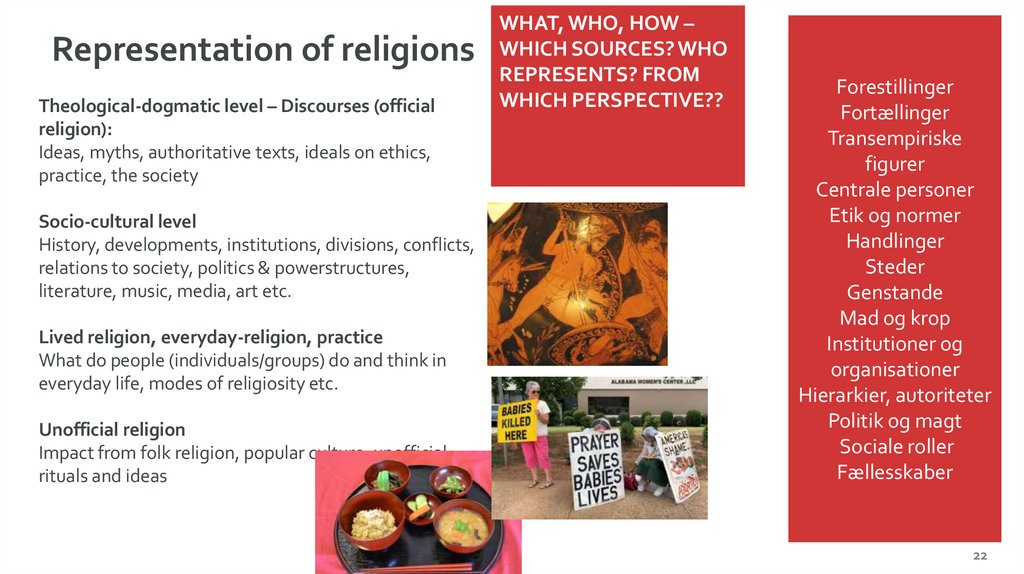
Representation of religionsTheological-dogmatic level – Discourses (official
religion):
Ideas, myths, authoritative texts, ideals on ethics,
practice, the society
Socio-cultural level
History, developments, institutions, divisions, conflicts,
relations to society, politics & powerstructures,
literature, music, media, art etc.
Lived religion, everyday-religion, practice
What do people (individuals/groups) do and think in
everyday life, modes of religiosity etc.
Unofficial religion
Impact from folk religion, popular culture, unofficial
rituals and ideas
WHAT, WHO, HOW –
WHICH SOURCES? WHO
REPRESENTS? FROM
WHICH PERSPECTIVE??
Forestillinger
Fortællinger
Transempiriske
figurer
Centrale personer
Etik og normer
Handlinger
Steder
Genstande
Mad og krop
Institutioner og
organisationer
Hierarkier, autoriteter
Politik og magt
Sociale roller
Fællesskaber
22
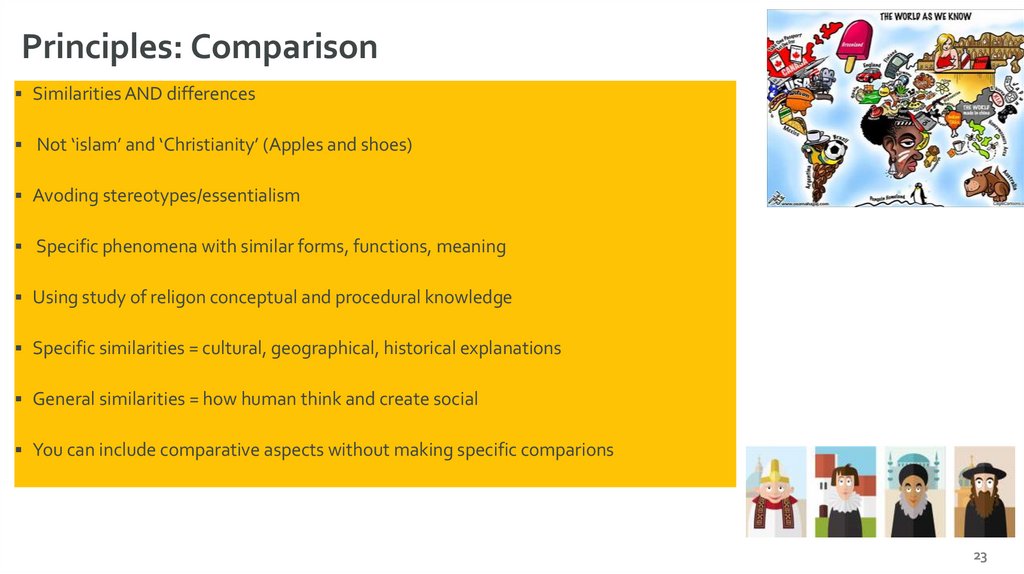
23. Principles: Comparison
Similarities AND differencesNot ‘islam’ and ‘Christianity’ (Apples and shoes)
Avoding stereotypes/essentialism
Specific phenomena with similar forms, functions, meaning
Using study of religon conceptual and procedural knowledge
Specific similarities = cultural, geographical, historical explanations
General similarities = how human think and create social
You can include comparative aspects without making specific comparions
23
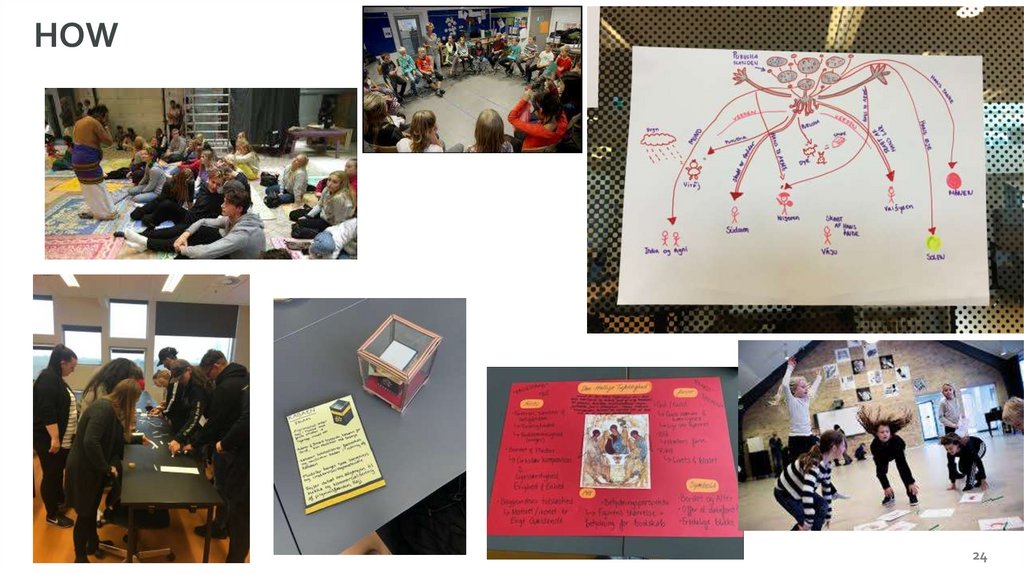
24. HOW
2425.
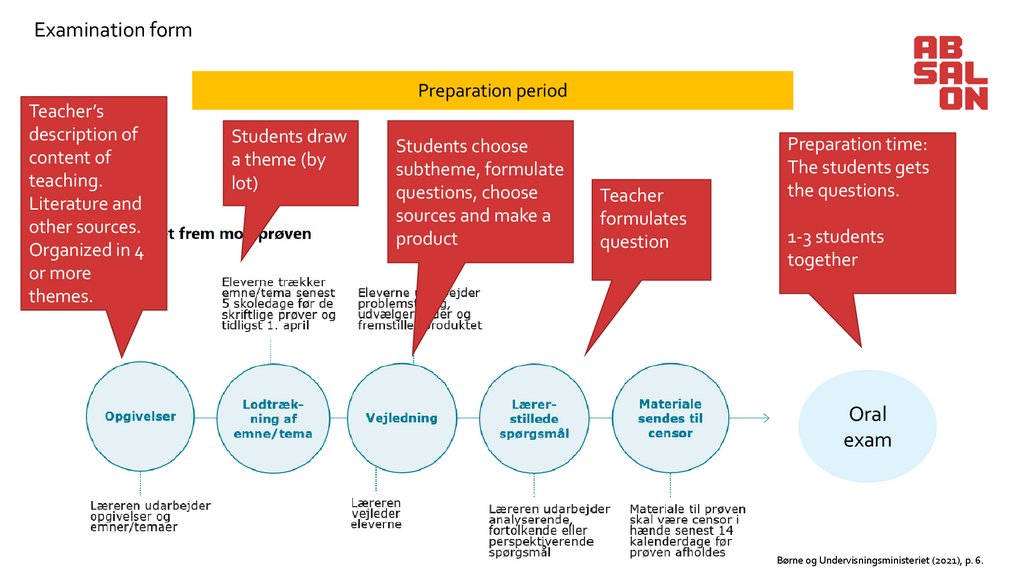
Examination formPreparation period
Teacher’s
description of
content of
teaching.
Literature and
other sources.
Organized in 4
or more
themes.
Students draw
a theme (by
lot)
Students choose
subtheme, formulate
questions, choose
sources and make a
product
Teacher
formulates
question
Preparation time:
The students gets
the questions.
1-3 students
together
Oral
exam
Børne og Undervisningsministeriet (2021), p. 6.