
 Английский язык
Похожие презентации:







The Infinitive, Participle I,II and the Gerund
1. “About a boy” by Nick hornby
“ABOUT A BOY”BY NICK HORNBY
The Infinitive, Participle I,II and
the Gerund
by Emine Seytdjalilova
2. The Infinitive
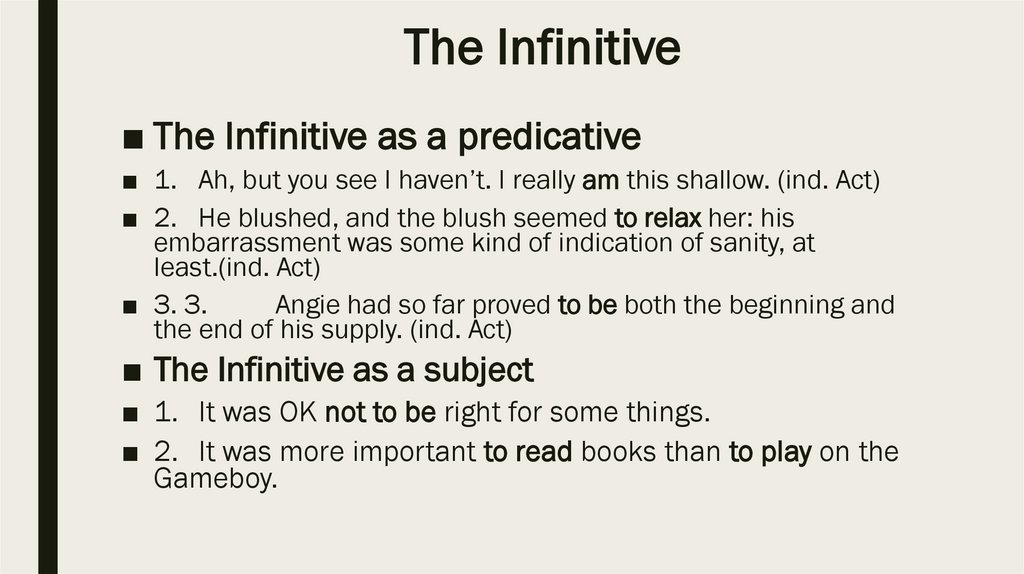
■ The Infinitive as a predicative■ 1. Ah, but you see I haven’t. I really am this shallow. (ind. Act)
■ 2. He blushed, and the blush seemed to relax her: his
embarrassment was some kind of indication of sanity, at
least.(ind. Act)
■ 3. 3.
Angie had so far proved to be both the beginning and
the end of his supply. (ind. Act)
■ The Infinitive as a subject
■ 1. It was OK not to be right for some things.
■ 2. It was more important to read books than to play on the
Gameboy.
3. The Infinitive as a Part of the Compound Verbal Modal Predicate
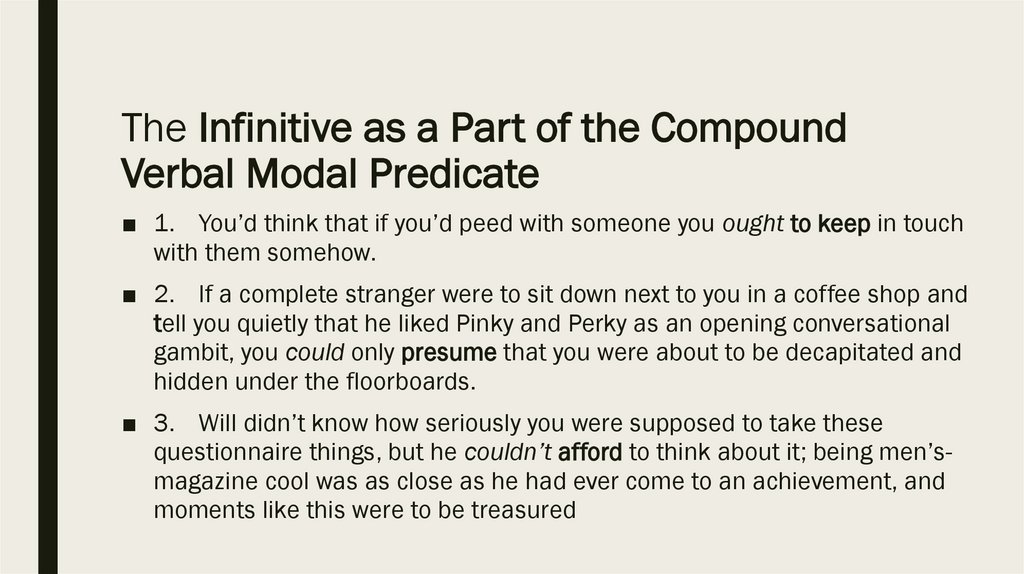
■ 1. You’d think that if you’d peed with someone you ought to keep in touchwith them somehow.
■ 2. If a complete stranger were to sit down next to you in a coffee shop and
tell you quietly that he liked Pinky and Perky as an opening conversational
gambit, you could only presume that you were about to be decapitated and
hidden under the floorboards.
■ 3. Will didn’t know how seriously you were supposed to take these
questionnaire things, but he couldn’t afford to think about it; being men’smagazine cool was as close as he had ever come to an achievement, and
moments like this were to be treasured
4. The Infinitive as an object
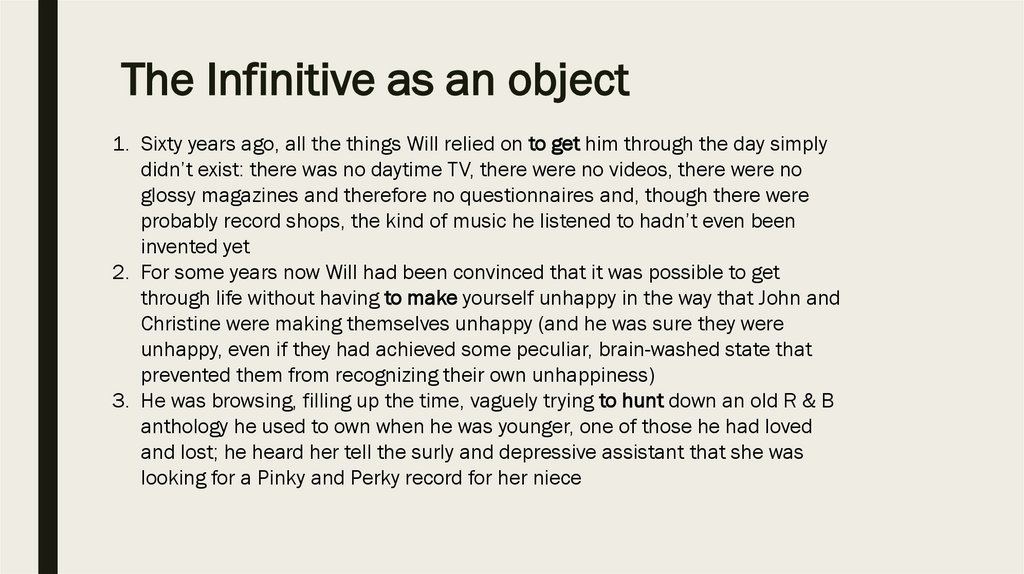
1. Sixty years ago, all the things Will relied on to get him through the day simplydidn’t exist: there was no daytime TV, there were no videos, there were no
glossy magazines and therefore no questionnaires and, though there were
probably record shops, the kind of music he listened to hadn’t even been
invented yet
2. For some years now Will had been convinced that it was possible to get
through life without having to make yourself unhappy in the way that John and
Christine were making themselves unhappy (and he was sure they were
unhappy, even if they had achieved some peculiar, brain-washed state that
prevented them from recognizing their own unhappiness)
3. He was browsing, filling up the time, vaguely trying to hunt down an old R & B
anthology he used to own when he was younger, one of those he had loved
and lost; he heard her tell the surly and depressive assistant that she was
looking for a Pinky and Perky record for her niece
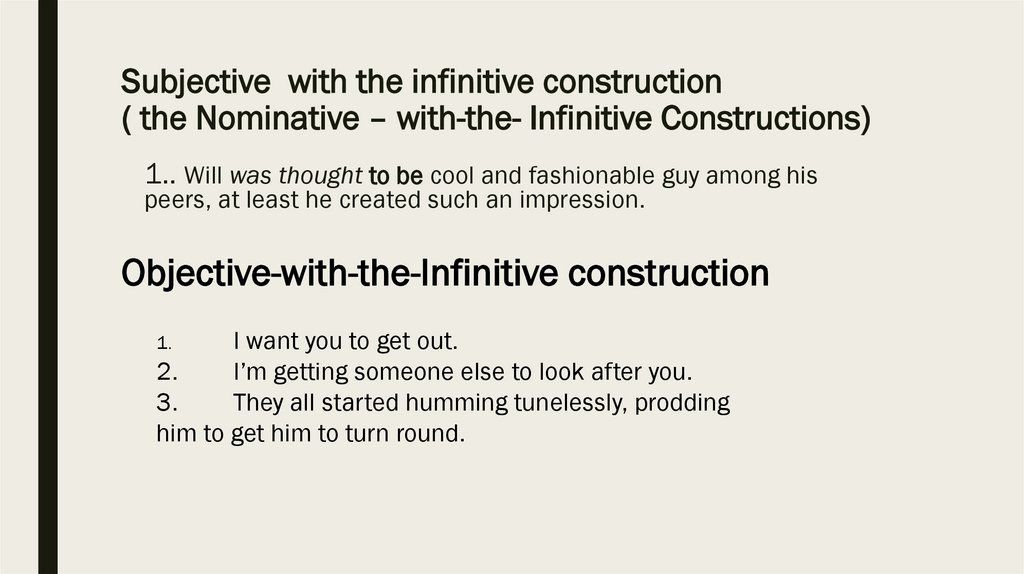
5. Subjective with the infinitive construction ( the Nominative – with-the- Infinitive Constructions)
1.. Will was thought to be cool and fashionable guy among hispeers, at least he created such an impression.
Objective-with-the-Infinitive construction
I want you to get out.
2.
I’m getting someone else to look after you.
3.
They all started humming tunelessly, prodding
him to get him to turn round.
1.
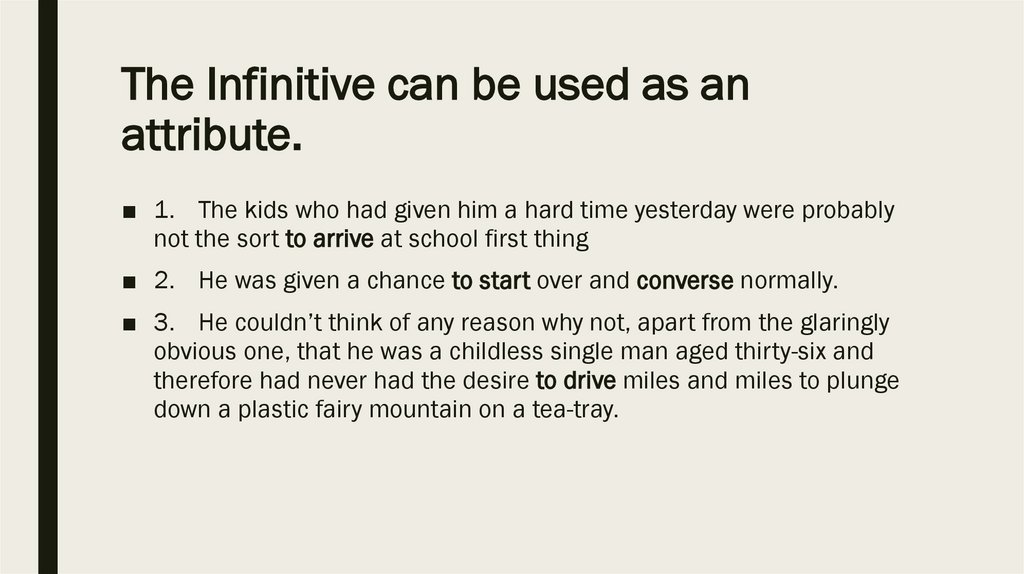
6. The Infinitive can be used as an attribute.
■ 1. The kids who had given him a hard time yesterday were probablynot the sort to arrive at school first thing
■ 2. He was given a chance to start over and converse normally.
■ 3. He couldn’t think of any reason why not, apart from the glaringly
obvious one, that he was a childless single man aged thirty-six and
therefore had never had the desire to drive miles and miles to plunge
down a plastic fairy mountain on a tea-tray.
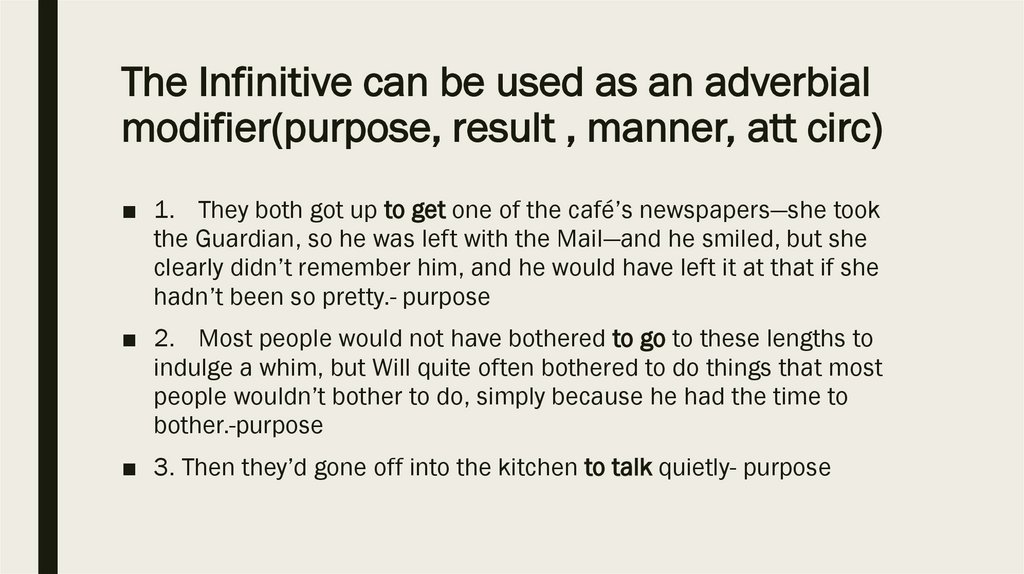
7. The Infinitive can be used as an adverbial modifier(purpose, result , manner, att circ)
■ 1. They both got up to get one of the café’s newspapers—she tookthe Guardian, so he was left with the Mail—and he smiled, but she
clearly didn’t remember him, and he would have left it at that if she
hadn’t been so pretty.- purpose
■ 2. Most people would not have bothered to go to these lengths to
indulge a whim, but Will quite often bothered to do things that most
people wouldn’t bother to do, simply because he had the time to
bother.-purpose
■ 3. Then they’d gone off into the kitchen to talk quietly- purpose
8.
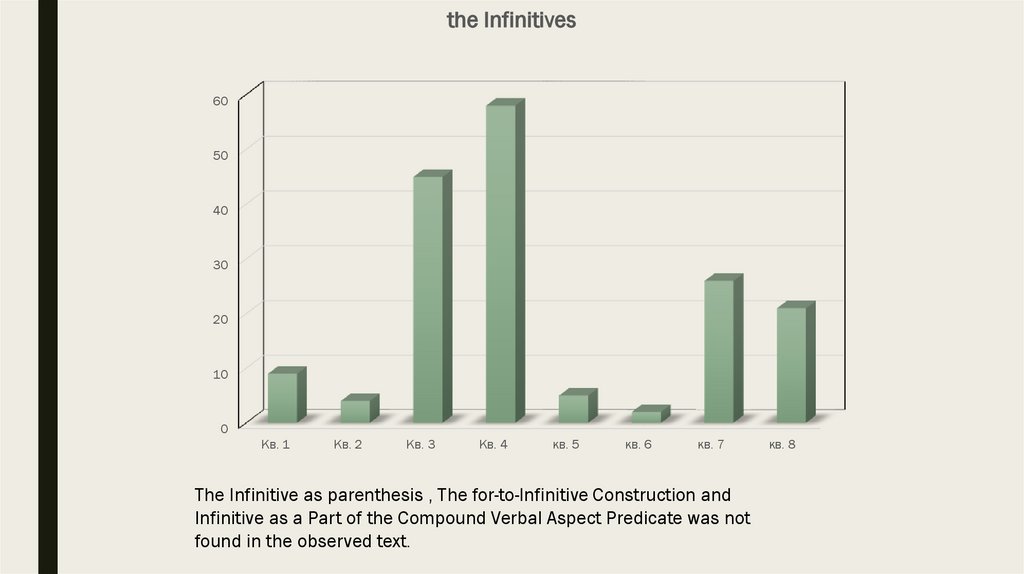
the Infinitives60
50
40
30
20
10
0
Кв. 1
Кв. 2
Кв. 3
Кв. 4
кв. 5
кв. 6
кв. 7
The Infinitive as parenthesis , The for-to-Infinitive Construction and
Infinitive as a Part of the Compound Verbal Aspect Predicate was not
found in the observed text.
кв. 8
9. Participle I
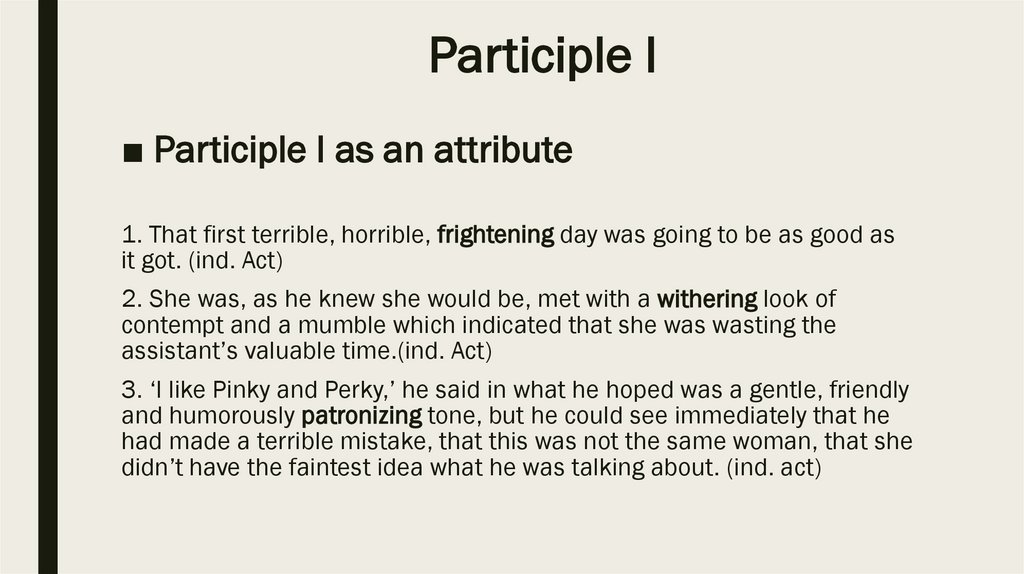
■ Participle I as an attribute1. That first terrible, horrible, frightening day was going to be as good as
it got. (ind. Act)
2. She was, as he knew she would be, met with a withering look of
contempt and a mumble which indicated that she was wasting the
assistant’s valuable time.(ind. Act)
3. ‘I like Pinky and Perky,’ he said in what he hoped was a gentle, friendly
and humorously patronizing tone, but he could see immediately that he
had made a terrible mistake, that this was not the same woman, that she
didn’t have the faintest idea what he was talking about. (ind. act)
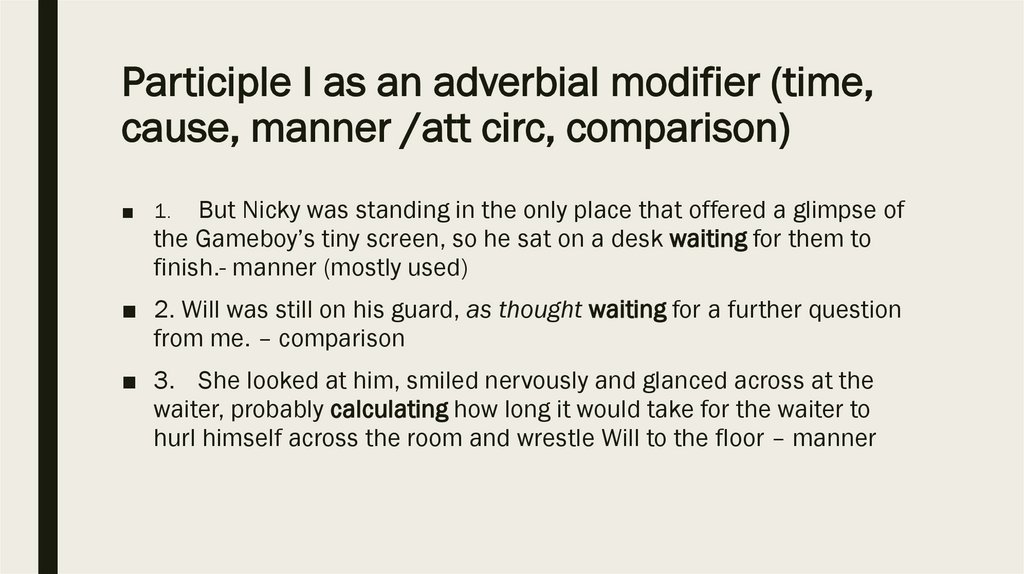
10. Participle I as an adverbial modifier (time, cause, manner /att circ, comparison)
But Nicky was standing in the only place that offered a glimpse ofthe Gameboy’s tiny screen, so he sat on a desk waiting for them to
finish.- manner (mostly used)
■ 1.
■ 2. Will was still on his guard, as thought waiting for a further question
from me. – comparison
■ 3. She looked at him, smiled nervously and glanced across at the
waiter, probably calculating how long it would take for the waiter to
hurl himself across the room and wrestle Will to the floor – manner
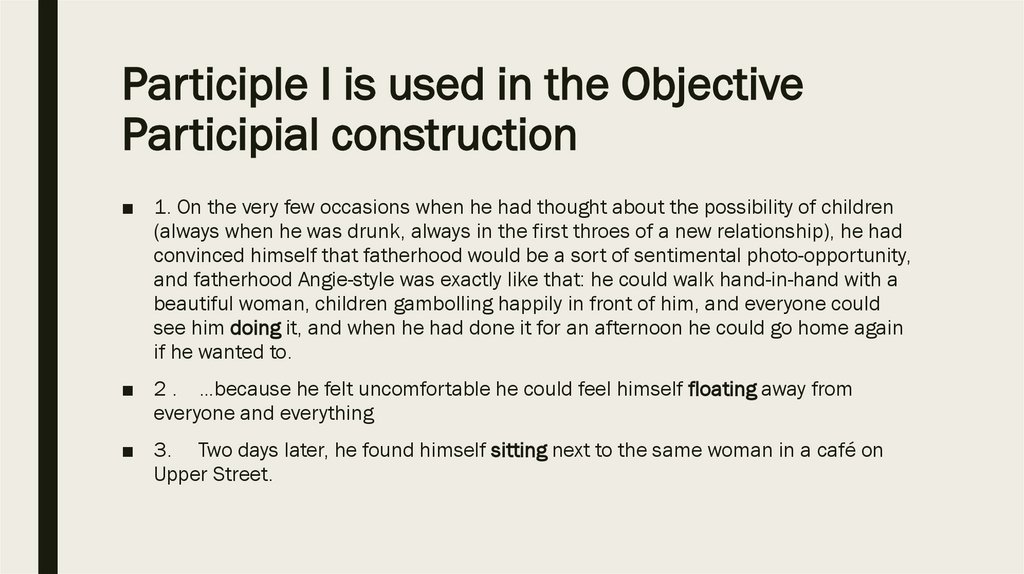
11. Participle I is used in the Objective Participial construction
■ 1. On the very few occasions when he had thought about the possibility of children(always when he was drunk, always in the first throes of a new relationship), he had
convinced himself that fatherhood would be a sort of sentimental photo-opportunity,
and fatherhood Angie-style was exactly like that: he could walk hand-in-hand with a
beautiful woman, children gambolling happily in front of him, and everyone could
see him doing it, and when he had done it for an afternoon he could go home again
if he wanted to.
■ 2 . …because he felt uncomfortable he could feel himself floating away from
everyone and everything
■ 3. Two days later, he found himself sitting next to the same woman in a café on
Upper Street.
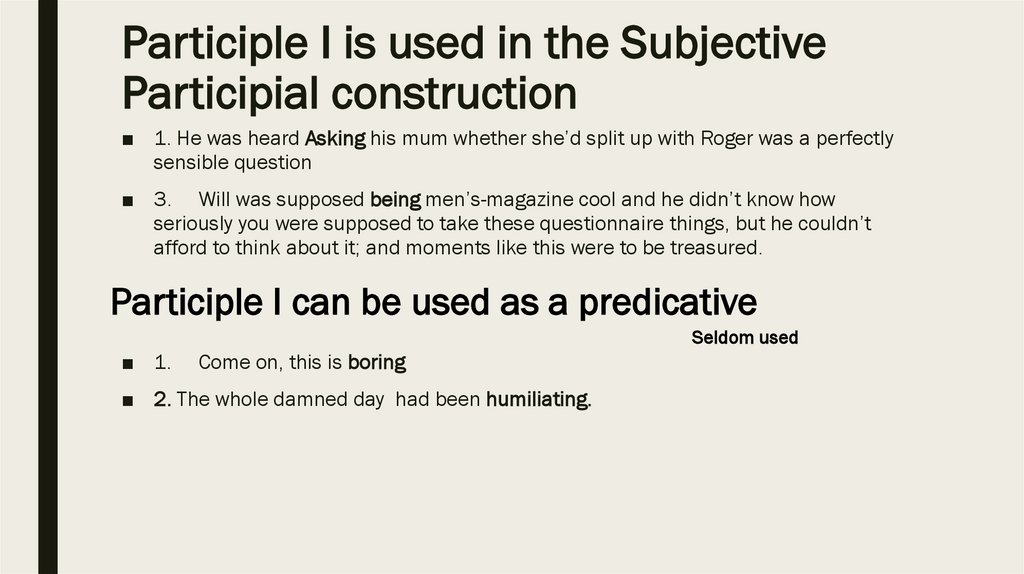
12. Participle I is used in the Subjective Participial construction
■ 1. He was heard Asking his mum whether she’d split up with Roger was a perfectlysensible question
■ 3. Will was supposed being men’s-magazine cool and he didn’t know how
seriously you were supposed to take these questionnaire things, but he couldn’t
afford to think about it; and moments like this were to be treasured.
Participle I can be used as a predicative
Seldom used
■ 1.
Come on, this is boring
■ 2. The whole damned day had been humiliating.
13.
Столбец135
30
25
20
15
10
5
0
Кв. 1
Кв. 2
Кв. 3
Кв. 4
кв. 5
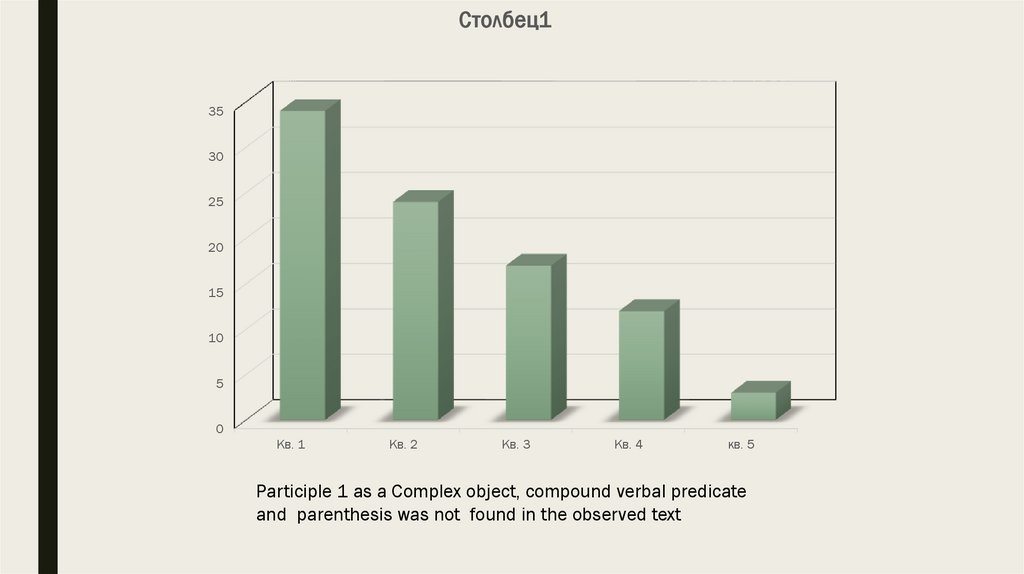
Participle 1 as a Complex object, compound verbal predicate
and parenthesis was not found in the observed text
14. Participle II
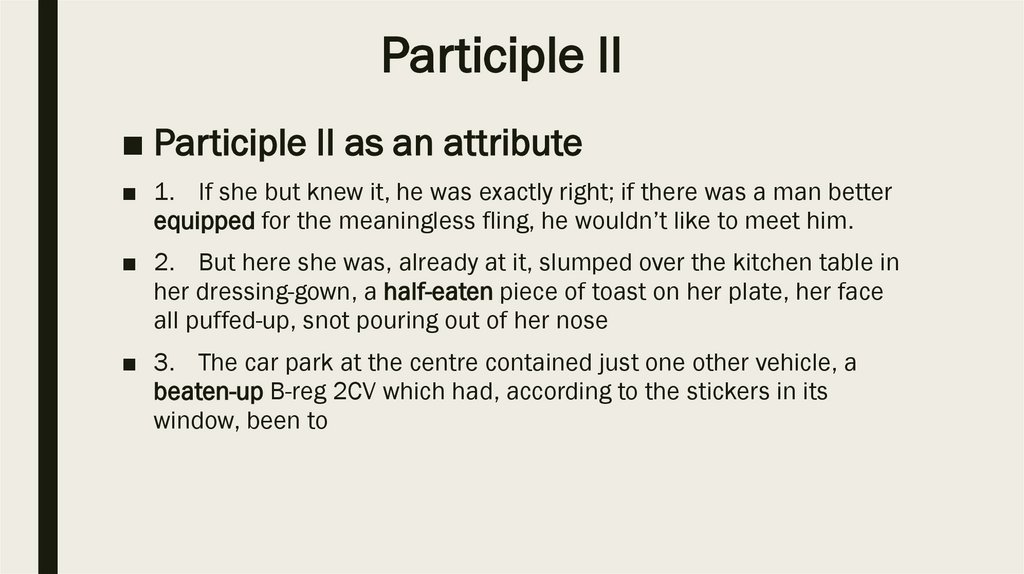
■ Participle II as an attribute■ 1. If she but knew it, he was exactly right; if there was a man better
equipped for the meaningless fling, he wouldn’t like to meet him.
■ 2. But here she was, already at it, slumped over the kitchen table in
her dressing-gown, a half-eaten piece of toast on her plate, her face
all puffed-up, snot pouring out of her nose
■ 3. The car park at the centre contained just one other vehicle, a
beaten-up B-reg 2CV which had, according to the stickers in its
window, been to
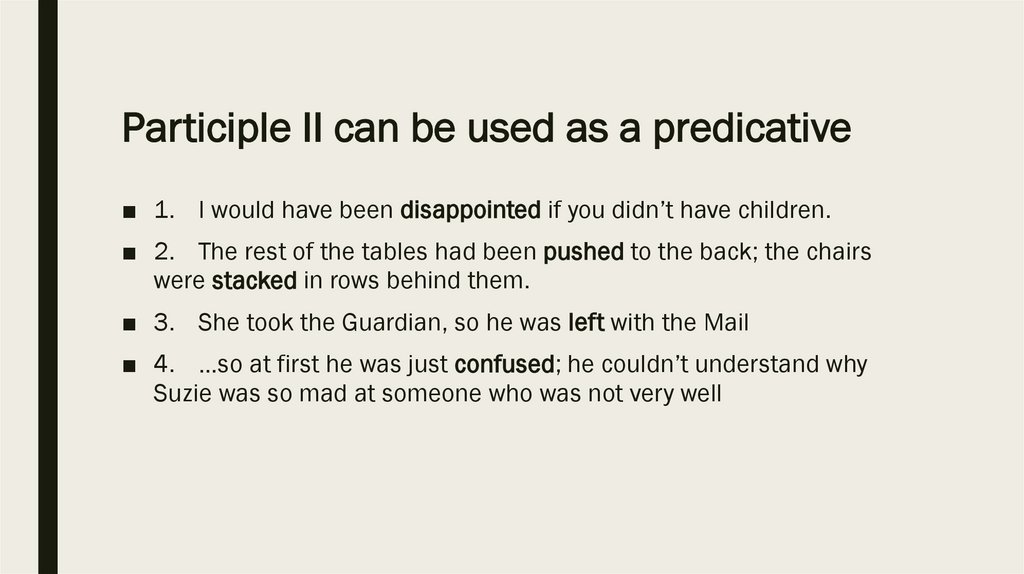
15. Participle II can be used as a predicative
■ 1. I would have been disappointed if you didn’t have children.■ 2. The rest of the tables had been pushed to the back; the chairs
were stacked in rows behind them.
■ 3. She took the Guardian, so he was left with the Mail
■ 4. …so at first he was just confused; he couldn’t understand why
Suzie was so mad at someone who was not very well
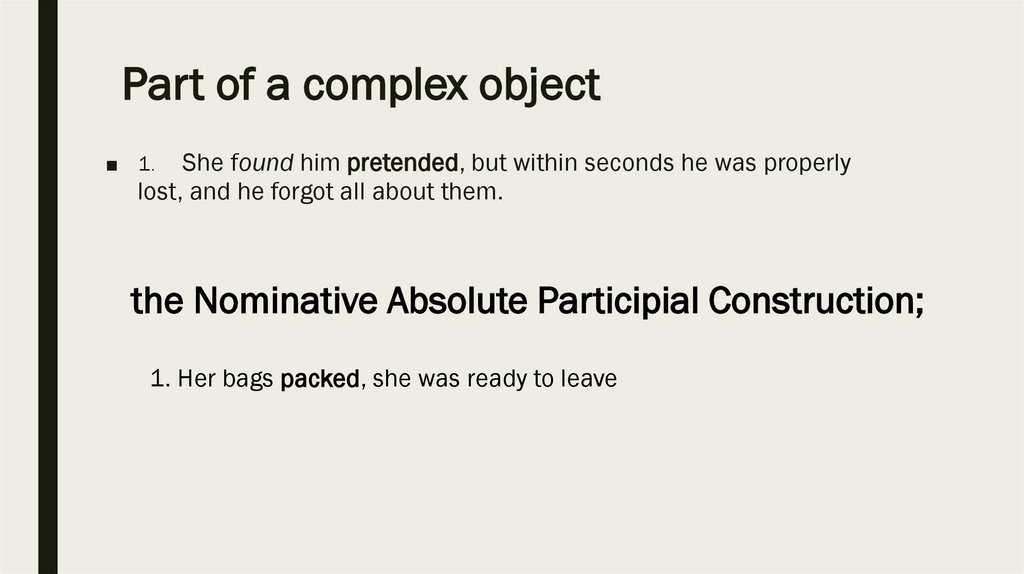
16. Part of a complex object
She found him pretended, but within seconds he was properlylost, and he forgot all about them.
■ 1.
the Nominative Absolute Participial Construction;
1. Her bags packed, she was ready to leave
17.
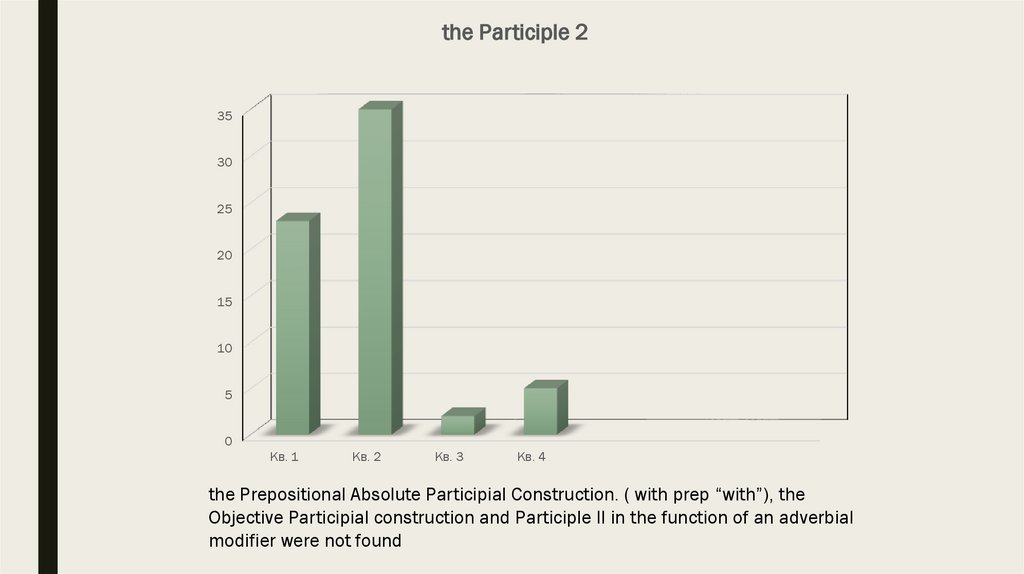
the Participle 235
30
25
20
15
10
5
0
Кв. 1
Кв. 2
Кв. 3
Кв. 4
the Prepositional Absolute Participial Construction. ( with prep “with”), the
Objective Participial construction and Participle II in the function of an adverbial
modifier were not found
18. The Gerund
■ The Gerund as a subject1. Morning crying was something new, and it was a bad, bad sign
2. Doing nothing all day gave him endless opportunities to dream and scheme
and pretend to be something he wasn’t.
3. But walking away wasn’t Will’s style
4. What got him about this was that there wasn’t even anything very shocking,
just some puke and some shouting, and he could see his mum wasn’t dead or
anything.
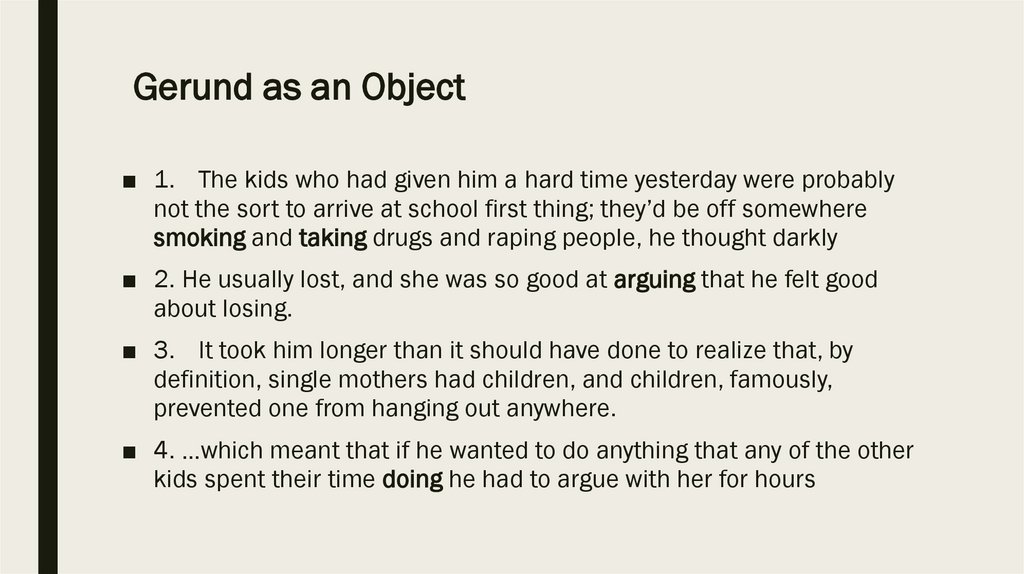
19. Gerund as an Object
■ 1. The kids who had given him a hard time yesterday were probablynot the sort to arrive at school first thing; they’d be off somewhere
smoking and taking drugs and raping people, he thought darkly
■ 2. He usually lost, and she was so good at arguing that he felt good
about losing.
■ 3. It took him longer than it should have done to realize that, by
definition, single mothers had children, and children, famously,
prevented one from hanging out anywhere.
■ 4. …which meant that if he wanted to do anything that any of the other
kids spent their time doing he had to argue with her for hours
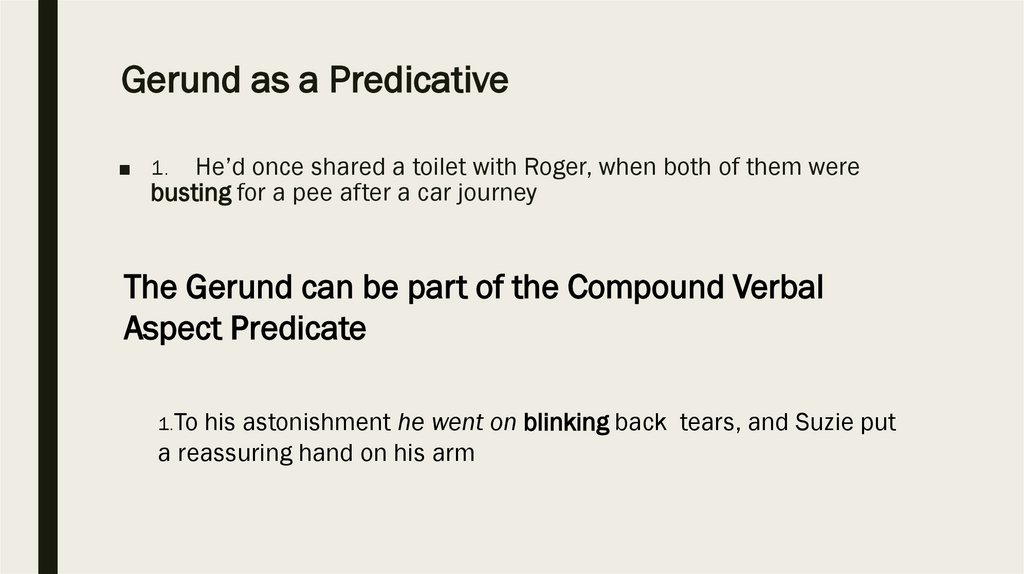
20. Gerund as a Predicative
He’d once shared a toilet with Roger, when both of them werebusting for a pee after a car journey
■ 1.
The Gerund can be part of the Compound Verbal
Aspect Predicate
1.To his astonishment he went on blinking back tears, and Suzie put
a reassuring hand on his arm
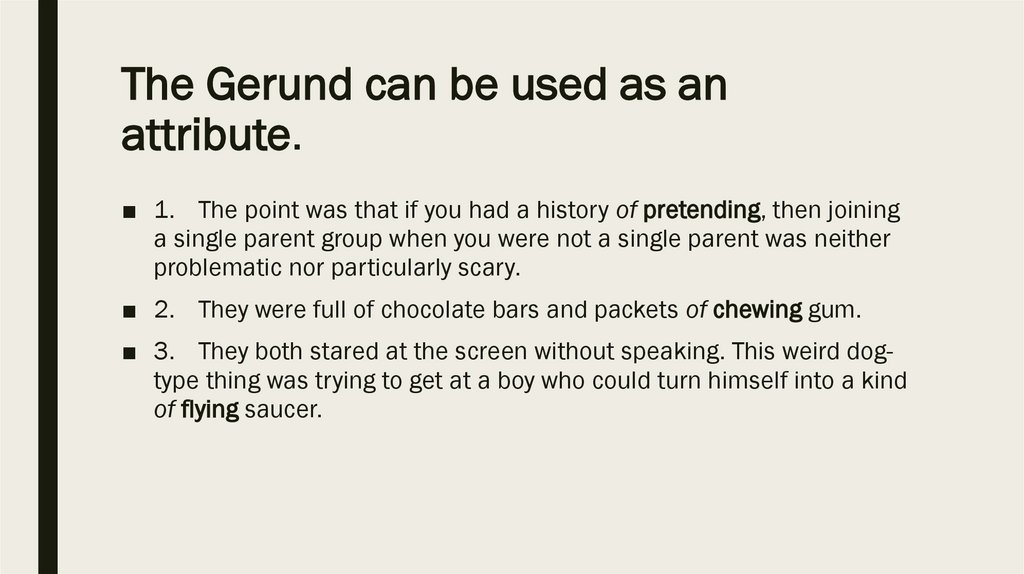
21. The Gerund can be used as an attribute.
■ 1. The point was that if you had a history of pretending, then joininga single parent group when you were not a single parent was neither
problematic nor particularly scary.
■ 2. They were full of chocolate bars and packets of chewing gum.
■ 3. They both stared at the screen without speaking. This weird dogtype thing was trying to get at a boy who could turn himself into a kind
of flying saucer.
22. The Gerund can be used as an adverbial modifier
■ 1. The twenty-year-old Will would have been surprised and perhapsdisappointed to learn that he would reach the age of thirty-six without
finding a life for himself, but the thirty-six-year-old Will wasn’t particularly
unhappy about it; there was less clutter this way." – condition
■ 2. For some years now Will had been convinced that it was possible to get
through life without having to make yourself unhappy in the way that John
and Christine were making themselves unhappy (and he was sure they were
unhappy, even if they had achieved some peculiar, brain-washed state that
prevented them from recognizing their own unhappiness)."- attend. Circm
■ 3. He knew then that there would be other women like Angie—women who
would start off by thinking that they wanted a regular fuck, and end up
deciding that a quiet life was worth any number of noisy orgasms - manner
23.
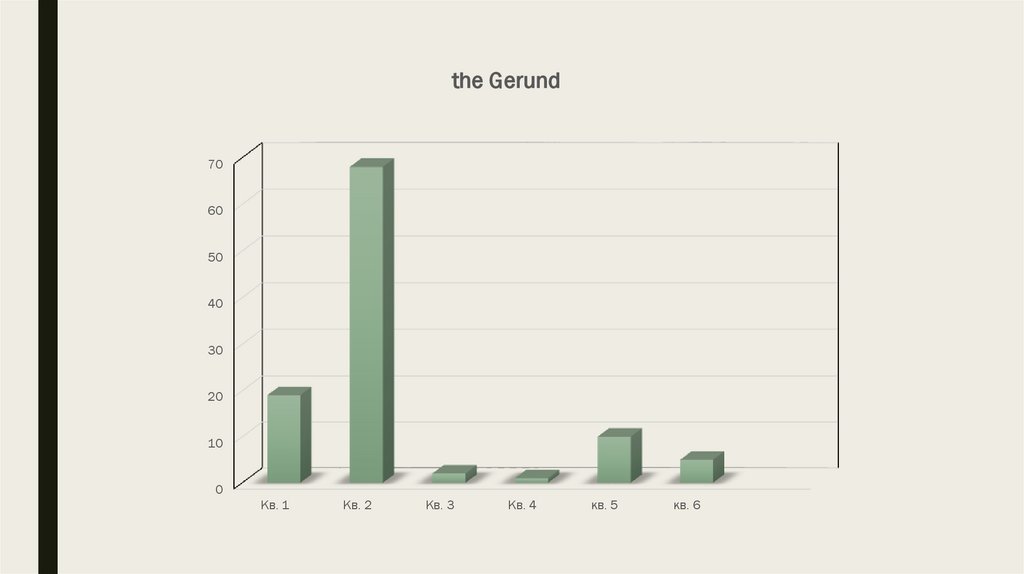
the Gerund70
60
50
40
30
20
10
0
Кв. 1
Кв. 2
Кв. 3
Кв. 4
кв. 5
кв. 6
24.
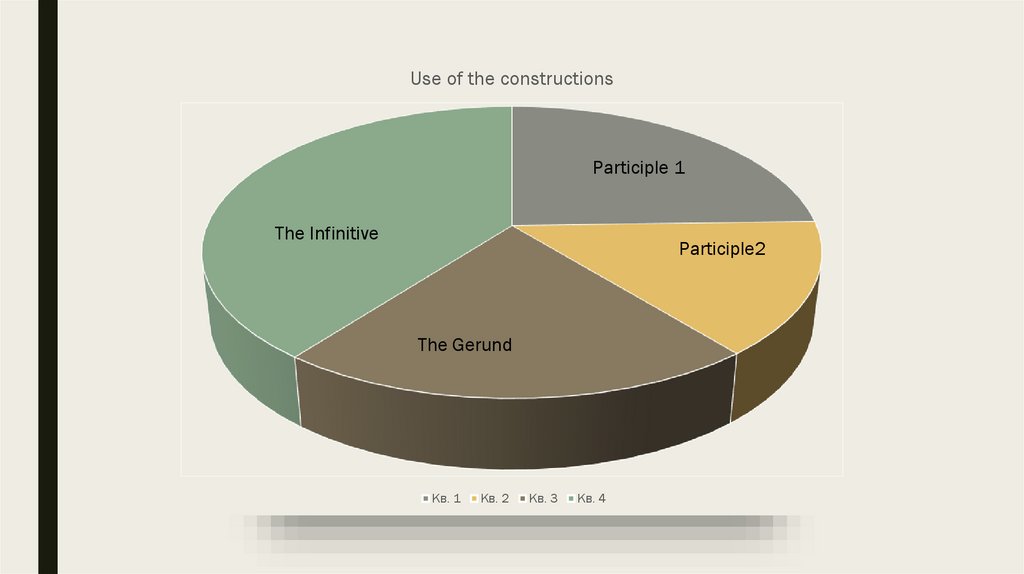
Use of the constructionsParticiple 1
The Infinitive
Participle2
The Gerund
Кв. 1
Кв. 2
Кв. 3
Кв. 4