 Английский язык
Похожие презентации:






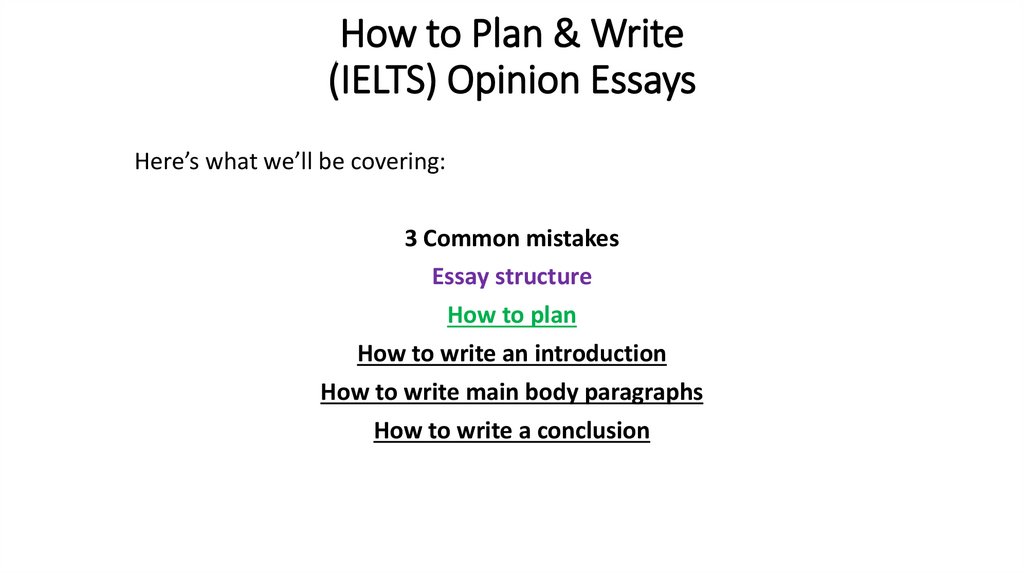
How to Plan & Write (IELTS) Opinion Essays
1. How to Plan & Write (IELTS) Opinion Essays
How to Plan & Write(IELTS) Opinion Essays
Here’s what we’ll be covering:
3 Common mistakes
Essay structure
How to plan
How to write an introduction
How to write main body paragraphs
How to write a conclusion
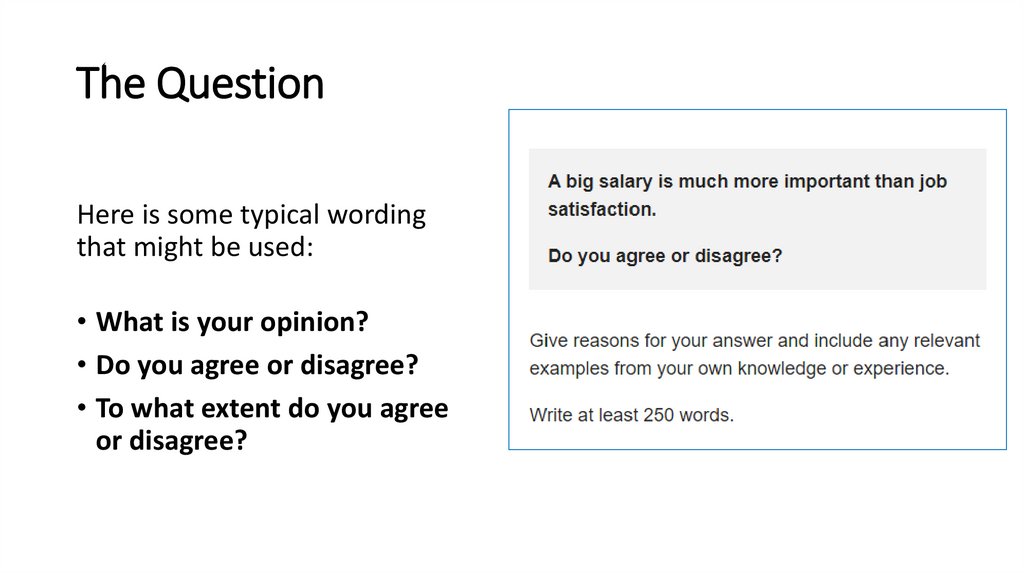
2. The Question
Here is some typical wordingthat might be used:
• What is your opinion?
• Do you agree or disagree?
• To what extent do you agree
or disagree?
3. 3 Common Mistakes
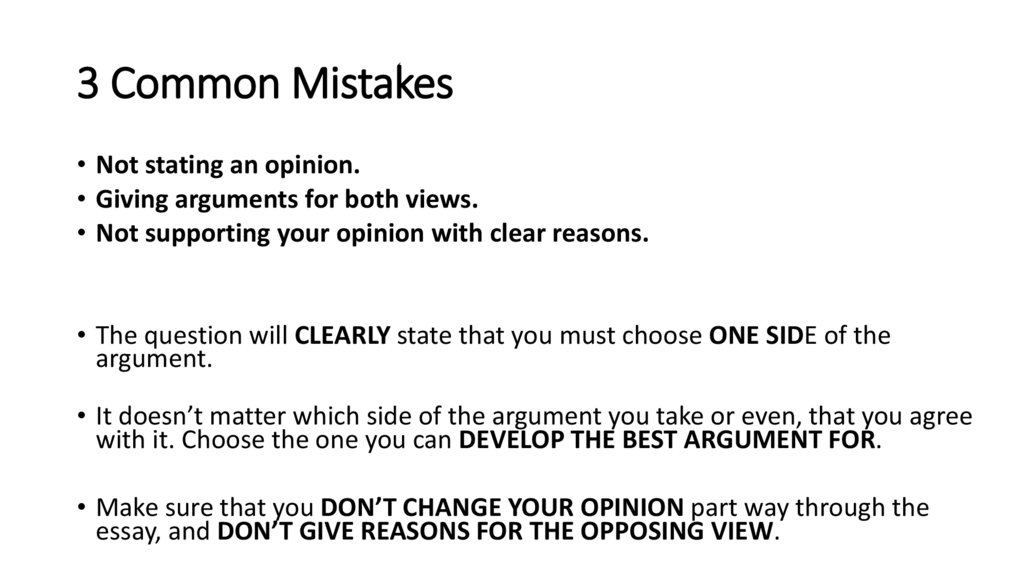
• Not stating an opinion.• Giving arguments for both views.
• Not supporting your opinion with clear reasons.
• The question will CLEARLY state that you must choose ONE SIDE of the
argument.
• It doesn’t matter which side of the argument you take or even, that you agree
with it. Choose the one you can DEVELOP THE BEST ARGUMENT FOR.
• Make sure that you DON’T CHANGE YOUR OPINION part way through the
essay, and DON’T GIVE REASONS FOR THE OPPOSING VIEW.
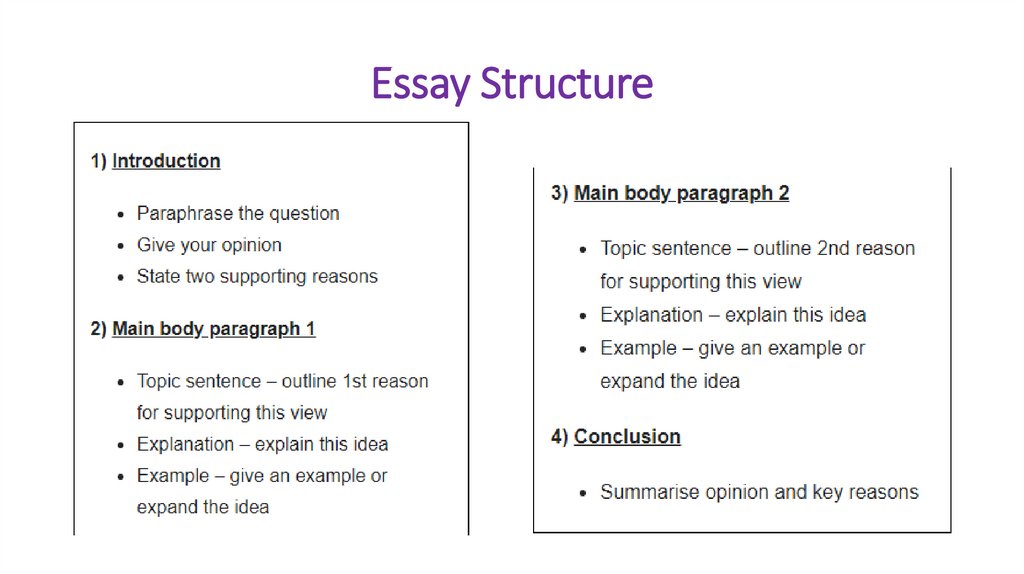
4. Essay Structure
5. How To Plan IELTS Opinion Essays
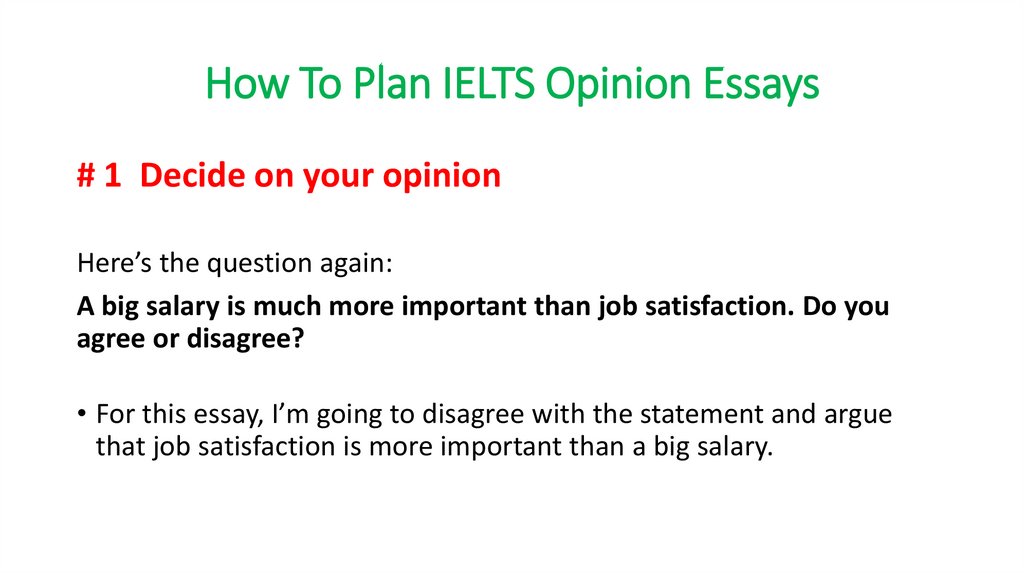
# 1 Decide on your opinionHere’s the question again:
A big salary is much more important than job satisfaction. Do you
agree or disagree?
• For this essay, I’m going to disagree with the statement and argue
that job satisfaction is more important than a big salary.
6. # 2 Generate ideas
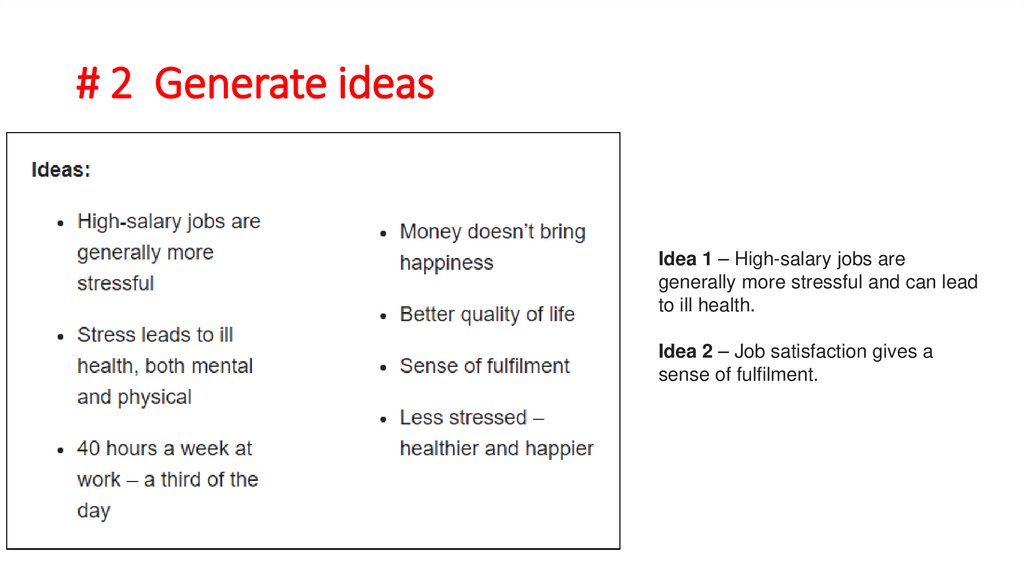
# 2 Generate ideasIdea 1 – High-salary jobs are
generally more stressful and can lead
to ill health.
Idea 2 – Job satisfaction gives a
sense of fulfilment.
7. # 3 Vocabulary
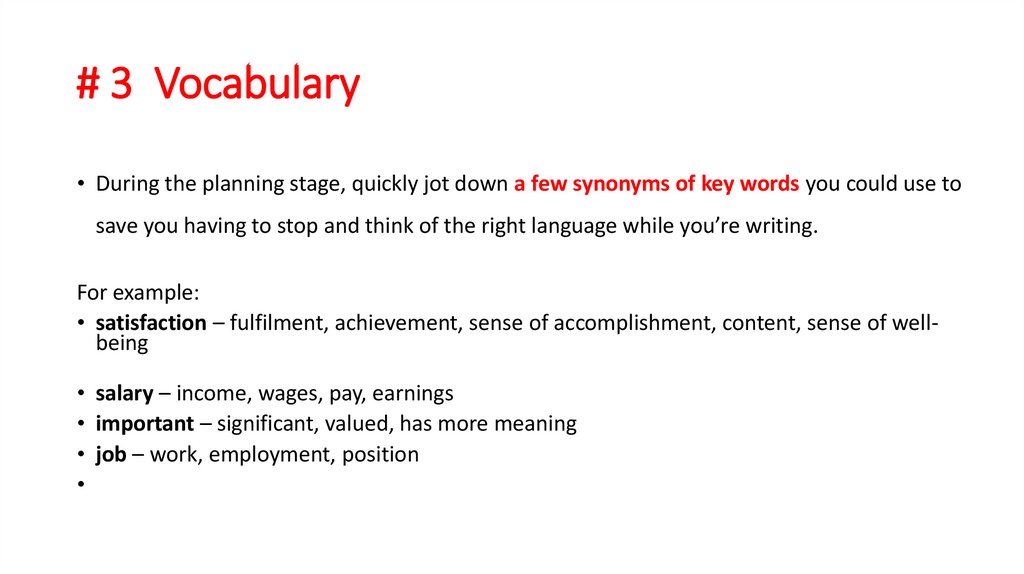
# 3 Vocabulary• During the planning stage, quickly jot down a few synonyms of key words you could use to
save you having to stop and think of the right language while you’re writing.
For example:
• satisfaction – fulfilment, achievement, sense of accomplishment, content, sense of wellbeing
• salary – income, wages, pay, earnings
• important – significant, valued, has more meaning
• job – work, employment, position
8. How To Write an Introduction
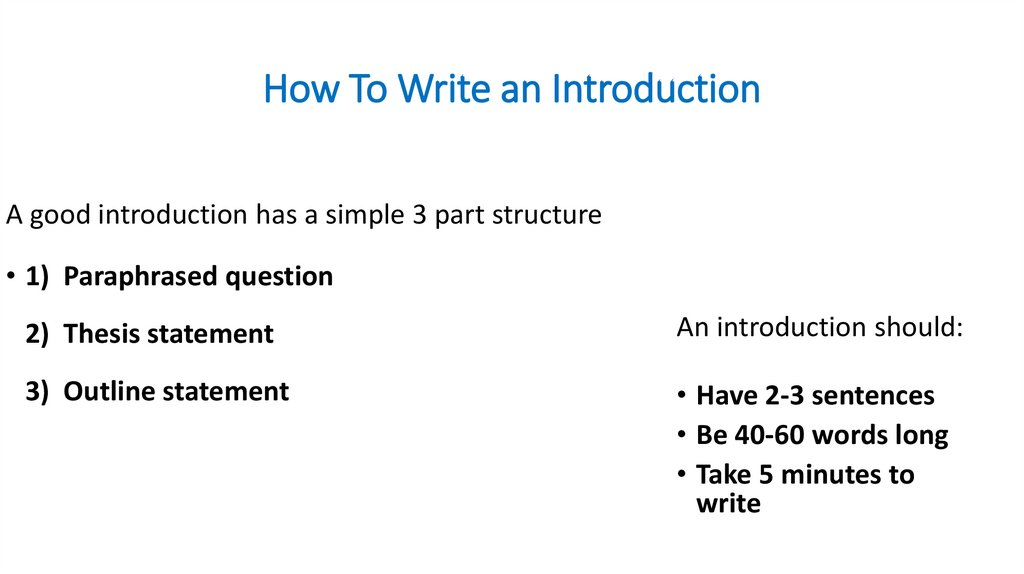
A good introduction has a simple 3 part structure• 1) Paraphrased question
2) Thesis statement
An introduction should:
3) Outline statement
• Have 2-3 sentences
• Be 40-60 words long
• Take 5 minutes to
write
9. 1) Paraphrase the question
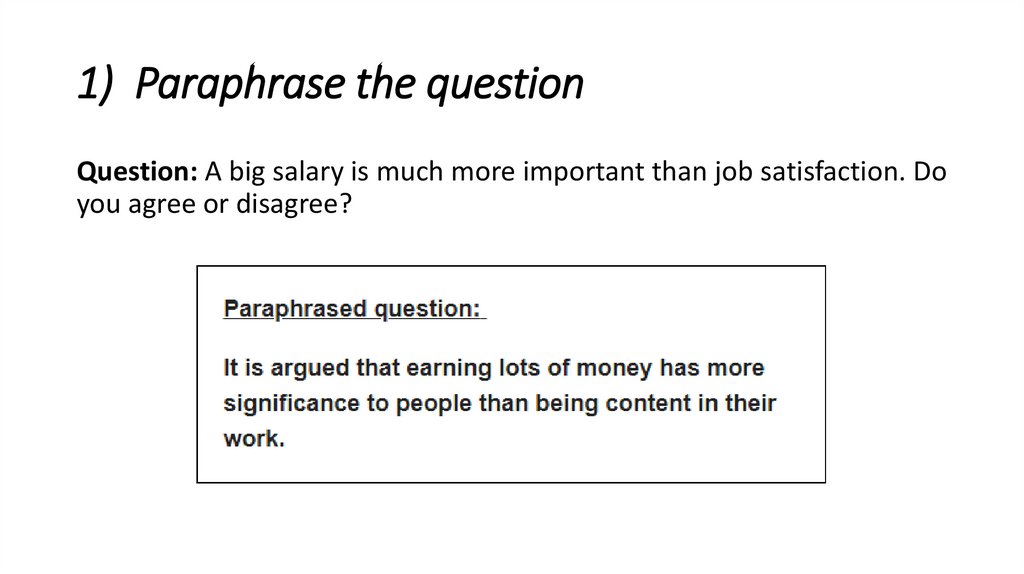
1) Paraphrase the questionQuestion: A big salary is much more important than job satisfaction. Do
you agree or disagree?
10. 2) Thesis statement
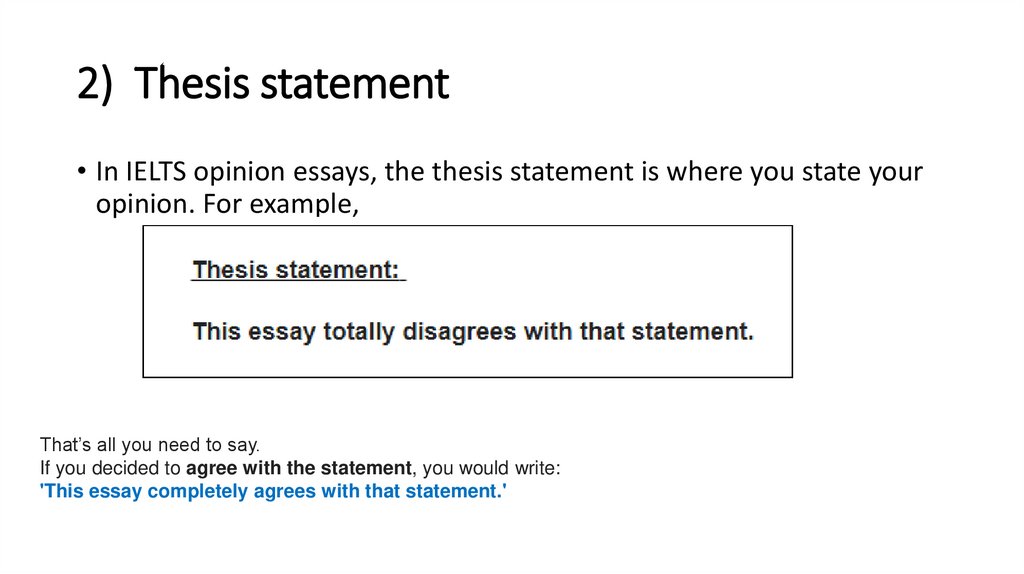
2) Thesis statement• In IELTS opinion essays, the thesis statement is where you state your
opinion. For example,
That’s all you need to say.
If you decided to agree with the statement, you would write:
'This essay completely agrees with that statement.'
11. 3) Outline statement
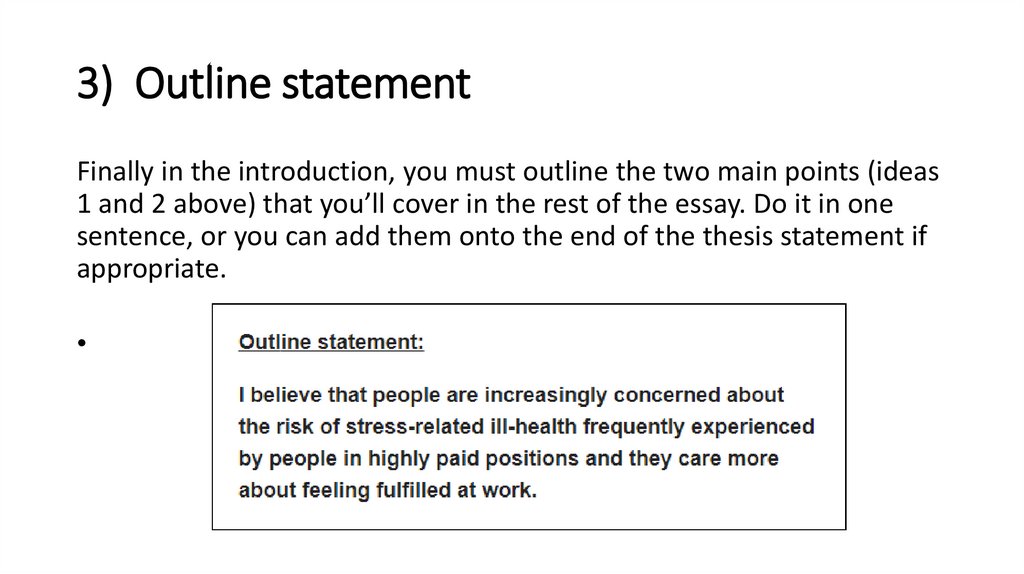
3) Outline statementFinally in the introduction, you must outline the two main points (ideas
1 and 2 above) that you’ll cover in the rest of the essay. Do it in one
sentence, or you can add them onto the end of the thesis statement if
appropriate.
12. Introduction
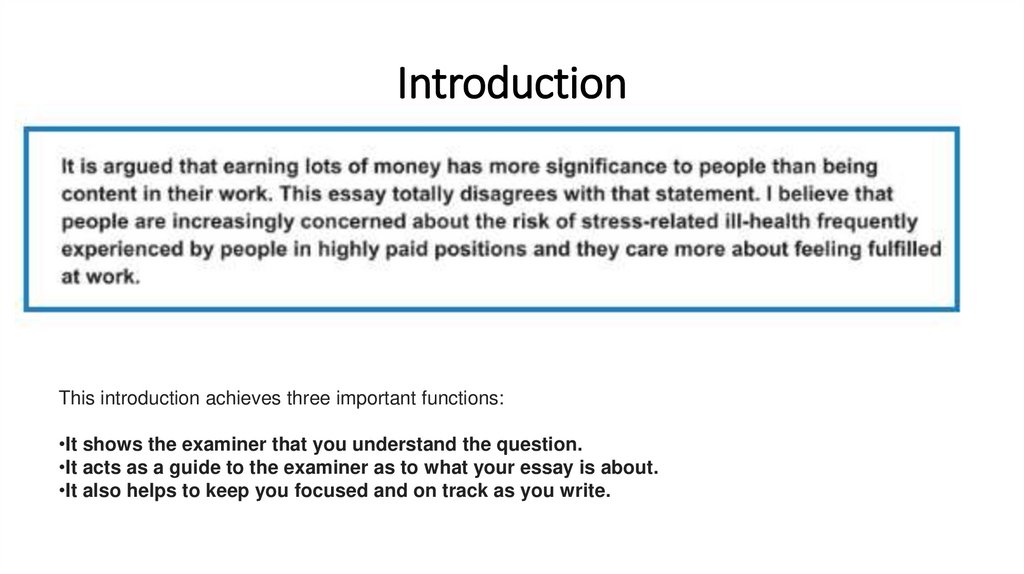
This introduction achieves three important functions:•It shows the examiner that you understand the question.
•It acts as a guide to the examiner as to what your essay is about.
•It also helps to keep you focused and on track as you write.
13. Main body
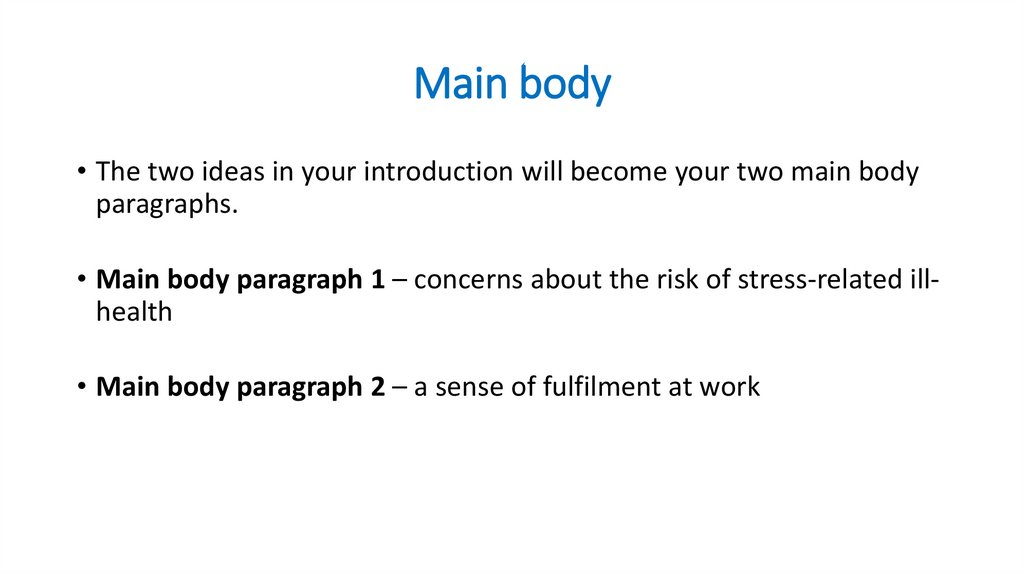
• The two ideas in your introduction will become your two main bodyparagraphs.
• Main body paragraph 1 – concerns about the risk of stress-related illhealth
• Main body paragraph 2 – a sense of fulfilment at work
14. How To Write Main Body Paragraphs
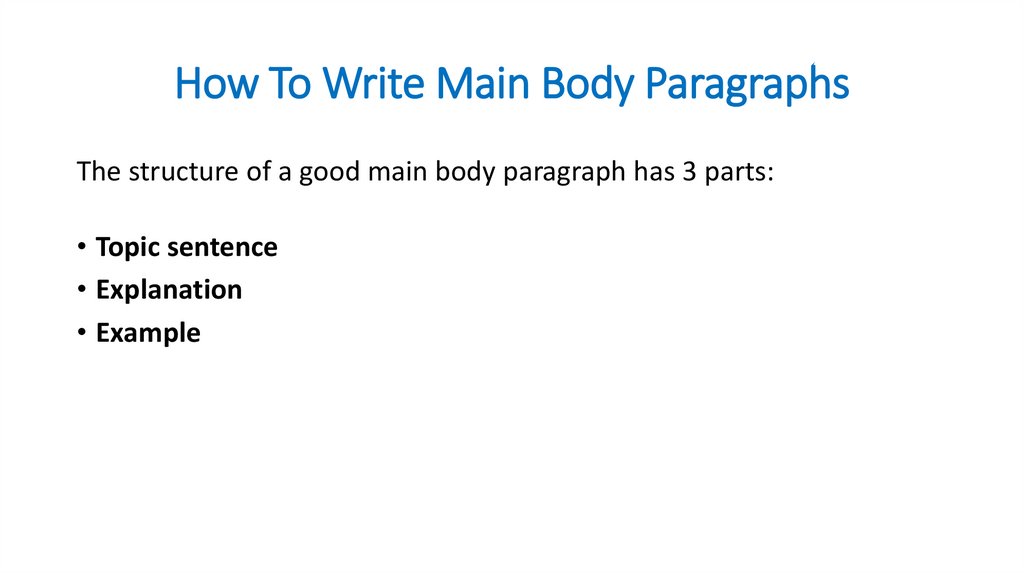
The structure of a good main body paragraph has 3 parts:• Topic sentence
• Explanation
• Example
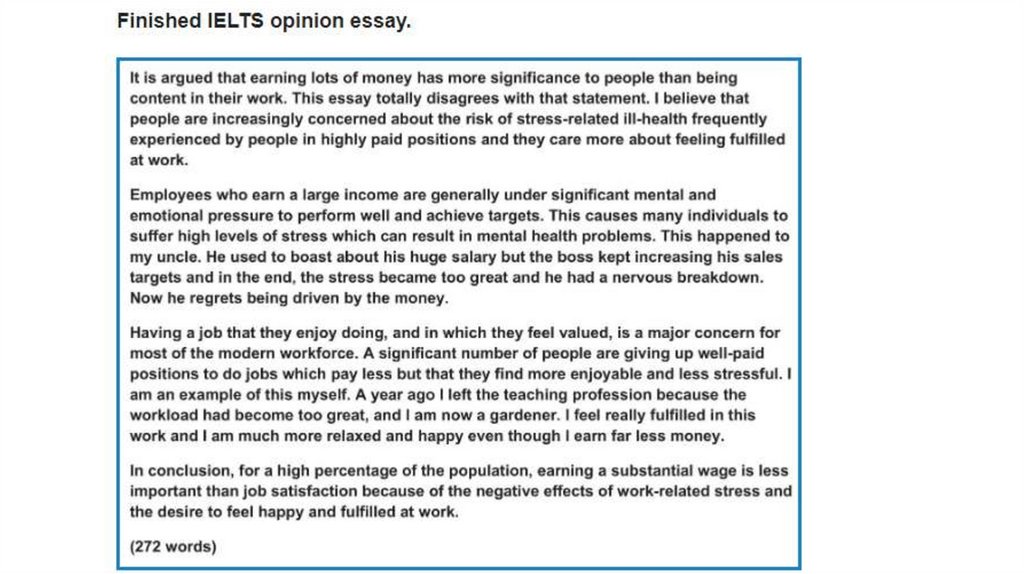
15. Main Body Paragraph 1
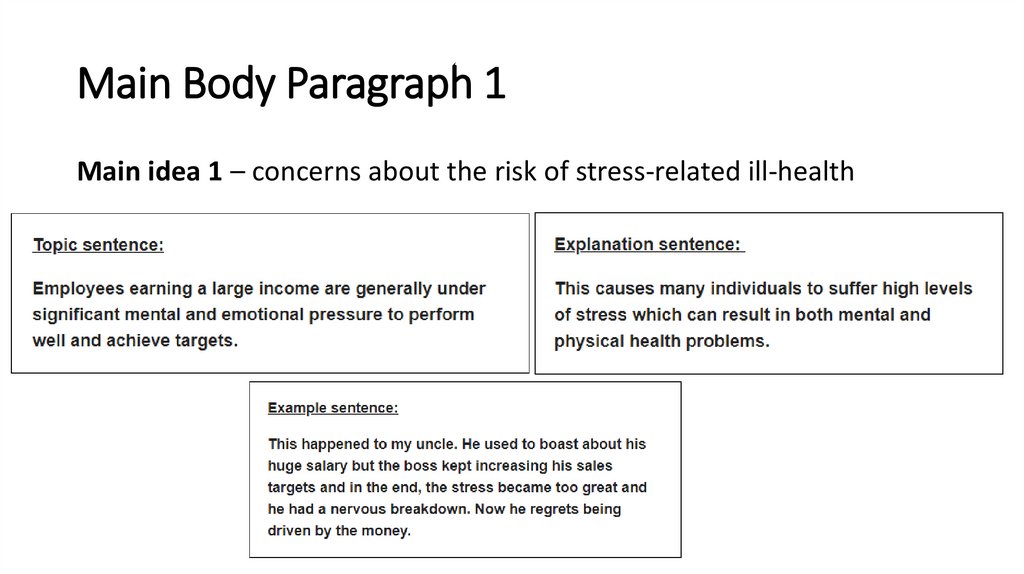
Main idea 1 – concerns about the risk of stress-related ill-health16. Main Body Paragraph 2
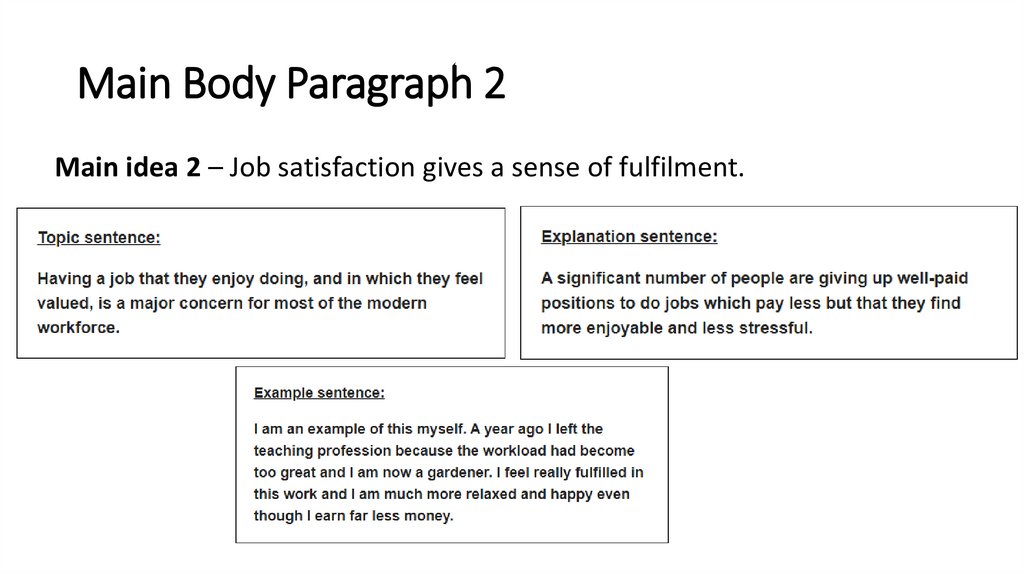
Main idea 2 – Job satisfaction gives a sense of fulfilment.17. How To Write a Conclusion
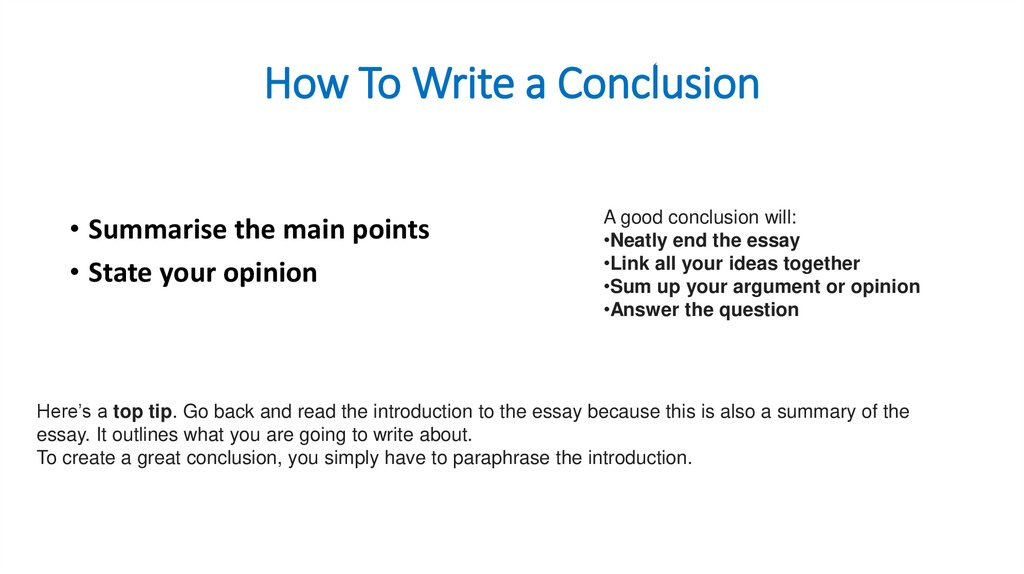
• Summarise the main points• State your opinion
A good conclusion will:
•Neatly end the essay
•Link all your ideas together
•Sum up your argument or opinion
•Answer the question
Here’s a top tip. Go back and read the introduction to the essay because this is also a summary of the
essay. It outlines what you are going to write about.
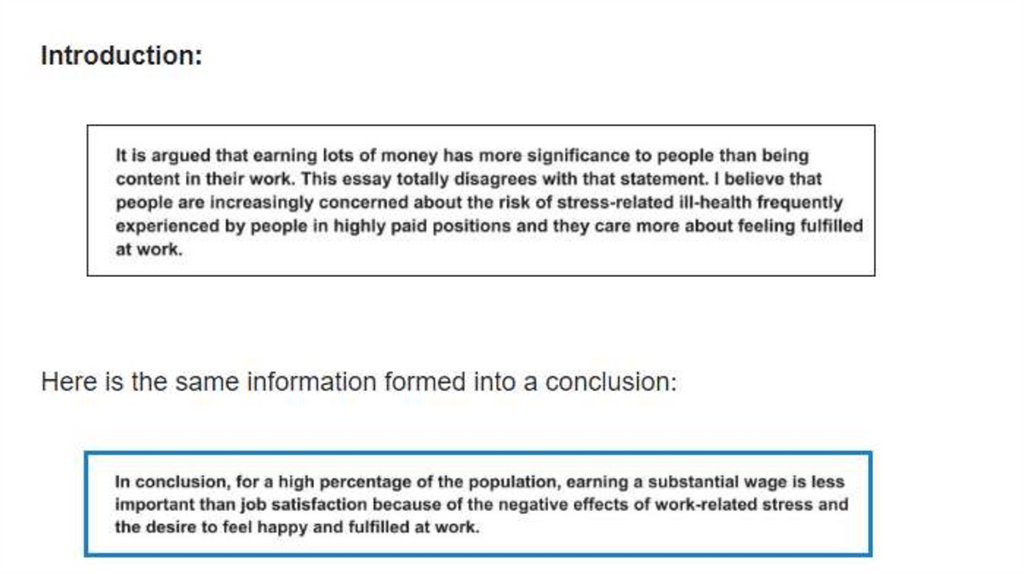
To create a great conclusion, you simply have to paraphrase the introduction.
18.
19.
20. How To Generate Ideas. 4 main techniques
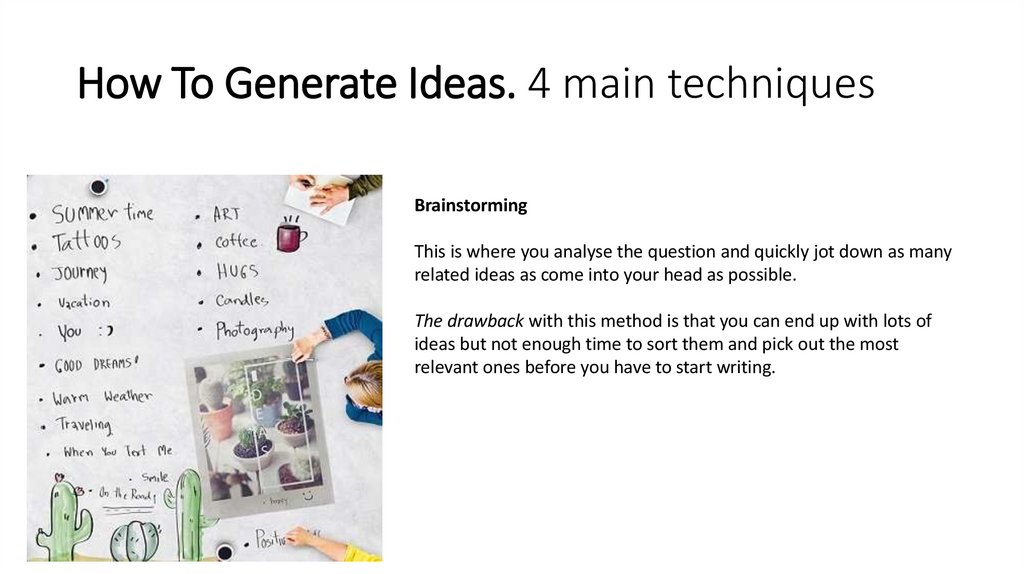
BrainstormingThis is where you analyse the question and quickly jot down as many
related ideas as come into your head as possible.
The drawback with this method is that you can end up with lots of
ideas but not enough time to sort them and pick out the most
relevant ones before you have to start writing.
21. How To Generate Ideas. 4 main techniques
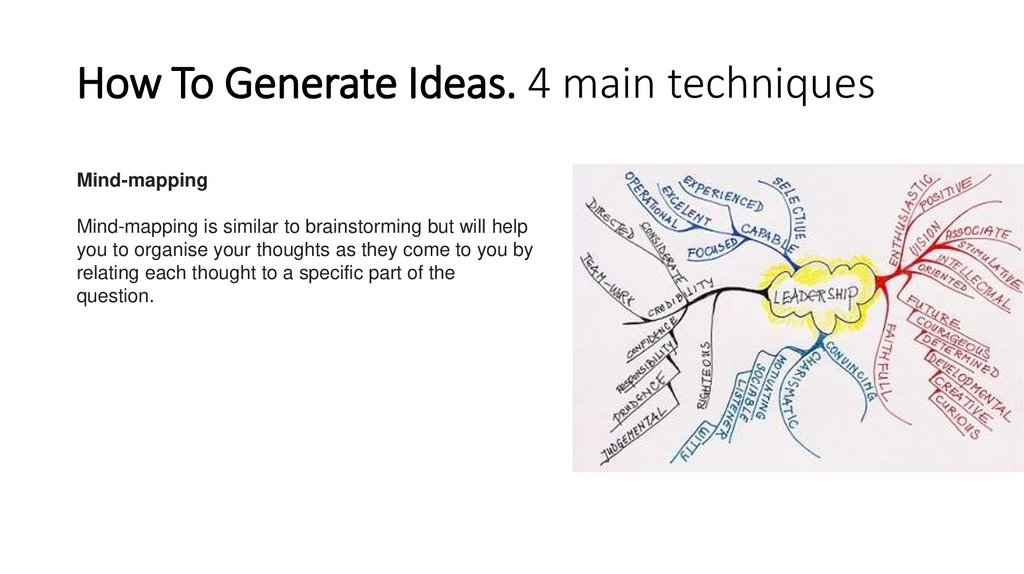
Mind-mappingMind-mapping is similar to brainstorming but will help
you to organise your thoughts as they come to you by
relating each thought to a specific part of the
question.
22. How To Generate Ideas. 4 main techniques
Friends TechniqueImagine you are chatting with a friend and they ask you the question in
a casual conversation. What answers would you give them off the top
of your head? Plan your essay around these ideas.
Doing this will help you to come up with simple answers in everyday
language rather than straining your brain to think of amazing ideas
using high level language, which isn’t necessary.
23. How To Generate Ideas. 4 main techniques
Example method• All you do is to think of SPECIFIC EXAMPLES related to the question.
These can come from your own experience or be something you’ve
read or heard about.
• You can even MAKE UP EXAMPLES or tweak real examples to better fit
the question. The examiner isn’t going to check your facts but they
must, of course, be plausible.
24. Vocabulary
Useful vocabulary/phrases to OPEN/START the essay:*Many/some people claim/opine/believe that...
Useful vocabulary/phrases to END THE
INTRODUCTION PART:
*There is no denying that...
However, I strongly believe that...
*It is often said that...
I oppose the view and my reasons will be
*These days.../ Nowadays.../ In this day and age...
explained in the following paragraphs.
*It goes without saying that...
I will support this view with arguments in the
*It is universally accepted that...
following paragraphs.
*We live in an age when many of us are...
I personally believe that...
*People are divided in their opinion regarding...
I wholeheartedly believe that this trend should
*.... is one of the most important issues...
be changed.
*Whether .... or .... is a controversial issue...
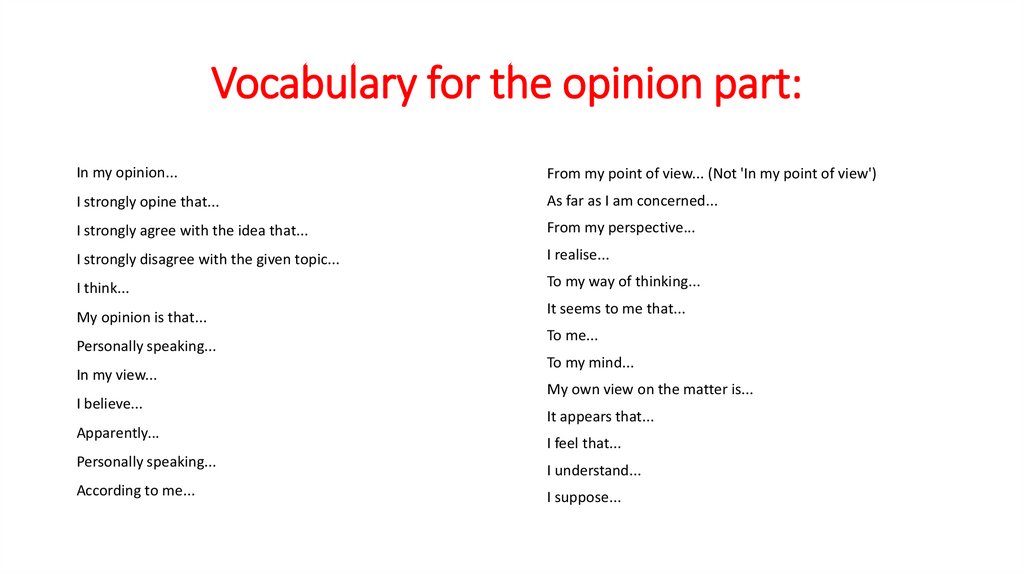
25. Vocabulary for the opinion part:
Vocabulary for the opinion part:In my opinion...
From my point of view... (Not 'In my point of view')
I strongly opine that...
As far as I am concerned...
I strongly agree with the idea that...
From my perspective...
I strongly disagree with the given topic...
I realise...
I think...
To my way of thinking...
My opinion is that...
Personally speaking...
In my view...
I believe...
Apparently...
Personally speaking...
According to me...
It seems to me that...
To me...
To my mind...
My own view on the matter is...
It appears that...
I feel that...
I understand...
I suppose...
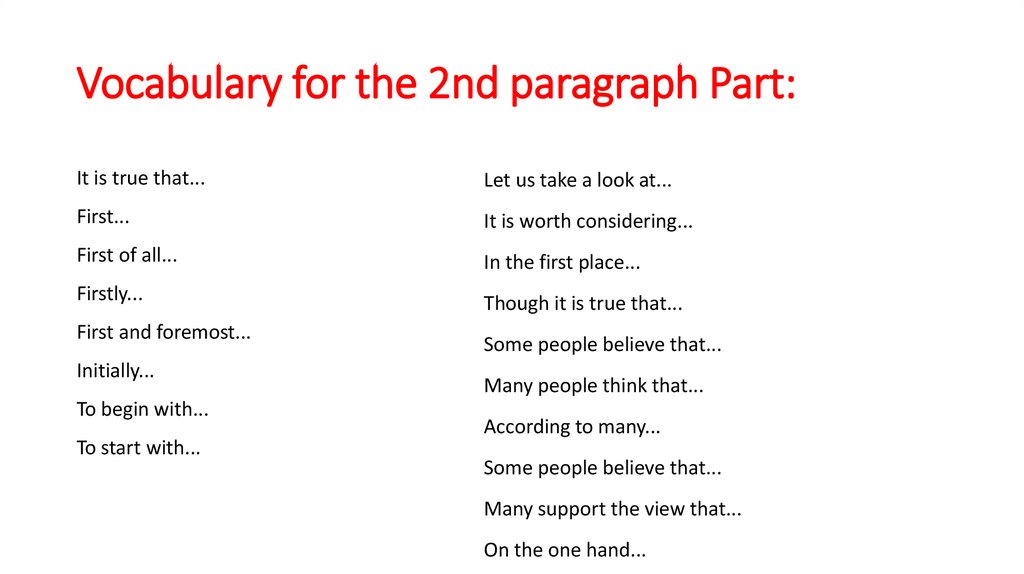
26. Vocabulary for the 2nd paragraph Part:
It is true that...Let us take a look at...
First...
It is worth considering...
First of all...
In the first place...
Firstly...
Though it is true that...
First and foremost...
Initially...
To begin with...
To start with...
Some people believe that...
Many people think that...
According to many...
Some people believe that...
Many support the view that...
On the one hand...
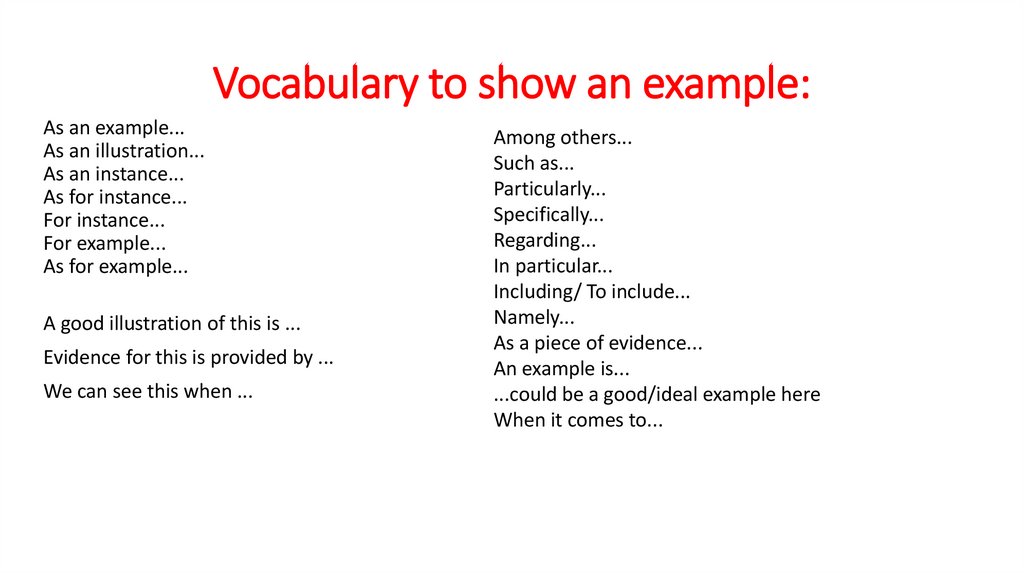
27. Vocabulary to show an example:
As an example...As an illustration...
As an instance...
As for instance...
For instance...
For example...
As for example...
A good illustration of this is ...
Evidence for this is provided by ...
We can see this when ...
Among others...
Such as...
Particularly...
Specifically...
Regarding...
In particular...
Including/ To include...
Namely...
As a piece of evidence...
An example is...
...could be a good/ideal example here
When it comes to...
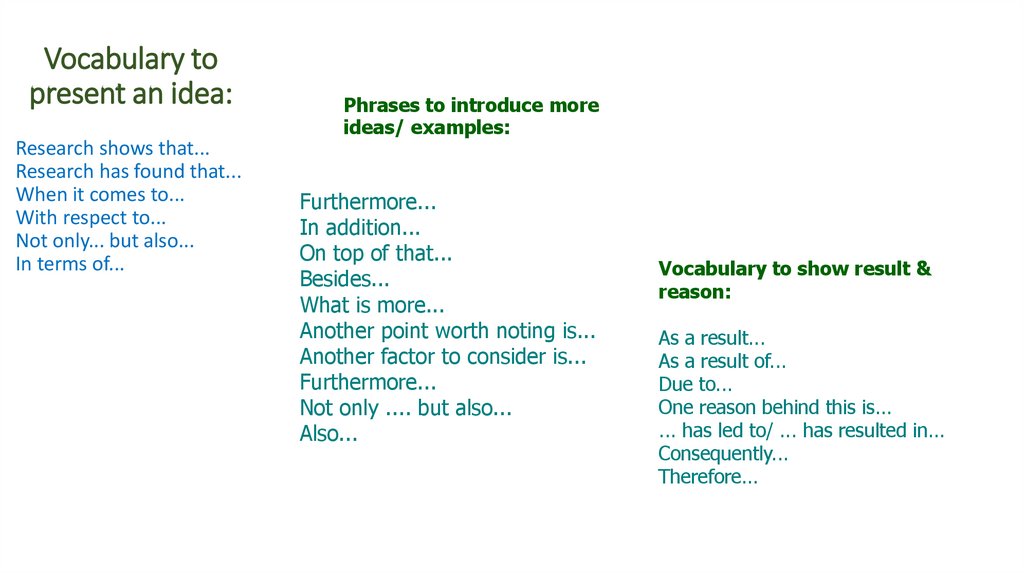
28. Vocabulary to present an idea:
Research shows that...Research has found that...
When it comes to...
With respect to...
Not only... but also...
In terms of...
Phrases to introduce more
ideas/ examples:
Furthermore...
In addition...
On top of that...
Besides...
What is more...
Another point worth noting is...
Another factor to consider is...
Furthermore...
Not only .... but also...
Also...
Vocabulary to show result &
reason:
As a result...
As a result of...
Due to...
One reason behind this is...
... has led to/ ... has resulted in...
Consequently...
Therefore...
29.
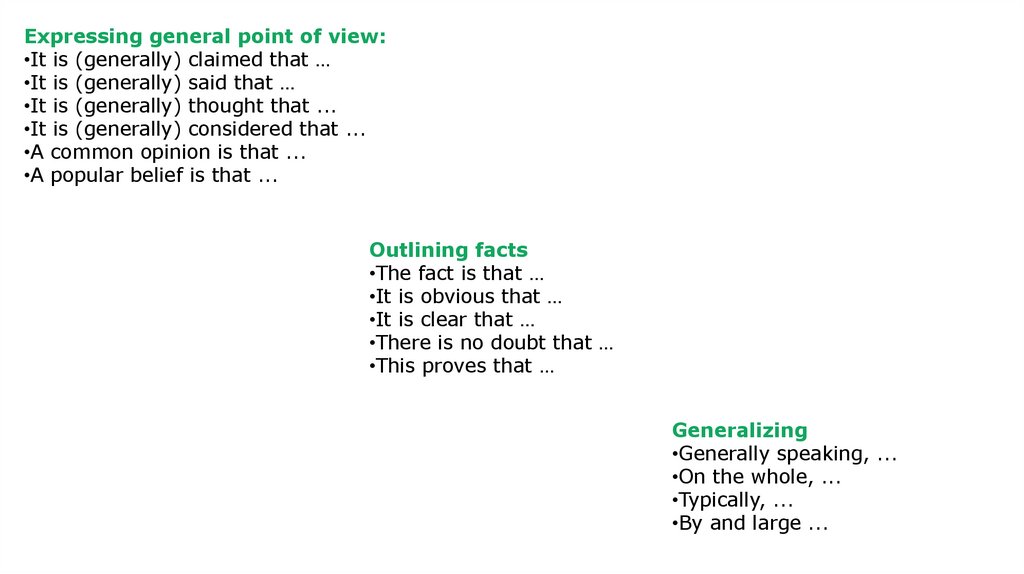
Expressing general point of view:•It is (generally) claimed that …
•It is (generally) said that …
•It is (generally) thought that ...
•It is (generally) considered that ...
•A common opinion is that ...
•A popular belief is that ...
Outlining facts
•The fact is that …
•It is obvious that …
•It is clear that …
•There is no doubt that …
•This proves that …
Generalizing
•Generally speaking, ...
•On the whole, ...
•Typically, ...
•By and large ...
30. Vocabulary for the conclusion part:
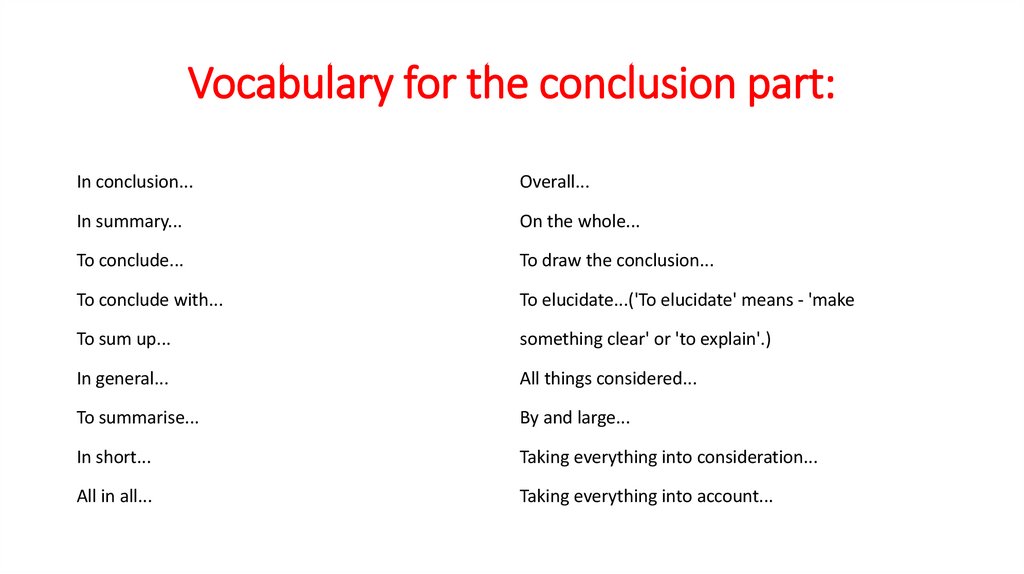
In conclusion...Overall...
In summary...
On the whole...
To conclude...
To draw the conclusion...
To conclude with...
To elucidate...('To elucidate' means - 'make
To sum up...
something clear' or 'to explain'.)
In general...
All things considered...
To summarise...
By and large...
In short...
Taking everything into consideration...
All in all...
Taking everything into account...