
 Английский язык
Похожие презентации:






Starter Speaking Writing
1.
2.
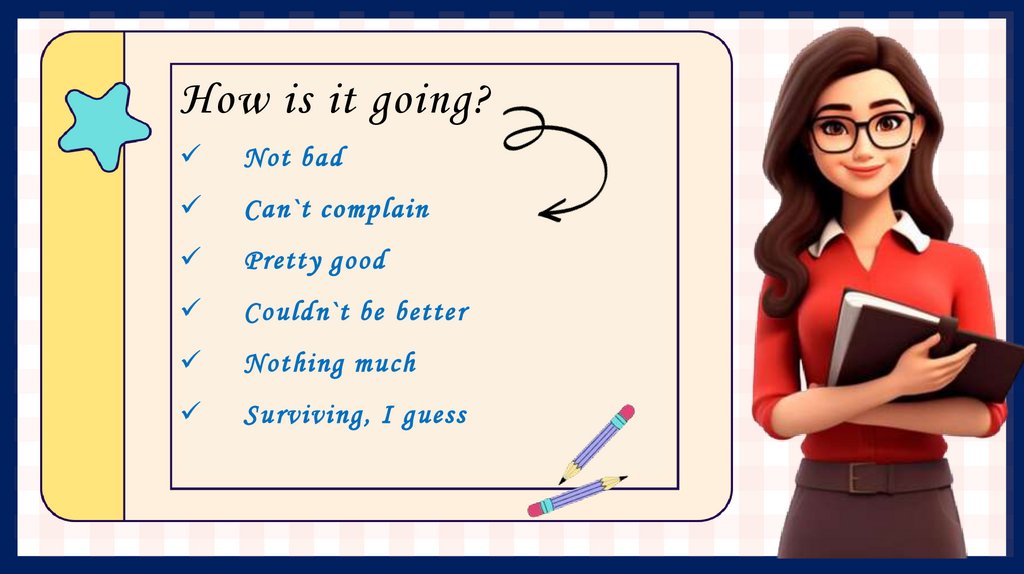
How is it going?Not bad
Can`t complain
Pretty good
Couldn`t be better
Nothing much
Surviving, I guess
3.
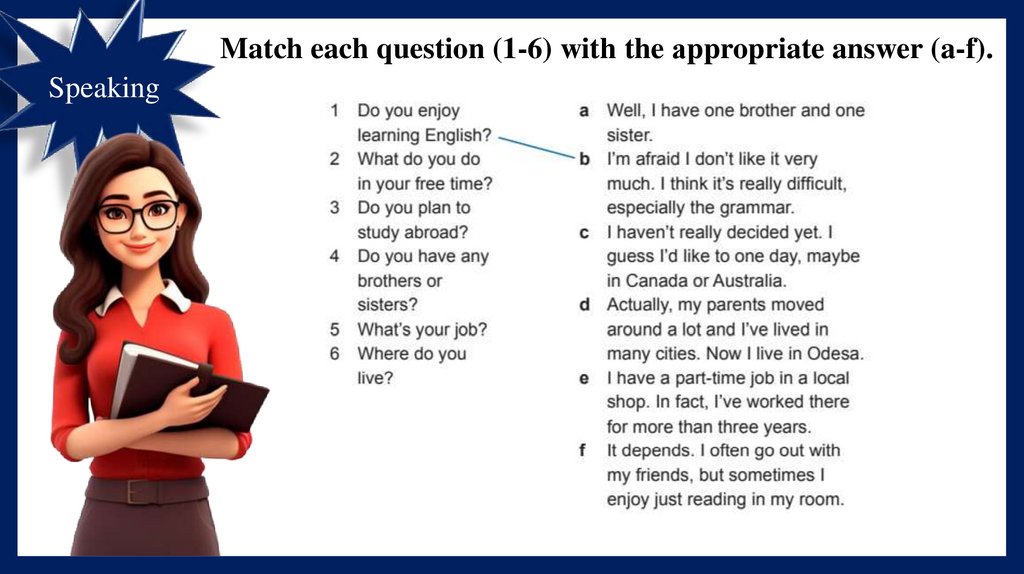
Match each question (1-6) with the аppropriate answer (a-f).Speaking
4.
Usefullanguage
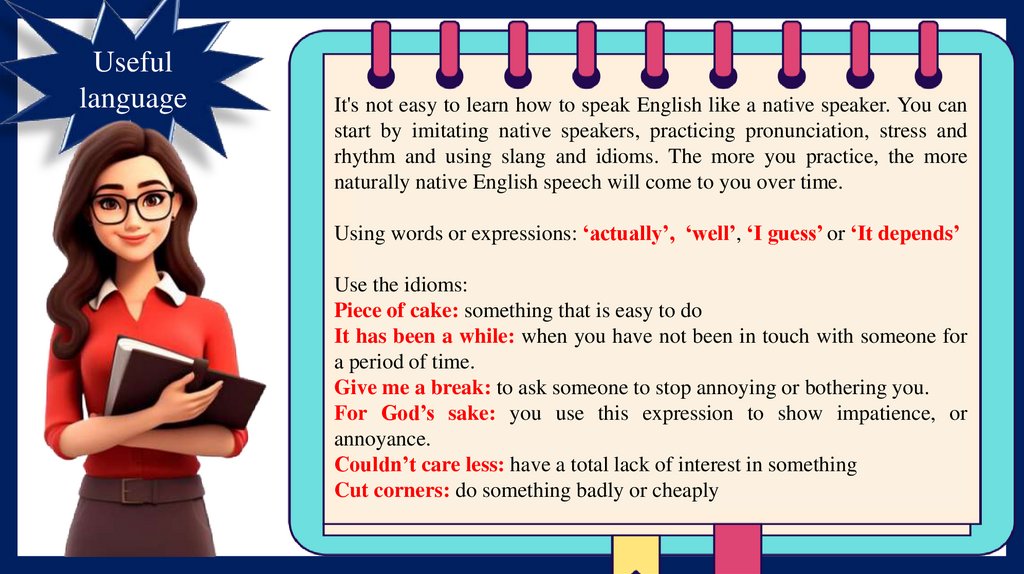
It's not easy to learn how to speak English like a native speaker. You can
start by imitating native speakers, practicing pronunciation, stress and
rhythm and using slang and idioms. The more you practice, the more
naturally native English speech will come to you over time.
Using words or expressions: ‘actually’, ‘well’, ‘I guess’ or ‘It depends’
Use the idioms:
Piece of cake: something that is easy to do
It has been a while: when you have not been in touch with someone for
a period of time.
Give me a break: to ask someone to stop annoying or bothering you.
For God’s sake: you use this expression to show impatience, or
annoyance.
Couldn’t care less: have a total lack of interest in something
Cut corners: do something badly or cheaply
5.
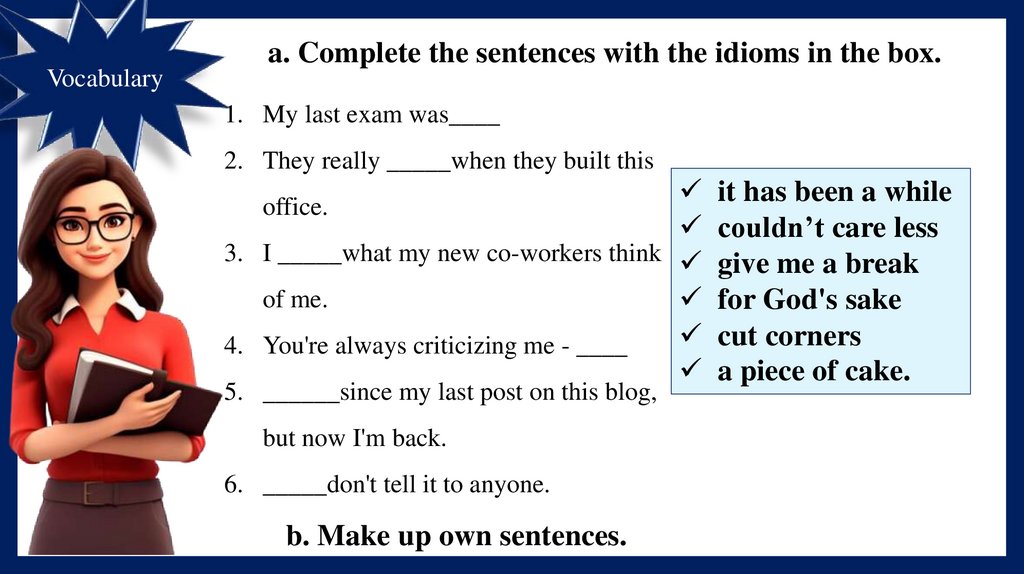
a. Complete the sentences with the idioms in the box.Vocabulary
1. My last exam was____
2. They really _____when they built this
it has been a while
couldn’t care less
3. I _____what my new co-workers think give me a break
of me.
for God's sake
cut corners
4. You're always criticizing me - ____
a piece of cake.
office.
5. ______since my last post on this blog,
but now I'm back.
6. _____don't tell it to anyone.
b. Make up own sentences.
6.
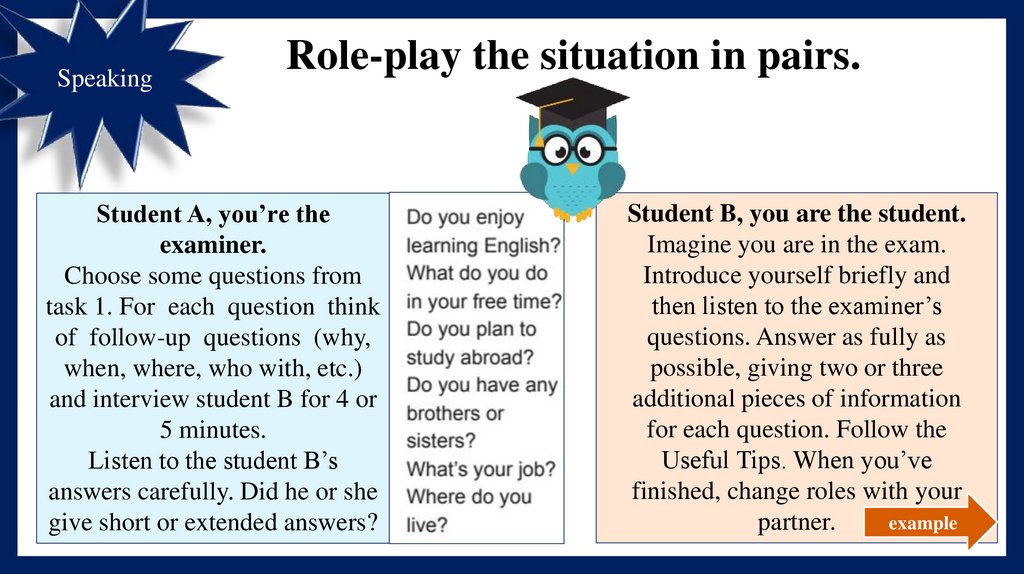
SpeakingRole-play the situation in pairs.
Student A, you’re the
examiner.
Choose some questions from
task 1. For each question think
of follow-up questions (why,
when, where, who with, etc.)
and interview student B for 4 or
5 minutes.
Listen to the student B’s
answers carefully. Did he or she
give short or extended answers?
Student B, you are the student.
Imagine you are in the exam.
Introduce yourself briefly and
then listen to the examiner’s
questions. Answer as fully as
possible, giving two or three
additional pieces of information
for each question. Follow the
Useful Tips. When you’ve
finished, change roles with your
example
partner.
7.
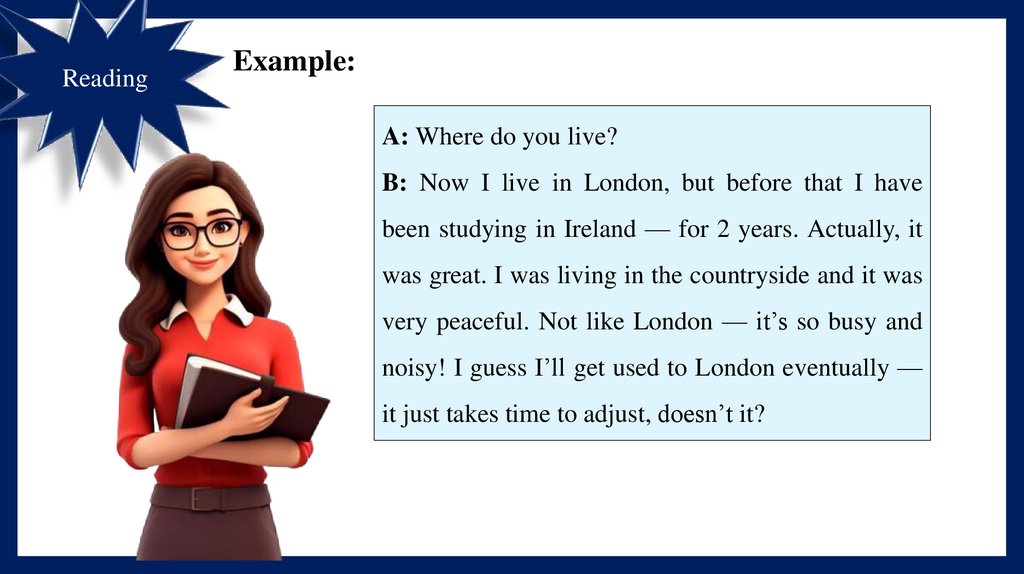
ReadingExample:
A: Where do you live?
B: Now I live in London, but before that I have
been studying in Ireland — for 2 years. Actually, it
was great. I was living in the countryside and it was
very peaceful. Not like London — it’s so busy and
noisy! I guess I’ll get used to London eventually —
it just takes time to adjust, doesn’t it?
8.
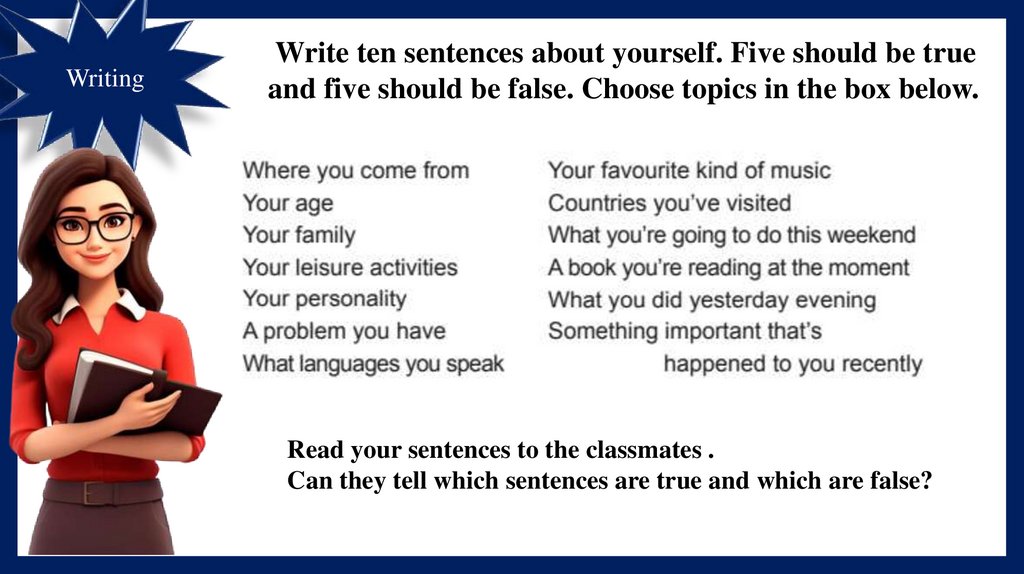
WritingWrite ten sentences about yourself. Five should be true
and five should be false. Choose topics in the box below.
Read your sentences to the classmates .
Can they tell which sentences are true and which are false?
9.
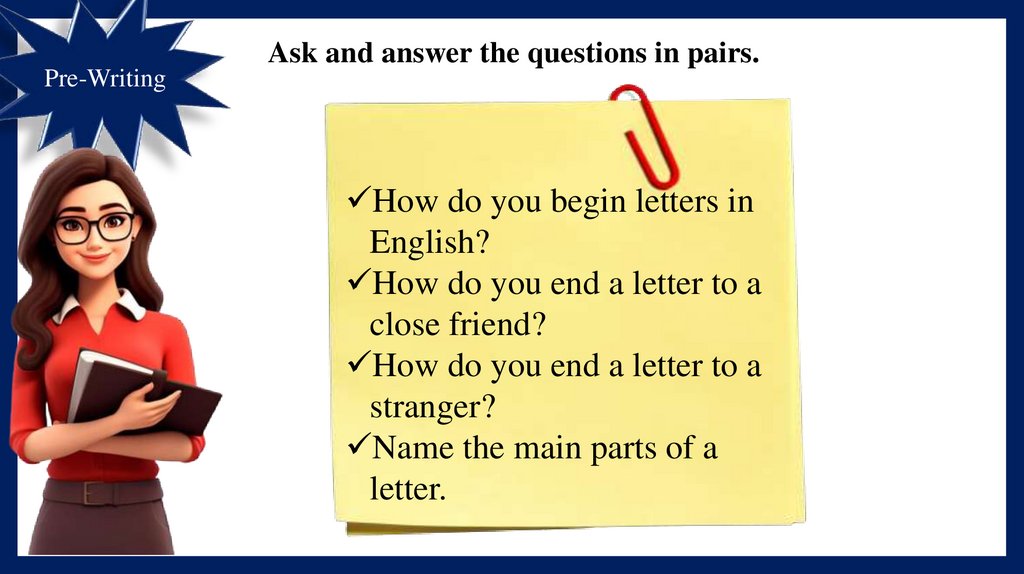
Ask and answer the questions in pairs.Pre-Writing
How do you begin letters in
English?
How do you end a letter to a
close friend?
How do you end a letter to a
stranger?
Name the main parts of a
letter.
10.
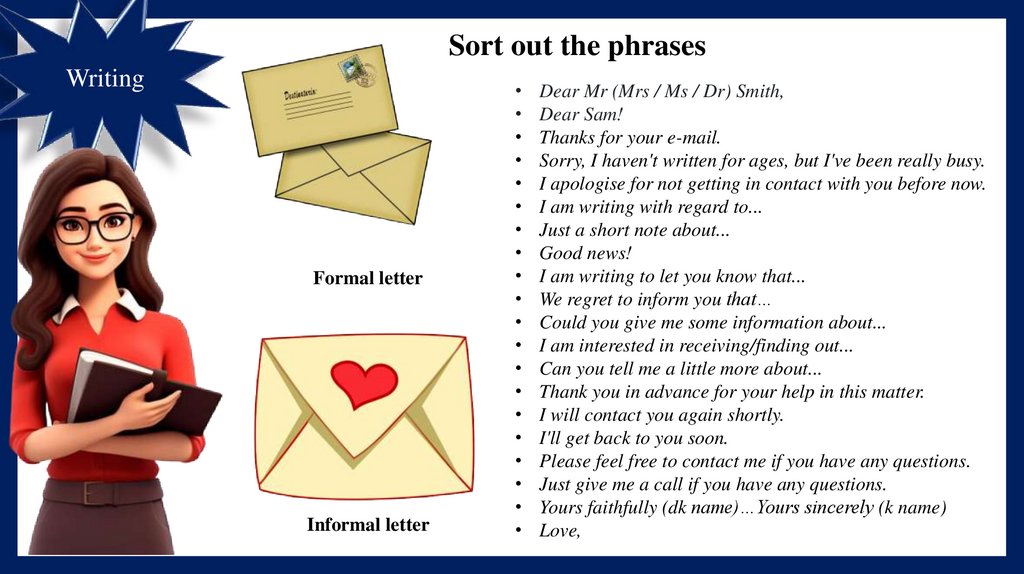
Sort out the phrasesWriting
Formal letter
Informal letter
Dear Mr (Mrs / Ms / Dr) Smith,
Dear Sam!
Thanks for your e-mail.
Sorry, I haven't written for ages, but I've been really busy.
I apologise for not getting in contact with you before now.
I am writing with regard to...
Just a short note about...
Good news!
I am writing to let you know that...
We regret to inform you that…
Could you give me some information about...
I am interested in receiving/finding out...
Can you tell me a little more about...
Thank you in advance for your help in this matter.
I will contact you again shortly.
I'll get back to you soon.
Please feel free to contact me if you have any questions.
Just give me a call if you have any questions.
Yours faithfully (dk name)…Yours sincerely (k name)
Love,
11.
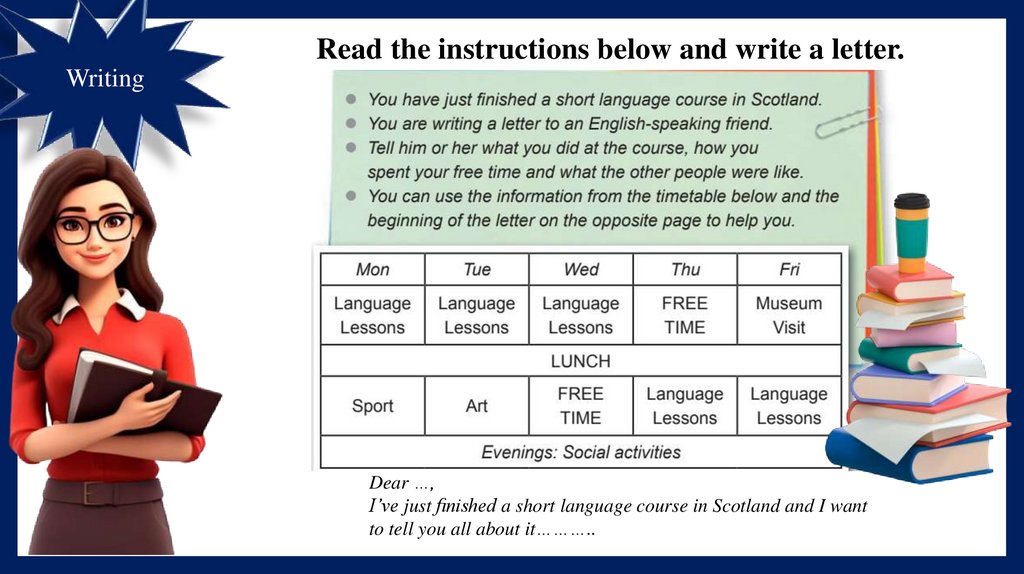
Read the instructions below and write a letter.Writing
Dear …,
I’ve just nished a short language course in Scotland and I want
to tell you all about it………..
12.
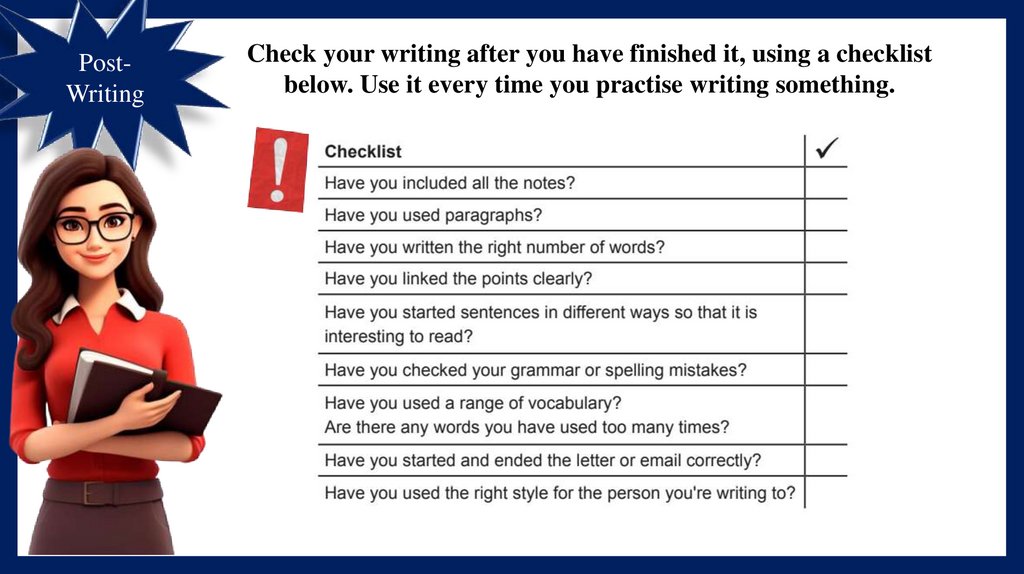
PostWritingCheck your writing after you have finished it, using a checklist
below. Use it every time you practise writing something.
13.
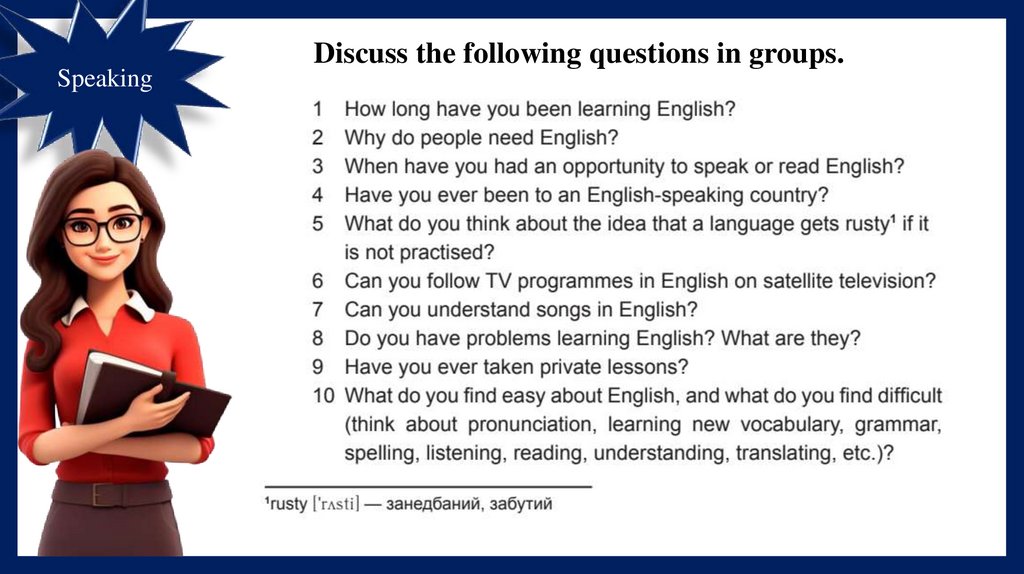
SpeakingDiscuss the following questions in groups.
14.
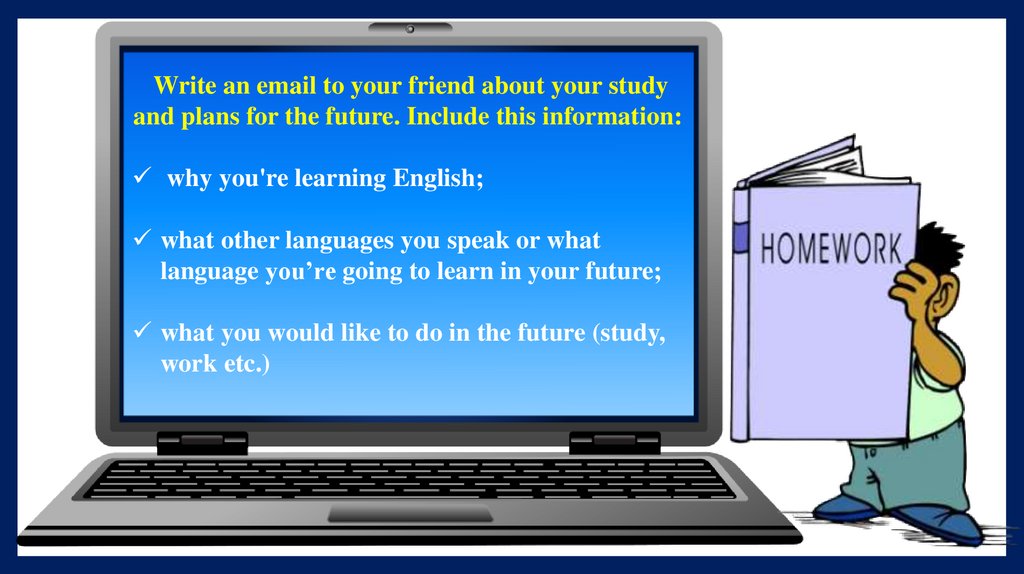
Write an email to your friend about your studyand plans for the future. Include this information:
why you're learning English;
what other languages you speak or what
language you’re going to learn in your future;
what you would like to do in the future (study,
work etc.)
15.
Take careHave a
good one