 Английский язык
Похожие презентации:








Simple Tenses
1.
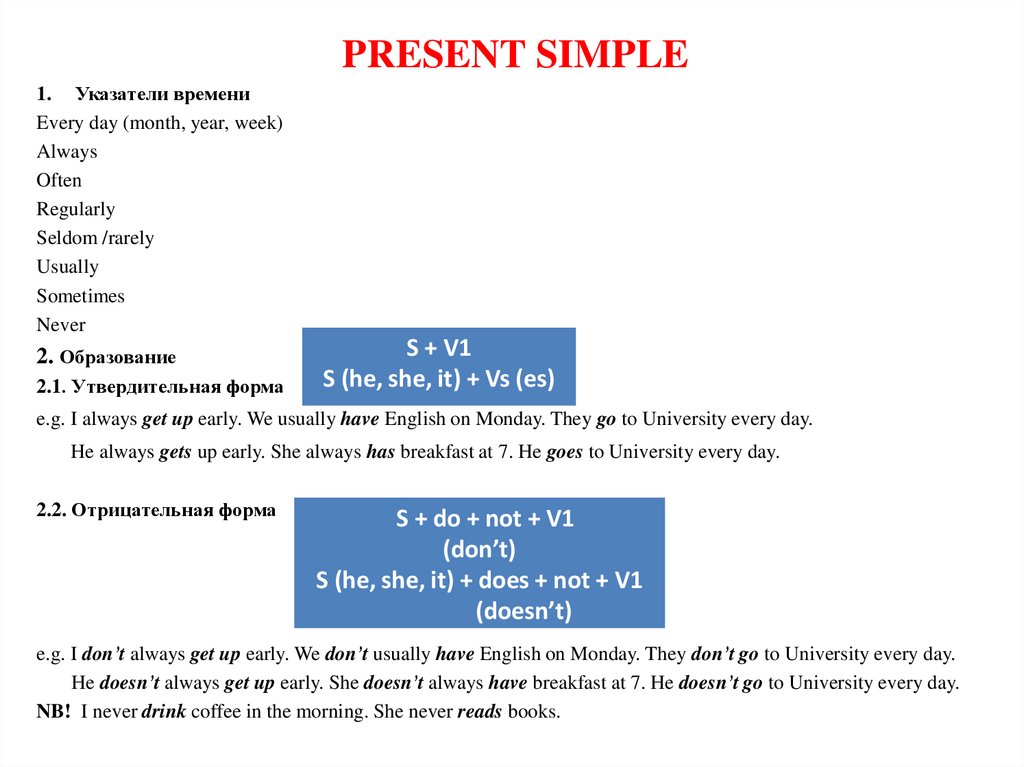
2. PRESENT SIMPLE
1. Указатели времениEvery day (month, year, week)
Always
Often
Regularly
Seldom /rarely
Usually
Sometimes
Never
2. Образование
2.1. Утвердительная форма
S + V1
S (he, she, it) + Vs (es)
e.g. I always get up early. We usually have English on Monday. They go to University every day.
He always gets up early. She always has breakfast at 7. He goes to University every day.
2.2. Отрицательная форма
S + do + not + V1
(don’t)
S (he, she, it) + does + not + V1
(doesn’t)
e.g. I don’t always get up early. We don’t usually have English on Monday. They don’t go to University every day.
He doesn’t always get up early. She doesn’t always have breakfast at 7. He doesn’t go to University every day.
NB! I never drink coffee in the morning. She never reads books.
3. PRESENT SIMPLE
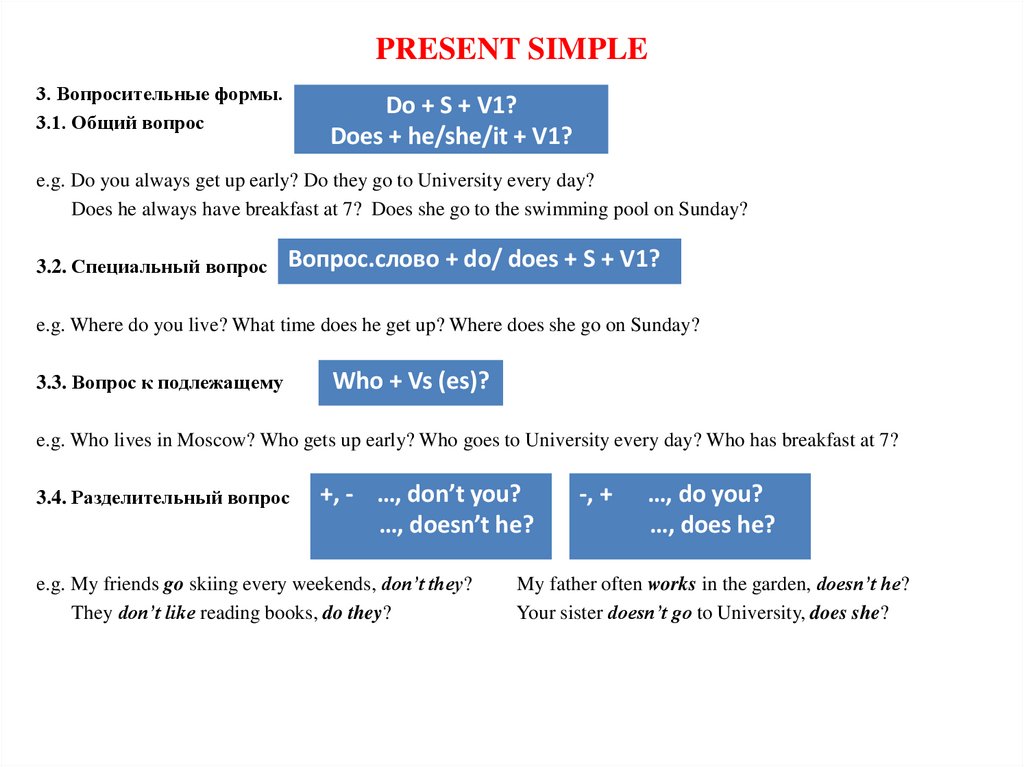
3. Вопросительные формы.3.1. Общий вопрос
Do + S + V1?
Does + he/she/it + V1?
e.g. Do you always get up early? Do they go to University every day?
Does he always have breakfast at 7? Does she go to the swimming pool on Sunday?
3.2. Специальный вопрос
Вопрос.слово + do/ does + S + V1?
e.g. Where do you live? What time does he get up? Where does she go on Sunday?
3.3. Вопрос к подлежащему
Who + Vs (es)?
e.g. Who lives in Moscow? Who gets up early? Who goes to University every day? Who has breakfast at 7?
3.4. Разделительный вопрос
+, - …, don’t you?
…, doesn’t he?
e.g. My friends go skiing every weekends, don’t they?
They don’t like reading books, do they?
-, +
…, do you?
…, does he?
My father often works in the garden, doesn’t he?
Your sister doesn’t go to University, does she?
4.
5.
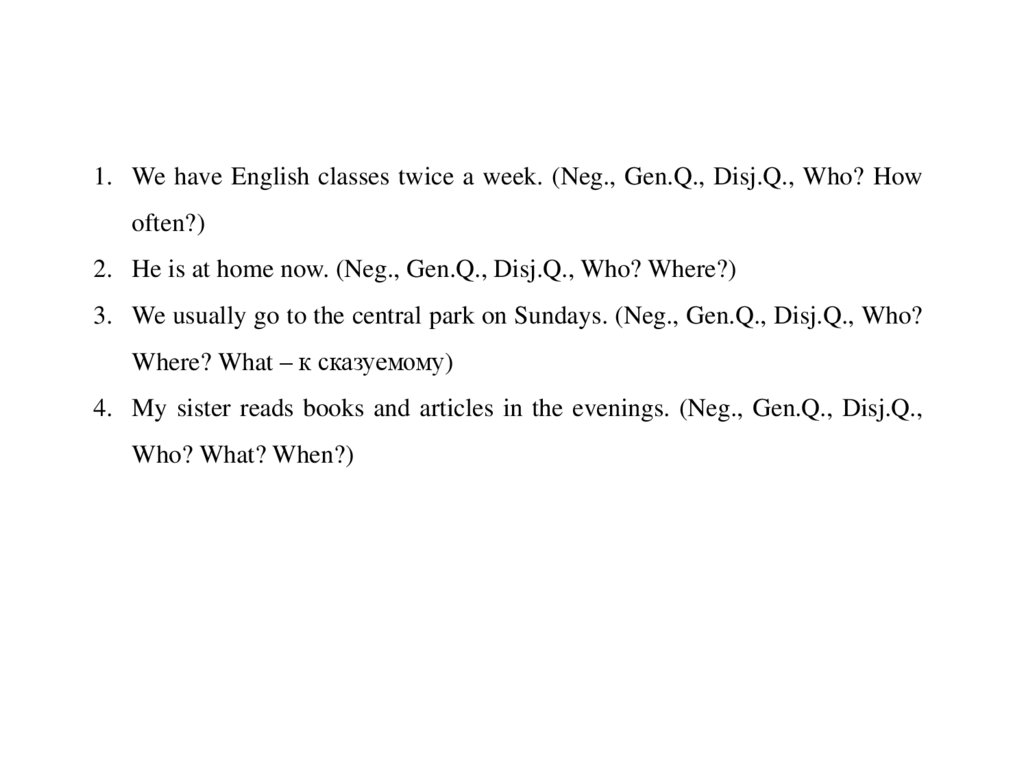
1. We have English classes twice a week. (Neg., Gen.Q., Disj.Q., Who? Howoften?)
2. He is at home now. (Neg., Gen.Q., Disj.Q., Who? Where?)
3. We usually go to the central park on Sundays. (Neg., Gen.Q., Disj.Q., Who?
Where? What – к сказуемому)
4. My sister reads books and articles in the evenings. (Neg., Gen.Q., Disj.Q.,
Who? What? When?)
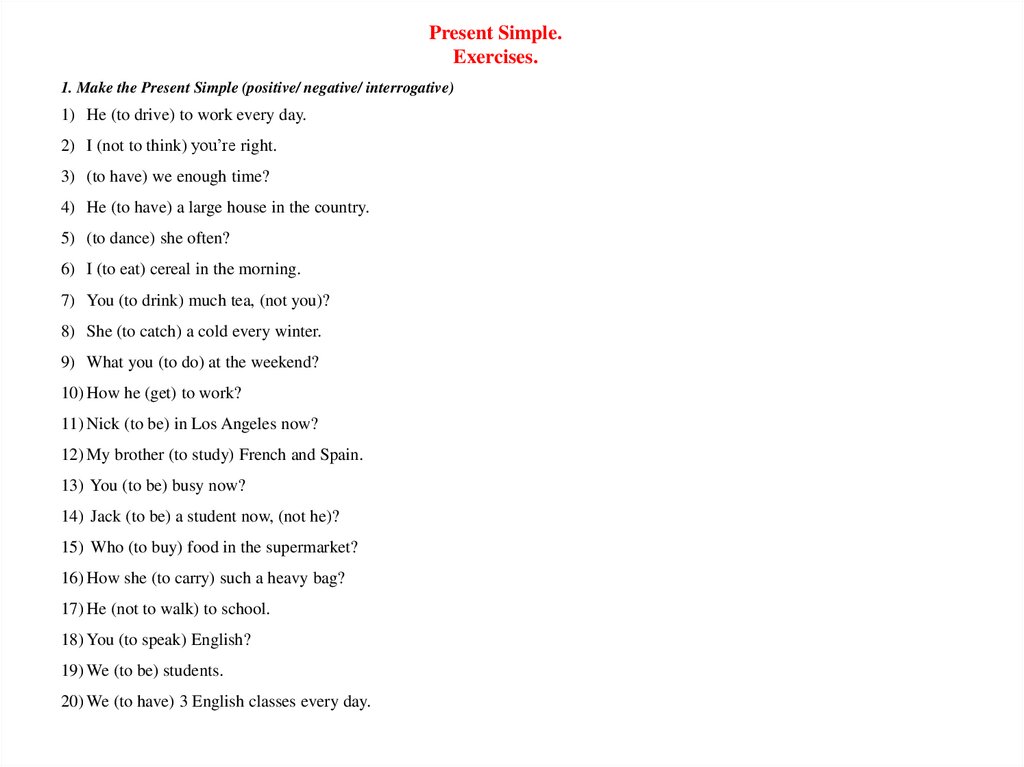
6. Present Simple. Exercises.
1. Make the Present Simple (positive/ negative/ interrogative)1) He (to drive) to work every day.
2) I (not to think) you’re right.
3) (to have) we enough time?
4) He (to have) a large house in the country.
5) (to dance) she often?
6) I (to eat) cereal in the morning.
7) You (to drink) much tea, (not you)?
8) She (to catch) a cold every winter.
9) What you (to do) at the weekend?
10) How he (get) to work?
11) Nick (to be) in Los Angeles now?
12) My brother (to study) French and Spain.
13) You (to be) busy now?
14) Jack (to be) a student now, (not he)?
15) Who (to buy) food in the supermarket?
16) How she (to carry) such a heavy bag?
17) He (not to walk) to school.
18) You (to speak) English?
19) We (to be) students.
20) We (to have) 3 English classes every day.
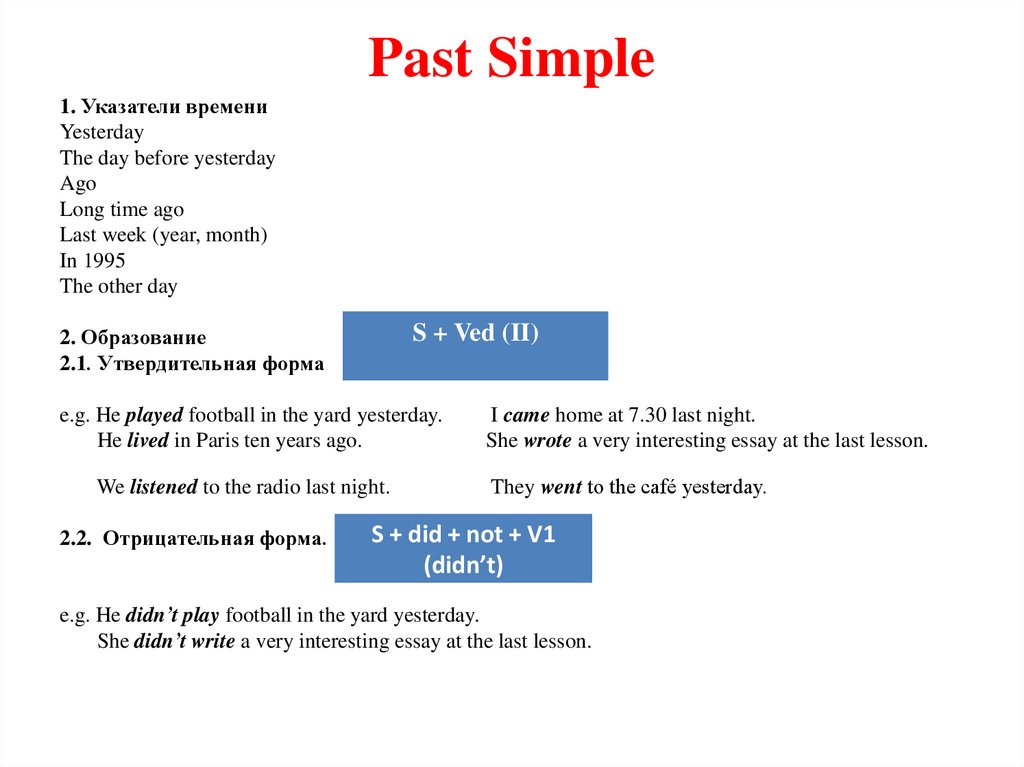
7. Past Simple
1. Указатели времениYesterday
The day before yesterday
Ago
Long time ago
Last week (year, month)
In 1995
The other day
S + Ved (II)
2. Образование
2.1. Утвердительная форма
e.g. He played football in the yard yesterday.
He lived in Paris ten years ago.
We listened to the radio last night.
2.2. Отрицательная форма.
I came home at 7.30 last night.
She wrote a very interesting essay at the last lesson.
They went to the café yesterday.
S + did + not + V1
(didn’t)
e.g. He didn’t play football in the yard yesterday.
She didn’t write a very interesting essay at the last lesson.
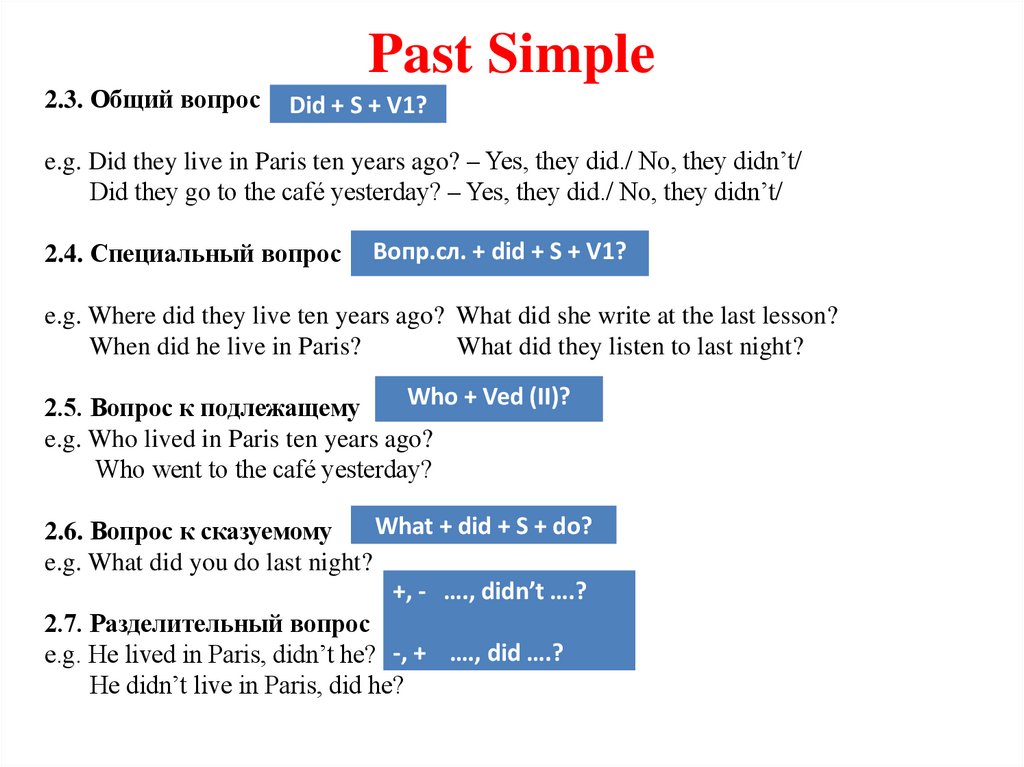
8. Past Simple
2.3. Общий вопросDid + S + V1?
e.g. Did they live in Paris ten years ago? – Yes, they did./ No, they didn’t/
Did they go to the café yesterday? – Yes, they did./ No, they didn’t/
2.4. Специальный вопрос
Вопр.сл. + did + S + V1?
e.g. Where did they live ten years ago? What did she write at the last lesson?
When did he live in Paris?
What did they listen to last night?
Who + Ved (II)?
2.5. Вопрос к подлежащему
e.g. Who lived in Paris ten years ago?
Who went to the café yesterday?
What + did + S + do?
2.6. Вопрос к сказуемому
e.g. What did you do last night?
+, - …., didn’t ….?
2.7. Разделительный вопрос
e.g. He lived in Paris, didn’t he? -, + …., did ….?
He didn’t live in Paris, did he?
9.
10.
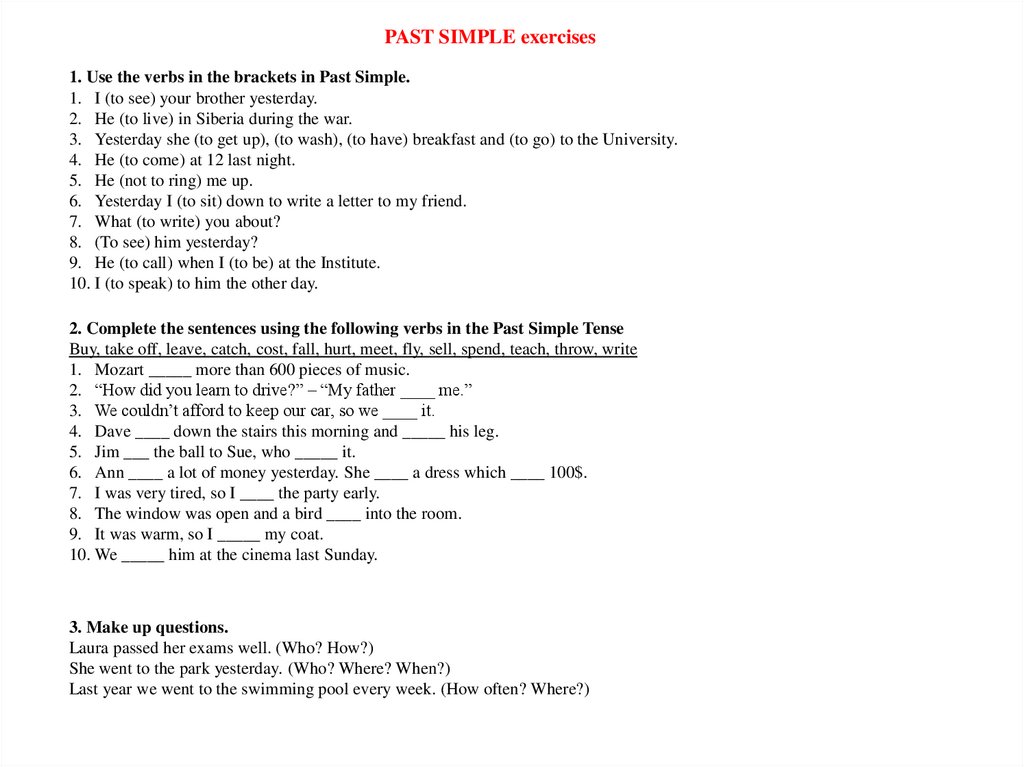
PAST SIMPLE exercises1. Use the verbs in the brackets in Past Simple.
1. I (to see) your brother yesterday.
2. He (to live) in Siberia during the war.
3. Yesterday she (to get up), (to wash), (to have) breakfast and (to go) to the University.
4. He (to come) at 12 last night.
5. He (not to ring) me up.
6. Yesterday I (to sit) down to write a letter to my friend.
7. What (to write) you about?
8. (To see) him yesterday?
9. He (to call) when I (to be) at the Institute.
10. I (to speak) to him the other day.
2. Complete the sentences using the following verbs in the Past Simple Tense
Buy, take off, leave, catch, cost, fall, hurt, meet, fly, sell, spend, teach, throw, write
1. Mozart _____ more than 600 pieces of music.
2. “How did you learn to drive?” – “My father ____ me.”
3. We couldn’t afford to keep our car, so we ____ it.
4. Dave ____ down the stairs this morning and _____ his leg.
5. Jim ___ the ball to Sue, who _____ it.
6. Ann ____ a lot of money yesterday. She ____ a dress which ____ 100$.
7. I was very tired, so I ____ the party early.
8. The window was open and a bird ____ into the room.
9. It was warm, so I _____ my coat.
10. We _____ him at the cinema last Sunday.
3. Make up questions.
Laura passed her exams well. (Who? How?)
She went to the park yesterday. (Who? Where? When?)
Last year we went to the swimming pool every week. (How often? Where?)
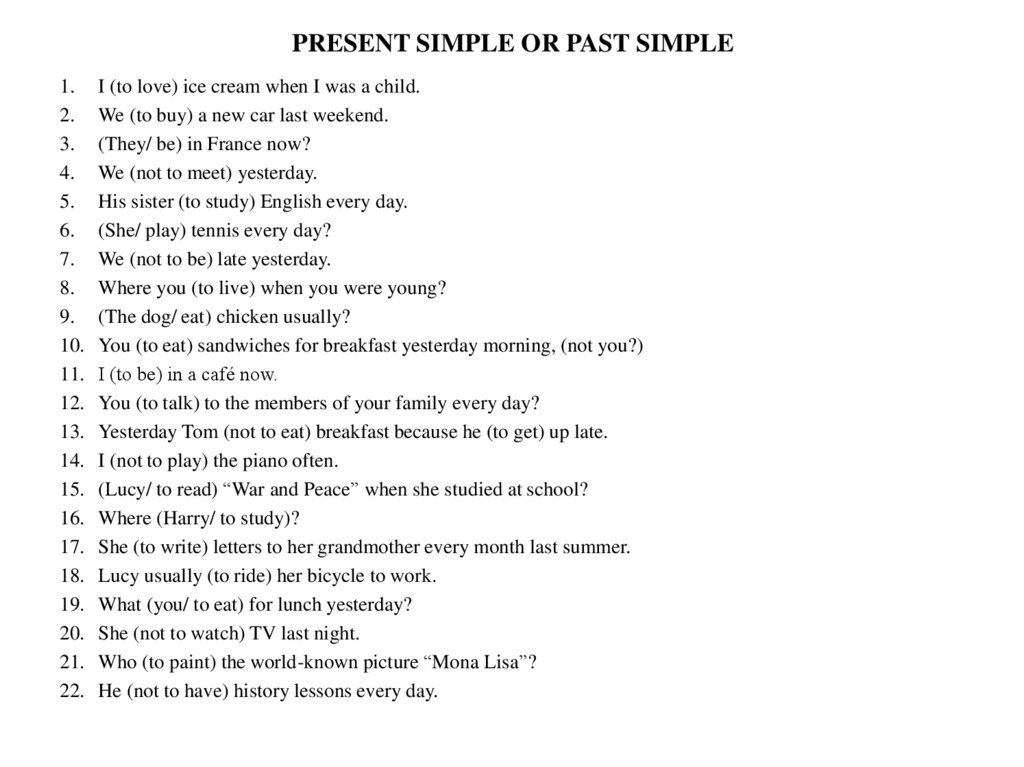
11. PRESENT SIMPLE OR PAST SIMPLE
1. I (to love) ice cream when I was a child.2. We (to buy) a new car last weekend.
3. (They/ be) in France now?
4. We (not to meet) yesterday.
5. His sister (to study) English every day.
6. (She/ play) tennis every day?
7. We (not to be) late yesterday.
8. Where you (to live) when you were young?
9. (The dog/ eat) chicken usually?
10. You (to eat) sandwiches for breakfast yesterday morning, (not you?)
11. I (to be) in a café now.
12. You (to talk) to the members of your family every day?
13. Yesterday Tom (not to eat) breakfast because he (to get) up late.
14. I (not to play) the piano often.
15. (Lucy/ to read) “War and Peace” when she studied at school?
16. Where (Harry/ to study)?
17. She (to write) letters to her grandmother every month last summer.
18. Lucy usually (to ride) her bicycle to work.
19. What (you/ to eat) for lunch yesterday?
20. She (not to watch) TV last night.
21. Who (to paint) the world-known picture “Mona Lisa”?
22. He (not to have) history lessons every day.
12.
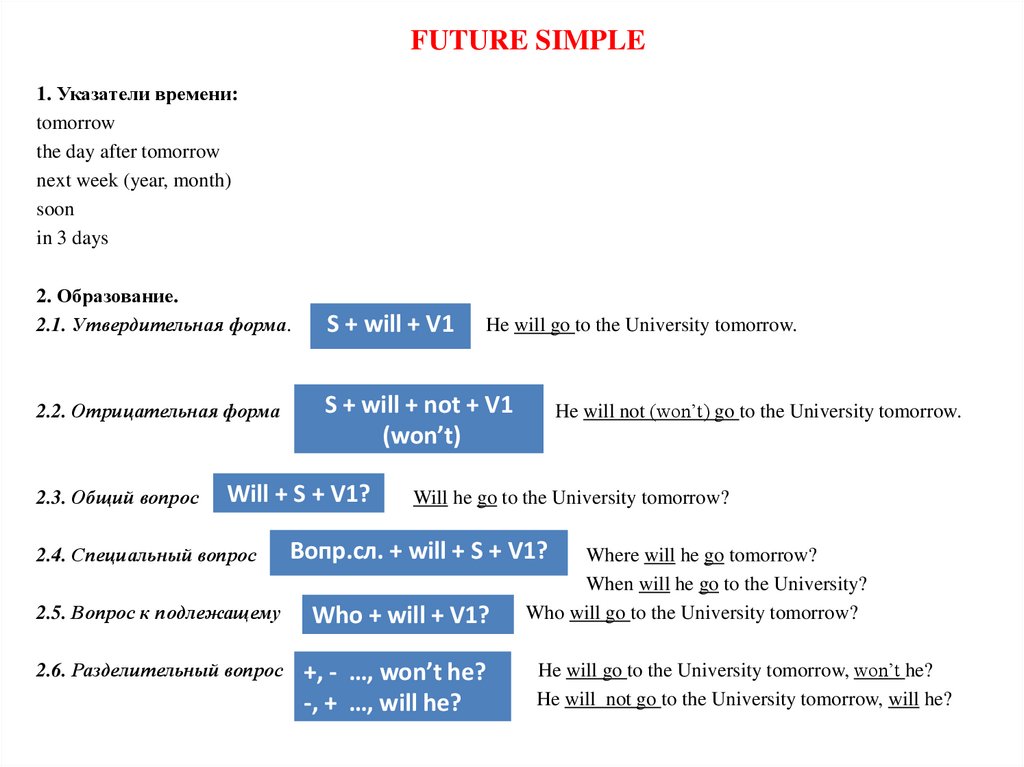
13. FUTURE SIMPLE
1. Указатели времени:tomorrow
the day after tomorrow
next week (year, month)
soon
in 3 days
2. Образование.
2.1. Утвердительная форма.
2.2. Отрицательная форма
2.3. Общий вопрос
S + will + V1
S + will + not + V1
(won’t)
Will + S + V1?
2.4. Специальный вопрос
He will go to the University tomorrow.
He will not (won’t) go to the University tomorrow.
Will he go to the University tomorrow?
Вопр.сл. + will + S + V1?
2.5. Вопрос к подлежащему
Who + will + V1?
Where will he go tomorrow?
When will he go to the University?
Who will go to the University tomorrow?
2.6. Разделительный вопрос
+, - …, won’t he?
-, + …, will he?
He will go to the University tomorrow, won’t he?
He will not go to the University tomorrow, will he?
14.
15.
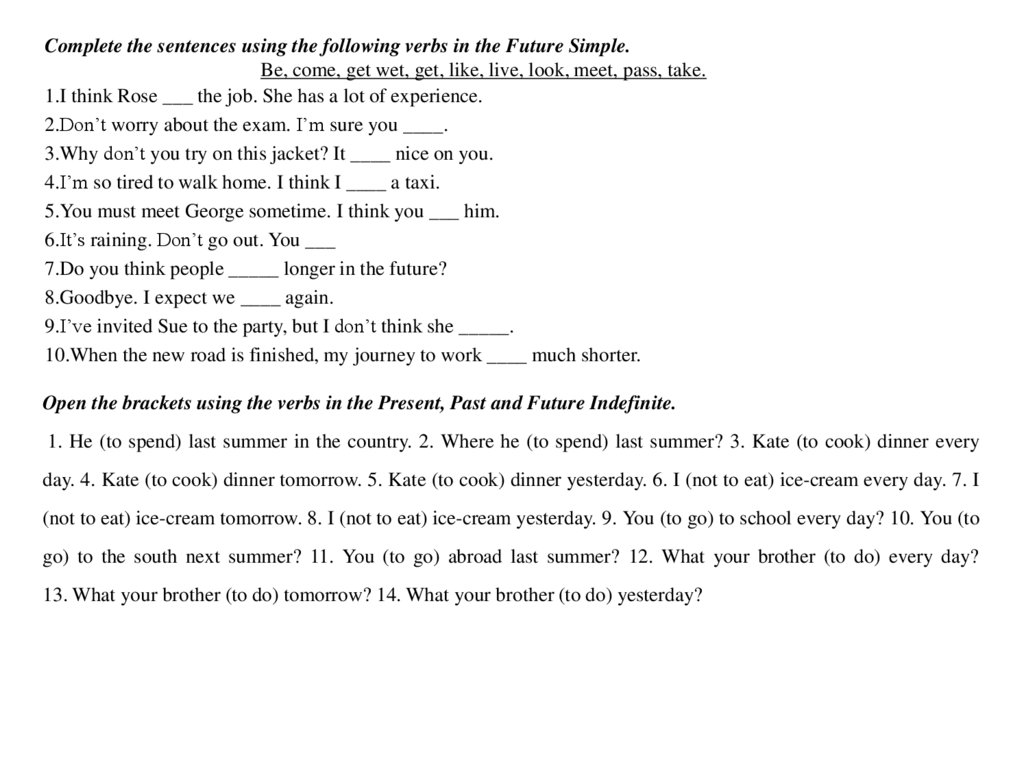
Complete the sentences using the following verbs in the Future Simple.Be, come, get wet, get, like, live, look, meet, pass, take.
1.I think Rose ___ the job. She has a lot of experience.
2.Don’t worry about the exam. I’m sure you ____.
3.Why don’t you try on this jacket? It ____ nice on you.
4.I’m so tired to walk home. I think I ____ a taxi.
5.You must meet George sometime. I think you ___ him.
6.It’s raining. Don’t go out. You ___
7.Do you think people _____ longer in the future?
8.Goodbye. I expect we ____ again.
9.I’ve invited Sue to the party, but I don’t think she _____.
10.When the new road is finished, my journey to work ____ much shorter.
Open the brackets using the verbs in the Present, Past and Future Indefinite.
1. He (to spend) last summer in the country. 2. Where he (to spend) last summer? 3. Kate (to cook) dinner every
day. 4. Kate (to cook) dinner tomorrow. 5. Kate (to cook) dinner yesterday. 6. I (not to eat) ice-cream every day. 7. I
(not to eat) ice-cream tomorrow. 8. I (not to eat) ice-cream yesterday. 9. You (to go) to school every day? 10. You (to
go) to the south next summer? 11. You (to go) abroad last summer? 12. What your brother (to do) every day?
13. What your brother (to do) tomorrow? 14. What your brother (to do) yesterday?
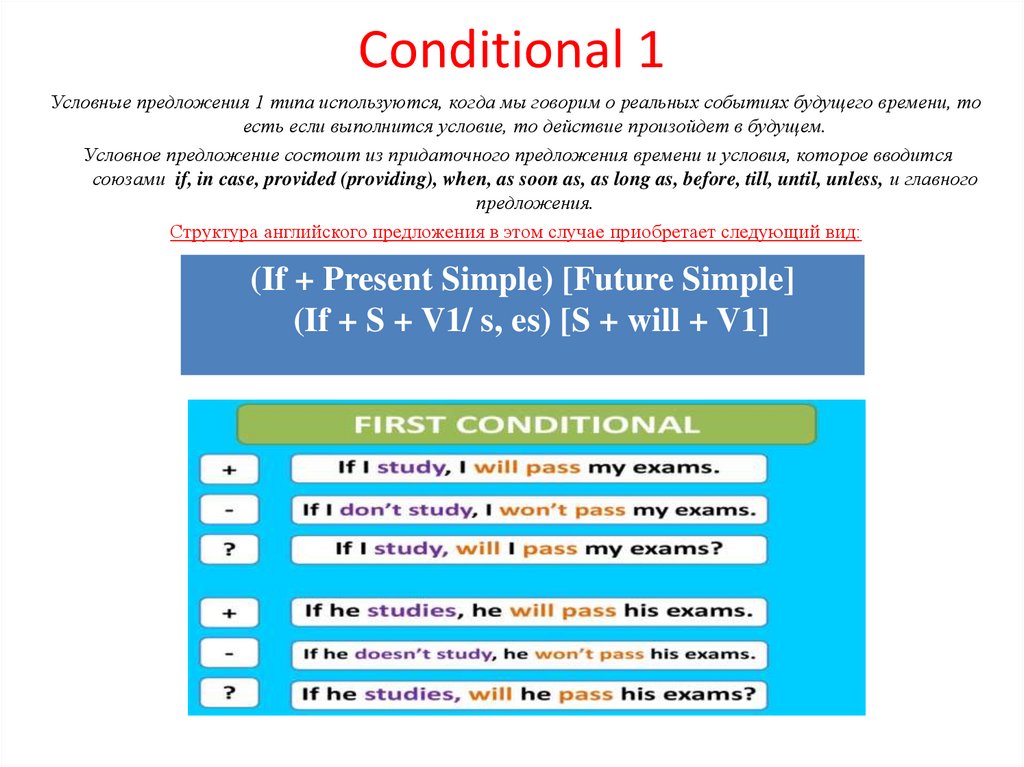
16. Conditional 1
Условные предложения 1 типа используются, когда мы говорим о реальных событиях будущего времени, тоесть если выполнится условие, то действие произойдет в будущем.
Условное предложение состоит из придаточного предложения времени и условия, которое вводится
союзами if, in case, provided (providing), when, as soon as, as long as, before, till, until, unless, и главного
предложения.
Структура английского предложения в этом случае приобретает следующий вид:
(If + Present Simple) [Future Simple]
(If + S + V1/ s, es) [S + will + V1]
17.
1. Раскройте скобки, употребляя глаголы в Present Simple или Future Simple (все предложения относятся к будущему)1. If I (to stay) some more days in your town, I (to call) on you and we (to have) a good talk. 2. He (to go) to the Public Library very
often when he (to be) a student. 3. As soon as I (to return) from school, I (to ring) you up. 4. You (to pass) many towns and villages on
your way before you (to arrive) in Moscow. 5. I (to stay) at home till she (to come). Then we (to go) to the theatre if she (to bring)
tickets. 6. I (to go) to university when I (to leave) school. 7. When he (to return) to St. Petersburg, he (to call) on us. 8. If I (to see)
him, I (to tell) him about their letter. 9. We (to gather) at our place when my brother (to come) back from Africa. 10. I (to sing) this
song with you if you (to tell) me the words. 11. I hope you (to join) us when we (to gather) in our country house next time. 12. What
you (to do) when you (to come) home? 13. When they (to cross) the road, they (to see) the hotel. 14. What we (to do) if it (to rain)
tonight? 15. If the bus (to be) very crowded, you (to be) exhausted by the time you (to get) to work. 16. If it (to be) very cold tonight,
our car (not to start) in the morning.
2. Раскройте скобки, употребляя глаголы в Present Simple или Future Simple (все предложения относятся к будущему)
1. If the weather (to be) nice, we probably (to go) to the beach. 2. If he still (to have) a cold and (not to feel) better, he (not to go) to a
disco. 3. If they (go) to California next year, they (to visit) his friend in San Francisco. 4. If she (not to work) properly, her boss (to
fire) her and (to hire) my sister. 5. I (to see) you before you (to start)? 6. What he (to do) when he (to come) home? 7. Where they (to
go) if the weather (to be) fine? 8. I am sure he (to come) to say goodbye to us before he (to leave) St. Petersburg. 9. If we (to be)
tired, we (to stop) at a small village halfway to Moscow and (to have) a short rest there. 10. She (to make) the arrangements about it
before she (to fly) there. 11. Before he (to start) for London, he (to spend) a week or two at a health resort not far from here. 12. We
(to go) to the station to meet Sergey when he (to come) to Moscow.